Similes are figures of speech that compare two different things using words like “as” or “like.” They help readers imagine situations more clearly by connecting unfamiliar ideas with familiar images.
Instead of simply saying something is dry, using a simile paints a stronger picture. For example, saying “as dry as a bone” helps readers instantly feel the lack of moisture. Similes make writing more colorful, creative, and memorable for both students and educators. They turn ordinary descriptions into vivid experiences.
Benefits of Using Similes for Dry
- Create vivid imagery: Readers can clearly imagine the level of dryness.
- Make writing engaging: Descriptions feel lively instead of plain.
- Improve understanding: Comparisons help young learners grasp meanings quickly.
- Add emotional tone: Dryness can feel uncomfortable, serious, or even humorous depending on the simile used.
- Strengthen storytelling: Scenes become more realistic and expressive.
Why Similes for Dry Are Important?
Similes for dry are important because dryness can describe weather, skin, humor, land, food, or even personality. Using creative comparisons helps writers avoid repetition and keeps readers interested. They also support better communication, especially in classrooms where imagination helps students learn descriptive language more effectively.
Similes for: As Dry As
1. As dry as a bone
Explanation: This simile suggests extreme dryness, often used for weather, soil, or humor. It creates a strong and clear image in the reader’s mind.
Examples:
- The desert air was as dry as a bone, so my lips cracked quickly.
- His sense of humor was as dry as a bone, yet everyone laughed softly.
- The soil felt as dry as a bone because it had not rained for weeks.
- My throat was as dry as a bone, so I drank two glasses of water.
- The old bread was as dry as a bone, and nobody wanted to eat it.
Best Use: “I need some water.” “Why?” “My throat is as dry as a bone!”
2. As dry as dust
Explanation: This comparison emphasizes lifeless, powdery dryness, often used for land, books, or lectures.
Examples:
- The road was as dry as dust, so clouds rose behind the car.
- The field looked as dry as dust after the long summer.
- His lecture felt as dry as dust, yet the topic was important.
- My skin became as dry as dust during winter.
- The old pages were as dry as dust, and they crumbled easily.
Best Use: “This book is boring.” “Yes, it’s as dry as dust.”
3. As dry as a desert
Explanation: This simile shows complete lack of moisture, often referring to climate or skin.
Examples:
- The air was as dry as a desert, so we stayed indoors.
- Her hands felt as dry as a desert after washing dishes.
- The land remained as dry as a desert throughout the season.
- My mouth was as dry as a desert before my speech.
- The wind blew across fields as dry as a desert.
Best Use: “Why are you using lotion?” “My skin is as dry as a desert.”
4. As dry as parchment
Explanation: This describes something thin and lacking moisture, often used for skin or paper.
Examples:
- The old letter was as dry as parchment, yet it was precious.
- His lips were as dry as parchment, so he applied balm.
- The leaves were as dry as parchment before they fell.
- The ancient scroll felt as dry as parchment in my hands.
- Her voice sounded as dry as parchment, but she continued speaking.
Best Use: “Your hands look rough.” “They’re as dry as parchment.”
5. As dry as sand
Explanation: This simile suggests grainy, moistureless dryness.
Examples:
- The cake was as dry as sand, so we added cream.
- The beach felt as dry as sand under the sun.
- His throat was as dry as sand before the race.
- The wind left my hair as dry as sand.
- The soil crumbled as dry as sand between my fingers.
Best Use: “How’s the cake?” “It’s as dry as sand!”
6. As dry as straw
Explanation: This indicates rough and brittle dryness.
Examples:
- Her hair felt as dry as straw after swimming.
- The grass was as dry as straw, so it caught fire easily.
- The farmer worried because the crops were as dry as straw.
- His voice sounded as dry as straw during the speech.
- The hay lay as dry as straw in the barn.
Best Use: “Why is your hair so rough?” “It’s as dry as straw.”
7. As dry as a cracker
Explanation: This simile often describes food lacking moisture.
Examples:
- The chicken tasted as dry as a cracker, so we added sauce.
- My sandwich was as dry as a cracker because I forgot mayo.
- The biscuit was as dry as a cracker, yet we ate it anyway.
- The toast felt as dry as a cracker without butter.
- The cookie was as dry as a cracker and hard to chew.
Best Use: “How’s the sandwich?” “It’s as dry as a cracker.”
8. As dry as chalk
Explanation: This describes powdery and moisture-free dryness.
Examples:
- The ground felt as dry as chalk after months without rain.
- My throat was as dry as chalk, so I coughed gently.
- The paint left the wall as dry as chalk.
- The air seemed as dry as chalk inside the room.
- The cookie crumbled as dry as chalk in my hand.
Best Use: “You sound tired.” “My throat is as dry as chalk.”
9. As dry as a sponge in the sun
Explanation: This suggests something completely drained of moisture.
Examples:
- The towel was as dry as a sponge in the sun.
- My skin felt as dry as a sponge in the sun after swimming.
- The land remained as dry as a sponge in the sun.
- His lips were as dry as a sponge in the sun.
- The air stayed as dry as a sponge in the sun all afternoon.
Best Use: “Do you need water?” “Yes, I’m as dry as a sponge in the sun.”
10. As dry as old leaves
Explanation: This simile suggests brittle dryness that easily breaks.
Examples:
- The leaves were as dry as old leaves, so they crunched loudly.
- Her hands felt as dry as old leaves in winter.
- The paper sounded as dry as old leaves.
- The grass lay as dry as old leaves under the sun.
- His humor was as dry as old leaves, yet clever.
Best Use: “Why is the lawn so noisy?” “It’s as dry as old leaves.”
11. As dry as toast without butter
Explanation: This simile describes something lacking moisture and softness, especially food, but it can also describe speech or writing that feels plain and unexciting.
Examples:
- The sandwich was as dry as toast without butter, so I added some sauce.
- His presentation felt as dry as toast without butter, yet the information was useful.
- The chicken tasted as dry as toast without butter because it was overcooked.
- My throat became as dry as toast without butter, so I kept sipping water.
- The story sounded as dry as toast without butter, although the topic was interesting.
Best Use: “How’s the food?” “It’s as dry as toast without butter.”
12. As dry as a sunbaked brick
Explanation: This simile suggests extreme dryness caused by heat, often used for land, walls, or weather conditions.
Examples:
- The ground was as dry as a sunbaked brick, so cracks spread across it.
- The walls felt as dry as a sunbaked brick after the heatwave.
- His lips were as dry as a sunbaked brick because he forgot his lip balm.
- The air stayed as dry as a sunbaked brick throughout the afternoon.
- The farmer worried because his fields were as dry as a sunbaked brick.
Best Use: “Why are the crops failing?” “The soil is as dry as a sunbaked brick.”
13. As dry as a forgotten well
Explanation: This comparison shows complete emptiness of moisture, often describing land, ideas, or creativity.
Examples:
- The village well was as dry as a forgotten well after months without rain.
- My throat felt as dry as a forgotten well before the speech.
- His imagination seemed as dry as a forgotten well that day.
- The riverbed lay as dry as a forgotten well in summer.
- The conversation became as dry as a forgotten well, so we changed the topic.
Best Use: “Why aren’t you talking?” “My mind is as dry as a forgotten well.”
14. As dry as cotton
Explanation: This simile suggests softness but complete lack of moisture, often used for skin, mouth, or fabric.
Examples:
- My mouth felt as dry as cotton after the long walk.
- The towel was as dry as cotton because it had been in the sun.
- Her hands became as dry as cotton in winter, so she used lotion.
- The cake turned out as dry as cotton since we forgot the syrup.
- The air was as dry as cotton, yet the sun kept shining brightly.
Best Use: “Do you need water?” “Yes, my mouth is as dry as cotton.”
15. As dry as a biscuit left out
Explanation: This simile describes food or objects that have lost moisture because they were exposed to air for too long.
Examples:
- The cookie was as dry as a biscuit left out overnight.
- His joke landed as dry as a biscuit left out, yet he kept smiling.
- The bread tasted as dry as a biscuit left out on the table.
- My lips felt as dry as a biscuit left out in the heat.
- The rice became as dry as a biscuit left out because we reheated it twice.
Best Use: “How’s the dessert?” “It’s as dry as a biscuit left out.”
16. As dry as a thirsty traveler’s throat
Explanation: This simile shows urgent dryness and discomfort, often describing thirst or extreme heat.
Examples:
- My throat was as dry as a thirsty traveler’s throat after the hike.
- The desert wind felt as dry as a thirsty traveler’s throat.
- His voice sounded as dry as a thirsty traveler’s throat before he drank water.
- The air seemed as dry as a thirsty traveler’s throat in the afternoon sun.
- Her lips cracked as dry as a thirsty traveler’s throat.
Best Use: “Why are you rushing for water?” “My throat is as dry as a thirsty traveler’s throat!”
17. As dry as a notebook in summer
Explanation: This simile suggests complete dryness, especially in hot weather.
Examples:
- The pages felt as dry as a notebook in summer.
- The classroom air was as dry as a notebook in summer, so we opened windows.
- My hands were as dry as a notebook in summer because of the heat.
- The field looked as dry as a notebook in summer.
- The soil crumbled as dry as a notebook in summer.
Best Use: “Why is the dust everywhere?” “Because it’s as dry as a notebook in summer.”
18. As dry as a winter wind
Explanation: This simile describes cold, moistureless air that often dries skin and lips.
Examples:
- The air felt as dry as a winter wind, so my skin itched.
- Her lips were as dry as a winter wind in January.
- The field stood as dry as a winter wind despite the cold.
- My throat became as dry as a winter wind during the night.
- The leaves sounded as dry as a winter wind blowing through them.
Best Use: “Why are your hands so rough?” “They’re as dry as a winter wind.”
19. As dry as a burnt cookie
Explanation: This simile describes overcooked food that has lost all moisture.
Examples:
- The cake turned out as dry as a burnt cookie, so we added cream.
- The bread felt as dry as a burnt cookie after baking too long.
- His speech sounded as dry as a burnt cookie, yet it was informative.
- The chicken became as dry as a burnt cookie because we forgot it in the oven.
- The biscuit crumbled as dry as a burnt cookie in my hand.
Best Use: “Did you like the cake?” “It was as dry as a burnt cookie.”
20. As dry as an empty riverbed
Explanation: This simile paints a strong picture of land completely without water.
Examples:
- The valley looked as dry as an empty riverbed after the drought.
- My mouth felt as dry as an empty riverbed before I spoke.
- The farmland was as dry as an empty riverbed that season.
- The wind swept across ground as dry as an empty riverbed.
- His humor stayed as dry as an empty riverbed, yet clever.
Best Use: “When will it rain?” “Soon, I hope — the land is as dry as an empty riverbed.”
21. As dry as cracked earth
Explanation: This simile describes extreme dryness that causes surfaces to split or break apart, often used for land or skin.
Examples:
- The field was as dry as cracked earth, so the crops began to fail.
- Her hands felt as dry as cracked earth because she forgot to use lotion.
- The ground looked as dry as cracked earth after weeks without rain.
- My lips were as dry as cracked earth, yet I kept talking.
- The path appeared as dry as cracked earth, and dust rose with every step.
Best Use: “Why does the garden look so bad?” “It’s as dry as cracked earth.”
22. As dry as paper in the attic
Explanation: This simile suggests something old, brittle, and completely without moisture.
Examples:
- The old letter felt as dry as paper in the attic, yet it was still readable.
- The leaves were as dry as paper in the attic, so they crumbled easily.
- His voice sounded as dry as paper in the attic during the long speech.
- The book’s pages were as dry as paper in the attic, and they tore quickly.
- The air seemed as dry as paper in the attic, so we used a humidifier.
Best Use: “Be careful with that book.” “I know, it’s as dry as paper in the attic.”
23. As dry as a hot oven
Explanation: This simile highlights dryness caused by strong heat.
Examples:
- The kitchen felt as dry as a hot oven while we were baking.
- My throat became as dry as a hot oven, so I paused for water.
- The wind blew as dry as a hot oven across the field.
- The bread turned out as dry as a hot oven because we overcooked it.
- The summer air was as dry as a hot oven, yet we kept playing outside.
Best Use: “Why is it so uncomfortable in here?” “It’s as dry as a hot oven!”
24. As dry as a cactus spine
Explanation: This simile suggests sharp, desert-like dryness with no softness at all.
Examples:
- The desert air felt as dry as a cactus spine under the sun.
- His humor was as dry as a cactus spine, yet surprisingly funny.
- The land stretched out as dry as a cactus spine.
- My lips were as dry as a cactus spine after the trip.
- The wind seemed as dry as a cactus spine, and it irritated my skin.
Best Use: “How’s the weather there?” “It’s as dry as a cactus spine.”
25. As dry as a wooden stick
Explanation: This comparison shows rough, hard dryness with no moisture inside.
Examples:
- The branch snapped because it was as dry as a wooden stick.
- The bread felt as dry as a wooden stick, so we added butter.
- His throat sounded as dry as a wooden stick during the call.
- The soil looked as dry as a wooden stick in the heat.
- My hands were as dry as a wooden stick after washing dishes.
Best Use: “Why did it break so easily?” “It was as dry as a wooden stick.”
26. As dry as old bread
Explanation: This simile is often used for stale food or dull speech.
Examples:
- The loaf was as dry as old bread, yet we toasted it anyway.
- His explanation felt as dry as old bread, but it was informative.
- The cake tasted as dry as old bread because we forgot syrup.
- My throat was as dry as old bread before the exam.
- The sandwich seemed as dry as old bread, so I added sauce.
Best Use: “How’s the sandwich?” “It’s as dry as old bread.”
27. As dry as a dusty shelf
Explanation: This simile suggests long-term dryness and neglect.
Examples:
- The room felt as dry as a dusty shelf, so we opened the windows.
- The book looked as dry as a dusty shelf in the corner.
- His tone was as dry as a dusty shelf, yet serious.
- The ground appeared as dry as a dusty shelf during summer.
- My skin felt as dry as a dusty shelf, so I applied cream.
Best Use: “When was this cleaned?” “It’s as dry as a dusty shelf.”
28. As dry as a husk
Explanation: This simile describes something completely emptied of moisture.
Examples:
- The corn felt as dry as a husk after harvest.
- My throat became as dry as a husk during the speech.
- The leaves were as dry as a husk, and they cracked underfoot.
- The bread tasted as dry as a husk because it was stale.
- The soil lay as dry as a husk beneath the sun.
Best Use: “Why is it cracking?” “It’s as dry as a husk.”
29. As dry as a faded book
Explanation: This simile suggests dryness along with age and dullness.
Examples:
- The pages felt as dry as a faded book in storage.
- His lecture sounded as dry as a faded book, yet detailed.
- The air seemed as dry as a faded book in the old library.
- The leaves crumbled as dry as a faded book.
- My lips were as dry as a faded book during winter.
Best Use: “Was the class interesting?” “It was as dry as a faded book.”
30. As dry as a long summer day
Explanation: This simile reflects extended heat and lack of rain.
Examples:
- The land was as dry as a long summer day, so cracks formed.
- My throat felt as dry as a long summer day after running.
- The wind blew as dry as a long summer day across the plains.
- The grass stood as dry as a long summer day in July.
- The cake turned out as dry as a long summer day because we baked it too long.
Best Use: “When will it cool down?” “It’s as dry as a long summer day.”
31. As dry as a clay pot
Explanation: This simile describes solid, baked dryness.
Examples:
- The soil hardened as dry as a clay pot under the sun.
- My hands felt as dry as a clay pot after cleaning.
- The air was as dry as a clay pot in the afternoon heat.
- The bread became as dry as a clay pot in the oven.
- The leaves were as dry as a clay pot and easy to crush.
Best Use: “Why is the ground so hard?” “It’s as dry as a clay pot.”
32. As dry as wind-blown soil
Explanation: This simile suggests loose, dusty dryness moved by wind.
Examples:
- The field was as dry as wind-blown soil, so dust filled the air.
- My throat felt as dry as wind-blown soil after the game.
- The path looked as dry as wind-blown soil in the heat.
- The bread tasted as dry as wind-blown soil without sauce.
- The leaves scattered as dry as wind-blown soil.
Best Use: “Why is it so dusty?” “It’s as dry as wind-blown soil.”
33. As dry as a matchstick
Explanation: This simile suggests brittle dryness that can catch fire easily.
Examples:
- The wood was as dry as a matchstick, so it burned quickly.
- The grass stood as dry as a matchstick during drought.
- My lips felt as dry as a matchstick in winter.
- The soil appeared as dry as a matchstick under the sun.
- The branch snapped as dry as a matchstick.
Best Use: “Be careful with the fire.” “The grass is as dry as a matchstick.”
34. As dry as a farmer’s field in drought
Explanation: This simile emphasizes extreme agricultural dryness.
Examples:
- The land was as dry as a farmer’s field in drought, so nothing grew.
- My throat felt as dry as a farmer’s field in drought.
- The wind blew across ground as dry as a farmer’s field in drought.
- The crops looked as dry as a farmer’s field in drought that year.
- The soil cracked as dry as a farmer’s field in drought.
Best Use: “Why are the plants dying?” “The soil is as dry as a farmer’s field in drought.”
35. As dry as an unused sponge
Explanation: This simile shows something completely lacking moisture.
Examples:
- The sponge felt as dry as an unused sponge in the cupboard.
- My throat was as dry as an unused sponge before drinking water.
- The soil looked as dry as an unused sponge in summer.
- The bread tasted as dry as an unused sponge without butter.
- The air seemed as dry as an unused sponge indoors.
Best Use: “Why are you coughing?” “My throat is as dry as an unused sponge.”
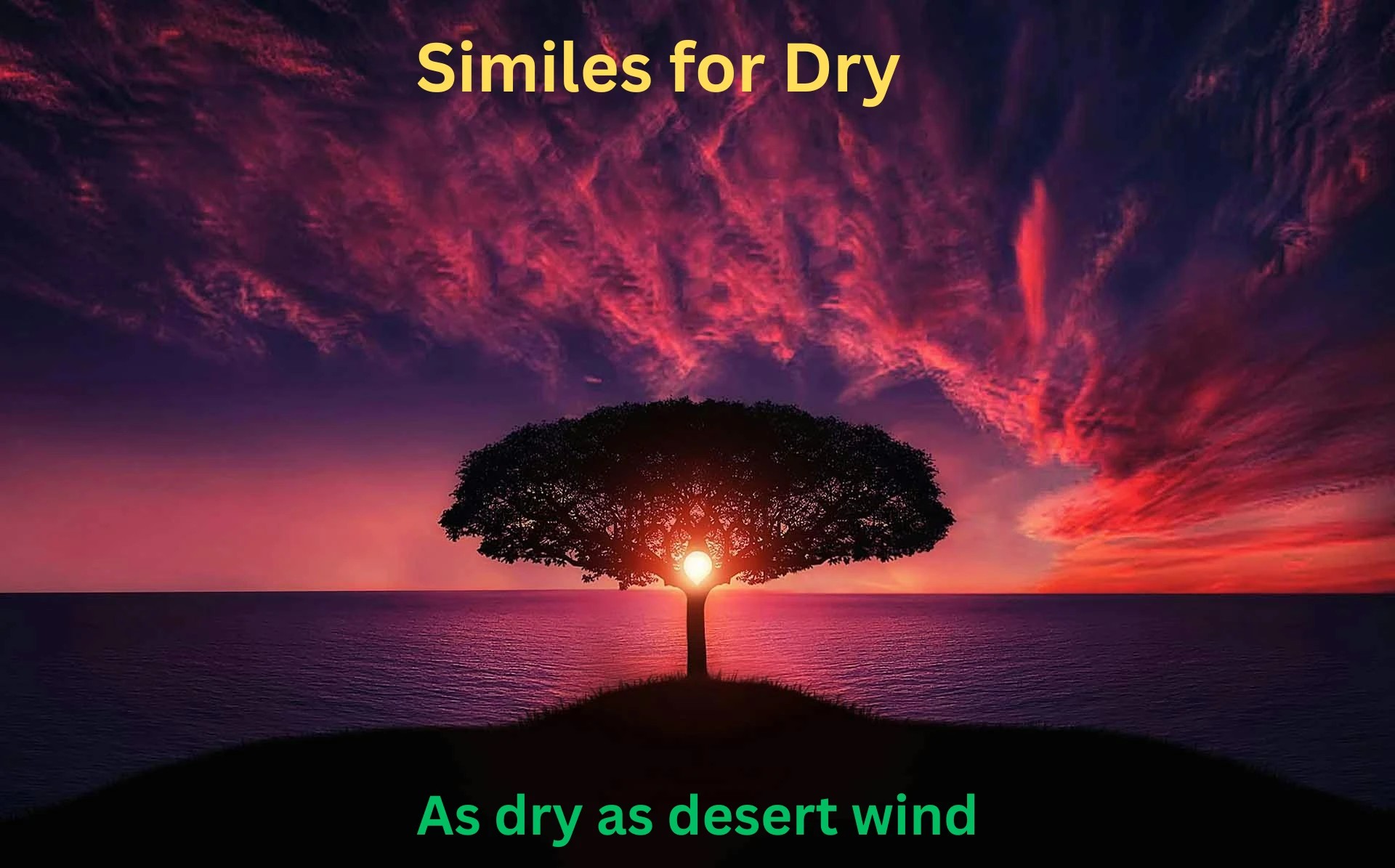
36. As dry as desert wind
Explanation: This simile highlights harsh, hot dryness carried by wind.
Examples:
- The air blew as dry as desert wind across the valley.
- My lips cracked as dry as desert wind in the heat.
- The land remained as dry as desert wind during summer.
- His humor was as dry as desert wind, yet clever.
- The afternoon felt as dry as desert wind.
Best Use: “How’s the climate there?” “It’s as dry as desert wind.”
37. As dry as a towel in the heat
Explanation: This simile shows complete dryness after exposure to warmth.
Examples:
- The towel was as dry as a towel in heat after hanging outside.
- My throat felt as dry as a towel in heat.
- The ground looked as dry as a towel in heat.
- The bread turned as dry as a towel in heat in the oven.
- The air seemed as dry as a towel in heat indoors.
Best Use: “Did the clothes dry?” “Yes, they’re as dry as a towel in heat.”
38. As dry as brittle grass
Explanation: This simile suggests fragile dryness that breaks easily.
Examples:
- The lawn was as dry as brittle grass during the drought.
- The leaves sounded as dry as brittle grass underfoot.
- My hands felt as dry as brittle grass in winter.
- The field stood as dry as brittle grass in the heat.
- The hay cracked as dry as brittle grass.
Best Use: “Why is it so crunchy?” “It’s as dry as brittle grass.”
39. As dry as an old newspaper
Explanation: This simile suggests thin, fragile dryness.
Examples:
- The paper felt as dry as an old newspaper in storage.
- The leaves crumbled as dry as an old newspaper.
- My lips were as dry as an old newspaper in winter.
- The soil appeared as dry as an old newspaper.
- The bread tasted as dry as an old newspaper left out overnight.
Best Use: “Be gentle with it.” “It’s as dry as an old newspaper.”
40. As dry as a roof in summer
Explanation: This simile describes heat-dried surfaces with no trace of moisture.
Examples:
- The tiles were as dry as a roof in summer under the sun.
- My throat felt as dry as a roof in summer after the run.
- The ground looked as dry as a roof in summer.
- The wind blew as dry as a roof in summer across the town.
- The bread turned out as dry as a roof in summer because we baked it too long.
Best Use: “Has it rained at all?” “No, everything’s as dry as a roof in summer.”
FAQs:
1. What is a simile?
A simile is a figure of speech that compares two different things using words like “as” or “like.” It helps readers understand something better by linking it to a familiar image. For example, saying “as dry as a bone” creates a clearer picture than simply saying “very dry.”
2. Why should I use similes instead of just saying “dry”?
Using similes makes your writing more vivid and interesting because it paints a strong mental image. Instead of repeating the same word, you give readers something they can see, feel, or imagine, which makes your description more powerful and creative.
3. Can similes for dry be used in everyday conversation?
Yes, similes are commonly used in daily speech. People often say phrases like “as dry as a desert” or “as dry as a cracker” during casual conversations, especially when describing weather, food, or humor.
4. Are similes helpful for students learning English?
Absolutely. Similes improve vocabulary and help students understand descriptive language more easily. They also encourage creative thinking because learners begin to make their own comparisons when writing stories or essays.
5. Can similes for dry describe things other than weather?
Yes, they can describe many things such as food, skin, humor, land, books, speeches, and even emotions. For example, a joke can be “as dry as dust,” while bread can be “as dry as old bread.”
6. What is the difference between a simile and a metaphor?
A simile uses comparison words like “as” or “like,” while a metaphor directly states that one thing is another. For example, “Her throat was as dry as cotton” is a simile, but “Her throat was cotton” is a metaphor.
7. How can I create my own simile for dry?
Think about something you know that has no moisture, such as sand, paper, or a desert. Then connect it using “as” or “like.” For example, you could say, “The soil was as dry as flour in a bowl.”
8. Are similes only used in creative writing?
No, similes can be used in stories, essays, speeches, and even classroom explanations. They make communication clearer and more engaging, which is helpful in both academic and casual settings.
Final Thoughts
Using similes for dry helps writers describe weather, food, skin, land, humor, and emotions more clearly and creatively. Instead of repeating the same simple word, these comparisons bring scenes to life and make communication more engaging.
Whether you are a student learning descriptive language or an educator teaching creative writing, similes add color, clarity, and imagination to every sentence.