Looking for other ways to say just checking in without sounding repetitive, pushy, or unprofessional? The best alternative replaces vague wording with a clear purpose, such as asking for a project update, following up on a proposal, or offering help. For example, you could write, “I wanted to follow up on our last conversation” or “Have you had a chance to review the proposal?”
The right phrase depends on your relationship with the recipient, the urgency of your request, and the communication channel. A recruiter needs a different message from a sales prospect, while a teammate might appreciate a quick Slack message instead of a formal email. Understanding professional email etiquette, polite follow-up phrases, and workplace communication helps you choose language that feels natural and encourages a useful response.
This guide covers more than 30 alternatives to “just checking in,” complete with examples, email templates, and practical advice for professional situations.
Professional and Polite Ways to Say Just Checking In
The best professional alternatives to “just checking in” explain why you’re contacting someone and what you need from them. Phrases such as “I wanted to follow up on our discussion,” “Could you share an update?” and “Please let me know if you need additional information” sound clear without putting unnecessary pressure on the recipient.
Use the following expressions when writing to clients, managers, colleagues, business partners, or other professional contacts.
Formal alternatives for business emails
Formal emails benefit from direct, respectful language. Instead of adding a vague opening, connect your message to a previous discussion, an outstanding task, or a specific question.
| Alternative phrase | Best situation | Example |
| I wanted to follow up on our last conversation regarding… | Revisiting a discussion | I wanted to follow up on our last conversation regarding the marketing proposal. |
| I’m circling back to see if you have any questions about… | Revisiting an offer or document | I’m circling back to see if you have any questions about the contract. |
| I wanted to stay aligned on our next steps for… | Coordinating a project | I wanted to stay aligned on our next steps for the product launch. |
| Following up to see if you’ve had an opportunity to review… | Requesting feedback | Following up to see if you’ve had an opportunity to review the revised budget. |
| I’m reaching out to see whether you need any additional information. | Offering support | I’m reaching out to see whether you need any additional information before making a decision. |
| Could you share an update on…? | Requesting a status report | Could you share an update on the website redesign? |
| I wanted to revisit our discussion about… | Restarting a conversation | I wanted to revisit our discussion about the annual service agreement. |
| I’m writing to see where things stand with… | Checking progress | I’m writing to see where things stand with the onboarding process. |
These phrases work because they give the recipient context. Rather than forcing someone to remember what you discussed, they identify the subject and make the next step clear.
For example, “I’m writing to see where things stand with the onboarding process” works better than “Just checking in” when you need a progress update. The recipient immediately understands the topic.
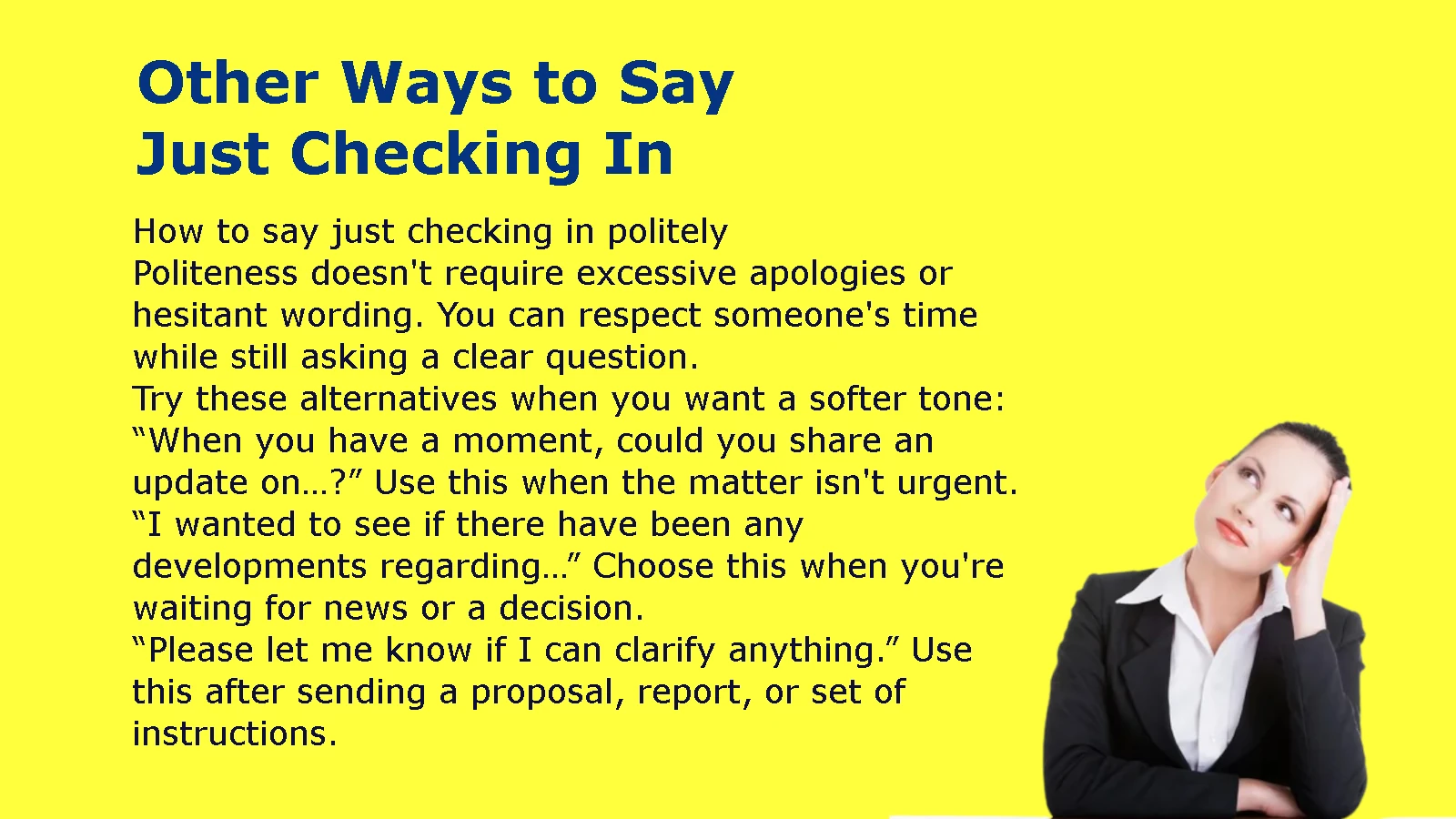
How to say just checking in politely
Politeness doesn’t require excessive apologies or hesitant wording. You can respect someone’s time while still asking a clear question.
Try these alternatives when you want a softer tone:
- “When you have a moment, could you share an update on…?” Use this when the matter isn’t urgent.
- “I wanted to see if there have been any developments regarding…” Choose this when you’re waiting for news or a decision.
- “Please let me know if I can clarify anything.” Use this after sending a proposal, report, or set of instructions.
- “I hope your week is going well. I wanted to follow up on…” Add a brief personal touch before getting to the point.
- “Would you be able to let me know the current status of…?” Choose this when you need a specific answer.
- “Whenever convenient, I’d appreciate your thoughts on…” Use this when requesting feedback without a strict deadline.
Consider the difference between these two messages:
Less effective: “Sorry to bother you. I was just checking in to see if you maybe had time to look at my email.”
Better: “When you have a moment, could you share your thoughts on the proposal I sent Tuesday?”
The second version sounds confident and respectful. It removes unnecessary apologies, identifies the document, and gives the recipient a clear action.
Other Ways to Say Just Checking In After a Job Interview
The best interview follow-up messages express continued interest while asking about the hiring timeline or next steps. A useful message thanks the interviewer, references the position, and asks one clear question. It should sound interested and professional rather than demanding an immediate decision.
Recruiters often manage several candidates and competing priorities. Your message should make it easy for them to understand who you are and which opportunity you’re discussing.
Professional interview follow-up phrases
Choose an alternative based on how long you’ve been waiting and what you want to know.
To ask about the hiring timeline:
“I’m excited about the [Job Title] opportunity and wanted to ask whether there are any updates on the hiring timeline.”
To offer additional information:
“I wanted to see if there’s any additional information I can provide as you review candidates.”
To reiterate your interest:
“I’m following up to reiterate my interest in the position and ask whether there are any updates on the next steps.”
To thank the interviewer and request an update:
“Thank you again for speaking with me about the [Job Title] position. I enjoyed learning more about the team and would appreciate any update you can share about the hiring process.”
To follow up after a promised response date:
“You mentioned that the team hoped to make a decision by [Date]. I wanted to follow up to see whether the timeline has changed.”
Each message serves a different purpose. If you simply want to demonstrate enthusiasm, reaffirm your interest. If the recruiter provided a decision date, refer to it directly.
When should you send an interview follow-up email?
The best time depends on what the recruiter or hiring manager told you.
- After the interview: Send a thank-you email within 24 hours when practical.
- After a stated decision date: Follow up if the employer misses the date, allowing a reasonable amount of time for a response.
- When no timeline was provided: Waiting about five to seven business days before requesting an update is a reasonable starting point.
- After an unanswered follow-up: Give the recruiter several more business days before sending another brief message.
These are general guidelines, not strict rules. Follow any timeline the employer gives you, and avoid sending repeated messages every day.
A thoughtful follow-up can reinforce your professionalism. However, no wording guarantees a response or changes a hiring decision.
High-Impact Alternatives to Just Checking In for Sales and Client Follow-Ups
The strongest sales follow-ups give the recipient a reason to reopen the conversation. Instead of sending a generic reminder, share useful information, address an unresolved concern, offer a relevant update, or suggest a specific next step.
In business-to-business (B2B) communication, every email competes with other demands on the recipient’s attention. A message that adds value is more useful than one that merely announces your presence.
Value-first sales follow-up phrases
Use these expressions when you want to reconnect with a prospect without making the conversation feel like a sales pitch.
- “I came across this industry article and thought it might help with your team’s current goals.” Share a genuinely relevant resource.
- “Since we last spoke, we’ve introduced a feature that addresses your request for…” Explain a meaningful product improvement.
- “I wanted to share a quick update on the proposal we discussed.” Give the recipient a reason to revisit an earlier conversation.
- “I thought this case study might be useful as you evaluate your options.” Provide evidence relevant to the prospect’s decision.
- “Based on our last conversation, I put together a few options that may fit your budget.” Demonstrate that you listened to the client’s needs.
The key is relevance. Sending an unrelated article or generic company announcement doesn’t automatically add value. Your information should connect to a problem the recipient wants to solve.
Polite client reminders that encourage a response
Sometimes you don’t have new information to share. You simply need to know whether a prospect reviewed a proposal or whether a client approved the next step.
These alternatives can help:
When a proposal may have been overlooked:
“I wanted to make sure our proposal didn’t get buried in your inbox. Have you had a chance to review it?”
When a client needs to approve pricing:
“Have you had a chance to review the pricing options? I’m happy to clarify any details.”
When a prospect has gone quiet:
“Would it make sense to revisit this next month, or have your priorities changed?”
When you need a decision:
“To help us plan the next steps, could you let me know whether you’d like to move forward by [Date]?”
When a client is considering several options:
“Is there anything about our proposed approach that you’d like us to adjust before you make a decision?”
These questions make it easier for the recipient to respond. The last two also reveal potential obstacles, which helps you determine whether to clarify an issue, adjust your offer, or pause the conversation.
Practical example: Reviving a stalled sales conversation
Imagine that you sent a software proposal two weeks ago and haven’t received a response.
Generic follow-up:
“Hi Jordan, just checking in to see if you’ve had a chance to look at my proposal.”
More useful follow-up:
“Hi Jordan,
I wanted to follow up on the software proposal I sent on October 5. Based on our discussion about reducing manual reporting, I can also show you how the automated dashboard would work for your team.
Would a 15-minute walkthrough next week be helpful?
Best,
Alex”
The improved version identifies the proposal, reminds Jordan of the original business need, and offers a concrete next step. It doesn’t rely on a vague request for attention.
Casual Ways to Say Just Checking In on Slack, Teams, or WhatsApp
Casual follow-up messages work best when they’re short, specific, and appropriate for your relationship with the recipient. On Slack, Microsoft Teams, or WhatsApp, you can often skip formal openings and ask directly about a task, offer assistance, or suggest a quick conversation.
However, casual language shouldn’t mean unclear communication. Your teammate still needs to understand what you’re asking.
Short workplace chat alternatives
Use these messages for routine updates, collaborative tasks, and everyday workplace conversations.
| Phrase | Best use |
| “Hey! Quick ping to see how [Task Name] is coming along.” | Asking for progress |
| “Just wanted to loop back on this when you have a minute.” | Revisiting a previous message |
| “Let me know if you need a hand with [Project Name]!” | Offering assistance |
| “Any updates on [Topic] when you get a chance?” | Requesting a brief update |
| “Ping me whenever you’re free to chat about [Topic].” | Arranging a conversation |
| “How are things looking for the [Deadline] deadline?” | Checking readiness |
| “Are we still on track for [Milestone]?” | Confirming a schedule |
| “Is anything blocking progress on your end?” | Identifying obstacles |
| “Could you share where we stand on [Task]?” | Getting a status report |
| “Let me know when you’ve had a chance to review this.” | Requesting feedback |
These messages fit different situations. “Let me know if you need a hand” sounds supportive, while “Are we still on track for Friday?” focuses on a commitment.
Choose the phrase that matches your objective rather than using the same message for every task.
How to follow up without sounding pushy at work
Your wording should reflect urgency, responsibility, and the recipient’s workload.
For a routine task: “Any updates on the draft when you get a chance?”
For a deadline approaching soon: “Could you share the current status of the draft by 2 p.m.? I need to include it in today’s report.”
When a teammate seems stuck: “Is anything blocking progress? I can help resolve an issue if needed.”
When you’re waiting for approval: “Could you review the final version by Thursday so we can stay on schedule?”
Notice that the deadline message explains why you need the update. That context helps the recipient prioritize the request.
For nonurgent matters, avoid sending multiple pings within a short period. If the task is time-sensitive, state the deadline clearly instead of expecting the recipient to infer urgency from repeated messages.
Best Alternatives to Just Checking In by Situation
Sometimes you don’t need a long list of synonyms. You need one phrase that fits the exact situation.
The table below matches common workplace scenarios with more specific alternatives.
| Your objective | Avoid saying | Better alternative |
| Follow up on a proposal | Just checking in on the proposal. | Have you had a chance to review the proposal I sent on [Date]? |
| Chase an unpaid invoice | Just checking in on this money. | Could you confirm receipt of invoice [Number], sent on [Date]? |
| Re-engage a cold client | Just checking in to see if you want to buy. | I wanted to share an update that may be relevant to your current priorities. |
| Request a project update | Are you done yet? Just checking in. | Could you share the current status of [Task Name] for our weekly report? |
| Follow up after an interview | Just checking in about the job. | I wanted to ask whether there are any updates on the hiring timeline. |
| Offer assistance | Just checking in. | Is there anything I can clarify or help you with? |
| Restart a stalled conversation | Just following up again. | Would it make sense to revisit this next month? |
| Request feedback | Just checking in to see what you think. | I’d appreciate your feedback on [Document] when you have a chance. |
| Confirm a meeting | Just checking in about tomorrow. | Could you confirm whether we’re still on for tomorrow’s meeting? |
| Check a pending approval | Just checking on approval. | Could you let me know whether [Request] has been approved? |
| Remind someone about a deadline | Just checking in on the deadline. | Are we still on track to complete [Task] by [Date]? |
How to choose the right follow-up phrase
Use three questions to select your wording.
What do you need? If you need a status update, ask for one. If you need approval, name the item awaiting approval.
Why does it matter? Explain the next step when the recipient needs context. For example, an invoice reminder can mention the payment due date, while a project update can explain how the information affects your report.
How urgent is it? Use a softer request for routine matters and a clear deadline for time-sensitive work.
This approach also prevents a common mistake: treating every follow-up as a relationship-building message. Sometimes a brief, direct question is the most respectful option.
Special case: Following up on invoices and payments
Payment reminders deserve more precision than general check-ins. Include the invoice number, issue date, due date, and requested action when relevant.
For example:
“Hello [Name],
I’m following up on invoice [Number], issued on [Date] and due on [Due Date]. Could you confirm whether your team has received it and advise when we can expect payment?
Please let me know if you need another copy.
Best,
[Your Name]”
This message creates a clear written record and helps the recipient identify the transaction. If the payment is overdue, state the actual due date rather than using vague wording such as “It’s been a while.”
Ready-to-Use Follow-Up Email Templates
The right template gives you a starting point, but you should still personalize it. Replace placeholders with real details, keep the request focused, and remove any sentence that doesn’t help the recipient understand what you need.
Template for a formal post-interview follow-up
Subject: Follow-Up on [Job Title] Interview
Hi [Interviewer’s Name],
Thank you again for taking the time to discuss the [Job Title] position with me. I enjoyed learning more about the team and the role.
I’m following up to see whether there are any updates on the hiring timeline. I’m still very interested in the opportunity and would be happy to provide any additional information.
Thank you for your time.
Best,
[Your Name]
Why it works: The message expresses appreciation, reinforces interest, and asks about the timeline without demanding an immediate decision.
Template for a B2B client reminder
Subject: Following Up on [Proposal or Project Name]
Hi [Client’s Name],
I wanted to follow up on the [Proposal or Project Name] we discussed on [Date].
Based on our conversation about [Specific Goal or Challenge], I believe the proposed approach could help your team [Relevant Benefit]. I’d be happy to answer questions or adjust the proposal if your requirements have changed.
Would you be available for a brief conversation next week, or would you prefer to share your feedback by email?
Best regards,
[Your Name]
Why it works: It reconnects the proposal to the client’s needs and offers two straightforward ways to continue the conversation.
Template for an internal teammate follow-up
Subject: Update on [Project Name]
Hi [Teammate’s Name],
I’m putting together the [Report or Deliverable] and need the latest status of [Task Name].
Could you share an update by [Time or Date]? If anything is blocking progress, let me know and I’ll see how I can help.
Thanks,
[Your Name]
Why it works: It explains the reason for the request, sets a clear deadline, and offers help instead of simply demanding progress.
Template for a client who hasn’t responded
Subject: Next Steps for [Project or Proposal]
Hi [Client’s Name],
I wanted to revisit our conversation about [Project or Proposal]. I understand priorities can change, so I wanted to see whether this is still something your team plans to pursue.
Would you prefer to discuss the next steps, revisit this at a later date, or put the conversation on hold for now?
Best,
[Your Name]
Why it works: It gives the recipient an easy way to respond honestly. You can determine whether to continue following up or focus your attention elsewhere.
Frequently Asked Questions About Other Ways to Say Just Checking In
Why shouldn’t you say just checking in in an email?
“Just checking in” isn’t grammatically incorrect or inherently rude. However, it can sound vague when you don’t explain what you need. The word “just” may also minimize the importance of your request. A more effective email identifies the topic and asks a specific question.
What is a professional synonym for checking in?
Common professional synonyms include following up, circling back, requesting an update, checking on the status, and revisiting our discussion. Use “following up” for an earlier message, “requesting an update” for progress, and “revisiting our discussion” when reopening a conversation.
How do you say just checking in politely?
Use respectful wording that still communicates your purpose. For example, “When you have a moment, could you share an update on the proposal?” or “Please let me know if you need any additional information.” You can soften the tone without adding repeated apologies or unnecessary qualifiers.
What is a good alternative to just checking in after an interview?
Try: “Thank you again for discussing the [Job Title] position with me. I’m following up to see whether there are any updates on the hiring timeline. I’m still very interested in the opportunity.” This wording shows enthusiasm while keeping the request professional.
Is circling back better than checking in?
“Circling back” often works well when you want to revisit an existing discussion, proposal, or decision. “Checking in” can suit broader relationship-building messages. Neither phrase is automatically better; the strongest choice depends on your purpose and the recipient’s expectations.
How long should you wait before sending a follow-up email?
Follow the timeline the recipient provided. If someone promised an update by a particular date, wait until that date passes before following up. When no timeline exists, waiting several business days is often reasonable. For interviews, about five to seven business days can be a useful starting point after the expected response period.
Conclusion: Make Every Follow-Up More Intentional
The best other ways to say just checking in do more than replace a familiar phrase. They tell the recipient why you’re writing, what you need, and how they can respond.
Use “I wanted to follow up on our conversation” for formal business emails, ask about the hiring timeline after an interview, and offer relevant information when reconnecting with a sales prospect. For everyday workplace messages, keep your wording short while naming the task or deadline.
You don’t need to eliminate “just checking in” from every conversation. Instead, choose a phrase that fits the situation and makes your purpose clear.
Before sending your next follow-up, replace the vague opening with one specific question, useful update, or offer of help. That small change can make your message easier to understand and easier to answer.













