Other ways to say what are you doing include “What are you up to?”, “What’s keeping you busy?”, “What’s going on?”, and “What are you working on?” The best phrase depends on your relationship with the person and the tone you want to convey. You might prefer a cute text message for your crush, a flirty question for your partner, a funny expression for a friend, or a polite alternative for a coworker.
The phrase “what are you doing?” asks about someone’s current activity, but it can also start a conversation, show interest, or lead to plans. Alternatives such as “WYD,” “What’s the move?”, “Got any plans?”, and “How’s your day going?” serve slightly different purposes. Some ask what a person is doing right now, while others focus on their plans, mood, or availability.
This guide covers casual alternatives, cute and flirty texts, funny expressions, slang synonyms, formal questions, and translations into French, Spanish, and Japanese. You’ll also find examples that show how each phrase sounds in a real conversation, helping you choose words that feel natural rather than forced.
What Are Other Ways to Say “What Are You Doing”?
Other ways to say “what are you doing?” include “What are you up to?”, “What’s going on?”, “What are you working on?”, and “How’s your day going?” These alternatives help you ask about someone’s activities without repeating the same question. Choose a phrase that fits your relationship, purpose, and level of formality.
Quick Alternatives to “What Are You Doing?”
Here are 15 natural alternatives you can use in everyday conversations, texts, or professional settings.
| Alternative phrase | Tone | Best situation |
| What are you up to? | Casual | Friends and family |
| What’s going on? | Informal | Starting a conversation |
| What are you working on? | Professional | Asking about a task |
| How’s your day going? | Friendly | Checking in with someone |
| What have you been up to? | Conversational | Catching up |
| Got any plans? | Casual | Discussing future activities |
| What’s keeping you busy? | Friendly | Asking about someone’s activities |
| What are you doing today? | Neutral | Asking about today’s schedule |
| How are you spending your day? | Warm | Casual conversation |
| What’s happening? | Informal | Checking in |
| Are you busy right now? | Direct | Checking availability |
| What are you getting into? | Playful | Asking about activities |
| Anything interesting going on? | Friendly | Keeping a conversation going |
| What’s on your agenda? | Neutral to professional | Discussing plans |
| What’s the plan? | Casual | Making arrangements |
Tip: “What are you up to?” is a versatile everyday alternative. However, “What are you working on?” fits a task-focused conversation better, while “Got any plans?” works when you want to know whether someone is available.
Which Alternative Should You Use?
The best alternative depends on what you actually want to know. A question about someone’s current activity isn’t always the same as a question about their plans or availability.
| Your goal | Phrase to use | Example |
| Start a casual chat | What are you up to? | “Hey, what are you up to?” |
| Check on a friend | How’s your day going? | “How’s your day going so far?” |
| Ask about work | What are you working on? | “What are you working on this afternoon?” |
| Show romantic interest | What’s keeping you busy, handsome? | “Hey, what’s keeping you busy, handsome?” |
| Make someone laugh | What kind of trouble are you causing? | “What kind of trouble are you causing today?” |
| Find out about plans | Got any plans later? | “Got any plans later tonight?” |
| Check availability | Are you free right now? | “Are you free for a quick call?” |
| Reconnect with someone | What have you been up to? | “It’s been a while. What have you been up to?” |
One important distinction is that “What are you doing?” asks about an activity, while “Are you free?” asks about availability. If you want to invite someone out, asking about availability may get you a clearer answer.
Casual and Everyday Ways to Ask What Someone Is Doing
Casual alternatives to “what are you doing?” make everyday conversations sound more relaxed and natural. You can use them with friends, relatives, classmates, and people you know well. The right expression depends on whether you’re checking in, asking about a current activity, or trying to start a longer conversation.
Natural Ways to Ask Friends What They’re Doing
When texting a friend, you don’t need a complicated question. Simple expressions usually work best because they sound spontaneous.
Try these alternatives:
- What are you up to? — A natural, general question about someone’s activities.
- What’s going on with you? — A friendly way to check in.
- What’s new? — Useful when you haven’t talked recently.
- What are you getting into? — A playful question about current activities.
- How have you been keeping busy? — Good for catching up.
- What’s happening today? — A casual way to ask about the day’s events.
- How’s everything going? — Broader than asking about one activity.
- What have you been up to lately? — Best for reconnecting after some time apart.
For example:
You: “Hey, what have you been up to lately?”
Friend: “Not much. Just trying to finish a few things at work.”
You: “Same here! Want to grab coffee this weekend?”
The opening question invites a response without making the conversation feel like an interview. You can then use the answer to find a shared topic or suggest an activity.
Short Alternatives for Text Messages
Short questions are useful when you want to start a conversation without sending a long message. They’re especially common in informal texting.
| Short phrase | Meaning or use |
| WYD? | What are you doing? |
| You busy? | Are you busy right now? |
| What’s up? | What’s happening or how are things? |
| U free? | Are you available? |
| Doing anything? | Are you occupied or making plans? |
| What’s the plan? | What are we doing or planning? |
| Sup? | A very informal greeting or check-in |
| Any plans? | Asking about future activities |
These expressions aren’t interchangeable in every situation. “WYD?” asks about current activity, “U free?” checks availability, and “Any plans?” usually refers to future events.
For instance, if you want to invite a friend to lunch, “You free around noon?” is more useful than “WYD?” because it tells your friend exactly what you need to know.
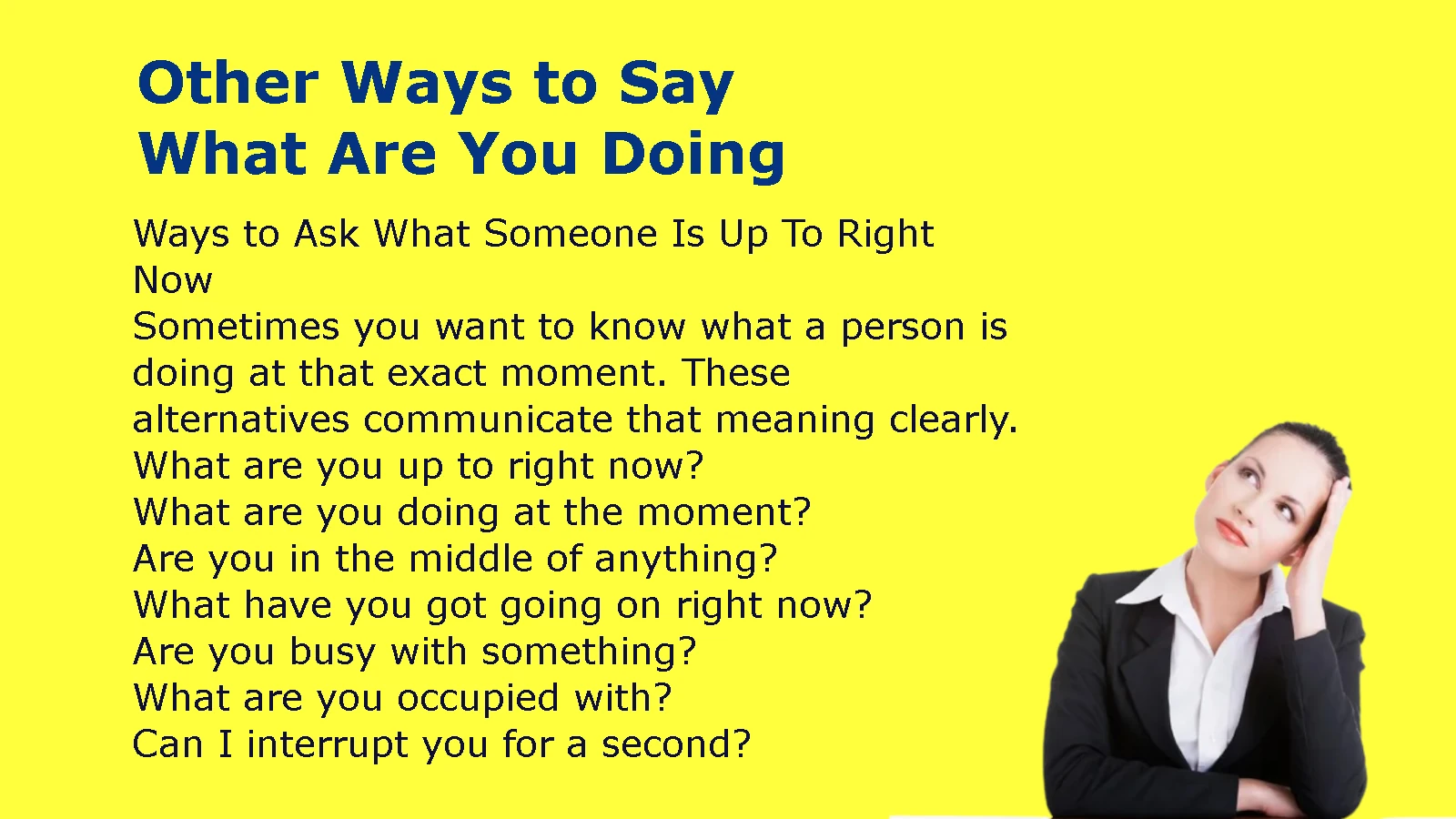
Ways to Ask What Someone Is Up To Right Now
Sometimes you want to know what a person is doing at that exact moment. These alternatives communicate that meaning clearly.
- What are you up to right now?
- What are you doing at the moment?
- Are you in the middle of anything?
- What have you got going on right now?
- Are you busy with something?
- What are you occupied with?
- Can I interrupt you for a second?
- Do you have a minute?
Choose your wording based on the situation. “What are you occupied with?” sounds more formal than everyday speech, while “Are you in the middle of anything?” politely checks whether someone can talk.
If you need help, a considerate approach is to ask about availability first:
“Hey, are you in the middle of anything? I wanted to ask you a quick question.”
This phrasing acknowledges that the other person may be busy and gives them room to respond.
Alternatives to “What Are You Doing Today?”
When you’re interested in someone’s schedule, use a question that refers directly to their plans.
- What does your day look like?
- Got anything planned for today?
- How are you spending your day?
- What have you got planned?
- Anything exciting happening today?
- Are you doing anything later?
- How’s your schedule looking?
- What’s on your agenda today?
The difference matters. “How are you spending your day?” invites someone to describe their activities, while “Are you doing anything later?” often signals that you may want to make plans.
For example, instead of texting “What are you doing today?” when you want to meet a friend, try:
“Got anything planned this afternoon? I was thinking about checking out that new café.”
Your message gives the other person a reason to answer and makes the conversation easier to continue.
Cute Ways to Say “What Are You Doing?”
Cute ways to say “what are you doing?” combine curiosity with warmth, affection, or a little playfulness. They’re useful when texting a partner, someone you like, or a close friend. A sweet message doesn’t need elaborate wording; a simple question with a personal touch can feel more genuine.
Sweet Ways to Ask Someone What They’re Up To
Use these expressions when you want to sound caring rather than overly romantic.
- What’s my favorite person up to?
- How’s your day going, sunshine?
- What are you up to, cutie?
- What’s keeping you busy today?
- How’s your little world today?
- What’s my favorite human doing?
- Having a good day, sweetheart?
- What adventures are you getting into today?
- How are you spending your lovely day?
- What’s keeping that busy mind occupied?
The best choice depends on how you normally talk to the person. Calling someone “sunshine” or “sweetheart” may feel natural in an established relationship but too familiar if you’ve only exchanged a few messages.
A useful rule: Match the affection in your message to the closeness you already share. You want to make someone smile, not make them feel pressured to respond romantically.
Cute Text Messages for Your Partner
When messaging a partner, you can make a familiar question feel more personal by referring to your relationship, a shared joke, or something you know about their day.
Here are some ready-to-send examples:
- “Hey, what’s my favorite person up to right now?”
- “What are you doing, love? Just checking on you.”
- “How’s my favorite human spending their day?”
- “Busy being adorable again?”
- “What’s my sweetheart up to today?”
- “Taking a break yet, or still being productive?”
- “What are you up to, sleepyhead?”
- “Just checking in. How’s your day treating you?”
- “What’s happening in your little corner of the world?”
- “Are you working hard or hardly working?”
A personal message often works better than a generic romantic line. If your partner has an important meeting, for example, you could text, “How did your meeting go? What are you up to now?”
That message shows you remember their day and care about the answer. It also gives them something specific to discuss.
Adorable Ways to Check In on Your Crush
When texting a crush, keep things light enough that the person can respond comfortably. You can show interest without making assumptions about their feelings.
Try these messages:
- “Hey, how’s your day going?”
- “What are you up to, you?”
- “Doing anything fun today?”
- “What’s keeping you busy?”
- “How’s your day treating you?”
- “Got anything exciting planned?”
- “What are you getting into this evening?”
- “Just curious, what’s your day looking like?”
- “What’s the highlight of your day so far?”
- “Tell me something interesting about your day.”
Some of these messages are more effective conversation starters than a bare “What are you doing?” because they invite a fuller response.
For example, “What’s the highlight of your day so far?” encourages the person to share a story. If they answer enthusiastically, you have an easy opening for a longer conversation.
Examples of Cute “What Are You Doing?” Texts
The following examples show how a small change in wording can affect the tone.
Situation: Your partner is at work
“Hey, love. Are you getting a chance to relax, or is work keeping you busy?”
Situation: You’re texting a new crush
“Hey! What’s your day looking like?”
Situation: Your partner is having a difficult day
“How are you holding up today? Want to talk about it?”
Situation: You want to start a playful conversation
“Important question: what is my favorite human doing right now?”
Situation: You haven’t talked all day
“Hey, stranger! How’s your day been?”
Each message serves a slightly different purpose. The first checks in on a partner, the second opens a low-pressure conversation, and the third offers emotional support.
A cute question works best when it sounds like something you would actually say. Don’t force pet names or exaggerated affection if that isn’t your usual communication style.
Flirty Ways to Say “What Are You Doing?”
Flirty alternatives to “what are you doing?” add playful interest to a conversation. They’re useful when messaging a crush, dating someone, or teasing a partner. Good flirting leaves room for the other person to respond in their own way rather than demanding attention or assuming they feel the same.
Flirty Questions to Text Your Crush
These messages express interest while keeping the conversation relaxed.
- What’s keeping you busy, handsome?
- So, what are you up to, trouble?
- Doing anything fun, or should I suggest something?
- What’s someone as interesting as you doing today?
- Are you always this busy, or am I just missing you?
- What’s your evening looking like?
- Got any plans, or is your schedule still open?
- What are you up to besides making people curious?
- How’s your day going, cutie?
- Tell me, what’s keeping you entertained today?
Flirting depends on context. A playful compliment may work well when the conversation already has a warm tone. If you’re just getting to know someone, start with a simple question and see how they respond.
Playful Ways to Get Someone’s Attention
If you want to make your message stand out, try a question that invites curiosity or humor.
- “Quick question: what’s distracting you today?”
- “What’s the current status of your exciting life?”
- “Are you busy, or can I borrow a minute of your attention?”
- “What mischief are you planning today?”
- “Should I assume you’re busy being amazing?”
- “What’s on your agenda, and is there room for me?”
- “What are you up to, and should I be jealous of your plans?”
- “Can I steal you away for a quick chat?”
Some of these are more teasing than romantic. Use them with someone who already enjoys playful banter. A message such as “Should I be jealous of your plans?” may sound funny in one conversation and insecure in another.
Flirty Ways to Ask If Someone Is Free
When your real goal is to spend time together, ask about availability rather than hiding your intention behind several vague questions.
Consider these alternatives:
- “Are you free later? I’d love to see you.”
- “What’s your evening looking like?”
- “Any chance I can steal an hour of your time?”
- “Are you doing anything fun tonight?”
- “Got room in your schedule for a little company?”
- “Would you be up for hanging out later?”
- “Are you free for a coffee date?”
- “Can I claim a little of your time this weekend?”
These phrases make your interest clearer. For instance, “Are you free later? I’d love to see you” tells the other person what you want without making them guess.
If they say they’re busy, you can respond with “No worries. Maybe another day?” That keeps the conversation respectful and avoids turning a friendly invitation into pressure.
Examples of Flirty Text Conversations
Example: Light flirting
You: “Hey, what are you up to?”
Them: “Just relaxing at home.”
You: “Sounds nice. Is there room for one more?”
This exchange works because the flirtation develops naturally from the other person’s response.
Example: Asking someone out
You: “What’s your evening looking like?”
Them: “Nothing much. Why?”
You: “I was hoping to take you out for coffee.”
The direct invitation removes uncertainty and gives the other person a clear opportunity to say yes or no.
Example: Playful teasing
You: “What’s keeping you busy, trouble?”
Them: “Trying to survive my workload.”
You: “Sounds serious. Should I send coffee or a rescue team?”
The humor gives the conversation momentum without requiring a romantic response.
Funny Ways to Say “What Are You Doing?”
Funny ways to say “what are you doing?” replace a routine question with humor, exaggeration, or playful teasing. They’re especially useful with friends, siblings, and people who enjoy joking around. The key is to make the question fit your relationship rather than relying on a joke that could sound insulting.
Funny Questions to Send Your Friends
Use these expressions when you want to get a laugh or start a lighthearted conversation.
- What kind of trouble are you causing today?
- What nonsense are you up to?
- What’s the current episode of your life about?
- Are you being productive or professionally procrastinating?
- What questionable decisions are happening today?
- What’s your brain busy plotting?
- What’s the latest episode of your chaos?
- Are you saving the world or just avoiding chores?
- What’s happening in your department of questionable ideas?
- What’s your current level of laziness?
These are playful expressions, not neutral synonyms. A friend who enjoys sarcasm may find them funny, while someone having a difficult day might not appreciate the teasing.
Silly and Random Ways to Ask What Someone Is Doing
If you want a more absurd or unexpected message, try one of these:
- “What are you doing, and why is it probably suspicious?”
- “Are you currently starring in a personal documentary?”
- “What side quest are you working on today?”
- “What important business is keeping you away from your phone?”
- “What’s cooking in that overactive imagination?”
- “Are you busy becoming a legend?”
- “What adventure has accidentally found you today?”
- “What are you doing in your natural habitat?”
- “What mission are we pretending is urgent today?”
- “What’s the plot twist in your afternoon?”
The humor comes from treating ordinary activities as dramatic events. “What side quest are you working on today?” borrows the language of video games to ask what someone is doing in a playful way.
This kind of wording works particularly well in group chats, among gaming friends, or with people who share your sense of humor.
Sarcastic Ways to Ask What Someone Is Up To
Sarcasm adds an extra layer of teasing. Use these alternatives only when the other person understands your humor.
- “Busy doing absolutely nothing, I see?”
- “What grand achievement are you working on today?”
- “Are you pretending to be busy again?”
- “What extremely important task has captured your attention?”
- “Are you solving world peace or scrolling again?”
- “What masterpiece of procrastination are you creating?”
- “What could possibly be more interesting than talking to me?”
- “How’s your very serious business going?”
Sarcasm can be difficult to interpret in text because readers cannot hear your voice. A joke that sounds harmless in person may come across as criticism in a message.
If you’re unsure, add a friendly detail or emoji, or choose a more straightforward question. The goal is to invite a conversation, not make someone defend how they spend their time.
Funny Text Messages That Start a Conversation
Here are three examples of how humorous questions can lead to natural conversations.
Example: Checking in with a friend
You: “What side quest are you working on today?”
Friend: “Trying to finish my laundry.”
You: “A dangerous mission. Good luck, soldier.”
Example: Messaging a sibling
You: “What nonsense are you up to?”
Sibling: “Making food.”
You: “Should I be concerned, or is the kitchen still standing?”
Example: Starting a group chat
You: “Important investigation: what is everyone doing right now?”
Friend 1: “Watching a movie.”
Friend 2: “Working.”
You: “Excellent. A balanced team of entertainment and productivity.”
These examples show how a funny opening can lead into a real conversation. A good joke gives the other person something to respond to rather than ending with a simple yes or no.
“What Are You Doing?” Synonyms in Slang
Slang alternatives to “what are you doing?” include “WYD?”, “What’s up?”, “What’s good?”, and “What’s the move?” Their meanings overlap, but each expression carries a slightly different tone. Some ask about current activities, while others work as greetings or questions about plans.
Common Slang Alternatives to “What Are You Doing?”
| Slang expression | Meaning | Typical use |
| WYD? | What are you doing? | Casual texting |
| What’s up? | What’s happening? | Greeting or check-in |
| What’s good? | What’s happening or going well? | Informal conversation |
| What’s the move? | What’s the plan? | Making social plans |
| What you up to? | What are you doing? | Casual conversation |
| What’s happening? | What’s going on? | Informal check-in |
| What’s the vibe? | What’s the mood or atmosphere? | Social situations |
| You doing anything? | Are you busy or making plans? | Checking availability |
| What’s poppin’? | What’s happening? | Very informal slang |
| Sup? | What’s up? | Brief greeting |
Important distinction: “What’s the move?” usually asks about the plan, not necessarily what someone is doing at that moment. Likewise, “What’s the vibe?” asks about the atmosphere or mood rather than a specific activity.
Slang changes across communities and regions. A phrase that sounds natural in one social group may feel outdated or unfamiliar in another. Choose language that fits how you and the other person normally communicate.
Texting Abbreviations and Short Forms
Texting abbreviations make messages shorter, especially when you already have an informal relationship with the recipient.
Common examples include:
- WYD: What are you doing?
- WYA: Where are you at?
- WBU: What about you?
- HBU: How about you?
- HRU: How are you?
- LMK: Let me know.
- HMU: Hit me up, meaning contact me.
- BRB: Be right back.
These abbreviations don’t all mean the same thing. For example, WYA asks about location, whereas WYD asks about activity. WBU and HBU usually follow a statement or question and invite the other person to share their own answer.
A natural text exchange might look like this:
You: “WYD?”
Friend: “Watching a show. WBU?”
You: “Just finished dinner. Want to call?”
Use abbreviations when the conversation is informal. For a professional email or a message to someone you don’t know well, write the complete phrase.
Popular Ways to Ask “WYD” Without Saying It
If you want to avoid repeating WYD, these alternatives can communicate the same general idea while adding more personality.
- “What are you up to?”
- “What’s keeping you busy?”
- “Doing anything interesting?”
- “How’s your day going?”
- “What are you getting into?”
- “What’s going on over there?”
- “What are you busy with?”
- “How are things on your end?”
- “What’s happening with you?”
- “What’s your day looking like?”
For example, if you’ve already asked “WYD?” and received a short answer, you could follow up with “Anything interesting happening today?” That question gives the other person an easy way to share more.
Avoid sending several versions of the same question in quick succession. If someone hasn’t replied, give them time instead of repeatedly asking what they’re doing.
Which Slang Expressions Sound Natural in American English?
In informal American English, expressions such as “What are you up to?”, “What’s up?”, and “WYD?” are widely recognizable. Other slang phrases depend more heavily on the social group, age, and situation.
Here is a practical comparison:
| Expression | What it communicates | Example |
| What are you up to? | Current activity or general plans | “What are you up to tonight?” |
| What’s up? | Greeting or general check-in | “Hey, what’s up?” |
| WYD? | Current activity | “WYD after class?” |
| What’s the move? | Plans or next steps | “What’s the move for Friday?” |
| What’s good? | Greeting or general inquiry | “What’s good with you?” |
You don’t need to use the newest slang to sound natural. A familiar expression that fits your personality usually works better than a trendy phrase that feels forced.
Formal Ways to Ask “What Are You Doing?”
Formal alternatives to “what are you doing?” help you ask about someone’s work, responsibilities, or availability without sounding abrupt. In professional settings, phrases such as “What are you currently working on?” and “Could you tell me what you’re focusing on?” communicate your purpose more clearly than a general question about someone’s activities.
Professional Alternatives for Workplace Conversations
Choose a phrase that matches the information you need.
- What are you currently working on? — Ask about a task or project.
- What are you focusing on today? — Ask about priorities.
- Which project are you handling at the moment? — Ask about assigned work.
- Could you update me on your current tasks? — Request a work update.
- What are your main priorities this afternoon? — Discuss scheduling.
- How is your current project progressing? — Ask about progress rather than activity.
- What are you planning to work on next? — Ask about upcoming tasks.
- Could you walk me through what you’re working on? — Request an explanation.
Consider the difference between asking a coworker “What are you doing?” and “What are you focusing on this afternoon?”
The first question is broad and may sound as though you’re monitoring the person. The second identifies a work-related purpose and makes it easier to provide a useful answer.
When speaking to a manager or client, add a polite opening if the situation calls for it: “Could I ask what you’re currently focusing on?” You don’t need to make every sentence overly formal; clarity and respect matter more than elaborate wording.
Polite Ways to Ask About Someone’s Activities
Sometimes you need to ask about someone’s activity without sounding demanding.
Useful options include:
- “May I ask what you’re working on?”
- “Would you mind sharing what you’re focusing on?”
- “What are you occupied with at the moment?”
- “Could you tell me what you’re currently handling?”
- “Do you have a moment to discuss your current task?”
- “Would now be a convenient time to talk?”
- “Are you available for a quick conversation?”
- “May I check what you have planned for this afternoon?”
These expressions differ in purpose. “Would now be a convenient time to talk?” asks about availability, while “Could you tell me what you’re currently handling?” asks for information about work.
A polite question should also respect boundaries. You may have a valid reason to ask a colleague about a shared project, but you don’t necessarily need to know what they’re doing outside work.
How to Ask What Someone Is Doing in an Email
Written communication benefits from clear wording because the reader cannot hear your tone.
Here are some practical examples.
For a coworker
“Hi Jordan,
Could you share what you’re currently working on? I’d like to coordinate our priorities for the afternoon.
Thanks!”
For a manager
“Hello,
When you have a moment, could you let me know which tasks you’d like me to prioritize next?
Thank you.”
For a client
“Hello,
Would you be available for a brief update on the project and its current status?
Best regards”
Notice that these messages don’t ask what the recipient is doing simply out of curiosity. Each question explains the information needed or the next step.
When writing professional emails, prefer specific requests over vague questions. “Could you send me an update on the project?” is usually more useful than “What are you doing?”
Formal Alternatives to “What Are You Doing Right Now?”
When timing matters, you can ask about availability or current responsibilities in a respectful way.
| Phrase | Purpose |
| Are you available at the moment? | Check whether someone can talk |
| Would now be a good time? | Request a conversation |
| What are you currently working on? | Ask about a task |
| Are you in the middle of anything? | Avoid interrupting |
| Could we speak when you’re free? | Arrange a convenient time |
| What are your current priorities? | Discuss workload |
| Is there anything you’re focusing on right now? | Ask about current work |
Example: Instead of saying, “What are you doing right now? I need help,” try “Are you available for a quick question, or would another time work better?”
This phrasing communicates urgency without assuming the other person can stop what they’re doing.
Other Ways to Say “What Are You Doing?” in Different Languages
Translations of “what are you doing?” depend on the language, the relationship between speakers, and the intended meaning. A literal translation may sound unnatural in a real conversation. When learning French, Spanish, or Japanese, consider whether you’re asking about a current activity, someone’s plans, or their general well-being.
How to Say “What Are You Doing?” in French
In French, “Qu’est-ce que tu fais ?” is a common informal way to ask “What are you doing?” You can also use “Que fais-tu ?”, which is grammatically correct but may sound more formal or deliberate in everyday conversation, depending on context.
| French expression | English meaning | Context |
| Qu’est-ce que tu fais ? | What are you doing? | Informal |
| Tu fais quoi ? | What are you doing? | Casual conversation |
| Qu’est-ce que vous faites ? | What are you doing? | Formal or plural |
| Tu fais quoi ce soir ? | What are you doing tonight? | Asking about plans |
| Qu’est-ce que tu deviens ? | How have you been? / What have you been up to? | Catching up after a while |
Example conversation:
Person A: “Salut ! Tu fais quoi ?”
Person B: “Je regarde un film. Et toi ?”
Translation:
Person A: “Hey! What are you doing?”
Person B: “I’m watching a movie. And you?”
French uses tu for informal singular conversations and vous for formal situations or when addressing multiple people. Choosing the right pronoun helps you match the relationship and level of politeness.
If you’re asking about plans, adding a time reference makes the question clearer. For example, “Tu fais quoi ce week-end ?” means “What are you doing this weekend?”
How to Say “What Are You Doing?” in Spanish
In Spanish, “¿Qué estás haciendo?” means “What are you doing?” and commonly refers to an activity happening right now. The informal alternative “¿Qué haces?” can also ask what someone is doing, depending on context.
| Spanish expression | English meaning | Context |
| ¿Qué estás haciendo? | What are you doing? | Current activity |
| ¿Qué haces? | What are you doing? | Everyday conversation |
| ¿Qué andas haciendo? | What have you been up to? / What are you doing? | Informal; varies by region |
| ¿Qué haces hoy? | What are you doing today? | Daily plans |
| ¿Qué vas a hacer? | What are you going to do? | Future plans |
| ¿En qué estás trabajando? | What are you working on? | Work or projects |
Example conversation:
Person A: “Hola, ¿qué estás haciendo?”
Person B: “Estoy preparando la cena. ¿Y tú?”
Translation:
Person A: “Hi, what are you doing?”
Person B: “I’m making dinner. And you?”
Spanish varies across countries and communities. Some expressions that sound natural in one region may be less common elsewhere. Start with “¿Qué estás haciendo?” or “¿Qué haces?” if you want a broadly understandable phrase.
Remember that “¿Qué vas a hacer?” asks about what someone will do, not necessarily what they are doing at the moment. This distinction matters when you want to know whether someone is available now or planning something later.
How to Say “What Are You Doing?” in Japanese
In Japanese, “何をしていますか?” (Nani o shite imasu ka?) is a polite way to ask “What are you doing?” A more casual expression is “何してるの?” (Nani shiteru no?). Japanese speakers often omit pronouns and contextually obvious words, so natural phrasing depends on the situation.
| Japanese expression | English meaning | Context |
| 何をしていますか? | What are you doing? | Polite |
| 何してるの? | What are you doing? | Casual |
| 今、何してる? | What are you doing right now? | Casual |
| 今日は何をしますか? | What will you do today? | Polite, asking about plans |
| 何をしていたの? | What were you doing? | Asking about a past activity |
Example conversation:
Person A: “今、何してる?”
Person B: “テレビを見てるよ。”
Translation:
Person A: “What are you doing right now?”
Person B: “I’m watching TV.”
Japanese politeness depends on the relationship and setting. The polite form suits many conversations with unfamiliar people, while casual forms are common among friends. The most appropriate expression isn’t always the most literal one.
Also, be careful with direct questions. Depending on the relationship, repeatedly asking someone what they’re doing can sound intrusive. A greeting or a question about shared plans may feel more natural.
How to Choose the Right Translation for the Situation
Before translating “what are you doing?”, identify what you want to communicate.
| Situation | English phrase | Translation approach |
| Asking a close friend about now | What are you doing? | Use the language’s casual expression |
| Speaking to someone you don’t know well | What are you doing? | Choose a polite form |
| Asking about tonight | What are you doing tonight? | Use the expression for future plans |
| Asking about work | What are you working on? | Use a task-specific question |
| Reconnecting after a long time | What have you been up to? | Use an expression for catching up |
Translation requires more than swapping words between languages. Verb tense, pronouns, politeness, and local habits all affect what sounds natural.
If you are learning a language, practice each phrase in a short conversation instead of memorizing it in isolation. That approach helps you understand not only what the phrase means but also when native speakers would use it.
How to Choose the Best Alternative for Your Situation
The best alternative to “what are you doing?” depends on your relationship with the other person and the information you want. A friendly check-in, a romantic message, a work question, and an invitation all benefit from different wording. Match your phrase to your purpose to make conversations clearer and more comfortable.
Best Alternatives for Friends and Family
With friends and relatives, use natural expressions that invite conversation.
Good options include:
- “What are you up to?”
- “What’s going on?”
- “How’s your day going?”
- “What have you been up to lately?”
- “Anything interesting happening?”
- “Got any plans for the weekend?”
If you haven’t spoken to someone in a while, “What have you been up to lately?” acknowledges the gap and invites them to share an update.
For a close friend, a short “WYD?” may be enough. For a relative you want to reconnect with, a warmer question such as “How have you been keeping busy?” may encourage a more meaningful conversation.
Best Alternatives for Dating and Romantic Texts
Romantic messages work best when they reflect the stage of the relationship.
| Relationship or situation | Suggested message |
| New crush | “Hey, how’s your day going?” |
| Someone you’ve been flirting with | “What’s keeping you busy, cutie?” |
| Established partner | “What’s my favorite person up to?” |
| Planning a date | “Are you free for dinner this week?” |
| Checking in after a busy day | “How did everything go today?” |
| Wanting to talk | “Do you have time for a quick call?” |
If you’re unsure how the other person feels, choose a message that doesn’t assume intimacy. You can always make the conversation more playful if they respond positively.
A direct invitation can also be more effective than repeated check-ins. If you want to see someone, saying so clearly avoids making them guess why you’re asking about their activities.
Best Alternatives for Work and Professional Settings
In a professional environment, focus on tasks, availability, or priorities.
Use these phrases:
- “What are you currently working on?”
- “How is the project progressing?”
- “What are your priorities for today?”
- “Are you available for a quick discussion?”
- “Could you share an update on your current tasks?”
- “What would you like to focus on next?”
For example, a team leader might ask, “What are your main priorities this afternoon?” to coordinate workloads. A coworker might say, “Are you available for a quick question?” before interrupting someone.
Avoid using formal language merely to sound important. A short, clear question is usually more professional than a long sentence filled with unnecessary politeness.
Best Alternatives When You Want to Start a Conversation
If your main goal is to get a conversation going, choose an open-ended question that encourages more than a one-word answer.
Try:
- “What’s been the best part of your day?”
- “Anything exciting happening this week?”
- “What have you been enjoying lately?”
- “What are you looking forward to?”
- “How have things been going for you?”
- “What’s something interesting you’ve done recently?”
These questions move beyond current activity and invite a story, opinion, or personal update.
For example: “What are you doing?” might receive “Nothing much.” Asking “What are you looking forward to this week?” gives the other person a chance to mention a trip, an event, a personal goal, or something they enjoy.
If the conversation stalls, respond to the details in their answer instead of immediately asking another question. Good conversation depends on listening as much as asking.
Frequently Asked Questions
What Is Another Way to Say “What Are You Doing”?
You can say “What are you up to?”, “What’s going on?”, “What are you working on?”, or “How’s your day going?” Use “What are you up to?” for general conversation and “What are you working on?” when you want to know about a specific task.
How Do You Ask “What Are You Doing?” in a Cute Way?
Use a warm or playful question such as “What’s my favorite person up to?”, “How’s your day going, sunshine?” or “What are you up to, cutie?” Choose a message that matches your relationship and feels natural in your usual conversations.
What Is a Flirty Way to Ask Someone What They’re Doing?
Try “What’s keeping you busy, handsome?”, “Are you free later? I’d love to see you,” or “What’s your evening looking like?” If you want to make plans, a clear invitation often works better than an indirect question.
What Does WYD Mean in Texting?
WYD means “What are you doing?” People commonly use it in casual text messages and online chats to ask about someone’s current activity. Depending on the conversation, it can also start a chat or lead to an invitation.
How Do You Ask “What Are You Doing?” Professionally?
Use a task-specific or polite alternative such as “What are you currently working on?”, “Could you share an update on your current priorities?” or “Are you available for a quick conversation?” The best option depends on whether you need information about work or simply want to check availability.
Is “What Are You Up To?” the Same as “What Are You Doing?”
The phrases have similar meanings, but they aren’t always identical. “What are you doing?” usually asks about a current activity, while “What are you up to?” can ask about current activities, general plans, or what someone has been doing lately.
Choose a Phrase That Fits Your Conversation
Finding other ways to say “what are you doing?” is about more than avoiding repetition. The right phrase helps you express curiosity, show affection, make plans, ask about work, or start a conversation without sounding awkward.
Use “What are you up to?” for everyday conversations, cute alternatives for warm messages, flirty questions when the tone is mutual, and funny expressions with friends who enjoy your humor. In professional settings, choose clear phrases such as “What are you currently working on?” When speaking another language, consider local usage and politeness rather than relying on a literal translation.
Try one of these alternatives the next time you text a friend, message your crush, or check in with a coworker. A small change in wording can make the conversation feel more natural and give the other person a better reason to reply.













