Have you ever come across the word “denote” and wondered exactly what it means? While Denote Meaning may seem straightforward, this useful word can be confusing because it often appears in formal writing, academic texts, and explanations.
Denote is a verb that means to indicate, represent, or mean something clearly. It is often used when a word, symbol, sign, or action points to a particular meaning or idea.
Examples:
- The red light denotes danger.
- In this equation, x denotes an unknown number.
The confusion is understandable. People often search for what does denote mean, denote meaning in English, denote meaning in a sentence, or how to use denote because the word can have slightly different uses depending on the context. And here’s the kicker: denote is often confused with connote, but the two words don’t mean exactly the same thing.
In this guide, you’ll learn the complete Denote Meaning, including its definition, pronunciation, part of speech, synonyms, correct usage, and examples in sentences. You’ll also discover the difference between denote and connote, common mistakes to avoid, and simple ways to remember what denote means.
What Does Denote Mean?
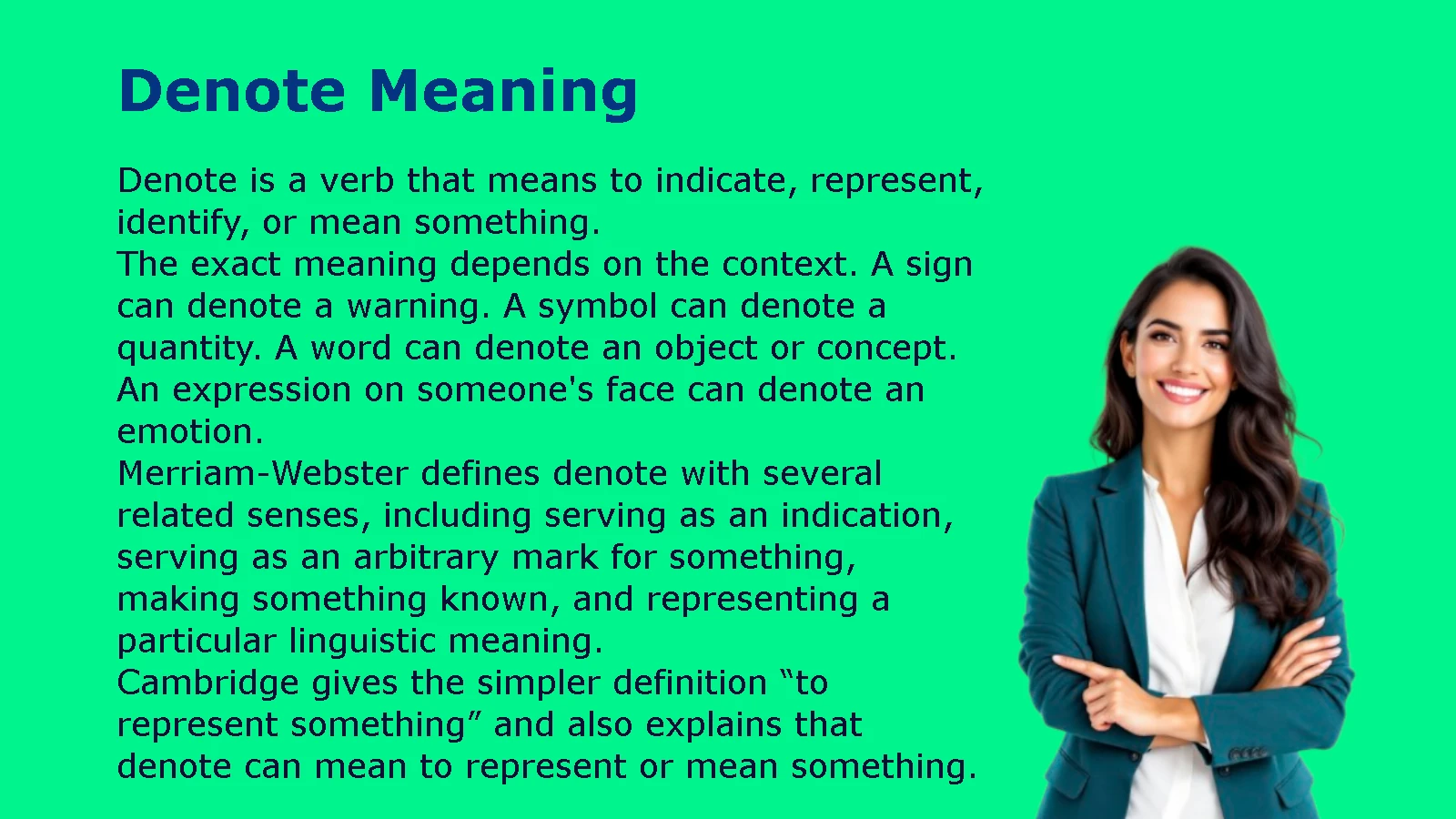
Denote is a verb that means to indicate, represent, identify, or mean something.
The exact meaning depends on the context. A sign can denote a warning. A symbol can denote a quantity. A word can denote an object or concept. An expression on someone’s face can denote an emotion.
Merriam-Webster defines denote with several related senses, including serving as an indication, serving as an arbitrary mark for something, making something known, and representing a particular linguistic meaning.
Cambridge gives the simpler definition “to represent something” and also explains that denote can mean to represent or mean something.
Denote Meaning in Simple Words
If you want the shortest possible definition:
Denote means to show, indicate, represent, or mean something.
Think of denote as a bridge between one thing and the meaning it communicates.
For example:
- A red light denotes danger or a need to stop.
- A star on a chart denotes a special item.
- The letter x can denote an unknown number.
- A smile can denote happiness.
- The word “dog” can denote a particular type of animal.
The key idea is direct indication or representation.
Denote Definition and Core Meanings
Although denote has several dictionary senses, they are closely connected. They all involve one thing pointing toward, representing, or communicating another thing.
| Meaning of denote | What it means | Example |
| Indicate | To show that something exists or is happening | Dark clouds may denote rain. |
| Represent | To stand for something | The symbol “%” denotes a percentage. |
| Mean | To have a particular meaning | The word “infant” denotes a very young child. |
| Signal | To communicate something through a sign or feature | A warning bell denotes danger. |
| Designate | To identify something specifically | The letter A denotes the first category. |
These meanings overlap, which explains why dictionaries often list indicate, signify, mean, represent, and designate among related words.
Merriam-Webster lists signify, mean, imply, and indicate among the synonyms associated with denote.
Denote Pronunciation
In American English, denote is pronounced:
/dɪˈnoʊt/
An easy pronunciation guide is:
dee-NOHT
The second syllable receives the main stress.
Denote Pronunciation Breakdown
- de → /dɪ/
- note → /noʊt/
- Stress → NOHT
The word rhymes approximately with “remote” in its final syllable.
Cambridge gives the American pronunciation as /dɪˈnoʊt/.
Is Denote a Verb or Noun?
Denote is a verb.
It describes the action of indicating, representing, or meaning something.
For example:
The blue line denotes the river.
Here, denotes tells us what the blue line represents.
The noun related to the direct meaning of a word or sign is usually denotation.
Compare these forms:
| Word | Part of speech | Meaning |
| denote | Verb | To indicate or represent |
| denotes | Verb | Present-tense form used with singular subjects |
| denoted | Verb | Past tense or past participle |
| denoting | Verb | Present participle |
| denotation | Noun | The direct or referential meaning |
Examples of Different Forms
- The symbol denotes a positive value.
- The symbol denoted the original measurement.
- The arrow is denoting the direction of movement.
- The word’s denotation refers to its direct meaning.
Cambridge identifies denoted as the past simple and past participle of denote.
How to Use Denote in a Sentence
The most common structure is:
Subject + denote + object
For example:
The symbol denotes a specific value.
Here:
- The symbol = subject
- denotes = verb
- a specific value = object
You can also use denote with words such as something, a change, a meaning, a value, danger, a category, or a particular type.
Common Sentence Patterns
Something denotes something:
The red flag denotes danger.
A word denotes something:
The term “bachelor” denotes an unmarried man.
A symbol denotes something:
The letter x denotes an unknown quantity.
An action or expression denotes something:
Her smile denoted relief.
Something is denoted by something:
The different species are denoted by separate symbols.
This last structure uses the passive voice. It can be useful when the thing being represented matters more than the thing doing the representing.
Denote Examples in Sentences
Seeing the word in different contexts makes its meaning much clearer.
Everyday Denote Examples
- A red traffic light denotes that vehicles must stop.
- Dark clouds may denote an approaching storm.
- A wedding ring can denote marriage.
- A warning sign denotes a potential hazard.
- Her nervous expression denoted uncertainty.
- The flashing light denotes an emergency.
- A thumbs-up can denote approval.
- The bell denoted the beginning of the class.
- A closed door may denote that the room is occupied.
- The sign denotes the entrance to the building.
The examples do not all involve formal symbols. Behavior, visual features, and physical signs can denote something too.
Academic Examples
- The term denotes a specific category of plants.
- The diagram uses arrows to denote movement.
- In this equation, x denotes the unknown quantity.
- The asterisk denotes an important exception.
- The shaded region denotes the area under the curve.
- The phrase denotes a particular historical period.
Professional Examples
- The blue icon denotes an active account.
- The symbol denotes a required field.
- The highlighted section denotes the revised policy.
- The label denotes products intended for professional use.
- A red mark denotes an item that requires review.
Merriam-Webster’s usage examples include symbols and markings that identify locations, categories, or specific information.
What Does Denote Mean in a Sentence?
In a sentence, denote establishes a relationship between something that communicates meaning and the thing being communicated.
Consider this sentence:
The red color denotes danger.
The red color is the sign. Danger is what that sign represents.
Now consider:
The letter x denotes an unknown number.
The letter x doesn’t physically resemble an unknown number. Instead, people agree to use the symbol as a representation of that mathematical concept.
That distinction matters.
Denote doesn’t require physical similarity. A symbol can denote something because people have assigned a particular meaning to it.
This is especially common in mathematics, science, maps, charts, and technical writing.
Denote vs. Connote
One of the most important distinctions to understand is denote vs. connote.
The two words look similar because both deal with meaning. However, they describe different relationships between a word or sign and an idea.
Denote Meaning
Denote generally points to a direct meaning, reference, or representation.
Connote Meaning
Connote generally points to an associated, suggested, or implied meaning.
Consider the word rose.
A rose can denote a particular type of flower.
At the same time, a rose can connote love, romance, beauty, or affection depending on the context.
The distinction looks like this:
| Word | Main idea | Example |
| Denote | Directly indicate or represent | “Rose” denotes a type of flower. |
| Connote | Suggest an associated idea | A rose can connote love. |
An Easy Way to Remember Denote vs. Connote
Use this simple rule:
Denote = direct meaning
Connote = connected meaning
Imagine an onion with two layers.
The denotation is the basic layer that tells you what something directly represents. The connotation adds the feelings, associations, cultural ideas, or suggestions that may surround it.
The distinction becomes especially useful in literature, advertising, media analysis, and everyday communication.
Denote vs. Mean
Denote and mean can sometimes be interchangeable, but they don’t always sound equally natural.
Mean is the ordinary word people use in everyday conversation.
What does this word mean?
Denote sounds more precise or formal.
The symbol denotes the average value.
You could technically replace denotes with means in some contexts, but the result may sound less precise.
Compare:
The symbol means addition.
The symbol denotes addition.
Both can communicate the idea. The second sentence sounds more suited to a mathematical or academic explanation.
When Should You Use Denote Instead of Mean?
Use mean when you’re talking casually about the meaning of a word, phrase, statement, or idea.
Use denote when you want to emphasize representation, indication, designation, or a specific reference.
For example:
- Casual: “What does this word mean?”
- Formal: “The term denotes a particular class of organisms.”
- Casual: “What does this symbol mean?”
- Technical: “The symbol denotes the measured quantity.”
Denote vs. Signify
Denote and signify overlap heavily.
Both can mean to indicate, represent, or communicate a particular meaning.
| Word | Typical emphasis |
| Denote | Direct representation or specific reference |
| Signify | Indication, meaning, or importance |
| Indicate | Showing or pointing toward something |
| Mean | General meaning |
| Represent | Standing for something else |
For example:
The red light denotes danger.
The red light signifies danger.
Both sentences work.
However, signify can sometimes carry a broader sense of importance or meaning:
His promotion signified a major change in the company.
In that sentence, signified emphasizes what the event meant or represented rather than a formal symbol-to-meaning relationship.
Synonyms for Denote
The best synonym depends on the sentence.
Synonyms Meaning “Indicate”
- indicate
- show
- signal
- point to
- suggest
- identify
Example:
Dark clouds indicate rain.
Synonyms Meaning “Represent”
- represent
- symbolize
- stand for
- signify
- designate
Example:
The dove often symbolizes peace.
Synonyms Meaning “Mean”
- mean
- refer to
- signify
- express
- designate
Example:
The term refers to a specific type of agreement.
Denote Synonym Comparison
| Synonym | Best used when… |
| Indicate | Something provides evidence or points toward something |
| Represent | Something stands for another thing |
| Signify | Something communicates meaning or importance |
| Mean | You simply want to explain meaning |
| Symbolize | A symbol represents an idea or concept |
| Designate | Something is officially identified or assigned |
| Suggest | The evidence points toward an idea without proving it |
Not every synonym works in every situation. Denote is especially useful when a direct relationship exists between a sign, term, symbol, or feature and what it represents.
Antonyms of Denote
There isn’t one perfect opposite of denote for every context.
Possible contrasting words include:
- conceal
- hide
- obscure
- misrepresent
- disguise
However, these words don’t function as exact opposites in every sentence.
For example:
The symbol denotes the location.
The opposite idea might be:
The symbol conceals the location.
But in another context, denote might mean “indicate,” making obscure or hide a more suitable contrast.
So it is better to treat these as contextual opposites rather than a fixed antonym list.
Denote Word Forms
Understanding the related forms helps you recognize the word in different types of writing.
Denote
The base form is denote.
Symbols denote specific values.
Denotes
Use denotes with a singular third-person subject.
The arrow denotes direction.
This term denotes a specific process.
Denoted
Denoted is the past-tense and past-participle form.
The mark denoted the center of the circle.
The boundary was denoted by a dashed line.
Denoting
Denoting is the present participle.
The chart contains symbols denoting different categories.
Denotation
Denotation is a noun associated with the direct meaning or reference of a word or sign.
The denotation of the word is straightforward.
The verb and noun should not be confused:
denote = action
denotation = concept or meaning
Denote and Denotation: What’s the Difference?
The easiest way to remember the difference is grammatical.
A word denotes something.
The denotation of a word is its direct meaning or reference.
For example:
The word “cat” denotes a type of domesticated feline animal.
Here, denotes is the verb.
Now:
The denotation of “cat” refers to the animal itself.
Here, denotation is the noun.
| Term | Example | Role |
| Denote | The word “cat” denotes an animal. | Verb |
| Denotation | The denotation of “cat” is the animal it refers to. | Noun |
| Connote | The word may connote independence in a particular context. | Verb |
| Connotation | The word has positive connotations. | Noun |
This distinction becomes especially important when studying semantics, linguistics, literature, and communication.
Common Collocations With Denote
A collocation is a combination of words that naturally appear together.
Some common combinations with denote include:
- denote a meaning
- denote danger
- denote a change
- denote a value
- denote a symbol
- denote a category
- denote a relationship
- denote a particular type
- denote an area
- denote a location
- denote a quantity
- denote a specific concept
Examples:
The red markings denote danger.
The letter x denotes a value.
Different colors denote different categories.
A dashed line denotes a boundary.
These patterns are common because denote naturally connects a sign or representation with what it communicates.
How to Use Denote Correctly
Using denote correctly becomes much easier when you ask one simple question:
Is one thing directly representing or indicating another thing?
If the answer is yes, denote may fit naturally.
Use Denote for Symbols
Symbols are one of the clearest examples.
The “$” symbol denotes a dollar amount.
The plus sign denotes addition.
The asterisk denotes a footnote.
A symbol does not need to look like what it represents. Its meaning can come from an established convention.
Use Denote for Labels
Labels can denote categories, properties, or classifications.
The blue labels denote premium products.
The letters denote different sections of the experiment.
Use Denote for Words
A word can denote an object, person, action, concept, or category.
The word “infant” denotes a very young child.
This is where denote connects directly with language and semantics.
Use Denote for Visual Features
Colors, shapes, lines, and markings can also denote information.
A solid line denotes a confirmed boundary.
Red denotes a warning in the diagram.
The shaded region denotes the area being studied.
Don’t Use Denote When You Really Mean “Suggest”
This distinction is important.
Suppose someone says:
His silence denoted that he was angry.
The sentence can work if the silence clearly served as a sign of anger.
However, if the silence merely gives you a reason to consider anger as one possibility, suggested may be more precise:
His silence suggested that he was angry.
Denote tends to work best when the connection is relatively direct or established.
Suggest is better when the evidence is uncertain or open to interpretation.
Denote in Mathematics
Mathematics relies heavily on symbols that denote specific quantities, operations, relationships, or objects.
For example:
Let x denote the unknown number.
Here, x acts as a symbol representing a quantity.
Other examples include:
- + denotes addition.
- − denotes subtraction.
- = denotes equality.
- % denotes a percentage.
- π denotes the mathematical constant pi.
- ∞ is commonly used to denote infinity.
The important point is that mathematical notation creates a compact system of representation.
Instead of repeatedly writing:
“the unknown quantity”
a mathematician can write:
x
That single letter carries the assigned meaning within the problem.
A Simple Mathematical Example
Suppose a problem says:
Let x denote the number of books on a shelf.
If the shelf contains 24 books, then:
x = 24
The letter x doesn’t naturally mean “24.” The problem assigns it that role.
That’s a classic example of denotation through convention.
Denote in Science
Scientific writing uses denote for the same basic reason: researchers need precise ways to connect symbols, measurements, labels, and concepts.
For example:
The symbol T denotes temperature.
The letter m denotes mass.
Different colors denote different experimental groups.
Scientific notation works because readers understand what particular symbols represent within a given field.
A symbol may have different meanings in different disciplines, so context matters.
For example, a letter used for mass in one equation could represent something entirely different in another.
That’s why technical writing usually defines symbols before using them.
Denote in Maps, Charts, and Diagrams
Maps and diagrams are packed with things that denote information.
A map might use:
- Blue lines to denote rivers
- Black lines to denote roads
- Symbols to denote landmarks
- Shaded areas to denote regions
- Dotted lines to denote boundaries
A chart can work in the same way.
For example:
| Visual element | Possible meaning |
| Blue line | River |
| Red marker | Important location |
| Dashed line | Boundary |
| Star | Featured location |
| Shaded area | Selected region |
The exact meaning depends on the map or chart’s legend.
This is a useful reminder that denote does not mean a symbol has one universal meaning. A symbol denotes something because the surrounding system, context, or convention gives it that meaning.
Denote in Linguistics and Semantics
In linguistics, denotation deals with what an expression refers to or represents.
Consider the word:
tree
At its most direct level, the word refers to a particular category of plant.
That direct reference is different from the feelings or associations the word may evoke.
For one reader, “tree” might suggest nature. For another, it might suggest childhood memories, shade, or a particular landscape.
Those additional associations belong to the broader idea of connotation rather than the basic act of denoting.
Denotation vs. Connotation
| Concept | Focus |
| Denotation | Direct meaning or reference |
| Connotation | Associated ideas, feelings, or cultural suggestions |
For example, the word home can denote a place where someone lives. It can also connote safety, family, comfort, or belonging.
That difference helps explain why two words can refer to similar things while creating very different emotional reactions.
A Practical Case Study: Traffic Signs
Traffic signs provide one of the clearest real-world examples of denote meaning.
Imagine approaching an intersection and seeing a red octagonal sign.
The sign itself is a physical object. Its shape, color, and lettering work together to communicate a specific instruction.
The word STOP directly identifies the required action.
In this context, the sign denotes the instruction to stop.
Now imagine a different sign showing a falling rock.
The image denotes the possibility of falling rocks ahead. Drivers don’t need a paragraph explaining the hazard. The symbol communicates the information quickly.
This is why signs are so powerful: a small visual element can carry a large amount of agreed-upon meaning.
A Practical Case Study: Mathematical Notation
Consider this statement:
r denotes the radius of the circle.
The sentence establishes a precise relationship.
The letter r is the symbol. The radius of the circle is what it represents.
Once the definition is established, the writer can use r throughout the rest of the calculation.
For example:
A = πr²
The notation becomes compact because the symbol has already been assigned a meaning.
This is one reason technical fields depend so heavily on words such as denote, represent, and designate. They allow writers to define relationships precisely.
A Practical Case Study: Language
Consider the word “vehicle.”
The word denotes a broad category of transportation devices. A car, bus, truck, and motorcycle can all fall within that category.
Now compare it with the word “car.”
Both words can refer to transportation, but their ranges differ.
The more specific term narrows the category.
This example shows that denote can describe the relationship between a linguistic expression and what it refers to. The word itself is not the object. It is a linguistic representation of the object or category.
Common Mistakes With Denote
Confusing Denote With Connote
This is probably the most common conceptual mistake.
Remember:
- Denote → direct representation or reference
- Connote → associated or implied meaning
A word can do both at the same time.
Using Denote as a Noun
Don’t write:
The denote of the word is…
Use:
The denotation of the word is…
Denote is a verb.
Assuming Denote Always Means “Prove”
It doesn’t.
If something denotes a particular condition, that doesn’t necessarily mean the condition has been scientifically proven.
For example:
Dark clouds may denote rain.
The clouds are a sign of possible rain. They don’t guarantee it.
Context determines whether the relationship is direct, conventional, suggestive, or evidential.
Treating Every Synonym as Identical
Words such as indicate, signify, represent, mean, and suggest overlap with denote, but their emphasis can differ.
Replacing one with another without considering context can make a sentence less precise.
Is Denote a Formal Word?
Yes, denote is more common in formal, academic, technical, and analytical writing than in casual conversation.
That doesn’t make it unusual or outdated. It remains a standard English verb.
You might naturally say:
What does this word mean?
You probably wouldn’t ask:
What does this word denote?
The second sentence is grammatically correct, but it sounds more formal.
In a textbook, research paper, mathematical explanation, or technical manual, however, denote can be exactly the right word.
When Denote Works Best
Use denote when writing about:
- Mathematics
- Science
- Linguistics
- Literature
- Symbols
- Maps
- Charts
- Labels
- Signs
- Categories
- Technical definitions
- Formal explanations
For casual conversation, mean, show, or stand for may sound more natural.
Denote Meaning: Quick Reference
| Question | Answer |
| What does denote mean? | To indicate, represent, refer to, or mean something. |
| Is denote a verb? | Yes. |
| What is a simple synonym for denote? | Indicate, represent, signify, or mean. |
| What is the noun form of denote? | Denotation. |
| What is the difference between denote and connote? | Denote focuses on direct representation or reference; connote focuses on associated or implied meaning. |
| Is denote formal? | It is more common in formal, academic, and technical writing. |
| Can symbols denote things? | Yes. Symbols frequently denote values, operations, categories, and concepts. |
| Can words denote things? | Yes. Words can denote objects, concepts, categories, and other meanings. |
| Can actions denote emotions? | Yes, when the action or expression serves as an indication of an emotion. |
| What is the past tense of denote? | Denoted. |
| What is the -ing form? | Denoting. |
Frequently Asked Questions About Denote Meaning
What does denote mean in simple English?
Denote means to show, indicate, represent, or mean something.
For example, a red warning sign can denote danger.
What is an example of denote?
The symbol “%” denotes a percentage.
The symbol represents a specific mathematical concept, so denotes is appropriate.
Is denote the same as mean?
Sometimes, but not always.
Mean is a broader and more common word. Denote often emphasizes direct representation or indication, especially in formal or technical contexts.
What is the difference between denote and connote?
Denote refers to direct meaning or representation. Connote refers to an associated or suggested meaning.
For example, a rose denotes a type of flower. It can connote love or romance.
What is the noun form of denote?
The related noun is denotation.
Denote is the verb, while denotation refers to the direct meaning or reference.
Is denote a verb or noun?
Denote is a verb.
For example:
The symbol denotes the answer.
What are the best synonyms for denote?
Depending on context, useful synonyms include:
- indicate
- represent
- signify
- mean
- designate
- show
- symbolize
- stand for
How do you use denote in a sentence?
Use denote when one thing indicates or represents another.
The blue line denotes the river.
Is denote a formal word?
Yes. While denote is a normal English word, it appears especially often in academic, scientific, mathematical, linguistic, and technical writing.
Final Takeaway: Denote Meaning Explained
The simplest way to understand denote is to think “directly indicate or represent.”
A symbol can denote a value. A color can denote a warning. A word can denote an object or concept. A gesture can denote an emotion. A label can denote a category.
The word is especially useful when you need to describe a clear relationship between a sign and what that sign represents.
Remember the key distinction:
Denote = direct meaning or representation
Connote = associated or suggested meaning
Once that difference clicks, denote becomes much easier to use. Whether you’re reading a dictionary, solving an equation, analyzing a poem, studying linguistics, or interpreting a chart, the basic idea stays the same: one thing points to, represents, or communicates another thing.