Have you ever met someone who seems to make every conversation about themselves? If so, you may have wondered whether egocentric is the right word to describe their behavior. The Egocentric Meaning can be easy to understand, but the word has a deeper meaning when you consider a person’s thoughts, behavior, and view of the world.
Egocentric means focused excessively on oneself and one’s own interests, opinions, or experiences. An egocentric person may have difficulty seeing situations from another person’s point of view because they naturally focus on their own perspective.
Examples:
- He is too egocentric to consider how his actions affect others.
- Her egocentric attitude made it difficult to work as a team.
The confusion is understandable. People often search for what does egocentric mean, egocentric meaning in psychology, egocentric meaning in a relationship, or egocentric vs selfish because the word can describe different types of behavior depending on the context. And here’s the kicker: being egocentric doesn’t always mean someone is intentionally rude or selfish. It can also refer to a person’s natural tendency to view situations mainly from their own perspective.
In this guide, you’ll learn the complete Egocentric Meaning, its definition, pronunciation, synonyms, antonyms, and correct usage. You’ll also discover egocentric meaning in psychology, examples of egocentric behavior, how to use the word in sentences, and the difference between egocentric, selfish, self centered, and narcissistic.
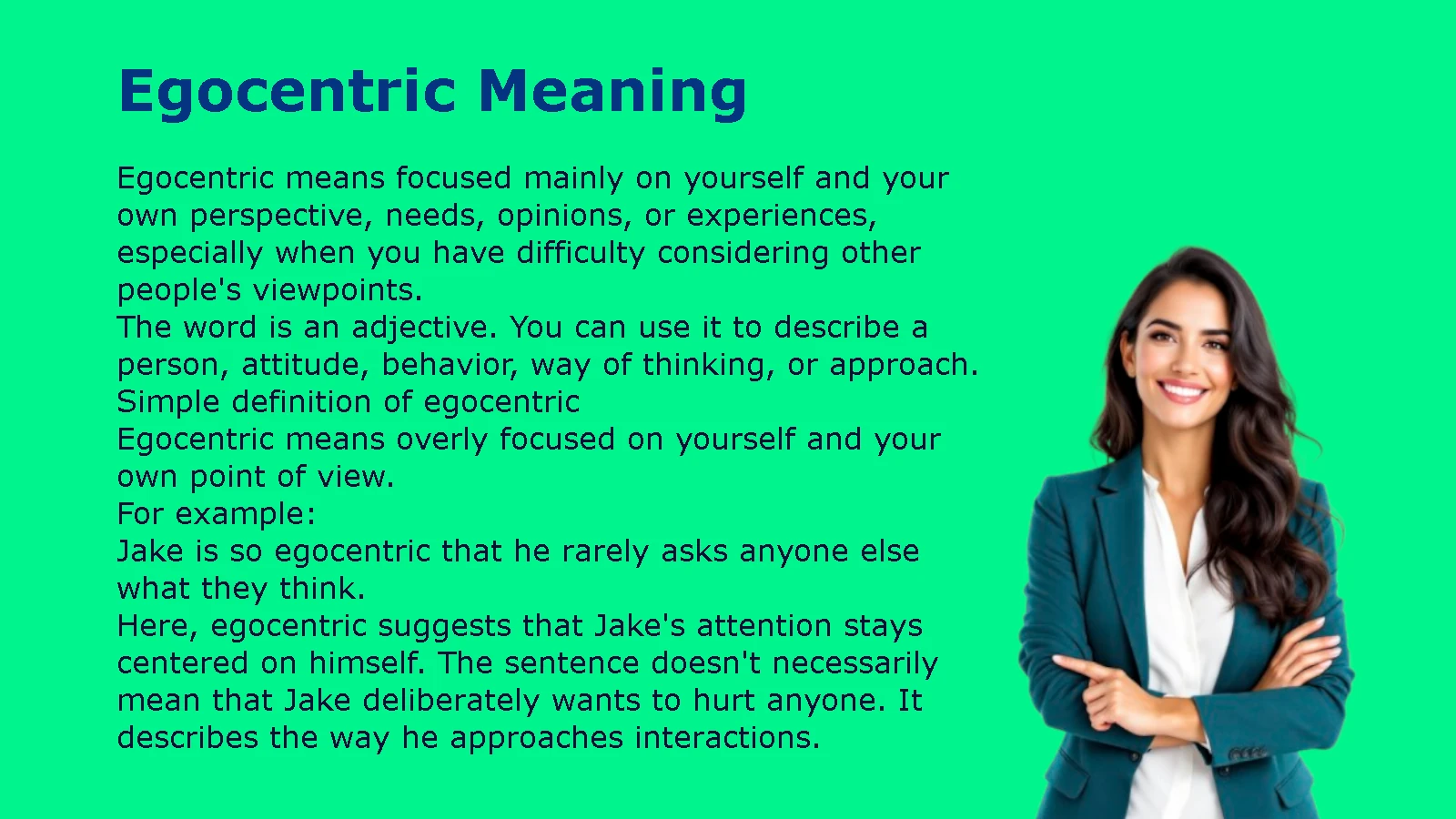
Egocentric Meaning
Egocentric means focused mainly on yourself and your own perspective, needs, opinions, or experiences, especially when you have difficulty considering other people’s viewpoints.
The word is an adjective. You can use it to describe a person, attitude, behavior, way of thinking, or approach.
Simple definition of egocentric
Egocentric means overly focused on yourself and your own point of view.
For example:
Jake is so egocentric that he rarely asks anyone else what they think.
Here, egocentric suggests that Jake’s attention stays centered on himself. The sentence doesn’t necessarily mean that Jake deliberately wants to hurt anyone. It describes the way he approaches interactions.
Cambridge also lists self-centered and egoistic among related terms.
Egocentric at a glance
| Feature | Meaning |
| Word | Egocentric |
| Part of speech | Adjective |
| Pronunciation | /ˌiːˈɡoʊˌsen.trɪk/ |
| Basic meaning | Focused mainly on oneself |
| Noun form | Egocentrism, egocentricity |
| Common synonym | Self-centered |
| Common opposite | Altruistic, selfless |
| Tone | Usually negative or critical |
The pronunciation uses the stress pattern ee-go-CEN-tric.
What Does Egocentric Mean in Everyday Language?
In everyday conversation, calling someone egocentric usually means that the person puts too much emphasis on themselves.
Imagine two friends talking after one of them loses a job. The first friend explains what happened. Instead of listening, the second friend immediately says:
“That reminds me of when I lost my job. Mine was much worse.”
The second person may not have intended to be cruel. Yet repeatedly turning someone else’s experience into a story about yourself can appear egocentric.
The key idea is perspective.
An egocentric person may naturally interpret events from their own position without giving enough attention to how those events affect other people.
Egocentric does not always mean intentionally selfish
This distinction matters.
Someone can behave egocentrically without consciously deciding, “Other people’s feelings don’t matter.” Sometimes the problem involves limited awareness. The person may simply fail to notice that another perspective exists.
For example:
- You explain why you’re upset, but the person immediately explains why they’re upset.
- You ask for their opinion, and they assume everyone agrees with them.
- A group makes a decision, but they judge the decision only by how it affects them.
- Someone shares exciting news, but they quickly redirect the conversation toward their own achievements.
One isolated incident doesn’t prove that someone is egocentric. People have bad days. They become distracted. They sometimes talk too much.
Egocentric usually becomes more accurate when self focus appears as a repeated pattern.
Egocentric Definition
The egocentric definition has both an everyday and a psychological side.
In ordinary English, it describes someone who focuses heavily on themselves. Cambridge’s learner definition simplifies the idea to being “interested only in yourself.”
In psychology, however, egocentrism can refer more specifically to difficulty understanding a perspective other than one’s own.
That difference prevents an important misunderstanding.
Being egocentric doesn’t automatically mean a person has a psychological disorder. It isn’t a diagnosis by itself. It’s a descriptive word.
Egocentric as an adjective
You can use egocentric before a noun:
- an egocentric person
- an egocentric attitude
- an egocentric viewpoint
- an egocentric approach
- egocentric behavior
- an egocentric way of thinking
You can also use it after a linking verb:
His approach seems egocentric.
The decision was extremely egocentric.
Egocentric Examples
The easiest way to understand egocentric meaning is to see it in realistic situations.
Example in a friendship
Maya rarely asks about her friends because she spends most conversations talking about herself.
This behavior can be described as egocentric because the interaction revolves heavily around Maya.
Example at work
The manager took an egocentric approach and considered only how the new schedule would affect his own routine.
The issue isn’t simply that he made a decision he liked. The concern is that he ignored the effect on everyone else.
Example in a disagreement
An egocentric person may assume that everyone who disagrees with them simply doesn’t understand the issue.
The person may struggle to recognize that two people can examine the same situation and reach different conclusions.
Example in a family
Her egocentric behavior made family discussions difficult because she focused almost entirely on her own plans.
Example in everyday conversation
He sounded egocentric when he turned every topic into a story about his achievements.
Example with a neutral meaning
The word isn’t always used to describe personality in a harsh way.
The navigation system uses an egocentric frame of reference based on the observer’s position.
In technical contexts, egocentric can describe a first person or observer centered perspective. Cambridge’s examples include technical uses involving egocentric frames of reference and spatial coding.
That use is quite different from saying someone is self absorbed.
Egocentric in a Sentence
Here are natural examples of egocentric in a sentence:
- His egocentric attitude made it difficult for him to accept criticism.
- She can be egocentric when conversations become competitive.
- The character is portrayed as egocentric and overly concerned with his own success.
- An egocentric viewpoint can make it harder to understand another person’s experience.
- His decision seemed egocentric because he ignored everyone else’s needs.
- The child showed an egocentric understanding of the situation.
- Her egocentric behavior frustrated her coworkers.
- The article examines how an egocentric perspective affects decision making.
- He isn’t necessarily rude, but he can come across as egocentric.
- The story follows an egocentric character who gradually learns to consider other people.
Egocentric used naturally
A useful rule is to use egocentric when you want to emphasize self focus or limited perspective.
If you simply mean someone wants something for themselves, another word may fit better.
For example:
He was selfish with his money.
This sounds more natural than:
He was egocentric with his money.
The second sentence isn’t impossible, but selfish describes the behavior more precisely.
Egocentric vs Selfish
Egocentric and selfish overlap, but they aren’t identical.
Selfish usually describes putting your own interests ahead of other people’s interests. Egocentric focuses more strongly on being centered on yourself or your own viewpoint.
| Word | Main focus | Example |
| Egocentric | Your own perspective | “He assumes everyone sees the issue as he does.” |
| Selfish | Your own interests | “She kept all the food for herself.” |
| Self-centered | Yourself and your activities | “He talks mostly about himself.” |
| Self-absorbed | Being deeply wrapped up in yourself | “She was too self-absorbed to notice his reaction.” |
Cambridge treats self-centered as a close synonym of egocentric and defines it as being interested mainly in yourself and your own activities.
A simple way to remember the difference
Think of it this way:
Selfish = “I want what benefits me.”
Egocentric = “I see things mainly from my point of view.”
A person can be one without strongly showing the other.
For example, someone may refuse to share their dessert because they are selfish. Someone else may dominate a conversation because they are egocentric.
The same person can certainly display both traits.
Egocentric vs Narcissistic
People often use egocentric and narcissistic as if they mean the same thing. They don’t.
Egocentric is a general descriptive adjective. It refers to self focused thinking or behavior.
Narcissistic has a more specific psychological meaning and can describe traits associated with excessive self importance, admiration seeking, entitlement, and related patterns. A clinical diagnosis requires much more than simply acting self centered.
So, calling someone egocentric doesn’t mean that person has narcissistic personality disorder.
Compare the terms
| Egocentric | Narcissistic |
| Focuses on one’s own perspective | Can involve exaggerated self importance |
| General descriptive term | Can describe a psychological pattern |
| Doesn’t indicate a disorder | Clinical diagnosis requires professional assessment |
| Can involve poor perspective taking | May involve entitlement or strong admiration needs |
| Common in everyday language | Often has a stronger psychological meaning |
For example:
He was egocentric because he assumed everyone agreed with him.
This says nothing about a diagnosis.
By contrast:
The character displays narcissistic traits.
This makes a stronger claim about a recognizable pattern of personality traits.
Don’t use “narcissistic” as a casual replacement for every instance of self centered behavior.
Egocentric vs Egotistical
The words egocentric and egotistical both relate to the self, but they emphasize different things.
Egocentric focuses on self centered thinking or perspective.
Egotistical usually suggests an inflated opinion of yourself, especially your abilities, importance, or achievements.
For example:
He is egocentric because he rarely considers other people’s perspectives.
versus:
He is egotistical because he constantly boasts about how talented he is.
The two traits can appear together, but they aren’t interchangeable.
Egocentric vs egoistic vs egotistical
| Word | General idea |
| Egocentric | Focused on oneself or one’s own perspective |
| Egoistic | Concerned strongly with one’s own interests |
| Egotistical | Excessively proud or impressed with oneself |
Cambridge lists egoistic as a synonym related to egotistic and places egocentric among its related terms.
Synonyms for Egocentric
The best synonym for egocentric depends on what you want to emphasize.
Common egocentric synonyms
- Self-centered
- Selfish
- Self-absorbed
- Self-focused
- Self-important
- Egoistic
- Egotistical
- Self-interested
- Inconsiderate
- Conceited
These words aren’t perfect substitutes in every sentence.
For instance, conceited usually emphasizes an inflated opinion of yourself. Selfish emphasizes personal gain. Self-absorbed emphasizes being deeply occupied with your own thoughts or concerns.
Best synonym by context
| If you mean… | Consider using… |
| Focused on yourself | Self-centered |
| Prioritizing your own benefit | Selfish |
| Wrapped up in yourself | Self-absorbed |
| Thinking highly of yourself | Conceited |
| Excessively proud | Egotistical |
| Focused on personal interests | Self-interested |
| Unconcerned about others | Inconsiderate |
If you need the closest everyday alternative, self-centered is usually the safest choice.
Antonyms for Egocentric
The opposite of egocentric is someone who can look beyond their own interests or perspective.
Common antonyms include:
- Selfless
- Altruistic
- Considerate
- Empathetic
- Unselfish
- Generous
- Other-focused
- Thoughtful
Cambridge lists altruistic as an opposite of egocentric and altruistic and selfless as opposites of egoistic.
Example
Egocentric: “I don’t care how the decision affects everyone else.”
Considerate: “Let’s see how this decision affects everyone before we choose.”
The contrast comes down to perspective. One centers the self. The other makes room for other people.
Egocentric Behavior
Egocentric behavior often becomes noticeable during conversations, disagreements, group decisions, and personal relationships.
Some common patterns include:
- Dominating conversations
- Interrupting frequently
- Turning other people’s stories into personal stories
- Assuming others share the same opinions
- Ignoring perspectives that conflict with their own
- Taking disagreement personally
- Focusing heavily on personal achievements
- Judging situations mainly by personal benefit
- Showing limited curiosity about other people’s experiences
- Struggling to recognize how their behavior affects others
However, context matters.
Someone who talks about themselves after receiving good news isn’t necessarily egocentric. Someone who interrupts once may simply be excited or distracted.
A better indicator is repetition and pattern.
Case study: The team meeting
Consider a fictional workplace meeting.
A team needs to choose between two project schedules. Alex immediately supports the schedule that gives Alex more free time. When coworkers explain how the schedule could create problems for them, Alex responds:
“It works for me, so I don’t see what the problem is.”
Alex hasn’t necessarily acted maliciously. Yet the reasoning is egocentric because it treats Alex’s experience as the main measure of whether the decision works.
A more balanced response would be:
“The schedule works well for me, but let’s look at how it affects everyone else.”
That small change shows perspective taking.
Egocentricity and Egocentrism
The nouns egocentricity and egocentrism describe the quality or tendency behind egocentric behavior.
Egocentrism
Egocentrism refers to a tendency to view the world primarily from one’s own perspective.
Example:
His egocentrism made it difficult for him to understand why his coworkers disagreed.
Egocentricity
Egocentricity refers to the quality of being egocentric.
Example:
Her egocentricity became obvious during the group discussion.
Both nouns relate directly to egocentric.
| Form | Part of speech | Example |
| Egocentric | Adjective | “He has an egocentric attitude.” |
| Egocentrism | Noun | “Egocentrism can affect perspective taking.” |
| Egocentricity | Noun | “His egocentricity frustrated the group.” |
| Egocentrically | Adverb | “She interpreted the situation egocentrically.” |
Egocentrism in Psychology
The psychological meaning of egocentrism deserves special attention because it isn’t simply a technical version of calling someone selfish.
Developmental psychologist Jean Piaget used the concept when describing children’s thinking. In this context, egocentrism refers to difficulty taking another person’s perspective.
That doesn’t mean children are deliberately selfish.
Instead, the concept concerns how a developing mind understands other viewpoints.
Piaget and perspective taking
Piaget’s work on cognitive development helped establish the idea that children’s thinking changes as they develop. In early childhood, children may have difficulty recognizing that another person can have information, perceptions, or a viewpoint different from their own.
This distinction matters because everyday language often treats egocentrism as a character flaw. Developmental psychology uses the term to describe a feature of cognitive development.
Egocentrism is not the same as narcissism
A child displaying egocentric thinking isn’t automatically narcissistic.
Likewise, an adult who behaves egocentrically in a particular situation doesn’t automatically have a personality disorder.
The concepts belong to different contexts.
Everyday meaning: excessive self focus.
Developmental psychology: difficulty taking another person’s perspective.
Clinical diagnosis: something much more specific that requires professional assessment.
Keeping those categories separate makes the word easier to understand and use accurately.
Is Being Egocentric the Same as Being Self-Centered?
In everyday English, egocentric and self-centered are very close.
Both can describe someone who pays too much attention to themselves and their own concerns. Cambridge lists egocentric as a synonym of self-centered.
Still, there can be a subtle difference in emphasis.
Self-centered often sounds more focused on someone’s interests, activities, or needs.
Egocentric can place greater emphasis on the person’s perspective or way of interpreting the world.
For example:
He is self-centered because he only thinks about what he wants.
He is egocentric because he assumes everyone sees the situation the way he does.
In casual conversation, though, many speakers could use either word.
How to Use Egocentric Correctly
Because egocentric is an adjective, it normally modifies a noun or follows a linking verb.
Before a noun
She has an egocentric attitude.
His egocentric behavior caused tension.
The character has an egocentric worldview.
After a linking verb
His response was egocentric.
The approach seems egocentric.
Her reasoning became increasingly egocentric.
As an adverb
The related adverb is egocentrically.
He interpreted the disagreement egocentrically.
The adverb appears less often in everyday speech than the adjective.
Avoid awkward usage
Instead of:
He egocentric thinks about himself.
Use:
He thinks about himself in an egocentric way.
Or simply:
He is egocentric.
Is Egocentric a Negative Word?
Usually, yes.
Egocentric generally carries a critical tone when you use it to describe a person. It suggests that the person’s focus on themselves has become excessive or problematic.
For example:
She is confident.
sounds positive.
She is egocentric.
sounds critical.
Yet the technical meaning can be more neutral. In fields such as psychology, spatial cognition, or neuroscience, egocentric can describe a first person centered frame of reference without making a moral judgment.
This difference depends heavily on context.
Compare the tone
| Sentence | Tone |
| He has strong self-confidence. | Positive |
| He is very self-focused. | Neutral to mildly negative |
| He is egocentric. | Usually negative |
| He is selfish. | Clearly negative |
| He is narcissistic. | Strongly negative and potentially psychological |
Egocentric vs Self-Important
These terms can overlap, but they point in different directions.
Someone self-important believes they matter more than they actually do or expects special treatment.
Someone egocentric focuses heavily on themselves or their own viewpoint.
For example:
The executive was self-important and expected everyone to follow his instructions immediately.
That describes an inflated sense of importance.
Meanwhile:
The executive was egocentric and ignored how the decision would affect the staff.
That highlights limited perspective.
A person can certainly be both.
Egocentric vs Self-Absorbed
Self-absorbed describes someone who becomes deeply occupied with their own thoughts, feelings, problems, or experiences.
Egocentric is broader.
Someone may be egocentric because they assume their viewpoint is universal. Someone may be self-absorbed because they’re so caught up in personal concerns that they barely notice what others are saying.
For example:
She was self-absorbed after the breakup and talked constantly about her feelings.
This doesn’t necessarily mean she believed her feelings were more important than everyone else’s. She may simply have been overwhelmed.
That distinction makes self-absorbed a better word in some situations.
Why Perspective Matters in the Meaning of Egocentric
At its heart, egocentric meaning revolves around the relationship between self and perspective.
Everyone naturally experiences life from their own point of view. That’s unavoidable. You see through your own eyes, remember your own experiences, and make decisions based on your own knowledge.
The problem appears when that personal viewpoint becomes the only viewpoint that seems real or important.
Think of it like looking through a camera lens.
A healthy perspective says:
“This is what I see. What do you see?”
An egocentric perspective may sound more like:
“This is what I see. Therefore, this must be what you see too.”
That small difference explains much of the word’s meaning.
Examples of Egocentric Thinking vs Balanced Thinking
| Situation | Egocentric response | Balanced response |
| Friend cancels plans | “They don’t care about me.” | “Maybe something happened. I’ll ask.” |
| Coworker disagrees | “They’re wrong.” | “Let’s understand why they see it differently.” |
| Group chooses another idea | “My idea was obviously better.” | “What made the group choose the other option?” |
| Someone shares bad news | “That happened to me too.” | “I’m sorry. How are you feeling?” |
| Schedule changes | “This is terrible for me.” | “How will this affect everyone?” |
The balanced response doesn’t require abandoning your own needs. It simply leaves room for other perspectives.
Common Misunderstandings About Egocentric
Egocentric does not mean confident
Confidence means having a reasonable belief in your abilities or worth.
Egocentrism involves excessive self focus or difficulty considering other viewpoints.
A confident person can listen carefully to criticism. An egocentric person may struggle to do so.
Egocentric does not always mean selfish
The terms overlap, but selfishness usually focuses on personal benefit. Egocentrism can focus on perspective.
Egocentric does not automatically mean narcissistic
The words aren’t interchangeable. Egocentric is a broad descriptive term. Narcissistic can refer to a more specific set of personality traits or a clinical condition when formally diagnosed.
Everyone can act egocentrically sometimes
People naturally focus on themselves at certain moments. Stress, excitement, grief, competition, or fatigue can temporarily make someone less attentive to others.
Calling someone egocentric usually makes more sense when self focused behavior appears consistently.
Frequently Asked Questions About Egocentric
What is the simple meaning of egocentric?
Egocentric means overly focused on yourself, your own interests, or your own point of view. It often describes someone who has difficulty considering other people’s perspectives.
Is egocentric a negative word?
Usually, yes. When you describe a person as egocentric, you generally suggest that they focus too much on themselves. However, technical uses of egocentric can be neutral when describing a first person centered perspective.
What is an example of an egocentric person?
Someone who constantly redirects conversations toward themselves and assumes other people share their opinions could be described as egocentric.
What is the opposite of egocentric?
Common opposites include selfless, altruistic, considerate, empathetic, and unselfish. The best choice depends on the specific meaning you want.
Is egocentric the same as selfish?
Not exactly. Selfish usually means putting your own interests ahead of others. Egocentric emphasizes being centered on yourself or your own perspective.
Is egocentric the same as self-centered?
They are very close. In everyday English, self-centered is one of the closest synonyms for egocentric. Cambridge explicitly lists egocentric as a synonym for self-centered.
What is the noun form of egocentric?
The main noun forms are egocentrism and egocentricity.
Example:
His egocentrism made it difficult to understand other people’s viewpoints.
What is the difference between egocentric and narcissistic?
Egocentric means overly focused on oneself or one’s own perspective. Narcissistic can describe a broader pattern involving traits such as exaggerated self importance, entitlement, or a strong need for admiration. The terms shouldn’t be treated as interchangeable.
Can someone be egocentric without being narcissistic?
Yes. A person can behave egocentrically without having narcissistic traits or a psychological disorder.
What is egocentrism in psychology?
In developmental psychology, egocentrism refers to difficulty taking another person’s perspective. The concept is strongly associated with Jean Piaget’s work on children’s cognitive development.
What is another word for egocentric?
The closest everyday alternatives include self-centered, self-absorbed, self-focused, self-interested, and selfish. The right synonym depends on whether you’re emphasizing perspective, personal interests, pride, or lack of consideration.
Final Takeaway: What Does Egocentric Mean?
The egocentric meaning is straightforward once you focus on its central idea: the self becomes the center of attention or perspective.
An egocentric person may focus heavily on their own opinions, experiences, needs, or interests. They may also struggle to recognize that other people can see the same situation differently.
The word has several related forms:
- Egocentric = focused mainly on oneself
- Egocentrism = the tendency toward self centered thinking
- Egocentricity = the quality of being egocentric
- Egocentrically = in an egocentric manner
In everyday English, self-centered is probably the closest synonym. However, selfish, self-absorbed, egotistical, and narcissistic carry different shades of meaning.
Most importantly, egocentric doesn’t automatically mean cruel, selfish, or narcissistic. Context matters. A technical discussion may use the word to describe a first person centered perspective, while an everyday conversation may use it to criticize someone’s behavior.
When you remember that distinction, the word becomes much easier to understand and use accurately.