Have you ever come across the word mortgage and wondered what it actually means? Mortgage is a common word in real estate and personal finance, but its meaning can vary slightly depending on how it is used. Understanding the word is especially important when you see it in home-buying, banking, or loan-related conversations.
A mortgage is a loan used to buy a house or other property, where the property usually serves as security for the loan. The person or business borrowing the money typically repays it over an agreed period, along with interest. In simple terms, a mortgage lets you buy property now and pay for it over time.
Examples:
- They took out a mortgage to buy their first home.
- She makes her mortgage payment at the beginning of each month.
The confusion is understandable. People often search for mortgage meaning, what does mortgage mean, mortgage definition, or mortgage meaning in English because the word can sound confusing if you’re unfamiliar with financial terms. It can also refer to the loan itself or the legal agreement securing the loan, depending on the context.
In this guide, you’ll learn the complete meaning of mortgage, including its definition, pronunciation, origin, types, and usage. You’ll also see clear examples that explain how the word works in everyday English and financial contexts.
What Does Mortgage Mean?
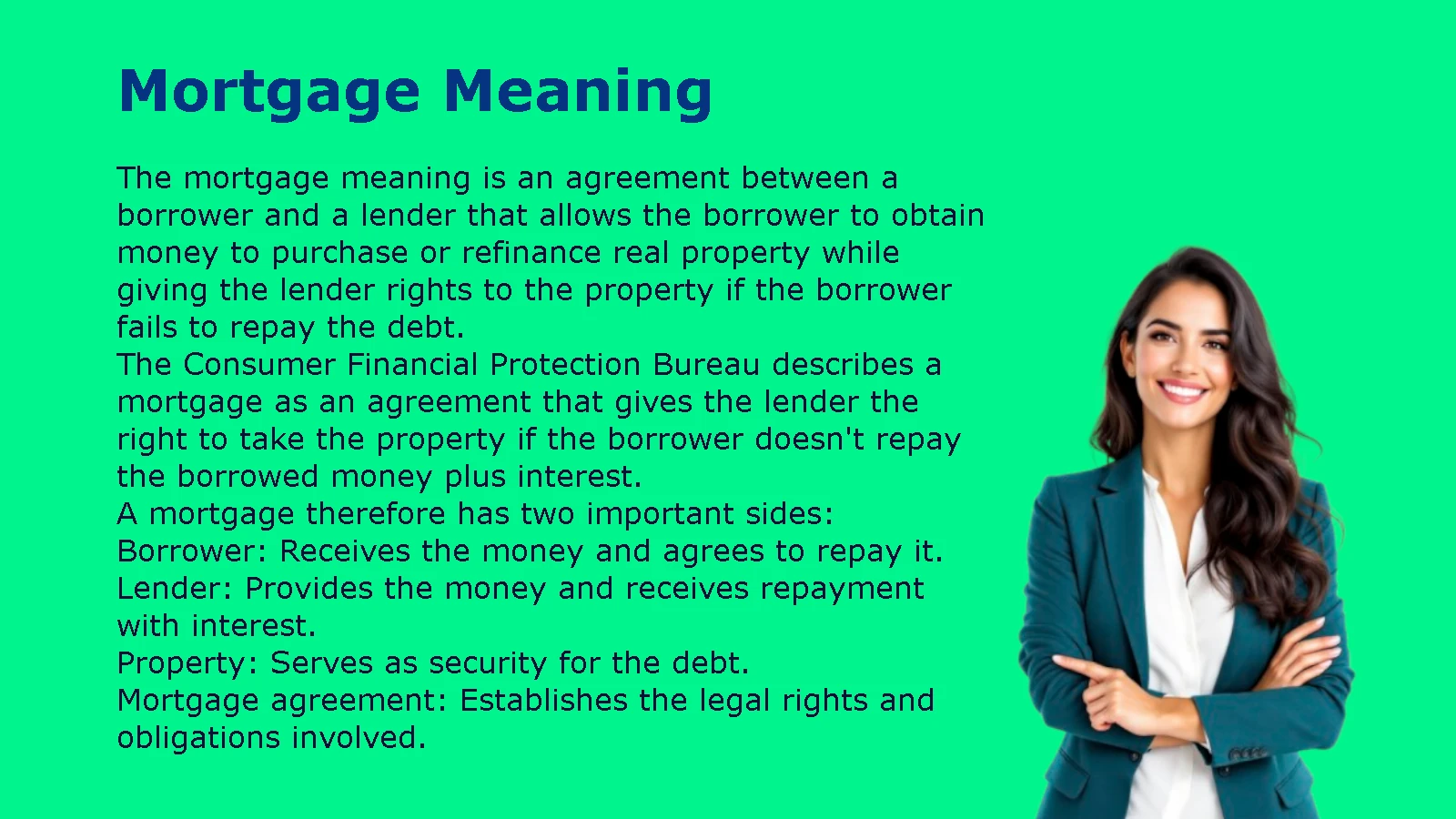
The mortgage meaning is an agreement between a borrower and a lender that allows the borrower to obtain money to purchase or refinance real property while giving the lender rights to the property if the borrower fails to repay the debt.
The Consumer Financial Protection Bureau describes a mortgage as an agreement that gives the lender the right to take the property if the borrower doesn’t repay the borrowed money plus interest.
A mortgage therefore has two important sides:
- Borrower: Receives the money and agrees to repay it.
- Lender: Provides the money and receives repayment with interest.
- Property: Serves as security for the debt.
- Mortgage agreement: Establishes the legal rights and obligations involved.
Mortgage Meaning in Simple Words
Think of a mortgage as borrowing money to buy a house while using the house as security for the loan.
Suppose you want to buy a $300,000 home but don’t have $300,000 in cash. You might provide a down payment and borrow the rest from a mortgage lender.
You then make regular payments.
If you follow the loan agreement and eventually repay what you owe, the mortgage debt is satisfied. If you stop making payments and fail to resolve the problem, the lender may have legal remedies that can ultimately include foreclosure, depending on the circumstances and applicable law.
Mortgage as a Noun
The word mortgage is most commonly used as a noun.
For example:
She took out a mortgage to buy her first home.
Here, “mortgage” refers to the loan arrangement secured by the property.
You might also hear:
- mortgage loan
- home mortgage
- mortgage payment
- mortgage lender
- mortgage interest
- mortgage rate
These expressions all relate to the same general financing concept.
Mortgage as a Verb
Mortgage can also function as a verb, although this use is less common in everyday conversation.
For example:
They mortgaged the property to obtain financing.
In this sense, to mortgage property means to use it as security for borrowed money.
Mortgage Example
A simple example makes the meaning of mortgage much easier to understand.
Imagine a buyer purchases a home for $400,000 and makes a $80,000 down payment.
The basic financing would look like this:
| Item | Example amount |
| Home price | $400,000 |
| Down payment | $80,000 |
| Mortgage amount | $320,000 |
| Down payment percentage | 20% |
| Loan-to-value ratio | 80% |
The buyer doesn’t borrow the full $400,000. Instead, the buyer contributes $80,000 and borrows $320,000.
The $320,000 becomes the principal balance at the beginning of the mortgage.
Interest is then charged according to the loan’s terms.
Mortgage Example With Monthly Payments
Consider a hypothetical $320,000 fixed-rate mortgage with:
- 6.5% annual interest rate
- 30-year term
- Monthly payments
- No taxes, insurance, mortgage insurance, or other costs included in the calculation
Under those assumptions, the principal-and-interest payment would be approximately $2,023 per month.
Over 30 years, those principal-and-interest payments would total roughly $728,142, assuming the loan remained in place for the entire term and the borrower made every scheduled payment.
That means approximately $408,142 would represent interest over the full term.
This example shows why the mortgage rate and loan term matter. A lower monthly payment doesn’t necessarily mean a lower total borrowing cost.
Important: This is an illustrative calculation, not a current mortgage-rate quote. Actual mortgage payments depend on the interest rate, loan amount, term, fees, taxes, insurance, mortgage insurance, and other loan-specific factors.
How Does a Mortgage Work?
A mortgage generally follows a straightforward process.
Choose a property → Apply for financing → Lender evaluates the loan → Close the mortgage → Make payments → Reduce the balance → Pay off the loan
Here’s what happens at each stage.
You Choose a Property
The process usually begins when you decide to purchase a home or another eligible property.
The purchase price determines how much financing you may need after accounting for your down payment and other available funds.
You Apply for a Mortgage
You provide financial information to a lender.
Depending on the loan and lender, this can include information about:
- Income
- Employment
- Existing debts
- Credit history
- Assets
- Down payment funds
- The property itself
The Lender Evaluates the Application
The lender evaluates both the borrower and the property.
The borrower’s finances matter because the lender needs to assess repayment risk. The property matters because it serves as security for the mortgage.
The lender may also require an appraisal or another valuation process.
You Close on the Mortgage
At closing, the mortgage documents and purchase documents are finalized.
Closing costs can include items such as origination charges, appraisal fees, credit report costs, title-related fees, and other transaction expenses. The CFPB notes that closing costs are summarized in the Loan Estimate and Closing Disclosure for covered mortgage transactions.
You Make Regular Payments
After closing, you make payments according to the loan agreement.
A typical payment may contain:
- Principal
- Interest
- Property taxes
- Homeowners insurance
- Mortgage insurance, if applicable
Not every mortgage handles these costs in exactly the same way.
What Is Mortgage Principal?
Mortgage principal is the amount of money you borrow from the lender.
If you buy a $400,000 home and borrow $320,000 after making an $80,000 down payment, the initial principal is $320,000.
When part of your payment goes toward principal, your outstanding loan balance decreases.
For example:
| Stage | Mortgage balance |
| Starting loan | $320,000 |
| After paying down $5,000 | $315,000 |
| After paying down another $10,000 | $305,000 |
The actual balance reduction depends on the loan’s amortization schedule.
The CFPB explains that paying principal reduces the amount owed and can build equity in the property.
What Is Mortgage Interest?
Mortgage interest is the cost of borrowing money from the lender.
If your mortgage has a 6.5% annual interest rate, that percentage forms part of the calculation used to determine how much interest you owe under the loan’s terms.
Interest doesn’t reduce the principal balance. Instead, it represents the lender’s charge for providing the financing.
That’s why two mortgages with the same loan amount can have very different total costs if their interest rates or repayment terms differ.
Interest Rate vs. APR
These terms sound similar, but they aren’t identical.
| Term | Meaning |
| Interest rate | The rate charged for borrowing the money |
| APR | A broader measure that reflects the interest rate plus certain loan charges |
The CFPB explains that APR can include the interest rate, points, mortgage broker fees, and other applicable charges.
So when comparing mortgages, looking at the interest rate alone can leave out important information about the overall cost of borrowing.
What Is Home Equity?
Home equity is the portion of the property’s value that belongs to you after accounting for the mortgage debt.
A simple formula is:
Home equity = Property value − Mortgage balance
Suppose your home is worth $400,000 and you owe $300,000 on the mortgage.
Your equity would be:
$400,000 − $300,000 = $100,000
Equity can change for two main reasons:
- You pay down the mortgage principal.
- The property’s market value changes.
For instance, if the mortgage balance falls while the home’s value rises, your equity can increase from both directions.
However, home values can also decline. Equity isn’t guaranteed to rise every year.
What Is Included in a Mortgage Payment?
One of the biggest misunderstandings about mortgages involves the difference between the principal-and-interest payment and the total monthly housing payment.
The basic principal-and-interest payment isn’t always the amount that leaves your bank account each month.
A total mortgage payment may include:
| Component | What it pays for |
| Principal | Reduces the mortgage balance |
| Interest | Cost of borrowing |
| Property taxes | Taxes imposed by the relevant local government |
| Homeowners insurance | Insurance coverage for the property |
| Mortgage insurance | Insurance that can protect the lender under certain loan arrangements |
The CFPB commonly describes principal, interest, taxes, and insurance as PITI.
Principal and Interest
Principal and interest form the core of most mortgage payments.
The principal reduces what you owe.
Interest pays the lender for providing the money.
On a standard fixed-rate mortgage, the combined principal-and-interest payment generally stays constant. However, the amount allocated to principal and interest changes throughout the repayment period.
Property Taxes and Homeowners Insurance
Property taxes and homeowners insurance aren’t technically costs of borrowing money. They’re costs of owning the property.
Still, a lender may collect money for these expenses through an escrow account.
The lender or mortgage servicer then holds those funds and pays applicable bills when they become due.
The CFPB notes that escrow amounts can change when property taxes or insurance costs change.
Mortgage Insurance
Mortgage insurance can apply when the borrower makes a smaller down payment or uses certain loan programs.
For many conventional mortgages, a down payment below 20% can result in a requirement for private mortgage insurance (PMI). FHA and USDA loans can also involve mortgage insurance requirements.
The exact rules depend on the loan program and circumstances.
What Is Mortgage Amortization?
Mortgage amortization is the process of gradually paying off the loan through scheduled payments.
Early in a typical amortizing mortgage, the outstanding balance is relatively high. As a result, more of the payment goes toward interest.
As the principal balance falls, the interest charged on that balance decreases. More of the scheduled payment can then go toward principal.
The CFPB describes this shift as a normal part of amortization.
Mortgage Amortization Example
Imagine a borrower has a large mortgage balance.
During the early years:
Higher balance → More interest → Smaller principal reduction
Later in the loan:
Lower balance → Less interest → Larger principal reduction
This doesn’t mean the scheduled principal-and-interest payment automatically increases. Instead, the internal split between interest and principal changes.
An amortization schedule shows this process payment by payment.
What Is a Down Payment?
A down payment is the portion of the property’s purchase price that you pay upfront rather than financing through the mortgage.
For a $400,000 home:
- $40,000 down payment = 10%
- $80,000 down payment = 20%
- $120,000 down payment = 30%
A larger down payment generally means you borrow less money.
However, the ideal down payment isn’t simply a matter of putting down as much cash as possible. Buyers also need money for closing costs, moving expenses, emergency savings, repairs, and other financial needs.
Mortgage requirements also vary significantly by loan type.
What Is Loan-to-Value Ratio?
The loan-to-value ratio, or LTV, compares the mortgage amount with the property’s value.
The basic formula is:
LTV = Mortgage amount ÷ Property value × 100
Suppose a $400,000 home has a $320,000 mortgage.
$320,000 ÷ $400,000 × 100 = 80% LTV
A larger down payment generally produces a lower LTV because the mortgage represents a smaller percentage of the property’s value.
LTV is one factor lenders may use when evaluating mortgage risk.
Types of Mortgages
Mortgages come in several forms. The most important differences involve the interest-rate structure, loan program, repayment period, and eligibility requirements.
Fixed-Rate Mortgage
A fixed-rate mortgage has an interest rate that remains fixed according to the loan terms.
That gives borrowers greater predictability for principal-and-interest payments.
The total monthly payment can still change if taxes, insurance, or mortgage insurance change.
Fixed-rate mortgages are commonly available with terms such as 15 or 30 years.
Adjustable-Rate Mortgage
An adjustable-rate mortgage, commonly called an ARM, can change its interest rate after an initial period according to the loan’s terms.
Many ARMs begin with a fixed introductory period. After that period ends, the rate can adjust at specified intervals.
An ARM typically involves several important features, including:
- Initial rate
- Initial fixed period
- Index
- Margin
- Adjustment frequency
- Rate caps
HUD explains that an ARM’s later rate can be calculated using an index plus the lender’s margin, subject to the loan’s adjustment rules.
Because the rate can change, the payment can also rise or fall.
Conventional Mortgage
A conventional mortgage is a mortgage that isn’t part of a specific government-backed loan program.
Conventional loans make up a major part of the mortgage market. The CFPB notes that they typically cost less than FHA loans but can be harder to qualify for.
FHA Mortgage
An FHA mortgage is backed by the Federal Housing Administration.
FHA loans can provide access to home financing with lower down-payment options and can accommodate borrowers who may not qualify for some conventional loans.
Mortgage insurance requirements are an important part of FHA financing.
VA Mortgage
A VA-backed mortgage is available to eligible veterans, servicemembers, and certain surviving spouses who meet applicable requirements.
VA-backed purchase loans can offer significant financing features. For eligible borrowers, VA states that purchase loans can allow no down payment when the sales price doesn’t exceed the home’s appraised value. VA-backed loans also generally don’t require private mortgage insurance.
Eligibility and lender requirements still apply.
USDA Mortgage
USDA mortgage programs can help eligible borrowers finance homes in qualifying rural areas.
The CFPB identifies USDA loans as government-backed financing designed for low- to middle-income borrowers in rural areas.
Eligibility depends on the specific USDA program, property location, income, and other requirements.
Mortgage vs. Home Loan
People often use mortgage and home loan as if they mean exactly the same thing.
In everyday conversation, that’s usually understandable.
A home loan is money borrowed to finance a home. A mortgage refers to the loan arrangement secured by real property.
The key idea is the security interest in the property.
If you borrow money to buy a house and the house secures the debt, you’re dealing with a mortgage arrangement.
Mortgage vs. Rent
A mortgage and rent both involve paying for housing, but they work very differently.
| Mortgage | Rent |
| Used to finance property ownership | Used to pay for the right to occupy a property |
| Borrower owns the property subject to the mortgage | Landlord owns the property |
| Payments can reduce mortgage principal | Rent generally doesn’t reduce a mortgage balance for the tenant |
| Owner is responsible for ownership costs | Many ownership costs remain with the landlord |
| Borrower can build equity | Tenant generally doesn’t gain ownership equity from rent payments |
Neither arrangement eliminates housing costs.
A homeowner may pay for property taxes, insurance, repairs, maintenance, utilities, and possibly HOA fees in addition to the mortgage.
A renter may also have utilities, renters insurance, deposits, and other expenses.
The important difference is ownership.
What Is a Mortgage Lender?
A mortgage lender is a company or institution that provides mortgage financing.
Depending on the transaction, lenders can include:
- Banks
- Credit unions
- Mortgage companies
- Other financial institutions
A lender evaluates the application, establishes loan terms, and provides or funds the mortgage according to its business model and applicable rules.
Mortgage Lender vs. Mortgage Broker
A mortgage lender provides the financing.
A mortgage broker generally helps connect borrowers with lenders and mortgage products.
That distinction matters because the company helping you find a mortgage isn’t necessarily the institution ultimately providing the money.
What Determines Whether You Qualify for a Mortgage?
Mortgage approval depends on the loan program and lender, but lenders commonly evaluate several parts of your financial picture.
Income
Lenders need evidence that you have sufficient income to support the proposed debt.
The type and stability of income can matter.
Credit History
Your credit history provides information about how you’ve handled borrowing and repayment in the past.
Credit requirements vary between lenders and mortgage programs.
Existing Debt
A borrower with substantial existing debt may have less income available for a new mortgage payment.
That’s one reason lenders consider debt obligations when evaluating applications.
Debt-to-Income Ratio
Debt-to-income ratio, or DTI, compares monthly debt obligations with gross monthly income.
For example, if qualifying monthly debt payments total $2,000 and gross monthly income is $6,000:
$2,000 ÷ $6,000 × 100 = 33.3% DTI
Different lenders and loan programs use different standards.
Down Payment
The down payment affects the size of the mortgage and can influence mortgage insurance requirements and other loan terms.
Property Value
Because the property secures the mortgage, its value matters to the lender.
An appraisal may be used to establish an opinion of the property’s market value for lending purposes.
What Is a Mortgage Closing?
Mortgage closing is the stage when the loan and property transaction are finalized.
You’ll encounter several important documents and costs during this stage.
For covered U.S. mortgage transactions, the Loan Estimate provides information about expected loan terms and costs. The Closing Disclosure provides final loan terms and closing costs before closing.
Closing costs can include:
- Loan origination charges
- Appraisal fees
- Credit report fees
- Title-related charges
- Government fees
- Prepaid interest
- Initial escrow deposits
- Other transaction-specific costs
The exact costs vary by transaction.
Mortgage Case Study: How a Homebuyer Builds Equity
Consider a hypothetical buyer named Sarah.
Sarah purchases a $400,000 home and makes an $80,000 down payment.
Her starting mortgage is therefore $320,000.
Assume, purely for illustration, that she has a 30-year fixed mortgage at 6.5%.
Her approximate principal-and-interest payment is $2,023 per month.
At the beginning of the loan, the balance is high, so a relatively large portion of each payment goes toward interest.
As Sarah pays down principal, the balance falls.
That changes the interest calculation over time.
After several years, Sarah’s equity can come from two sources:
Equity from principal repayment + Equity from any increase in property value
Suppose the property later becomes worth $450,000 and her mortgage balance falls to $290,000.
Her approximate equity would be:
$450,000 − $290,000 = $160,000
That’s why a homeowner’s equity isn’t simply equal to the amount they’ve paid in monthly mortgage payments.
The CFPB specifically notes that interest doesn’t reduce the loan balance, while principal payments do.
What Happens If You Stop Paying a Mortgage?
Missing a mortgage payment doesn’t mean a lender immediately takes the home.
Mortgage delinquency generally begins when required payments aren’t made on time. If the problem continues, the borrower may face additional fees, collection activity, loss-mitigation processes, and eventually foreclosure proceedings depending on the circumstances and applicable law.
The exact process varies by jurisdiction and loan.
If you’re struggling to make payments, contacting the mortgage servicer early can be important. The CFPB also directs borrowers experiencing mortgage problems toward HUD-approved housing counseling resources.
The key point is simple:
A mortgage is a long-term financial obligation, so payment problems should not be ignored.
What Happens When a Mortgage Is Paid Off?
When you make the final required payment and satisfy the mortgage debt, the loan is paid off.
The lender’s security interest in the property is then released through the applicable legal and recording process.
However, paying off the mortgage doesn’t mean the cost of owning the home disappears.
You may still have:
- Property taxes
- Homeowners insurance
- Maintenance costs
- Repairs
- Utilities
- HOA fees, if applicable
The major difference is that you no longer have the mortgage debt itself.
What Happens If You Sell a Home With a Mortgage?
You can generally sell a home even when you still owe money on the mortgage.
At closing, the outstanding mortgage balance normally has to be addressed.
Consider a simplified example:
- Home sells for: $450,000
- Mortgage balance: $280,000
- Other selling costs: $30,000
After paying the mortgage and those hypothetical selling costs, approximately $140,000 would remain before accounting for other applicable adjustments.
The calculation is:
$450,000 − $280,000 − $30,000 = $140,000
That remaining amount represents proceeds available to the seller before considering other transaction-specific factors.
If the property sells for less than the amount owed, the situation becomes more complicated. The borrower may need to bring money to closing or explore other options depending on the loan and circumstances.
Common Mortgage Terms You Should Know
Understanding a few basic terms makes mortgage documents much easier to read.
| Mortgage term | Simple meaning |
| Principal | Amount borrowed |
| Interest | Cost charged for borrowing |
| Interest rate | Percentage rate used to calculate interest |
| APR | Broader measure of borrowing cost that includes certain charges |
| Down payment | Money paid upfront toward the property |
| Loan term | Period allowed to repay the mortgage |
| Equity | Property value minus mortgage balance |
| Escrow | Account used to hold money for certain property expenses |
| Amortization | Process of gradually paying down the loan |
| LTV | Loan amount compared with property value |
| DTI | Debt payments compared with gross income |
| PMI | Private mortgage insurance used with certain conventional loans |
| Closing costs | Costs associated with completing the mortgage and property transaction |
| Refinancing | Replacing an existing mortgage with a new loan |
| Foreclosure | Legal process through which a lender may enforce its rights after serious default |
The CFPB’s mortgage glossary confirms the core meanings of terms such as principal, PMI, PITI, property taxes, mortgage insurance, and prepayment penalties.
Mortgage Terms That Are Easy to Confuse
Some mortgage terms sound interchangeable even though they describe different things.
Mortgage Rate vs. APR
The interest rate describes the rate charged for borrowing.
The APR provides a broader measure that can incorporate certain fees and charges.
A mortgage with a lower interest rate doesn’t automatically have the lower APR.
Mortgage Payment vs. Principal and Interest
Your principal-and-interest payment may be smaller than your total monthly mortgage payment.
Taxes, insurance, and mortgage insurance can increase the amount you actually pay each month.
Mortgage Balance vs. Equity
Your mortgage balance is what you still owe the lender.
Your equity is the value of the property minus that debt.
They’re related, but they’re not the same thing.
How Long Is a Mortgage?
A mortgage can have different repayment terms.
Common examples include:
- 15 years
- 20 years
- 30 years
A longer term generally produces a lower required monthly principal-and-interest payment but can result in more interest paid over the life of the loan.
A shorter term generally means higher monthly payments but can reduce the total interest paid when compared with a longer loan at otherwise similar terms.
The CFPB notes that borrowers can encounter terms such as 15-year and 30-year mortgages, with the term affecting both monthly payments and total interest costs.
What Are Mortgage Closing Costs?
Closing costs are expenses associated with completing a mortgage and property transaction.
They can include:
- Origination charges
- Appraisal costs
- Credit report fees
- Title-related fees
- Government charges
- Prepaid interest
- Initial escrow deposits
Some costs relate directly to obtaining the mortgage. Others relate to completing the property transaction.
The CFPB notes that closing costs can include origination charges, appraisal fees, credit report costs, title insurance fees, and other required transaction expenses.
That’s why the amount of cash needed at closing can be substantially higher than the down payment alone.
What Is Refinancing a Mortgage?
Refinancing means replacing an existing mortgage with a new mortgage.
A homeowner might consider refinancing for reasons such as:
- Obtaining a different interest rate
- Changing the loan term
- Altering the loan structure
- Accessing home equity in certain refinancing arrangements
Refinancing isn’t automatically beneficial.
The borrower needs to consider the new interest rate, closing costs, loan term, monthly payment, and total borrowing cost.
What Is a Mortgage Prepayment Penalty?
A prepayment penalty is a fee that may apply when a borrower pays off some or all of a mortgage earlier than allowed under the loan’s terms.
Not every mortgage has one.
The CFPB identifies prepayment penalties as a feature that borrowers should check when comparing mortgage options.
Before making a large extra payment or refinancing, review the loan documents to determine whether any applicable restrictions or charges exist.
Mortgage Meaning in Banking
In banking, a mortgage represents secured lending tied to real estate.
The bank or other lender provides funds.
The borrower promises to repay the debt.
The property provides security for the loan.
This structure distinguishes a mortgage from many unsecured loans.
With an unsecured loan, the lender generally doesn’t have a specific piece of real property serving as collateral.
With a mortgage, the property is central to the lending arrangement.
Mortgage Meaning in Real Estate
In real estate, the mortgage is closely connected to the financing side of buying property.
For example, a home purchase may involve:
Buyer + Seller + Lender + Mortgage + Property
The buyer acquires the property.
The lender provides financing.
The mortgage gives the lender a legal interest connected to the property as security for the debt.
The buyer then repays the mortgage according to the agreed terms.
Mortgage Meaning in Legal Terms
In legal terms, a mortgage involves a security interest in real property that protects the lender’s position if the borrower doesn’t fulfill the debt obligation.
The precise legal structure differs by jurisdiction.
That’s important because foreclosure procedures, recording rules, borrower protections, and enforcement processes can vary by state and country.
For that reason, a general definition shouldn’t be treated as legal advice for a particular property or loan.
Mortgage Synonyms and Related Terms
Several expressions can refer to a mortgage or something closely associated with it.
Common Related Terms
- Home loan
- Mortgage loan
- Home mortgage
- Housing loan
- Real estate loan
- Property loan
These terms aren’t always perfect legal synonyms.
For example, “home loan” emphasizes the borrowing purpose, while “mortgage” emphasizes the secured financing arrangement involving real property.
Mortgage vs. Other Types of Loans
A mortgage is only one type of borrowing.
| Loan type | Usually secured by | Common purpose |
| Mortgage | Real estate | Buying or refinancing property |
| Auto loan | Vehicle | Buying a vehicle |
| Personal loan | Often unsecured | Various personal expenses |
| Student loan | Generally not secured by a physical asset | Education |
| Home equity loan | Home equity/property | Borrowing against home equity |
The defining feature of a mortgage is its connection to real property as security.
Frequently Asked Questions About Mortgage Meaning
What does mortgage mean in simple terms?
A mortgage is a loan used to buy or refinance real estate where the property secures the debt. You repay the borrowed amount plus interest according to the loan’s terms.
Is a mortgage a loan?
Yes. A mortgage is a type of loan secured by real property.
What is an example of a mortgage?
If you buy a $400,000 home with an $80,000 down payment and borrow $320,000, the $320,000 financing can be structured as a mortgage.
What does it mean to have a mortgage?
Having a mortgage means you have an outstanding loan secured by your property. You must make the required payments under the loan agreement.
Is a mortgage the same as a home loan?
People commonly use the terms interchangeably. In practical conversation, “home loan” usually refers to money borrowed to finance a home, while “mortgage” refers to the secured financing arrangement involving the property.
What are the main parts of a mortgage payment?
The core components are principal and interest. A total monthly payment can also include property taxes, homeowners insurance, and mortgage insurance when applicable.
What is mortgage interest?
Mortgage interest is the charge for borrowing money through the mortgage.
What is mortgage principal?
Mortgage principal is the amount borrowed from the lender. Payments toward principal reduce the outstanding mortgage balance.
What is mortgage equity?
Home equity is the property’s value minus the amount still owed on the mortgage.
Does a mortgage mean you own the house?
A mortgage is used to finance property ownership, but the lender has a security interest in the property until the mortgage debt is satisfied. The exact legal structure and terminology can vary by jurisdiction.
What happens when you finish paying a mortgage?
The mortgage debt is satisfied, and the lender’s security interest is released through the applicable legal process. You still remain responsible for ordinary costs of owning the property, such as taxes, insurance, maintenance, and repairs.
Can a mortgage payment change?
Yes. With a fixed-rate mortgage, the principal-and-interest portion generally remains stable. However, the total payment can change if taxes, homeowners insurance, mortgage insurance, or other applicable costs change. With an adjustable-rate mortgage, the principal-and-interest payment can also change when the interest rate adjusts.
Is a 30-year mortgage cheaper than a 15-year mortgage?
Not necessarily.
A 30-year mortgage generally spreads repayment over a longer period, which can reduce the required monthly principal-and-interest payment. However, keeping the loan for the full term can result in substantially more interest paid than with a shorter term.
The loan’s interest rate and other costs also matter.
What is escrow in a mortgage?
An escrow account can hold money collected from the borrower for expenses such as property taxes and homeowners insurance. The mortgage servicer then uses those funds to pay the applicable bills when they come due.
What is mortgage insurance?
Mortgage insurance generally protects the lender against losses associated with certain mortgage defaults. Requirements depend on the loan type and circumstances.
For example, conventional borrowers with less than a 20% down payment may have PMI requirements, while government-backed programs have their own mortgage insurance rules.
Key Takeaway: Mortgage Meaning
The simplest mortgage meaning is this:
A mortgage is a loan secured by real property, commonly used to finance the purchase or refinancing of a home.
You borrow money from a lender and repay the debt over an agreed period. Each payment can include principal and interest, while taxes, insurance, and mortgage insurance may also form part of the total monthly payment.
The most important mortgage concepts to understand are:
- Principal: The amount borrowed.
- Interest: The cost of borrowing.
- Down payment: Money paid upfront toward the property.
- Equity: Property value minus the outstanding mortgage balance.
- Amortization: The process of gradually paying down the loan.
- Escrow: An account that may hold money for taxes and insurance.
- LTV: The mortgage balance compared with the property’s value.
- APR: A broader measure of mortgage borrowing costs.
- Loan term: The period over which the mortgage is scheduled to be repaid.
Once these terms make sense, the rest of the mortgage process becomes much easier to understand.
A mortgage isn’t simply a monthly bill. It’s a long-term financial arrangement involving the property, the borrower, the lender, interest, repayment, and legal rights connected to the home. Understanding those pieces before signing a mortgage can make the numbers and obligations far less intimidating.













