Have you ever met someone new and wanted to ask their name without sounding too formal or repetitive? There are many Other Ways to Ask What’s Your Name, from simple and friendly questions to more casual expressions you can use in everyday conversations.
Asking someone’s name is a basic part of starting a conversation, but the best wording can depend on the situation, relationship, and tone you want to use. For example, “What’s your name?” is direct and natural, while “May I ask your name?” sounds more polite and formal. In a relaxed setting, you might simply say, “Who am I speaking with?”
Examples:
- What’s your name?
- May I ask your name?
- What should I call you?
- Who am I speaking with?
The confusion is understandable. People often search for other ways to ask what’s your name, different ways to ask someone’s name, polite ways to ask someone’s name, or how to ask someone their name without being awkward because the same question can sound very different depending on the wording. And here’s the kicker: you don’t always need to ask the exact phrase “What’s your name?” to start a natural introduction.
In this guide, you’ll discover the best Other Ways to Ask What’s Your Name, including polite, casual, friendly, and professional alternatives. You’ll also see clear examples and learn when to use each expression so you can choose the right way to ask someone’s name in any conversation.
What Does “What’s Your Name?” Mean?
“What’s your name?” is a direct question used to ask someone to tell you their name.
It is one of the most common ways to introduce yourself to someone you haven’t met before. The phrase is generally neutral, so it can work in everyday conversations, social situations, classrooms, and many informal workplace settings.
For example:
“Hi, I’m Daniel. What’s your name?”
However, the directness of the phrase isn’t always ideal. In a formal business setting, speaking to an older person you don’t know, or asking for someone’s name over the phone, you may prefer a more polite or professional alternative.
That’s where expressions such as “May I have your name?” or “Could you tell me your name?” become useful.
Other Ways to Ask What’s Your Name
If you’re searching for other ways to ask what’s your name, these 27 expressions cover common social, professional, formal, and casual situations.
1. May I Have Your Name?
Meaning: A polite way to ask someone to tell you their name.
Best for: Customer service, professional introductions, and polite first meetings.
Tone: Polite and professional.
Example:
“Good afternoon. May I have your name, please?”
This is especially useful when you want to sound courteous without being overly formal.
2. Could You Tell Me Your Name?
Meaning: A polite request for someone’s name.
Best for: Everyday conversations, workplaces, and first meetings.
Tone: Polite and neutral.
Example:
“I’m sorry, I don’t think we were introduced. Could you tell me your name?”
Compared with “What’s your name?”, this version sounds a little softer because it frames the question as a polite request.
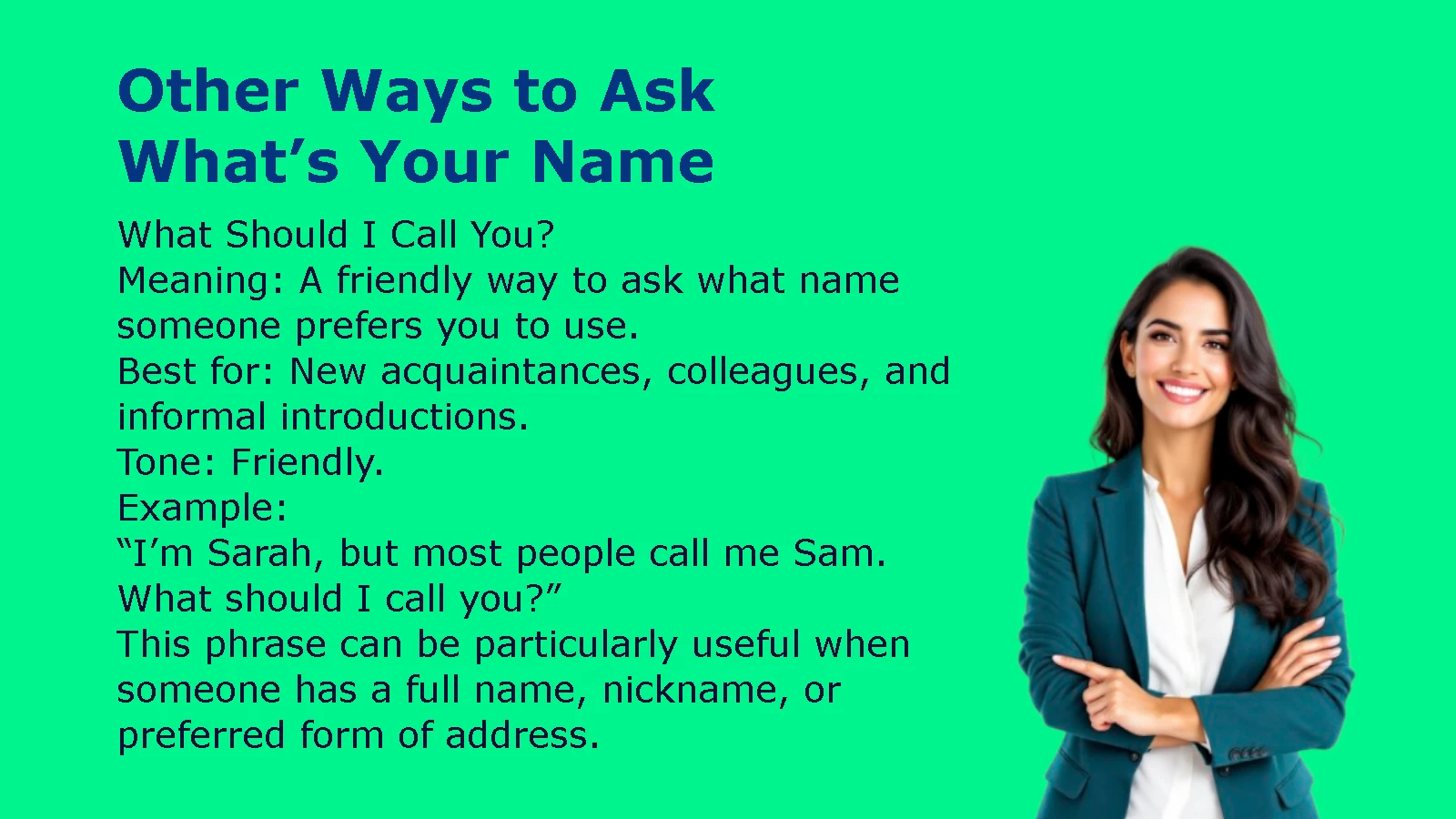
3. What Should I Call You?
Meaning: A friendly way to ask what name someone prefers you to use.
Best for: New acquaintances, colleagues, and informal introductions.
Tone: Friendly.
Example:
“I’m Sarah, but most people call me Sam. What should I call you?”
This phrase can be particularly useful when someone has a full name, nickname, or preferred form of address.
4. How Should I Address You?
Meaning: A formal question about the appropriate name or title to use when speaking to someone.
Best for: Formal professional or official situations.
Tone: Formal.
Example:
“Professor Williams, how should I address you?”
Unlike “What’s your name?”, this question may involve titles such as Dr., Professor, Mr., Ms., or another preferred form of address.
5. May I Ask Your Name?
Meaning: A courteous way to ask someone’s name.
Best for: Polite introductions and situations where you want to sound respectful.
Tone: Polite.
Example:
“May I ask your name? I don’t believe we’ve met before.”
The wording feels natural when you are meeting someone for the first time.
6. Who Am I Speaking With?
Meaning: A polite way to identify the person you’re talking to.
Best for: Phone calls, customer service, business conversations, and professional settings.
Tone: Professional.
Example:
“I’m sorry, the connection is poor. Who am I speaking with?”
This expression is more appropriate for conversations where you don’t already know the person’s identity.
7. Could I Get Your Name?
Meaning: A polite request for someone’s name.
Best for: Workplaces, stores, appointments, and service situations.
Tone: Polite and professional.
Example:
“Before I schedule the appointment, could I get your name?”
In customer service, this can sound natural and efficient.
8. And Your Name Is?
Meaning: A way to ask someone to confirm or provide their name.
Best for: Introductions, professional situations, or when you’ve already provided your own name.
Tone: Neutral.
Example:
“I’m Michael from the sales team. And your name is?”
The phrase often works as a natural follow-up after introducing yourself.
9. What Can I Call You?
Meaning: A friendly question about what name someone prefers.
Best for: Casual conversations and new acquaintances.
Tone: Friendly and casual.
Example:
“Your full name is beautiful, but what can I call you?”
This sounds warmer than simply asking for someone’s name.
10. How May I Address You?
Meaning: A formal way to ask how someone prefers to be addressed.
Best for: Official, academic, or highly formal settings.
Tone: Formal.
Example:
“Before we begin the interview, how may I address you?”
It can be more formal than most everyday situations require, so use it when the setting calls for extra courtesy.
11. Would You Mind Telling Me Your Name?
Meaning: A very polite request for someone’s name.
Best for: Formal or particularly courteous interactions.
Tone: Polite and formal.
Example:
“Would you mind telling me your name so I can add it to the guest list?”
The expression is useful when you want to make the request sound especially considerate.
12. Could You Remind Me of Your Name?
Meaning: A polite way to ask for someone’s name when you have forgotten it or can’t remember it.
Best for: People you’ve met before.
Tone: Polite and friendly.
Example:
“I’m sorry, could you remind me of your name?”
This is better than “What’s your name?” when you’ve already met the person.
13. I Don’t Think We’ve Met. What’s Your Name?
Meaning: A natural way to introduce yourself to someone you haven’t met.
Best for: Parties, social events, workplaces, and gatherings.
Tone: Friendly.
Example:
“I don’t think we’ve met. What’s your name?”
Starting with the observation that you haven’t met makes the question feel more conversational.
14. I Don’t Believe We’ve Met. May I Ask Your Name?
Meaning: A polite introduction that acknowledges you haven’t met before.
Best for: Professional events, conferences, and formal social settings.
Tone: Formal and polite.
Example:
“I don’t believe we’ve met. May I ask your name?”
This is a good option when “What’s your name?” feels too abrupt for the situation.
15. Can I Get Your Name?
Meaning: A casual way to ask someone for their name.
Best for: Everyday interactions, service situations, and informal workplaces.
Tone: Casual.
Example:
“Can I get your name so I can put you on the list?”
Although casual, the phrase is common in practical situations where you need someone’s name.
16. Who Should I Say Is Calling?
Meaning: A professional way to ask for the caller’s name.
Best for: Receptionists, offices, phone calls, and business settings.
Tone: Professional.
Example:
“Certainly. Who should I say is calling?”
This isn’t a general substitute for “What’s your name?” because it specifically fits telephone conversations.
17. May I Know Your Name?
Meaning: A polite request for someone’s name.
Best for: Formal or polite interactions.
Tone: Polite.
Example:
“May I know your name before we begin?”
The expression is understandable in American English, although “May I have your name?” or “May I ask your name?” will often sound more natural in everyday US English.
18. What Name Do You Go By?
Meaning: A question about the name someone uses or prefers.
Best for: Learning someone’s name or nickname.
Tone: Friendly and neutral.
Example:
“Your name is Alexandra, but what name do you go by?”
This is useful when someone may use a shortened name or nickname.
19. What Do People Call You?
Meaning: A casual way to ask about someone’s usual or name.
Best for: Friendly introductions.
Tone: Casual and friendly.
Example:
“Is it Alexander or Alex? What do people call you?”
The question focuses more on the name the person normally uses than on their legal or full name.
20. How Do I Address You?
Meaning: A question about the appropriate name or title to use.
Best for: Formal professional or academic situations.
Tone: Formal.
Example:
“I want to make sure I address you correctly. How do I address you?”
This is particularly useful when you’re unsure whether someone prefers a title or first name.
21. Could I Ask Who You Are?
Meaning: A direct request for someone’s identity.
Best for: Situations where you don’t recognize someone or need clarification about their identity.
Tone: Neutral to direct.
Example:
“I’m sorry, could I ask who you are?”
Be careful with this one. In some situations, “Who are you?” or similar wording can sound confrontational. Context and tone matter.
22. Could You Introduce Yourself?
Meaning: A request for someone to give their name and usually a little information about themselves.
Best for: Meetings, classes, presentations, interviews, and groups.
Tone: Professional or neutral.
Example:
“Before we start the workshop, could you introduce yourself?”
This goes beyond simply asking for someone’s name, so it isn’t an exact replacement in every situation.
23. Would You Introduce Yourself?
Meaning: A polite request for someone to say who they are.
Best for: Formal meetings, groups, classrooms, and organized events.
Tone: Formal.
Example:
“Would you introduce yourself to the rest of the group?”
Because it usually invites more than a name, this expression is best when you want a brief introduction.
24. Tell Me Your Name
Meaning: A direct request for someone’s name.
Best for: Situations where a straightforward command or request is appropriate.
Tone: Direct.
Example:
“Tell me your name, and I’ll add you to the list.”
In everyday American English, this can sound more forceful than “What’s your name?” or “Could you tell me your name?” Use it carefully.
25. Your Name, Please?
Meaning: A very brief request for someone’s name.
Best for: Forms, appointments, customer service, and situations where brevity is useful.
Tone: Direct and polite depending on delivery.
Example:
“Your name, please?”
A friendly tone makes this sound perfectly natural. Without the right tone, however, it can feel abrupt.
26. Who Are You?
Meaning: A direct question asking someone to identify themselves.
Best for: Situations where you genuinely don’t know who someone is.
Tone: Direct and potentially confrontational.
Example:
“I’m sorry, who are you?”
Although this technically asks for someone’s identity, it is not usually the best polite alternative to “What’s your name?” In most introductions, choose a softer expression instead.
27. Could You Introduce Yourself to Me?
Meaning: A polite request for someone to give their name and briefly explain who they are.
Best for: Professional meetings, group settings, interviews, and organized introductions.
Tone: Polite and professional.
Example:
“Before we discuss the project, could you introduce yourself to me?”
This works best when you want more information than just the person’s name.
Polite Ways to Ask Someone’s Name
When meeting someone for the first time, politeness often comes from the wording around the question rather than the question itself.
Instead of asking:
“What’s your name?”
you can soften it with:
- May I ask your name?
- Could you tell me your name?
- May I have your name?
- Would you mind telling me your name?
- I don’t think we’ve met. May I ask your name?
For example, at a professional event, you might say:
“Hi, I’m Emma. I don’t think we’ve met. May I ask your name?”
That sounds natural because you introduce yourself first and then invite the other person to share their name.
Professional Ways to Ask What’s Your Name
In a workplace, business meeting, conference, or phone call, context matters.
If you’re meeting someone face to face, try:
“May I have your name?”
Or:
“I don’t believe we’ve met. Could you tell me your name?”
During a phone call, “Who am I speaking with?” is more appropriate.
For a business reception:
“Good evening. May I ask your name?”
Meanwhile, if you’re leading a meeting, “Could you introduce yourself?” may be better because you may want the person’s role as well as their name.
Formal Ways to Ask Someone’s Name
For a formal setting, these expressions are particularly useful:
- May I ask your name?
- May I have your name?
- Would you mind telling me your name?
- How should I address you?
- How may I address you?
- I don’t believe we’ve met. May I ask your name?
- Would you introduce yourself?
A formal phrase doesn’t need to sound complicated. In fact, “May I ask your name?” is often more natural than an overly elaborate question.
Casual Ways to Ask Someone’s Name
When you’re meeting someone at a party, club, social event, or gathering, you can keep things simple:
- What’s your name?
- What should I call you?
- What can I call you?
- What do people call you?
- What name do you go by?
- Who are you? only when the context makes it appropriate.
For instance:
“Hey, I don’t think we’ve met. What should I call you?”
That feels relaxed and conversational without sounding overly formal.
Ways to Ask Someone’s Name at Work
A workplace introduction doesn’t always require a formal phrase. The best wording depends on your role and the situation.
If you’re meeting a coworker:
“Hi, I don’t think we’ve met. What’s your name?”
For a client:
“Good morning. May I have your name?”
When answering the phone:
“Certainly. Who am I speaking with?”
At a meeting:
“Could you introduce yourself to the group?”
If you’ve forgotten someone’s name:
“I’m sorry, could you remind me of your name?”
Each version fits a slightly different situation, which is why choosing the exact phrase matters more than simply finding a synonym.
Ways to Ask Someone’s Name Without Saying “What’s Your Name?”
If you’re trying to avoid the exact phrase “What’s your name?”, these are among the most natural choices:
- May I ask your name?
- May I have your name?
- Could you tell me your name?
- What should I call you?
- What can I call you?
- How should I address you?
- Who am I speaking with?
- Could you introduce yourself?
- What name do you go by?
- What do people call you?
The strongest choice depends on what you actually need. If you simply want someone’s name, “May I ask your name?” is straightforward. If you want to know their name, “What should I call you?” is better.
How to Choose the Right Alternative
Use the situation to guide your choice rather than trying to make the question sound unnecessarily sophisticated.
| Phrase | Tone | Best For | Example |
| May I ask your name? | Polite | First meetings | “May I ask your name?” |
| May I have your name? | Polite | Business and service | “May I have your name?” |
| Could you tell me your name? | Neutral | General introductions | “Could you tell me your name?” |
| What should I call you? | Friendly | New acquaintances | “What should I call you?” |
| What can I call you? | Casual | Informal conversations | “What can I call you?” |
| How should I address you? | Formal | Official settings | “How should I address you?” |
| Who am I speaking with? | Professional | Phone calls | “Who am I speaking with?” |
| Could you introduce yourself? | Professional | Meetings and groups | “Could you introduce yourself?” |
| What name do you go by? | Friendly | names | “What name do you go by?” |
| Could you remind me of your name? | Polite | Forgotten names | “Could you remind me of your name?” |
| Your name, please? | Direct | Service situations | “Your name, please?” |
| Who are you? | Direct | Identifying someone | “Sorry, who are you?” |
Common Questions
What is another way to ask “What’s your name?”
You can say “May I ask your name?”, “May I have your name?”, “Could you tell me your name?”, “What should I call you?”, or “What can I call you?”
What is a polite way to ask someone’s name?
“May I ask your name?” and “Could you tell me your name?” are natural polite choices. For a professional setting, “May I have your name?” also works well.
How do you ask someone’s name professionally?
Try “May I have your name?”, “May I ask your name?”, or “Who am I speaking with?” for a phone conversation. If you’re in a meeting, “Could you introduce yourself?” may be more appropriate.
What is a casual way to ask someone’s name?
You can simply say “What’s your name?”, “What should I call you?”, or “What can I call you?” These work naturally in informal conversations.
How do you ask someone’s name without being awkward?
A simple introduction can make the question feel more natural. For example:
“Hi, I’m James. I don’t think we’ve met. What’s your name?”
Alternatively, you can say:
“Nice to meet you. May I ask your name?”
What can I say instead of “What’s your name?” in an email?
For professional communication, “May I have your name?” or “Could you please provide your name?” may work. However, if you’re asking someone you’ve already been corresponding with, you may not need to ask for their name at all.
Is “What should I call you?” polite?
Yes. “What should I call you?” is generally friendly and polite. It can be especially useful when you want to know someone’s name rather than simply their full name.
Is “Who are you?” rude?
It can sound rude or confrontational in an ordinary introduction. If you’re meeting someone for the first time, “May I ask your name?” or “Could you introduce yourself?” is usually a better choice.
What is the most formal way to ask someone’s name?
“How may I address you?” is highly formal, especially when you’re asking about the appropriate title or form of address. For most professional situations, however, “May I ask your name?” sounds more natural.
Final Thoughts
There are many other ways to ask what’s your name, but the best phrase depends on the setting.
For a polite introduction, use “May I ask your name?” or “Could you tell me your name?”. In a casual conversation, “What should I call you?” sounds friendly and natural. At work, “May I have your name?” or “Who am I speaking with?” can fit better depending on the situation.
Most importantly, don’t overcomplicate a simple question. A natural “Hi, I don’t think we’ve met. What’s your name?” will often sound better than a formal phrase that doesn’t match the situation.













