Other ways to say be confident include “trust your abilities,” “speak with conviction,” “own the room,” and “back yourself.” These alternatives turn general encouragement into specific advice that helps someone handle a job interview, lead a meeting, deliver a speech, or face a personal challenge.
The best phrase depends on the situation. Professional confidence calls for language that emphasizes expertise and credibility, while public speaking confidence focuses on clear delivery, composure, and presence. When you encourage a friend or child, warmer expressions such as believe in yourself or own your magic may feel more natural.
Understanding these differences helps you choose words that motivate people without sounding pushy, vague, or unrealistic. Below, you’ll find practical synonyms for be confident, professional alternatives, casual expressions, example sentences, and advice on building genuine self-assurance.
What Are the Best Other Ways to Say Be Confident?
The best alternative to “be confident” is one that tells someone what confidence looks like in a particular situation. “Trust your preparation” works before an interview, “speak with conviction” suits a presentation, and “back yourself” encourages someone to take a personal or professional risk.
Here are some useful alternatives at a glance:
| Alternative phrase | Tone | Best situation |
| Trust your abilities | Supportive | Interviews, exams, new challenges |
| Stand tall in your expertise | Professional | Leadership and career development |
| Project professional authority | Formal | Client meetings and presentations |
| Own the room | Energetic | Public speaking and networking |
| Speak with conviction | Direct | Persuasive communication |
| Believe in yourself | Warm | Personal challenges and encouragement |
| Back yourself | Casual | Decisions and career changes |
| Stay poised under pressure | Reassuring | Difficult conversations |
| Assert your perspective | Professional | Team meetings and discussions |
| Own your magic | Playful | Friends, creativity, and personal growth |
| Trust your judgment | Practical | Decision-making |
| Take up space | Empowering | Group discussions and leadership |
Each expression communicates confidence differently. Some encourage inner belief, others focus on visible behavior, and a few help people communicate their opinions without hesitation.
For example, telling a nervous colleague to “be confident” gives them little direction. Saying, “Trust your preparation and explain your recommendation clearly,” gives them two actions they can take immediately.
Professional Alternatives to Say Be Confident at Work
Professional alternatives to “be confident” should communicate competence, self-assurance, and credibility without encouraging arrogance. The right phrase can help an employee speak up, prepare for an interview, present an idea, or take responsibility for a decision.
Use these expressions when communicating with colleagues, managers, employees, clients, or job candidates.
Stand Tall in Your Expertise
“Stand tall in your expertise” reminds someone to recognize the knowledge and experience they already possess. It works particularly well when a qualified person doubts themselves before an important professional moment.
The phrase combines a physical image with a mental reminder. Standing tall suggests composure, while expertise points to a foundation of real knowledge.
Example sentences:
- “You’ve spent months preparing this proposal, so stand tall in your expertise.”
- “You understand the project better than anyone in the room. Trust that experience and stand tall in your expertise.”
- “As you step into your new leadership role, remember to stand tall in your expertise.”
Best for: Job interviews, promotion discussions, client pitches, and leadership coaching.
Why it works: It connects confidence to preparation rather than empty self-praise. The person has a reason to believe in their abilities.
Project Professional Authority
“Project professional authority” encourages someone to communicate competence through their words, tone, preparation, and behavior. It suits formal situations where others need to understand a person’s credibility.
However, authority doesn’t mean acting superior. A confident professional can explain a recommendation clearly, listen to objections, and acknowledge uncertainty when necessary.
Example sentences:
- “When you present the quarterly results, project professional authority by explaining the figures clearly.”
- “You know the client requirements well, so project professional authority during the discussion.”
- “Keep your message concise and project professional authority without dismissing other opinions.”
Best for: Executive meetings, business presentations, negotiations, and client communications.
Practical tip: Replace vague qualifiers with precise statements when the evidence supports them. Instead of saying, “I kind of think this approach might work,” try, “The results suggest this approach will improve the process.”
That small adjustment makes the message clearer without requiring an artificial change in personality.
Trust Your Capabilities
“Trust your capabilities” is a warm, professional way to encourage self-belief. It reminds someone that their existing skills, training, and experience can help them manage a challenge.
Unlike expressions that focus on appearance, this phrase directs attention toward competence.
Example sentences:
- “You’ve handled similar projects successfully. Trust your capabilities as you take on this one.”
- “Don’t let one difficult meeting undermine your progress. Trust your capabilities and keep learning.”
- “You have the technical knowledge for this role, so trust your capabilities during the interview.”
Best for: Mentoring, career development, performance reviews, and unfamiliar assignments.
This phrase works especially well when you can identify specific strengths. For example, “Trust your capabilities—you’ve already led two successful launches” offers more meaningful encouragement than a general compliment.
Assert Your Perspective
“Assert your perspective” means expressing your viewpoint clearly and confidently. It encourages someone to contribute without apologizing for having an opinion.
The word assert doesn’t mean dominating a conversation. Assertiveness allows you to communicate your needs and ideas while respecting other people’s rights to disagree.
Example sentences:
- “You have valuable insights, so assert your perspective during tomorrow’s meeting.”
- “Don’t hesitate to assert your perspective when the team discusses the project timeline.”
- “You’ve reviewed the evidence carefully. Assert your perspective and explain your reasoning.”
Best for: Team meetings, brainstorming sessions, negotiations, and workplace discussions.
Try this: Encourage a quieter colleague to prepare one key point before a meeting. Having a clear contribution in mind can make it easier to speak when an opportunity arises.
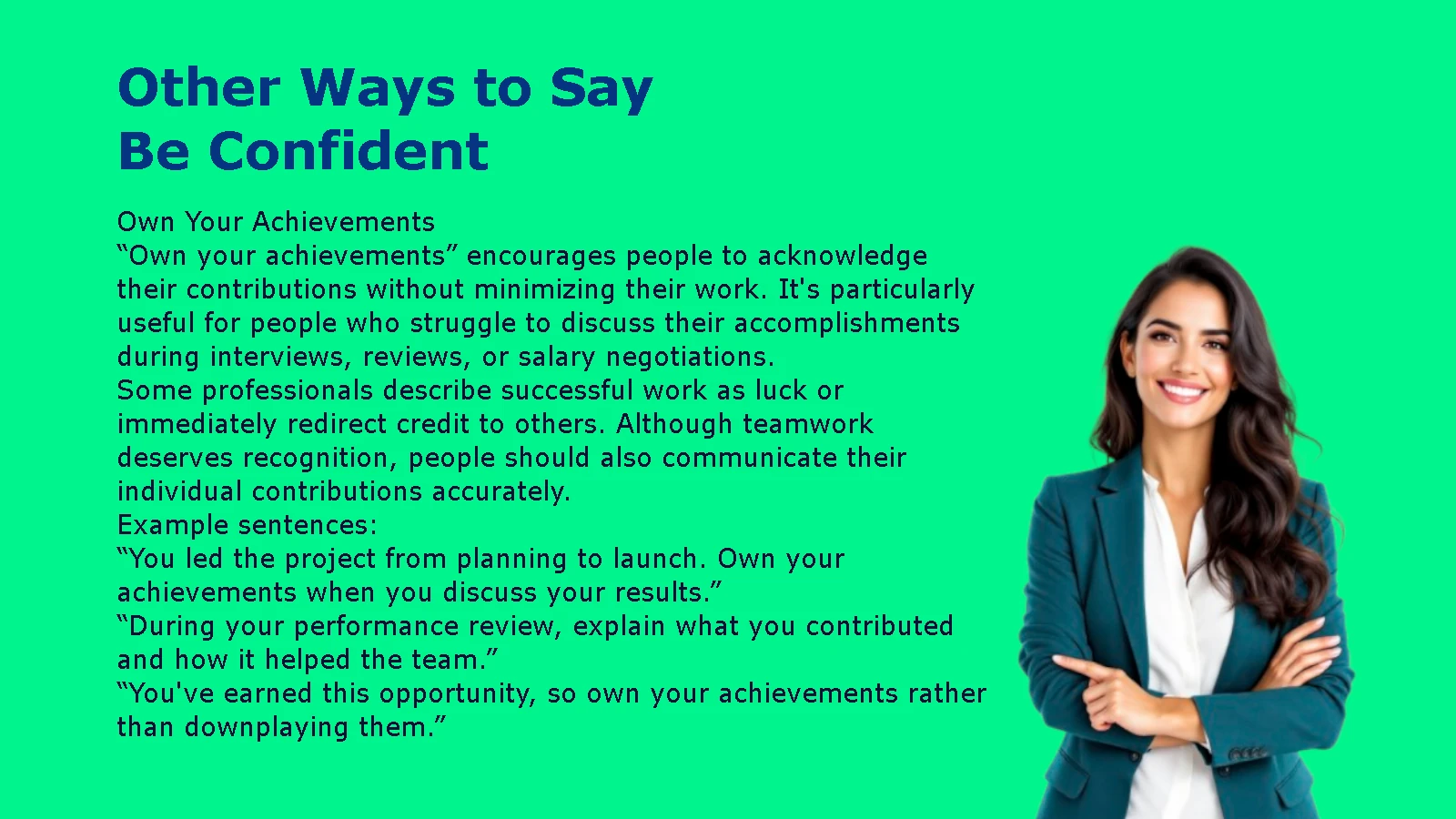
Own Your Achievements
“Own your achievements” encourages people to acknowledge their contributions without minimizing their work. It’s particularly useful for people who struggle to discuss their accomplishments during interviews, reviews, or salary negotiations.
Some professionals describe successful work as luck or immediately redirect credit to others. Although teamwork deserves recognition, people should also communicate their individual contributions accurately.
Example sentences:
- “You led the project from planning to launch. Own your achievements when you discuss your results.”
- “During your performance review, explain what you contributed and how it helped the team.”
- “You’ve earned this opportunity, so own your achievements rather than downplaying them.”
Best for: Performance reviews, interviews, promotion requests, and professional biographies.
A useful formula is to describe the action, the contribution, and the result. For instance: “I reorganized the onboarding process, which reduced repeated questions and helped new employees get started faster.”
That statement demonstrates confidence through evidence.
Powerful Synonyms for Be Confident in Public Speaking
When encouraging a speaker, choose phrases that emphasize stage presence, vocal delivery, composure, and audience engagement. Instead of telling someone to feel confident, give them a clear communication goal they can practice before stepping onto the stage.
These alternatives work for conferences, classroom presentations, wedding speeches, panel discussions, and professional seminars.
Own the Room
“Own the room” means entering a space with confidence and engaging the audience through purposeful communication. It doesn’t mean demanding attention or acting as though everyone else is unimportant.
A speaker owns the room by understanding the message, connecting with listeners, and communicating with presence.
Example sentences:
- “You’ve practiced your opening several times. Take a breath, look at the audience, and own the room.”
- “Your story is compelling, so trust your preparation and own the room.”
- “Walk onto the stage with purpose, pause before you begin, and own the room.”
Best for: Keynote speeches, conferences, presentations, and important introductions.
How to apply it: Start with a deliberate pause rather than rushing into your first sentence. Look toward the audience, settle into a comfortable stance, and begin at a pace that allows people to follow your message.
These behaviors give the speaker something practical to focus on instead of worrying about how everyone perceives them.
Speak With Conviction
“Speak with conviction” means expressing a message clearly and firmly because you believe in what you’re saying. It emphasizes vocal delivery and word choice rather than physical appearance alone.
Conviction doesn’t require a loud voice. A quiet speaker can sound confident by choosing precise words, organizing ideas logically, and avoiding unnecessary hesitation.
Example sentences:
- “You know the research supports your recommendation, so speak with conviction.”
- “State your main argument early and speak with conviction throughout the presentation.”
- “When you explain the benefits, speak with conviction instead of apologizing for your proposal.”
Best for: Persuasive speeches, business pitches, debates, and interviews.
Compare these two statements:
- Uncertain: “I just think this might possibly be a useful option.”
- Clearer: “I recommend this option because it addresses the main problem.”
The second version communicates a definite recommendation and gives a reason. You should still express uncertainty when the evidence is incomplete, but you don’t need to weaken every statement with unnecessary qualifiers.
Command the Stage
“Command the stage” encourages a speaker to use the available space purposefully and maintain the audience’s attention. It’s a more dramatic alternative to “be confident,” making it suitable for larger events or performance-oriented presentations.
Example sentences:
- “You know the material, so command the stage and let your personality come through.”
- “Use purposeful movement, pause between major points, and command the stage.”
- “Before the awards ceremony begins, remind the host to command the stage with warmth and confidence.”
Best for: Large presentations, keynote speeches, award ceremonies, and live performances.
Practical tip: Avoid pacing continuously or making movements simply to appear confident. Move when a transition supports your message, then settle into a comfortable position when you want the audience to focus on an important point.
Stay Poised Under Pressure
“Stay poised under pressure” encourages someone to remain composed when facing unexpected questions, mistakes, or challenging circumstances.
It doesn’t mean suppressing every sign of nervousness. Instead, it suggests responding thoughtfully rather than allowing stress to control the conversation.
Example sentences:
- “If someone challenges your figures, stay poised under pressure and explain your calculations.”
- “You don’t need to answer every question instantly. Pause, think, and stay poised under pressure.”
- “Even if you lose your place, stay poised under pressure and return to your main point.”
Best for: Media interviews, live presentations, panel discussions, and difficult meetings.
A practical technique is to pause before answering an unexpected question. That brief moment gives you time to understand the question, organize your response, and avoid reacting defensively.
Warm and Casual Ways to Say Be Confident
Casual alternatives often work best when they sound personal, supportive, and natural. When you encourage a friend, child, student, or family member, emotional reassurance may matter more than formal language about competence or authority.
Choose the expression according to the person’s needs. Someone facing a new challenge may need reassurance, while a friend preparing to take a risk may appreciate a direct push.
Believe in Yourself
“Believe in yourself” encourages someone to trust their abilities and continue despite uncertainty. It’s one of the most familiar alternatives because it applies to nearly any personal challenge.
Example sentences:
- “You’ve worked hard for this opportunity. Believe in yourself and give it your best.”
- “You don’t have to know everything on your first day. Believe in yourself and stay open to learning.”
- “Whatever happens at the audition, believe in yourself and enjoy the experience.”
Best for: Exams, auditions, competitions, new jobs, and personal goals.
The phrase becomes more meaningful when you pair it with a concrete reminder. Instead of simply saying, “Believe in yourself,” try, “You’ve practiced every evening for weeks. Trust that preparation and believe in yourself.”
This approach grounds encouragement in something the person can recognize.
Own Your Magic
“Own your magic” is a playful, expressive way to encourage someone to embrace their personality, talents, and individuality. It works well in friendly conversations where formal motivational language would feel stiff.
The word magic is metaphorical. It refers to the qualities that make a person distinctive, not a literal ability.
Example sentences:
- “Your designs have a style of their own. Own your magic and share them with the world.”
- “You bring so much energy to the group. Don’t hide it—own your magic.”
- “You have a different perspective, and that’s your strength. Own your magic.”
Best for: Creative projects, personal milestones, supportive messages, and informal encouragement.
Because the expression is casual, it may feel out of place in a formal performance review or a serious workplace discussion. In those situations, “recognize your strengths” or “trust your expertise” communicates a similar idea with a more professional tone.
Keep Your Chin Up
“Keep your chin up” means remaining hopeful and resilient when things go wrong. It encourages someone not to let disappointment erase their sense of possibility.
This phrase is especially useful after a setback, although it should not replace genuine empathy when someone is struggling.
Example sentences:
- “I know the interview didn’t go as planned, but keep your chin up. You’ll learn from the experience.”
- “The first attempt was difficult. Keep your chin up and try a different approach.”
- “You worked hard for this result, and it’s understandable to feel disappointed. Keep your chin up.”
Best for: Disappointments, setbacks, difficult exams, and unsuccessful applications.
A useful distinction: “Keep your chin up” focuses on resilience, while “trust your abilities” focuses on capability. Choose the first when someone needs encouragement after a setback and the second when they doubt their skills.
Back Yourself
“Back yourself” means trusting your own judgment and supporting your decisions rather than automatically seeking approval from everyone else.
The phrase is common in British and Commonwealth English and sounds direct, friendly, and encouraging.
Example sentences:
- “You’ve done your research and built a solid plan. Back yourself.”
- “If the new role fits your goals, back yourself and apply.”
- “You have a strong proposal, so back yourself when you present it.”
Best for: Career decisions, entrepreneurship, personal challenges, and situations that require initiative.
Backing yourself doesn’t mean ignoring advice or refusing to reconsider a decision. It means evaluating the available information, listening to useful feedback, and making a choice without letting fear alone decide for you.
For example, someone considering a business venture can review the costs, test the idea, and seek advice before moving forward. They can then back themselves based on the evidence rather than blind optimism.
Remember Who You Are
“Remember who you are” is a grounding phrase that reminds someone of their values, strengths, and identity during a difficult moment.
It carries more emotional weight than a simple instruction to feel confident. Depending on the relationship and context, it can express affection, reassurance, or a reminder not to compromise personal values.
Example sentences:
- “You’ve overcome difficult challenges before. Remember who you are and what you’re capable of.”
- “Don’t let one person’s criticism make you forget your strengths. Remember who you are.”
- “As you start this new chapter, remember who you are and what matters most to you.”
Best for: Personal transitions, difficult decisions, setbacks, and emotional encouragement.
Use this phrase thoughtfully. It can sound deeply supportive when someone knows you care about them, but it may seem vague or dramatic in a routine professional conversation.
Take Up Space
“Take up space” encourages someone to participate fully instead of shrinking back, apologizing unnecessarily, or assuming their ideas matter less than everyone else’s.
In this context, the phrase refers to assertiveness, participation, and self-expression. It doesn’t mean interrupting people or monopolizing a conversation.
Example sentences:
- “Your ideas deserve consideration, so take up space in the meeting.”
- “You don’t need to apologize before every suggestion. Take up space and share your thinking.”
- “You earned your place on this panel. Take up space and contribute to the discussion.”
Best for: Group discussions, leadership development, classroom participation, and networking.
One practical way to apply this advice is to prepare a question or suggestion before entering a meeting. When a suitable opening appears, share it clearly and allow others to respond.
A Quick Comparison: Which Phrase Should You Choose?
The most effective phrase depends on what the person needs: stronger self-belief, more decisive communication, composure, or permission to participate.
Use this table when you need to choose an alternative quickly.
| Alternative phrase | Tone | Best used for | Example |
| Stand tall in your expertise | Professional | Interviews and promotions | “You know the subject well, so stand tall in your expertise.” |
| Project professional authority | Formal | Client pitches and leadership meetings | “Present your findings clearly and project professional authority.” |
| Trust your capabilities | Supportive | New responsibilities | “You’ve handled similar tasks before. Trust your capabilities.” |
| Assert your perspective | Direct | Team meetings | “You’ve considered the options carefully. Assert your perspective.” |
| Own the room | Energetic | Public speaking | “Take a breath and own the room.” |
| Speak with conviction | Persuasive | Presentations and debates | “Explain your recommendation and speak with conviction.” |
| Command the stage | Dynamic | Large events | “Use purposeful movement and command the stage.” |
| Stay poised under pressure | Reassuring | Difficult questions | “Pause before answering and stay poised under pressure.” |
| Believe in yourself | Warm | Personal challenges | “You’ve prepared well. Believe in yourself.” |
| Keep your chin up | Encouraging | Setbacks | “This result doesn’t define you. Keep your chin up.” |
| Back yourself | Casual | Decisions and risks | “You’ve weighed the options. Back yourself.” |
| Take up space | Empowering | Group discussions | “Your contribution matters. Take up space.” |
How to Choose the Right Alternative
Before choosing a phrase, ask yourself three questions:
- What does the person need? Reassurance, clear direction, recognition, or a push to act?
- What is the setting? A workplace email calls for different language than a text to a friend.
- What action should follow? The best encouragement gives the person something useful to do.
For example, if a colleague is nervous about presenting a report, “Speak with conviction” may help with delivery. If that colleague doubts the accuracy of the report despite careful preparation, “Trust your expertise” may address the real concern more directly.
The distinction matters because confidence is not a single behavior. Someone can know their subject well yet struggle to speak in front of a group. Another person may speak fluently but need more preparation to support their claims.
Match the phrase to the actual challenge instead of treating every confidence problem the same way.
What Does “Fake It Till You Make It” Mean?
“Fake it till you make it” means behaving as though you feel capable or comfortable while you develop the experience that makes those feelings more natural. In the context of confidence, it usually means practicing helpful behaviors before they feel automatic.
For example, a new employee might feel nervous when speaking during team meetings. They can prepare one useful observation, practice expressing it clearly, and contribute even while feeling anxious. Over time, repeated experience may make participation feel easier.
However, the phrase has limits. Practicing confident behavior is different from pretending to possess skills you don’t have.
How Confident Actions Can Support Self-Belief
Confidence and behavior can influence each other. When you take a manageable action despite feeling nervous, you gain an opportunity to learn that discomfort doesn’t always prevent success.
This process works best when you combine action with preparation and honest reflection.
Try these practical steps:
- Prepare in advance. Review the subject, anticipate likely questions, and organize your main points.
- Practice your opening. Rehearse the first few sentences of a presentation or introduction until you can deliver them comfortably.
- Use comfortable body language. Keep a balanced posture, look toward your listeners when appropriate, and avoid movements that distract you.
- Take small steps. Contribute one idea in a meeting before volunteering to lead a major presentation.
- Review what happened. Identify what worked, what challenged you, and what you want to change next time.
Consider a new manager who feels nervous about leading their first team meeting. Rather than waiting to feel completely confident, they prepare an agenda, practice the opening, and plan how to invite questions.
The meeting may still feel uncomfortable. Yet completing it gives the manager practical experience to draw on the next time.
This is a more useful interpretation of “fake it till you make it” than pretending to feel fearless.
Acting Confident vs. Faking Competence
The difference comes down to honesty.
| Acting confident | Faking competence |
| Speaking clearly despite nervousness | Claiming expertise you don’t possess |
| Preparing thoroughly before a presentation | Pretending you understand material you haven’t studied |
| Asking thoughtful questions | Hiding important gaps in your knowledge |
| Admitting uncertainty calmly | Inventing an answer to appear knowledgeable |
| Practicing a new skill | Misrepresenting your qualifications |
A person can communicate confidence while admitting they don’t know something.
For example, imagine a client asks a project manager for a technical detail that falls outside their expertise. The manager could invent an answer to protect their image, or they could respond:
“I want to verify that detail before giving you an accurate answer. I’ll check with our technical team and follow up.”
The second response demonstrates accountability and composure. Real professional confidence includes knowing when to ask questions, verify information, and acknowledge limits.
Does “Fake It Till You Make It” Actually Work?
It can be useful when it means practicing constructive behaviors while developing genuine skills and experience. It becomes counterproductive when it encourages deception, unrealistic claims, or ignoring meaningful weaknesses.
The goal isn’t to convince everyone that you never feel nervous. It’s to become capable of taking appropriate action even when nerves appear.
A helpful alternative is to act on your preparation, not on your fear. You don’t need to feel perfectly confident before you begin. You need a reasonable plan, an honest understanding of your abilities, and a willingness to learn from the experience.
How to Encourage Someone to Be More Confident Without Sounding Pushy
Sometimes, the phrase matters less than the way you deliver it. Telling a nervous person to “be confident” may unintentionally suggest that their anxiety is a problem they should simply switch off.
More thoughtful encouragement acknowledges the challenge and offers specific support.
Use Specific, Supportive Language
Instead of giving a broad instruction, connect your encouragement to the person’s strengths or next action.
| Instead of saying | Try saying |
| “Just be confident.” | “You’ve prepared well. Trust the work you’ve done.” |
| “Stop doubting yourself.” | “It’s understandable to feel uncertain. Let’s look at what you already know.” |
| “You need to speak up more.” | “I’d like to hear your ideas more often because your perspective adds value.” |
| “Don’t be nervous.” | “Take your time. You don’t have to rush your answer.” |
| “Act like you know what you’re doing.” | “Focus on what you’ve learned, and ask questions when you need clarification.” |
| “You can do anything.” | “You have the skills to take this next step, and we can work through the difficult parts.” |
These alternatives recognize the person without demanding that they immediately change how they feel.
A Workplace Example
Imagine a talented employee who rarely shares ideas during meetings. Their manager wants to encourage more participation.
A vague instruction such as “You need to be more confident” identifies a perceived problem but offers no clear path forward.
A more useful response would be:
“I appreciate the thought you put into your work. Your analysis often raises points the team should consider, and I’d like to hear your perspective during our discussions. Would you be comfortable sharing one of your recommendations at the next meeting?”
This approach does three things:
- Recognizes a specific strength.
- Explains the behavior the manager would like to see.
- Offers a manageable next step.
It also leaves room for the employee to explain whether they need more preparation, clearer meeting expectations, or another form of support.
The lesson: Good encouragement helps people recognize their abilities and gives them a realistic opportunity to use those abilities.
Conclusion: Choose Words That Help Confidence Grow
The best other ways to say be confident depend on the situation and the person you’re encouraging. “Trust your capabilities” works well in professional development, “speak with conviction” supports persuasive communication, and “back yourself” gives someone a direct push to trust their judgment.
For public speaking, try “own the room” or “stay poised under pressure.” When encouraging a friend or child, “believe in yourself,” “keep your chin up,” and “remember who you are” can sound more personal and reassuring.
Remember that confidence doesn’t require constant certainty. It grows through preparation, practice, honest feedback, and the willingness to take reasonable action when a challenge feels unfamiliar.
Your next step: Choose one phrase that fits a situation you’re facing this week. Pair it with a concrete action, such as practicing your opening statement, sharing an idea in a meeting, or asking a question you’ve been holding back. Specific encouragement becomes more powerful when you put it into practice.
Frequently Asked Questions
What Is a Single-Word Synonym for “Be Confident”?
Useful single-word alternatives include assured, poised, assertive, and self-assured, depending on the context. “Poised” emphasizes composure, “assertive” emphasizes expressing yourself clearly, and “self-assured” describes someone who trusts their own abilities and judgment.
Because “confident” is an adjective, you can also say “be assertive,” “remain poised,” or “feel assured” when you need a natural replacement for the full phrase.
How Do You Politely Tell an Employee to Be More Confident?
Encourage the employee to share their ideas and recognize the value of their expertise. For example: “I’d like to hear your insights more often because your perspective brings value to the team. Please feel comfortable sharing your recommendations during our discussions.”
This wording identifies a positive contribution and invites a specific behavior without criticizing the employee’s personality.
What Is a Professional Way to Say “Believe in Yourself”?
Professional alternatives include trust your judgment, have confidence in your abilities, rely on your preparation, and recognize your expertise.
For example, before an important presentation, you could say, “You’ve reviewed the evidence and prepared a clear recommendation. Trust your judgment and explain your reasoning.”
What Does “Speak With Conviction” Mean?
To speak with conviction means communicating clearly and firmly in a way that reflects genuine belief in your message. It involves choosing precise words, organizing your ideas, and delivering your points without unnecessary hesitation.
Conviction doesn’t require aggression or absolute certainty. A person can speak confidently while acknowledging limitations or explaining that more information is needed.
Is “Own the Room” Appropriate in a Professional Setting?
Yes. Own the room suits presentations, conferences, networking events, and leadership situations where presence and audience engagement matter. It has an energetic, informal tone, so it may not fit every corporate email or formal document.
For a more restrained alternative, use “project professional authority,” “communicate with confidence,” or “present your ideas clearly.”
Does “Fake It Till You Make It” Actually Work?
It can help when it means practicing confident behaviors while building genuine skills and experience. Preparing carefully, speaking up in manageable situations, and learning from each attempt can make unfamiliar tasks feel more comfortable over time.
However, the expression shouldn’t encourage you to lie about your qualifications or hide important gaps in your knowledge. Build confidence through action, preparation, and honest self-assessment.













