Looking for other ways to say “have fun”? The best alternatives include “enjoy yourself,” “have a great time,” “have a wonderful time,” “have a blast,” and “make the most of it.” Each phrase carries a slightly different tone, so the right choice depends on who you’re talking to, what they’re doing, and how casual or professional you want to sound.
“Have fun” is already one of the most natural ways to wish someone an enjoyable experience. Cambridge Dictionary defines it as “to enjoy yourself.”
Still, repeating the same phrase can get dull. You might also need something warmer for a close friend, more polished for a coworker, or more enthusiastic before an exciting trip.
This guide covers 35 natural alternatives to “have fun” and explains exactly when to use each one. You’ll find options for friends, family, coworkers, bosses, customers, clients, emails, text messages, parties, vacations, dates, concerts, and everyday conversations.
Quick Answer: The Best Alternatives to “Have Fun”
| Alternative | Tone | Formality | Best For | Example |
| Enjoy yourself | Warm, friendly | Neutral | Most situations | “Enjoy yourself at the party!” |
| Have a great time | Friendly | Neutral | Events and outings | “Have a great time tonight!” |
| Have a wonderful time | Warm | Neutral | Special occasions | “Have a wonderful time on your trip.” |
| Have an amazing time | Enthusiastic | Neutral | Exciting plans | “Have an amazing time in Miami!” |
| Have a good time | Relaxed | Neutral | Everyday situations | “Have a good time at the concert.” |
| Have a blast | Energetic | Casual | Parties and concerts | “Have a blast tonight!” |
| Make the most of it | Encouraging | Neutral | Trips and opportunities | “Make the most of your vacation.” |
| Enjoy every moment | Warm | Neutral | Special experiences | “Enjoy every moment of your trip.” |
| Enjoy the experience | Polished | Semi-formal | Events and activities | “Enjoy the experience!” |
| Live it up | Playful | Casual | Celebrations | “Live it up this weekend!” |
Other Ways to Say “Have Fun”
Not every alternative has exactly the same meaning. Some emphasize enjoyment, while others add excitement, encouragement, warmth, or humor.
Enjoy Yourself
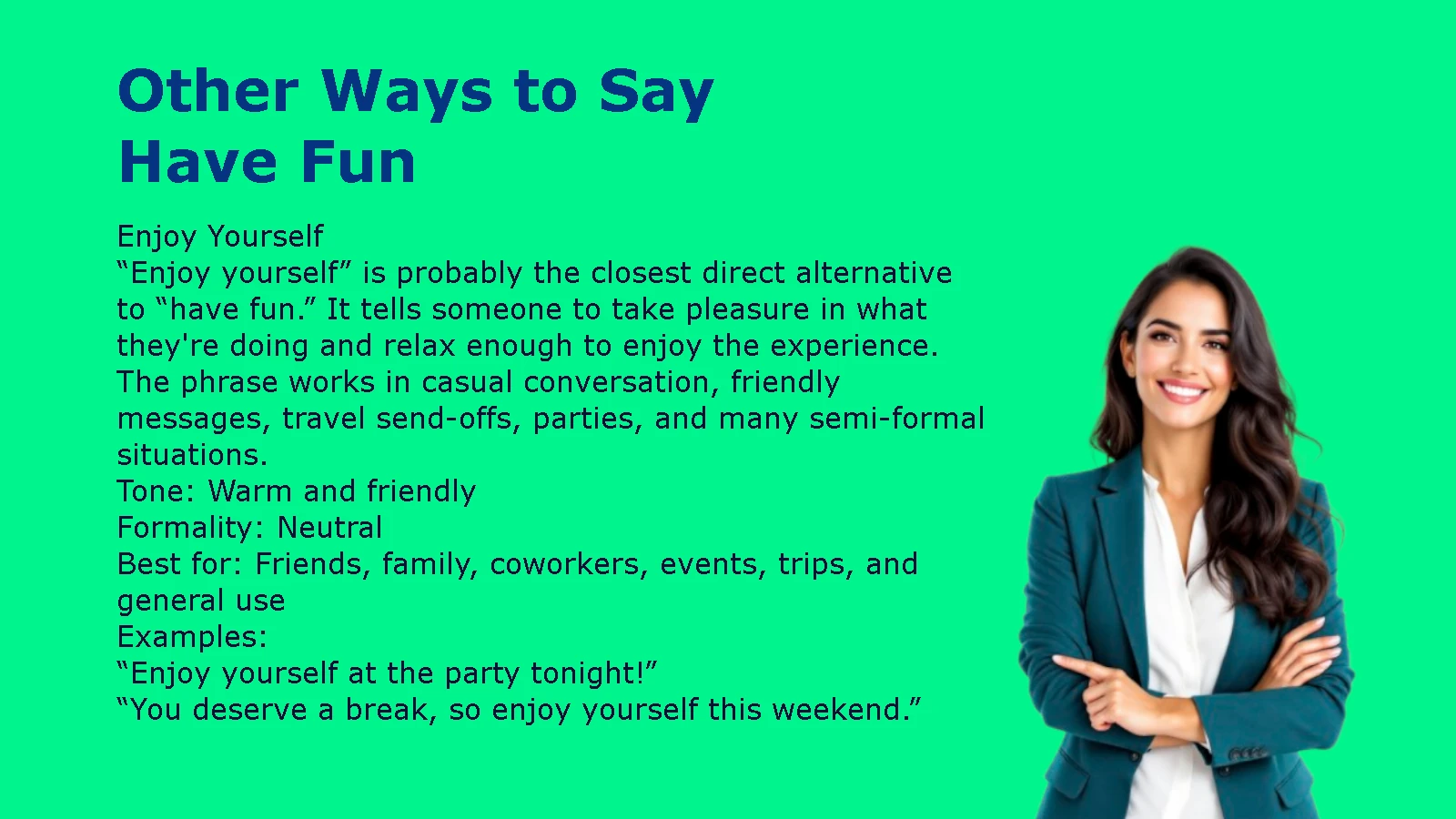
“Enjoy yourself” is probably the closest direct alternative to “have fun.” It tells someone to take pleasure in what they’re doing and relax enough to enjoy the experience.
The phrase works in casual conversation, friendly messages, travel send-offs, parties, and many semi-formal situations.
Tone: Warm and friendly
Formality: Neutral
Best for: Friends, family, coworkers, events, trips, and general use
Examples:
- “Enjoy yourself at the party tonight!”
- “You deserve a break, so enjoy yourself this weekend.”
- “Enjoy yourself while you’re in Chicago.”
- “I hope you enjoy yourself at the wedding.”
Unlike some slang expressions, “enjoy yourself” doesn’t sound overly casual. That’s what makes it such a reliable choice.
Have a Great Time
“Have a great time” is one of the most versatile alternatives to “have fun.” It works before almost any enjoyable activity.
You can say it to a friend going to a concert, a coworker attending a party, or a family member leaving for vacation.
Tone: Friendly and positive
Formality: Neutral
Best for: Almost any situation
Examples:
- “Have a great time at the concert!”
- “Have a great time on your vacation.”
- “Have a great time with your friends tonight.”
- “I hope you have a great time at the conference.”
If you’re unsure which expression to choose, this is one of the safest options.
Have a Wonderful Time
“Have a wonderful time” adds a little more warmth than “have fun.”
It works particularly well for weddings, vacations, birthdays, anniversaries, dinners, and other occasions that feel special.
Examples:
- “Have a wonderful time at the wedding!”
- “I hope you have a wonderful time in Italy.”
- “Have a wonderful time with your family.”
- “Wishing you a wonderful time at the celebration.”
It sounds friendly without becoming overly formal.
Have an Amazing Time
Use “have an amazing time” when you want to sound enthusiastic.
The word “amazing” raises the energy level. It suggests that you expect the experience to be especially memorable.
Examples:
- “Have an amazing time at the festival!”
- “I hope you have an amazing time in New York.”
- “Have an amazing time on your first day of vacation.”
This expression works especially well in texts and social conversations.
Have a Good Time
Sometimes the simplest option is the best one.
“Have a good time” is natural, relaxed, and easy to use. It can refer to almost any enjoyable activity.
Examples:
- “Have a good time tonight!”
- “Have a good time at the game.”
- “You guys have a good time.”
- “I hope you have a good time on your trip.”
It’s slightly less enthusiastic than “have an amazing time,” but that can actually make it sound more natural in everyday conversation.
Enjoy the Experience
“Enjoy the experience” sounds more polished and specific than “have fun.”
It’s especially useful when someone is trying something new, attending an event, traveling, taking a course, or participating in an activity.
Examples:
- “Enjoy the experience and take plenty of pictures.”
- “I hope you enjoy the experience.”
- “Enjoy the experience of exploring the city.”
- “You’ll learn a lot, so enjoy the experience.”
This phrase fits professional communication better than slang such as “have a blast.”
Make the Most of It
“Make the most of it” doesn’t simply mean “have fun.” It encourages someone to get as much enjoyment or value as possible from an experience.
That subtle difference makes it useful for vacations, opportunities, trips, conferences, and special occasions.
Examples:
- “You’re only there for three days, so make the most of it!”
- “Make the most of your vacation.”
- “This is a great opportunity. Make the most of it.”
- “Enjoy the conference and make the most of your time there.”
It carries a slightly more thoughtful tone than “have fun.”
Enjoy Every Moment
“Enjoy every moment” sounds warm, thoughtful, and encouraging.
It’s particularly effective when someone is experiencing something memorable, such as a vacation, wedding, graduation, honeymoon, or major celebration.
Examples:
- “Enjoy every moment of your vacation.”
- “You worked hard for this trip. Enjoy every moment.”
- “Enjoy every moment with your family.”
- “Have a wonderful wedding and enjoy every moment.”
Have a Blast
If “have fun” feels too plain, “have a blast” adds energy.
This is a distinctly casual expression. It works beautifully for parties, concerts, festivals, road trips, birthdays, and nights out.
Examples:
- “Have a blast at the concert!”
- “You guys are going to have a blast.”
- “Have a blast this weekend!”
- “I hope you have a blast at the party.”
Avoid it in highly formal business communication. A client email probably isn’t the place to write, “Have a blast at the conference!”
Have a Great One
“Have a great one” is short, casual, and conversational.
The word “one” gets its meaning from context. It might refer to a day, evening, weekend, trip, or general experience.
Examples:
- “Enjoy the concert. Have a great one!”
- “Thanks for stopping by. Have a great one!”
- “Have a great one this weekend.”
It’s especially common in casual spoken American English.
Enjoy!
“Enjoy!” is one of the shortest alternatives available.
It’s common when the activity or experience is already obvious.
For example, if someone tells you they’re heading to a concert, you can simply say, “Enjoy!”
You can also say:
- “Enjoy the show!”
- “Enjoy your trip!”
- “Enjoy the weekend!”
- “Enjoy your dinner!”
In formal writing, specifying what the person should enjoy often sounds more polished. In conversation, however, “Enjoy!” is perfectly natural.
Have an Awesome Time
“Have an awesome time” is upbeat, casual, and enthusiastic.
It’s especially natural in texts between friends.
Examples:
- “Have an awesome time at the beach!”
- “Hope you have an awesome time tonight.”
- “Have an awesome time on your trip!”
It’s less suitable for highly formal situations because “awesome” is strongly conversational.
Hope You Have a Great Time
This version sounds a little more personal because you’re expressing a direct hope for the person’s experience.
Examples:
- “Hope you have a great time tonight!”
- “Hope you have a great time on your vacation.”
- “I hope you have a great time at the party.”
It’s excellent for text messages, cards, emails, and social conversations.
Hope You Have an Amazing Time
This takes the previous expression and adds more enthusiasm.
It’s especially useful when you genuinely want to emphasize excitement.
Example:
“You’re finally heading to Hawaii! Hope you have an amazing time.”
Enjoy Your Time
“Enjoy your time” works when someone is spending a period of time somewhere or doing something.
Examples:
- “Enjoy your time in Boston.”
- “Enjoy your time with your family.”
- “Enjoy your time at the resort.”
It sounds more natural when the context already tells the listener what “your time” refers to.
Make Some Great Memories
This expression shifts attention from having fun to creating memorable experiences.
Examples:
- “Have a great trip and make some great memories!”
- “Enjoy the wedding and make some amazing memories.”
- “Have fun with the kids and make some great memories.”
It’s warm and sentimental without being excessively emotional.
Have an Unforgettable Time
Use “have an unforgettable time” for something you expect to be particularly special.
Examples:
- “Have an unforgettable time on your honeymoon.”
- “I hope you have an unforgettable trip.”
- “Have an unforgettable night!”
It sounds more dramatic than “have fun,” so save it for occasions that genuinely feel significant.
Casual Ways to Say “Have Fun”
Casual conversations give you much more freedom. You can use shorter phrases, slang, and playful idioms without worrying about sounding overly formal.
Go Have Some Fun
“Go have some fun” sounds like friendly encouragement.
It works well when someone has been working too much, stressing over something, or simply needs a break.
Examples:
- “You’ve been working all week. Go have some fun!”
- “Forget about work tonight. Go have some fun.”
- “Go have some fun with your friends.”
Have Tons of Fun
“Have tons of fun” is cheerful and informal.
It’s especially natural with children, close friends, and family.
Example:
“Have tons of fun at the water park!”
Live It Up
“Live it up” means to enjoy yourself fully, often during a celebration, vacation, or special occasion.
Examples:
- “You’re in Vegas now. Live it up!”
- “Live it up on your birthday!”
- “You finally have a week off, so live it up.”
It’s playful and distinctly informal.
Let Loose
“Let loose” means to relax and stop worrying about normal restrictions or responsibilities.
Examples:
- “It’s Friday. Go out and let loose!”
- “Forget about work for a while and let loose.”
- “Everyone was ready to let loose after the conference.”
This phrase doesn’t necessarily mean partying. It can simply mean relaxing and being less restrained.
Go Wild
“Go wild” is playful but stronger than “have fun.”
It suggests doing something exciting or carefree.
Examples:
- “You finally have the weekend off. Go wild!”
- “Have fun at the festival and go wild.”
- “Go wild tonight. You’ve earned it.”
Use it carefully because the phrase can imply behavior that is more extreme than simply enjoying yourself.
Paint the Town Red
“Paint the town red” is an idiom for going out and having an exciting night, usually involving entertainment, food, drinks, dancing, or socializing.
Example:
“It’s her birthday tonight, so they’re going to paint the town red.”
Don’t use it as a universal replacement for “have fun.” It specifically suggests a lively night out.
Warm and Friendly Alternatives to “Have Fun”
Sometimes you want to sound caring rather than merely cheerful.
Have the Best Time
“Have the best time” sounds enthusiastic and affectionate.
Examples:
- “Have the best time at the wedding!”
- “Have the best time on your trip.”
- “I hope you have the best time tonight.”
It’s particularly natural in texts.
Enjoy Every Minute
This is similar to “enjoy every moment,” but slightly more conversational.
Example:
“Enjoy every minute of your vacation. You deserve it!”
Have a Fantastic Time
“Have a fantastic time” is cheerful without sounding as casual as “have a blast.”
Examples:
- “Have a fantastic time at the conference.”
- “I hope you have a fantastic time with your family.”
- “Have a fantastic weekend!”
Have a Memorable Time
Use this when the goal is to emphasize a lasting experience.
Examples:
- “Have a memorable time on your trip.”
- “I hope you have a memorable evening.”
- “Have a memorable celebration!”
Professional Ways to Say “Have Fun”
The phrase “have fun” isn’t grammatically wrong in professional communication. The issue is tone.
In a relaxed workplace, telling a coworker “Have fun at the concert!” sounds completely normal. A formal client email, however, may call for something more polished.
Enjoy Yourself
This is one of the safest professional alternatives.
Example:
“I hope you enjoy yourself at the reception.”
Enjoy the Event
This works especially well for conferences, dinners, ceremonies, exhibitions, and networking events.
Examples:
- “I hope you enjoy the event.”
- “Enjoy the conference!”
- “I hope you enjoy the reception this evening.”
Enjoy the Experience
This phrase is useful when the activity is professional, educational, or unfamiliar.
Example:
“I hope you enjoy the experience and find the workshop valuable.”
I Hope You Have an Enjoyable Time
This is more formal than everyday expressions such as “have a blast.”
Example:
“I hope you have an enjoyable time at the annual conference.”
I Hope You Enjoy the Occasion
This works particularly well for formal celebrations or ceremonies.
Example:
“We hope you enjoy the occasion and have a pleasant evening.”
Wishing You an Enjoyable Experience
This has a distinctly polished tone and works well in formal written communication.
Example:
“Wishing you an enjoyable experience during your stay.”
Ways to Say “Have Fun” to a Coworker
With coworkers, the best phrase depends on your relationship.
For a close coworker:
- “Have a blast!”
- “Have an awesome time!”
- “Have a great weekend!”
- “Enjoy yourself!”
For a more formal workplace relationship:
- “Have a great time!”
- “Enjoy the event!”
- “I hope you enjoy the conference.”
- “Have a wonderful evening.”
Example workplace exchange:
Coworker: “I’m heading to the concert after work.”
You: “Nice! Have a great time!”
There’s no need to make everyday workplace English sound like a corporate memo.
Ways to Say “Have Fun” to Your Boss or Manager
With a boss or manager, choose a phrase that feels warm but doesn’t sound overly familiar.
Good choices include:
- Enjoy the event.
- Have a great time.
- I hope you enjoy the conference.
- Have a wonderful evening.
- I hope you have a great time at the event.
For example:
“I hope you have a great time at the conference, Sarah.”
That’s friendly without sounding too casual.
Ways to Say “Have Fun” to a Customer or Client
Customer-facing communication calls for a little more polish.
Instead of:
“Have a blast!”
try:
- “Enjoy the event!”
- “I hope you enjoy your visit.”
- “I hope you have a wonderful time.”
- “We hope you enjoy the experience.”
- “Enjoy your stay!”
- “I hope you have a pleasant evening.”
The best expression often depends on the actual service or event. Specific language sounds more thoughtful than a generic “have fun.”
Ways to Say “Have Fun” in an Email
The right phrase depends heavily on the relationship.
Casual Email
“Have a great time this weekend!”
Coworker Email
“Enjoy the conference!”
Professional Email
“I hope you enjoy the event.”
Formal Email
“Wishing you an enjoyable experience at the conference.”
Customer-Facing Email
“We hope you enjoy your visit.”
A useful rule is simple: the more formal the relationship, the more specific and polished the expression should become.
Casual Texting Alternatives to “Have Fun”
Text messages allow you to be brief.
Try:
- Have a blast!
- Have an awesome time!
- Enjoy!
- Have the best time!
- Have a great one!
- Go have some fun!
- Live it up!
- Enjoy yourself!
- Have fun out there!
Example text conversation
Friend: “We’re heading to the beach now!”
You: “Have a blast! 🌊”
Or:
Friend: “First day of vacation starts tomorrow!”
You: “Have the best time! You deserve it.”
The goal isn’t to sound impressive. It is to sound like a real person.
Ways to Say “Have Fun” to Friends
Friends give you the widest range of options.
You can say:
- “Have a blast!”
- “Have an awesome time!”
- “Live it up!”
- “Have the best time!”
- “Go have some fun!”
- “Have a great one!”
- “Enjoy yourself!”
- “Have fun out there!”
Best choice by vibe
| If you want to sound… | Try… |
| Relaxed | Have a good time! |
| Excited | Have a blast! |
| Warm | Enjoy yourself! |
| Playful | Live it up! |
| Affectionate | Have the best time! |
| Encouraging | Go have some fun! |
| Thoughtful | Enjoy every moment! |
Ways to Say “Have Fun” to Family
Family conversations tend to favor simple, warm expressions.
Good options include:
- “Have fun!”
- “Have a great time!”
- “Enjoy yourself!”
- “Have a blast!”
- “Enjoy every moment!”
- “Have fun out there!”
- “Make some great memories!”
For children, simple language usually works best:
“Have fun at the party!”
For an adult family member leaving for vacation:
“Have a wonderful time. Send me some pictures!”
That second version adds warmth without forcing an elaborate phrase.
Cute and Romantic Ways to Say “Have Fun”
When you’re speaking to someone you love, a little extra warmth can make a simple message feel more personal.
Try:
- Have the best time!
- Enjoy every moment.
- Have an amazing time, love.
- Make some beautiful memories.
- Have a wonderful time!
- Enjoy yourself. You deserve it.
- Have fun, and tell me all about it later.
For example:
“Have the best time tonight. I can’t wait to hear all about it!”
That’s more personal than simply replacing “have fun” with a dictionary synonym.
“Have Fun” vs. Similar Expressions
Small wording changes can create noticeable differences in tone.
“Have Fun” vs. “Enjoy Yourself”
These are extremely close in meaning.
Have fun is shorter and more casual.
Enjoy yourself can sound slightly more polished and puts more emphasis on the person’s own enjoyment.
Compare:
“Have fun at the party!”
“Enjoy yourself at the party!”
Both sound natural. The second simply has a slightly more polished feel.
“Have Fun” vs “Have a Great Time”
“Have a great time” often sounds especially natural when you’re referring to a particular event or outing.
is broad.
“Have a great time at the concert!”
connects the wish directly to the activity.
“Have Fun” vs. “Have a Blast”
“Have a blast” is much more energetic.
Compare:
- Have fun at the concert. → Neutral
- Have a blast at the concert! → Excited and casual
The second phrase suggests a lively, memorable experience.
“Have Fun” vs. “Make the Most of It”
These aren’t exact synonyms.
“Have fun” focuses on enjoyment.
“Make the most of it” encourages someone to take full advantage of an opportunity or experience.
For example:
“Have fun on your trip!”
simply wishes them enjoyment.
“Make the most of your trip!”
encourages them to explore, participate, and appreciate the limited time.
“Have Fun” vs. “Enjoy”
“Enjoy” is flexible because you can use it with a specific object:
- “Enjoy the show.”
- “Enjoy the concert.”
- “Enjoy your vacation.”
- “Enjoy your dinner.”
- “Enjoy the weekend.”
You can also use “Enjoy!” by itself in casual conversation when the context is obvious.
Is “Have Fun” Formal or Informal?
“Have fun” is generally friendly and informal to neutral.
It’s completely natural in:
- Everyday conversation
- Text messages
- Social events
- Family conversations
- Friendships
- Casual workplaces
- Travel conversations
It can also appear in professional communication when the relationship is relaxed.
However, formal writing may benefit from alternatives such as:
- “Enjoy the event.”
- “I hope you enjoy the experience.”
- “I hope you have an enjoyable time.”
- “Wishing you an enjoyable experience.”
The important point is that “have fun” isn’t inherently unprofessional. Context determines whether it fits.
Is “Enjoy” a Correct Alternative to “Have Fun”?
Yes.
“Enjoy!” is a very common conversational expression. However, formal writing often benefits from specifying what the person should enjoy.
For example:
- Casual: “Enjoy!”
- Neutral: “Enjoy the show!”
- Professional: “I hope you enjoy the event.”
- Formal: “We hope you enjoy your visit.”
The verb “enjoy” normally takes an object when used in a complete sentence. That object can be a person reflexive, an activity, an event, or an experience.
Examples include:
- “Enjoy yourself.”
- “Enjoy the trip.”
- “Enjoy the evening.”
- “Enjoy your vacation.”
How to Choose the Right Alternative
The best alternative depends on four things:
Who you’re talking to.
A close friend gives you more freedom than a customer.
What they’re doing.
A vacation, concert, business conference, and family dinner each invite slightly different wording.
How excited you want to sound.
“Have a good time” is relaxed. “Have a blast!” is energetic.
How formal the situation is.
“Live it up!” works with friends. “I hope you enjoy the event” works better with a client.
Quick decision table
| Situation | Best Alternative | Why It Works |
| Friend | Have a blast! | Casual and energetic |
| Family | Have a great time! | Warm and natural |
| Coworker | Enjoy the event! | Friendly and appropriate |
| Boss | Have a great time! | Respectful without being stiff |
| Client | I hope you enjoy the event. | Polished and courteous |
| Text | Have an awesome time! | Short and enthusiastic |
| Party | Have a blast! | High-energy |
| Vacation | Enjoy every moment! | Warm and thoughtful |
| Concert | Have a great time! | Natural and versatile |
| Date | Have an amazing time! | Warm and enthusiastic |
| Formal email | I hope you have an enjoyable time. | Professional |
| Business event | Enjoy the event! | Specific and polished |
| Child | Have fun! | Simple and direct |
| Romantic partner | Have the best time! | Affectionate |
| Special occasion | Enjoy every moment! | Thoughtful |
Common Mistakes When Replacing “Have Fun”
Finding a synonym isn’t enough. The replacement needs to preserve the intended meaning.
Using a Goodbye Phrase Instead
“See you later,” “take care,” and “catch you later” can accompany “have fun,” but they don’t actually mean the same thing.
For example:
“Have fun at the concert. See you later!”
The first sentence wishes someone enjoyment. The second signals the end of the conversation.
Don’t treat every farewell expression as a direct synonym.
Using Slang in a Formal Email
“Have a blast!” sounds great in a text to a friend.
It may sound too casual in an email to a senior client.
Instead, write:
“I hope you enjoy the event.”
Saying “Have a Fun”
This is a common mistake for English learners.
The natural expression is:
Have fun!
Not:
Have a fun!
“Fun” functions as an uncountable noun in the standard expression. Cambridge likewise lists “fun” as a noun and gives “have fun” as the established phrase.
You can say:
- “Have a fun day!”
- “Have a fun weekend!”
- “Have a fun evening!”
Here, fun modifies the noun that follows it.
Overusing Idioms
Expressions such as “paint the town red” and “live it up” are colorful, but they don’t fit every situation.
If someone is attending a quiet museum exhibition, “Enjoy the experience” may be much more appropriate.
Good writing isn’t about choosing the fanciest phrase. It’s about choosing the phrase that fits.
Natural American English: The Most Useful Choices
If your goal is to sound natural in American English, prioritize expressions that people actually use in everyday conversations.
Most versatile
- Have a great time
- Enjoy yourself
- Have a good time
- Have a wonderful time
- Have an amazing time
More casual
- Have a blast
- Have a great one
- Have an awesome time
- Go have some fun
- Live it up
polished
- Enjoy the experience
- Enjoy the event
- I hope you have an enjoyable time
- I hope you enjoy the occasion
- Wishing you an enjoyable experience
More expressive
- Enjoy every moment
- Make some great memories
- Have an unforgettable time
- Make the most of it
idiomatic
- Live it up
- Let loose
- Go wild
- Paint the town red
Recent English-language guides also consistently identify “enjoy yourself,” “have a great time,” “make the most of it,” “enjoy the experience,” and “have a wonderful time” among the most useful alternatives.
Real-Life Examples of “Have Fun” Alternatives
At a Workplace
Situation: A coworker is leaving for a concert.
“Have a great time tonight!”
Situation: A coworker is attending a conference.
“Enjoy the conference!”
Situation: Your manager is attending a company event.
“I hope you have a great time at the event.”
In a Text Message
Situation: Your friend is going to a party.
“Have a blast tonight!”
Situation: Your friend is starting vacation.
“Have the best time! You deserve it.”
Situation: Your sibling is going out with friends.
“Go have some fun!”
Before a Trip
“Have a wonderful time!”
“Enjoy every moment!”
“Make the most of your trip!”
“Have an amazing time!”
Before a Date
“Have a great time tonight!”
“Have the best time!”
“Enjoy yourself!”
Before a Concert
“Have a blast!”
“Have an awesome time!”
“Enjoy the show!”
Before a Wedding
“Have a wonderful time!”
“Enjoy every moment!”
“Have the best time celebrating!”
A Simple Rule for Choosing the Right Phrase
When in doubt, match the energy of your phrase to the energy of the occasion.
A quiet dinner calls for:
“Enjoy your evening!”
A friend’s birthday party calls for:
“Have a blast!”
A business conference calls for:
“I hope you enjoy the event.”
A long-awaited vacation calls for:
“Enjoy every moment!”
A close friend heading out for the night might get:
“Go have some fun!”
This small adjustment makes your English sound more natural because you’re responding to the situation rather than mechanically replacing one phrase with another.
FAQ About Other Ways to Say “Have Fun”
What is another way to say “have fun”?
The closest alternatives are “enjoy yourself,” “have a great time,” “have a good time,” and “have a wonderful time.” For a more energetic tone, use “have a blast.”
What is a professional way to say “have fun”?
In professional communication, try “Enjoy the event,” “Enjoy the experience,” “I hope you have an enjoyable time,” or “I hope you enjoy the occasion.” The best choice depends on the event and your relationship with the recipient.
How do you say “have fun” casually?
For a casual conversation, you can say “Have a blast,” “Have an awesome time,” “Have the best time,” “Go have some fun,” or “Live it up.”
What can I say instead of “have fun” in an email?
For a casual email, “Have a great time!” works well. For a professional email, try “I hope you enjoy the event,” “Enjoy the conference,” or “I hope you have an enjoyable time.”
What is a warm way to say “have fun”?
Warm alternatives include “Enjoy every moment,” “Have a wonderful time,” “Have the best time,” “Make some great memories,” and “I hope you have an amazing time.”
Is “have a great time” the same as “have fun”?
They’re very close. Both expressions wish someone an enjoyable experience. “Have a great time” can sound slightly more natural when referring to a specific event, trip, or outing.
Is “have a blast” the same as “have fun”?
Not exactly. “Have a blast” is more energetic and informal. It suggests a particularly exciting or enjoyable experience.
Is “enjoy yourself” better than “have fun”?
Neither is universally better. “Have fun” is shorter and more casual, while “enjoy yourself” can sound slightly more polished. Both are natural in American English.
Is “have fun” professional?
It can be professional in a relaxed workplace, especially when speaking to a coworker. For formal client communication, however, expressions such as “Enjoy the event” or “I hope you enjoy the experience” may fit better.
What is a cute way to say “have fun”?
Try “Have the best time!”, “Enjoy every moment!”, “Have an amazing time!”, or “Make some great memories!” For someone close to you, adding a personal detail can make the message feel warmer.
What is a funny way to say “have fun”?
For close friends, playful options include “Go wild,” “Live it up,” “Paint the town red,” or “Go have some fun!” These are informal, so use them with people who understand your sense of humor.
Final Thoughts on Other Ways to Say “Have Fun”
The best alternative to “have fun” isn’t necessarily the most creative one. It’s the phrase that matches the person, activity, relationship, and tone.
For a reliable everyday choice, say “Have a great time.” For something slightly warmer, use “Enjoy yourself.” When you’re talking to a close friend, “Have a blast!” adds energy. For a professional event, “Enjoy the event” sounds polished without becoming stiff. And when someone is heading off on a meaningful trip or celebration, “Enjoy every moment” adds a thoughtful touch.
A small change in wording can make a familiar message feel much more personal.
When you want to wish someone well, choose the phrase that sounds like something you’d naturally say to that person—not simply the phrase that happens to appear in a synonym list.













