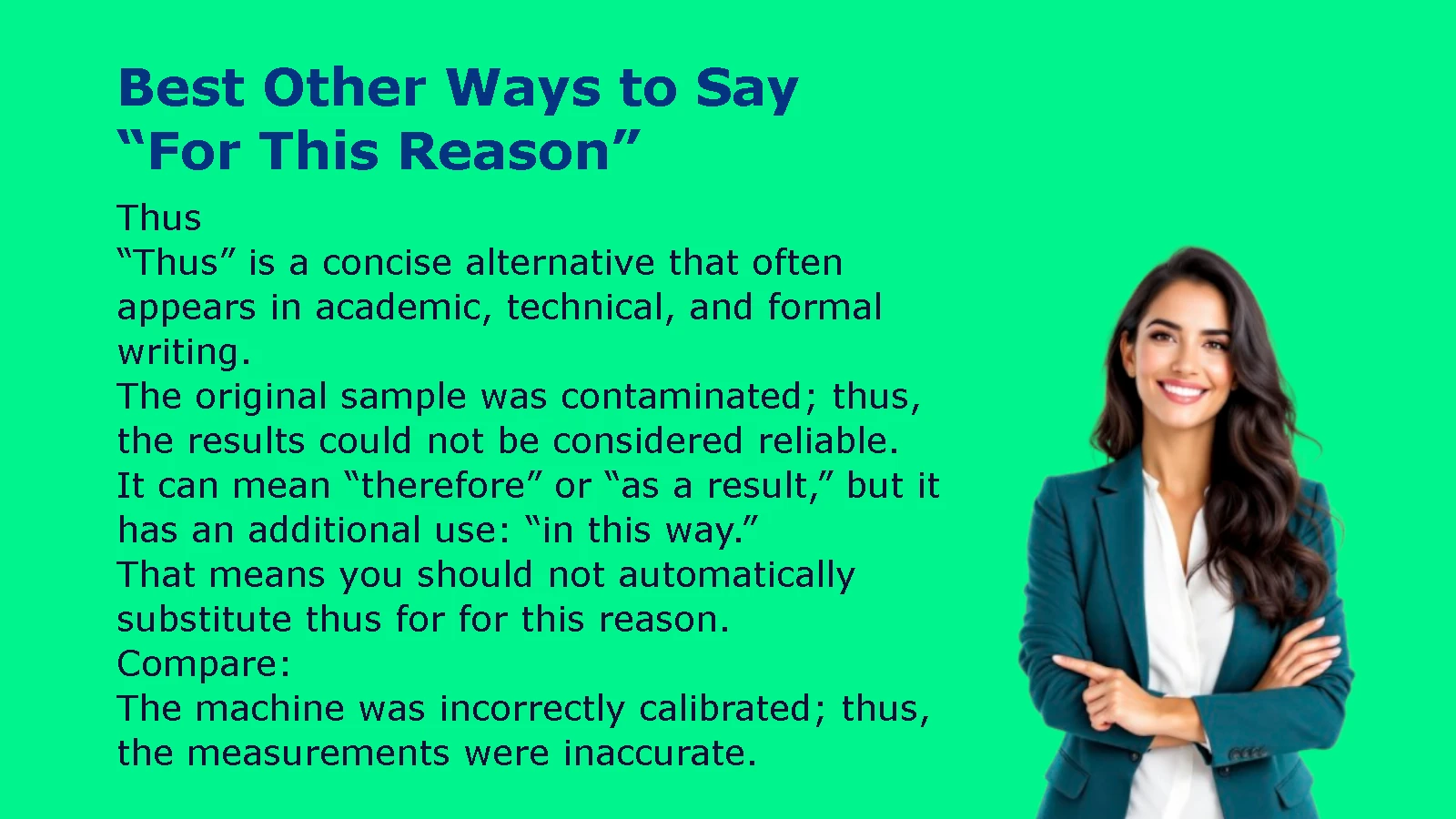
Other ways to say “for this reason” can help you make your writing sound more natural, precise, and varied. The phrase “for this reason” is commonly used to explain why something happened or to connect a cause with its result. Depending on the situation, you might replace it with expressions such as “therefore,” “because of this,” “as a result,” “that’s why,” “consequently,” “for that reason,” or “due to this.”
The phrase “for this reason” means because of the situation, fact, or circumstance just mentioned. It is often used in essays, professional emails, academic writing, business communication, and everyday conversations to show a clear relationship between an earlier point and the conclusion that follows. However, some alternatives may sound more formal, conversational, persuasive, or concise depending on the context.
In this guide, you’ll learn the best ways to say “for this reason,” what each alternative means, and when to use them in different situations. You’ll also see examples for formal writing, academic contexts, workplace communication, casual conversations, and everyday sentences so you can choose the expression that fits your message naturally.
By the end, you’ll have a useful list of alternatives to “for this reason” and know exactly which phrase to use when you want to explain a cause, introduce a result, or make your writing more varied and effective.
Best Alternatives to “For This Reason” at a Glance
If you want a quick answer, use this table to find the phrase that fits your situation.
| Alternative | Tone | Formality | Best For | Example |
| Therefore | Logical, direct | Formal/neutral | Essays, reports | The evidence was incomplete; therefore, we repeated the test. |
| As a result | Clear, explanatory | Neutral | General and professional writing | The road was closed. As a result, we took another route. |
| Consequently | Serious, logical | Formal | Reports and academic writing | Costs increased. Consequently, prices rose. |
| Thus | Concise, logical | Formal | Academic and technical writing | The sample was contaminated; thus, the results were invalid. |
| Hence | Concise, formal | Very formal | Academic and technical contexts | The evidence was insufficient; hence, the delay. |
| Accordingly | Deliberate, logical | Formal | Business and official writing | Demand fell; accordingly, production was reduced. |
| For that reason | Direct | Neutral/formal | General writing | The evidence was weak. For that reason, we rejected the claim. |
| Because of this | Explanatory | Neutral | General writing | The instructions were unclear. Because of this, several people made mistakes. |
| That’s why | Conversational | Casual | Speech and texting | I was tired. That’s why I went home early. |
| So | Simple, natural | Casual/neutral | Everyday English | It was raining, so we stayed inside. |
| In light of this | Analytical | Formal | Decisions and reports | The results were inconsistent. In light of this, we repeated the study. |
| For these reasons | Conclusive | Formal/neutral | Multiple reasons | For these reasons, the proposal was rejected. |
25+ Other Ways to Say “For This Reason”
Not every phrase below is an exact synonym. Some emphasize the result, some emphasize the cause, and others explain a decision based on previous information.
That distinction is what makes these alternatives useful.
Therefore
“Therefore” is probably the strongest general-purpose replacement for “for this reason.”
It introduces a conclusion or result that follows logically from the information before it.
The company failed to meet the safety requirements. Therefore, the facility remained closed.
It works especially well in:
- Academic essays
- Business reports
- Professional emails
- Formal explanations
- Analytical writing
- Arguments and conclusions
Tone and formality
Formal to neutral
Compared with “so,” therefore sounds more deliberate and analytical. Compared with “hence,” it is generally more familiar and versatile.
A useful rule is:
Use “therefore” when you want to make the logical connection especially clear.
For example:
The roads were severely damaged by the storm. Therefore, repairs will take several weeks.
As a Result
“As a result” is one of the most natural alternatives when you want to emphasize an outcome.
The flight was delayed by several hours. As a result, many passengers missed their connections.
It works well because it clearly tells the reader:
Cause → Result
Best situations
Use as a result in:
- Essays
- Reports
- Articles
- Emails
- Explanations
- Everyday writing
It is also useful when you want something less formal than “consequently” but more polished than “so.”
Sales declined during the quarter. As a result, the company reduced its spending.
Grammar resources commonly classify as a result as a result marker rather than a phrase that introduces the cause itself.
Consequently
“Consequently” means roughly “as a consequence” or “as a result.”
It has a formal, analytical tone.
The company ignored several safety warnings. Consequently, production was suspended.
It is especially appropriate when the result is significant, serious, or directly connected to the preceding situation.
Best for
- Academic writing
- Business reports
- Formal explanations
- Research writing
- Analytical articles
In casual conversation, however, “so” or “that’s why” usually sounds more natural.
Example
Formal:
The evidence was unreliable. Consequently, the researchers repeated the experiment.
Conversational:
The evidence wasn’t reliable, so they repeated the experiment.
Thus
“Thus” is a concise alternative that often appears in academic, technical, and formal writing.
The original sample was contaminated; thus, the results could not be considered reliable.
It can mean “therefore” or “as a result,” but it has an additional use: “in this way.”
That means you should not automatically substitute thus for for this reason.
Compare:
The machine was incorrectly calibrated; thus, the measurements were inaccurate.
Here, thus means something close to therefore.
But:
Hold the device thus.
Here, thus means in this way.
That distinction is important when choosing a synonym.
Hence
“Hence” is another formal alternative to “for this reason.”
The evidence was inconclusive; hence, further investigation was necessary.
It is particularly common in:
- Formal writing
- Academic writing
- Technical writing
- Mathematical reasoning
- Legal or highly formal contexts
However, hence can sound stiff or old-fashioned in ordinary conversation.
You would normally say:
The roads were blocked, so we stayed home.
rather than:
The roads were blocked; hence, we stayed home.
One useful feature of hence is that it can appear before a noun phrase:
The road was unsafe; hence the need for repairs.
Accordingly
“Accordingly” is especially useful when an action, decision, or response follows logically from previous information.
Demand has fallen significantly. Accordingly, the company has reduced production.
This is slightly different from simply saying that something happened as a consequence.
Compare:
The storm damaged the building. As a result, the roof needs repairs.
with:
The storm damaged the building. Accordingly, the company hired a contractor.
The second example emphasizes the action taken in response.
That makes accordingly particularly useful in professional and business writing.
For That Reason
“For that reason” is extremely close to “for this reason.”
The evidence was incomplete. For that reason, the researchers delayed publication.
The difference is usually one of reference and context rather than meaning.
- For this reason → points to the reason just mentioned or currently being discussed.
- For that reason → can point back to a previously established reason or fact.
Both are natural in formal and general writing.
Because of This
“Because of this” is a clear and natural alternative.
The instructions were unclear. Because of this, several employees completed the form incorrectly.
This expression tends to make the cause more prominent.
Compare:
The instructions were unclear. Therefore, several employees made mistakes.
with:
The instructions were unclear. Because of this, several employees made mistakes.
The first sounds more like a logical conclusion. The second directly connects the result to the preceding cause.
Because of That
“Because of that” is similar to because of this, but that often points more conversationally to something already mentioned.
He missed the deadline. Because of that, the project was delayed.
This is natural in conversation and informal writing.
For formal writing, therefore, as a result, or because of this may sound more polished.
That’s Why
If you’re looking for a natural conversational alternative, “that’s why” is one of the best choices.
I didn’t sleep well last night. That’s why I’m tired today.
It sounds natural in:
- Conversation
- Text messages
- Informal emails
- Friendly explanations
- Everyday American English
Compare:
I didn’t sleep well. Therefore, I’m tired.
with:
I didn’t sleep well. That’s why I’m tired.
The second sounds much more natural in ordinary conversation.
This Is Why
“This is why” emphasizes the connection between the preceding fact and the result.
The company has invested heavily in training. This is why its employees are highly skilled.
It can work in both speech and writing.
It is especially useful when you want to draw attention to the explanation rather than simply insert a formal transition.
So
For everyday American English, “so” is often the simplest and most natural alternative.
I was tired, so I went home.
Instead of:
I was tired. Therefore, I went home.
The second sentence is grammatically fine, but it sounds unnecessarily formal for casual conversation.
So vs. therefore
So is a coordinating conjunction, while therefore is a conjunctive adverb. This difference affects punctuation and sentence structure.
Correct:
I was tired, so I went home.
Also correct:
I was tired; therefore, I went home.
Or:
I was tired. Therefore, I went home.
Avoid joining two independent clauses with only a comma before therefore.
As a Consequence
“As a consequence” means essentially “as a result.”
The company failed to meet the deadline. As a consequence, the launch was postponed.
It is somewhat more formal than as a result and can work particularly well when the consequence is important or negative.
Several safety rules were ignored. As a consequence, the project was halted.
In Light of This
“In light of this” is useful when a decision or conclusion is being made after considering new information.
The test results were inconsistent. In light of this, the researchers decided to repeat the experiment.
This isn’t always a direct synonym for for this reason.
The phrase emphasizes consideration of evidence or circumstances, rather than simply signaling cause and effect.
That makes it especially useful in:
- Reports
- Recommendations
- Business writing
- Academic analysis
- Formal decisions
Given This
“Given this” means roughly “considering this information.”
The budget is limited. Given this, we need to prioritize the most important projects.
It works particularly well when the writer is moving from information to a practical conclusion.
You can also use:
Given these circumstances, we decided to postpone the event.
On This Basis
“On this basis” works when a conclusion or decision is made from previously stated evidence.
The initial tests showed no significant improvement. On this basis, the team decided to change its approach.
This phrase is particularly useful in formal analytical writing.
On These Grounds
“On these grounds” is useful when a decision is being justified by specific reasons.
The application failed to meet the eligibility requirements. On these grounds, it was rejected.
Because it sounds formal and somewhat institutional, it is more appropriate for:
- Official decisions
- Legal writing
- Formal reports
- Policy discussions
It would sound excessive in a casual text message.
In View of This
“In view of this” is another formal expression for moving from information to a decision or conclusion.
Several important concerns were raised. In view of this, the committee postponed the vote.
It is useful when the preceding information has influenced what happens next.
For These Reasons
Use “for these reasons” when you have presented multiple reasons, rather than one specific reason.
The proposal is expensive, difficult to implement, and unlikely to produce immediate results. For these reasons, we decided not to proceed.
This is an important distinction:
- For this reason → one reason
- For these reasons → multiple reasons
That makes for these reasons particularly useful in essay conclusions and argumentative writing.
Which Alternative Should You Use?
There isn’t one universally best synonym for “for this reason.” The best choice depends on your audience, sentence, and intended emphasis.
| Situation | Best Choice |
| Everyday conversation | So |
| Casual explanation | That’s why |
| Academic essay | Therefore |
| Academic analysis | Thus / Therefore |
| Formal report | Consequently / Accordingly |
| Professional email | As a result / Therefore |
| Explaining an outcome | As a result |
| Highlighting a consequence | Consequently |
| Explaining a cause | Because of this |
| Referring to several reasons | For these reasons |
| Justifying a decision | On this basis / In light of this |
| Highly formal writing | Hence / Thus |
| Simple, neutral writing | For that reason |
The important point is that more formal does not automatically mean better.
If you’re texting a friend, hence probably isn’t an improvement over that’s why. If you’re writing an academic paper, however, therefore or thus may fit much better.
“For This Reason” vs. “Therefore” vs. “As a Result”
These three expressions are closely related, but they can create slightly different effects.
| Phrase | Main Emphasis | Tone | Example |
| For this reason | The stated reason | Neutral/formal | The evidence was weak. For this reason, we rejected the claim. |
| Therefore | Logical conclusion | Formal/neutral | The evidence was weak; therefore, we rejected the claim. |
| As a result | Outcome | Neutral | The evidence was weak. As a result, we rejected the claim. |
For this reason
This phrase directly points back to a reason already given.
The road was unsafe. For this reason, it was closed.
Therefore
This emphasizes the logical conclusion.
The road was unsafe; therefore, it was closed.
As a result
This emphasizes what happened because of the earlier condition.
The road was unsafe. As a result, it was closed.
The practical difference is subtle, which is why these phrases can often be exchanged without changing the basic message.
Formal Alternatives to “For This Reason”
If you’re writing an academic paper, report, formal email, or professional document, consider these choices:
- Therefore
- Consequently
- Thus
- Hence
- Accordingly
- As a consequence
- In light of this
- On this basis
- In view of this
- For these reasons
Example: Academic writing
The sample size was relatively small. Therefore, the findings should be interpreted cautiously.
Example: Business writing
Customer demand declined during the quarter. Accordingly, production was reduced.
Example: Formal analysis
The available evidence was inconclusive. Consequently, further investigation was required.
These choices are consistent with standard descriptions of result markers in academic and formal English.
Casual Alternatives to “For This Reason”
When you’re talking to someone rather than writing an academic paper, simpler expressions usually sound better.
Use:
- So
- That’s why
- Because of that
- Because of this
- This is why
- And so
Workplace conversation
The meeting was moved to Friday, so we have more time to prepare.
Text message
I was stuck in traffic. That’s why I’m late.
Conversation with a friend
The restaurant was packed, so we went somewhere else.
Using therefore in these situations isn’t incorrect. It simply sounds more formal than most people would naturally choose.
How to Say “For This Reason” in an Email
The best phrase depends on how formal the email is.
Professional
The requested documents were not received. As a result, we cannot complete the review at this time.
More formal
The requested documents were not received. Accordingly, we cannot complete the review at this time.
Direct and neutral
The requested documents were not received. For this reason, we cannot complete the review at this time.
Conversational
We didn’t receive the requested documents, so we can’t complete the review yet.
For most professional emails, as a result, therefore, for this reason, and accordingly are useful choices. The correct option depends on how formal you want the message to sound.
How to Say “For This Reason” in an Essay
Academic writing benefits from clear transitions, but you don’t need to replace for this reason every time simply to sound sophisticated.
Good choices include:
- Therefore
- Thus
- Consequently
- As a result
- For this reason
- Accordingly
- Hence
Example
Original:
The study included only 25 participants. For this reason, the results should not be generalized to the wider population.
Alternative:
The study included only 25 participants. Therefore, the results should not be generalized to the wider population.
Another option:
The study included only 25 participants. As a result, the findings should be interpreted cautiously.
The key is to choose the transition that accurately describes the relationship between the ideas.
How to Say “For This Reason” in Everyday Conversation
In spoken American English, so is often the most natural option.
Instead of:
I wasn’t feeling well. For this reason, I stayed home.
A native speaker would commonly say:
I wasn’t feeling well, so I stayed home.
Or:
I wasn’t feeling well. That’s why I stayed home.
The difference is mostly one of register.
Formal:
The weather was severe. Therefore, the event was canceled.
Natural conversation:
The weather was bad, so they canceled the event.
Both communicate the same basic relationship.
“For This Reason” vs. “Because of This”
These expressions are close, but they can emphasize different sides of the relationship.
For this reason
The instructions were unclear. For this reason, several people made mistakes.
This presents the preceding information as the reason for the result.
Because of this
The instructions were unclear. Because of this, several people made mistakes.
This more directly points to the previous situation as the cause.
In many ordinary sentences, either works.
However, don’t confuse either phrase with because, which normally introduces a clause:
We stayed home because it was raining.
versus:
It was raining. Because of this, we stayed home.
The distinction between cause connectors and result markers is important when choosing the right structure.
“For This Reason” vs. “That’s Why”
These phrases are especially useful to compare because they can express nearly the same relationship while creating very different tones.
For this reason sounds more formal:
The roads were flooded. For this reason, schools were closed.
That’s why sounds more conversational:
The roads were flooded. That’s why schools were closed.
Use for this reason when you want a more formal written tone.
Use that’s why when you’re explaining something naturally in conversation.
How to Avoid Repeating “For This Reason”
You don’t need to replace every instance of “for this reason.” Sometimes it is exactly the right phrase.
The goal is to vary your wording when the context calls for it, not to replace words mechanically.
Improved version
The data was incomplete. Therefore, the researchers repeated the test. As a result, publication was delayed. Consequently, the final report was postponed.
Now each transition performs a slightly different job.
An even more natural version
The data was incomplete, so the researchers repeated the test. Publication was delayed, and the final report was postponed until the results were verified.
This illustrates an important writing principle: sometimes the best alternative is no transition at all.
You don’t need a linking phrase in every sentence.
Common Mistakes When Replacing “For This Reason”
Treating Every Synonym as Interchangeable
Words such as therefore, hence, because of this, accordingly, and so overlap in meaning, but their grammar and register differ.
Don’t choose a phrase simply because a thesaurus lists it as a synonym.
Using “Due To” as a Direct Replacement
Due to usually introduces a noun phrase rather than functioning like a standalone result transition.
Correct:
The flight was delayed due to heavy rain.
But:
It rained heavily. As a result, the flight was delayed.
Not every instance of for this reason can simply be changed to due to without restructuring the sentence.
Using “Hence” in Casual Conversation
I missed the bus; hence, I’m late.
This is understandable, but it sounds unusually formal in everyday speech.
More natural:
I missed the bus, so I’m late.
Or:
I missed the bus. That’s why I’m late.
Using “Thus” Without Checking Its Meaning
Remember that thus can mean either “therefore” or “in this way.”
Compare:
The evidence was unreliable; thus, the conclusion was rejected.
with:
Fold the paper thus.
The second use has nothing to do with cause and effect.
Using “As a Result” Without a Real Result
As a result needs a logical outcome.
Good:
The storm damaged the power lines. As a result, thousands of homes lost electricity.
Poor:
The storm was expected to arrive. As a result, the meteorologists issued a warning.
The second sentence may be logically possible, but the relationship needs clearer wording because the warning is a response to the forecast rather than simply an automatic result.
How to Punctuate Alternatives to “For This Reason”
Punctuation matters, especially with formal transitions.
Therefore
When therefore connects two independent clauses, a semicolon is a safe structure:
The evidence was incomplete; therefore, the researchers repeated the experiment.
You can also separate the sentences:
The evidence was incomplete. Therefore, the researchers repeated the experiment.
Don’t normally write:
The evidence was incomplete, therefore the researchers repeated the experiment.
That creates a comma splice when both sides are independent clauses. Grammar resources specifically distinguish so from therefore in this respect.
So
Because so can function as a coordinating conjunction, it can directly connect two independent clauses with a comma:
The evidence was incomplete, so the researchers repeated the experiment.
This is one reason so is often simpler in everyday writing.
As a Result
When it begins a new sentence, a comma usually follows it:
The storm damaged the bridge. As a result, traffic was diverted.
Consequently
The same pattern commonly works with consequently:
The company missed its target. Consequently, the board changed its strategy.
These punctuation and positioning patterns are consistent with common grammar guidance for result markers.
Natural American English: Which Alternatives Sound Best?
If your goal is natural American English, don’t automatically choose the most formal expression.
Most natural in everyday speech
- So
- That’s why
- Because of that
- Because of this
- This is why
Natural in general writing
- For that reason
- Therefore
- As a result
- Because of this
More formal
- Consequently
- Accordingly
- Thus
- Hence
- In light of this
- On this basis
A useful rule is:
Choose the simplest phrase that accurately expresses the relationship between your ideas.
A sophisticated word isn’t automatically a better word.
Practical Examples of Replacing “For This Reason”
Workplace Conversation
Original:
The client requested several changes. For this reason, we’ll need another meeting.
Natural:
The client requested several changes, so we’ll need another meeting.
Professional:
The client requested several changes. As a result, we’ll need another meeting.
Professional Email
Original:
The requested information was incomplete. For this reason, we cannot process the application.
Alternative:
The requested information was incomplete. Therefore, we cannot process the application at this time.
Another option:
The requested information was incomplete. As a result, we cannot process the application at this time.
Academic Writing
Original:
The sample was relatively small. For this reason, the findings should be interpreted cautiously.
Alternative:
The sample was relatively small. Therefore, the findings should be interpreted cautiously.
Business Report
Original:
Customer demand fell significantly. For this reason, production was reduced.
Alternative:
Customer demand fell significantly. Accordingly, production was reduced.
Casual Text
Original:
I missed the train. For this reason, I’ll be late.
Natural:
I missed the train, so I’ll be late.
Or:
I missed the train. That’s why I’ll be late.
Family Conversation
Original:
Mom wasn’t feeling well. For this reason, she stayed home.
Natural:
Mom wasn’t feeling well, so she stayed home.
A Quick Decision Guide
When you are unsure which alternative to choose, ask yourself one question:
What am I trying to emphasize?
A logical conclusion?
Use therefore.
The evidence was strong; therefore, the theory was accepted.
An outcome?
Use as a result.
The storm caused major flooding. As a result, roads were closed.
A significant consequence?
Use consequently.
The company violated the regulations. Consequently, it faced penalties.
A formal conclusion?
Use thus or hence.
The data was unreliable; thus, the experiment was repeated.
A decision or action based on information?
Use accordingly.
Demand had fallen. Accordingly, production was reduced.
A conversational explanation?
Use that’s why.
I was sick. That’s why I didn’t come.
A simple everyday connection?
Use so.
I was hungry, so I made lunch.
Several reasons?
Use for these reasons.
The plan was expensive, risky, and difficult to implement. For these reasons, it was rejected.
Frequently Asked Questions
What is another way to say “for this reason”?
The most useful alternatives include therefore, as a result, consequently, thus, hence, accordingly, for that reason, because of this, so, and that’s why. The best option depends on your desired tone and whether you want to emphasize the reason, result, or conclusion.
What is the best synonym for “for this reason”?
Therefore is one of the best general-purpose alternatives. It clearly signals a logical result and works well in academic, professional, and formal writing.
What is a more formal way to say “for this reason”?
Use therefore, consequently, thus, hence, accordingly, in light of this, or in view of this. Among these, therefore is generally the most familiar and versatile.
What is a casual way to say “for this reason”?
Use so, that’s why, because of that, or this is why. These expressions sound much more natural in everyday American English.
What can I use instead of “for this reason” in an essay?
Good choices include therefore, thus, consequently, as a result, accordingly, and for these reasons. Choose based on whether you are presenting a conclusion, consequence, or multiple reasons.
Is “therefore” the same as “for this reason”?
They are very similar when they introduce a logical result, but they can emphasize slightly different relationships. Therefore often presents a conclusion, while for this reason more directly points back to a stated reason.
Is “as a result” the same as “for this reason”?
They can often be used in the same sentence, but as a result emphasizes the outcome, while for this reason emphasizes the reason behind that outcome.
Is “because of this” the same as “for this reason”?
They are closely related, but because of this tends to emphasize the preceding situation as the cause. For this reason works more broadly as a transition to the resulting conclusion or action.
Is “that’s why” a good alternative to “for this reason”?
Yes. That’s why is especially natural in conversation, texting, and informal communication. It is usually less formal than therefore or consequently.
Should I use “thus” or “therefore”?
Use therefore when you want a familiar, clear formal transition. Use thus when you want a concise, more academic or technical style. Both can signal a logical result.
What is the difference between “hence” and “therefore”?
Both can indicate a result or conclusion, but hence generally sounds more formal and is less common in everyday American English. Therefore is the more versatile choice for most formal writing.
Can I use “so” instead of “for this reason”?
Yes, when the sentence is conversational or informal. So is often the most natural spoken alternative, although its grammar and punctuation differ from for this reason and therefore.
Choose the Alternative That Fits Your Meaning
The best alternative to “for this reason” isn’t necessarily the longest, most formal, or most sophisticated expression.
For everyday conversation, so and that’s why are usually the most natural choices. For general writing, therefore, as a result, and for that reason are reliable options. In academic and formal writing, therefore, thus, consequently, hence, and accordingly can provide a more polished connection between ideas.
The key is to match the transition to the relationship you are expressing:
- Therefore → logical conclusion
- As a result → outcome
- Consequently → consequence
- Thus → concise formal conclusion
- Hence → formal result
- Accordingly → action or decision that follows
- Because of this → cause-focused explanation
- So → natural everyday result
- That’s why → conversational explanation
- For these reasons → multiple reasons
If you’re trying to improve your writing, don’t replace “for this reason” mechanically. Instead, ask whether you’re explaining a cause, result, consequence, decision, or conclusion. Once you identify that relationship, the right phrase becomes much easier to choose.













