Have you ever heard someone say “reiterate” and wondered what it really means? While Reiterate Meaning may seem a little formal at first, the word is actually quite simple. It describes the act of saying or stating something again, usually to make an important point clear or emphasize it.
Reiterate is a verb that means to repeat something that has already been said or stated, especially to emphasize or clarify a point. It is often used in formal conversations, emails, meetings, and written communication.
Examples:
- I want to reiterate the importance of meeting the deadline.
- She reiterated her concerns during the meeting.
The confusion is understandable. People often search for what does reiterate mean, reiterate meaning in text, reiterate meaning in a sentence, or reiterate synonym because the word can sound more formal than everyday alternatives like “repeat.” And here’s the kicker: reiterate doesn’t simply mean repeating words for no reason. It often suggests repeating something to reinforce its importance or make it clearer.
In this guide, you’ll learn the complete Reiterate Meaning, its definition, pronunciation, part of speech, and examples in sentences. You’ll also discover how to use reiterate correctly, its synonyms, common mistakes to avoid, and the difference between reiterate and repeat.
What Does Reiterate Mean?
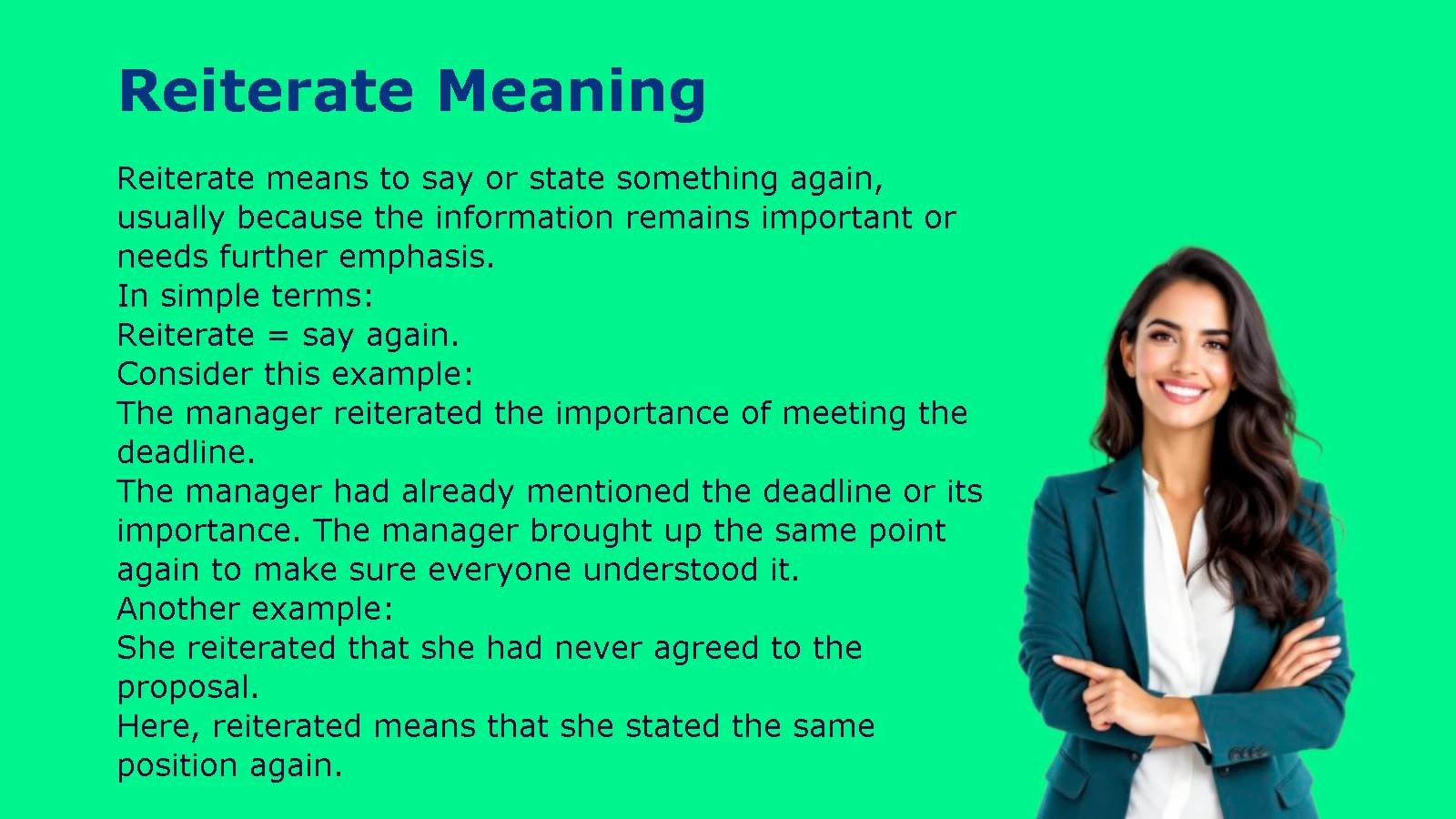
Reiterate means to say or state something again, usually because the information remains important or needs further emphasis.
In simple terms:
Reiterate = say again.
Consider this example:
The manager reiterated the importance of meeting the deadline.
Another example:
She reiterated that she had never agreed to the proposal.
Here, reiterated means that she stated the same position again.
Cambridge lists repeat and restate as synonyms for reiterate. Oxford adds that the word often carries the idea of emphasis.
Reiterate Meaning in Simple Words
You can understand reiterate through these simple phrases:
- Say again
- State again
- Repeat a point
- Repeat a statement
- Emphasize a point by stating it again
- Make your position clear again
For example:
| Sentence | Simple meaning |
| I want to reiterate my request. | I want to make my request again. |
| She reiterated her concerns. | She expressed her concerns again. |
| He reiterated that the plan would continue. | He said again that the plan would continue. |
| The teacher reiterated the instructions. | The teacher explained or stated the instructions again. |
The key idea is repetition of something already stated.
Reiterate Definition
The dictionary definition of reiterate is closely tied to repetition.
Cambridge defines it as saying something again, either once or several times. Oxford describes it as repeating something already said, particularly to emphasize it. Merriam-Webster defines it as stating or doing something over again or repeatedly.
A useful working definition is:
Reiterate means to state or express something again, often to reinforce its importance.
Is Reiterate a Verb?
Yes. Reiterate is a verb.
More specifically, dictionaries treat it as a transitive verb, which means it normally takes an object.
For example:
She reiterated her concerns.
The verb is reiterated, and its object is her concerns.
You can also use reiterate before a that-clause:
She reiterated that the meeting would begin at nine.
The two most useful patterns are:
reiterate + noun
He reiterated his request.
reiterate + that + clause
He reiterated that he had already submitted the form.
Oxford specifically lists both patterns in its usage information.
Reiterate Pronunciation
In American English, reiterate is pronounced approximately:
ree-IT-uh-rate
The American English pronunciation given by Cambridge is /riˈɪt̬.ɚ.eɪt/. Oxford gives the corresponding pronunciation as /riˈɪtəreɪt/.
The main stress falls on the second syllable:
ree-IT-uh-rate
Its related noun, reiteration, has a different stress pattern:
ree-it-uh-RAY-shun
How to Use Reiterate in a Sentence
The easiest way to use reiterate correctly is to think about what you are repeating.
You can reiterate a:
- Point
- Request
- Statement
- Argument
- Position
- Opinion
- Concern
- Warning
- Commitment
- Promise
- Demand
- Offer
- Instruction
- Message
Oxford’s examples and collocations include combinations such as reiterate an argument, reiterate a demand, reiterate an offer, and reiterate the importance.
Reiterate + Noun
This is one of the most common sentence structures.
The director reiterated the company’s commitment to quality.
She reiterated her concerns about the schedule.
The customer reiterated his request for a refund.
The professor reiterated the main argument of the study.
In each example, the speaker or writer mentions something that has already been communicated.
Reiterate + That Clause
You can also follow reiterate with that and a complete clause.
She reiterated that the documents were confidential.
The manager reiterated that employees must follow the policy.
He reiterated that he had no involvement in the decision.
The company reiterated that customer safety remained its priority.
This structure works especially well when you need to repeat a complete statement rather than a short noun phrase.
Reiterate a Point
Reiterate a point is a common phrase in formal communication.
Let me reiterate one important point: the deadline cannot be extended.
This phrase tells the reader or listener that the point has already appeared but deserves attention again.
You might hear it during a presentation:
Before we move on, I’d like to reiterate the main point.
Or in an academic discussion:
The researcher reiterated the point that the results required further analysis.
The phrase doesn’t necessarily mean that someone has repeated the exact same words. The person may express the same idea again.
Reiterate Meaning With Examples
Seeing the word in different contexts makes its meaning much easier to understand.
Everyday Example
I want to reiterate that you’re always welcome here.
The speaker has already said this but wants to emphasize it again.
Workplace Example
The manager reiterated the importance of submitting reports on time.
The manager repeated the instruction because meeting the deadline matters.
Email Example
I’d like to reiterate my request for the updated sales figures.
The writer has previously requested the figures and is making the request again.
Academic Example
The professor reiterated the central argument during the final part of the lecture.
The professor returned to the main argument to reinforce it.
Formal Example
The organization reiterated its commitment to protecting customer information.
The organization stated its commitment again.
Personal Example
She had already communicated that she wasn’t angry or upset. She stated it again.
Warning Example
The supervisor reiterated the safety instructions before the team entered the site.
The instructions had already been given, but the supervisor repeated them because they were important.
Political or Public Statement Example
The minister reiterated the government’s position on the proposed legislation.
The minister repeated an existing official position.
The word itself doesn’t tell you whether the repeated statement is true, false, positive, negative, friendly, or hostile. Context determines the tone.
What Does It Mean to Reiterate a Point?
To reiterate a point means to make the same point again after already expressing it.
Imagine you’re in a meeting. You explain that a project needs another week. Later, someone asks whether the original deadline still applies.
You might say:
“I’d like to reiterate my earlier point: we need another week to complete the project properly.”
You’re not introducing a brand-new idea. You’re returning to an idea you’ve already expressed.
That’s an important distinction.
Reiterate doesn’t require you to repeat the exact same words. You can communicate the same idea using different wording.
For example:
First: “We need more time to test the software.”
Later: “I’d like to reiterate that additional testing is necessary before launch.”
The wording changed, but the central message stayed the same.
Reiterate vs. Repeat
Reiterate and repeat overlap heavily, but they don’t always sound the same.
| Reiterate | Repeat |
| Means to say or state something again | Means to say or do something again |
| Often sounds formal | Usually sounds neutral |
| Common in professional and official communication | Common in everyday speech |
| Often draws attention to an important point | Can describe any kind of repetition |
| Can suggest emphasis | Doesn’t necessarily suggest emphasis |
Compare these sentences:
Please repeat the question.
I’d like to reiterate my earlier concerns.
The first sentence sounds perfectly natural in ordinary conversation. The second sounds more formal and deliberate.
Cambridge lists repeat as a synonym of reiterate, while Oxford explains that reiterate commonly involves repeating something for emphasis.
When Should You Use Reiterate?
Use reiterate when the formal tone fits the situation and you want to emphasize that something has already been said.
It works naturally in:
- Business emails
- Reports
- Presentations
- Academic writing
- Official announcements
- Policy statements
- Formal discussions
- Professional correspondence
When Should You Use Repeat?
Choose repeat when you’re speaking casually or simply asking someone to say something again.
For example:
Could you repeat that?
That sounds much more natural than:
Could you reiterate that?
The second sentence isn’t necessarily wrong, but it sounds unnecessarily formal in many everyday situations.
Reiterate vs. Restate
Reiterate and restate are close synonyms, but they can emphasize slightly different things.
Restate focuses on expressing an idea again, sometimes in a different way.
Compare:
The speaker reiterated her position.
This emphasizes that she stated her position again.
The speaker restated her position in simpler terms.
This suggests that she expressed the same position again, perhaps using clearer or different wording.
In real usage, the two words can overlap. Cambridge identifies restate as a synonym of reiterate.
However, the distinction can help you choose the more precise word when writing.
Reiterate vs. Reaffirm
This distinction matters because reiterate and reaffirm sometimes appear in the same kinds of formal statements.
Reiterate
Reiterate means to state something again.
The company reiterated its position.
Reaffirm
Reaffirm means to confirm or state continued support for something again.
The company reaffirmed its commitment to customer safety.
The second sentence carries a stronger sense of renewed confirmation or continued support.
If you’re simply saying something again, reiterate fits.
If you’re emphasizing that a belief, commitment, agreement, or position remains firm, reaffirm may be more precise.
Is Reiterate a Formal Word?
Yes. Reiterate is generally considered formal.
Cambridge labels the word formal, and Oxford also marks it as formal.
That doesn’t mean you can’t use it in ordinary conversation. It simply means the word often sounds more polished or official than repeat.
Compare the levels of formality:
| Situation | Natural wording |
| Casual conversation | I just want to say that again. |
| Neutral | I want to repeat that point. |
| Formal | I want to reiterate that point. |
| Very formal | I would like to reiterate my previous statement. |
There’s no prize for choosing the most formal option. Good writing matches the language to the situation.
If you’re texting a friend, repeat will usually do the job. If you’re writing an official response, reiterate may fit much better.
Is Reiterate Positive or Negative?
Reiterate is neutral.
The word itself doesn’t express approval or disapproval. It simply describes the act of saying or stating something again.
Positive Example
The coach reiterated her confidence in the team.
The repeated message is positive.
Negative Example
The manager reiterated his concerns about the proposal.
The repeated message is critical.
Neutral Example
The teacher reiterated the instructions before the test.
The message is neither positive nor negative.
This is useful to remember because words that often appear alongside reiterate can influence how the sentence feels.
For example:
- Reiterate support → positive
- Reiterate commitment → usually positive
- Reiterate concerns → negative or cautious
- Reiterate a warning → serious
- Reiterate a request → neutral or firm
- Reiterate a refusal → firm or negative
The verb remains neutral. The surrounding words create the tone.
Common Phrases With Reiterate
Certain combinations appear naturally in formal English.
Reiterate a Point
The speaker reiterated an important point about data security.
Use this when you want to emphasize an idea that has already been discussed.
Reiterate a Statement
The spokesperson reiterated the earlier statement.
This works well when referring to an official or previously published statement.
Reiterate a Request
I am writing to reiterate my request for the missing documents.
This is common in professional correspondence.
Reiterate a Position
The organization reiterated its position on the issue.
This often appears in formal or institutional writing.
Reiterate Concerns
Several employees reiterated their concerns about the proposed changes.
This means they expressed those concerns again.
Reiterate a Commitment
The company reiterated its commitment to improving customer service.
This phrase often appears in corporate communication.
Reiterate a Warning
The supervisor reiterated the safety warning before work began.
Here, repetition serves a practical purpose. The information is important enough to repeat.
Reiterate That…
The director reiterated that all employees must complete the training.
This construction is especially useful when the repeated message is a complete statement.
Reiterate in Professional Emails
The word reiterate has a natural place in professional email writing, particularly when you need to repeat something without sounding overly casual.
Reiterating a Request
I’d like to reiterate my request for the revised proposal.
This is polite but firm.
Reiterating a Deadline
I want to reiterate that the final deadline is Friday, August 14.
This makes the timing clear.
Reiterating a Concern
I’d like to reiterate my concerns about the current project timeline.
This signals that the concern isn’t new.
Reiterating an Agreement
I’d like to reiterate our agreement regarding the revised delivery schedule.
This can help reinforce an understanding reached earlier.
A Better Alternative When “Reiterate” Sounds Too Formal
You don’t need to force the word into every professional email.
Instead of:
I would like to reiterate my request for a response.
You could write:
I’m following up on my earlier request for a response.
Or:
I wanted to follow up on my previous message.
The best choice depends on what you’re actually trying to communicate.
Reiterate emphasizes repetition. Follow up emphasizes continued communication or action.
Reiterate Meaning in Different Grammatical Forms
The word changes form depending on tense and grammatical use.
| Form | Example |
| Reiterate | I reiterate my request. |
| Reiterates | She reiterates her position. |
| Reiterated | He reiterated his concerns. |
| Reiterating | They are reiterating the importance of safety. |
| Reiteration | The letter was a reiteration of the earlier warning. |
Reiterate
Use the base form with I, you, we, and they in the present tense.
We reiterate our commitment to the project.
Reiterates
Use reiterates with a singular third-person subject.
The company reiterates its commitment to quality.
Reiterated
Use reiterated for the simple past and as a past participle.
The manager reiterated the instructions yesterday.
Reiterating
Use reiterating as the present participle or gerund.
The spokesperson is reiterating the government’s position.
Reiteration
Reiteration is the noun form.
The letter served as a reiteration of the company’s earlier position.
Cambridge and Merriam-Webster both list reiteration as the noun related to reiterate.
The History of the Word Reiterate
The history of reiterate explains why the word has such a strong connection with repetition.
Oxford traces it through Middle English to Latin reiterare, meaning to go over or do something again. It combines re-, meaning “again,” with iterare, meaning to do a second time.
Merriam-Webster dates the first known English use of reiterate to the 15th century. It also traces the word to Latin reiteratus, the past participle of reiterare.
So the basic idea behind the word has remained remarkably stable: doing or saying something again.
Does Reiterate Mean “Repeat Again and Again”?
Not necessarily.
This is a common point of confusion.
Some people assume that because reiterate contains re- and relates to repetition, it must mean repeat repeatedly.
Actual dictionary usage doesn’t support such a strict rule.
Merriam-Webster notes that reiterate can refer to a single repetition or multiple repetitions. It also explains that the related verb iterate can similarly refer to repeating something once or several times.
So this sentence is perfectly reasonable:
She reiterated her point once.
You don’t need multiple repetitions for reiterate to be correct.
Common Mistakes With Reiterate
Although reiterate is easy to understand, a few usage mistakes can make your writing awkward.
Using Reiterate When Repeat Sounds Better
In casual conversation, reiterate can sound stiff.
Instead of:
Could you reiterate what you just said?
Most people would naturally say:
Could you repeat what you just said?
The first sentence is grammatical. The second usually sounds more conversational.
Assuming Reiterate Means “Repeat Repeatedly”
As noted above, reiterate doesn’t require multiple repetitions.
A single restatement can qualify.
Confusing Reiterate With Reaffirm
These verbs overlap, but they aren’t identical.
She reiterated her statement.
The second sentence carries a stronger sense of renewed confirmation.
Using Reiterate Without Anything to Repeat
The meaning depends on previous context.
For example:
I reiterated my concerns.
This naturally suggests that the concerns had already been expressed.
Without that context, the reader may wonder, “When did you say that before?”
Overusing Reiterate
Because reiterate already signals repetition, using it repeatedly in the same paragraph can make your writing feel repetitive.
For example, this is clumsy:
A better version varies the language:
The manager reiterated the deadline and reviewed the instructions. He also explained the policy and outlined the consequences.
Good writing doesn’t need to sound like a dictionary entry. Let the context do some of the work.
Reiterate Synonyms
The best synonym depends on the context.
| Synonym | Best use |
| Repeat | General repetition |
| Restate | Expressing the same idea again |
| Say again | Simple, conversational writing |
| State again | Clear and neutral |
| Reaffirm | Confirming continued support or belief |
| Reassert | Stating a position firmly again |
| Recapitulate | Summarizing main points again, especially formally |
Repeat
The most common alternative is repeat.
Please repeat the instructions.
It’s simple and works in almost every register.
Restate
Use restate when you’re expressing an idea again, particularly if you’re changing the wording.
The author restated the argument in simpler terms.
Reaffirm
Use reaffirm when someone confirms continued support, belief, or commitment.
The organization reaffirmed its commitment to transparency.
Reassert
Reassert often carries a sense of firmly stating a position or claim again.
The company reasserted its right to terminate the agreement.
Recapitulate
Recapitulate means to summarize or repeat the main points, often in formal or academic contexts.
It’s more specialized than reiterate and isn’t a direct replacement in every sentence.
Practical Case Studies: How Reiterate Works in Context
The following scenarios show why the word can be useful.
Case Study: A Workplace Deadline
Imagine a project manager tells a team on Monday that all reports are due Friday. On Wednesday, several team members ask about the deadline.
The manager could say:
“Let me reiterate that all reports are due Friday.”
Why does reiterate work here?
Because the deadline isn’t new. The manager is restating previously communicated information to remove any doubt.
A casual alternative would be:
“Just to repeat, the reports are due Friday.”
Both work. The first sounds more formal.
Case Study: A Customer Service Request
A customer has already contacted a company about a missing order but hasn’t received a response.
A follow-up email might say:
“I would like to reiterate my request for an update on the order.”
Here, reiterate signals that the request has already been made.
However, if the writer wants to sound more natural and less formal, this may be better:
“I’m following up on my earlier request for an update.”
That’s an important writing lesson: a correct word isn’t automatically the best word.
Case Study: An Academic Argument
A researcher presents a central argument at the beginning of a paper and returns to it in the conclusion.
A sentence might read:
“The findings reiterate the importance of considering environmental factors in the analysis.”
Here, the word can signal that the evidence or discussion reinforces an idea already established.
The surrounding context determines whether reiterate refers to someone literally repeating a statement or whether later communication effectively repeats and reinforces an earlier point.
Quick Facts About Reiterate
| Fact | Answer |
| Part of speech | Verb |
| Basic meaning | Say or state again |
| Typical register | Formal |
| Common synonyms | Repeat, restate |
| Common noun form | Reiteration |
| Common structure | Reiterate + noun |
| Another common structure | Reiterate that + clause |
| American pronunciation | /riˈɪt̬.ɚ.eɪt/ |
| First known English use | 15th century |
| Word origin | Latin reiterare |
| Does it require multiple repetitions? | No |
The pronunciation, formal register, grammatical forms, and word history above are supported by Oxford, Cambridge, and Merriam-Webster.
Frequently Asked Questions About Reiterate Meaning
What does reiterate mean in simple terms?
Reiterate means to say or state something again. It often implies that the speaker wants to emphasize an important point.
What is another word for reiterate?
The most common alternatives are repeat and restate. Depending on context, reaffirm or reassert may also work.
Is reiterate a formal word?
Yes. Major dictionaries classify reiterate as formal. It’s especially common in professional, academic, official, and business communication.
Does reiterate mean repeat?
Yes. Reiterate means to say or state something again. However, it often sounds more formal than repeat and frequently appears when someone wants to emphasize a point.
Does reiterate mean repeat again and again?
No. It can refer to repeating something once or multiple times. Merriam-Webster specifically notes that actual usage doesn’t require repeated repetition.
What does “I reiterate” mean?
“I reiterate” means “I say or state this again.”
For example:
I reiterate my earlier request.
This means:
I am making my earlier request again.
What does “to reiterate” mean?
To reiterate means to repeat or restate something that has already been said.
What does “reiterate a point” mean?
It means to make the same point again, usually because the point remains important.
Is reiterate positive or negative?
Neither. Reiterate is neutral. The statement being repeated determines whether the overall message sounds positive, negative, critical, supportive, or neutral.
What is the noun form of reiterate?
The noun form is reiteration.
Example:
The letter was a reiteration of the company’s previous statement.
What is the difference between reiterate and restate?
Reiterate emphasizes saying something again. Restate often emphasizes expressing the same idea again, potentially using different words.
What is the difference between reiterate and reaffirm?
Reiterate means to state something again. Reaffirm means to confirm or express continued support for something again.
Final Takeaway: Reiterate Meaning
The meaning of reiterate is simple despite its formal sound: to say or state something again.
The word becomes especially useful when you want to show that a person is returning to an earlier point because it still matters.
Remember these three ideas:
- Reiterate = say or state again
- Reiterate is generally formal
- It often emphasizes an important point, position, request, or statement