Being alone is a deeply human experience that can feel both peaceful and sad depending on the moment. In writing, similes for alone help express this complex feeling in a more vivid and relatable way. Instead of simply stating that someone is alone, similes compare solitude to powerful images like a silent road at midnight, a lone leaf drifting in the wind, or a lighthouse standing far from the shore. These comparisons allow readers to feel the emotion rather than just understand it.
Literary devices are widely used in poetry, storytelling, and everyday language because they bring emotional depth and clarity. Solitude can sometimes feel calming, like a quiet forest untouched by footsteps, where thoughts become clearer and more peaceful. At other times, it can feel isolating, as a single boat lost in an endless ocean with no land in sight. Through such imagery, writers can show not only the state of being alone but also the emotions attached to it.
In this article, you will discover figurative languagege that describes being alone in different ways. These expressions will help enhance your writing, improve emotional storytelling, and give voice to feelings that are often difficult to explain directly.
Importance of Similes for Alone
Similes for “alone” are important because they transform a simple emotional state into something visual and meaningful. Instead of directly stating loneliness, similes allow writers to compare it with objects or situations that readers already understand. This makes the emotion more powerful and relatable.
In communication, similes help express deep feelings without long explanations. They are especially useful in poetry, creative writing, and storytelling where emotional impact matters. A well-crafted simile can make the reader pause and truly feel the meaning behind the words. By using similes for alone, writers can connect with audiences on a deeper emotional level and create lasting impressions.
Similes for Alone Examples
1. Alone like a lone tree in a desert
- Explanation: Shows complete isolation in a wide empty place
- Examples:
- He stood like a lone tree in a desert.
- She felt like a lone tree in a desert.
- I walked like a lone tree in a desert.
- They looked like a lone tree in a desert.
- The child was like a lone tree in a desert playground.
- Best use: “I feel like a lone tree in a desert today.”
2. Alone like a ship lost at sea
- Explanation: Shows being directionless and isolated
- Examples:
- He drifted like a ship lost at sea.
- She felt like a ship lost at sea.
- I was like a ship lost at sea in life.
- They looked like a ship lost at sea.
- The boy sat like a ship lost at sea in thought.
- Best use: “I am like a ship lost at sea right now.”
3. Alone like a star in daylight
- Explanation: Invisible and isolated despite existence
- Examples:
- He was like a star in daylight.
- She felt like a star in daylight.
- I stood like a star in daylight.
- They were like a star in daylight at school.
- The man looked like a star in daylight.
- Best use: “I feel like a star in daylight here.”
4. Alone like a single cloud in a clear sky
- Explanation: Solitary presence in a vast space
- Examples:
- He floated like a single cloud in a clear sky.
- She felt like a single cloud in a clear sky.
- I moved like a single cloud in a clear sky.
- They were like a single cloud in a clear sky.
- The child was like a single cloud in a clear sky.
- Best use: “I am like a single cloud in a clear sky.”
5. Alone like a forgotten book on a shelf
- Explanation: Ignored and untouched
- Examples:
- He sat like a forgotten book on a shelf.
- She felt like a forgotten book on a shelf.
- I was like a forgotten book on a shelf.
- They looked like a forgotten book on a shelf.
- The student felt like a forgotten book on a shelf.
- Best use: “I feel like a forgotten book on a shelf.”
6. Alone like a street light in an empty road
- Explanation: Standing alone in silence
- Examples:
- He stood like a street light in an empty road.
- She felt like a street light in an empty road.
- I was like a street light in an empty road.
- They looked like a street light in an empty road.
- The boy waited like a street light in an empty road.
- Best use: “I am like a street light in an empty road tonight.”
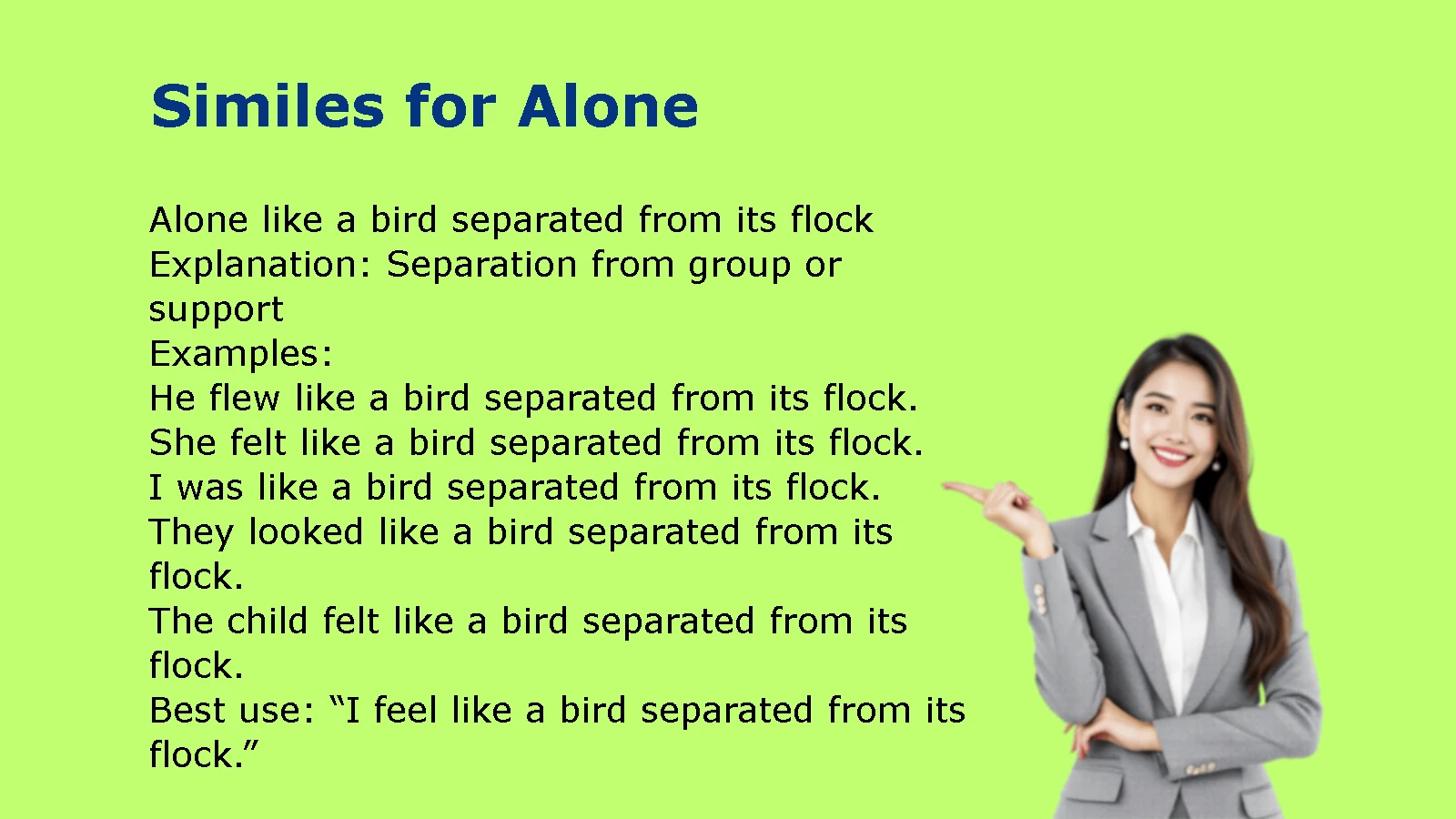
7. Alone like a bird separated from its flock
- Explanation: Separation from group or support
- Examples:
- He flew like a bird separated from its flock.
- She felt like a bird separated from its flock.
- I was like a bird separated from its flock.
- They looked like a bird separated from its flock.
- The child felt like a bird separated from its flock.
- Best use: “I feel like a bird separated from its flock.”
8. Alone like a candle in a dark room
- Explanation: Small presence in darkness
- Examples:
- He glowed like a candle in a dark room.
- She felt like a candle in a dark room.
- I was like a candle in a dark room.
- They stood like a candle in a dark room.
- The boy felt like a candle in a dark room.
- Best use: “I am like a candle in a dark room.”
9. Alone like a broken toy in a corner
- Explanation: Ignored and left behind
- Examples:
- He sat like a broken toy in a corner.
- She felt like a broken toy in a corner.
- I was like a broken toy in a corner.
- They looked like a broken toy in a corner.
- The child felt like a broken toy in a corner.
- Best use: “I feel like a broken toy in a corner.”
Related post: similes for crying examples
10. Alone like a leaf falling far from the tree
- Explanation: Separation from origin or support
- Examples:
- He fell like a leaf far from the tree.
- She felt like a leaf far from the tree.
- I was like a leaf far from the tree.
- They looked like a leaf far from the tree.
- The boy felt like a leaf far from the tree.
- Best use: “I am like a leaf far from the tree.”
11. Alone like an empty playground at night
- Explanation: Silence and lack of activity
- Examples:
- He stood like an empty playground at night.
- She felt like an empty playground at night.
- I was like an empty playground at night.
- They looked like an empty playground at night.
- The child felt like an empty playground at night.
- Best use: “I feel like an empty playground at night.”
12. Alone like a raft in the ocean
- Explanation: Weak and isolated in vast space
- Examples:
- He drifted like a raft in the ocean.
- She felt like a raft in the ocean.
- I was like a raft in the ocean.
- They looked like a raft in the ocean.
- The boy felt like a raft in the ocean.
- Best use: “I am like a raft in the ocean.”
13. Alone like a shadow without its body
- Explanation: Lost identity or support
- Examples:
- He moved like a shadow without its body.
- She felt like a shadow without its body.
- I was like a shadow without its body.
- They looked like a shadow without its body.
- The child felt like a shadow without its body.
- Best use: “I feel like a shadow without its body.”
14. Alone like a locked room with no key
- Explanation: Closed off and unreachable
- Examples:
- He felt like a locked room with no key.
- She was like a locked room with no key.
- I am like a locked room with no key.
- They looked like a locked room with no key.
- The boy felt like a locked room with no key.
- Best use: “I am like a locked room with no key.”
15. Alone like a bench in the rain
- Explanation: Silent, unused, and exposed
- Examples:
- He sat like a bench in the rain.
- She felt like a bench in the rain.
- I was like a bench in the rain.
- They looked like a bench in the rain.
- The child felt like a bench in the rain.
- Best use: “I feel like a bench in the rain.”
16. Alone like a missing puzzle piece
- Explanation: Incomplete and separate
- Examples:
- He felt like a missing puzzle piece.
- She was like a missing puzzle piece.
- I am like a missing puzzle piece.
- They looked like a missing puzzle piece.
- The boy felt like a missing puzzle piece.
- Best use: “I feel like a missing puzzle piece.”
17. Alone like a whisper in a storm
- Explanation: Weak voice in chaos
- Examples:
- He sounded like a whisper in a storm.
- She felt like a whisper in a storm.
- I was like a whisper in a storm.
- They looked like a whisper in a storm.
- The child felt like a whisper in a storm.
- Best use: “I am like a whisper in a storm.”
18. Alone like a candle burning at midnight
- Explanation: Quiet solitude in darkness
- Examples:
- He burned like a candle at midnight.
- She felt like a candle at midnight.
- I was like a candle at midnight.
- They looked like a candle at midnight.
- The boy felt like a candle at midnight.
- Best use: “I feel like a candle at midnight.”
19. Alone like a frozen lake in winter
- Explanation: Stillness and emotional coldness
- Examples:
- He stood like a frozen lake in winter.
- She felt like a frozen lake in winter.
- I was like a frozen lake in winter.
- They looked like a frozen lake in winter.
- The child felt like a frozen lake in winter.
- Best use: “I am like a frozen lake in winter.”
20. Alone like a radio with no signal
- Explanation: No connection or communication
- Examples:
- He felt like a radio with no signal.
- She was like a radio with no signal.
- I am like a radio with no signal.
- They looked like a radio with no signal.
- The boy felt like a radio with no signal.
- Best use: “I feel like a radio with no signal.”
21. Alone like a dried riverbed
- Explanation: Shows complete emptiness where life once flowed.
- Examples:
- I felt like a dried riverbed after the argument.
- He sat like a dried riverbed in silence.
- She looked like a dried riverbed in that empty room.
- They stood like a dried riverbed after the festival ended.
- My heart felt like a dried riverbed without friends.
- Best use: “I feel like a dried riverbed with no flow of life.”
22. Alone like a lonely mountain peak
- Explanation: Represents strong but isolated existence.
- Examples:
- He stood like a lonely mountain peak above everyone.
- She felt like a lonely mountain peak in her journey.
- I was like a lonely mountain peak at school.
- They looked like a lonely mountain peak in the valley.
- The man remained like a lonely mountain peak in life.
- Best use: “I am like a lonely mountain peak, standing alone.”
23. Alone like a deserted highway
- Explanation: Suggests emptiness and lack of movement or company.
- Examples:
- I walked like a deserted highway at night.
- He felt like a deserted highway after everyone left.
- She looked like a deserted highway during the holidays.
- They were like a deserted highway in the village.
- My thoughts were like a deserted highway, empty and quiet.
- Best use: “I feel like a deserted highway with no travelers.”
24. Alone like a single flame in the wind
- Explanation: Shows weakness and isolation under pressure.
- Examples:
- I felt like a single flame in the wind during hard times.
- He stood like a single flame in the wind at night.
- She was like a single flame in the wind after the breakup.
- They looked like a single flame in the wind in the storm.
- My hope felt like a single flame in the wind.
- Best use: “I am like a single flame in the wind, struggling to survive.”
25. Alone like a stranded traveler
- Explanation: Represents confusion and lack of direction.
- Examples:
- I felt like a stranded traveler in a new city.
- He looked like a stranded traveler on the road.
- She was like a stranded traveler after missing the bus.
- They stood like a stranded traveler in the forest.
- My heart felt like a stranded traveler in life.
- Best use: “I feel like a stranded traveler with no path.”
26. Alone like a silent forest at night
- Explanation: Deep silence and peaceful isolation.
- Examples:
- I felt like a silent forest at night.
- He stood like a silent forest under the moonlight.
- She was like a silent forest after everyone left.
- They looked like a silent forest during winter.
- My mind felt like a silent forest at night.
- Best use: “I am like a silent forest, quiet and alone.”
27. Alone like a lost letter in the mail
- Explanation: Forgotten and without destination.
- Examples:
- I felt like a lost letter in the mail.
- He was like a lost letter never delivered.
- She looked like a lost letter on a desk.
- They stood like a lost letter in the system.
- My dreams felt like a lost letter.
- Best use: “I am like a lost letter with no destination.”
28. Alone like a broken clock
- Explanation: Stuck and not moving forward.
- Examples:
- I felt like a broken clock in that moment.
- He looked like a broken clock in silence.
- She was like a broken clock after the news.
- They stood like a broken clock in the room.
- My life felt like a broken clock.
- Best use: “I am like a broken clock, stopped and alone.”
29. Alone like a boat without an anchor
- Explanation: Drifting without stability or support.
- Examples:
- I felt like a boat without an anchor in life.
- He was like a boat without an anchor at sea.
- She looked like a boat without an anchor in emotion.
- They stood like a boat without an anchor in a storm.
- My thoughts were like a boat without an anchor.
- Best use: “I am like a boat without an anchor, drifting alone.”
30. Alone like a single drop in the ocean
- Explanation: Insignificant and isolated in a large space.
- Examples:
- I felt like a single drop in the ocean.
- He was like a single drop in the vast sea.
- She looked like a single drop in the crowd.
- They stood like a single drop in the world.
- My presence felt like a single drop.
- Best use: “I am like a single drop in the ocean.”
31. Alone like a closed shop at midnight
- Explanation: Empty, silent, and inactive.
- Examples:
- I felt like a closed shop at midnight.
- He looked like a closed shop after hours.
- She stood like a closed shop in the street.
- They were like a closed shop during the holidays.
- My heart felt like a closed shop.
- Best use: “I am like a closed shop at midnight, empty inside.”
32. Alone like a bird on an empty wire
- Explanation: Small and isolated in a wide space.
- Examples:
- I felt like a bird on an empty wire.
- He sat like a bird on a lonely wire.
- She looked like a bird on a silent wire.
- They were like a bird on an empty wire.
- My soul felt like a bird on a wire.
- Best use: “I am like a bird on an empty wire, all alone.”
33. Alone like a dim street in fog
- Explanation: Unclear, quiet, and isolated environment.
- Examples:
- I walked like a dim street in fog.
- He felt like a dim street at night.
- She was like a dim street in silence.
- They looked like a dim street in fog.
- My mind felt like a dim street.
- Best use: “I am like a dim street in fog, unclear and alone.”
34. Alone like a forgotten path in the woods
- Explanation: Rarely used or noticed.
- Examples:
- I felt like a forgotten path in the woods.
- He was like a forgotten path overgrown.
- She looked like a forgotten path in forest.
- They stood like a forgotten path in silence.
- My journey felt like a forgotten path.
- Best use: “I am like a forgotten path no one walks on.”
35. Alone like a single note in silence
- Explanation: Small sound in vast quietness.
- Examples:
- I felt like a single note in silence.
- He sounded like a single note in a hall.
- She was like a single note in quiet room.
- They looked like a single note in silence.
- My voice felt like a single note.
- Best use: “I am like a single note in silence.”
36. Alone like a hollow shell
- Explanation: Empty inside despite outward presence.
- Examples:
- I felt like a hollow shell after loss.
- He stood like a hollow shell in silence.
- She was like a hollow shell emotionally.
- They looked like a hollow shell in the room.
- My heart felt like a hollow shell.
- Best use: “I am like a hollow shell, empty and alone.”
37. Alone like a fading star
- Explanation: Losing brightness and attention.
- Examples:
- I felt like a fading star in the sky.
- He was like a fading star in life.
- She looked like a fading star at night.
- They stood like a fading star in silence.
- My dreams felt like a fading star.
- Best use: “I am like a fading star, slowly disappearing.”
38. Alone like a single grain of sand
- Explanation: Tiny and unnoticed in vastness.
- Examples:
- I felt like a single grain of sand on the beach.
- He was like a grain of sand in desert.
- She looked like a grain of sand in crowd.
- They stood like a grain of sand in world.
- My identity felt like a grain of sand.
- Best use: “I am like a single grain of sand in the world.”
39. Alone like a shadow at noon
- Explanation: Barely visible and almost gone.
- Examples:
- I felt like a shadow at noon.
- He was like a shadow under bright sun.
- She looked like a shadow at midday.
- They stood like a shadow in sunlight.
- My presence felt like a shadow.
- Best use: “I am like a shadow at noon, almost invisible.”
40. Alone like a locked diary
- Explanation: Private, hidden, and unread.
- Examples:
- I felt like a locked diary.
- He was like a locked diary in silence.
- She looked like a locked diary in the room.
- They stood like a locked diary.
- My feelings were like a locked diary.
- Best use: “I am like a locked diary, unread and alone.”
41. Alone like a silent bell
- Explanation: Something meant to be heard but not ringing.
- Examples:
- I felt like a silent bell in church.
- He was like a silent bell in a tower.
- She looked like a silent bell in school.
- They stood like a silent bell.
- My voice felt like a silent bell.
- Best use: “I am like a silent bell, unheard and alone.”
42. Alone like a broken bridge
- Explanation: Cut off from connection or support.
- Examples:
- I felt like a broken bridge in friendship.
- He was like a broken bridge in the family.
- She looked like a broken bridge after a fight.
- They stood like a broken bridge in life.
- My heart felt like a broken bridge.
- Best use: “I am like a broken bridge, disconnected and alone.”
43. Alone like a winter tree without leaves
- Explanation: Empty, bare, and lifeless appearance.
- Examples:
- I felt like a winter tree without leaves.
- He was like a bare tree in winter.
- She looked like a leafless tree.
- They stood like a winter tree.
- My life felt like a winter tree.
- Best use: “I am like a winter tree without leaves.”
44. Alone like a deserted station
- Explanation: No movement, people, or activity.
- Examples:
- I felt like a deserted station at night.
- He was like an empty station platform.
- She looked like a deserted station in rain.
- They stood like a silent station.
- My surroundings felt like a deserted station.
- Best use: “I am like a deserted station, empty and quiet.”
45. Alone like a drifting cloud at dusk
- Explanation: Slow movement with no direction or company.
- Examples:
- I felt like a drifting cloud at dusk.
- He was like a cloud moving alone.
- She looked like a drifting cloud in sky.
- They stood like a cloud at sunset.
- My thoughts felt like a drifting cloud.
- Best use: “I am like a drifting cloud at dusk, moving alone.”
Conclusion
In the end, similes for alone offer a powerful way to express one of the most complex human emotions—solitude. If loneliness feels peaceful like a quiet forest or heavy like an empty house at night, similes help turn those feelings into clear and relatable images. They allow writers to go beyond simple statements and create emotional depth that readers can see and feel.
These comparisons are especially useful in poetry, storytelling, and descriptive writing, where emotions need to be shown rather than told. By using similes, solitude becomes more than just being by oneself; it transforms into meaningful imagery that reflects mood, thought, and experience.
Ultimately, learning and using similes for alone can make your writing more expressive, creative, and emotionally engaging, helping you connect with readers on a deeper level.