Time is a deeply abstract concept that becomes more meaningful when expressed through vivid comparison. In writing, similes for time are used to translate its invisible flow into relatable imagery, helping readers perceive duration, speed, and change more emotionally and visually. These comparisons connect temporal experiences with familiar natural and physical patterns, making abstract moments easier to understand.
In creative expression, time is often described through imagery drawn from nature and movement—such as flowing rivers, drifting clouds, melting ice, or fading light. These simile structures reflect how time feels in different contexts: sometimes fast and fleeting, other times slow and heavy. This flexibility allows writers to shape emotional tone while describing the passage of moments.
Similes for time also enhance storytelling by adding depth, rhythm, and sensory detail. A moment can feel as quick as a shooting star or as slow as a shadow stretching at sunset, depending on the emotion being conveyed. Such expressions not only describe time but also shape how it is experienced by the reader.
Overall, similes make the concept of time more expressive and engaging, turning an abstract idea into a vivid and relatable part of language.
Importance of Similes for Time
Similes for time are important because time itself is an abstract concept that cannot be seen or touched. Writers often struggle to describe its speed, flow, or emotional impact. By using similes, time becomes relatable and easier to understand through familiar comparisons like nature, objects, or movement.
In communication and writing, similes help create strong mental images. They allow readers to experience time as something fast, slow, heavy, or light depending on the situation. This improves storytelling, poetry, and even everyday descriptions. Without similes, writing about time can feel flat and less engaging.
Similes for Time Examples
1. Time is like a river
- Explanation: It flows continuously forward
- Examples:
- Time flows like a river every day.
- My childhood passed like a river.
- Time moves like a calm river.
- The moment slipped like a river current.
- Life goes like a flowing river.
- Best use: “Time is like a river; you can’t stop it.”
2. Time is like a speeding train
- Explanation: It moves fast and unstoppable
- Examples:
- Time ran like a speeding train today.
- The weekend passed like a fast train.
- My holidays went like a train.
- Time moved like a rushing train.
- The exam day came like a train.
- Best use: “Time felt like a speeding train.”
3. Time is like sand slipping through fingers
- Explanation: It is hard to hold or control
- Examples:
- Time slipped like sand in my hand.
- The day passed like falling sand.
- Moments went like sand grains.
- Time escapes like sand quickly.
- Childhood left like slipping sand.
- Best use: “Time is like sand slipping away.”
4. Time is like lightning
- Explanation: Extremely fast
- Examples:
- The hour passed like lightning.
- Time struck like lightning today.
- The event ended like lightning.
- Moments flashed like lightning.
- The game went like lightning speed.
- Best use: “Time passed like lightning.”
5. Time is like a flowing cloud
- Explanation: Soft and continuous movement
- Examples:
- Time drifted like clouds.
- The day moved like a soft cloud.
- Time passed like floating clouds.
- Moments went like drifting sky clouds.
- Life moved like slow clouds.
- Best use: “Time flows like a cloud in the sky.”
6. Time is like a ticking clock
- Explanation: Constant and steady movement
- Examples:
- Time passed like a ticking clock.
- My wait felt like a clock ticking.
- Hours moved like a slow clock.
- Time ran like ticking seconds.
- The night passed like a clock.
- Best use: “Time is like a ticking clock.”
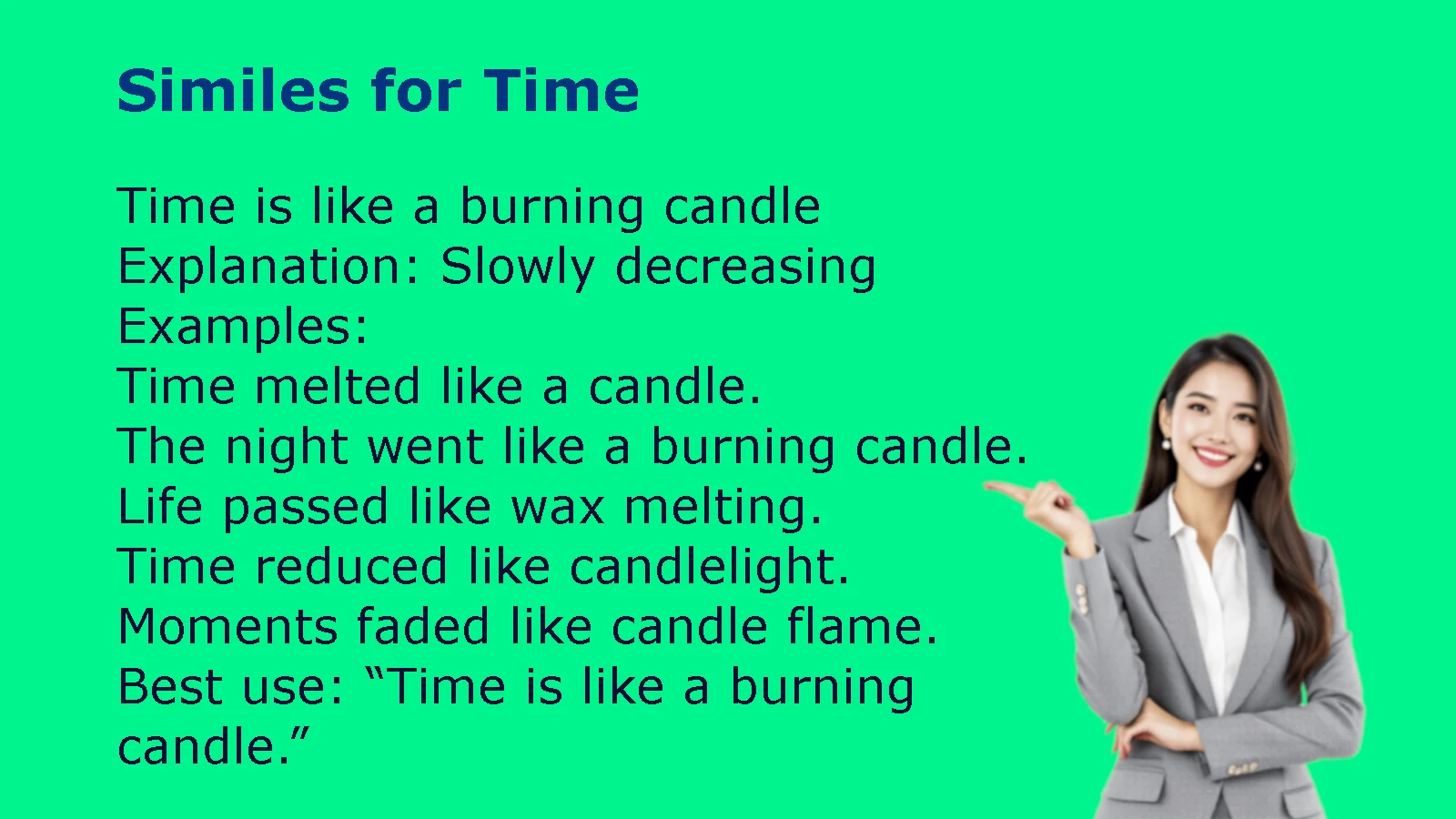
7. Time is like a burning candle
- Explanation: Slowly decreasing
- Examples:
- Time melted like a candle.
- The night went like a burning candle.
- Life passed like wax melting.
- Time reduced like candlelight.
- Moments faded like candle flame.
- Best use: “Time is like a burning candle.”
8. Time is like a fast wind
- Explanation: Quick and invisible movement
- Examples:
- Time rushed like wind today.
- The day flew like strong wind.
- Hours passed like breeze.
- Time moved like a storm wind.
- Moments vanished like wind.
- Best use: “Time moves like fast wind.”
9. Time is like a flowing ocean tide
- Explanation: Continuous rise and fall
- Examples:
- Time came like ocean waves.
- The day passed like tides.
- Moments moved like sea waves.
- Time flowed like water tide.
- Life went like ocean flow.
- Best use: “Time is like ocean tides.”
10. Time is like a blinking eye
- Explanation: Very quick moment
- Examples:
- The moment passed like a blink.
- Time went like an eye blink.
- The match ended like a blink.
- Hours passed like blinking eyes.
- Time vanished like blinking.
- Best use: “Time passed like a blink of an eye.”
11. Time is like a racing car
- Explanation: It moves extremely fast and feels unstoppable
- Examples:
- Time passed like a racing car today.
- The meeting went like a fast car on a highway.
- My school day felt like a racing car.
- Time moved like a speeding vehicle.
- The holiday ended like a race car.
- Best use: “Time is like a racing car on the track.”
12. Time is like melting ice
- Explanation: It slowly disappears over time
- Examples:
- Time slipped away like melting ice.
- The afternoon passed like ice melting in the sun.
- My free time felt like melting ice.
- Hours went like slowly melting cubes.
- Childhood faded like ice in warmth.
- Best use: “Time is like melting ice under the sun.”
13. Time is like a falling leaf
- Explanation: Gentle, slow, and natural movement
- Examples:
- Time passed like a falling leaf in autumn.
- The day drifted like leaves in the wind.
- Moments dropped like a leaf from a tree.
- Time moved softly like falling foliage.
- My evening went like a leaf floating down.
- Best use: “Time flows like a falling leaf.”
14. Time is like a spinning wheel
- Explanation: Constant motion without stopping
- Examples:
- Time moved like a spinning wheel.
- My day felt like a turning wheel.
- Life goes like a spinning cycle.
- Hours passed like a rotating wheel.
- Time never stops, like a spinning wheel.
- Best use: “Time is like a spinning wheel of life.”
15. Time is like a shooting star
- Explanation: Very fast and short-lived
- Examples:
- The moment passed like a shooting star.
- Time flashed like a star in the sky.
- The opportunity went like a shooting star.
- My vacation ended like a quick star streak.
- The night felt like a shooting star.
- Best use: “Time passed like a shooting star in the sky.”
16. Time is like a flowing fountain
- Explanation: Continuous and steady movement
- Examples:
- Time flowed like a fountain.
- My day passed like water from a fountain.
- Moments came like a flowing spray.
- Time moved like a steady water stream.
- Life goes like a fountain of seconds.
- Best use: “Time flows like a fountain of life.”
17. Time is like a moving shadow
- Explanation: Always present but changing position
- Examples:
- Time followed me like a shadow.
- The day passed like a moving shadow.
- Hours went like shifting shadows.
- Time stayed like a quiet shadow.
- Life moved like a fading shadow.
- Best use: “Time is like a moving shadow behind us.”
18. Time is like a bursting bubble
- Explanation: Sudden and quick disappearance
- Examples:
- The moment ended like a bursting bubble.
- Time disappeared like a popped balloon.
- The joy went like a broken bubble.
- Hours passed like soap bubbles bursting.
- The event ended like a bubble pop.
- Best use: “Time ends like a bursting bubble.”
19. Time is like a rolling ball
- Explanation: Continuous forward motion
- Examples:
- Time moved like a rolling ball.
- My day went like a ball rolling downhill.
- Hours passed like a moving sphere.
- Time kept rolling without stopping.
- Life goes like a rolling ball of moments.
- Best use: “Time is like a rolling ball downhill.”
20. Time is like a burning match
- Explanation: Short and quickly ending
- Examples:
- Time passed like a burning matchstick.
- The meeting ended like a quick flame.
- My break went like a burning match.
- Hours disappeared like fire on a match.
- The moment ended like a flicker.
- Best use: “Time burns like a matchstick.”
21. Time is like a flying bird
- Explanation: Fast and free movement
- Examples:
- Time flew like a bird in the sky.
- The weekend passed like a flying eagle.
- My holiday went like a bird’s flight.
- Time moved like wings in the air.
- Moments disappeared like flying birds.
- Best use: “Time flies like a bird in the sky.”
22. Time is like a drifting boat
- Explanation: Slow, calm movement
- Examples:
- Time passed like a boat on water.
- My evening drifted like a riverboat.
- Hours moved like a floating ship.
- Time sailed slowly like a boat.
- The day went like a drifting vessel.
- Best use: “Time is like a drifting boat on water.”
23. Time is like a storm
- Explanation: Fast, powerful, and overwhelming
- Examples:
- Time passed like a sudden storm.
- The day went like a thunderstorm.
- Moments hit like a strong storm.
- Time rushed like a violent windstorm.
- The event passed like stormy weather.
- Best use: “Time comes like a storm.”
24. Time is like a heartbeat
- Explanation: Steady and constant rhythm
- Examples:
- Time moves like a heartbeat.
- My life passed like heartbeats.
- Seconds came like rhythmic beats.
- Time felt like a steady pulse.
- The moment went like a heart rhythm.
- Best use: “Time is like a heartbeat of life.”
25. Time is like a turning page
- Explanation: One moment changes into another
- Examples:
- Time passed like turning pages.
- My day went like a book page.
- Life changed like flipping pages.
- Moments moved like page turns.
- Time flows like a story page.
- Best use: “Time is like turning pages of a book.”
26. Time is like flowing ink
- Explanation: It continuously writes life’s story
- Examples:
- Time passed like flowing ink on paper.
- My memories formed like ink spreading.
- The day went like written ink.
- Time moved like ink in a pen.
- Life continued like flowing words of ink.
- Best use: “Time is like flowing ink writing life.”
27. Time is like melting snow
- Explanation: Slowly disappearing and fading away
- Examples:
- Time slipped like melting snow in sunlight.
- The moment faded like snow melting.
- Hours passed like soft snow dissolving.
- Childhood went like melting snow.
- The day ended like snow vanishing.
- Best use: “Time fades like melting snow.”
28. Time is like a fast arrow
- Explanation: Straight, quick, and unstoppable
- Examples:
- Time moved like a fast arrow.
- The day passed like a flying arrow.
- Moments went like arrows in motion.
- Time shot forward like an arrow.
- My weekend flew like a sharp arrow.
- Best use: “Time goes like a fast arrow.”
29. Time is like a spinning top
- Explanation: Constant motion but unstable
- Examples:
- Time turned like a spinning top.
- My day felt like a spinning toy.
- Hours moved like a wobbling top.
- Time rotated like a fast-spinning toy.
- Life went like a spinning object.
- Best use: “Time spins like a top.”
30. Time is like a fading echo
- Explanation: Slowly disappearing sound or effect
- Examples:
- Time faded like an echo in the mountains.
- The moment went like a soft echo.
- Hours passed like a disappearing sound.
- Time slipped like a fading voice.
- Memories felt like echoing sounds.
- Best use: “Time is like a fading echo.”
31. Time is like a cloud shadow
- Explanation: Slow-moving and gentle
- Examples:
- Time moved like a drifting cloud shadow.
- My afternoon passed like soft shade.
- Hours went like moving cloud cover.
- Time floated like sky shadows.
- The day moved like shifting shade.
- Best use: “Time is like a cloud shadow.”
32. Time is like a racing horse
- Explanation: Fast, energetic, and powerful
- Examples:
- Time ran like a racing horse.
- The day passed like a galloping horse.
- Hours moved like fast hooves.
- Time rushed like a wild horse.
- Moments went by like racing animals.
- Best use: “Time runs like a racing horse.”
33. Time is like a flowing stream
- Explanation: Smooth, continuous movement
- Examples:
- Time passed like a flowing stream.
- My life went like a gentle river stream.
- Hours moved like water flow.
- Time drifted like a small creek.
- The day passed like flowing water.
- Best use: “Time flows like a stream.”
34. Time is like a broken hourglass
- Explanation: Loss of control over time
- Examples:
- Time slipped like a broken hourglass.
- My schedule felt like spilled sand.
- Hours went like lost grains.
- Time fell apart like broken glass sand timer.
- The moment felt uncontrollable like sand spilling.
- Best use: “Time is like a broken hourglass.”
35. Time is like a glowing spark
- Explanation: Short-lived but bright
- Examples:
- Time passed like a glowing spark.
- The moment shined like a spark.
- Hours went like fire sparks.
- Time flashed like glowing light.
- Life felt like a quick spark.
- Best use: “Time is like a glowing spark in darkness.”
36. Time is like a flying kite
- Explanation: Moves freely but unpredictably
- Examples:
- Time flew like a kite in the sky.
- My day went like a drifting kite.
- Hours moved like wind-blown string.
- Time floated like a flying object.
- Moments went like a loose kite.
- Best use: “Time is like a flying kite in wind.”
37. Time is like a wheel of fortune
- Explanation: Always changing and unpredictable
- Examples:
- Time turned like a wheel of fortune.
- My luck changed like spinning time.
- Hours went like rotating destiny.
- Time shifted like a turning wheel.
- Life moved like fortune spinning.
- Best use: “Time is like a wheel of fortune.”
38. Time is like a river current
- Explanation: Strong and unstoppable flow
- Examples:
- Time moved like a river current.
- The day was pulled like strong water flow.
- Hours passed like a deep river movement.
- Time rushed like underwater current.
- Life went like flowing stream force.
- Best use: “Time is like a strong river current.”
39. Time is like a falling raindrop
- Explanation: Quick and continuous moments
- Examples:
- Time dropped like falling rain.
- My day passed like rain drops.
- Hours went like water falling.
- Time slipped like rain from clouds.
- Moments came like raindrops.
- Best use: “Time falls like raindrops from sky.”
40. Time is like a closing book
- Explanation: Ending or finishing phase
- Examples:
- Time ended like a closing book.
- My day felt like finishing a story.
- Hours passed like shutting pages.
- Time closed like a book cover.
- The moment ended like story end.
- Best use: “Time is like a closing book.”
41. Time is like a rising sun
- Explanation: New beginnings and cycles
- Examples:
- Time started like a rising sun.
- My morning felt like sunrise.
- Hours came like morning light.
- Time grew like sun in sky.
- Life began like sunrise glow.
- Best use: “Time is like a rising sun.”
42. Time is like a setting sun
- Explanation: Ending or completion
- Examples:
- Time ended like a setting sun.
- The day closed like evening light.
- Hours passed like sunset glow.
- Time faded like sun going down.
- Moments ended like dusk.
- Best use: “Time is like a setting sun.”
43. Time is like a fast elevator
- Explanation: Sudden and rapid change
- Examples:
- Time moved like a fast elevator.
- The day went up like lift speed.
- Hours changed like elevator movement.
- Time jumped like a lift going up.
- Moments passed like quick travel.
- Best use: “Time moves like a fast elevator.”
44. Time is like a flowing river of sand
- Explanation: Continuous but hard to control
- Examples:
- Time slipped like sand river.
- My life went like flowing desert sand.
- Hours passed like sand stream.
- Time moved like golden sand flow.
- Moments disappeared like desert flow.
- Best use: “Time is like a river of sand.”
45. Time is like a vanishing mist
- Explanation: Quickly disappearing and unclear
- Examples:
- Time faded like morning mist.
- The moment went like fog disappearing.
- Hours passed like soft mist.
- Time vanished like smoke in air.
- Life felt like drifting fog.
- Best use: “Time is like vanishing mist.”
Conclusion
In conclusion, similes for time play an important role in transforming an abstract concept into a vivid and meaningful expression. By comparing time to familiar elements such as flowing rivers, fading light, drifting clouds, or shifting sand, writers make the passage of time easier to visualize and understand emotionally. These comparisons bridge the gap between intangible duration and sensory experience, giving language more depth and clarity.
In creative writing, similes about time help convey emotional states such as urgency, nostalgia, calm, or transience. A moment can feel extremely fast or painfully slow depending on the comparison used, which adds flexibility and richness to storytelling. This makes similes a powerful tool for poets, writers, and learners who want to improve their descriptive language skills.
Ultimately, mastering similes for time enhances both imagination and communication. It allows writers to present time not just as a measurement, but as a living experience shaped by emotion and perception.