Food is one of the most powerful human experiences because it connects people through taste, aroma, culture, and emotion, whether you are preparing it at home or eating outside. However, describing its richness often requires more than simple adjectives. This is where similes for food become especially useful, as they help writers express flavors and textures more vividly and imaginatively. Instead of saying something is “tasty” or “soft,” figurative language may intensify your appetite by comparing food to familiar objects and experiences that readers can easily visualize.
For example, food can be described as “as sweet as sugar melting on the tongue,” “as crunchy as dry autumn leaves underfoot,” or “as rich as melted butter spreading over warm bread.” These comparisons bring ordinary descriptions to life, making them more engaging and enjoyable to read. A spicy dish might be described as “as hot as a burning fire,” while a smooth dessert could be “as soft as silk or cotton clouds.”
Such similes not only enhance visual imagery but also allow readers to almost taste, smell, and feel the food being described. In storytelling, poetry, and descriptive writing, similes for food play an important role in turning simple meals into sensory experiences filled with emotion and detail.
Ultimately, these creative comparisons enrich language and help readers connect more deeply with the joy and diversity of food, making every description more flavorful and memorable.
Importance of Similes for Food
Similes for food are important because they transform simple food descriptions into rich sensory experiences. Instead of just telling what food is, similes help show how it looks, tastes, or feels. This makes communication more powerful in both writing and speaking.
In literature, similes help authors create strong emotional and sensory connections with readers. In everyday communication, they help people express opinions about food more interestingly. For example, saying food is “as crispy as autumn leaves” paints a stronger picture than simply saying it is crispy. This makes language more expressive, engaging, and enjoyable.
Similes for Food Examples
1. As sweet as honey
Explanation: Describes food with natural sugary sweetness
- The cake was as sweet as honey.
- Her smile was as sweet as honey on a warm day.
- This juice tastes as sweet as honey.
- The candy is as sweet as honey.
- The dessert feels as sweet as honey in every bite.
Best use: “This dessert is as sweet as honey.”
2. As spicy as chili
Explanation: Used for very hot and spicy food
- The curry is as spicy as chili.
- His joke was as spicy as chili.
- This sauce feels as spicy as chili.
- The noodles are as spicy as chili.
- The dish tastes as spicy as chili.
Best use: “This curry is as spicy as chili.”
3. As soft as butter
Explanation: Describes very soft and smooth food
- The bread is as soft as butter.
- The cake feels as soft as butter.
- Her voice was as soft as butter.
- The pastry is as soft as butter.
- This dessert melts as soft as butter.
Best use: “This cake is as soft as butter.”
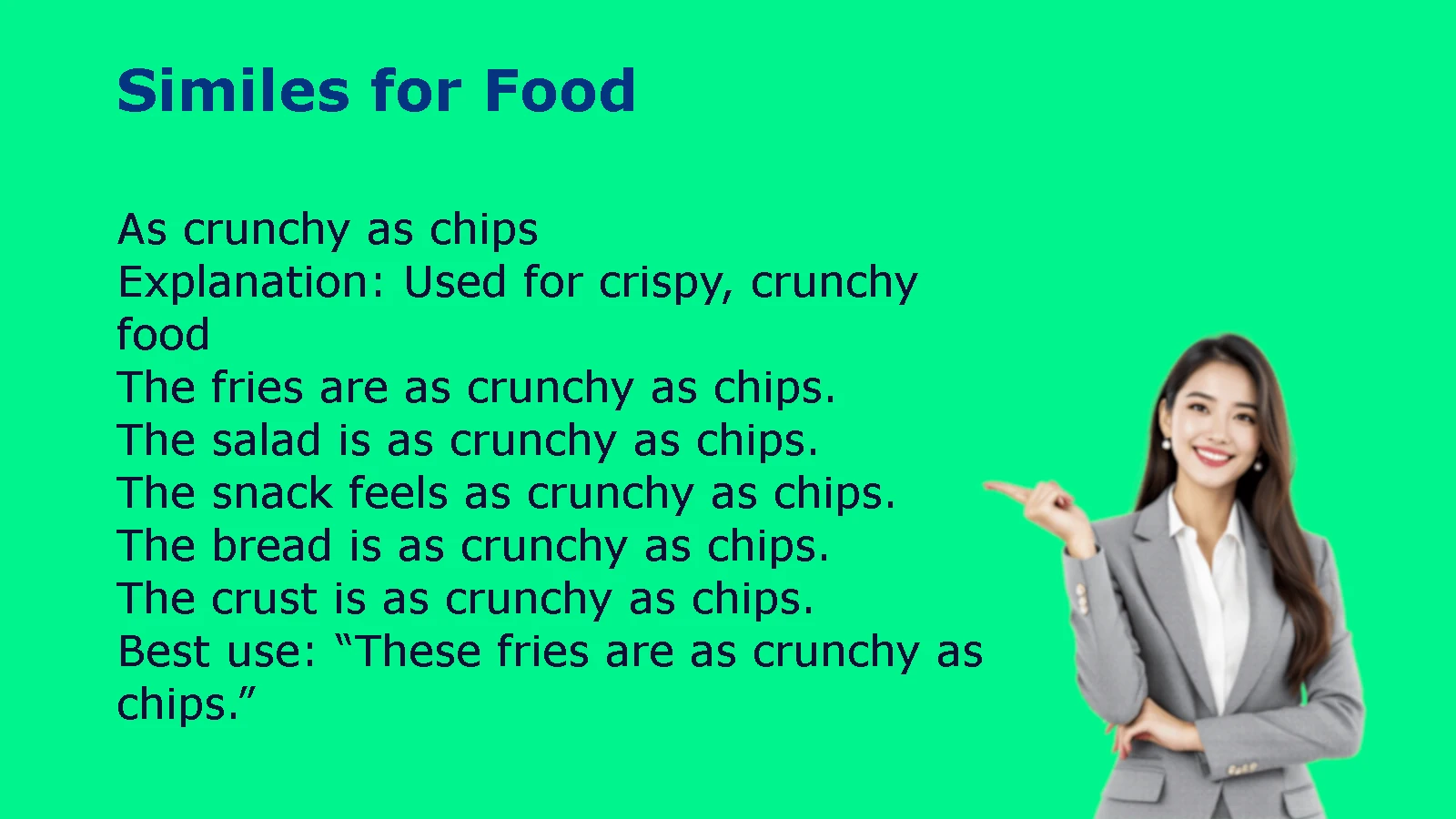
4. As crunchy as chips
Explanation: Used for crispy, crunchy food
- The fries are as crunchy as chips.
- The salad is as crunchy as chips.
- The snack feels as crunchy as chips.
- The bread is as crunchy as chips.
- The crust is as crunchy as chips.
Best use: “These fries are as crunchy as chips.”
5. As fresh as morning dew
Explanation: Describes very fresh food
- The salad is as fresh as morning dew.
- The vegetables are as fresh as morning dew.
- The juice tastes as fresh as morning dew.
- The fish is as fresh as morning dew.
- The fruit feels as fresh as morning dew.
Best use: “This salad is as fresh as morning dew.”
6. As bitter as medicine
Explanation: Used for very bitter food
- The tea is as bitter as medicine.
- The coffee tastes as bitter as medicine.
- The herb is as bitter as medicine.
- The drink feels as bitter as medicine.
- The vegetable is as bitter as medicine.
Best use: “This coffee is as bitter as medicine.”
7. As juicy as a watermelon
Explanation: Describes very juicy food
- The burger is as juicy as a watermelon.
- The steak is as juicy as a watermelon.
- The fruit feels as juicy as a watermelon.
- The chicken is as juicy as a watermelon.
- The orange is as juicy as a watermelon.
Best use: “This burger is as juicy as a watermelon.”
8. As hot as fire
Explanation: Extremely hot or spicy food
- The soup is as hot as fire.
- The curry tastes as hot as fire.
- The tea feels as hot as fire.
- The sauce is as hot as fire.
- The dish burns as hot as fire.
Best use: “This soup is as hot as fire.”
9. As cold as ice cream
Explanation: Very cold food or drink
- The drink is as cold as ice cream.
- The smoothie is as cold as ice cream.
- The dessert feels as cold as ice cream.
- The water is as cold as ice cream.
- The milkshake is as cold as ice cream.
Best use: “This drink is as cold as ice cream.”
10. As light as air
Explanation: Very light food texture
- The cake is as light as air.
- The mousse feels as light as air.
- The snack is as light as air.
- The bread is as light as air.
- The dessert melts as light as air.
Best use: “This cake is as light as air.”
11. As smooth as cream
Explanation: Very smooth-textured food
- The soup is as smooth as cream.
- The pudding feels as smooth as cream.
- The sauce is as smooth as cream.
- The dessert is as smooth as cream.
- The drink tastes as smooth as cream.
Best use: “This soup is as smooth as cream.”
12. As salty as the sea
Explanation: Very salty food
- The chips are as salty as the sea.
- The soup tastes as salty as the sea.
- The snack feels as salty as the sea.
- The fish is as salty as the sea.
- The dish is as salty as the sea.
Best use: “These chips are as salty as the sea.”
13. As sweet as sugar
Explanation: Extremely sweet taste
- The candy is as sweet as sugar.
- The cake is as sweet as sugar.
- The juice tastes as sweet as sugar.
- The dessert is as sweet as sugar.
- The fruit feels as sweet as sugar.
Best use: “This candy is as sweet as sugar.”
14. As chewy as gum
Explanation: Food with a chewy texture
- The bread is as chewy as gum.
- The meat feels as chewy as gum.
- The snack is as chewy as gum.
- The candy is as chewy as gum.
- The noodles are as chewy as gum.
Best use: “This bread is as chewy as gum.”
15. As flaky as pastry
Explanation: Light, layered texture
- The pie is as flaky as a pastry.
- The crust is as flaky as pastry.
- The snack feels as flaky as a pastry.
- The bread is as flaky as pastry.
- The dessert is as flaky as a pastry.
Best use: “This pie is as flaky as pastry.”
16. As rich as a chocolate cake
Explanation: Describes very rich, heavy, and flavorful food
- The dessert is as rich as a chocolate cake.
- The pudding feels as rich as chocolate cake.
- The drink tastes as rich as chocolate cake.
- The sauce is as rich as chocolate cake.
- The pastry is as rich as a chocolate cake.
Best use: “This dessert is as rich as chocolate cake.”
17. As warm as fresh bread
Explanation: Describes comforting warm food
- The bread is as warm as fresh bread from the oven.
- The soup feels as warm as fresh bread.
- The meal is as warm as fresh bread.
- The drink tastes as warm as fresh bread.
- The dish is as warm as fresh bread on a winter day.
Best use: “This soup is as warm as fresh bread.”
18. As tangy as lemon juice
Explanation: Used for sour and sharp taste
- The salad is as tangy as lemon juice.
- The sauce tastes as tangy as lemon juice.
- The drink feels as tangy as lemon juice.
- The fruit is as tangy as lemon juice.
- The dressing is as tangy as lemon juice.
Best use: “This dressing is as tangy as lemon juice.”
19. As bland as plain rice
Explanation: Very simple or tasteless food
- The soup is as bland as plain rice.
- The dish tastes as bland as plain rice.
- The meal feels as bland as plain rice.
- The snack is as bland as plain rice.
- The food is as bland as plain rice without spices.
Best use: “This meal is as bland as plain rice.”
20. As aromatic as roasted coffee
Explanation: Strong and pleasant smell
- The kitchen smells as aromatic as roasted coffee.
- The dish is as aromatic as roasted coffee.
- The spice feels as aromatic as roasted coffee.
- The food is as aromatic as roasted coffee.
- The meal smells as aromatic as roasted coffee in the morning.
Best use: “This dish is as aromatic as roasted coffee.”
21. As fragrant as baked bread
Explanation: Pleasant food smell.
- The kitchen is as fragrant as baked bread.
- The pastry smells as fragrant as baked bread.
- The cake is as fragrant as baked bread.
- The dish feels as fragrant as baked bread.
- The snack is as fragrant as baked bread fresh from oven.
Best use: “This kitchen smells as fragrant as baked bread.”
22. As oily as fried snacks
Explanation: Describes greasy food
- The chips are as oily as fried snacks.
- The burger feels as oily as fried snacks.
- The food is as oily as fried snacks.
- The meal tastes as oily as fried snacks.
- The dish is as oily as fried snacks from a street stall.
Best use: “These fries are as oily as fried snacks.”
23. As tender as slow-cooked meat
Explanation: Very soft meat texture
- The chicken is as tender as slow-cooked meat.
- The beef feels as tender as slow-cooked meat.
- The dish is as tender as slow-cooked meat.
- The meal tastes as tender as slow-cooked meat.
- The roast is as tender as slow-cooked meat.
Best use: “This chicken is as tender as slow-cooked meat.”
24. As dry as toast
Explanation: Very dry food
- The bread is as dry as toast.
- The cake feels as dry as toast.
- The snack is as dry as toast.
- The food tastes as dry as toast.
- The meal is as dry as toast without sauce.
Best use: “This bread is as dry as toast.”
25. As sticky as caramel
Explanation: Very sticky texture
- The candy is as sticky as caramel.
- The sauce feels as sticky as caramel.
- The dessert is as sticky as caramel.
- The fingers are as sticky as caramel after eating.
- The sweet is as sticky as caramel.
Best use: “This candy is as sticky as caramel.”
26. As sour as vinegar
Explanation: Extremely sour taste
- The drink is as sour as vinegar.
- The sauce tastes as sour as vinegar.
- The fruit is as sour as vinegar.
- The dish feels as sour as vinegar.
- The salad dressing is as sour as vinegar.
Best use: “This drink is as sour as vinegar.”
27. As nutty as roasted almonds
Explanation: Strong nut flavor
- The cake is as nutty as roasted almonds.
- The snack tastes as nutty as roasted almonds.
- The butter feels as nutty as roasted almonds.
- The dessert is as nutty as roasted almonds.
- The cereal is as nutty as roasted almonds.
Best use: “This snack is as nutty as roasted almonds.”
28. As refreshing as mint water
Explanation: Cooling and fresh feeling
- The drink is as refreshing as mint water.
- The juice feels as refreshing as mint water.
- The salad is as refreshing as mint water.
- The smoothie tastes as refreshing as mint water.
- The fruit bowl is as refreshing as mint water.
Best use: “This drink is as refreshing as mint water.”
29. As earthy as mushrooms
Explanation: Natural, deep flavor
- The soup is as earthy as mushrooms.
- The dish tastes as earthy as mushrooms.
- The sauce feels as earthy as mushrooms.
- The meal is as earthy as mushrooms.
- The stew is as earthy as mushrooms.
Best use: “This soup is as earthy as mushrooms.”
30. As zesty as orange peel
Explanation: Sharp citrus flavor
- The salad is as zesty as orange peel.
- The drink tastes as zesty as orange peel.
- The sauce feels as zesty as orange peel.
- The dish is as zesty as orange peel.
- The snack is as zesty as orange peel.
Best use: “This salad is as zesty as orange peel.”
31. As fluffy as cotton candy
Explanation: Very light and airy food
- The cake is as fluffy as cotton candy.
- The dessert feels as fluffy as cotton candy.
- The bread is as fluffy as cotton candy.
- The mousse is as fluffy as cotton candy.
- The pastry is as fluffy as cotton candy.
Best use: “This cake is as fluffy as cotton candy.”
32. As dense as fudge
Explanation: Very thick and heavy texture
- The cake is as dense as fudge.
- The brownie feels as dense as fudge.
- The dessert is as dense as fudge.
- The sweet tastes as dense as fudge.
- The snack is as dense as fudge.
Best use: “This brownie is as dense as fudge.”
33. As burnt as overcooked toast
Explanation: Food is overly cooked
- The bread is as burnt as overcooked toast.
- The pizza feels as burnt as overcooked toast.
- The food tastes as burnt as overcooked toast.
- The snack is as burnt as overcooked toast.
- The meal is as burnt as overcooked toast.
Best use: “This toast is as burnt as overcooked toast.”
34. As colorful as fruit salad
Explanation: Bright and mixed colors
- The plate is as colorful as fruit salad.
- The dessert looks as colorful as fruit salad.
- The meal is as colorful as fruit salad.
- The snack is as colorful as fruit salad.
- The dish feels as colorful as fruit salad.
Best use: “This bowl is as colorful as fruit salad.”
35. As rich as cream cheese
Explanation: Thick and creamy taste
- The sauce is as rich as cream cheese.
- The dessert tastes as rich as cream cheese.
- The spread feels as rich as cream cheese.
- The cake is as rich as cream cheese.
- The frosting is as rich as cream cheese.
Best use: “This frosting is as rich as cream cheese.”
36. As crispy as autumn leaves
Explanation: Very crisp texture
- The chips are as crispy as autumn leaves.
- The snack feels as crispy as autumn leaves.
- The fries are as crispy as autumn leaves.
- The bread is as crispy as autumn leaves.
- The crust is as crispy as autumn leaves.
Best use: “These chips are as crispy as autumn leaves.”
37. As warm as soup on a cold day
Explanation: Comforting warm food
- The meal is as warm as soup on a cold day.
- The drink feels as warm as soup on a cold day.
- The dish is as warm as soup on a cold day.
- The food tastes as warm as soup on a cold day.
- The bowl is as warm as soup on a cold day.
Best use: “This soup is as warm as soup on a cold day.”
38. As sharp as aged cheese
Explanation: Strong taste
- The cheese is as sharp as aged cheese.
- The sauce tastes as sharp as aged cheese.
- The dish feels as sharp as aged cheese.
- The snack is as sharp as aged cheese.
- The flavor is as sharp as aged cheese.
Best use: “This cheese is as sharp as aged cheese.”
39. As sweet as birthday cake
Explanation: Very sweet festive food
- The dessert is as sweet as birthday cake.
- The cake tastes as sweet as a birthday cake.
- The frosting feels as sweet as birthday cake.
- The snack is as sweet as birthday cake.
- The treat is as sweet as birthday cake.
Best use: “This cake is as sweet as birthday cake.”
40. As fresh as garden vegetables
Explanation: Very fresh produce
- The salad is as fresh as garden vegetables.
- The dish feels as fresh as garden vegetables.
- The juice tastes as fresh as garden vegetables.
- The food is as fresh as garden vegetables.
- The meal is as fresh as garden vegetables.
Best use: “This salad is as fresh as garden vegetables.”
41. As heavy as fruitcake
Explanation: Dense and heavy food
- The cake is as heavy as fruitcake.
- The dessert feels as heavy as fruitcake.
- The snack is as heavy as fruitcake.
- The food tastes as heavy as fruitcake.
- The meal is as heavy as fruitcake.
Best use: “This dessert is as heavy as fruitcake.”
42. As soft as marshmallows
Explanation: Very soft texture
- The cake is as soft as marshmallows.
- The dessert feels as soft as marshmallows.
- The bread is as soft as marshmallows.
- The snack is as soft as marshmallows.
- The treat is as soft as marshmallows.
Best use: “This cake is as soft as marshmallows.”
43. As flavorful as spices in curry
Explanation: Strong mixed flavors
- The dish is as flavorful as the spices in curry.
- The food tastes as flavorful as the spices in curry.
- The meal feels as flavorful as spices in curry.
- The snack is as flavorful as the spices in curry.
- The soup is as flavorful as the spices in curry.
Best use: “This curry is as flavorful as the spices in curry.”
44. As delicate as sushi rice
Explanation: Light and soft texture
- The rice is as delicate as sushi rice.
- The dish feels as delicate as sushi rice.
- The meal is as delicate as sushi rice.
- The snack tastes as delicate as sushi rice.
- The food is as delicate as sushi rice.
Best use: “This rice is as delicate as sushi rice.”
45. As thick as a milkshake
Explanation: Very thick liquid texture
- The drink is as thick as a milkshake.
- The smoothie feels as thick as a milkshake.
- The dessert is as thick as a milkshake.
- The shake tastes as thick as a milkshake.
- The beverage is as thick as a milkshake.
Best use: “This shake is as thick as a milkshake.”
Conclusion:
In conclusion, similes for food are powerful tools that make writing more vivid, expressive, and enjoyable. By comparing flavors, textures, and aromas to familiar objects and experiences, they help transform simple food descriptions into rich sensory images. Instead of plain statements, similes allow readers to imagine how food tastes, feels, and even smells, making the description more engaging and memorable.
Whether it is “as sweet as honey,” “as crunchy as dry leaves,” or “as smooth as silk,” these comparisons bring life to everyday language. They are widely used in poetry, storytelling, blogs, and descriptive writing to create stronger emotional and visual impact. Similes not only improve clarity but also add creativity, helping writers connect more deeply with their readers.
Ultimately, using similes for food enhances communication by turning ordinary meals into meaningful experiences. They remind us that food is not just something we eat, but something we feel, enjoy, and remember through imagination and expression.