A thanks reply is a response you give when someone says “thank you” or “thanks.” The most common reply is “You’re welcome,” but it isn’t your only option. Depending on the situation, you can say “My pleasure,” “No problem,” “Anytime,” “Happy to help,” or something more professional.
The right response depends on who you’re talking to, what they’re thanking you for, and how formal the conversation is. A casual “No worries!” might work perfectly with a friend, while “It was my pleasure” may sound better in a professional conversation.
What Is the Best Reply to “Thank You”?
The best reply depends on the situation. Here are some of the most natural responses:
| Reply | Best for |
| You’re welcome | Almost any situation |
| No problem | Casual conversations |
| No worries | Friendly, informal conversations |
| My pleasure | Polite and professional situations |
| Anytime | Friends and casual conversations |
| Of course | Friendly and natural conversations |
| Happy to help | Work and everyday situations |
| Glad I could help | Helpful or supportive situations |
| Don’t mention it | Polite, traditional response |
| It was nothing | When the favor was small |
For most everyday situations, “You’re welcome” is the safest choice.
40+ Ways to Reply to “Thank You”
1. You’re Welcome
“You’re welcome” is the most standard response to “thank you.” It works in casual, professional, and formal conversations.
Example:
“Thank you for helping me with this.”
“You’re welcome!”
Use it when you want a simple, polite response without adding anything unnecessary.
2. No Problem
“No problem” is friendly and casual. It tells the other person that helping them wasn’t difficult or inconvenient.
Example:
“Thanks for picking me up.”
“No problem!”
It’s especially common in everyday American English.
3. No Worries
“No worries” is another relaxed way to respond to thanks. It means that the favor wasn’t a burden.
Example:
“Thanks for waiting for me.”
“No worries!”
It’s best suited to informal conversations.
4. My Pleasure
“My pleasure” sounds warm, polite, and professional. It suggests that you were happy to help.
Example:
“Thank you for your assistance.”
“My pleasure.”
It’s a good alternative to repeatedly saying “you’re welcome.”
5. Anytime
“Anytime” means you’re happy to help again in the future.
Example:
“Thanks for helping me move.”
“Anytime!”
This works particularly well with friends, family, and people you know well.
6. Of Course
“Of course” is a natural and friendly response when helping someone feels normal or expected.
Example:
“Thanks for sending me the notes.”
“Of course!”
It can sound warmer than a simple “you’re welcome.”
7. Happy to Help
“Happy to help” works well when someone has thanked you for doing something useful.
Example:
“Thank you for helping me solve this problem.”
“Happy to help!”
It’s particularly useful in workplace conversations.
8. Glad I Could Help
This response emphasizes that you’re pleased your help was useful.
Example:
“Thanks for explaining everything.”
“Glad I could help.”
It sounds friendly without being overly casual.
9. Don’t Mention It
“Don’t mention it” is a polite way of saying that the favor wasn’t a big deal.
Example:
“Thank you for carrying my bag.”
“Don’t mention it.”
It’s a little more traditional than “no problem.”
10. It Was Nothing
“It was nothing” means the favor was small and didn’t require much effort.
Example:
“Thanks for fixing that for me.”
“It was nothing.”
This is best for small favors.
11. Sure
A simple “Sure” can work as a casual response to thanks.
Example:
“Thanks for getting that for me.”
“Sure!”
It sounds natural among friends and people you know.
12. Sure Thing
“Sure thing” is a friendly, informal alternative to “you’re welcome.”
Example:
“Thanks for bringing my book.”
“Sure thing!”
It’s particularly natural in casual American English.
13. Absolutely
“Absolutely” can communicate enthusiasm and willingness to help.
Example:
“Thanks for helping with the presentation.”
“Absolutely!”
It works well when you want your response to sound positive and confident.
14. Certainly
“Certainly” is more formal than “sure” or “no problem.”
Example:
“Thank you for your assistance.”
“Certainly.”
It’s suitable for professional or formal interactions.
15. Not at All
“Not at all” means that helping was no trouble.
Example:
“Thank you for taking the time to explain this.”
“Not at all.”
It’s polite and slightly formal.
16. It’s My Pleasure
“It’s my pleasure” is a warm, courteous response. It tells someone that you were pleased to help.
Example:
“Thank you for organizing everything.”
“It’s my pleasure.”
This works especially well in professional settings.
17. Happy to Do It
This response shows that you were willing to help.
Example:
“Thanks for staying late to help me.”
“Happy to do it.”
It’s friendly and appropriate for many workplace situations.
18. Glad to Help
“Glad to help” is short, natural, and positive.
Example:
“Thanks for answering my questions.”
“Glad to help!”
It’s a particularly useful response at work.
19. Anytime You Need
This response lets the person know they can ask you for help again.
Example:
“Thanks for helping me prepare for the interview.”
“Anytime you need.”
It’s warm and supportive.
20. No Trouble at All
“No trouble at all” reassures the person that helping them wasn’t inconvenient.
Example:
“Thanks for coming over to help.”
“No trouble at all.”
It’s polite while still sounding natural.
21. It Was Nothing
When someone thanks you for a very small favor, “It was nothing” is an easy response.
Example:
“Thanks for holding the door.”
“It was nothing.”
22. You Got It
“You got it” is informal and upbeat. It can work when someone thanks you after you’ve agreed to or completed a task.
Example:
“Thanks for taking care of that.”
“You got it!”
It’s best among friends, coworkers, or in relaxed environments.
23. Of Course, Anytime
Combining two friendly expressions can make your response warmer.
Example:
“Thanks for helping me study.”
“Of course, anytime!”
This sounds natural when speaking to someone you know well.
24. Always Happy to Help
“Always happy to help” communicates that you’re willing to assist again.
Example:
“Thank you for helping me with the project.”
“Always happy to help.”
It can work particularly well in professional communication.
25. Happy I Could Help
This response focuses on the positive result of your assistance.
Example:
“Thanks for helping me understand the assignment.”
“Happy I could help.”
26. You Bet
“You bet” is a very casual American English response to thanks.
Example:
“Thanks for grabbing that for me.”
“You bet!”
Use it in relaxed conversations rather than formal situations.
27. Sure, No Problem
This combination is casual and reassuring.
Example:
“Thanks for sending that over.”
“Sure, no problem!”
It’s useful in everyday conversations and informal workplace chats.
28. No Need to Thank Me
This response suggests that you were happy to help without expecting thanks.
Example:
“Thank you so much for helping.”
“No need to thank me.”
It works best when the relationship is friendly.
29. Think Nothing of It
“Think nothing of it” means that the person shouldn’t worry about thanking you because the favor was small.
Example:
“Thank you for helping me with my bags.”
“Think nothing of it.”
This expression sounds somewhat traditional.
30. Don’t Worry About It
“Don’t worry about it” tells the person that there is nothing they need to feel concerned about.
Example:
“Sorry for making you wait, and thanks for being patient.”
“Don’t worry about it.”
Depending on your tone, it can sound either reassuring or slightly dismissive, so use it naturally.
31. It’s Nothing
“It’s nothing” is another way to minimize the effort involved in helping.
Example:
“Thanks for carrying that.”
“It’s nothing.”
32. You’re Very Welcome
Adding “very” makes the standard response sound warmer and more enthusiastic.
Example:
“Thank you very much for your help.”
“You’re very welcome.”
It’s suitable for polite and professional situations.
33. You’re Most Welcome
“You’re most welcome” is a more formal or traditional variation of “you’re welcome.”
Example:
“Thank you for your assistance.”
“You’re most welcome.”
It’s less common in casual American conversation but remains perfectly understandable.
34. It Was a Pleasure
“It was a pleasure” is polite and professional.
Example:
“Thank you for meeting with me today.”
“It was a pleasure.”
It works particularly well after meetings, conversations, or professional interactions.
35. The Pleasure Was Mine
“The pleasure was mine” is a gracious response that means you also enjoyed helping or meeting the person.
Example:
“Thank you for taking the time to meet with me.”
“The pleasure was mine.”
This sounds more formal and polished.
36. I’m Glad You Found It Helpful
This response works when someone thanks you for advice, information, or an explanation.
Example:
“Thanks for your advice. It really helped.”
“I’m glad you found it helpful.”
It feels more personal than simply saying “you’re welcome.”
37. I’m Happy It Helped
Use this when someone tells you that your assistance made a difference.
Example:
“Thanks for explaining that. I finally understand it.”
“I’m happy it helped.”
38. Always
A simple “Always” can be a warm response between close friends or family members.
Example:
“Thanks for being there for me.”
“Always.”
Because it can sound personal, it’s best used when you already have a close relationship.
39. You’re Welcome, Anytime
This combines politeness with an invitation to ask for help again.
Example:
“Thanks for helping me with the project.”
“You’re welcome, anytime.”
40. Anything for You
“Anything for you” can be a warm response when speaking to someone you’re close to.
Example:
“Thanks for doing that for me.”
“Anything for you.”
Use it when the relationship and tone make the expression appropriate.
41. Don’t Give It a Second Thought
This means the person doesn’t need to worry about the favor or feel indebted to you.
Example:
“Thanks for helping me out.”
“Don’t give it a second thought.”
It’s more conversational than formal.
42. It’s the Least I Could Do
“It’s the least I could do” is useful when you want to say that helping was a natural or appropriate thing to do.
Example:
“Thank you for helping me through this.”
“It’s the least I could do.”
This response often sounds more sincere in situations involving meaningful support.
How to Reply to “Thanks So Much”
When someone says “Thanks so much,” you can respond with:
- You’re very welcome.
- My pleasure!
- No problem at all.
- Happy to help!
- Of course!
- Anytime!
- Glad I could help.
- It was my pleasure.
- No worries!
- Absolutely!
Example:
“Thanks so much for helping me with this.”
“My pleasure! I’m glad I could help.”
The best response depends on the relationship and the situation.
How to Reply to “Thank You for Your Help”
For “Thank you for your help,” these responses work especially well:
- You’re welcome.
- Happy to help.
- Glad I could help.
- My pleasure.
- Anytime.
- Of course.
- It was no trouble.
- Always happy to help.
For a professional conversation, “Happy to help” or “My pleasure” usually sounds natural and polished.
How to Reply to “I Appreciate It”
When someone says “I appreciate it,” you don’t have to repeat “you’re welcome.” Try:
“Of course!”
“Happy to help.”
“Anytime.”
“Glad I could help.”
“My pleasure.”
For example:
“I really appreciate you staying late.”
“Of course. Happy to help.”
How to Reply to Thank You Professionally
Professional situations usually call for a response that’s polite but not overly casual.
Good professional responses include:
- You’re welcome.
- My pleasure.
- Happy to help.
- Glad I could assist.
- It’s my pleasure.
- Certainly.
- You’re very welcome.
- It was a pleasure.
- Always happy to help.
- I’m glad I could help.
Example
Coworker: “Thank you for helping me with the report.”
You: “Happy to help. I’m glad we got it finished.”
For a customer or client, you could say:
“You’re very welcome. Please let me know if there’s anything else I can help you with.”
How to Reply to Thank You in a Text
Text messages are usually less formal, so short replies work well:
- No problem!
- No worries!
- Anytime!
- Of course!
- Sure!
- You got it!
- Happy to help!
- Absolutely!
- Anytime 😊
- You’re welcome!
Example
Friend: Thanks for sending that!
You: No worries!
You don’t need to write a long response to a simple “thanks” message.
How to Reply to Thank You From a Friend
With friends, you can keep your response relaxed:
“No worries!”
“Anytime!”
“Of course!”
“You got it!”
“Sure thing!”
“No problem!”
“Always!”
The best choice depends on how close you are and how serious the situation is.
How to Reply to Thank You From a Coworker
With a coworker, you can be friendly while keeping the tone professional:
- Happy to help.
- No problem.
- Of course.
- Glad I could help.
- Anytime.
- My pleasure.
- You’re welcome.
- Absolutely.
For example:
Coworker: “Thanks for sending me those files.”
You: “Of course! Let me know if you need anything else.”
How to Reply When Someone Thanks You for a Gift
If someone thanks you for giving them a gift, a warm response is usually better than a formal one.
You could say:
- I’m glad you like it!
- You’re very welcome!
- I hope you enjoy it!
- Of course!
- My pleasure!
- I’m happy you like it.
- You deserve it!
Example
“Thank you so much for the gift!”
“I’m so glad you like it!”
This is often more natural than simply saying “you’re welcome.”
How to Reply When Someone Says “Thanks for Everything”
“Thanks for everything” often carries more emotion than a simple “thanks,” so a slightly warmer response can work well.
Try:
- You’re very welcome.
- I’m always happy to help.
- Of course.
- Anytime.
- It was my pleasure.
- I’m glad I could be there for you.
- You don’t have to thank me.
- Always.
Example
“Thanks for everything you’ve done for me.”
“Of course. I’m glad I could be there for you.”
“You’re Welcome” vs. “No Problem”
Both expressions are correct, but they have slightly different tones.
“You’re welcome” is the standard, universally understood response. It works in formal and informal situations.
“No problem” is more casual. It emphasizes that the favor wasn’t difficult or inconvenient.
Compare:
“Thank you for your assistance.”
“You’re welcome.”
This sounds polished and professional.
“Thanks for helping me move.”
“No problem!”
This sounds relaxed and friendly.
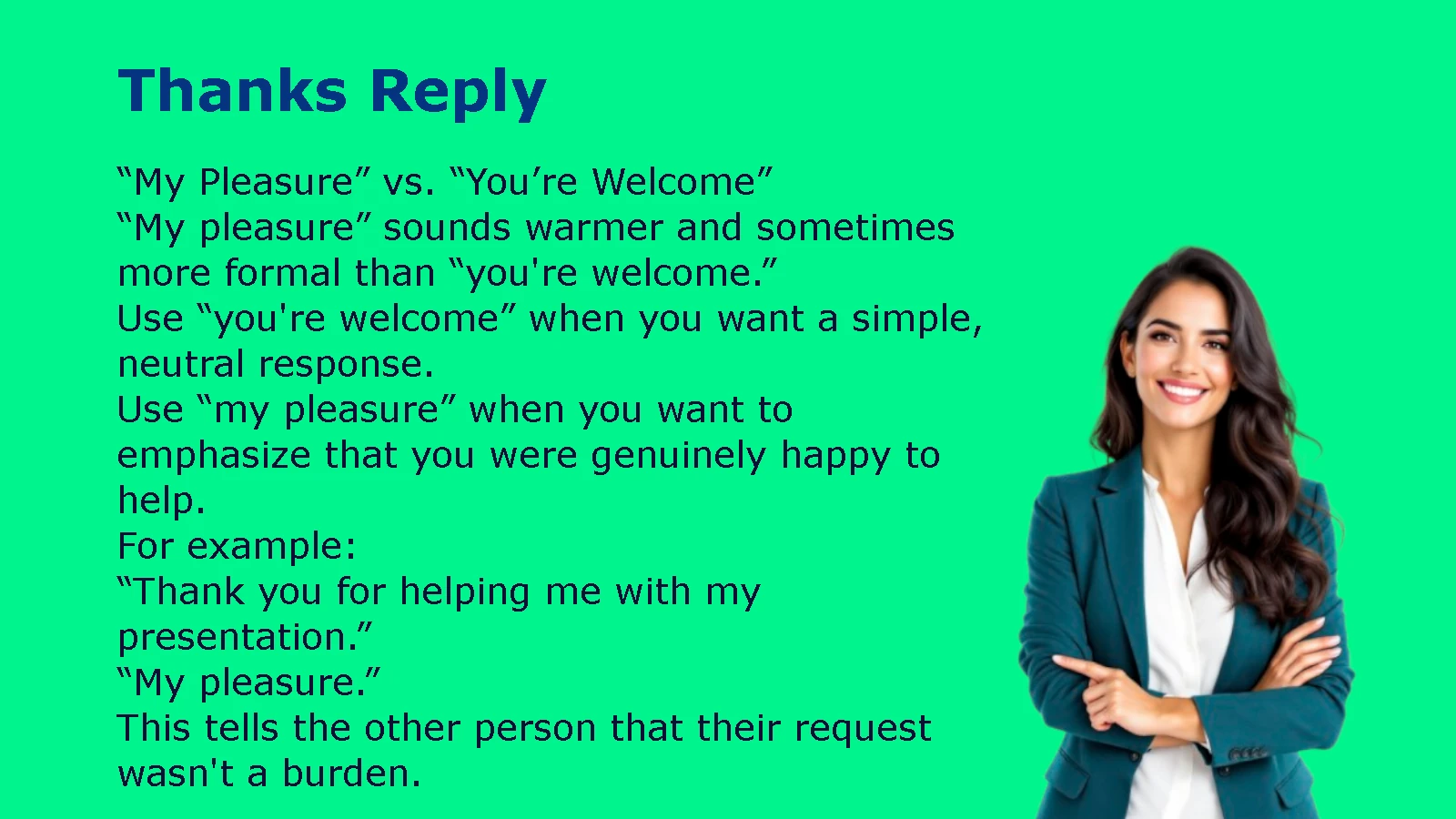
“My Pleasure” vs. “You’re Welcome”
“My pleasure” sounds warmer and sometimes more formal than “you’re welcome.”
Use “you’re welcome” when you want a simple, neutral response.
Use “my pleasure” when you want to emphasize that you were genuinely happy to help.
For example:
“Thank you for helping me with my presentation.”
“My pleasure.”
This tells the other person that their request wasn’t a burden.
Is “No Problem” a Good Reply to Thank You?
Yes. “No problem” is a common and natural response to “thank you,” especially in casual conversations.
However, it can sound less formal than “you’re welcome” or “my pleasure.”
For a friend:
“Thanks for picking me up.”
“No problem!”
For a formal business interaction:
“Thank you for your assistance.”
“You’re very welcome.”
The context matters more than the phrase itself.
What Is the Most Natural Reply to “Thank You”?
For everyday English, these are among the most natural choices:
Casual:
- No problem!
- No worries!
- Anytime!
- Of course!
- Sure thing!
Neutral:
- You’re welcome.
- Happy to help.
- Glad I could help.
Professional:
- My pleasure.
- You’re very welcome.
- It was a pleasure.
- Happy to assist.
You don’t need to memorize every possible response. Choose one that matches the situation and your relationship with the person.
Quick Guide to Thanks Replies
| Situation | Natural response |
| Friend thanks you | No worries! |
| Someone thanks you casually | No problem! |
| Coworker thanks you | Happy to help! |
| Customer thanks you | You’re very welcome. |
| Someone thanks you formally | My pleasure. |
| Someone thanks you for advice | Glad I could help. |
| Someone thanks you for a gift | I’m glad you like it! |
| Someone says “Thanks so much” | You’re very welcome! |
| Someone says “I appreciate it” | Of course! |
| Someone thanks you by text | No worries! |
| Someone thanks you for a small favor | It was nothing. |
| Someone thanks you for meeting | It was a pleasure. |
| Someone thanks you for ongoing support | Always. |
| Someone thanks you for helping at work | Happy to help. |
| Someone thanks you repeatedly | You don’t have to thank me. |
Final Tip: Match Your Reply to the Situation
There isn’t one perfect thanks reply for every situation.
If you’re talking to a friend, “No worries,” “Anytime,” or “Of course” sounds natural. In a workplace, “Happy to help,” “Glad I could help,” or “My pleasure” may be a better fit. In a formal setting, “You’re very welcome” or “It was a pleasure” works well.
The most important thing is to sound natural. You don’t need a complicated phrase when a simple “You’re welcome!” does the job.













