Agonist meaning refers to an agent that activates or produces an action. In pharmacology, an agonist binds to a specific receptor and activates it to trigger a biological response. In anatomy, an agonist is the primary muscle responsible for a particular movement. The term also appears in biology, medicine, and discussions of competition or conflict.
Understanding the difference between an agonist and antagonist helps explain how drugs interact with receptors, how muscles coordinate movement, and how biological systems respond to different substances. It is also important to distinguish agonist from agnostic and agonistic, as these words have different meanings despite their similar spelling.
| Question | Answer |
| What does agonist mean? | An agent that activates or promotes an action or response. |
| What is an agonist in pharmacology? | A substance that binds to and activates a receptor. |
| What is the difference between agonist and antagonist? | An agonist activates a receptor, while an antagonist blocks its activation. |
| What is an agonist muscle? | The primary muscle responsible for producing a particular movement. |
| Is agonist the same as agnostic? | No. Agonist is a scientific term, while agnostic describes a position about knowledge, particularly religious knowledge. |
What Does Agonist Mean?
An agonist is a substance, agent, or structure that initiates or promotes an action. Its precise meaning depends on the subject.In anatomy, it refers to the primary muscle that creates a movement.
The word commonly appears in scientific and medical discussions because many biological processes depend on activation and response.
Simple Definition of Agonist
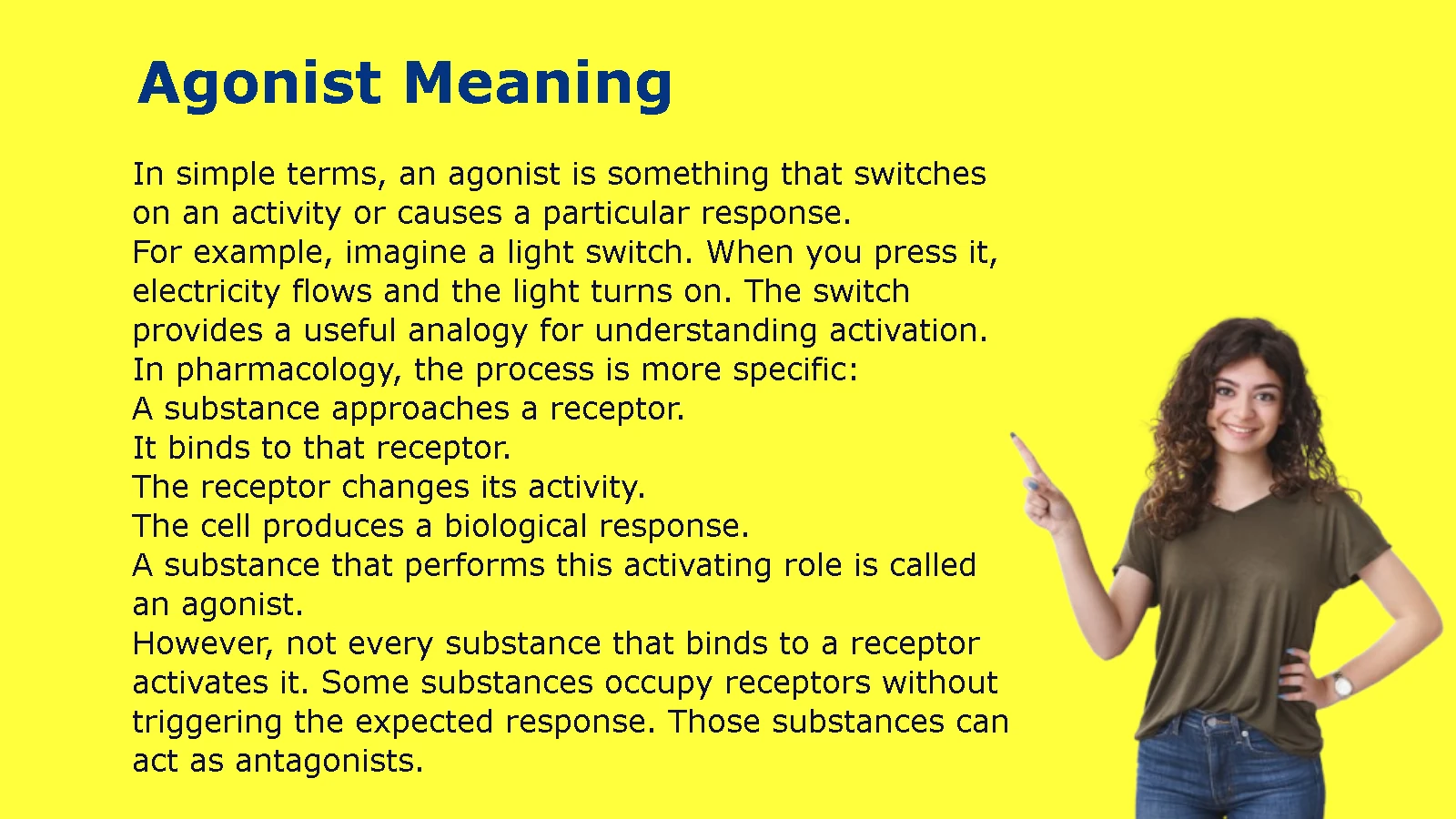
In simple terms, an agonist is something that switches on an activity or causes a particular response.
For example, imagine a light switch. When you press it, electricity flows and the light turns on. The switch provides a useful analogy for understanding activation.
In pharmacology, the process is more specific:
- A substance approaches a receptor.
- It binds to that receptor.
- The receptor changes its activity.
- The cell produces a biological response.
A substance that performs this activating role is called an agonist.
However, not every substance that binds to a receptor activates it. Some substances occupy receptors without triggering the expected response. Those substances can act as antagonists.
Agonist Meaning in Simple Words
The easiest way to understand an agonist is to think of it as an activator.
Consider these examples:
- A drug activates a receptor and produces a therapeutic effect.
- A neurotransmitter activates receptors on a nerve cell.
- A muscle acts as the main force behind a particular joint movement.
All three examples involve something that produces or promotes an action.
The exact scientific mechanism differs, but the central idea involves activation and response.
Origin and Etymology of the Word Agonist
The word agonist comes from the Greek word agōnistēs, which referred to a competitor or person who participated in a contest. It connects to agōn, meaning a contest, struggle, or competition.
Ancient Greek culture placed considerable importance on athletic and dramatic competitions. Participants in these contests were associated with the idea of striving toward a goal.
The word later developed specialized meanings in medicine and biology.
Today, pharmacologists use agonist to describe substances that activate receptors. Anatomists use it to describe muscles that produce particular movements.
This historical development explains why the word can appear in seemingly unrelated fields.
Agonist Pronunciation and Word Forms
The standard pronunciation of agonist is:
AG-uh-nist
It contains three syllables, with the stress on the first syllable.
Here are some related word forms:
| Word | Part of speech | Meaning |
| Agonist | Noun | An activating agent or primary moving muscle |
| Agonists | Plural noun | More than one agonist |
| Agonism | Noun | Agonist activity or a related concept |
| Agonistic | Adjective | Relating to struggle, competition, or agonism |
| Agonistically | Adverb | In a competitive or agonistic manner |
Remember that agonistic does not always mean the same thing as agonist. The former describes a quality or relationship, while the latter identifies an agent or structure.
Agonist vs. Antagonist: What’s the Difference?
An agonist activates a receptor and produces a biological response, whereas an antagonist binds to a receptor without activating it and prevents or reduces the effects of an agonist. Both can interact with the same receptor, but they produce different functional outcomes.
The distinction matters in pharmacology, biology, and anatomy.
What Is an Antagonist?
An antagonist is an agent that opposes, blocks, or reduces another agent’s activity.
In pharmacology, an antagonist binds to a receptor but does not activate it. By occupying the receptor, it can prevent an agonist from binding and producing its usual response.
For example, some medications block histamine receptors. Histamine normally contributes to allergy symptoms such as itching, sneezing, and swelling. An antihistamine blocks certain histamine receptors, reducing the effects of histamine.
The antagonist does not need to destroy histamine. It changes how the receptor responds to it.
Key Differences Between Agonist and Antagonist
| Feature | Agonist | Antagonist |
| Main function | Activates a receptor | Blocks receptor activation |
| Receptor binding | Usually binds to a receptor | Binds without activating it |
| Biological response | Produces a response | Prevents or reduces agonist effects |
| Pharmacological role | Stimulates receptor activity | Inhibits receptor activation |
| Example | Dopamine receptor agonist | Dopamine receptor antagonist |
| Primary effect | Receptor activation | Receptor blockade |
The most important distinction is efficacy. An agonist has the ability to activate a receptor, while a neutral antagonist does not produce receptor activation.
Agonist vs. Antagonist Examples in Real Life
Consider a receptor as a lock and a chemical messenger as a key.
An agonist works like a key that fits the lock and activates the mechanism. An antagonist can fit into the same lock but prevents the activating key from working.
This analogy helps explain receptor interactions.
For example, consider the relationship between dopamine and dopamine receptors:
- Dopamine naturally activates dopamine receptors.
- A dopamine agonist can imitate dopamine by activating those receptors.
- A dopamine antagonist can block dopamine from producing its usual receptor-mediated effects.
This mechanism helps researchers develop medications that influence specific signaling pathways.
Can an Agonist Also Act as an Antagonist?
Yes. A partial agonist can sometimes act as a functional antagonist when a full agonist is also present.
A partial agonist activates a receptor but produces a lower maximum response than a full agonist in the same biological system. When both compete for the same receptors, the partial agonist can reduce the overall response by replacing some of the more effective full agonist molecules.
For example, buprenorphine acts as a partial agonist at mu-opioid receptors. Its receptor activity differs from that of full opioid agonists.
This distinction is important because a drug’s effects depend on its receptor activity, dose, and the biological environment.
Agonist Meaning in Pharmacology
An agonist in pharmacology is a drug or chemical substance that binds to a receptor and activates it to produce a biological effect. These substances imitate or enhance the activity of natural chemical messengers, such as hormones and neurotransmitters. Pharmacologists study agonists to understand how medications influence cells, organs, and body systems.
Receptors act as communication points between cells and chemical signals. When an agonist activates a receptor, it can change cellular activity and produce effects throughout the body.
How Does an Agonist Work in Pharmacology?
Agonists work through interactions between chemical substances and biological receptors. These receptors may sit on the cell surface or inside cells.
The process generally follows four steps:
- Receptor recognition: The agonist encounters a receptor with a compatible binding site.
- Receptor binding: The agonist attaches to the receptor through chemical interactions.
- Receptor activation: Binding produces a change in receptor activity.
- Cellular response: The activated receptor influences signaling pathways and triggers a biological effect.
For example, adrenaline activates beta-adrenergic receptors in certain tissues. This interaction can increase heart rate, relax some airway muscles, and prepare the body for physical activity.
However, different receptors produce different responses. The same signaling molecule may affect several organs because those organs contain different receptor types.
Two important pharmacological concepts help explain these interactions:
- Affinity: How strongly a substance binds to a receptor.
- Efficacy: How effectively a substance activates a receptor after binding.
A substance can have high affinity but low efficacy. In other words, it may bind strongly without producing a powerful biological response.
Types of Pharmacological Agonists
Pharmacologists classify agonists according to how they influence receptor activity. Understanding these categories helps explain why different drugs produce different effects, even when they interact with the same receptor.
Full Agonist
A full agonist activates a receptor and can produce the maximum response available in a particular biological system.
For example, morphine acts as a full agonist at mu-opioid receptors. It activates these receptors and produces analgesic effects, although it can also cause serious adverse effects, including respiratory depression.
Important characteristics include:
- Produces a high level of receptor activation.
- Can generate the system’s maximum response.
- May produce dose-dependent effects.
- Can compete with other substances for the same receptor.
A full agonist does not necessarily produce the same maximum response in every tissue. Receptor density and cellular signaling capacity influence the final effect.
Partial Agonist
A partial agonist binds to a receptor and activates it but produces a lower maximum response than a full agonist under comparable conditions.
Buprenorphine is a well-known example. It acts as a partial agonist at mu-opioid receptors.
Partial agonists have an interesting property. They can activate receptors when no full agonist is present, but they may reduce receptor activity when they compete with a full agonist.
For example:
- A full agonist produces a strong receptor response.
- A partial agonist produces a smaller response.
- If the partial agonist occupies receptors that a full agonist would otherwise activate, the overall response may decrease.
This behavior explains why partial agonists can sometimes function as functional antagonists.
Inverse Agonist
An inverse agonist binds to a receptor and reduces its baseline activity.
Some receptors show constitutive activity, meaning they can remain partially active even without an activating chemical messenger.
A neutral antagonist blocks the effects of agonists without changing this baseline activity. An inverse agonist goes further by shifting receptor activity in the opposite direction.
The distinction is:
| Receptor interaction | Effect |
| Full agonist | Produces a strong activating response |
| Partial agonist | Produces a limited activating response |
| Neutral antagonist | Blocks agonist activity without changing baseline activity |
| Inverse agonist | Reduces constitutive receptor activity |
Inverse agonists matter because they allow researchers to influence receptors that remain active even without an external agonist.
Biased Agonist
A biased agonist activates a receptor in a way that favors certain intracellular signaling pathways over others.
Some receptors can activate several signaling mechanisms. A biased agonist may favor one pathway while producing less activity through another.
For example, researchers study biased signaling at opioid receptors to investigate whether particular receptor pathways can produce pain relief with fewer unwanted effects.
This remains an important area of drug development. However, biased signaling does not automatically guarantee a safer medication. Researchers must evaluate the actual effects in clinical settings.
What Is the Difference Between Agonist Potency and Efficacy?
Potency and efficacy describe two different properties of a drug.
Potency refers to how much of a drug is needed to produce a particular response. Efficacy describes the maximum response the drug can produce.
A highly potent agonist may produce an effect at a low concentration, but it does not necessarily produce a greater maximum effect than a less potent agonist.
| Feature | Potency | Efficacy |
| Meaning | Amount needed for an effect | Maximum achievable response |
| Common measurement | EC50 | Emax |
| Main question | How much is needed? | How much response is possible? |
| Clinical relevance | Helps compare concentrations or doses | Helps compare maximum effects |
For example, imagine two medications that activate the same receptor.
- Drug A produces a particular response at a lower concentration.
- Drug B requires a higher concentration to produce that same response.
- Drug A is more potent for that measured effect.
- If Drug B produces a higher maximum response, it may have greater efficacy.
This distinction prevents a common misunderstanding: a more potent drug is not automatically a more effective drug.
Examples of Agonist Drugs
Many medications work by activating specific receptors.
| Drug or substance | Receptor target | General pharmacological effect |
| Salbutamol (albuterol) | Beta-2 adrenergic receptors | Relaxes airway smooth muscle |
| Morphine | Mu-opioid receptors | Produces pain relief |
| Pramipexole | Dopamine receptors | Activates dopamine signaling |
| Phenylephrine | Alpha-1 adrenergic receptors | Produces blood vessel constriction |
| Adrenaline (epinephrine) | Alpha and beta adrenergic receptors | Produces several sympathetic responses |
These examples demonstrate that agonists do not all produce the same outcome. Their effects depend on the receptor they activate and the tissue where that receptor operates.
Dopamine Agonist Meaning: What Does It Do?
A dopamine agonist is a substance that activates dopamine receptors and imitates some of the effects of the neurotransmitter dopamine. These medications influence signaling pathways involved in movement, motivation, reward, and hormone regulation.
Dopamine agonists have important medical applications, particularly in treating certain neurological and endocrine conditions.
What Is a Dopamine Agonist?
Dopamine is a neurotransmitter that helps nerve cells communicate. It participates in several important processes, including:
- Voluntary movement
- Motivation and reward
- Learning and reinforcement
- Attention
- Hormone regulation
A dopamine agonist activates dopamine receptors without requiring the body to release additional dopamine first.
This differs from substances that increase dopamine availability by affecting its production, release, or breakdown.
The distinction matters because direct receptor activation and increased dopamine concentration are not the same mechanism.
How Do Dopamine Agonists Work?
Dopamine receptors belong to a family of G protein-coupled receptors. Scientists commonly divide them into two major groups:
- D1-like receptors: D1 and D5.
- D2-like receptors: D2, D3, and D4.
These receptor groups influence different signaling pathways.
Dopamine agonists bind to particular dopamine receptors and activate their signaling mechanisms. Their effects depend on receptor selectivity, brain region, and individual pharmacological properties.
For example, activating certain dopamine receptors can help improve movement-related symptoms in people with Parkinson’s disease.
Examples of Dopamine Agonists
Several medications act as dopamine receptor agonists.
| Medication | General action | Common medical application |
| Pramipexole | Activates dopamine receptors, especially D2-like receptors | Parkinson’s disease and restless legs syndrome |
| Ropinirole | Stimulates dopamine receptors | Parkinson’s disease and restless legs syndrome |
| Bromocriptine | Acts mainly at D2-like receptors | Certain endocrine conditions and Parkinson’s disease |
| Rotigotine | Activates dopamine receptors through a transdermal patch | Parkinson’s disease and restless legs syndrome |
These medications have different indications, dosing requirements, and safety considerations.
What Are Dopamine Agonists Used For?
Doctors prescribe dopamine agonists for selected conditions involving dopamine signaling.
Parkinson’s disease
Parkinson’s disease involves the progressive loss of dopamine-producing neurons in certain brain regions. This reduces dopamine signaling and contributes to movement problems.
Dopamine agonists stimulate dopamine receptors and can help improve symptoms such as:
- Muscle stiffness
- Slowness of movement
- Difficulty initiating movement
- Certain movement-related symptoms
Restless legs syndrome
Some dopamine agonists have also been used to treat restless legs syndrome, a condition that causes uncomfortable sensations and an urge to move the legs.
However, long-term dopamine agonist treatment can cause augmentation, in which symptoms begin earlier, become more intense, or spread to other body areas. Treatment decisions require careful medical assessment.
Endocrine conditions
Certain dopamine agonists reduce prolactin secretion from the pituitary gland. Doctors may prescribe medications such as bromocriptine or cabergoline for selected cases of hyperprolactinemia.
Dopamine agonists can cause side effects, including nausea, dizziness, low blood pressure, sleepiness, and, in some cases, impulse-control problems. They require professional medical supervision.
Agonist Meaning in Biology
In biology, an agonist is a substance that binds to a receptor and activates it to produce a biological response. Agonists help regulate communication between cells and influence processes such as metabolism, growth, movement, hormone activity, and nervous system function.
Biological agonists may be naturally produced by the body or introduced from outside.
What Is an Agonist in Biology?
Biological systems rely on chemical communication. Cells release signaling molecules that interact with receptors on other cells or sometimes on the same cell.
These signaling molecules include:
- Hormones
- Neurotransmitters
- Peptides
- Other chemical messengers
When a signaling molecule activates its receptor, it acts as an agonist.
For example, insulin binds to insulin receptors and activates signaling pathways that help regulate glucose uptake and metabolism. Insulin is the natural ligand and receptor activator in this system.
A pharmaceutical substance can also act as an agonist if it activates the same receptor.
How Do Biological Agonists Affect Cells?
Agonists can influence cells through several stages of communication.
Receptor activation: A chemical messenger binds to a compatible receptor.
Signal transmission: The receptor activates intracellular signaling mechanisms.
Cellular response: The cell changes its activity based on the incoming signal.
These responses can include:
- Opening or closing ion channels.
- Activating enzymes.
- Changing gene expression.
- Releasing additional chemical messengers.
- Altering cell growth or metabolism.
For example, adrenaline binds to adrenergic receptors and activates signaling pathways that help the body respond to stressful or physically demanding situations.
Agonist vs. Antagonist in Biological Systems
Biological agonists and antagonists influence receptor activity in different ways.
Consider a cell that contains receptors for a particular hormone.
- The hormone binds to its receptor and activates a response.
- An agonist can imitate the hormone and activate the receptor.
- An antagonist can occupy the receptor and prevent the hormone from activating it.
This relationship allows biological systems to regulate signaling with considerable precision.
The same principle guides the development of medications that activate or block specific receptors.
Agonist Meaning in Anatomy
In anatomy and movement science, an agonist muscle is the primary muscle responsible for producing a particular movement. It is also called the prime mover. The agonist works with other muscles, including antagonists and synergists, to create controlled movement around a joint.
Unlike the pharmacological meaning, this definition focuses on muscle function rather than receptor activation.
What Is an Agonist Muscle?
An agonist muscle produces the main force responsible for a specific movement.
For example, when you bend your elbow, the biceps brachii contributes significantly to elbow flexion. It acts as an agonist during that movement.
The muscle contracts and generates tension, helping move the forearm toward the upper arm.
However, a muscle does not always perform the same role. Its function depends on the movement being performed.
A muscle that acts as an agonist during one movement may act as an antagonist during the opposite movement.
Agonist vs. Antagonist Muscles
Agonist and antagonist muscles coordinate to produce controlled movements.
The agonist generates the primary force for a movement, while the antagonist produces an opposing action. The nervous system coordinates their activity to support smooth and controlled motion.
For example, during elbow flexion:
- The biceps brachii acts as an agonist.
- The triceps brachii acts as an antagonist.
- Other muscles help stabilize the joint.
During elbow extension, their roles reverse.
This coordination allows you to bend and straighten your arm without uncontrolled movement.
Examples of Agonist Muscles in the Human Body
| Movement | Agonist muscle | Antagonist muscle |
| Elbow flexion | Biceps brachii | Triceps brachii |
| Elbow extension | Triceps brachii | Biceps brachii |
| Knee extension | Quadriceps | Hamstrings |
| Knee flexion | Hamstrings | Quadriceps |
| Ankle plantar flexion | Gastrocnemius and soleus | Tibialis anterior |
| Ankle dorsiflexion | Tibialis anterior | Gastrocnemius and soleus |
These examples show how muscle roles change depending on the direction of movement.
What Are Synergist Muscles?
A synergist muscle assists the agonist in producing a movement.
Synergists may contribute additional force, stabilize a joint, or prevent unwanted movement.
For example, during elbow flexion, the brachialis and brachioradialis assist the biceps brachii.
The three main muscle roles are:
| Muscle type | Function |
| Agonist | Produces the primary movement |
| Antagonist | Opposes or controls the movement |
| Synergist | Assists the agonist |
Muscle coordination also involves stabilizers, which help maintain the position of a joint or body part during movement.
Practical Example: What Happens When You Perform a Biceps Curl?
How to Do Bicep Curls: Form, Mistakes & Progressions (2026) — FitCraft
A biceps curl provides an easy way to understand the agonist muscle.
When you lift a dumbbell toward your shoulder:
- The biceps brachii contracts and helps flex the elbow.
- The brachialis and brachioradialis assist the movement.
- The triceps brachii controls the opposing movement.
- The shoulder and other muscles help stabilize your arm.
When you lower the dumbbell, the elbow flexors control the descent through eccentric contraction.
This example demonstrates that an agonist does not always shorten during muscle activity. It can generate force while lengthening to control a movement.
Agonist Meaning in Religion and Philosophy
The term agonist does not have one universally accepted meaning in religion. It is not a standard name for a religious belief system. In philosophical and theological discussions, related terms such as agonistic may describe struggle, disagreement, or tension between competing ideas.
This distinction matters because many readers confuse agonist with agnostic, which refers to a position about religious knowledge.
What Does Agonist Mean in Religion?
In religious discussions, agonist may appear in specialized writing about conflict, struggle, or competing beliefs. However, it does not generally identify someone who believes in God or follows a particular religion.
The word agonistic is more relevant in discussions of religious conflict and philosophical disagreement.
For example:
- A philosopher may describe religious debates as agonistic when different traditions compete over fundamental questions.
- A theologian may discuss the struggle between opposing moral or spiritual forces.
- A researcher may examine how religious communities manage disagreement.
These uses relate to the broader idea of struggle or contest rather than receptor activation in pharmacology.
If someone searches for agonist meaning in religion, they may actually be looking for agnostic meaning. The two words have different definitions.
What Does Agnostic Mean?
An agnostic is someone who believes that the existence of God or a higher power is unknown or cannot be known with certainty.
The term comes from the Greek prefix a-, meaning without, and gnōsis, meaning knowledge.
Agnosticism focuses primarily on knowledge rather than religious affiliation.
For example, an agnostic person may say:
“I don’t claim to know whether God exists because I don’t believe the available evidence establishes the answer.”
Agnosticism can exist alongside different religious and philosophical positions. Some people identify as agnostic theists, while others identify as agnostic atheists.
What Is an Agnostic Religion?
Agnosticism is not a religion itself. It is a philosophical position concerning whether humans can know that God or a higher power exists.
However, someone can participate in a religious tradition while holding agnostic views.
For example, a person may attend religious services, follow cultural traditions, or participate in spiritual practices without claiming certainty about the existence of God.
It helps to separate three concepts:
- Religion: A system of beliefs, practices, traditions, and institutions.
- Agnosticism: A position concerning the limits of knowledge about divine existence.
- Theism: Belief in at least one God or deity.
An individual may identify with more than one of these descriptions depending on their beliefs and practices.
Agnostic vs. Atheist vs. Theist
These terms describe different positions concerning belief and knowledge.
| Term | Meaning | Main focus |
| Agnostic | Believes that knowledge of God’s existence is unknown or unknowable | Knowledge |
| Atheist | Lacks belief in God or gods | Belief |
| Theist | Believes in at least one God or deity | Belief |
| Agnostic theist | Believes in God but does not claim certain knowledge | Belief and knowledge |
| Agnostic atheist | Does not believe in God but does not claim certain knowledge of nonexistence | Belief and knowledge |
A common misconception is that agnosticism and atheism always contradict each other.
They do not necessarily conflict because they address different questions.
Atheism concerns whether someone believes in a deity. Agnosticism concerns whether someone claims to know that a deity exists.
Is Agonist the Same as Agnostic?
No. Agonist and agnostic are different words with different meanings.
An agonist activates a receptor in pharmacology or serves as the primary mover in anatomy. An agnostic describes someone who considers divine existence unknown or unknowable.
Compare their uses:
| Word | Meaning | Example |
| Agonist | An activating agent | The medication acts as a receptor agonist. |
| Agnostic | A person who holds an agnostic position | She describes herself as an agnostic. |
| Agonistic | Related to competition or struggle | The debate involved agonistic political relationships. |
The spelling difference is small, but the meanings are unrelated in ordinary usage.
Agonistic Meaning: Definition and Examples
Agonistic is an adjective that describes competition, struggle, opposition, or conflict. It relates to the broader historical idea of an agon, or contest. In biology, agonistic behavior includes interactions such as aggression, threats, submission, and defensive displays.
The word appears in behavioral science, philosophy, politics, and social studies.
What Does Agonistic Mean?
Agonistic describes an interaction involving competing interests or opposing forces.
For example, two animals may compete for food or territory. Their interaction may involve threats, displays of aggression, or submission.
In social and political discussions, agonistic can describe disagreement between groups that hold competing views.
The word does not necessarily imply physical violence. Competition can also involve ideas, beliefs, and social positions.
Agonistic vs. Agnostic
These words look similar, but their grammatical functions and meanings differ.
| Feature | Agonistic | Agnostic |
| Part of speech | Adjective | Noun or adjective |
| Main meaning | Competitive or related to struggle | Concerned with uncertainty about knowledge of God |
| Common context | Biology, politics, philosophy | Religion and philosophy |
| Example | Agonistic behavior | Agnostic beliefs |
Consider these original examples:
- The researchers observed agonistic behavior between two territorial animals.
- The student adopted an agnostic position on the existence of God.
- The political discussion became increasingly agonistic as disagreements intensified.
A useful memory tip is that agnostic relates to knowledge, while agonistic relates to struggle or competition.
Agonistic Behavior and Agonistic Relationships
In animal behavior, agonistic behavior describes interactions associated with competition and conflict.
These interactions may include:
- Threat displays
- Aggressive behavior
- Physical fighting
- Defensive postures
- Submission signals
- Withdrawal from confrontation
For example, two male deer competing during the breeding season may display their antlers, posture aggressively, and engage in physical competition.
Not every agonistic interaction ends in a fight. Animals often use signals to establish dominance or avoid costly physical encounters.
This behavior can help researchers understand social hierarchies, territory defense, and competition for resources.
Agonistic in Philosophy and Social Sciences
In philosophy and political theory, agonistic pluralism describes an approach that recognizes disagreement and conflict as natural parts of democratic society.
Instead of expecting everyone to reach complete agreement, agonistic approaches emphasize the importance of allowing opposing perspectives to compete within shared democratic rules.
For example, people may disagree about:
- Economic policy
- Religious freedom
- Environmental protection
- Social justice
- Government authority
Agonistic political theory recognizes that disagreement can remain even when people share a commitment to democratic participation.
The central idea is that healthy political systems need ways to manage disagreement without treating every opponent as an enemy.
Agonist Examples in Sentences
Examples make the meaning of agonist easier to understand because the term changes slightly depending on the subject.
The following sentences demonstrate how to use it in medical, scientific, anatomical, and everyday contexts.
Agonist in Medical and Scientific Sentences
- The researchers identified a compound that acts as an agonist at the dopamine receptor.
- The medication activates beta-2 receptors and helps relax airway muscles.
- A partial agonist produces a smaller maximum response than a full agonist.
- The experiment examined how receptor activation influenced cellular signaling.
- The drug showed strong receptor affinity but limited efficacy.
- Scientists compared the effects of an agonist and an antagonist in the laboratory.
- The neurotransmitter acts as a natural agonist in the nervous system.
Agonist in Anatomy Sentences
- The biceps brachii acts as an agonist during elbow flexion.
- The quadriceps serve as the agonist muscles during knee extension.
- The hamstrings become agonists when the knee bends.
- The triceps act as the primary movers during elbow extension.
- Several synergist muscles assist the agonist during a controlled movement.
Agnostic and Agonist in Everyday Sentences
- The scientist studied how the agonist activated the receptor.
- My friend identifies as an agnostic because she does not claim certainty about God’s existence.
- The medication works by stimulating a specific receptor.
- The philosophical discussion explored the limits of human knowledge.
- The researchers recorded agonistic interactions between competing animals.
These examples show why context matters. A scientific article about receptor activation uses agonist, while a discussion about religious knowledge may use agnostic.
Related Terms and Commonly Confused Words
Several words share linguistic roots or similar spelling with agonist. Understanding their differences helps prevent mistakes in scientific writing and everyday communication.
Agonist vs. Agonism
An agonist is an agent that activates a receptor or produces a particular movement. Agonism describes the activity or concept associated with agonists.
For example:
- The agonist activated the receptor.
- Researchers measured agonism at the target receptor.
In pharmacology, agonism refers to the functional activation of a receptor by an agonist.
Agonist vs. Antagonism
Agonist and antagonism describe opposing pharmacological concepts.
An agonist activates a receptor, while antagonism describes the process of blocking or opposing receptor activation.
For example, a drug may produce an agonistic effect at one receptor while another drug produces an antagonistic effect at that same receptor.
The terms describe different types of receptor activity, not necessarily different categories of chemical substances in every possible context.
Agonist vs. Protagonist
A protagonist is the main character in a story, play, novel, or film. An agonist, in scientific usage, activates a receptor or acts as the primary muscle responsible for movement.
Both words have historical connections to the Greek concept of competition or contest, but their modern meanings differ.
| Word | Meaning | Common context |
| Agonist | Receptor activator or primary moving muscle | Pharmacology and anatomy |
| Protagonist | Main character in a story | Literature and entertainment |
| Antagonist | Receptor blocker or opposing character or force | Pharmacology and storytelling |
For example, the protagonist drives the story forward, while the antagonist creates opposition or conflict.
Agonist vs. Agonistic
The main difference is grammatical.
Agonist is a noun that identifies an activating agent or primary muscle.
Agonistic is an adjective that describes something related to competition, struggle, or agonism.
Examples:
- The drug is an agonist.
- The animals displayed agonistic behavior.
Remembering the noun-and-adjective distinction makes the two terms easier to use correctly.
Agonist vs. Agnostic
This is one of the most common spelling confusions.
An agonist activates a receptor or produces a movement. An agnostic is someone who considers the existence of God unknown or unknowable.
Use agonist when discussing:
- Receptor activation
- Pharmacology
- Biological signaling
- Muscle movement
Use agnostic when discussing:
- Religious knowledge
- Philosophy
- The existence of God
- Agnosticism
The difference is especially important in medical and educational writing, where substituting one word for the other can completely change a sentence’s meaning.
Conclusion: Understanding the Meaning of Agonist
The agonist meaning depends on the context in which the word appears, but its central idea involves producing or promoting an action.
Understanding the difference between agonists and antagonists is especially important when studying medications, neurotransmitters, and muscle function.
Remember these key distinctions:
- Agonist: Activates a receptor or produces a movement.
- Antagonist: Blocks or opposes an agonist’s activity.
- Partial agonist: Activates a receptor but produces a limited maximum response.
- Inverse agonist: Reduces a receptor’s baseline activity.
- Agnostic: Describes a position concerning knowledge of God’s existence.
- Agonistic: Describes competition, struggle, or opposition.
Whether you encounter the term in a pharmacology textbook, anatomy lesson, or scientific article, identifying its context will help you understand its exact meaning. Explore related terminology such as antagonist, agnostic, and dopamine to strengthen your understanding of scientific and philosophical vocabulary.
Frequently Asked Questions About Agonist Meaning
What does agonist mean in simple terms?
An agonist is something that activates or produces an action. In pharmacology, it is a substance that binds to a receptor and activates it to create a biological response.
What is the difference between an agonist and an antagonist?
An agonist activates a receptor and produces a response, while an antagonist binds to a receptor without activating it and blocks or reduces the effects of an agonist.
What does agonist mean in pharmacology?
In pharmacology, an agonist is a drug or chemical substance that binds to a receptor and activates it. Examples include morphine, salbutamol, and dopamine receptor agonists.
What does dopamine agonist mean?
A dopamine agonist is a substance that activates dopamine receptors and imitates some effects of dopamine. Doctors prescribe certain dopamine agonists for conditions such as Parkinson’s disease and restless legs syndrome.
Is agonist the same as agnostic?
No. An agonist is an activating agent in scientific contexts, while an agnostic is someone who believes that knowledge of God’s existence is unknown or unknowable.













