Kidding aside means putting jokes or humor aside to say something serious, honest, or important. People use this common conversational expression when they want to move from a playful conversation to a genuine point. It is similar to joking aside, all jokes aside, and seriously though. Understanding the phrase also helps distinguish it from related expressions such as just kidding, no kidding, and kidding around.
Whether you encounter “kidding aside” in a text message, workplace conversation, social media comment, or everyday discussion, its purpose remains the same: it signals that the speaker is about to say something they genuinely mean. You can also use it to introduce sincere appreciation, serious advice, an honest opinion, or an important observation.
| Question | Answer |
| What does kidding aside mean? | It means putting jokes aside to speak seriously or sincerely. |
| What is another word for kidding aside? | Joking aside, all jokes aside, seriously though, and on a serious note. |
| What does kidding aside mean in Tagalog? | It can mean “sa seryosong usapan” or “tabi muna ang biro,” depending on context. |
| Is kidding aside the same as joking aside? | Yes. Both expressions introduce a serious thought after humor. |
| Does kidding aside have an acronym? | No widely recognized standard acronym or abbreviation exists. |
What Does Kidding Aside Mean?
Kidding aside is an expression people use to change the tone of a conversation from humorous or playful to serious. It tells listeners that the speaker is moving beyond jokes and wants them to pay attention to a genuine statement.
For example:
“Kidding aside, I really appreciate everything you’ve done for me.”
In this sentence, the speaker moves away from a joking tone and expresses sincere gratitude.
The phrase does not mean that someone has stopped joking permanently. Instead, it signals a temporary shift in the conversation.
Simple Definition of Kidding Aside
In simple words, kidding aside means jokes aside or speaking seriously.
The expression usually appears at the beginning of a sentence. It prepares the listener for something sincere, important, or meaningful. A person might use it after making a funny comment, teasing a friend, or participating in a lighthearted discussion.
Consider these examples:
- Kidding aside, you did an excellent job.
- Kidding aside, we need to take this problem seriously.
- Kidding aside, I think she deserves the promotion.
- Kidding aside, your friendship means a lot to me.
Each sentence begins with a conversational expression but quickly moves toward a genuine statement.
The phrase also helps speakers avoid an abrupt change in tone. Rather than suddenly introducing a serious subject, they give listeners a verbal signal that the conversation is becoming more meaningful.
What Does Kidding Aside Mean in Everyday Conversations?
In everyday conversations, kidding aside helps people separate humor from genuine opinions or feelings.
Friends often joke about ordinary situations. However, one person might eventually want to express something important without making the conversation uncomfortable.
For example:
“You’re always late, and we should probably give you your own calendar. Kidding aside, I really need you to arrive on time tomorrow.”
The first sentence uses humor to make the criticism less confrontational. The second communicates the actual concern.
People commonly use the expression in these situations:
- Friendship: To express genuine appreciation after teasing someone.
- Family discussions: To introduce sincere advice or concern.
- Workplace conversations: To move from casual conversation to an important issue.
- Public speaking: To transition from a humorous opening to a meaningful message.
- Online communication: To clarify that a comment is becoming serious.
One important detail is that the expression does not automatically make a serious statement polite. Tone, timing, and the relationship between speakers still matter.
Is Kidding Aside an Idiom or a Common Expression?
“Kidding aside” is an established conversational expression that functions like an idiomatic introductory phrase.
Its meaning comes from the combined expression rather than a literal interpretation of individual words.
The word kidding refers to joking or teasing, while aside suggests putting something to one side temporarily.
Together, the words communicate the idea of setting humor aside to discuss something sincerely.
For example:
- Kidding aside, this business needs a better marketing strategy.
- Kidding aside, I hope you understand how much I value your support.
The expression is especially common in informal conversations, although speakers can also use it in presentations, interviews, and relaxed professional discussions.
Kidding Aside Meaning in Tagalog
Kidding aside in Tagalog generally means setting jokes aside and speaking seriously. Depending on the context, natural Filipino translations include “sa seryosong usapan,” “tabi muna ang biro,” and “kung seryoso lang ang pag-uusapan.”
There is no single translation that works perfectly in every sentence. The best equivalent depends on the speaker’s intention and the surrounding conversation.
Kidding Aside in Filipino and Tagalog
Filipino speakers often use English expressions alongside Tagalog in everyday conversations. This practice is commonly called Taglish, a combination of Tagalog and English.
The expression “kidding aside” fits naturally into many Taglish conversations because it provides a quick transition from humor to sincerity.
Here are some possible Tagalog equivalents:
| Tagalog expression | English meaning |
| Sa seryosong usapan | On a serious note |
| Tabi muna ang biro | Let’s put the jokes aside for now |
| Kung seryoso lang ang pag-uusapan | If we’re talking seriously |
| Biro lang, pero seryoso ako | Just joking, but I’m serious |
| Seryoso lang | Seriously |
| Huwag muna tayong magbiro | Let’s not joke for now |
These expressions communicate similar ideas, but they are not always interchangeable.
For example, “tabi muna ang biro” emphasizes stopping the jokes, while “sa seryosong usapan” introduces a serious subject.
Kidding Aside Meaning in English vs. Tagalog
English and Tagalog speakers use the expression for the same general conversational purpose, but their sentence structures can differ.
Consider the following examples:
| English sentence | Natural Tagalog translation |
| Kidding aside, I love my family. | Sa seryosong usapan, mahal ko ang pamilya ko. |
| Kidding aside, you did a great job. | Biro man kanina, pero mahusay talaga ang ginawa mo. |
| Kidding aside, we need to work harder. | Tabi muna ang biro; kailangan nating magsikap pa. |
| Kidding aside, I appreciate your help. | Seryoso, nagpapasalamat ako sa tulong mo. |
| Kidding aside, this is an important decision. | Kung seryoso ang pag-uusapan, mahalagang desisyon ito. |
Notice that some translations use different words to preserve the original intention.
A literal translation might sound unnatural in Filipino. For that reason, translators should focus on the expression’s conversational meaning rather than translating each English word separately.
How Filipinos Use Kidding Aside in Conversations
Filipino speakers may use “kidding aside” when moving between friendly teasing and serious discussion.
For example:
With friends:
“Ang kulit mo talaga! Kidding aside, salamat sa pagiging mabuting kaibigan.”
At work:
“Kidding aside, kailangan nating tapusin ang report bago mag-Friday.”
In a family conversation:
“Kidding aside, gusto ko lang na maging maayos ang future mo.”
On social media:
“Ang dami nating pinagdaanan this year. Kidding aside, proud ako sa ating lahat.”
These examples show how the phrase can fit naturally into bilingual conversations without requiring a direct Tagalog replacement.
Kidding Aside Meaning in a Sentence: Examples
Kidding aside introduces a serious, honest, or sincere statement after a humorous remark or lighthearted discussion. It usually appears at the beginning of a sentence, followed by a comma and a genuine thought.
The following examples demonstrate how people use the expression in different situations.
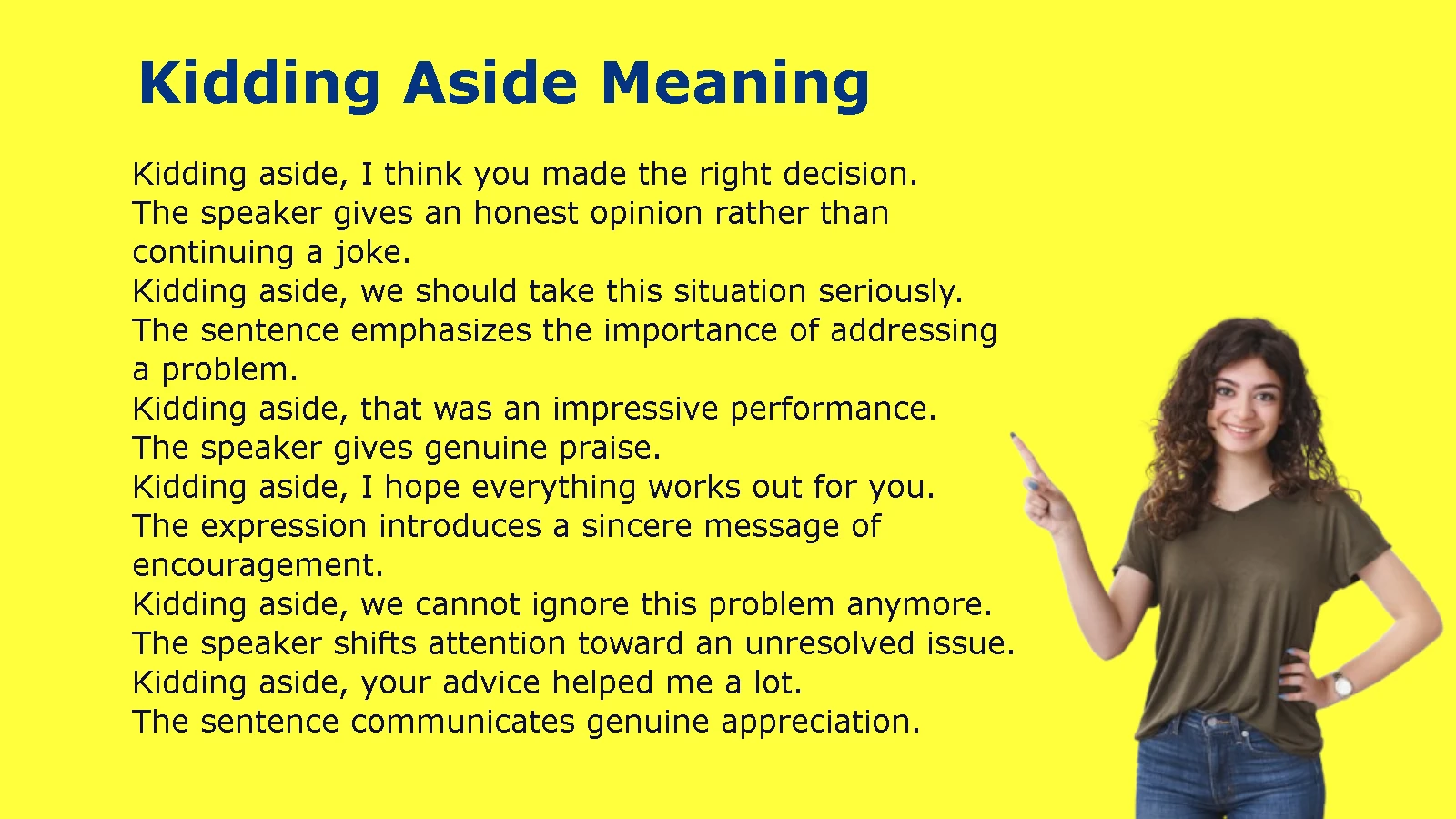
10 Everyday Examples of Kidding Aside
- Kidding aside, I really appreciate everything you’ve done for me.
The speaker expresses genuine gratitude after a playful conversation. - Kidding aside, we need to finish this project before Friday.
The sentence moves from casual discussion to an important deadline. - Kidding aside, she is one of the most talented people I know.
The speaker makes a sincere statement about someone’s abilities. - Kidding aside, exercise is important for your health.
The expression introduces a serious observation about fitness. - Kidding aside, I think you made the right decision.
The speaker gives an honest opinion rather than continuing a joke. - Kidding aside, we should take this situation seriously.
The sentence emphasizes the importance of addressing a problem. - Kidding aside, that was an impressive performance.
The speaker gives genuine praise. - Kidding aside, I hope everything works out for you.
The expression introduces a sincere message of encouragement. - Kidding aside, we cannot ignore this problem anymore.
The speaker shifts attention toward an unresolved issue. - Kidding aside, your advice helped me a lot.
The sentence communicates genuine appreciation.
Kidding Aside Examples in Different Situations
The meaning stays consistent, but the expression can serve different purposes depending on the situation.
With friends and family
People often use humor to create a relaxed atmosphere. The phrase helps them introduce something heartfelt without making the conversation feel overly serious.
Examples:
- Kidding aside, you’re always there when I need you.
- Kidding aside, I wouldn’t trade our friendship for anything.
- Kidding aside, Mom, I really appreciate everything you do.
- Kidding aside, you have become an important part of my life.
At work and in professional discussions
The expression can help colleagues transition from casual conversation to business matters. However, it works best in relaxed workplaces rather than formal reports or legal documents.
Examples:
- Kidding aside, we need to improve our customer service.
- Kidding aside, the team deserves recognition for this achievement.
- Kidding aside, our current strategy needs some adjustments.
- Kidding aside, meeting the deadline should be our priority.
At school and in academic conversations
Students may use the phrase when discussing assignments, examinations, or classroom activities.
Examples:
- Kidding aside, we should start preparing for the final examination.
- Kidding aside, that presentation taught me something valuable.
- Kidding aside, studying consistently is better than cramming.
On social media and in text messages
The expression works well in casual online conversations, especially when someone wants to make a genuine point after sharing a funny post or comment.
Examples:
- Kidding aside, I miss those unforgettable moments.
- Kidding aside, everyone deserves a second chance.
- Kidding aside, this is the best team I’ve ever worked with.
During serious discussions
People can also use the phrase to introduce difficult subjects.
Examples:
- Kidding aside, we need to discuss what happened yesterday.
- Kidding aside, your financial decisions deserve careful consideration.
- Kidding aside, I think we should find a solution before this becomes worse.
How to Start a Sentence With Kidding Aside
The most natural position for kidding aside is at the beginning of a sentence.
A common structure is:
Kidding aside + comma + serious statement.
Examples:
- Kidding aside, I respect your decision.
- Kidding aside, we have a lot of work ahead.
- Kidding aside, this opportunity could change your career.
- Kidding aside, I want everyone to feel welcome.
The comma separates the introductory expression from the main statement.
You can also use the phrase after an introductory humorous comment:
This construction works because the first sentence creates a playful atmosphere, while the second communicates genuine concern.
How to Use Kidding Aside at the End of a Sentence
Although people sometimes experiment with different sentence positions, kidding aside usually sounds most natural at the beginning.
Compare these examples:
| Sentence | Naturalness |
| Kidding aside, I appreciate your support. | Very natural |
| I appreciate your support, kidding aside. | Awkward in ordinary conversation |
| Kidding aside, we need to make a decision. | Very natural |
| We need to make a decision, kidding aside. | Less natural |
If you want to introduce a serious point, place the expression before the main statement.
This position makes your intention clear immediately.
Kidding Aside Synonyms and Alternative Expressions
Kidding aside synonyms are expressions that help speakers move from humor to a serious or sincere statement. Common alternatives include “joking aside,” “all jokes aside,” “seriously though,” “on a serious note,” and “in all seriousness.”
Although these expressions share a similar purpose, some sound more formal, emphatic, or conversational than others.
15 Other Ways to Say Kidding Aside
| Synonym | Meaning and usage |
| Joking aside | Setting humor aside to speak seriously |
| All jokes aside | Moving away from jokes to make a genuine point |
| Seriously though | Introducing a sincere statement |
| In all seriousness | Emphasizing that something is not a joke |
| On a serious note | Transitioning to an important subject |
| Jokes apart | Separating humor from the actual issue |
| Humor aside | Temporarily setting humor aside |
| But seriously | Introducing an earnest thought |
| Speaking seriously | Expressing a genuine opinion |
| Putting jokes aside | Stopping humorous comments to discuss something important |
| No joke | Emphasizing that something is genuine |
| Frankly speaking | Introducing an honest or direct opinion |
| Truthfully | Expressing something sincerely |
| To be serious | Signaling a change to a serious tone |
| In earnest | Speaking with genuine intention |
Formal Alternatives to Kidding Aside
“Kidding aside” is conversational. If you are writing a professional email, academic paper, business proposal, or formal report, another expression may fit better.
Consider these alternatives:
1. In all seriousness
Use this expression when you want to emphasize the importance of a statement.
Example: “In all seriousness, we need to reconsider our current business strategy.”
2. On a serious note
This phrase works when transitioning from a casual discussion to an important subject.
Example: “On a serious note, I appreciate the team’s dedication throughout the project.”
3. Speaking frankly
Use this expression when introducing an honest or direct opinion.
Example: “Speaking frankly, the proposed changes may not produce the expected results.”
4. More importantly
This alternative shifts attention toward a more significant point.
Example: “More importantly, we must ensure that every customer receives proper support.”
5. To address the matter seriously
This expression works in formal discussions where the subject requires careful attention.
Example: “To address the matter seriously, management should review the available evidence.”
Informal Alternatives to Kidding Aside
Casual conversations often benefit from shorter, more relaxed alternatives.
- But seriously: Introduces a genuine point after joking.
- Seriously though: Adds sincerity to a previous humorous exchange.
- All jokes aside: Signals that the speaker wants to stop joking.
- Jokes apart: Introduces a sincere thought.
- For real, though: Emphasizes that the speaker genuinely means something.
- No joke: Communicates that a statement is not exaggerated or humorous.
Examples:
- But seriously, you should consider taking that opportunity.
- Seriously though, I hope you’re doing well.
- All jokes aside, you’ve worked incredibly hard.
- For real, though, that was an amazing achievement.
Which Kidding Aside Synonym Should You Use?
The best synonym depends on your audience, tone, and communication setting.
| Situation | Recommended expression |
| Talking with friends | Seriously though |
| Making an important point | All jokes aside |
| Professional conversation | On a serious note |
| Formal writing | In all seriousness |
| Expressing an honest opinion | Speaking frankly |
| Emphasizing sincerity | But seriously |
| Casual text message | For real, though |
For most everyday conversations, joking aside and all jokes aside are the closest alternatives.
If you want a more polished expression, choose “on a serious note” or “in all seriousness.”
Kidding Aside vs. Joking Aside: Meaning and Differences
Kidding aside and joking aside have essentially the same meaning. Both expressions tell listeners that the speaker is moving away from humor to discuss something sincerely. The difference is mainly a matter of word choice and personal preference rather than a major difference in meaning.
What Does Joking Aside Mean?
Joking aside means temporarily setting jokes or humorous comments aside to make a serious statement.
It serves the same conversational purpose as “kidding aside.”
Examples:
- Joking aside, I think we need a better plan.
- Joking aside, you’re doing a fantastic job.
- Joking aside, this issue deserves our attention.
- Joking aside, I hope you achieve your goals.
The word “joking” refers to making jokes or speaking humorously. The word “aside” signals that the speaker wants to move beyond that humor.
Are Kidding Aside and Joking Aside Interchangeable?
Yes. In most everyday situations, you can replace one expression with the other without changing the overall meaning.
Consider these examples:
- Kidding aside, I really enjoyed the event.
- Joking aside, I really enjoyed the event.
Both sentences communicate genuine enjoyment.
The choice often comes down to personal preference and sentence rhythm.
| Feature | Kidding aside | Joking aside |
| Basic meaning | Setting humor aside | Setting humor aside |
| Tone | Conversational | Conversational |
| Grammar | Introductory expression | Introductory expression |
| Typical position | Beginning of a sentence | Beginning of a sentence |
| Main purpose | Introduce a serious point | Introduce a serious point |
Neither expression is inherently more formal than the other.
Kidding Aside vs. All Jokes Aside
These expressions also communicate similar ideas.
However, all jokes aside can place slightly more emphasis on ending the humorous part of a conversation.
Examples:
“Kidding aside, we need to improve our communication.”
“All jokes aside, we need to improve our communication.”
Both are natural sentences.
The second version may sound more emphatic because “all jokes” explicitly refers to every humorous comment in the discussion.
Which Expression Sounds More Natural?
All three expressions are natural in modern English:
- Kidding aside
- Joking aside
- All jokes aside
The best choice depends on your personal speaking style and the sentence.
For example:
Casual conversation: “Seriously though, I think you’re right.”
General conversation: “Kidding aside, I think you’re right.”
A more emphatic statement: “All jokes aside, I think you’re right.”
You do not need to memorize a strict rule that favors one expression over another. Focus on choosing the phrase that communicates your intention naturally.
Kidding Aside Shortcut and Acronym
Kidding aside does not have a widely recognized standard shortcut or acronym. Unlike common internet abbreviations such as LOL (laughing out loud), the expression is generally written in full. In casual messages, people often replace it with shorter phrases such as “seriously though” or “but seriously.”
Is There a Short Form for Kidding Aside?
There is no universally accepted abbreviation for “kidding aside” in standard English or everyday texting.
Some people may create personal shorthand, but that does not make it a recognized abbreviation.
For example, writing “KA” to represent “kidding aside” might make sense between two people who have agreed on that meaning. However, most readers will not automatically understand it.
If clarity matters, write the complete expression.
You can also choose shorter alternatives:
- Seriously though…
- But seriously…
- All jokes aside…
- For real, though…
- On a serious note…
These expressions communicate the same general idea without requiring an unfamiliar abbreviation.
Is Kidding Aside an Acronym?
No. “Kidding aside” is a phrase, not an established acronym.
An acronym is formed from the initial letters of a group of words and is generally pronounced as a word. An initialism also uses initial letters, but speakers pronounce the letters individually.
For comparison:
| Term | Full form | Type |
| LOL | Laughing out loud | Initialism commonly used as an abbreviation |
| ASAP | As soon as possible | Acronym |
| BRB | Be right back | Initialism |
| Kidding aside | Kidding aside | Ordinary expression |
Although someone could invent an abbreviation using the initials of the phrase, it would not automatically become standard English.
How to Say Kidding Aside in Text Messages
Text messages often favor short, direct expressions.
Instead of typing the entire phrase, you can use:
Example 1:
Friend: “You’re probably the laziest person I know.”
You: “Haha! But seriously, I need to finish my assignments tonight.”
Example 2:
Friend: “You should become a professional chef.”
You: “LOL. Seriously though, I really enjoy cooking.”
Example 3:
Friend: “We make a great team.”
You: “All jokes aside, we really do.”
These alternatives work because they preserve the original meaning while keeping the message natural.
No Kidding Aside Meaning
No kidding aside is not a widely established standard English expression. People who use it may be combining “no kidding” with “kidding aside” or “all jokes aside.” The intended meaning usually becomes clear from context, but choosing the appropriate established expression makes communication more natural.
What Does No Kidding Mean?
No kidding has several meanings depending on how someone uses it.
It can express surprise, disbelief, agreement, or sincerity.
For example:
1. Expressing surprise
Person A: “I got promoted yesterday.”
Person B: “No kidding! That’s fantastic!”
Here, “no kidding” expresses surprise and excitement.
2. Confirming something is true
Person A: “This restaurant has been open for 50 years.”
Person B: “No kidding?”
The second speaker wants confirmation because the information sounds surprising.
3. Emphasizing sincerity
“That was no kidding the hardest examination I’ve ever taken.”
In this context, the expression emphasizes that the statement is genuine.
No Kidding vs. Kidding Aside
These expressions contain the same word, but they perform different functions.
| Feature | No kidding | Kidding aside |
| Main meaning | Really? / I’m serious | Let’s put jokes aside |
| Main purpose | Express surprise or sincerity | Introduce a serious statement |
| Common usage | Reactions and emphasis | Conversational transitions |
| Example | No kidding! You won? | Kidding aside, you deserve to win. |
For example:
“No kidding, that was an amazing performance!”
This sentence expresses genuine surprise or emphasis.
“Kidding aside, that was an amazing performance.”
This sentence indicates that the speaker is moving away from humor to offer genuine praise.
Is No Kidding Aside Grammatically Correct?
Although people may understand “no kidding aside,” it is not the standard expression for introducing a serious statement.
The problem is that it combines two expressions with different grammatical and conversational functions.
Use these alternatives instead:
| Instead of | Write |
| No kidding aside, I appreciate you. | Kidding aside, I appreciate you. |
| No kidding aside, we should work harder. | All jokes aside, we should work harder. |
| No kidding aside, this is important. | In all seriousness, this is important. |
If you want to express surprise, use “no kidding.”
If you want to move from humor to seriousness, use “kidding aside.”
This simple distinction will help you avoid awkward phrasing.
Kidding Meaning and Just Kidding Meaning
Kidding means joking, teasing, or speaking in a playful way rather than making a completely serious statement. Just kidding tells someone that a previous statement was intended as a joke, while kidding aside signals a transition toward a serious point.
Although all three expressions contain the word “kidding,” their purposes are different.
What Does Kidding Mean?
Kidding is the present participle and gerund form of the verb “kid.”
As a verb, to kid someone means to joke with, tease, or playfully mislead another person.
Examples:
- I’m just kidding with you.
- Stop kidding around and finish your homework.
- Are you kidding me?
- He was kidding when he said he wanted to quit his job.
- She enjoys kidding her friends about their favorite sports teams.
The meaning can change slightly depending on the surrounding words.
For example, “Are you kidding me?” can express surprise, disbelief, frustration, or amusement.
Meanwhile, “Stop kidding around” tells someone to stop behaving playfully and become more serious.
What Does Just Kidding Mean?
Just kidding means that someone was joking and did not intend their previous statement to be taken seriously.
People commonly use it after teasing someone or making a humorous comment.
Examples:
- “I ate your lunch. Just kidding!”
- “You’re the worst singer I’ve ever heard. Just kidding, you sound great!”
- “I’m moving to another country tomorrow. Just kidding!”
- “You owe me a million dollars. Just kidding!”
The expression helps clarify the speaker’s intention.
However, adding “just kidding” does not automatically make an offensive remark harmless. A joke can still hurt someone’s feelings even when the speaker claims not to mean it.
Kidding vs. Just Kidding vs. Kidding Aside
These expressions have different meanings and grammatical functions.
| Expression | Meaning | Main purpose |
| Kidding | Joking or teasing | Describes playful speech |
| Just kidding | I was only joking | Clarifies that a statement was not serious |
| Kidding aside | Let’s stop joking and speak seriously | Introduces a genuine point |
| No kidding | Really? / I’m serious | Expresses surprise or sincerity |
| Joking aside | Setting jokes aside | Introduces a serious statement |
Consider this short conversation:
Person A: “You’re going to become a millionaire by selling your old shoes.”
B: “Just kidding, right?”
Person A: “Of course! Kidding aside, I actually have a business idea I want to discuss.”
The expressions work together, but each serves a different purpose.
Examples of Kidding and Just Kidding in Conversations
Friendly teasing
“You’re always stealing my snacks. I’m kidding, but you really should bring your own next time.”
Surprising someone
“Are you kidding me? You finished the entire assignment in one hour?”
Making a playful comment
“I’ve decided to become a professional dancer. Just kidding!”
Clarifying a joke
“I told him that his presentation was terrible, but I was just kidding.”
Moving to a serious topic
“We’ve had enough jokes about the deadline. Kidding aside, we need to finish the work today.”
Understanding these differences helps you select the right expression for each situation.
How to Use Kidding Aside Correctly
To use kidding aside correctly, place it at the beginning of a sentence when you want to introduce a sincere or serious statement after humor. Follow it with a comma, then express your genuine thought. The phrase works best when the conversation contains an existing humorous or playful context.
Where Does Kidding Aside Go in a Sentence?
The most common sentence structure is:
Kidding aside, + subject + verb + remaining sentence.
Examples:
- Kidding aside, I respect your hard work.
- Kidding aside, this decision requires careful thought.
- Kidding aside, we should help people who need support.
- Kidding aside, I think you have a bright future.
- Kidding aside, the results were better than expected.
You can also use the expression as a separate introductory sentence before expanding on your point.
Example:
“We’ve spent the entire afternoon joking about our terrible cooking skills. Kidding aside, I think we should learn a few basic recipes.”
This construction creates a smooth transition between two different conversational tones.
Should You Put a Comma After Kidding Aside?
Yes. When “kidding aside” introduces a sentence, a comma usually follows it.
The comma separates the introductory expression from the main clause.
Correct:
- Kidding aside, I appreciate your honesty.
- Kidding aside, we need to improve our communication.
- Kidding aside, this is a serious matter.
Incorrect in standard sentence punctuation:
- Kidding aside I appreciate your honesty.
- Kidding aside we need to improve our communication.
The comma improves readability and helps readers recognize where the introductory phrase ends.
Is Kidding Aside Formal or Informal?
“Kidding aside” is generally considered conversational and informal.
People use it naturally in everyday discussions, casual presentations, friendly workplace conversations, and social media posts.
However, it may not be the best choice for highly formal writing.
Consider these examples:
| Communication setting | Recommended wording |
| Chatting with friends | Kidding aside |
| Casual workplace discussion | Kidding aside |
| Business presentation | On a serious note |
| Professional email | In all seriousness |
| Academic writing | More importantly / In a serious consideration of the issue |
| Formal report | To address the matter directly |
For example, this sentence works well in a casual meeting:
“Kidding aside, our customer feedback has improved significantly.”
For a formal business report, a more direct version may sound better:
“More importantly, customer feedback has improved significantly.”
Choose the expression that fits the audience rather than forcing conversational language into every situation.
Common Mistakes to Avoid
Even though “kidding aside” is simple, people sometimes use it incorrectly.
Here are some common mistakes and how to fix them.
1. Confusing kidding aside with just kidding
These phrases do not mean the same thing.
Incorrect understanding: Both expressions simply mean that someone is joking.
Correct understanding: “Just kidding” clarifies a joke, while “kidding aside” introduces a serious point.
2. Writing no kidding aside
This combination is not a standard expression.
Better alternatives:
- Kidding aside, we should discuss the issue.
- All jokes aside, this situation needs attention.
- In all seriousness, we need to make a decision.
3. Forgetting the comma
Use a comma after “kidding aside” when it introduces a sentence.
Correct: “Kidding aside, I believe you can succeed.”
4. Using the expression without a serious statement
The phrase prepares readers for something genuine.
Awkward: “Kidding aside, haha, that was funny.”
Better: “Kidding aside, that was one of the best performances I’ve seen.”
5. Assuming every joke needs a serious transition
You do not need to use “kidding aside” after every humorous comment. Use it when you genuinely want to change the direction or tone of a conversation.
Real-Life Case Studies: Kidding Aside in Context
Understanding definitions is useful, but seeing how the expression works in realistic situations makes it easier to remember.
The following scenarios demonstrate how the phrase can change the meaning and tone of a conversation.
Case Study 1: A Workplace Discussion
Imagine a marketing team discussing a new campaign.
One employee jokes:
“If this campaign fails, we’ll all have to start selling lemonade.”
Another employee responds:
“Kidding aside, our advertising budget needs a closer review before we launch.”
Why it works: The expression acknowledges the humor but redirects attention to a genuine business concern. It helps the employee introduce criticism without making the conversation unnecessarily confrontational.
Case Study 2: A Conversation Between Friends
Two friends are discussing their school days.
One says:
“We were probably the most troublesome students in the entire class.”
The other responds:
“Kidding aside, those were some of the best years of my life.”
Why it works: The phrase creates a natural transition from playful memories to sincere nostalgia.
Case Study 3: Expressing Genuine Appreciation
A person makes fun of a friend’s habit of giving long speeches.
The friend laughs and replies:
“Kidding aside, I really value your advice. You’ve helped me through some difficult situations.”
Why it works: The expression helps communicate appreciation after a humorous exchange. It makes the transition from teasing to sincerity clear.
What These Examples Teach Us
Across these situations, the expression performs three main functions:
- Changes the tone: It moves a conversation from playful to serious.
- Clarifies intention: It tells listeners that the next statement is genuine.
- Creates a smoother transition: It connects humor with a meaningful point.
The phrase works best when the serious statement that follows relates naturally to the conversation.
Conclusion: Understanding and Using Kidding Aside
Kidding aside means putting jokes and humor aside to say something serious, sincere, or important. People use it in everyday conversations when they want to move from playful comments to genuine thoughts.
The expression is similar to joking aside, all jokes aside, and seriously though. However, it differs from just kidding, which tells someone that a previous statement was only a joke, and no kidding, which often expresses surprise or sincerity.
You can also use the phrase in Taglish conversations, professional discussions, social media posts, and personal messages. Remember to place a comma after it when it introduces a sentence.
If you want to improve your everyday English, start using expressions such as “kidding aside,” “on a serious note,” and “all jokes aside” in the right situations. These small language choices can make your conversations clearer, more natural, and more expressive.
Kidding aside, the best way to understand a phrase is to use it in real conversations.
Frequently Asked Questions About Kidding Aside Meaning
What Does Kidding Aside Mean in Simple Words?
Kidding aside means putting jokes aside and speaking seriously. People use it when they want to move from a humorous conversation to an honest, meaningful, or important statement.
Is Kidding Aside the Same as Joking Aside?
Yes. Both expressions mean setting humor aside to discuss something seriously. They are generally interchangeable in everyday English and commonly appear at the beginning of a sentence.
What Is Another Word for Kidding Aside?
Common alternatives include “joking aside,” “all jokes aside,” “seriously though,” “in all seriousness,” “on a serious note,” and “but seriously.” The best choice depends on the situation and the level of formality.
What Does Kidding Aside Mean in Tagalog?
Kidding aside can mean “sa seryosong usapan,” “tabi muna ang biro,” or “kung seryoso lang ang pag-uusapan.” The most natural translation depends on the context and intended meaning.
Does Kidding Aside Have an Abbreviation or Acronym?
No widely recognized standard abbreviation or acronym exists for kidding aside. People generally write the complete phrase or use shorter alternatives such as “seriously though” and “but seriously.”
What Is the Difference Between Just Kidding and Kidding Aside?
“Just kidding” means that someone was only joking and did not intend a previous statement to be taken seriously. “Kidding aside” means the speaker is moving away from humor to introduce a genuine or serious statement.
Can I Use Kidding Aside in a Professional Conversation?
Yes. You can use it in relaxed workplace discussions, meetings, and presentations. However, “on a serious note” or “in all seriousness” may sound more appropriate in formal business communication.
Is Kidding Aside Grammatically Correct?
Yes. “Kidding aside” is an established conversational expression. When it introduces a sentence, place a comma after it, as in “Kidding aside, I appreciate your support.”
What Does No Kidding Mean?
“No kidding” can express surprise, disbelief, or sincerity. For example, “No kidding! You won the competition?” expresses surprise, while “I’m not kidding” emphasizes that someone is telling the truth.
What Is the Difference Between Kidding and Kidding Aside?
“Kidding” means joking or teasing someone. “Kidding aside” means temporarily setting jokes aside to discuss something seriously. The first describes playful behavior, while the second introduces a change in conversational tone.













