The nicer meaning is more pleasant, kind, friendly, polite, or agreeable than someone or something else. Nicer is the comparative form of the adjective nice, and people use it to compare two people, places, experiences, behaviors, or things. For example, saying “She is nicer than her sister” means she behaves in a kinder or more pleasant way.
Understanding nicer, more nice, and nicest helps you use comparative and superlative adjectives correctly. Although people sometimes say “more nice” in conversation, nicer remains the standard comparative form. The expression “more nicer” is generally grammatically incorrect because it combines two comparative markers.
| Question | Answer |
| What does nicer mean? | More pleasant, kind, friendly, or agreeable than something else. |
| Is it nicer or more nice? | Nicer is the standard and more natural comparative form. |
| What does nicer mean in slang? | It usually means kinder, friendlier, more attractive, or more appealing in casual conversation. |
| What is the difference between nicer and nicest? | Nicer compares two things; nicest identifies the most pleasant one in a group. |
| What does more nicer mean? | It is a nonstandard double comparative. Use nicer instead. |
What Does Nicer Mean?
Nicer means more pleasant, friendly, kind, considerate, or agreeable when compared with another person or thing. It describes a higher degree of a positive quality. The word works as a comparative adjective, which means it expresses a difference between two people, objects, situations, or experiences.
The meaning depends on what you describe. When you call someone nicer, you might mean that they treat people better. When you describe a room as nicer, you might mean it looks more attractive or feels more comfortable.
For example:
- My new neighbor is nicer than the previous one.
- This restaurant has a nicer atmosphere.
- You should speak in a nicer tone.
- The weather looks nicer today.
In each sentence, nicer highlights a positive difference.
Simple Definition of Nicer
The simplest definition of nicer is more nice. However, standard English generally uses nicer rather than more nice.
The word can communicate several related qualities:
- Kindness: Someone shows more care or compassion toward others.
- Friendliness: A person behaves in a warmer, more welcoming way.
- Politeness: Someone uses better manners or speaks respectfully.
- Pleasantness: An experience, environment, or situation feels more enjoyable.
- Attractiveness: Something looks more appealing or attractive.
- Agreeableness: A person or situation feels easier and more comfortable to deal with.
Consider these examples:
| Context | Example | Meaning |
| Personality | She is nicer than her cousin. | She behaves more kindly. |
| Appearance | This dress looks nicer. | It looks more attractive. |
| Environment | The new office is nicer. | It feels more pleasant. |
| Behavior | Try to be nicer to your teammates. | Treat them more kindly. |
| Experience | We had a nicer vacation this year. | The vacation was more enjoyable. |
What Does Nicer Mean in Everyday English?
In everyday English, nicer often describes a noticeable improvement in how someone behaves or how something looks and feels.
People use it when they compare experiences without making a strong or exaggerated judgment.
For instance, imagine that a coworker usually communicates in a direct and impatient way. After receiving feedback, the coworker starts listening more carefully and responding politely. You might say:
“He’s much nicer to work with now.”
Here, nicer does not necessarily mean that the person has completely changed their personality. It means their behavior has become more pleasant.
The word also appears in everyday requests:
- “Could you be a little nicer?”
- “Let’s find a nicer place to eat.”
- “That color looks nicer on you.”
- “Your new manager seems nicer.”
These statements express comparison, improvement, or a preference for something more pleasant.
Nicer as an Adjective: Grammatical Function
Nicer is an adjective, specifically the comparative form of nice.
Adjectives describe nouns and pronouns. Comparative adjectives help speakers compare two subjects or show that one subject has a greater degree of a particular quality.
English commonly uses three degrees of adjective comparison:
| Degree | Word | Example |
| Positive | Nice | He is nice. |
| Comparative | Nicer | He is nicer than his brother. |
| Superlative | Nicest | He is the nicest person here. |
Notice how the adjective changes as the comparison becomes stronger.
- Nice: Describes a pleasant quality without making a comparison.
- Nicer: Shows that one person or thing has more of that quality than another.
- Nicest: Identifies the person or thing with the highest degree of that quality within a group.
The comparative form commonly appears with than, while the superlative form often appears with the.
Nicer or More Nice: Which Is Correct?
Nicer is the standard comparative form of the adjective nice. English normally forms the comparative of short adjectives by adding -er. Although “more nice” sometimes appears in conversation for emphasis or contrast, nicer sounds more natural in most situations. Avoid “more nicer” in standard English because it creates a double comparative.
Why Is Nicer More Common Than More Nice?
English follows several common patterns when forming comparative adjectives.
For most short adjectives, speakers add -er to show a greater degree of a quality.
Examples include:
- Tall → Taller
- Small → Smaller
- Fast → Faster
- Kind → Kinder
- Short → Shorter
- Nice → Nicer
Because nice has one syllable, it normally takes the comparative suffix -er.
This construction is shorter and more natural than using more before the adjective.
Compare these sentences:
| Less natural or nonstandard | Standard and natural |
| This restaurant is more nice. | This restaurant is nicer. |
| He is more nice than his brother. | He is nicer than his brother. |
| Your new shoes are more nice. | Your new shoes are nicer. |
| She seems more nice today. | She seems nicer today. |
The standard comparative form keeps the sentence clear and follows the usual grammar pattern.
When Can You Use More Nice?
Although nicer is the usual choice, you may encounter “more nice” in informal speech, creative writing, or sentences that emphasize a contrast.
For example:
“She’s not just polite; she’s more nice and approachable than most people I know.”
This construction may sound conversational, but many speakers would naturally rewrite it as:
“She’s not just polite; she’s nicer and more approachable than most people I know.”
Sometimes a writer may deliberately choose “more nice” to create a particular rhythm or emphasize the adjective itself. However, this is not the normal comparative construction.
For everyday writing, schoolwork, professional communication, and standard English, choose nicer.
More Nicer Meaning: Is It Grammatically Correct?
More nicer is a nonstandard double comparative. It combines the word “more” with the suffix “-er,” even though both already express comparison. Standard English normally requires only one comparative marker, so “nicer” is the correct form.
To understand the problem, consider how the two comparative markers work:
- More: Creates a comparative construction when placed before an adjective.
- -er: Changes an adjective into its comparative form.
Using both together creates unnecessary repetition.
Examples:
| Incorrect or nonstandard | Correct |
| She is more nicer than me. | She is nicer than me. |
| This house looks more nicer. | This house looks nicer. |
| He became more nicer over time. | He became nicer over time. |
| Your new design is more nicer. | Your new design is nicer. |
Remember: Use either the comparative suffix or the word more when grammar calls for it. Do not combine both in the same ordinary comparative construction.
Nicer vs. More Nice vs. More Nicer
These three expressions may appear similar, but they differ in grammatical correctness and naturalness.
| Expression | Usage | Recommendation |
| Nicer | Standard comparative adjective | Preferred |
| More nice | Less common comparative construction | Usually replace with nicer |
| More nicer | Double comparative | Avoid in standard English |
A useful way to remember the difference is to think about the adjective’s original form.
The word nice already has an established comparative form: nicer. You do not need to add another comparative marker.
Nicest Meaning: How Is It Different From Nicer?
Nicest means the most pleasant, friendly, kind, or agreeable within a particular group. It is the superlative form of nice. While nicer compares two people or things, nicest identifies the one with the highest degree of a positive quality among three or more subjects.
For example:
- My sister is nicer than my brother.
- My sister is the nicest person in our family.
The first sentence compares two people. The second identifies one person as having the highest degree of niceness within a group.
Nicer vs. Nicest: Main Differences
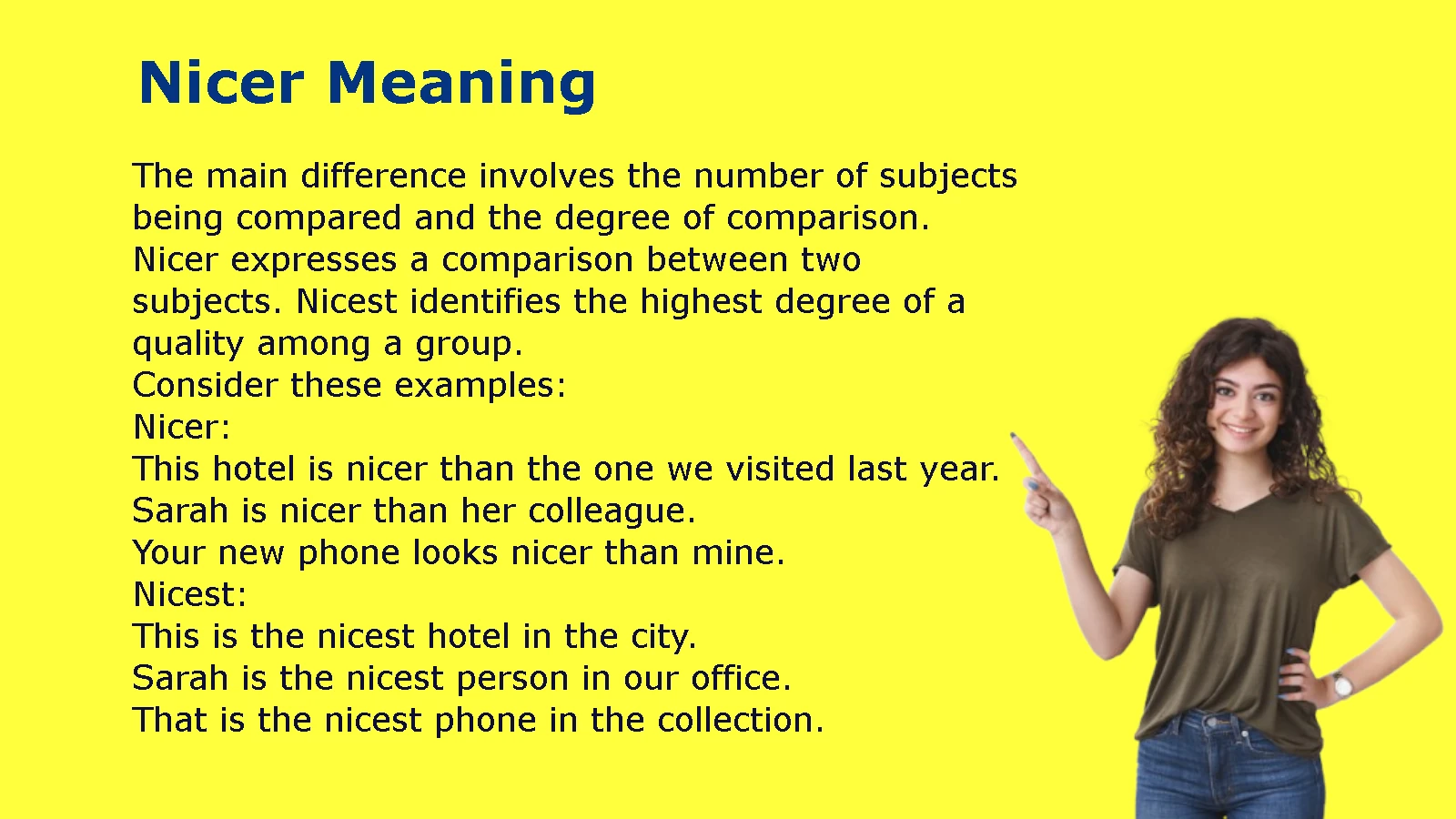
The main difference involves the number of subjects being compared and the degree of comparison.
Nicer expresses a comparison between two subjects. Nicest identifies the highest degree of a quality among a group.
Consider these examples:
Nicer:
- This hotel is nicer than the one we visited last year.
- Sarah is nicer than her colleague.
- Your new phone looks nicer than mine.
Nicest:
- This is the nicest hotel in the city.
- Sarah is the nicest person in our office.
- That is the nicest phone in the collection.
The distinction becomes easier when you look at the grammatical structure.
| Feature | Nicer | Nicest |
| Adjective degree | Comparative | Superlative |
| Basic meaning | More pleasant | Most pleasant |
| Typical comparison | Two subjects | Three or more subjects |
| Common structure | Nicer than | The nicest |
| Example | He is nicer than Tom. | He is the nicest in the group. |
Nice, Nicer, and Nicest in English Grammar
The three forms of the adjective nice follow a regular comparison pattern.
Nice
Positive degree
Describes a pleasant quality without comparison.
She is a nice person.
Nicer
Comparative degree
Compares one person or thing with another.
She is nicer than her colleague.
Nicest
Superlative degree
Identifies the highest degree of a quality.
She is the nicest person in the office.
The spelling also follows a consistent pattern:
- Nice
- Nicer
- Nicest
The final e in nice disappears before adding the comparative or superlative suffix.
When Should You Use Nicer and Nicest?
Use nicer when you want to compare two people, objects, places, or experiences.
Use nicest when you want to identify the most pleasant option within a larger group.
Here are practical examples:
Comparing two people:
“Daniel is nicer than Mark.”
This sentence compares the behavior or personality of two individuals.
Choosing between several restaurants:
“That is the nicest restaurant in this neighborhood.”
The speaker identifies one restaurant as the most pleasant among several options.
Comparing two experiences:
“This year’s trip was nicer than last year’s.”
The sentence describes an improvement in the overall experience.
Describing a group member:
“Emily is the nicest person on our team.”
The sentence identifies Emily as the person with the highest degree of niceness within the team.
Nicer Meaning in Slang and Casual Conversations
In slang and casual conversations, nicer generally means kinder, friendlier, more attractive, or more appealing. It does not have one fixed slang definition that replaces its standard meaning. Instead, speakers use the word informally to express approval, compliment someone, describe better treatment, or highlight something they prefer.
Does Nicer Have a Slang Meaning?
The word nicer does not have a widely established separate slang meaning. Its casual meaning usually develops from the context in which someone uses it.
For example, someone might say:
“Your new haircut is much nicer.”
This is an informal compliment. The speaker means that the haircut looks more attractive than the previous one.
Another person might say:
“He’s been a lot nicer lately.”
Here, the word describes an improvement in behavior.
In online conversations, text messages, and social media comments, people may use nicer to express:
- Approval: They like something more than another option.
- Attraction: Someone or something looks more appealing.
- Friendliness: A person behaves more warmly.
- Kindness: Someone treats others with greater consideration.
- Improvement: A situation has become more pleasant.
The context determines which meaning applies.
What Does Nicer Mean When Someone Says It to You?
When someone calls you nicer, they usually suggest that your behavior, attitude, or personality feels more pleasant than before or more pleasant than another person’s.
However, the exact meaning depends on the conversation.
Consider these situations:
1. Someone appreciates your behavior
“You’ve become much nicer since we started working together.”
This suggests that the person has noticed a positive change in how you communicate or interact.
2. Someone gives you a compliment
“You look nicer with that hairstyle.”
The speaker means that your hairstyle improves your appearance.
3. Someone requests better treatment
“Can you be a little nicer to your sister?”
This means you should treat your sister with more kindness or respect.
4. Someone compares personalities
“Your friend seems nicer than the other people in the group.”
The speaker believes your friend behaves in a more pleasant way.
A useful point is that nicer is not always a compliment. Sometimes it functions as a polite criticism or request for improvement.
For example, “You could be nicer” suggests that the listener’s current behavior is not as kind or friendly as expected.
What Does Nicer Man Mean?
The phrase nicer man describes a man who is kinder, friendlier, more considerate, or more pleasant than another man or someone previously discussed.
It does not represent a special slang expression. Instead, it combines the comparative adjective nicer with the noun man.
Examples:
- He is a nicer man than I expected.
- I have never met a nicer man.
- She deserves to be with a nicer man.
- My new manager is a much nicer man than the previous one.
The meaning can change slightly with context.
For example, “He is a nicer man” may describe his manners, kindness, honesty, or treatment of others.
However, the phrase “a nicer man” does not automatically mean someone is morally superior in every way. It simply expresses a comparison involving a positive quality.
Nicer Pronunciation and Word Forms
The word nicer is pronounced /ˈnaɪ.sər/ in common American English. It contains two syllables, with stress on the first syllable. Its spelling combines the adjective nice with the comparative suffix -er, creating a word that means more pleasant or agreeable.
How to Pronounce Nicer
Nicer
/ˈnaɪ.sər/
American English IPA
Pronunciation breakdown
- Number of syllables: 2
- Main stress: First syllable
- First sound: The long “i” sound, as in night
- Ending: An unstressed “-er” sound
To pronounce the word naturally:
- Begin with the long vowel sound found in “nice.”
- Add the second syllable with a relaxed ending.
- Place greater emphasis on the first syllable.
The pronunciation should sound smooth rather than like two equally stressed parts.
How to Spell Nicer Correctly
The correct spelling is nicer, not “niceer” or “nicier.”
The spelling rule is straightforward: When an adjective ends in a silent e, remove that final e before adding -er or -est.
Examples:
| Original adjective | Comparative | Superlative |
| Nice | Nicer | Nicest |
| Large | Larger | Largest |
| Fine | Finer | Finest |
| Wise | Wiser | Wisest |
| Safe | Safer | Safest |
This pattern explains why nice becomes nicer rather than niceer.
The same spelling principle applies to the superlative form. You remove the final e before adding -est.
Related Forms of Nice
Several related words come from the adjective nice. Understanding their grammatical roles helps you use them correctly.
| Word | Part of speech | Meaning | Example |
| Nice | Adjective | Pleasant or agreeable | She is nice. |
| Nicer | Comparative adjective | More pleasant | She is nicer than him. |
| Nicest | Superlative adjective | Most pleasant | She is the nicest person here. |
| Nicely | Adverb | In a pleasant or satisfactory way | He spoke nicely. |
| Niceness | Noun | The quality of being nice | Her niceness impressed everyone. |
These words share the same basic idea but serve different grammatical functions.
For example, you can say “She is nice” because nice describes her. You can say “She speaks nicely” because nicely describes how she speaks.
Nicer in a Sentence: 25+ Practical Examples
The word nicer appears in everyday conversations, professional communication, descriptions, comparisons, and polite requests. It can describe people, behavior, appearance, environments, and experiences. The following examples show how to use it naturally in different situations.
Nicer in Everyday Conversations
These sentences demonstrate common conversational uses.
- This restaurant is much nicer than the one we visited yesterday.
- Your new apartment looks nicer than your old one.
- Could you speak in a nicer tone?
- The weather seems nicer today.
- We should find a nicer place to celebrate.
- That color looks nicer on you.
- The new office feels nicer and more comfortable.
- I think this version is nicer than the original.
In these examples, nicer expresses a preference or comparison. It often communicates an improvement without sounding overly formal.
Nicer in Sentences About People and Personality
People frequently use nicer to describe someone’s attitude, manners, or behavior.
- My new neighbor is much nicer than the previous one.
- She has become nicer since we started working together.
- He is a nicer man than I expected.
- I wish people were nicer to each other.
- Your teacher seems nicer in person.
- My younger brother is getting nicer as he grows older.
- You should be nicer to your classmates.
- Her new manager is nicer and more understanding.
Notice that these sentences do not always describe someone’s permanent personality. They may describe how a person behaves in a particular situation.
Nicer in Sentences About Places and Things
You can also use nicer when comparing objects, locations, designs, and surroundings.
- This hotel has nicer rooms.
- The new apartment has a nicer kitchen.
- That park looks nicer in the morning.
- We should choose a nicer location for the meeting.
- This version has a nicer design.
- The renovated house looks much nicer.
- Your new phone has a nicer display.
- I prefer the nicer-looking furniture.
In these situations, nicer may refer to appearance, comfort, quality, or general appeal.
Nicer in Questions and Negative Sentences
The comparative adjective also works naturally in questions and negative statements.
- Could you be a little nicer?
- Why can’t we make this place nicer?
- Isn’t this neighborhood nicer than the old one?
- The weather isn’t getting any nicer.
- I expected a nicer response.
- Would you like to find a nicer restaurant?
- Why does everyone seem nicer today?
- This situation could be much nicer.
These examples show that nicer can express requests, dissatisfaction, expectations, and comparisons.
Nicer in Professional and Academic Writing
Although nicer often appears in casual English, it also works in professional and academic contexts when the meaning is clear.
Examples:
- The redesigned workspace provides a nicer environment for employees.
- The revised proposal offers a nicer balance between cost and quality.
- A nicer approach to customer communication may improve satisfaction.
- The second design creates a nicer visual experience.
- Employees responded more positively to the nicer working conditions.
However, in formal writing, consider whether a more precise adjective would communicate your meaning better.
For example:
- “A nicer working environment” could become “a more comfortable working environment.”
- “A nicer response” could become “a more professional response.”
- “A nicer design” could become “a more visually appealing design.”
The best choice depends on the quality you want to emphasize.
Common Grammar Mistakes When Using Nicer
Writers sometimes misuse nicer because they confuse comparative and superlative adjectives or apply the wrong comparison pattern. Learning a few basic rules will help you avoid these mistakes and write more naturally.
Using More Nicer Instead of Nicer
The most common mistake involves adding more before an adjective that already has the comparative suffix.
Incorrect:
“She is more nicer than her friend.”
Correct:
“She is nicer than her friend.”
The word nicer already expresses comparison. Adding more creates an unnecessary second comparative marker.
Remember this general rule:
- Use nicer, not more nicer.
- Use smarter, not more smarter.
- Use faster, not more faster.
- Use kinder, not more kinder.
This pattern applies to many short adjectives in English.
Confusing Nicer With Nicest
Another common mistake occurs when writers use the comparative form instead of the superlative form.
Incorrect:
“She is the nicer person in the entire class.”
Correct:
“She is the nicest person in the entire class.”
The first sentence suggests a comparison but does not clearly express the highest degree within the group.
Use nicer for a comparison between two subjects:
“She is nicer than her classmates.”
Use nicest to identify the highest degree:
“She is the nicest student in her class.”
Forgetting Than in Comparative Sentences
The word than often follows comparative adjectives when the writer identifies the second subject in a comparison.
Examples:
- My sister is nicer than my brother.
- This hotel is nicer than the previous one.
- Your new design looks nicer than mine.
However, you do not always need to include than.
For example:
“Your new hairstyle looks nicer.”
The comparison is understood from the context, even though the speaker does not explicitly identify the alternative.
Using Nicer When You Mean Better
The words nicer and better sometimes overlap, but they do not always communicate the same meaning.
Nicer focuses on pleasant qualities, such as friendliness, appearance, comfort, or agreeableness.
Better has a broader meaning. It can describe improved performance, higher quality, greater effectiveness, or a more suitable choice.
Compare these sentences:
| Sentence | Meaning |
| This restaurant is nicer. | It has a more pleasant atmosphere or appearance. |
| This restaurant is better. | It offers a higher overall quality or experience. |
| He is nicer than his colleague. | He behaves more kindly or pleasantly. |
| He is better at his job. | He performs his work more effectively. |
For example, a restaurant may have a nicer interior but serve worse food. In that situation, nicer describes its atmosphere, while better would describe its overall quality only if the evidence supports that judgment.
Synonyms and Related Words for Nicer
Several English adjectives can replace nicer, depending on the context. Although these words share positive meanings, they emphasize different qualities. Choosing the right synonym makes your writing more precise and helps you avoid repeating the same adjective.
Synonyms for Nicer
Here are useful alternatives:
| Synonym | Meaning | Example |
| Kinder | More caring or compassionate | She is kinder than her colleague. |
| Friendlier | More welcoming or sociable | The new receptionist is friendlier. |
| More pleasant | More enjoyable or agreeable | This room feels more pleasant. |
| More polite | More respectful in behavior | His response was more polite. |
| More considerate | More thoughtful toward others | She is more considerate of her team. |
| More agreeable | Easier to get along with | He seems more agreeable today. |
| More charming | More appealing or attractive | The renovated house looks more charming. |
| More welcoming | More inviting or hospitable | The new office feels more welcoming. |
| More enjoyable | More satisfying or entertaining | This activity is more enjoyable. |
| More attractive | Better-looking or more appealing | The updated design is more attractive. |
The best synonym depends on what you want to communicate.
For example, kinder works well when describing someone’s compassion, while more attractive works better when discussing appearance.
Choosing the Right Synonym Based on Context
Replacing nicer with another adjective can improve clarity.
Consider these situations:
When describing kindness:
Instead of “My new supervisor is nicer,” you can say:
“My new supervisor is more considerate.”
This version highlights thoughtful behavior rather than general pleasantness.
When describing social behavior:
Instead of “The receptionist is nicer,” you can say:
“The receptionist is friendlier.”
This emphasizes warmth and willingness to communicate.
When describing appearance:
Instead of “This dress looks nicer,” you can say:
“This dress looks more elegant.”
This gives the reader a clearer idea of the quality being compared.
When describing an experience:
Instead of “The new hotel is nicer,” you can say:
“The new hotel is more comfortable.”
This focuses on the actual benefit rather than general approval.
Nicer vs. Kinder vs. Friendlier
These three adjectives have related meanings, but they are not interchangeable in every situation.
| Word | Main focus | Example |
| Nicer | General pleasantness | She is nicer than before. |
| Kinder | Compassion and care | She is kinder to younger children. |
| Friendlier | Warm social interaction | She is friendlier toward new employees. |
Nicer is the broadest option. It can describe behavior, appearance, atmosphere, or experiences.
Kinder focuses more specifically on compassion and consideration.
Friendlier emphasizes social warmth, openness, and approachability.
For example, someone might be friendly without showing much compassion. Another person might be kind but quiet and reserved. These distinctions help you select the right adjective for your sentence.
Practical Usage: How to Choose Between Nice, Nicer, and Nicest
The easiest way to use these three forms correctly is to identify whether you are describing a quality, comparing two subjects, or selecting the highest degree within a group.
A Simple Three-Step Framework
Step 1: Identify whether you need a comparison.
If you are simply describing someone or something, use nice.
Example: “The new teacher is nice.”
Step 2: Compare two subjects.
If one subject has a greater degree of the quality, use nicer.
Example: “The new teacher is nicer than the previous one.”
Step 3: Identify the highest degree in a group.
If you are describing the most pleasant subject among several options, use nicest.
Example: “She is the nicest teacher in the school.”
Quick grammar decision guide
Choose the type of description you want to make.
I am describing one person or thing without comparison.
I am identifying the most pleasant option in a group.
Use NICER
Example: She is nicer than her sister.
A Real-Life Example: Comparing Three Restaurants
Imagine that you are choosing between three restaurants for dinner.
- Restaurant A has a pleasant atmosphere.
- Restaurant B has a more comfortable interior.
- Restaurant C has the most welcoming environment.
You could describe them using all three adjective forms:
“Restaurant A is nice, Restaurant B is nicer, and Restaurant C is the nicest.”
This example demonstrates the progression from a basic positive description to a comparison and finally to the highest degree.
The same framework works when discussing people, products, experiences, and locations.
Frequently Asked Questions About Nicer
What Does Nicer Mean in Simple Words?
Nicer means more pleasant, friendly, kind, or agreeable than someone or something else. It is the comparative form of nice. For example, “My new teacher is nicer” means the teacher behaves in a more pleasant or friendly way than someone previously discussed.
Is It Nicer or More Nice?
Nicer is the standard and more natural comparative form of nice. English usually adds -er to short adjectives to create comparisons. Although more nice sometimes appears in informal or emphatic speech, nicer is generally the preferred choice in everyday and formal writing.
What Does More Nicer Mean?
More nicer is a nonstandard double comparative. The word nicer already expresses comparison through the suffix -er, so adding more creates unnecessary repetition. Instead of writing “She is more nicer than her friend,” write “She is nicer than her friend.”
What Is the Difference Between Nicer and Nicest?
Nicer is the comparative form of nice and usually compares two people or things. Nicest is the superlative form and identifies the highest degree of pleasantness within a group. For example, “He is nicer than Tom” compares two people, while “He is the nicest person here” identifies one person in a group.
What Does Nicer Mean in Slang?
In casual conversation, nicer generally means kinder, friendlier, more attractive, or more appealing. It does not have one universally accepted slang definition separate from its standard meaning. The surrounding conversation determines whether someone refers to personality, behavior, appearance, or general approval.
How Do You Pronounce Nicer?
Nicer is pronounced /ˈnaɪ.sər/ in common American English. It has two syllables, with the primary stress on the first. The opening sound matches the long vowel in nice, while the ending has a relaxed “-er” sound.
Conclusion: Use Nicer Correctly in Everyday English
The word nicer is a simple but useful comparative adjective that describes something more pleasant, kind, friendly, attractive, or agreeable than another person or thing. It comes from the adjective nice and follows the standard English pattern of adding -er to form a comparative.
Remember these three forms:
- Nice: Describes a positive quality.
- Nicer: Compares two people or things.
- Nicest: Identifies the highest degree of a quality within a group.













