Broader means wider, more extensive, or more comprehensive than something else. It is the comparative form of the adjective broad, which describes physical width, scope, range, or coverage. People use broader to discuss everything from a broader perspective and broader knowledge to broader shoulders, musical sounds, and wider opportunities. Understanding the word also involves knowing its synonyms, pronunciation, grammatical forms, and translations into French, Spanish, and Chinese.
Whether you encountered broader in an academic article, everyday conversation, music discussion, or physical description, its central idea remains the same: something extends beyond a narrower limit or covers more ground. However, its exact meaning depends on the context.
| Question | Answer |
| What does broader mean? | Broader means wider, more extensive, or greater in scope than something else. |
| What is another word for broader? | Wider, more extensive, more comprehensive, more expansive, or greater. |
| What is the difference between broad and broader? | Broad describes width or scope, while broader compares something with another thing. |
| What does broader mean in French? | Common translations include plus large, plus vaste, and plus étendu. |
| How do you pronounce broader? | BROAD-er, with two syllables and stress on the first syllable. |
What Does Broader Mean?
Broader means having greater width, range, extent, or scope than another person, object, idea, or subject. It describes something that covers more space or includes more elements than something else. The word works in both physical and abstract situations.
For example, a broader road has more physical width than a narrower road. Similarly, a broader perspective considers more viewpoints, while a broader understanding includes additional information or ideas.
The word comes from broad, an adjective that describes something wide or extensive. Adding the suffix -er creates its comparative form.
Consider these examples:
- The new highway is broader than the old road.
- Reading different books gives students a broader understanding of history.
- The manager wants a broader discussion before making a decision.
- Her broader knowledge of technology helps her solve complicated problems.
- The company plans to reach a broader audience through social media.
In each sentence, broader communicates an increase in width, coverage, or range.
Broader Definition in Simple English
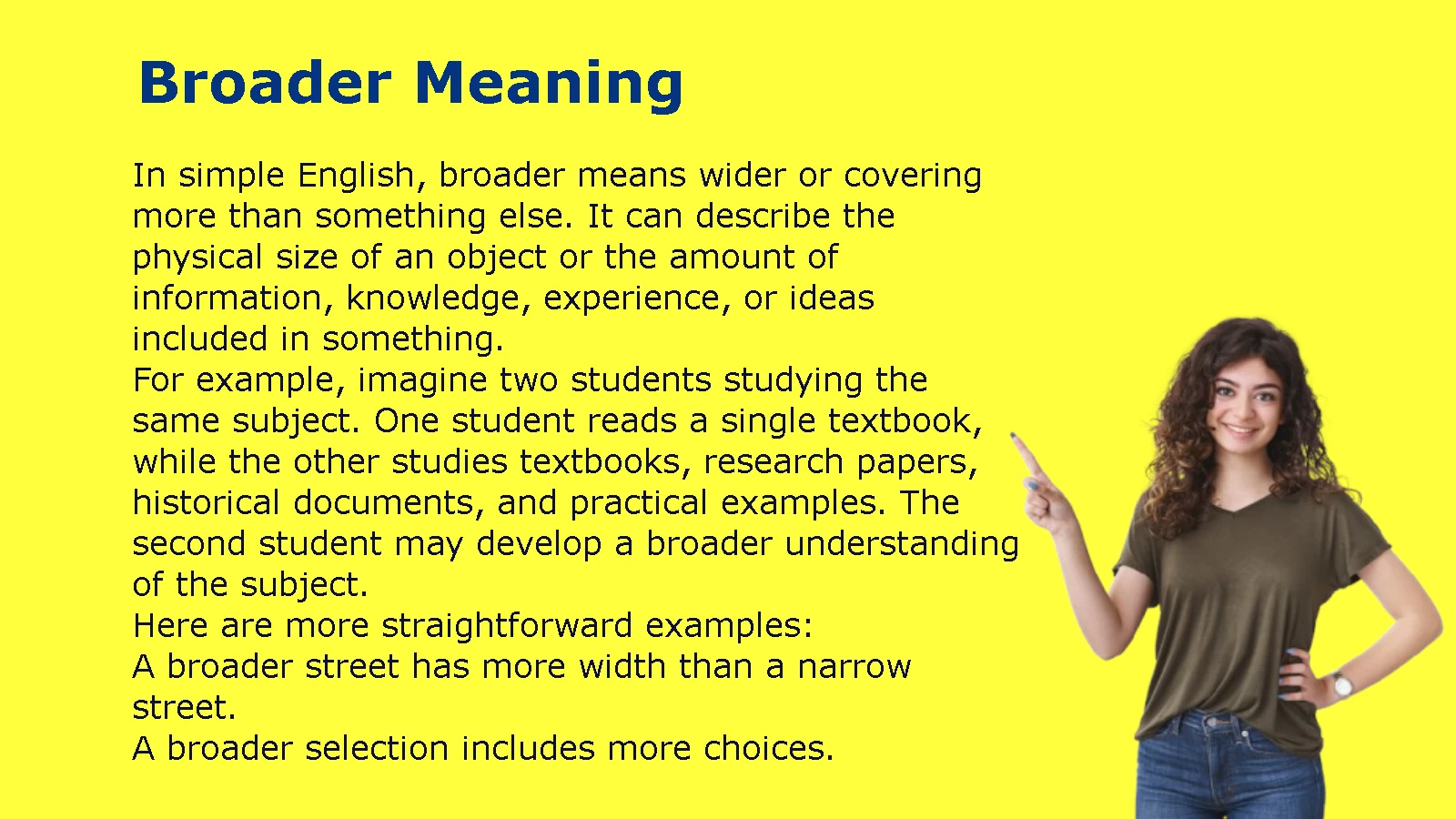
In simple English, broader means wider or covering more than something else. It can describe the physical size of an object or the amount of information, knowledge, experience, or ideas included in something.
For example, imagine two students studying the same subject. One student reads a single textbook, while the other studies textbooks, research papers, historical documents, and practical examples. The second student may develop a broader understanding of the subject.
Here are more straightforward examples:
- A broader street has more width than a narrow street.
- A broader selection includes more choices.
- A broader education covers more subjects.
- A broader conversation includes additional topics.
- A broader vision considers more possibilities.
The important point is that broader usually involves comparison. Something is broader because it extends further or covers more than another thing.
Broader Meaning in Different Contexts
The meaning of broader changes slightly depending on the noun it describes. Although the central idea involves greater extent, the word can communicate physical, intellectual, social, or professional differences.
| Expression | Meaning | Example |
| Broader perspective | Considering more viewpoints | Travel gave her a broader perspective on life. |
| Broader knowledge | Understanding more subjects | The course provides broader knowledge of economics. |
| Broader scope | Covering more areas | The project now has a broader scope. |
| Broader range | Including more options | The store offers a broader range of products. |
| Broader audience | Reaching more people | The campaign attracted a broader audience. |
| Broader shoulders | Greater shoulder width | The athlete has broader shoulders than his teammate. |
| Broader discussion | Covering additional issues | The meeting developed into a broader discussion. |
These examples show why context matters when interpreting the word. A broader perspective concerns ideas, whereas broader shoulders describe physical dimensions.
Is Broader an Adjective?
Yes. Broader is a comparative adjective derived from the base adjective broad.
Adjectives describe nouns by providing information about their qualities, characteristics, or conditions. Comparative adjectives express a difference between two people, objects, or situations.
For example:
- Broad street: Describes a street with considerable width.
- Broader street: Describes a street that is wider than another.
- Broad knowledge: Describes extensive knowledge.
- Broader knowledge: Describes knowledge covering more subjects or areas.
Broader commonly appears with the word than when the sentence makes an explicit comparison.
Example: This research covers a broader range of topics than the previous study.
However, the comparison does not always need to appear in the same sentence. The surrounding discussion may already establish the reference point.
Broad Meaning vs. Broader Meaning
The difference between broad and broader lies in grammatical comparison. Broad describes something as wide, extensive, or general without directly comparing it with another thing. Broader indicates a greater degree of width, coverage, or scope.
Both words can describe physical objects and abstract concepts, but they serve different purposes in sentences.
What Does Broad Mean?
Broad means wide, extensive, or covering a large area or range. It can refer to physical measurements, general knowledge, subjects, ideas, and categories.
For instance, a broad road has considerable width. A broad subject covers several related areas rather than focusing on one narrow topic.
Examples include:
- The river flows through a broad valley.
- She has a broad knowledge of literature.
- The professor introduced a broad topic for discussion.
- The company serves a broad customer base.
- He has broad shoulders and a strong frame.
Broad can also mean general rather than specific.
For example, the statement “Technology affects society” is a broad observation because it covers many different technologies and social effects without identifying one particular issue.
What Does Broader Mean Compared to Broad?
Broader expresses a greater degree of breadth than broad. It helps compare two things based on their physical dimensions, coverage, or general extent.
Look at this comparison:
- Broad: The road is broad.
- Broader: The new road is broader than the old one.
The first sentence describes the road. The second establishes a comparison between two roads.
The same grammatical distinction applies to abstract ideas:
- Broad: The report provides a broad overview of marketing.
- Broader: The updated report provides a broader overview of marketing.
The second report covers more areas or includes additional information.
Broad vs. Broader Examples in Sentences
| Broad | Broader |
| She has broad shoulders. | He has broader shoulders than his brother. |
| The course covers a broad subject. | The new course covers a broader range of subjects. |
| We need a broad understanding. | We need a broader understanding of the issue. |
| The road is broad. | This road is broader than the previous one. |
| The company has a broad customer base. | The campaign reached a broader customer base. |
Grammar tip: Use broad when describing a quality. Use broader when comparing that quality with something else.
What Is the Definition of a Broad Woman?
The expression broad woman generally describes a woman with a wide physical frame, broad shoulders, or a larger body structure. However, broad can also have an informal meaning when used as a noun to refer to a woman. That usage can sound outdated, disrespectful, or offensive depending on the speaker and situation.
Understanding the difference between these meanings helps prevent confusion.
Broad Woman Meaning in Physical Description
When someone describes a woman as broad, they usually refer to her physical proportions. The description may involve:
- Broad shoulders.
- A wide upper body.
- A naturally wide frame.
- A strong or sturdy build.
- Greater body width across the chest or torso.
For example:
“She has a broad frame that gives her a powerful athletic appearance.”
A woman can have broad shoulders and a relatively lean body. Similarly, someone can have a narrow frame and carry more body weight. Physical width and body weight describe different characteristics.
Is Calling a Woman Broad Offensive?
Calling a woman broad can sound blunt or insensitive, particularly when the speaker uses the word to judge her appearance.
The expression also has a separate informal noun usage. In older American slang, “a broad” referred to a woman. Depending on the situation, it could sound dismissive or derogatory.
More respectful alternatives include:
- Broad-shouldered woman.
- Strong-built woman.
- Woman with a wide frame.
- Athletic woman, when her athletic build is relevant.
- Woman with a sturdy physique.
For example, instead of saying, “She is broad,” you could say, “She has broad shoulders and an athletic build.”
The second description provides more precise information without making an unnecessarily personal judgment.
Broad Woman vs. Broad-Shouldered Woman
These expressions differ in precision.
| Expression | Meaning | Tone |
| Broad woman | A woman with a generally wide physical build; may also carry an informal slang meaning | Informal and potentially insensitive |
| Broad-shouldered woman | A woman with noticeably wide shoulders | More specific and neutral |
| Wide-framed woman | A woman with a naturally wider body structure | Generally neutral |
| Athletic woman | A woman with an athletic physique | Positive or descriptive, depending on context |
If you want to describe someone’s physical appearance accurately, broad-shouldered is usually a clearer choice than simply calling someone broad.
Broader Meaning Synonyms and Alternatives
Several words can replace broader, but the best synonym depends on the meaning you want to communicate.
Common Synonyms for Broader
Here are useful synonyms, their meanings, and examples.
| Synonym | Meaning | Example |
| Wider | Having greater physical width or range | This road is wider than the old one. |
| More extensive | Covering more ground or material | The team conducted more extensive research. |
| More comprehensive | Including more details or aspects | We need a more comprehensive report. |
| Greater | Larger in degree, amount, or extent | The proposal offers a greater range of opportunities. |
| More inclusive | Including more people or groups | The organization adopted a more inclusive policy. |
| More expansive | Extending over a larger area or scope | The company developed a more expansive strategy. |
| Far-reaching | Having effects across a wide area | The decision had far-reaching consequences. |
| More general | Covering a wider category rather than specific details | The article provides a more general explanation. |
| Wider-ranging | Covering more subjects or areas | The discussion became wider-ranging. |
| Enlarged | Increased in size, extent, or scope | The project now has an enlarged focus. |
These alternatives overlap, but they are not always interchangeable.
For example, wider usually works well for physical measurements. More comprehensive works better when discussing a report, explanation, or study that includes additional details.
Broader Synonyms for Different Contexts
Choosing a synonym based on context makes your writing more accurate and natural.
Broader perspective
Useful alternatives:
- Wider perspective.
- Expanded viewpoint.
- More comprehensive outlook.
- Broader outlook.
- More open-minded approach.
Example: Working with international clients gave the business owner a wider perspective on customer expectations.
Broader knowledge
Useful alternatives:
- Wider knowledge.
- More extensive knowledge.
- Greater understanding.
- Broader expertise.
- More comprehensive learning.
Example: Studying different economic systems helped the students develop a more extensive understanding of global markets.
Broader scope
Useful alternatives:
- Wider scope.
- Expanded range.
- Greater coverage.
- More extensive reach.
- Larger area of focus.
Example: The revised research project has a wider scope than the original proposal.
Broader audience
Useful alternatives:
- Larger audience.
- Wider readership.
- Greater reach.
- More diverse audience.
- Expanded customer base.
Example: The simplified website attracted a more diverse audience.
Broader shoulders
Useful alternatives:
- Wider shoulders.
- Wide shoulder frame.
- Broad upper body.
Example: The swimmer has wider shoulders than most people in his training group.
Broader vs. Wider vs. More Comprehensive
These three expressions are closely related, but each has a preferred use.
| Word or phrase | Main meaning | Best context |
| Broader | Greater width or scope | Physical and abstract comparisons |
| Wider | Greater physical width or range | Roads, spaces, selections, and coverage |
| More comprehensive | Including more aspects or details | Reports, explanations, plans, and research |
Consider the following sentences:
- The new bridge is wider than the old bridge.
- The new educational program has a broader curriculum.
- The updated report provides a more comprehensive explanation.
Using the most suitable alternative improves clarity and prevents repetitive writing.
Broader Meaning in French
The English word broader has several French translations, including plus large, plus vaste, and plus étendu. The correct choice depends on whether the word describes physical width, abstract scope, or the extent of something.
French adjectives also agree with the nouns they modify in gender and number. The comparative construction plus + adjective generally expresses a greater degree of a quality.
Broader in French: Plus Large
Plus large is a common translation when broader refers to physical width or a wider range.
Examples:
- A broader road = Une route plus large.
- A broader street = Une rue plus large.
- A broader selection = Un choix plus large.
This expression works for both physical and some abstract contexts.
For example:
“Nous avons besoin d’un choix plus large.”
Meaning: We need a broader selection.
Broader in French: Plus Vaste
Plus vaste usually communicates greater scope, extent, or breadth. It works particularly well for abstract subjects.
Examples:
- A broader perspective = Une perspective plus vaste.
- A broader vision = Une vision plus vaste.
- A broader field of study = Un domaine d’étude plus vaste.
This translation is useful when describing something that reaches beyond its original limits.
Broader in French: Plus Étendu
Plus étendu emphasizes something that covers a greater area or includes more elements.
Examples:
- Broader research = Une recherche plus étendue.
- A broader network = Un réseau plus étendu.
- A broader area = Une zone plus étendue.
The adjective étendu changes its ending according to the gender and number of the noun:
- Masculine singular: étendu.
- Feminine singular: étendue.
- Masculine plural: étendus.
- Feminine plural: étendues.
French Translation Examples
| English | French |
| Broader meaning | Sens plus large |
| Broader perspective | Perspective plus vaste |
| Broader understanding | Compréhension plus étendue |
| Broader range | Gamme plus large |
| Broader discussion | Discussion plus vaste |
| Broader knowledge | Connaissances plus étendues |
Translation tip: Do not translate broader using one French expression in every sentence. Choose plus large for width or range, plus vaste for general scope, and plus étendu when emphasizing greater coverage.
Broader Meaning in Spanish
In Spanish, broader is commonly translated as más amplio, más extenso, or más ancho. Each expression communicates a different type of width or extent.
Spanish adjectives generally agree with the nouns they describe in gender and number. The word más remains unchanged, while the adjective takes the appropriate form.
Broader in Spanish: Más Amplio
Más amplio is one of the most versatile translations of broader. It can describe physical space, knowledge, opportunities, perspectives, and general scope.
Examples:
- A broader perspective = Una perspectiva más amplia.
- A broader understanding = Una comprensión más amplia.
- A broader range = Una gama más amplia.
- A broader discussion = Una discusión más amplia.
This is often the most natural option when translating broader in abstract contexts.
Broader in Spanish: Más Extenso
Más extenso emphasizes greater extent, length, or coverage.
It works well when describing research, documents, discussions, and large subject areas.
Examples:
- Broader research = Una investigación más extensa.
- A broader report = Un informe más extenso.
- A broader discussion = Una discusión más extensa.
This expression is particularly useful when something includes more material or covers additional ground.
Broader in Spanish: Más Ancho
Más ancho generally refers to greater physical width.
Examples:
- A broader road = Una carretera más ancha.
- A broader bridge = Un puente más ancho.
- A broader table = Una mesa más ancha.
The adjective changes according to gender and number:
- Masculine singular: ancho.
- Feminine singular: ancha.
- Masculine plural: anchos.
- Feminine plural: anchas.
Spanish Translation Examples
| English | Spanish |
| Broader meaning | Significado más amplio |
| Broader perspective | Perspectiva más amplia |
| Broader audience | Público más amplio |
| Broader knowledge | Conocimientos más amplios |
| Broader shoulders | Hombros más anchos |
| Broader research | Investigación más extensa |
| Broader scope | Alcance más amplio |
The key distinction is straightforward: use más amplio for general breadth, más extenso for greater coverage, and más ancho for physical width.
Broader Meaning in Chinese
In Chinese, the word broader can be translated as 更广泛 (gèng guǎngfàn), 更宽 (gèng kuān), or 更广 (gèng guǎng).
These expressions communicate different forms of increased breadth. Chinese does not change adjective endings according to gender or number, so the context and surrounding words determine the intended meaning.
Broader in Chinese: 更广泛 (Gèng Guǎngfàn)
更广泛 means more widespread, more extensive, or broader in scope.
It works particularly well when discussing ideas, knowledge, influence, discussion, and social participation.
Examples:
- A broader discussion = 更广泛的讨论.
- Broader knowledge = 更广泛的知识.
- Broader influence = 更广泛的影响.
- A broader range of subjects = 更广泛的学科范围.
For example:
“我们需要更广泛的讨论。”
Meaning: We need a broader discussion.
Broader in Chinese: 更宽 (Gèng Kuān)
更宽 means wider or physically broader. It generally describes measurable width.
Examples:
- A broader road = 更宽的道路.
- A broader table = 更宽的桌子.
- A broader bridge = 更宽的桥.
This expression is appropriate when discussing the physical dimensions of objects or spaces.
Broader in Chinese: 更广 (Gèng Guǎng)
更广 means wider or greater in range, reach, or extent. It can describe geographical coverage, influence, and abstract scope.
Examples:
- Broader coverage = 覆盖范围更广.
- Broader impact = 影响更广.
- A broader audience = 更广泛的受众.
Although 更广 and 更广泛 overlap, 更广泛 often emphasizes wider coverage or participation, while 更广 can describe a greater overall reach.
Chinese Translation Examples
| English | Simplified Chinese | Pinyin |
| Broader perspective | 更广泛的视角 | Gèng guǎngfàn de shìjiǎo |
| Broader audience | 更广泛的受众 | Gèng guǎngfàn de shòuzhòng |
| Broader knowledge | 更广泛的知识 | Gèng guǎngfàn de zhīshi |
| Broader road | 更宽的道路 | Gèng kuān de dàolù |
| Broader influence | 更广泛的影响 | Gèng guǎngfàn de yǐngxiǎng |
| Broader coverage | 覆盖范围更广 | Fùgài fànwéi gèng guǎng |
What Does Broader Mean in Music?
In music, broader generally describes a sound, tonal range, musical texture, or expressive quality that feels more expansive. It can refer to a composition that uses more instruments, explores additional registers, develops richer harmonies, or creates a fuller listening experience.
Unlike terms such as pitch, tempo, and frequency, broader is not a fixed technical music-theory measurement. Its meaning depends on what the musician, producer, or reviewer wants to describe.
Broader Musical Sound
A broader musical sound usually feels fuller, richer, or more expansive than a simpler arrangement.
Several musical elements can contribute to this impression:
- Instrumentation: Adding instruments creates additional sonic layers.
- Orchestration: Different instruments contribute contrasting tones and textures.
- Harmony: Additional harmonic parts can make an arrangement feel richer.
- Dynamics: Changes in loudness and intensity can increase the sense of scale.
- Production: Panning, reverberation, and layering can create a wider soundstage.
For example, imagine a recording that initially features only an acoustic guitar and a singer. The producer later introduces bass, percussion, strings, and backing vocals.
The updated arrangement may sound broader because it contains more musical layers and a greater variety of tones.
Broader Tonal Range
A broader tonal range means a musical performance or composition explores a greater variety of pitches, registers, or tonal colors.
A singer who performs comfortably across lower and higher registers may demonstrate a broader vocal range than someone whose performance stays within a smaller pitch range.
Similarly, an orchestral composition can achieve a broader tonal palette by combining:
- Low-register instruments such as cellos and double basses.
- Midrange instruments such as violas and clarinets.
- High-register instruments such as violins and flutes.
- Percussion instruments that introduce different tonal and rhythmic qualities.
A broader tonal range can make music feel more varied and expressive.
Broader Musical Expression
Broader musical expression involves using additional musical techniques to communicate a wider range of emotions, moods, or ideas.
A composer might achieve this through:
- Changes in harmony.
- Contrasting rhythmic patterns.
- Different instrumental combinations.
- Shifts between quiet and powerful passages.
- Greater melodic variation.
- More diverse musical structures.
For instance, a composition that moves between calm acoustic sections and powerful orchestral passages may offer a broader emotional experience than one that maintains the same arrangement throughout.
Examples of Broader in Music
| Expression | Meaning |
| Broader orchestral arrangement | An arrangement featuring more instruments or musical layers |
| Broader vocal range | A greater span of notes a singer can perform |
| Broader musical palette | A wider selection of sounds, instruments, and techniques |
| Broader soundstage | A more expansive perceived spatial presentation |
| Broader harmonic range | Greater variety in harmonic material |
| Broader musical expression | More ways of communicating emotion or musical ideas |
Practical example: A music producer might say, “The revised arrangement has a broader sound.” This means the new version feels more expansive or contains a richer combination of musical elements. It does not necessarily mean the recording has a wider frequency response or a technically measurable increase in width.
How to Pronounce Broader
The word broader has two syllables and places its primary stress on the first syllable. It is pronounced with the same opening sound as broad, followed by an unstressed ending.
Pronunciation varies slightly between American and British English, particularly in the final R sound.
Broader Pronunciation in IPA
The International Phonetic Alphabet (IPA) provides a standardized way to represent pronunciation.
| English variety | IPA pronunciation |
| American English | /ˈbrɔːdər/ |
| British English | /ˈbrɔːdə/ |
In American English, the final R is generally pronounced. In many standard British English accents, the final R is not pronounced unless the following word begins with a vowel sound in connected speech.
How Many Syllables Does Broader Have?
Broader has two syllables: broad-er.
The first syllable receives the primary stress, while the second syllable remains unstressed.
Understanding this syllable pattern helps English learners pronounce the word naturally.
Compare the following words:
- Broad: One syllable.
- Broader: Two syllables.
- Broadest: Two syllables.
The spelling also reflects a common adjective formation pattern in English.
How to Pronounce Broader Correctly
Follow these steps to practice:
- Start with the word broad.
- Pronounce its opening consonant blend and vowel sound clearly.
- Add the unstressed ending.
- Keep the emphasis on the first syllable.
- Practice the complete word in a natural sentence.
Try these examples:
- The new highway is broader than the old road.
- She developed a broader understanding of business.
- The company wants to reach a broader audience.
Reading these sentences aloud can help you become more comfortable using the word in everyday speech.
How to Use Broader in a Sentence
Broader works in everyday conversations, academic writing, business communication, and professional discussions. It commonly appears before nouns such as perspective, understanding, knowledge, scope, range, audience, and shoulders.
The following examples demonstrate how to use the word naturally.
Broader in Everyday Conversation
In ordinary conversation, broader often describes improved understanding, more choices, or additional experiences.
Examples:
- Traveling abroad gave me a broader view of different cultures.
- We should consider a broader range of possibilities.
- Her experiences helped her develop a broader understanding of people.
- The new store offers a broader selection of clothing.
- Watching documentaries can give children a broader perspective on the world.
- His interests have become broader since he started university.
These sentences show how broader communicates an expansion beyond an existing limit.
Broader in Academic and Professional Writing
Academic and professional writing frequently uses broader to describe research, analysis, knowledge, strategies, and objectives.
Examples:
Education:
- The revised curriculum provides students with a broader understanding of scientific principles.
- Studying different historical periods offers a broader view of human development.
Business:
- The company adopted a broader marketing strategy to reach new customer groups.
- Management needs a broader analysis of market conditions before approving the investment.
Research:
- The researchers expanded their study to examine a broader range of environmental factors.
- A broader sample may provide additional insight into consumer behavior.
Communication:
- The report presents a broader discussion of workplace challenges.
- The organization wants to develop a broader communication strategy.
In professional writing, broader is especially useful when explaining why a narrow approach needs expansion.
Broader in Comparisons
The word commonly appears in several grammatical patterns.
Broader than
Use this structure to compare two things directly.
Examples:
- This road is broader than the one near our house.
- Her experience is broader than mine.
- The new research covers a broader area than the original project.
A broader range of
Use this expression when something includes more options, subjects, or possibilities.
Examples:
- The university offers a broader range of courses.
- Customers now have access to a broader range of products.
- The program introduces a broader range of career opportunities.
A broader understanding of
Use this expression when someone develops knowledge that covers more aspects of a subject.
Examples:
- The course gives students a broader understanding of economics.
- Practical experience provides a broader understanding of customer needs.
A broader perspective on
Use this expression when someone considers more viewpoints or approaches.
Examples:
- International experience gives employees a broader perspective on business.
- Reading different opinions can provide a broader perspective on social issues.
Common Mistakes When Using Broader
Although broader is relatively easy to understand, some common mistakes can affect sentence clarity.
Mistake 1: Confusing broad with broader
Incorrect: This road is broader.
This sentence is not necessarily grammatically incorrect, but it needs an established comparison or context to make the meaning clear.
Clearer: This road is broader than the road we used yesterday.
Mistake 2: Treating broader and bigger as identical
Bigger generally means greater in size, amount, or importance. Broader specifically emphasizes width, range, or scope.
For example:
- A bigger building may have more total floor space.
- A broader building may have greater width.
The two descriptions communicate different physical qualities.
Mistake 3: Using broader instead of more detailed
Broader and more detailed do not mean the same thing.
A broader explanation covers more aspects of a subject. A more detailed explanation provides additional information about particular aspects.
For example:
“The revised report offers a broader overview of the industry.”
This means the report covers more areas of the industry.
“The revised report offers a more detailed explanation of industry regulations.”
This means it explains specific information more thoroughly.
Mistake 4: Forgetting the comparison
Broader is a comparative form. If the sentence makes a direct comparison, identify the reference point.
Example:
- Better: The revised strategy has a broader focus than the original strategy.
- Less clear: The revised strategy is broader.
The second sentence can work when the comparison is already understood, but the first communicates the relationship more clearly.
Broad, Broader, and Broadest: Understanding the Degrees of Comparison
English adjectives often have three degrees of comparison: positive, comparative, and superlative.
The adjective broad follows the regular comparative and superlative pattern by adding -er and -est.
Broad: Positive Form
Broad is the basic form of the adjective. It describes width, extent, or scope without making a direct comparison.
Examples:
- The road is broad.
- She has broad shoulders.
- The report covers a broad subject.
- The university provides a broad education.
The positive form communicates a characteristic rather than a comparative relationship.
Broader: Comparative Form
Broader is the comparative form of broad. It describes something with greater width or extent than another thing.
Examples:
- This road is broader than the old one.
- The revised report covers a broader subject area.
- She has broader shoulders than her sister.
- The new course provides a broader education.
The word than often introduces the second part of a direct comparison.
Broadest: Superlative Form
Broadest is the superlative form of broad. It identifies the greatest degree of width or scope among three or more things.
Examples:
- This is the broadest road in the neighborhood.
- That was the broadest discussion of the entire conference.
- The final report covers the broadest range of subjects.
- She has the broadest experience among the candidates.
The superlative form usually appears with the word the when used attributively.
Examples of All Three Forms
| Degree | Word | Example |
| Positive | Broad | The topic is broad. |
| Comparative | Broader | This topic is broader than the previous one. |
| Superlative | Broadest | This is the broadest topic in the course. |
Spelling rule: Broad becomes broader and broadest without removing any letters. The adjective simply takes the comparative and superlative endings.
Practical Case Study: How Broader Changes Meaning Across Different Situations
Consider a company that initially sells products to customers in one city. Its original marketing strategy focuses on a small audience and a limited selection of products.
After reviewing customer feedback, the company decides to expand its operations.
It introduces additional product categories, creates content for different customer groups, and begins selling in several regions.
The marketing team describes the revised strategy as having a broader scope.
This description makes sense because the strategy now covers more markets, products, and potential customers.
The same word can describe other changes:
| Situation | Original approach | Broader approach |
| Education | Studying one subject | Studying several related subjects |
| Business | Targeting one customer group | Reaching multiple customer groups |
| Research | Examining one variable | Examining several related variables |
| Music | Using a small instrumental arrangement | Introducing more instruments and textures |
| Communication | Considering one viewpoint | Evaluating several perspectives |
The lesson is simple: broader describes an expansion in scope, coverage, width, or range. It does not automatically mean better. Whether the expansion improves the result depends on the purpose.
As a useful writing principle:
A broader approach considers more possibilities, but a focused approach examines fewer possibilities in greater depth.
This distinction helps writers use broader accurately instead of treating it as a universal synonym for better, bigger, or more detailed.
Frequently Asked Questions About Broader
What Does Broader Mean in Simple Words?
Broader means wider or more extensive than something else. It can describe physical width, such as a broader road, or an abstract quality, such as a broader understanding of a subject. It is the comparative form of broad and generally indicates greater range, coverage, or scope.
What Is Another Word for Broader?
Common synonyms for broader include wider, more extensive, more comprehensive, more expansive, greater, and more inclusive. The best alternative depends on the context. Use wider for physical dimensions, more comprehensive for detailed coverage, and more inclusive when discussing people or groups.
What Is the Difference Between Broad and Broader?
Broad is the base adjective used to describe something wide or extensive. Broader is its comparative form, which indicates a greater degree of width or scope. For example, “a broad road” describes a road, while “a broader road” compares its width with another road.
What Does Broader Mean in French?
Broader can translate into French as plus large, plus vaste, or plus étendu. Plus large commonly describes physical width or range, plus vaste emphasizes greater scope, and plus étendu highlights wider coverage. The correct translation depends on the noun and the context.
What Does Broader Mean in Spanish?
The common Spanish translations of broader are más amplio, más extenso, and más ancho. Más amplio works for perspectives and general scope, más extenso describes greater coverage, and más ancho usually refers to physical width.
What Does Broader Mean in Chinese?
Broader can be translated into Chinese as 更广泛 (gèng guǎngfàn), 更宽 (gèng kuān), or 更广 (gèng guǎng). 更广泛 describes wider coverage or scope, 更宽 refers to physical width, and 更广 communicates greater reach or extent.
What Does Broader Mean in Music?
In music, broader generally describes a sound, arrangement, tonal range, or expressive quality that feels more expansive. It may refer to additional instruments, richer harmonies, wider vocal registers, or a fuller musical texture. It is a descriptive expression rather than a fixed technical measurement.
Is Broader a Positive or Negative Word?
Broader is a neutral adjective. Its meaning is neither inherently positive nor negative. A broader perspective may be beneficial because it considers more viewpoints, while a broader project scope may create additional complexity. The surrounding context determines whether the expansion is desirable.
Is Broader the Comparative Form of Broad?
Yes. Broader is the regular comparative form of broad. The three degrees of comparison are broad, broader, and broadest. These forms describe the basic quality, a greater degree of that quality, and the greatest degree among a group, respectively.
How Many Syllables Does Broader Have?
Broader has two syllables: broad-er. The first syllable receives the primary stress. Its pronunciation varies slightly between American and British English, particularly in the final R sound.
Conclusion: Understanding and Using Broader Correctly
The word broader describes something that has greater width, scope, range, or extent than another thing. As the comparative form of broad, it appears in everyday conversation, academic writing, business communication, physical descriptions, and discussions about music.
Its meaning becomes clearer when you consider the context. A broader perspective includes more viewpoints, a broader range offers more choices, and broader shoulders describe greater physical width.
The word also has useful equivalents in other languages. French commonly uses plus large, plus vaste, and plus étendu. Spanish uses más amplio, más extenso, and más ancho, while Chinese uses expressions such as 更广泛 and 更宽.
When choosing synonyms, remember that wider, more comprehensive, more extensive, and more inclusive communicate different shades of meaning.













