Have you ever read a sentence and thought, “What does that actually mean?” If so, you may have come across something ambiguous. Ambiguous Meaning refers to a word, phrase, sentence, or situation that can have more than one possible interpretation.
Ambiguous is an adjective that describes something that is unclear, uncertain, or open to multiple meanings. Meaning refers to what a word, phrase, statement, or action expresses or communicates. Together, ambiguous meaning describes language that does not have one clear interpretation.
Examples:
- The teacher gave an ambiguous answer to the question.
- His message had an ambiguous meaning, so I wasn’t sure what he meant.
The confusion is understandable. People often search for what does ambiguous mean, ambiguous meaning in English, ambiguous meaning in a sentence, ambiguous meaning in text, or what is an ambiguous statement because unclear language can be easy to misunderstand. And here’s the kicker: a single sentence can mean two completely different things depending on the context, tone, or words used.
In this guide, you’ll learn the complete Ambiguous Meaning, its definition, pronunciation, correct usage, and examples in sentences. You’ll also discover the difference between ambiguous, vague, and unclear, along with common examples of ambiguous words and sentences.
What Does “Ambiguous” Mean?
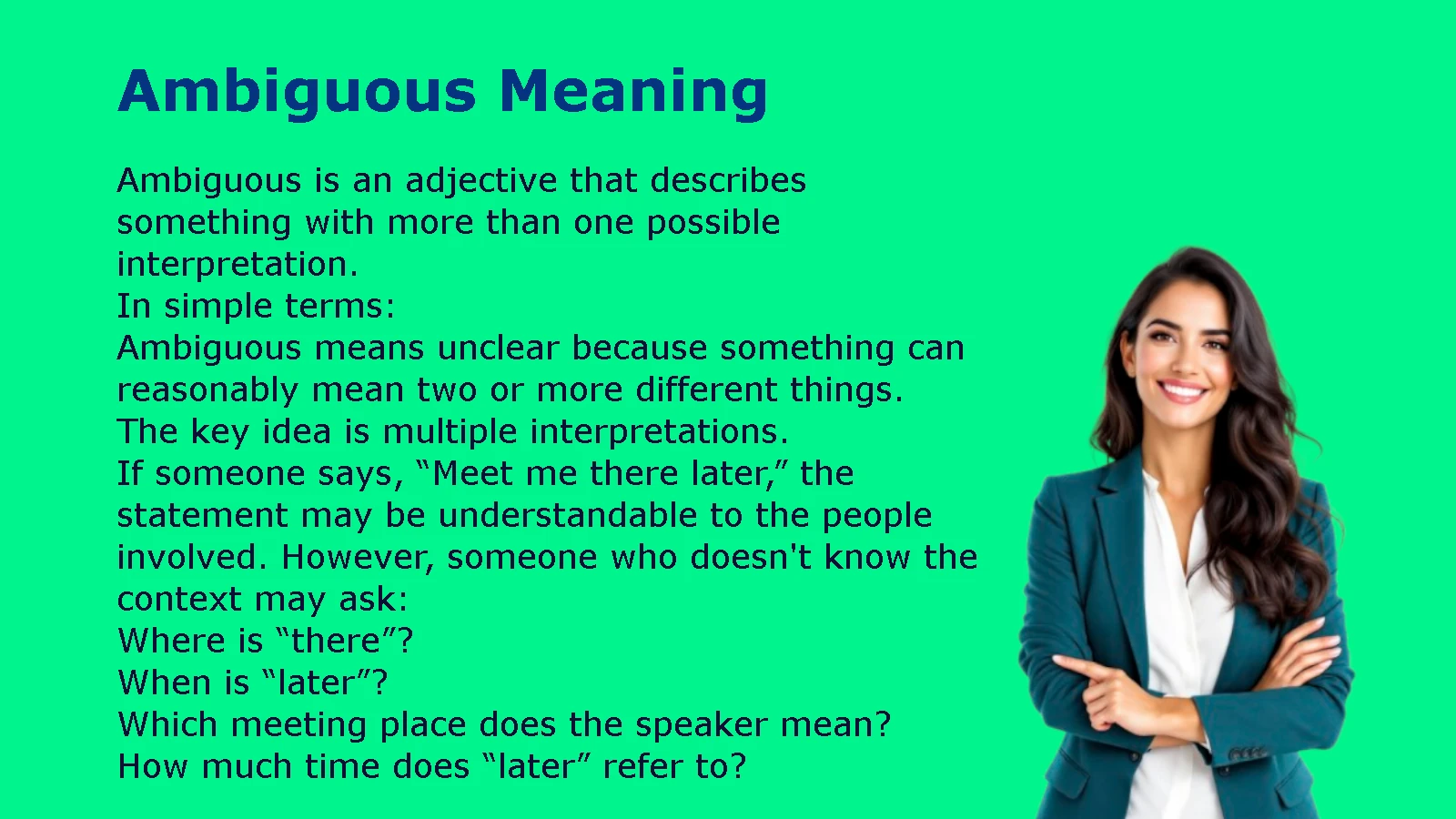
Ambiguous is an adjective that describes something with more than one possible interpretation.
In simple terms:
Ambiguous means unclear because something can reasonably mean two or more different things.
The key idea is multiple interpretations.
If someone says, “Meet me there later,” the statement may be understandable to the people involved. However, someone who doesn’t know the context may ask:
- Where is “there”?
- When is “later”?
- Which meeting place does the speaker mean?
- How much time does “later” refer to?
The statement isn’t necessarily meaningless. It simply leaves important details open.
Merriam Webster also notes that ambiguous can describe something difficult to categorize. For example, a person’s role in an organization might be described as ambiguous if it doesn’t fit neatly into one clearly defined category.
Ambiguous Meaning in Simple Words
Think of ambiguity as a fork in the road.
A clear sentence points you toward one meaning:
“The store closes at 8 p.m.”
There isn’t much room for interpretation.
An ambiguous sentence gives you two or more possible paths:
“The store closes early tonight.”
What does early mean? Six o’clock? Seven? Earlier than usual?
The reader needs more information before knowing exactly what the writer intends.
What Does Ambiguous Mean in Everyday English?
In everyday conversation, people often use ambiguous to describe:
- an unclear answer
- a statement with multiple meanings
- unclear instructions
- a confusing message
- an uncertain position
- an ending that doesn’t explain what happened
- wording that leaves several interpretations open
For example:
“Her answer was ambiguous.”
This means her answer didn’t clearly communicate one definite meaning.
It doesn’t necessarily mean she was wrong. She may have deliberately avoided giving a direct answer.
Ambiguous Definition and Part of Speech
Ambiguous functions as an adjective.
It describes nouns such as:
- statement
- answer
- sentence
- question
- message
- instruction
- wording
- expression
- situation
- ending
- role
- position
Here are some natural examples:
- “The contract contains ambiguous language.”
- “His response was ambiguous.”
- “The movie has an ambiguous ending.”
- “The instructions were ambiguous.”
- “The sentence has an ambiguous meaning.”
The related noun is ambiguity. The adverb is ambiguously. Merriam Webster also lists ambiguousness as a noun, although ambiguity is the more familiar form.
| Word | Part of speech | Meaning |
| Ambiguous | Adjective | Having more than one possible meaning |
| Ambiguity | Noun | The quality or state of being ambiguous |
| Ambiguously | Adverb | In an ambiguous way |
| Ambiguousness | Noun | The quality of being ambiguous |
How to Pronounce “Ambiguous”
The standard pronunciation is:
ambiguous: /æmˈbɪɡjuəs/
A simple pronunciation guide is:
am-BIG-yoo-us
The main stress falls on BIG.
The word has four syllables:
am • big • u • ous
The related noun ambiguity is pronounced differently:
am-bi-GU-i-ty
Learning both forms helps because they appear frequently in discussions about language, writing, law, literature, and communication.
Examples of “Ambiguous” in a Sentence
Seeing the word in context makes its meaning much easier to understand.
Everyday Examples of Ambiguous
- “His answer was ambiguous.”
- “The text message sounded ambiguous.”
- “Her smile was ambiguous, and I couldn’t tell what she meant.”
- “The instructions were too ambiguous to follow confidently.”
- “The ending of the movie was intentionally ambiguous.”
- “The question was ambiguous because it could be interpreted in two ways.”
- “The manager gave an ambiguous response about the proposed changes.”
- “The sign contained ambiguous wording.”
- “His intentions remained ambiguous.”
- “The phrase has an ambiguous meaning.”
Notice how ambiguous doesn’t always mean “bad.”
An ambiguous movie ending might be deliberate. A poem might use ambiguity to encourage several interpretations. A joke might depend on a phrase having two meanings.
The problem begins when the reader needs one specific meaning but receives several possible meanings instead.
Ambiguous Examples in School and Writing
Ambiguity appears frequently in essays, exams, instructions, and academic writing.
Consider:
“The teacher discussed the student’s paper with her colleague.”
Who does her refer to?
It could refer to the teacher or the student.
A clearer version would be:
“The teacher discussed the student’s paper with the student’s colleague.”
Or:
“The teacher discussed the student’s paper with another teacher.”
The second versions may sound less elegant, but they remove the uncertainty.
Ambiguous Examples at Work
Workplace communication often depends on precise details.
Compare:
“Please send the report soon.”
with:
“Please send the report by 3 p.m. Friday.”
The first sentence is ambiguous because soon doesn’t identify a specific deadline.
The second sentence gives the reader a clear time.
Other examples include:
- “We’ll review it later.”
- “Finish the project as soon as possible.”
- “The client wants the old version.”
- “Send it to the manager.”
- “The meeting is next Friday.”
Each sentence may make sense in context. However, each can become ambiguous if the surrounding information doesn’t establish exactly what the speaker means.
What Is an Ambiguous Sentence?
An ambiguous sentence is a sentence that permits two or more reasonable interpretations.
The ambiguity can come from a single word, sentence structure, pronouns, punctuation, or missing context.
Consider:
“I saw the man with the telescope.”
This sentence has at least two natural interpretations.
Meaning one: You used a telescope to see the man.
Meaning two: You saw a man who had a telescope.
The sentence doesn’t tell the reader which relationship the phrase “with the telescope” expresses.
That type of ambiguity isn’t caused by one word having two dictionary definitions. Instead, the structure of the sentence creates two possible readings.
More Ambiguous Sentence Examples
“Alex told Jordan that he was late.”
Who was late?
- Alex
- Jordan
The pronoun he doesn’t provide enough information.
A clearer version would be:
“Alex told Jordan that Jordan was late.”
Or:
“Alex told Jordan, ‘You are late.’”
“Visiting relatives can be boring.”
This sentence has two possible readings:
- Going to visit relatives can be boring.
- Relatives who are visiting can be boring.
The grammatical structure allows both interpretations.
“The chicken is ready to eat.”
This can mean:
- The chicken is ready to be eaten.
- The chicken is ready to eat something.
The context usually resolves the ambiguity. Without context, however, the sentence can make readers pause.
Types of Ambiguity
Ambiguity isn’t one single phenomenon. Linguists and philosophers study different forms of ambiguity because uncertainty can arise at different levels of language.
The major practical categories include lexical ambiguity, syntactic ambiguity, pronoun or referential ambiguity, and contextual ambiguity.
Lexical Ambiguity
Lexical ambiguity occurs when a word or expression has more than one meaning.
Consider the word bank.
It can refer to:
- a financial institution
- the land beside a river
Now consider:
“She sat on the bank.”
Without additional context, you might not know which meaning the speaker intends.
Another example is bat:
- a flying mammal
- a piece of sports equipment
The sentence:
“I saw a bat.”
doesn’t tell you which one appeared.
Lexical ambiguity is common because English contains many words with multiple meanings. Context normally helps listeners choose the intended sense.
Research on language processing also shows why context matters. A word with multiple possible meanings can become easier to interpret when surrounding information strongly points toward one meaning.
Syntactic Ambiguity
Syntactic ambiguity, sometimes called structural ambiguity, occurs when the grammatical structure of a sentence supports more than one interpretation.
Consider:
“I saw the man with the telescope.”
As explained earlier, the phrase with the telescope can attach to different parts of the sentence.
The sentence structure leaves the relationship open.
The Stanford Encyclopedia of Philosophy describes syntactic ambiguity as a case where a sentence can correspond to different underlying structures or interpretations.
Pronoun Ambiguity
Pronoun ambiguity occurs when a pronoun could reasonably refer to more than one person or thing.
For example:
“Maya told Olivia that she had won the award.”
Who won?
- Maya?
- Olivia?
The pronoun she doesn’t settle the question.
A clearer version would be:
“Maya told Olivia that Maya had won the award.”
Or:
“Maya told Olivia that Olivia had won the award.”
This type of ambiguity matters in professional and academic writing because readers shouldn’t have to guess which person a pronoun represents.
Contextual Ambiguity
Sometimes the words themselves aren’t especially problematic. The problem comes from missing context.
For example:
“I’ll see you there tomorrow.”
Someone who was part of the original conversation may understand it perfectly.
A stranger reading the sentence alone won’t know:
- where “there” means
- which event is involved
- what time the speaker has in mind
- whether “tomorrow” refers to the date when the message was written or received
Context acts like a spotlight. It narrows the possible meanings.
Ambiguous vs. Unclear
Ambiguous and unclear overlap, but they aren’t exact synonyms.
Something is unclear when it is difficult to understand or isn’t expressed clearly.
Something is ambiguous when the lack of clarity specifically allows multiple possible interpretations.
Merriam Webster makes essentially this distinction: unclear can describe something that is difficult to understand, while ambiguous often points to uncertainty caused by more than one possible meaning.
| Word | Main idea | Example |
| Ambiguous | More than one possible interpretation | “I saw her duck.” |
| Unclear | Difficult to understand | “The explanation was unclear.” |
| Vague | Lacking precise details | “I’ll arrive later.” |
| Confusing | Difficult or disorienting to understand | “The instructions confused everyone.” |
| Uncertain | Not known or firmly decided | “The date is uncertain.” |
This distinction is useful when choosing the right word.
If a teacher explains a difficult mathematical concept badly, you might call the explanation unclear.
If a sentence has two reasonable interpretations, ambiguous is more precise.
Ambiguous vs. Vague
These words often travel together, but they describe different problems.
Vague language lacks specific information.
Ambiguous language allows multiple interpretations.
Compare:
“I’ll meet you later.”
This is vague because later doesn’t give a specific time.
Now consider:
“I saw the girl with the camera.”
This is ambiguous because the sentence can mean that you used the camera to see her or that she had the camera.
A sentence can be both vague and ambiguous.
For example:
“He’ll handle it sometime soon.”
The sentence is vague about when and potentially ambiguous about who or what is involved.
Ambiguous vs. Ambivalent
This is one of the most common vocabulary mix ups.
Ambiguous describes something with multiple possible meanings or interpretations.
Ambivalent usually describes mixed or contradictory feelings.
For example:
“The instructions were ambiguous.”
The instructions have more than one possible interpretation.
But:
“She felt ambivalent about moving.”
She has conflicting feelings about moving. Part of her may want to move while another part wants to stay.
Merriam Webster specifically warns readers not to confuse these words. It explains that ambivalent generally relates to contradictory feelings, while ambiguous relates to multiple possible meanings or uncertainty.
Quick Comparison
| Word | Meaning | Example |
| Ambiguous | Open to more than one interpretation | “His answer was ambiguous.” |
| Ambivalent | Having conflicting feelings | “She was ambivalent about the decision.” |
Easy memory trick:
If you’re talking about the meaning of words, think ambiguous. If you’re talking about mixed feelings, think ambivalent.
Synonyms for Ambiguous
Several words can replace ambiguous, but each carries a slightly different shade of meaning.
Common Synonyms
- Unclear
- Vague
- Uncertain
- Equivocal
- Obscure
- Cryptic
- Enigmatic
- Indefinite
- Indeterminate
Merriam Webster lists several of these as related synonyms while also explaining that they don’t all carry exactly the same meaning.
Ambiguous vs. Equivocal
Equivocal is particularly useful when someone gives language that deliberately avoids a clear commitment.
For example:
“The politician gave an equivocal answer.”
This can suggest that the speaker intentionally avoided choosing a definite position.
By contrast:
“The sentence was ambiguous.”
This doesn’t necessarily suggest intentional deception or evasion.
Ambiguous vs. Obscure
Obscure generally suggests that something is difficult to understand because its meaning is hidden, poorly expressed, or not readily known.
Ambiguous specifically emphasizes multiple possible interpretations.
Ambiguous vs. Cryptic
Cryptic often describes something that seems deliberately mysterious or difficult to decode.
A crossword clue might be cryptic.
A contract clause can be ambiguous.
The difference is subtle but important.
Antonyms of Ambiguous
The most direct opposite of ambiguous is unambiguous.
Other useful antonyms include:
- clear
- definite
- explicit
- precise
- specific
- certain
- straightforward
- unmistakable
Consider the difference:
Ambiguous: “Submit the form soon.”
Unambiguous: “Submit the form by 5 p.m. on Friday.”
The second sentence removes the uncertainty by supplying a specific deadline.
What Is the Noun Form of Ambiguous?
The primary noun form is ambiguity.
Ambiguity means the quality or state of allowing more than one interpretation.
For example:
“The ambiguity of the sentence caused confusion.”
Another example:
“The poem’s ambiguity allows readers to develop different interpretations.”
Merriam Webster defines ambiguity as the quality or state of allowing more than one interpretation and also uses it for a word or expression that can be understood in multiple ways.
Word Family
- ambiguous — adjective
- ambiguity — noun
- ambiguously — adverb
- ambiguousness — noun
Examples:
“The wording is ambiguous.”
“The sentence contains ambiguity.”
“The instructions were written ambiguously.”
How to Use “Ambiguous” Correctly
The word commonly appears before nouns or after linking verbs.
Ambiguous + Noun
These combinations sound natural:
- ambiguous statement
- ambiguous answer
- ambiguous wording
- ambiguous sentence
- ambiguous question
- ambiguous instructions
- ambiguous message
- ambiguous ending
- ambiguous situation
- ambiguous position
Examples:
“The contract contains an ambiguous clause.”
“The teacher noticed an ambiguous sentence in the essay.”
“The director chose an ambiguous ending.”
“Was Ambiguous”
You can also use ambiguous after forms of be:
“His response was ambiguous.”
“The question is ambiguous.”
“The instructions were ambiguous.”
“Remain Ambiguous”
This construction often appears when something stays unresolved:
“The character’s motives remain ambiguous.”
“The final outcome remains ambiguous.”
This use is particularly common in discussions of literature, film, politics, and uncertain situations.
Is Ambiguous a Negative Word?
Not necessarily.
The word itself is neutral. Its effect depends on the situation.
Ambiguity can create a genuine problem when people need precise information.
For example:
“Take the medication sometime today.”
That wording could create a serious misunderstanding because the intended timing isn’t clear.
In contrast, ambiguity can be useful in creative work.
A novelist might deliberately create an ambiguous ending so readers can debate what really happened. A poet might choose words that support several interpretations. A comedian might exploit an ambiguous phrase to create a punchline.
In other words, ambiguity can be a flaw or a feature.
It depends on the goal.
Why Do People Use Ambiguous Language?
Ambiguous language doesn’t always happen because someone writes badly. There are several reasons it appears.
Lack of Precise Information
A speaker may not know the exact answer.
“We’ll probably arrive later this afternoon.”
The ambiguity may reflect genuine uncertainty.
Assumed Context
People often leave out information because they assume everyone involved already knows it.
“Put it over there.”
That instruction might be perfectly clear to two coworkers standing beside a specific table.
It becomes meaningless to someone who wasn’t present.
Avoiding Commitment
Sometimes people deliberately use ambiguous language to avoid making a firm statement.
For example:
“We’ll consider the proposal.”
This doesn’t clearly promise approval or rejection.
Intentional Creativity
Writers sometimes use ambiguity to make readers think.
A mysterious ending, double meaning, or carefully chosen phrase can add depth instead of confusion.
Poor Sentence Construction
Sometimes ambiguity is accidental.
A writer may use an unclear pronoun or attach a phrase to the wrong part of a sentence.
That’s when editing becomes important.
Ambiguous Meaning in Literature
Literary ambiguity can make a story more interesting because it invites readers to participate in interpretation.
A straightforward ending tells readers exactly what happened.
An ambiguous ending may leave an important question unresolved.
For example, a story might end with a character opening a mysterious letter and smiling. The writer never reveals its contents.
Readers may reasonably wonder:
- Did the letter contain good news?
- Did the character discover a secret?
- Did someone threaten them?
- Was the smile genuine or deceptive?
The uncertainty becomes part of the reading experience.
Philosophical and linguistic discussions of ambiguity similarly distinguish multiple meanings from ordinary difficulty in understanding. The Stanford Encyclopedia of Philosophy notes that ambiguity has long interested philosophers, linguists, cognitive scientists, writers, and literary critics because language can support more than one interpretation.
Ambiguous Meaning in Business Communication
In professional communication, ambiguity can become expensive.
A vague or ambiguous instruction may lead two employees to perform different tasks while both believe they followed the directions correctly.
Consider this message:
“Please update the document and send it to the client after the review.”
Several questions immediately appear:
- Which document?
- Who should review it?
- What changes should be made?
- Who sends it?
- When should it be sent?
- Does “after the review” mean immediately after or later that day?
A clearer version might say:
“Update the pricing section of the proposal, send the revised file to Maria for review, and email the approved version to the client by 4 p.m. Thursday.”
The second version is longer, but it is much harder to misinterpret.
Clarity isn’t about using fewer words at all costs. It’s about using the right words.
Ambiguous Meaning in Contracts and Legal Writing
Legal and contractual language requires particular care because different interpretations can affect people’s rights, responsibilities, costs, and obligations.
Consider a simple clause:
“The tenant must maintain the property regularly.”
What does regularly mean?
- weekly?
- monthly?
- whenever necessary?
- according to a maintenance schedule?
The problem isn’t necessarily the word itself. The problem is that the contract may fail to establish a sufficiently precise standard for the parties’ situation.
This is why legal drafting often defines important terms and specifies measurable requirements rather than relying on broad language.
The broader principle is simple: when the consequences of misunderstanding are high, ambiguity becomes more costly.
How to Avoid Ambiguous Writing
You don’t need to eliminate every possible interpretation from every sentence. That would make ordinary writing painfully stiff.
Instead, remove ambiguity when the reader needs a specific meaning.
Use Specific Details
Instead of:
“Send the report soon.”
Write:
“Send the report by noon Wednesday.”
Identify People Clearly
Instead of:
“Sarah told Emma that she needed to call the client.”
Write:
“Sarah told Emma that Sarah needed to call the client.”
Or:
“Sarah told Emma, ‘You need to call the client.’”
Clarify Pronouns
If a sentence contains he, she, it, they, this, that, or which, check whether the reader can identify exactly what each word refers to.
Avoid Unnecessary Structural Complexity
If a sentence can be interpreted in two ways, rewrite it.
For example:
“I photographed the woman with the camera.”
Could mean that you used the camera or that the woman had the camera.
A clearer version is:
“I used my camera to photograph the woman.”
Or:
“I photographed the woman who was carrying a camera.”
Define Important Terms
In technical, business, or professional writing, define terms that could reasonably be interpreted in different ways.
Instead of:
“The project must be completed promptly.”
Write:
“The project must be completed within five business days.”
The second sentence gives the reader something measurable.
A Practical Case Study: How One Ambiguous Sentence Changes Meaning
Consider this sentence:
“The manager told the employee that he would receive a promotion.”
At first glance, it seems straightforward.
But who does he refer to?
Interpretation One
The manager will receive a promotion.
Interpretation Two
The employee will receive a promotion.
The sentence contains a pronoun reference problem.
Now compare two revisions:
“The manager told the employee that the manager would receive a promotion.”
“The manager told the employee that the employee would receive a promotion.”
The meaning is now explicit.
This small example shows why ambiguity matters. A single pronoun can change the meaning of an entire statement.
Ambiguous Meaning vs. Confusing Meaning
People often use confusing and ambiguous interchangeably in casual conversation, but they describe different things.
Something can be confusing without being ambiguous.
For example, a complicated scientific explanation may have only one intended meaning. You may simply lack the background knowledge needed to understand it.
Something can also be ambiguous without being confusing.
For example:
“The chicken is ready to eat.”
A fluent speaker can understand both possible readings immediately. The sentence is still ambiguous.
So the distinction is:
Confusing means difficult to understand. Ambiguous means open to multiple interpretations.
That difference is worth remembering when discussing writing quality.
Common Questions About Ambiguous Meaning
What does ambiguous mean in simple words?
Ambiguous means something can be understood in more than one way. An ambiguous sentence, answer, or statement doesn’t clearly point to one specific interpretation.
What is an example of an ambiguous sentence?
A classic example is:
“I saw the man with the telescope.”
It can mean that you used a telescope to see the man, or that the man had the telescope.
Does ambiguous mean confusing?
Not exactly. Ambiguous means that multiple interpretations are possible. Confusing means something is difficult to understand. A sentence can be confusing without being ambiguous.
What is the opposite of ambiguous?
The most direct opposite is unambiguous. Other related opposites include clear, definite, explicit, precise, specific, and unmistakable.
What is the noun form of ambiguous?
The main noun form is ambiguity.
Example:
“The ambiguity of the statement caused disagreement.”
Is ambiguous positive or negative?
Neither by definition. Ambiguous is neutral. It can describe a useful creative technique, such as an ambiguous ending, or a communication problem, such as ambiguous instructions.
What is the difference between ambiguous and ambivalent?
Ambiguous describes something with multiple possible meanings. Ambivalent usually describes conflicting feelings.
“The instructions were ambiguous.”
“She was ambivalent about the decision.”
What is an ambiguous question?
An ambiguous question is one that can reasonably be interpreted in more than one way.
For example:
“When did you meet him?”
Without knowing which person him refers to, the question can be ambiguous.
What is ambiguity?
Ambiguity is the quality or state of having more than one possible interpretation. It can occur in individual words, phrases, sentences, statements, or broader situations.
Key Takeaways About Ambiguous Meaning
The easiest way to remember ambiguous meaning is to focus on one central idea: more than one possible interpretation.
Here are the most important points:
- Ambiguous is an adjective.
- It describes something that can be understood in more than one way.
- Ambiguity is the related noun.
- Ambiguity can come from word meanings, sentence structure, pronouns, or missing context.
- Lexical ambiguity involves multiple meanings of a word.
- Syntactic ambiguity comes from sentence structure.
- Pronoun ambiguity occurs when a pronoun could refer to more than one person or thing.
- Vague means lacking precise details, while ambiguous emphasizes multiple possible interpretations.
- Ambivalent describes conflicting feelings rather than multiple meanings.
- Ambiguity isn’t always a mistake. Writers sometimes use it intentionally.
- Clear writing becomes especially important when instructions, deadlines, contracts, or responsibilities are involved.
- The best way to remove ambiguity is to provide specific names, dates, times, references, and relationships.
Ultimately, ambiguous meaning isn’t simply about confusion. It is about the space between what words say and what they could reasonably mean. Context often closes that gap. When context doesn’t do enough, a reader can end up standing at the fork in the road, unsure which direction the writer intended.