Tergiversate means to avoid giving a clear answer, especially by changing your position, using evasive language, or deliberately being vague. It can also mean to abandon or betray a cause, belief, or responsibility.
If you’re searching for “tergiversate meaning,” “what does tergiversate mean,” or “tergiversate definition,” you’re likely looking for its simple meaning and how to use it in a sentence. In modern English, tergiversate is often used when someone avoids committing to a clear position or tries to escape a difficult question. The word can also suggest changing sides or acting disloyally.
| Question | Answer |
|---|---|
| What does tergiversate mean? | To avoid a clear answer or change your position. |
| What is the meaning of tergiversate? | To be evasive, vague, or disloyal. |
| Is tergiversate a negative word? | Yes, it usually suggests dishonesty, evasion, or a lack of commitment. |
| What is a synonym for tergiversate? | Evade, equivocate, hedge, prevaricate, or waver. |
What Does Tergiversate Mean?
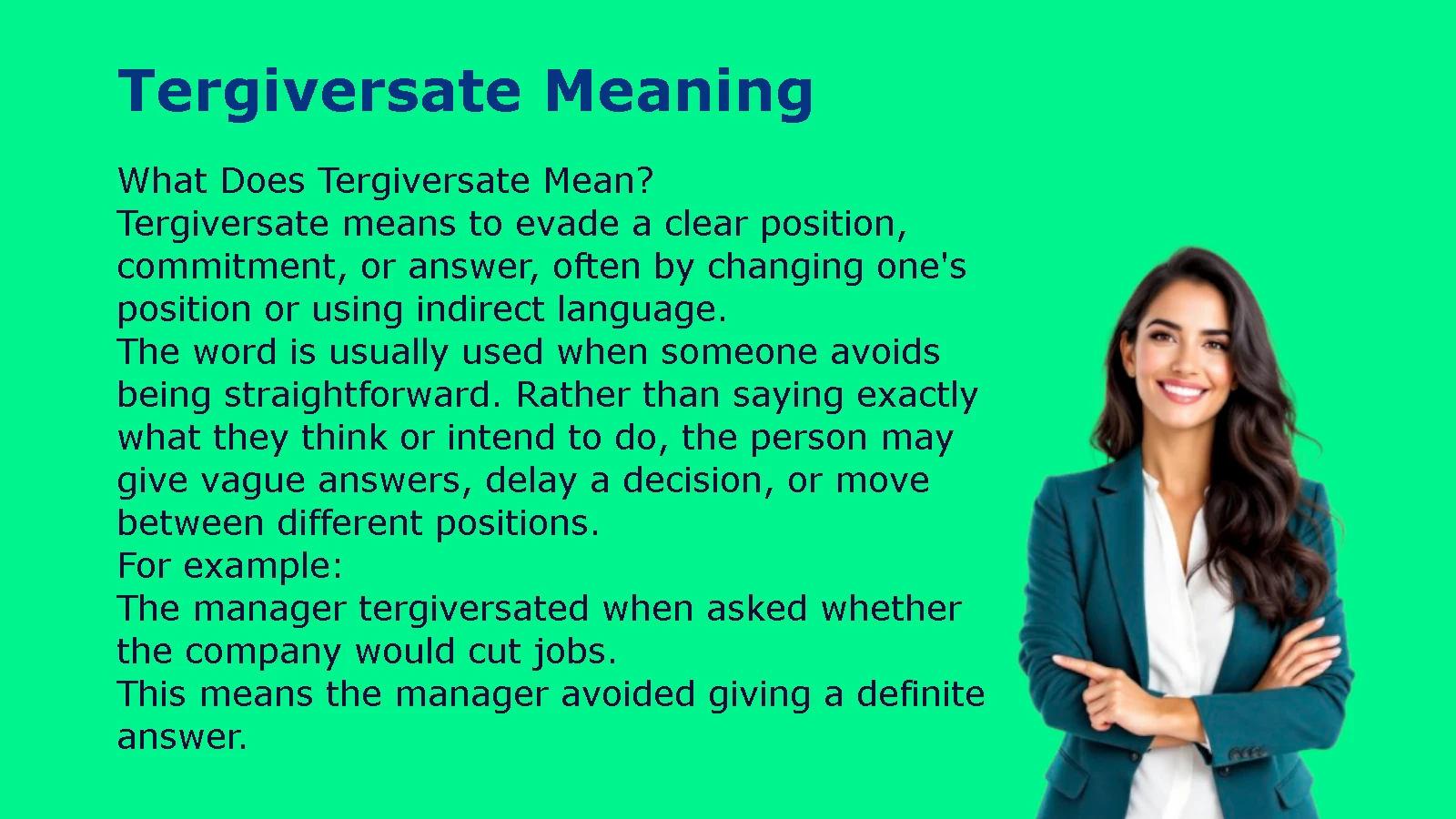
Tergiversate means to evade a clear position, commitment, or answer, often by changing one’s position or using indirect language.
The word is usually used when someone avoids being straightforward. Rather than saying exactly what they think or intend to do, the person may give vague answers, delay a decision, or move between different positions.
For example:
The manager tergiversated when asked whether the company would cut jobs.
This means the manager avoided giving a definite answer.
Tergiversate definition at a glance
| Word | Tergiversate |
| Part of speech | Verb |
| Pronunciation | /ˈtɜːrdʒɪvərseɪt/ |
| Simple meaning | To avoid a clear position or commitment |
| Common ideas | Evasion, indecision, hesitation, changing position |
| Tone | Usually negative or critical |
| Adjective | Tergiversant |
| Noun | Tergiversation |
The word often suggests more than ordinary hesitation. It can imply that someone is deliberately avoiding a straightforward answer or commitment.
Tergiversate Meaning in Simple English
In simple English, tergiversate means to avoid giving a clear answer or making a firm decision.
Imagine someone asks:
“Are you going to accept the offer?”
Instead of saying yes or no, the person responds:
“Well, there are many things to consider. We should see how everything develops.”
If the person repeatedly responds this way to avoid committing, they may be tergiversating.
A simple way to remember the word is:
Tergiversate = avoid being definite.
It can involve changing your position, delaying a decision, or giving evasive answers.
A simple example
She tergiversated instead of telling us whether she would attend.
In other words, she avoided giving a clear answer.
Tergiversate Definition and Deeper Meaning
The deeper meaning of tergiversate involves evasion or changing one’s position.
A person may tergiversate when they:
- avoid answering directly
- refuse to make a commitment
- keep changing their opinion
- delay an important decision
- use vague language to escape responsibility
- move from one position to another
- avoid taking a definite side
The word can describe political speeches, negotiations, arguments, business decisions, personal conversations, and formal writing.
It often carries a critical tone because people generally expect honesty and clarity when an important decision is involved.
Is tergiversate always intentional?
Not necessarily, although the word often suggests deliberate evasion.
Someone might hesitate because they genuinely feel uncertain. However, tergiversate usually draws attention to the person’s failure or refusal to take a clear position.
For simple uncertainty, words such as hesitate or waver may be more appropriate.
Tergiversate Pronunciation
Tergiversate is pronounced approximately:
TUR jih vur sayt
In phonetic form, it is commonly represented as:
/ˈtɜːrdʒɪvərseɪt/
The word can look intimidating because it contains several syllables, but its pronunciation becomes easier when broken into parts.
ter + gi + ver + sate
The pronunciation may vary slightly depending on the variety of English and the dictionary being followed.
What Part of Speech Is Tergiversate?
Tergiversate is a verb.
A verb describes an action or state, and tergiversate describes the act of evading, shifting, or avoiding a clear position.
Examples
- He tergiversated during the interview.
- The witness tergiversated when questioned.
- They continued to tergiversate over the agreement.
- She tergiversated rather than give a direct answer.
Because it is a verb, you can change its form according to tense.
| Tense | Example |
| Present | They tergiversate when challenged. |
| Third person | He tergiversates during difficult discussions. |
| Past | She tergiversated about the decision. |
| Present participle | They are tergiversating again. |
| Past participle | The issue has been tergiversated over repeatedly. |
In modern English, the simple past form tergiversated is much more likely to appear than unusual alternative forms.
Tergiversate Examples
Seeing the word in different situations makes its meaning easier to understand.
1. Political example
The candidate tergiversated when reporters asked about the controversial policy.
The candidate avoided taking a definite position.
2. Business example
The executive tergiversated when investors asked whether layoffs were planned.
Instead of providing a direct answer, the executive avoided committing to one.
3. Personal example
Mark tergiversated when his friends asked whether he was moving away.
Mark did not give a clear answer and may have kept changing or avoiding his response.
4. Legal example
The witness appeared to tergiversate during cross examination.
The witness may have avoided direct answers or changed positions under questioning.
5. Negotiation example
The two sides continued to tergiversate instead of agreeing to the final terms.
Neither side made a firm commitment.
6. Workplace example
The supervisor tergiversated when employees asked about the company’s future plans.
The supervisor avoided providing a definite response.
7. Academic example
The author seems to tergiversate whenever the argument reaches its most difficult point.
The author appears to avoid addressing the issue directly.
8. Social example
She tergiversated when asked whether she wanted to join the trip.
She avoided saying whether she would go.
9. Debate example
Rather than defend his original claim, the speaker tergiversated and changed the subject.
The speaker avoided defending the original position.
10. Decision making example
After weeks of tergiversating, the board finally approved the proposal.
The board spent a long time avoiding or delaying a definite decision.
Tergiversate in a Sentence
Here are more natural sentences using tergiversate:
- The minister continued to tergiversate when asked for a clear response.
- He tends to tergiversate whenever difficult questions arise.
- The company tergiversated instead of explaining its new policy.
- She refused to tergiversate and gave us a direct answer.
- The committee tergiversated for months before reaching a decision.
- His tendency to tergiversate frustrated everyone at the meeting.
- The witness appeared to tergiversate under pressure.
- Rather than tergiversate, the director accepted responsibility.
- The negotiator tergiversated until the deadline approached.
- They accused the administration of tergiversating on the issue.
These examples show an important feature of the word: tergiversate often appears in situations where someone is expected to be clear but fails to be so.
How to Use Tergiversate
Because tergiversate is a verb, it typically describes what a person or group does.
“Tergiversate about”
Use the word with about when someone avoids taking a position concerning a particular subject.
The committee tergiversated about the proposed changes.
“Tergiversate over”
You can also use over when referring to an issue or decision.
The board tergiversated over the final terms.
“Tergiversate when”
This structure works when someone avoids a response at a particular moment.
He tergiversated when asked about his plans.
“Tergiversate rather than”
This construction highlights a choice between being direct and avoiding a clear position.
She tergiversated rather than admit that she had made a mistake.
“Continue to tergiversate”
This phrase emphasizes repeated or prolonged evasion.
The officials continued to tergiversate instead of addressing the public’s concerns.
Tergiversation Meaning
Tergiversation is the noun form related to tergiversate. It refers to evasion, changing one’s position, or avoiding a definite commitment.
For example:
His constant tergiversation made the negotiation difficult.
Here, tergiversation refers to his repeated avoidance of a clear position.
Another example:
The committee’s tergiversation delayed the final decision.
The committee’s unwillingness to commit caused the delay.
Tergiversate vs tergiversation
| Word | Part of speech | Meaning |
| Tergiversate | Verb | To evade or avoid a definite position |
| Tergiversation | Noun | The act or practice of evading or changing position |
| Tergiversant | Adjective | Characterized by evasion or changing position |
Tergiversant Meaning
Tergiversant is an adjective that describes someone who evades, changes positions, or avoids committing to a clear stance.
For example:
The tergiversant politician avoided answering the question directly.
The adjective is relatively uncommon. In most everyday situations, evasive, indecisive, or noncommittal will sound more natural.
Tergiversate Synonyms
The best synonym depends on exactly what the person is doing.
| Synonym | Meaning | When to use it |
| Evade | Avoid dealing with something directly | General avoidance |
| Hesitate | Pause before acting or deciding | Genuine uncertainty |
| Waver | Move between different opinions or choices | Changing one’s position |
| Dodge | Deliberately avoid a question or issue | Informal situations |
| Prevaricate | Avoid giving a direct or truthful answer | Deliberate verbal evasion |
| Equivocate | Use ambiguous language to avoid commitment | Formal or careful speech |
| Vacillate | Keep changing between choices | Difficulty making decisions |
| Dilly dally | Delay instead of acting | Informal situations |
| Avoid | Stay away from an issue or action | Broadest meaning |
| Backtrack | Reverse or retreat from a previous position | Changing a previous stance |
Tergiversate vs equivocate
Equivocate means using ambiguous or unclear language, especially to avoid committing to a position.
The politician equivocated when asked about the proposal.
Tergiversate can involve equivocation, but it has a broader sense of avoiding commitment or shifting one’s position.
Tergiversate vs prevaricate
These words are very close.
Prevaricate usually focuses on avoiding the truth or giving a direct answer through misleading or evasive speech.
Tergiversate emphasizes evasion, hesitation, or changing position.
The witness prevaricated when asked whether he had seen the document.
The committee tergiversated for weeks before deciding what to do.
The first focuses on evasive answering. The second focuses more on avoiding a firm position.
Tergiversate vs vacillate
Vacillate means to move repeatedly between different choices or opinions.
She vacillated between accepting and rejecting the offer.
Tergiversate can involve this kind of changing position, but it often carries a stronger sense of evasion or avoidance.
Tergiversate Antonyms
There is no single perfect opposite of tergiversate, but several words express the opposite idea.
Possible antonyms include:
- decide
- commit
- clarify
- answer
- declare
- affirm
- state
- resolve
- confront
- address
- stand firm
- speak directly
For example:
Instead of tergiversating, she clearly stated her position.
The contrast is between avoiding a clear position and expressing one openly.
Tergiversate vs Hesitate
These words can overlap, but they are not identical.
Hesitate usually means pausing because you are uncertain, nervous, or unsure.
Tergiversate generally suggests avoiding a definite position or answer.
The first word does not necessarily imply deliberate evasion. The second often does.
Tergiversate vs Waver
Waver means to become uncertain or move between different opinions, choices, or positions.
She wavered between the two offers.
The focus is on uncertainty.
With tergiversate, the focus may be on avoiding a commitment:
She tergiversated when asked which offer she preferred.
Someone can waver internally without deliberately avoiding others. Tergiversation, however, often becomes visible through evasive behavior or speech.
Is Tergiversate a Negative Word?
Yes, tergiversate usually has a negative or critical connotation.
Calling someone a tergiversator or saying that they tergiversated often suggests that the person should have been more direct.
For example:
The director tergiversated instead of answering the employees’ questions.
This sentence does not simply describe uncertainty. It implies criticism of the director’s unwillingness to provide a clear response.
Still, the word itself does not mean that someone is dishonest. The person might be avoiding a decision because they are uncertain, cautious, or unwilling to commit.
Common Collocations With Tergiversate
Some combinations sound particularly natural in formal writing.
Tergiversate over a decision
The committee tergiversated over the final decision.
Tergiversate on an issue
The administration continued to tergiversate on the proposed reforms.
Tergiversate when questioned
The witness tergiversated when questioned about the incident.
Tergiversate rather than answer
He tergiversated rather than answer the question directly.
Continue to tergiversate
Officials continued to tergiversate as the deadline approached.
These constructions are particularly useful in journalism, political commentary, academic writing, and formal criticism.
Common Mistakes With Tergiversate
1. Thinking tergiversate means simply “hesitate”
Hesitation and tergiversation are related, but they are not identical.
Hesitate can describe ordinary uncertainty. Tergiversate usually suggests avoiding a clear position.
2. Using it when someone simply changes their mind
Changing your mind does not automatically mean you tergiversated.
I changed my mind after learning new information.
That is not necessarily tergiversation.
The word becomes more appropriate when someone avoids commitment or repeatedly shifts position, especially in a way that appears evasive.
3. Assuming it always means lying
Tergiversation can involve evasive or misleading speech, but tergiversate does not simply mean “lie.”
Someone can tergiversate without making a false statement.
4. Confusing tergiversate with procrastinate
Procrastinate means delaying an action.
Tergiversate means avoiding or delaying a clear position or commitment.
A person can procrastinate without tergiversating.
5. Using the word in very casual conversation
The word is relatively uncommon and has a formal tone.
Instead of:
Why are you tergiversating about dinner?
Most people would naturally say:
Why can’t you decide what you want for dinner?
Use tergiversate when the formal or literary tone fits the context.
Tergiversate in Formal Writing
The word works especially well when discussing people who avoid responsibility, decisions, or clear statements.
For example:
The committee’s tendency to tergiversate created uncertainty among investors.
Another example:
Rather than addressing the central question, the spokesperson continued to tergiversate.
This formal quality makes the word useful in:
- political commentary
- journalism
- academic writing
- legal discussions
- historical writing
- literary criticism
- formal essays
- professional analysis
For everyday speech, however, evade, hesitate, waver, or avoid will usually sound more natural.
Frequently Asked Questions About Tergiversate
What does tergiversate mean?
Tergiversate means to avoid taking a clear position, commitment, or answer, often by changing one’s position or using evasive language. The word usually carries a critical tone.
What is the simple meaning of tergiversate?
In simple English, tergiversate means to avoid giving a clear answer or making a firm decision. It can also describe someone who repeatedly shifts between different positions.
Is tergiversate a verb?
Yes. Tergiversate is a verb. It describes the action of avoiding a clear position, evading a response, or changing one’s stance.
What is an example of tergiversate?
“The politician tergiversated when reporters asked whether he supported the proposal.” The sentence means that the politician avoided giving a clear answer or commitment.
What is the noun form of tergiversate?
The noun form is tergiversation. It means the act of evading a clear position, changing one’s stance, or avoiding commitment.
What is a synonym for tergiversate?
Depending on the context, synonyms include evade, equivocate, prevaricate, waver, vacillate, dodge, hesitate, and avoid. The closest choice depends on whether the focus is on verbal evasion, indecision, or changing positions.
What is the opposite of tergiversate?
Possible opposites include commit, decide, clarify, declare, affirm, resolve, and state. These words describe taking or expressing a clear position instead of avoiding one.
Is tergiversate a negative word?
Usually, yes. Tergiversate generally has a negative or critical connotation because it suggests that someone is avoiding a clear answer, responsibility, or commitment.
What is the difference between tergiversate and hesitate?
Hesitate usually means to pause because of uncertainty or nervousness. Tergiversate more strongly suggests avoiding a definite position or answer, sometimes deliberately.
What is the difference between tergiversate and prevaricate?
Prevaricate usually refers to avoiding a direct or truthful answer through evasive speech. Tergiversate can involve verbal evasion but also includes shifting positions or avoiding a firm commitment.
Is tergiversate a common word?
No. Tergiversate is relatively uncommon and formal. In ordinary conversation, words such as avoid, hesitate, waver, evade, or dodge are more common.
Can tergiversate describe a person?
Yes, but the verb describes what the person does, rather than the person itself.
The witness tergiversated during questioning.
The related adjective tergiversant can describe a person who behaves in an evasive or shifting manner.
Final Thoughts
Tergiversate is a useful formal verb for describing someone who avoids a clear position, delays a commitment, or shifts between different positions.
The simplest meaning to remember is:
Tergiversate = to avoid being definite.
It differs from ordinary hesitation because it often suggests evasion or unwillingness to commit. Related words such as equivocate, prevaricate, waver, and vacillate can be useful alternatives, but each emphasizes a slightly different idea.
If you encounter tergiversate in an article, speech, or book, look for a situation in which someone is expected to be clear but instead evades, delays, or changes their position. That context usually reveals the meaning immediately.