Have you ever seen APR on a credit card, loan, or financing offer and wondered what it actually means? APR is a common financial abbreviation, but its meaning can be confusing when you’re trying to understand how much you’ll really pay to borrow money.
APR stands for Annual Percentage Rate. It represents the yearly cost of borrowing money, expressed as a percentage. Unlike a simple interest rate, APR can include certain fees and other borrowing costs, giving you a broader picture of what a loan or credit product may cost.
Examples:
- This credit card has an APR of 24.99%.
- The lender offered me a loan with a 7% APR.
The confusion is understandable. People often search for APR meaning, what does APR mean, APR meaning in banking, or what does APR stand for because the abbreviation appears on credit cards, personal loans, mortgages, and other financial products. And here’s the important part: a lower APR generally means a lower annual borrowing cost, but the actual amount you pay can still depend on the balance, fees, payment schedule, and other terms.
In this guide, you’ll learn the complete meaning of APR, including what it stands for, how it works, how APR differs from interest rates, and where you’ll commonly see it. You’ll also see clear examples to help you understand APR when comparing credit cards, loans, and other borrowing options.
What Does APR Mean?
APR means Annual Percentage Rate.
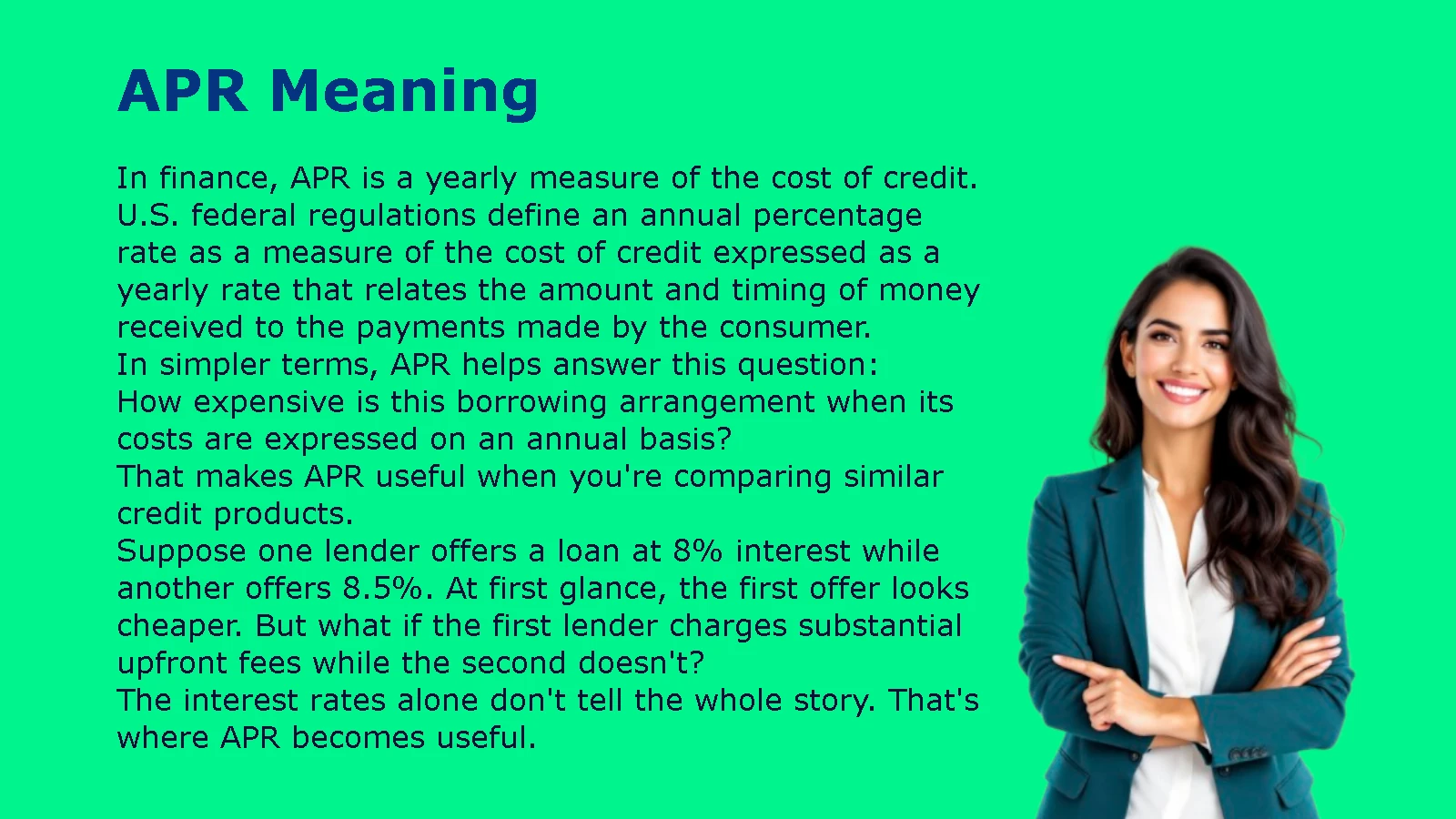
In finance, APR is a yearly measure of the cost of credit. U.S. federal regulations define an annual percentage rate as a measure of the cost of credit expressed as a yearly rate that relates the amount and timing of money received to the payments made by the consumer.
In simpler terms, APR helps answer this question:
How expensive is this borrowing arrangement when its costs are expressed on an annual basis?
That makes APR useful when you’re comparing similar credit products.
Suppose one lender offers a loan at 8% interest while another offers 8.5%. At first glance, the first offer looks cheaper. But what if the first lender charges substantial upfront fees while the second doesn’t?
The interest rates alone don’t tell the whole story. That’s where APR becomes useful.
The Consumer Financial Protection Bureau describes APR as a standard way to compare the cost of loan products. It accounts for the interest rate and certain fees and expresses those costs over a one-year period.
What Does APR Stand For?
The abbreviation breaks down into three words:
- A = Annual
- P = Percentage
- R = Rate
So, APR = Annual Percentage Rate.
“Annual” means the rate is expressed over a year. “Percentage” means it’s represented as a percentage rather than a dollar amount. “Rate” refers to the rate at which the cost or return is measured.
The important word here is annual. An APR of 24% doesn’t mean the lender automatically charges exactly 24% of your current balance every month. The actual calculation depends on the financial product, balance, payment schedule, compounding method, fees, and other terms.
APR Meaning in Simple Terms
Think of APR as a common measuring stick for the cost of credit.
A loan might have several pieces:
- Interest
- Origination charges
- Certain lender fees
- The amount borrowed
- The repayment period
- The timing of payments
APR brings relevant costs into an annual percentage figure so you can make a more meaningful comparison.
A Simple APR Example
Imagine two lenders offer you a $10,000 personal loan.
| Loan | Interest Rate | Fees | APR |
| Loan A | 8.00% | $500 | Higher than 8% |
| Loan B | 8.50% | $0 | Around the stated rate, subject to the calculation |
The first loan has the lower advertised interest rate. However, its upfront fee increases the overall cost represented by the APR.
That doesn’t automatically mean Loan B will cost less in every situation. You still need to consider the loan term, payment schedule, total finance charges, and other conditions.
APR gives you another important number to compare. It doesn’t replace the rest of the loan agreement.
APR Meaning on a Credit Card
Credit cards are one of the most common places you’ll encounter APR.
For a credit card, APR generally represents the annualized interest rate applied to a particular balance. A single card can have different APRs for different types of transactions, such as purchases, balance transfers, and cash advances.
For example, a card might have:
- 22.99% purchase APR
- 24.99% balance-transfer APR
- 29.99% cash-advance APR
- A temporary 0% promotional APR
These aren’t necessarily interchangeable. The applicable rate depends on the type of balance and the terms of the card agreement.
How Credit Card APR Works
Credit-card interest is often calculated using a periodic rate rather than simply charging the full annual percentage once a year.
Some issuers use a daily periodic rate to calculate interest. The Consumer Financial Protection Bureau explains that this rate can be calculated by dividing the APR by 360 or 365, depending on the issuer.
For example, suppose a card has a 24% APR and the issuer uses 365 days:
24% ÷ 365 ≈ 0.06575% per day
That doesn’t mean the card simply charges 0.06575% of your original purchase every day. The issuer applies its specific balance and interest-calculation method.
Some credit cards use an average daily balance method. Under certain methods, interest can compound daily.
Can You Avoid Credit Card Interest?
Often, yes.
Many credit cards provide a grace period for purchases. If you pay the statement balance in full by the due date, you may avoid interest on those purchases under the card’s terms. The CFPB notes that most cards provide a grace period for purchases, although issuers aren’t universally required to provide one.
That’s why a credit card’s APR doesn’t necessarily mean you’ll pay that percentage every year.
If you pay your eligible purchase balance in full and on time, the APR may never result in purchase interest for that billing cycle. If you carry a balance, however, the APR becomes much more important.
Common Types of Credit Card APR
Credit cards can have several APR categories.
| Type of APR | What it generally applies to |
| Purchase APR | Purchases made with the card |
| Balance-transfer APR | Balances transferred from another card |
| Cash-advance APR | Cash withdrawn using the credit card |
| Penalty APR | A higher rate that may apply after certain events under the card agreement |
| Promotional APR | A temporary introductory rate, such as 0% |
Always check the card’s agreement because the conditions and rates vary by issuer.
APR Meaning vs. Interest Rate
APR and interest rate are related, but they aren’t always the same thing.
An interest rate generally represents the cost of borrowing the principal. APR provides a broader annualized measure that can incorporate certain fees and charges associated with obtaining the credit.
The CFPB describes a loan’s interest rate as the cost paid to the lender for borrowing money. It describes APR as the interest rate plus additional fees charged with the loan, such as certain origination charges.
Here’s the basic difference:
| Feature | Interest Rate | APR |
| Expressed as a percentage | Yes | Yes |
| Measures borrowing cost | Yes | Yes |
| Primarily reflects interest | Yes | Yes |
| Can reflect certain additional credit costs | Not generally | Yes |
| Useful for comparing similar credit offers | Yes | Yes |
| Expressed annually | Commonly | Yes |
Why Is APR Higher Than the Interest Rate?
Consider a hypothetical loan:
- Loan amount: $20,000
- Interest rate: 7%
- Origination fee: $400
The 7% interest rate describes the interest charged for borrowing the money. The APR can be higher because the calculation incorporates applicable costs associated with the credit.
That’s why a lender can truthfully advertise a loan with one interest rate and a higher APR.
The CFPB specifically notes that APR can include additional fees and that borrowers should compare APR to APR, rather than comparing one lender’s APR with another lender’s interest rate.
APR Meaning for a Car Loan
When you’re financing a car, APR tells you more than the advertised interest rate alone.
An auto loan’s APR represents the annualized cost of the credit, including the interest rate and applicable mandatory fees. The CFPB describes APR as a broader measure of borrowing cost than the interest rate.
For example, imagine two dealers offer financing for the same vehicle:
| Dealer A | Dealer B | |
| Amount financed | $30,000 | $30,000 |
| Interest rate | 6.5% | 6.9% |
| Fees | Higher | Lower |
| APR | Depends on full terms | Depends on full terms |
The dealer with the lower interest rate isn’t automatically the lower-cost financing option.
You need to compare the APR, loan term, amount financed, monthly payment, finance charge, and total amount paid.
Why APR Matters When Buying a Car
The difference between interest rate and APR can become especially important when dealers or lenders charge fees.
Federal Truth in Lending requirements require auto lenders and dealers to provide specific disclosures before you’re legally obligated on the loan. Those disclosures include the APR and other important loan costs.
A smart comparison therefore looks like this:
APR → loan term → finance charge → monthly payment → total amount paid
Don’t stop at the monthly payment. A longer loan can produce a lower monthly payment while increasing the total amount of interest paid.
APR Meaning in Banking
In banking, APR commonly refers to the Annual Percentage Rate used for credit products.
You may see APR when dealing with:
- Credit cards
- Personal loans
- Auto loans
- Mortgages
- Lines of credit
- Other forms of consumer borrowing
Banks and other lenders use APR to communicate the cost of credit in a standardized annual format.
For example, a bank might advertise a personal loan at:
Interest rate: 8.00%
APR: 8.75%
The difference may reflect eligible fees included in the APR calculation.
However, don’t assume every financial product calculates or presents APR in exactly the same way. Federal rules contain different provisions for open-end and closed-end credit.
APR vs. APY in Banking
Bank customers sometimes confuse APR with APY because both are annual percentage measures.
They serve different purposes.
| Term | Full form | Common context |
| APR | Annual Percentage Rate | Cost of credit or certain annualized financial rates |
| APY | Annual Percentage Yield | Earnings on deposit accounts and effects of compounding |
APR is commonly associated with borrowing. APY is commonly associated with what you earn on money in an account.
The distinction becomes especially important when compounding enters the picture.
APR Meaning Per Month
One of the most common misunderstandings is treating APR as a monthly rate.
APR is annual.
If a financial product has a 24% APR, you can’t automatically say that the lender charges 2% every month in every circumstance.
A simple mathematical conversion would be:
24% ÷ 12 = 2% per month
That can be useful as a rough way to understand the scale of the rate. But it doesn’t necessarily describe the actual interest calculation on a credit card or loan.
Why APR Isn’t Simply a Monthly Rate
Credit products can use different calculation methods.
For example, some credit cards use a daily periodic rate. If an issuer divides a 24% APR by 365, the resulting daily periodic rate is approximately 0.06575%.
The issuer can then use the daily rate and the applicable daily balance to calculate interest.
The CFPB explains that credit-card issuers may calculate interest using a daily periodic rate and that the rate can be based on 360 or 365 days depending on the issuer.
So when someone searches for APR meaning month, the simplest accurate answer is:
APR is a yearly rate. A monthly or daily periodic rate may be derived from it for actual interest calculations, but APR itself isn’t a monthly percentage.
How to Calculate the Monthly Rate From APR
For a basic approximation, divide the annual rate by 12.
For example:
36% APR ÷ 12 = 3% per month
This is a simple conversion, not a universal credit-card interest formula.
The actual amount of interest you pay can depend on:
- Your outstanding balance
- Daily or average daily balance
- Payment timing
- Compounding
- Grace-period rules
- Fees
- The issuer’s calculation method
That distinction matters because a quick calculator can make the math look cleaner than real-world credit calculations actually are.
APR Formula and Calculation
There isn’t one simple APR formula that works identically for every credit product.
For regulated consumer credit, the calculation can take into account the amount financed, payment timing, finance charges, and other variables. U.S. Regulation Z provides specific methods and tables for determining APR for different types of credit transactions.
Conceptually, APR connects:
Amount received + applicable credit costs + timing of payments → annualized cost
For a basic loan comparison, you might think about APR as incorporating:
- Principal borrowed
- Interest charges
- Certain upfront fees
- Loan term
- Payment frequency
- Timing of disbursements and payments
A Simple APR Calculation Example
Suppose you borrow $10,000 for one year.
The lender charges:
- 8% interest
- $200 in qualifying upfront fees
The simple interest cost would be $800 for the year.
The additional $200 charge increases the cost of obtaining the credit. As a result, the APR can be higher than the 8% interest rate.
The precise APR isn’t obtained by simply adding the fee percentage to the interest rate. The formal calculation accounts for the timing and structure of the transaction.
That’s why official APR calculations can be more complicated than a basic percentage calculation.
APR Calculator
An APR calculator can help you estimate or compare borrowing costs when you know the necessary inputs.
Depending on the product, you may need:
- Loan amount
- Interest rate
- Loan term
- Origination fees
- Other applicable charges
- Payment frequency
- Payment schedule
For regulated U.S. consumer credit, lenders use prescribed methods for APR disclosure. A consumer calculator can help you understand the numbers, but it shouldn’t be treated as a replacement for the APR disclosed in the actual credit agreement.
Why APR Matters When Comparing Loans
APR becomes particularly useful when two offers look similar on the surface.
Imagine these offers:
| Offer A | Offer B | |
| Interest rate | 7.00% | 7.25% |
| Upfront fees | $750 | $100 |
| Loan term | 5 years | 5 years |
| APR | Must be calculated from the full terms | Must be calculated from the full terms |
Looking only at the interest rate makes Offer A look cheaper.
Looking at the full cost may tell a different story.
That’s the central reason APR exists as a comparison tool. The CFPB says APR lets consumers compare loan costs on an “apples-to-apples” basis.
Still, “apples to apples” matters. A 5-year loan and a 15-year loan aren’t identical products just because both display an APR.
Is a Lower APR Always Better?
Not necessarily.
A lower APR can indicate a lower annualized cost of credit, but you still need to examine the complete terms.
Consider:
- Is the APR fixed or variable?
- Is the loan term the same?
- Are the amounts borrowed the same?
- Does one offer contain a temporary promotional rate?
- Are there fees that aren’t reflected in the comparison you’re making?
- Is one loan secured while the other isn’t?
- What happens after an introductory period?
- How much will you pay in total?
Mortgage comparisons demonstrate why this matters. The CFPB warns consumers to be careful when comparing different types of mortgage APRs, especially fixed-rate and adjustable-rate loans.
So APR is an important number, but it isn’t the entire contract.
Fixed APR vs. Variable APR
Your APR can be fixed or variable, depending on the credit product.
Fixed APR
A fixed APR generally remains unchanged according to the terms of the agreement.
That can make future interest costs easier to predict.
Variable APR
A variable APR can change based on the terms of the credit agreement and the underlying index or benchmark used by the lender.
Credit cards commonly use variable APR structures. The CFPB notes that credit-card interest rates can be fixed or adjustable based on an interest-rate index.
The practical difference is straightforward:
| Type | Can the rate change? | Main consideration |
| Fixed APR | Generally remains fixed under the agreement | More predictable |
| Variable APR | Can change according to the agreement | Future interest costs can change |
Always check the agreement rather than assuming a rate will remain unchanged.
APR Meaning in Crypto
The term APR also appears frequently in cryptocurrency and decentralized finance.
Here, APR can describe an annualized rate associated with activities such as:
- Staking
- Lending
- Yield farming
- Other crypto-based financial products
Coinbase explains that APR and APY are both used in crypto activities such as staking, lending, and yield farming. It also distinguishes APR from APY based on whether the calculation accounts for compounding.
APR vs. APY in Crypto
Suppose a crypto platform advertises:
10% APR
That generally represents a simple annualized rate before considering the effect of reinvesting rewards.
If those rewards are repeatedly compounded, the effective annual return can be different. That’s where APY becomes useful.
| Crypto term | What it generally represents |
| APR | Annualized rate without assuming reward compounding |
| APY | Annualized rate that accounts for compounding |
| Staking APR | Annualized staking reward rate |
| Lending APR | Annualized borrowing or lending rate, depending on the product |
Crypto rates can change. They can also depend on network conditions, platform rules, reward schedules, and other factors.
So a quoted crypto APR shouldn’t automatically be interpreted as a guaranteed return.
Coinbase notes that staking APR and APY figures can be estimates rather than guarantees and that actual outcomes can depend on network conditions and validator performance.
APR Meaning in Medical Terms
If you see APR in a medical record, don’t assume it means Annual Percentage Rate.
In medicine, APR can stand for abdominoperineal resection, a surgical procedure used in certain conditions involving the rectum and anus.
The National Cancer Institute describes an abdominoperineal resection as surgery that removes the anus, rectum, and part of the sigmoid colon. The end of the intestine is brought through an opening in the abdominal wall to create a colostomy.
What Is an Abdominoperineal Resection?
An abdominoperineal resection, often abbreviated APR, removes the distal rectum and anal canal along with the anal sphincter complex. The procedure results in a permanent end colostomy.
Doctors may consider APR for certain very low rectal cancers when preserving the anal sphincter isn’t possible or wouldn’t provide an appropriate oncologic result.
The procedure can involve:
- An abdominal surgical approach.
- Removal of the affected rectum and surrounding tissues.
- A perineal approach to remove the anus and sphincter complex.
- Creation of a permanent colostomy.
The exact procedure and structures removed depend on the disease, tumor location, anatomy, and surgical plan.
APR vs. Low Anterior Resection
APR and low anterior resection are different operations.
A low anterior resection (LAR) can preserve the anal canal and create a connection between the remaining colon and rectum or anus in appropriate patients.
An APR removes the anal sphincter complex and requires a permanent colostomy. The Society of Abdominal Radiology’s rectal-cancer lexicon describes APR as a procedure that removes the entire sphincter complex and requires a permanent colostomy.
The distinction matters because the two procedures have different anatomical and functional consequences.
If a medical document says “APR,” the surrounding words are crucial. A surgical note mentioning rectal cancer, colostomy, rectum, anus, or resection points toward the medical meaning rather than the financial one.
Common APR Meanings at a Glance
Because APR appears in several fields, context is the quickest way to determine what it means.
| Context | APR meaning |
| Loans | Annual Percentage Rate |
| Credit cards | Annualized interest rate for applicable balances |
| Auto financing | Annualized cost of credit, including applicable fees |
| Banking | Usually Annual Percentage Rate for credit products |
| Finance | Usually Annual Percentage Rate |
| Crypto | Annualized rate used for certain borrowing or reward products |
| Medicine | Abdominoperineal resection |
The financial meaning is by far the one most people encounter when comparing borrowing costs. The medical meaning becomes relevant when APR appears in a clinical or surgical context.
APR vs. APY
both look similar, but they answer different questions.
APR commonly expresses an annualized rate without incorporating the effect of compounding in the way APY does.
APY, or Annual Percentage Yield, reflects the effect of compounding.
Here’s a simple way to remember the difference:
APR tells you the annualized rate. APY shows the annualized result when compounding is included.
The distinction matters in both traditional finance and crypto.
For example, if you earn rewards and immediately reinvest those rewards, your effective annual return can exceed a simple APR because each new reward can potentially generate additional rewards.
That’s the basic power of compounding.
APR and Finance Charges Are Not the Same Thing
Another common source of confusion is the difference between APR and a finance charge.
APR is a percentage.
A finance charge is a dollar amount representing the cost of credit under the applicable calculation and terms.
For an auto loan, for example, the CFPB distinguishes APR from the finance charge. The APR expresses the annualized cost as a percentage, while the finance charge represents the total interest and certain fees paid over the life of the loan if payments are made as agreed.
That distinction is useful when reading a loan disclosure:
- APR: percentage-based comparison measure
- Interest rate: rate charged on borrowed principal
- Finance charge: dollar cost of credit
- Monthly payment: amount due at each payment period
- Total amount paid: overall amount paid according to the disclosed repayment schedule
Each number answers a different question.
What Does 0% APR Mean?
A 0% APR offer generally means the advertised annual interest rate is zero during a specified promotional period or under specified terms.
For example, a credit card might offer 0% APR on purchases for a limited number of months.
That doesn’t mean the account has no conditions.
Check:
- How long the promotional period lasts
- Which transactions qualify
- What APR applies afterward
- Whether fees still apply
- Whether the offer has special repayment requirements
A promotional APR can be useful, but the temporary rate shouldn’t be confused with the card’s long-term APR.
What Is a Good APR?
There isn’t one universal APR that qualifies as “good.”
A reasonable comparison depends on the product.
A credit-card APR shouldn’t be compared directly with a mortgage APR. A short-term loan shouldn’t be evaluated using the same assumptions as a 30-year mortgage.
When comparing similar offers, consider:
- APR
- Interest rate
- Loan term
- Fees
- Monthly payment
- Total finance charge
- Total amount repaid
- Fixed or variable rate
- Promotional terms
The most useful comparison is usually between products with similar amounts, terms, and conditions.
What Is a High APR?
A high APR means borrowing can become substantially more expensive, especially when you carry a balance for a long period.
However, there’s no single percentage that should be labeled “high” across every financial product.
Credit cards, personal loans, auto loans, mortgages, and short-term loans have different pricing structures and risk profiles.
For example, an APR that might appear on a credit card isn’t directly comparable to an APR on a mortgage.
The CFPB’s explanation of payday loans demonstrates why loan duration can dramatically affect APR. A $15 charge on $100 borrowed for only two weeks can annualize to an APR of nearly 400% even though the fee itself looks small in dollar terms.
That example highlights one of APR’s most useful features: it makes short-term borrowing costs easier to compare with longer-term credit products.
A Practical APR Case Study
Imagine you’re financing a $25,000 vehicle.
You receive two offers.
Offer A
- Interest rate: 6.5%
- Loan term: 60 months
- Higher mandatory fees
Offer B
- Interest rate: 6.8%
- Loan term: 60 months
- Lower mandatory fees
At first glance, Offer A looks cheaper because 6.5% is lower than 6.8%.
But the lower interest rate doesn’t tell you everything.
If the fees associated with Offer A raise its APR above Offer B’s APR, the second offer may have a lower annualized cost of credit despite its higher stated interest rate.
That doesn’t automatically tell you which loan you should choose. You’d still need to examine the complete terms and total repayment cost.
The lesson is simple: compare the same metric on comparable products.
Common Questions About APR
What does APR mean in simple terms?
APR means Annual Percentage Rate. In consumer finance, it expresses the annualized cost of borrowing money as a percentage and can include certain fees depending on the credit product.
What does APR stand for?
APR stands for Annual Percentage Rate.
Is APR monthly or yearly?
APR is a yearly rate. A lender or card issuer may use a monthly or daily periodic rate to calculate actual interest, but APR itself is annual.
Is APR the same as an interest rate?
Not always. An interest rate generally represents the cost of borrowing the principal. APR provides a broader annualized measure that can include certain additional credit costs.
What does APR mean on a credit card?
On a credit card, APR generally represents the annualized interest rate applied to a particular type of balance. A card can have separate APRs for purchases, balance transfers, cash advances, and other categories.
What does APR mean when buying a car?
For an auto loan, APR represents the annualized cost of the credit and can include the interest rate and applicable mandatory fees. It helps you compare financing offers.
What does APR mean in banking?
In banking, APR commonly refers to Annual Percentage Rate for credit products such as loans and credit cards.
What does APR mean in crypto?
In crypto, APR commonly describes an annualized rate associated with activities such as staking, lending, or yield products. The exact meaning depends on the platform and product.
What does APR mean in medical terms?
In medicine, APR can mean abdominoperineal resection, a surgical procedure that removes the anus, rectum, and part of the sigmoid colon and results in a permanent colostomy.
How do you calculate APR per month?
For a simple approximation, you can divide an annual APR by 12. For example, 24% divided by 12 equals 2% per month. However, actual credit-card calculations may use daily periodic rates and specific balance methods, so the simple division doesn’t necessarily equal the interest you’ll actually be charged.
Does a lower APR always mean a cheaper loan?
No. APR is an important comparison measure, but you should also examine the loan amount, term, fees, payment structure, fixed or variable rate, and total cost.
Why is APR higher than the interest rate?
For many loans, APR can be higher because the APR calculation incorporates certain additional costs associated with obtaining the credit. The exact treatment depends on the type of product and applicable rules.
What is the difference between APR and APY?
APR is commonly used to express an annualized rate without accounting for compounding in the same way APY does. APY incorporates the effect of compounding.
Key Takeaway: What Does APR Mean?
APR means Annual Percentage Rate.
In consumer finance, it represents the annualized cost of credit and can include the interest rate plus certain fees or charges, depending on the product and applicable rules. That’s why APR is often more useful for comparing similar borrowing offers than looking at the interest rate alone.
The meaning becomes more specific depending on the context:
- Credit card: APR usually refers to the annualized interest rate for a particular balance.
- Car loan: APR represents the annualized cost of auto credit, including applicable fees.
- Banking: APR commonly describes the cost of credit products.
- Finance: APR is generally Annual Percentage Rate.
- Crypto: APR can describe an annualized borrowing or reward rate.
- Medical: APR can mean abdominoperineal resection.
Most importantly, APR is annual, not monthly. If you’re comparing loans or credit cards, don’t look at APR in isolation. Compare equivalent products and examine the interest rate, fees, term, payment schedule, and total cost.
When the acronym appears in a medical document, however, forget the loan math for a moment. The surrounding medical context may indicate that APR means abdominoperineal resection, a completely different term.













