Have you ever had something go wrong and heard someone say “Tough luck”? While Tough Luck Meaning may sound harsh at first, this common phrase can express sympathy, disappointment, or a simple acceptance that something unfortunate happened.
Tough luck is an informal expression used to say that someone has experienced bad luck or an unfortunate situation. Depending on the tone, conversation, and context, it can sound sympathetic and supportive or sarcastic and dismissive.
Examples:
- You missed the last bus? Tough luck!
- Tough luck on losing the game. You played really well.
The confusion is understandable. People often search for what does tough luck mean, tough luck meaning in text, tough luck meaning in chat, or is tough luck rude because the phrase can carry different feelings depending on how someone says it. And here’s the kicker: a phrase that sounds sympathetic in one situation can come across as cold or sarcastic in another.
In this guide, you’ll learn the complete Tough Luck Meaning, its definition, pronunciation, correct usage, and examples in sentences. You’ll also discover tough luck meaning in texting, whether tough luck is rude or sarcastic, when it’s appropriate to use, and other phrases you can use to express sympathy or disappointment.
What Does “Tough Luck” Mean?
The simplest tough luck meaning is bad or unfortunate luck. However, when people use the phrase in conversation, it can carry two different attitudes.
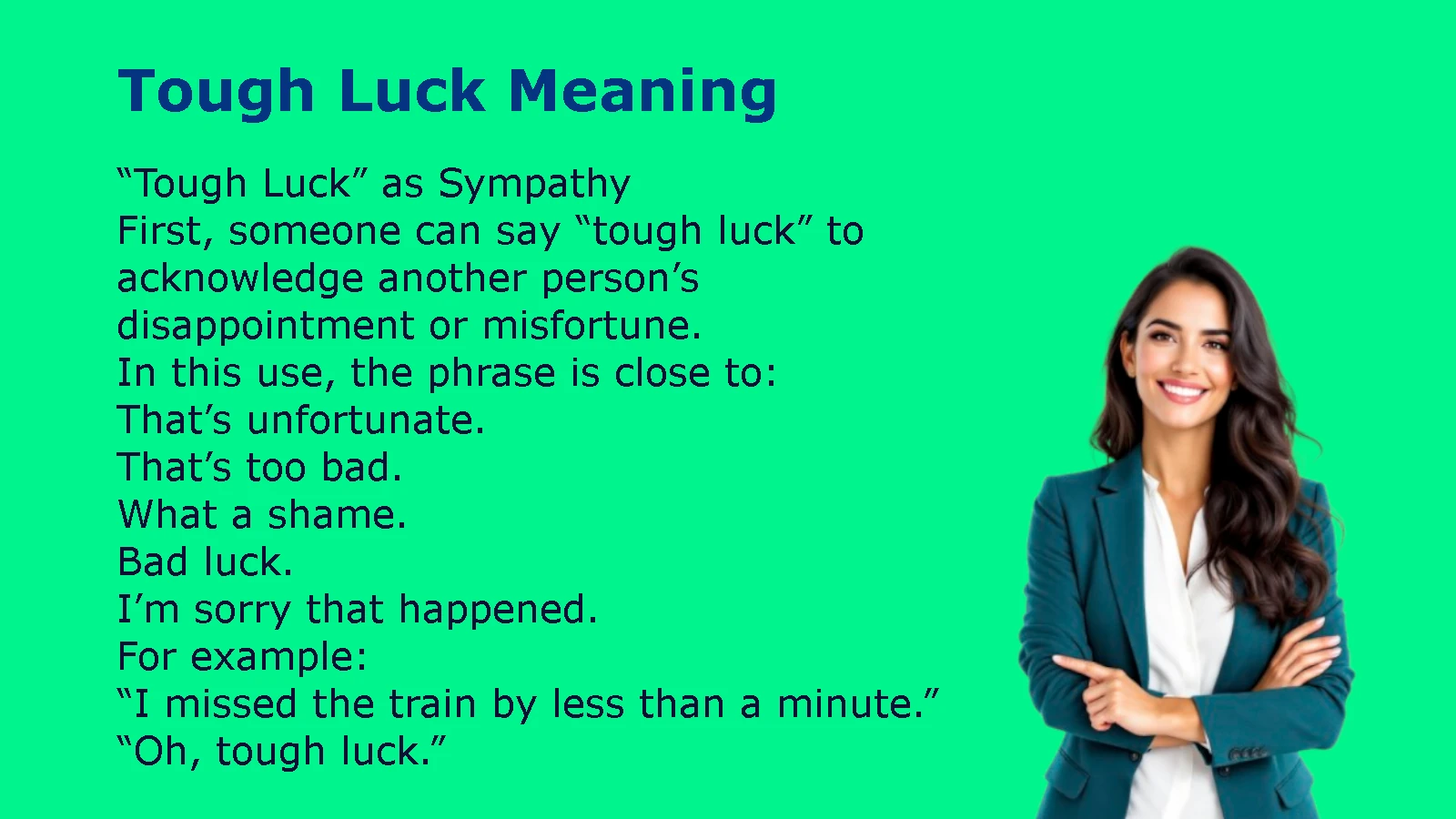
“Tough Luck” as Sympathy
First, someone can say “tough luck” to acknowledge another person’s disappointment or misfortune.
In this use, the phrase is close to:
- That’s unfortunate.
- That’s too bad.
- What a shame.
- Bad luck.
- I’m sorry that happened.
For example:
“I missed the train by less than a minute.”
“Oh, tough luck.”
The speaker isn’t blaming the person. Instead, they recognize that something frustrating happened.
Oxford lists this sympathetic use directly, giving the example of someone who failed by one point and receives the response, “That’s tough luck.”
“Tough Luck” as a Dismissive or Ironic Response
The second meaning is sharper.
Someone may say “tough luck” when they don’t feel sympathy for another person’s problem. In this case, the phrase can imply:
- That’s your problem.
- You’ll have to deal with it.
- I don’t feel sorry for you.
- You should have expected this.
- Too bad, but that’s how things turned out.
For example:
“I didn’t study for the exam, and I failed.”
“Tough luck.”
The response may sound sarcastic because the person could have prevented the problem.
Cambridge specifically defines this use as showing that the speaker has no sympathy for someone’s problems or difficulties.
The Two Meanings at a Glance
| Meaning | What the speaker communicates | Example |
| Sympathetic | “That’s unfortunate.” | “You lost by one point? Tough luck.” |
| Dismissive | “I don’t feel sorry for you.” | “You ignored the deadline? Tough luck.” |
| Ironic | “You have to accept the consequences.” | “You broke the rules and got disqualified? Tough luck.” |
The words stay the same. The attitude changes.
Tough Luck Meaning in Simple English
In simple English, tough luck can mean:
“Something unfortunate happened.”
When used sympathetically, it means:
“That’s unfortunate. I’m sorry you had bad luck.”
When used ironically, it means:
“That’s unfortunate, but I don’t feel sorry for you.”
The context usually tells you which meaning the speaker intends.
Consider these two conversations:
Conversation 1:
“My wallet was stolen on the bus.”
“Oh, tough luck. I hope you can recover your cards.”
This sounds sympathetic.
Conversation 2:
“I spent all my money even though I knew rent was due.”
“Tough luck.”
This sounds dismissive because the speaker may believe the person caused the problem themselves.
So, if you’re learning English, don’t translate tough luck into one fixed phrase every time. Think about why the speaker said it and how they said it.
Is “Tough Luck” an Idiom?
Yes. Tough luck is an informal idiom.
An idiom is an expression whose meaning can’t always be understood by interpreting every word literally.
Here, tough doesn’t mean physically hard, chewy, strong, or difficult to break. Luck refers to fortune or chance. Together, the expression refers to an unfortunate situation and, depending on context, the speaker’s reaction to it.
Oxford and Cambridge both classify tough luck as an informal idiom.
The phrase also belongs to a wider group of expressions involving luck, including:
- bad luck
- hard luck
- better luck next time
- no such luck
- just my luck
- the luck of the draw
- try your luck
- push your luck
These expressions don’t all mean the same thing. Each one has its own conversational purpose.
How to Use “Tough Luck” in a Sentence
The phrase usually appears as a short reaction to an unfortunate event.
You can use it on its own:
“Tough luck!”
You can also include it in a longer sentence:
“That’s tough luck.”
Another common pattern is:
“It was tough luck that she missed the opportunity.”
The exact structure depends on whether you’re reacting to an event or describing an unfortunate situation.
Using “Tough Luck” After a Loss
Suppose someone loses a competition after coming very close to winning.
“I lost the final by one point.”
“That’s tough luck.”
This normally sounds sympathetic.
The speaker recognizes that the person came close and experienced an unfortunate result.
Using “Tough Luck” After a Missed Opportunity
The phrase can also describe a missed opportunity.
“I arrived five minutes late and they had already sold the last ticket.”
“Tough luck.”
Whether that sounds caring or dismissive depends on the delivery.
A sympathetic speaker might say it with genuine concern. A sarcastic speaker might use it to suggest that the person should have arrived earlier.
Using “Tough Luck” When Someone Breaks a Rule
This is where the phrase often becomes more dismissive.
“I didn’t read the rules, and now I’m disqualified.”
“Tough luck.”
The response may imply that the outcome was avoidable.
The underlying message isn’t necessarily “You were unlucky.” It may be closer to “You knew the rules, so you’ll have to accept the result.”
Using “Tough Luck” in Sports
Sports conversations provide a natural setting for the sympathetic meaning.
“They scored in the final seconds.”
“Tough luck.”
Here, the speaker is acknowledging an unlucky result.
The phrase works particularly well when someone loses despite playing well.
For example:
“We dominated most of the match but conceded in stoppage time.”
“That’s tough luck.”
In this context, the phrase doesn’t necessarily criticize anyone. It recognizes the frustrating role of chance.
Tough Luck Examples in Everyday Conversations
The easiest way to understand the phrase is to see how context changes its meaning.
| Situation | Conversation | Meaning |
| Missed flight | “I got to the airport five minutes too late.” “Tough luck.” | Sympathy or mild resignation |
| Sports loss | “We lost in the last second.” “Tough luck.” | Sympathy |
| Missed deadline | “I forgot to submit it.” “Tough luck.” | Possibly dismissive |
| Broken phone | “I dropped my phone and cracked the screen.” “Oh, tough luck.” | Sympathy |
| Ignored instructions | “I didn’t follow the instructions and failed.” “Tough luck.” | Dismissive |
| Lost competition | “I came second after training for months.” “That’s tough luck.” | Sympathy |
| Missed sale | “I waited too long and now it’s sold out.” “Tough luck.” | Could be sympathetic or teasing |
| Bad decision | “I knew it was risky, but I did it anyway.” “Tough luck.” | Often dismissive |
Short Dialogue Examples
Example 1: Genuine sympathy
“My flight was canceled, and I missed my connection.”
“Oh, that’s tough luck.”
Example 2: A frustrating loss
“She missed the winning shot by an inch.”
“Tough luck. She played really well.”
Example 3: Sarcasm
“I didn’t study because I thought the test was next week.”
“Tough luck.”
Example 4: Consequences
“I broke the rules and got disqualified.”
“Well, tough luck.”
Example 5: Friendly teasing
“You said you didn’t want the last cookie.”
“I changed my mind.”
“Tough luck. I already ate it.”
The last example can sound playful rather than genuinely hostile. Relationship matters.
Is “Tough Luck” Rude?
It can be. It isn’t automatically rude.
The phrase sits in an unusual spot because the same words can express compassion or dismiss someone else’s feelings.
Tone does much of the work.
Compare:
“Oh, tough luck. That’s really frustrating.”
with:
“Tough luck. You should’ve known better.”
The first response sounds supportive. The second sounds judgmental.
What Makes “Tough Luck” Sound Rude?
Several factors can make the phrase feel harsh:
- A flat or mocking tone
- A serious problem
- A close relationship with the problem
- Blaming the person for what happened
- Using the phrase immediately after someone expresses strong emotions
- Adding language that emphasizes personal responsibility
For example, telling someone “Tough luck” after they lose a casual game may be harmless.
Saying the same thing to someone dealing with a major personal crisis can sound cruel.
How to Make It Sound More Sympathetic
If you want to show genuine concern, add a little context:
“Oh, tough luck. I know you were really looking forward to it.”
Or:
“That’s tough luck. Hopefully you can sort it out.”
These additions make your intention much clearer.
Is “Tough Luck” Formal or Informal?
Tough luck is informal.
Oxford, Cambridge, and Merriam Webster all identify the expression as informal.
It works naturally in:
- Casual conversations
- Text messages
- Friendly discussions
- Sports conversations
- Informal online communication
- Lighthearted exchanges
It generally isn’t the best choice for formal writing.
For example, a manager writing to an employee probably shouldn’t say:
“You missed the deadline. Tough luck.”
That wording can sound dismissive or hostile.
A more professional alternative would be:
“Unfortunately, the deadline has passed, so we’re unable to accept the submission.”
The second version communicates the same basic outcome without the conversational edge.
Tough Luck vs. Bad Luck
Bad luck and tough luck are closely related, but they don’t always perform the same job.
Bad luck usually describes an unfortunate event or situation.
“Missing the train was bad luck.”
Tough luck often works as a response to someone’s misfortune.
“You missed the train? Tough luck.”
Cambridge groups bad luck, hard luck, and tough luck as expressions that can show sympathy when something bad happens.
The Difference in Practice
| Expression | Typical function | Example |
| Bad luck | Describes misfortune | “It was bad luck that we missed the flight.” |
| Tough luck | Reacts to someone’s misfortune | “You missed the flight? Tough luck.” |
| Hard luck | Often expresses sympathy, especially in British English | “You lost the match? Hard luck.” |
There’s overlap, but the conversational role differs.
Tough Luck vs. Tough Break
Tough break is another informal expression for an unfortunate or disappointing situation.
For example:
“Losing the job after working there for ten years was a tough break.”
You can also say:
“You lost the job after ten years? Tough luck.”
The two expressions overlap, but they’re not identical in every sentence.
Tough break often labels the unfortunate event itself.
Tough luck often works as a reaction to the event.
The phrase tough break can also carry sympathy:
“That injury was a tough break for the team.”
Meanwhile, tough luck can carry either sympathy or irony. That makes its tone more context dependent.
Tough Luck vs. Hard Luck
Hard luck and tough luck have very similar meanings when someone expresses sympathy.
For example:
“We lost the game in overtime.”
“Hard luck.”
or:
“We lost the game in overtime.”
“Tough luck.”
Both can communicate disappointment.
However, hard luck is especially associated with British English in some dictionary treatments. Cambridge labels its standalone hard luck! entry as UK English, while its broader entry groups bad, hard, and tough luck together as sympathy expressions.
Tough luck is therefore a useful expression for learners who want an informal phrase that works naturally in American English as well as more broadly in English.
Tough Luck Synonyms and Alternatives
There isn’t one perfect synonym because tough luck can carry different tones.
The best alternative depends on what you want to communicate.
Sympathetic Alternatives
Use these when you genuinely feel bad about someone’s misfortune:
- That’s unfortunate.
- That’s too bad.
- What a shame.
- Bad luck.
- Hard luck.
- I’m sorry to hear that.
- Better luck next time.
Example:
“I missed the final interview because my flight was delayed.”
A sympathetic response could be:
“That’s unfortunate.”
or:
“I’m sorry to hear that.”
These sound warmer and clearer than a bare “Tough luck.”
Neutral Alternatives
When you want to acknowledge the problem without sounding overly emotional, try:
- That’s unfortunate.
- That’s disappointing.
- That’s a shame.
- Unfortunately, that happened.
- That’s frustrating.
These choices work better in many professional situations.
Dismissive Alternatives
When the context calls for a blunt response, expressions such as these may convey a similar attitude:
- Too bad.
- Oh well.
- That’s your problem.
- You’ll have to deal with it.
- That’s the way it goes.
Be careful with these. Some can sound much harsher than tough luck.
When Should You Say “Tough Luck”?
Tough luck works best when the situation is relatively minor or when the relationship makes the intended tone obvious.
Good situations include:
- A friend misses a train.
- A teammate loses a close game.
- Someone misses an opportunity through ordinary bad luck.
- A friend loses a casual competition.
- You’re joking with someone who understands your humor.
- You want to acknowledge an unfortunate result briefly.
For example:
“The store closed just before I got there.”
“Tough luck.”
That response can sound perfectly natural in casual conversation.
However, don’t assume the phrase will always sound friendly simply because it’s common.
When Should You Avoid Saying “Tough Luck”?
Avoid the phrase when the person needs clear empathy and the situation carries serious emotional weight.
It can be especially inappropriate when someone is discussing:
- A death
- A serious injury
- A major personal crisis
- A traumatic event
- A severe financial hardship
- A serious family problem
- A situation where the person clearly needs emotional support
Even if you intend “I’m sorry,” the listener may hear “I don’t care.”
A safer alternative is:
“I’m really sorry you’re dealing with that.”
or:
“That’s incredibly difficult. I hope things get better.”
The key lesson is simple: When empathy matters, choose wording that can’t easily be mistaken for sarcasm.
Can “Tough Luck” Be Sarcastic?
Yes. Tough luck can be strongly sarcastic.
This happens when the speaker believes the person brought the problem on themselves or simply doesn’t deserve sympathy.
Consider:
“I didn’t prepare for the presentation, and my boss criticized me.”
“Tough luck.”
The response suggests that the person should accept the outcome because their own actions contributed to it.
Merriam Webster explicitly notes that the expression is often used ironically to show that the speaker doesn’t feel sympathy.
Why Tone Matters So Much
Spoken language includes information that written text often loses.
A warm:
“Oh, tough luck.”
can sound sympathetic.
A short:
“Tough luck.”
can sound cold.
A sarcastic:
“Well, tough luck.”
can sound dismissive.
In text messages, this distinction becomes even harder to judge because the reader can’t hear your voice.
That’s why punctuation, surrounding words, and the relationship between the speakers can matter.
What Does “Tough Luck” Mean in Text Messages?
In texting, tough luck can mean either “that’s unfortunate” or “I don’t feel sorry for you.”
The surrounding message usually provides the clue.
Compare:
“My flight got canceled 😭. Tough luck.”
This could be friendly sympathy.
Now compare:
“You ignored the warning and now your account is locked. Tough luck.”
That sounds much more dismissive.
A text message removes facial expressions and vocal tone, so a short phrase like “tough luck” can be interpreted more harshly than intended.
If you want to avoid confusion, add a few words:
“Oh, tough luck. I know you were excited about the trip.”
That makes the sympathetic meaning much easier to understand.
Can You Use “Tough Luck” at Work?
Yes, but use it carefully.
It can appear in casual workplace conversation between colleagues who know each other well.
For example:
“I missed the last parking spot again.”
“Tough luck.”
That may be harmless.
However, the phrase becomes risky when someone has made a mistake, missed a deadline, or is facing a serious professional consequence.
Instead of:
“You missed the deadline. Tough luck.”
consider:
“Unfortunately, the deadline has passed.”
Or:
“I understand the situation, but we’ll need to follow the deadline.”
Professional communication usually benefits from clarity without unnecessary judgment.
Grammar and Usage of “Tough Luck”
The phrase is flexible enough to appear in several common structures.
“Tough Luck!”
This is the shortest form.
“You missed the last bus? Tough luck!”
Depending on tone, it can sound sympathetic, playful, or dismissive.
“That’s Tough Luck.”
This version often sounds slightly more conversational and sympathetic.
“You lost by one point? That’s tough luck.”
“It Was Tough Luck.”
This structure describes an unfortunate event.
“It was tough luck that she had to withdraw from the competition.”
“Tough Luck for Someone”
This construction identifies who experienced the unfortunate situation.
“It was tough luck for the team after they conceded in the final minute.”
This usage focuses more on the misfortune itself than on a direct response to someone.
What Does “Tough Luck” Really Communicate?
The phrase has an important pragmatic feature: it comments on the situation while also revealing the speaker’s attitude toward it.
That attitude can range from warm sympathy to complete indifference.
Think of the phrase as a volume dial.
At one end:
“Oh, tough luck. I’m really sorry.”
Strong sympathy.
In the middle:
“That’s tough luck.”
Neutral acknowledgment or mild sympathy.
At the other end:
“Tough luck. You knew what would happen.”
Dismissal.
The dictionary definition alone doesn’t capture this entire range. The social context completes the meaning.
Common Mistakes With “Tough Luck”
English learners sometimes make mistakes because they treat idioms as if every word has a literal meaning.
Mistake: Assuming It Always Means Sympathy
Not necessarily.
Tough luck can be sympathetic or ironic.
Always examine the context.
Mistake: Using It in Serious Situations
A phrase that works after a lost tennis match may sound terrible after a serious personal loss.
Choose stronger expressions of empathy when the situation demands them.
Mistake: Treating It as Formal English
It isn’t formal. Major dictionaries classify it as informal.
Use more professional wording in formal emails, reports, applications, and official communication.
Mistake: Assuming It Means “Good Luck”
It doesn’t.
Good luck wishes someone success.
Tough luck refers to misfortune or reacts to an unfortunate situation.
Compare:
“Good luck with your exam!”
with:
“You failed by one point? Tough luck.”
They point in opposite directions.
Case Study: How Context Changes the Meaning
Consider one situation:
A person misses an important train.
Now imagine three different responses.
Response A: Sympathy
“Oh, tough luck. Is there another train?”
The speaker recognizes the problem and offers help.
Response B: Neutral Reaction
“Tough luck. The next train is in an hour.”
The speaker acknowledges the inconvenience without much emotional emphasis.
Response C: Dismissive Reaction
“Tough luck. You should’ve left earlier.”
Now the speaker places responsibility on the person.
The phrase hasn’t changed.
The surrounding language has.
This is one of the most important things to understand about the tough luck meaning. Idioms don’t exist in a vacuum. Tone, context, relationship, and the seriousness of the event all shape how people interpret them.
Frequently Asked Questions About Tough Luck Meaning
What is the meaning of “tough luck”?
Tough luck is an informal idiom used when something unfortunate happens. It can express sympathy for someone’s misfortune or, ironically, show that the speaker doesn’t feel sorry for them.
Is “tough luck” a good thing or a bad thing?
It refers to an unfortunate situation, so the underlying event is bad or disappointing. However, the speaker’s attitude can be sympathetic or dismissive.
Is “tough luck” rude?
Sometimes. A sympathetic “tough luck” isn’t necessarily rude. A sarcastic or dismissive version can sound insensitive.
Is “tough luck” slang?
It’s more accurate to call tough luck an informal idiom or expression. Oxford and Cambridge classify it as an informal idiom.
What is another way to say “tough luck”?
Depending on your intended tone, you can say:
- That’s unfortunate.
- That’s too bad.
- What a shame.
- Bad luck.
- Hard luck.
- Tough break.
- I’m sorry to hear that.
What does “tough luck” mean in a text?
It can mean “that’s unfortunate” or “I don’t feel sorry for you.” Texting makes the tone harder to identify, so surrounding words provide important clues.
Can I say “tough luck” to a friend?
Yes. It’s common in casual conversation. Friends may use it sympathetically, jokingly, or sarcastically depending on their relationship.
Can I use “tough luck” in a formal email?
It’s usually better to avoid it. Because the phrase is informal and can sound dismissive, a professional alternative such as “That’s unfortunate” or “I’m sorry to hear that” is often safer.
Does “tough luck” mean “bad luck”?
Sometimes, but the expressions aren’t identical. Bad luck commonly describes an unfortunate event, while tough luck often serves as a reaction to someone’s misfortune.
Is “tough luck” the same as “tough break”?
They’re similar. Both can refer to an unfortunate situation. Tough luck can also function as a direct response and has a particularly clear ironic or dismissive use.
Tough Luck Meaning: Key Takeaways
The phrase tough luck looks simple, but its tone can shift dramatically.
Remember these points:
- Tough luck is an informal English idiom.
- It refers to misfortune or an unfortunate outcome.
- It can express genuine sympathy.
- It can also be ironic or dismissive.
- Tone and context determine which meaning the listener hears.
- It works naturally in casual conversations.
- It’s common when discussing sports, missed opportunities, mistakes, and everyday setbacks.
- It’s usually better to avoid it in formal communication.
- When someone is experiencing serious hardship, choose clearer and warmer language.
- “That’s unfortunate” is a safer neutral alternative.
- “I’m sorry to hear that” makes sympathy unmistakable.
Ultimately, tough luck is one of those English expressions where the words tell only half the story. The other half comes from who says it, why they say it, and how they say it. That is what makes a simple phrase capable of sounding kind in one conversation and cutting in the next.