Have you ever seen a place, lifestyle, or person described as “austere” and wondered what it really means? While Austere Meaning may sound complicated at first, the word usually describes something simple, plain, strict, or lacking comfort and decoration.
Austere is an adjective used to describe something that is deliberately simple or severe in appearance, lifestyle, or character. It can describe a plain room with little decoration, a strict person who avoids pleasure, or a difficult lifestyle with few comforts.
Examples:
- The room had an austere design with plain walls and simple furniture.
- He lived an austere life and avoided unnecessary luxuries.
The confusion is understandable. People often search for what does austere mean, austere meaning in a sentence, austere meaning in English, or austere synonym because the word can have slightly different meanings depending on the context. It may suggest simplicity in one sentence, strictness in another, and even severity or harshness in a different situation.
In this guide, you’ll learn the complete Austere Meaning, its definition, pronunciation, synonyms, antonyms, correct usage, and examples in sentences. You’ll also discover how austere is used to describe people, places, lifestyles, writing, and conditions, along with the difference between austere, simple, strict, and harsh.
What Does Austere Mean?
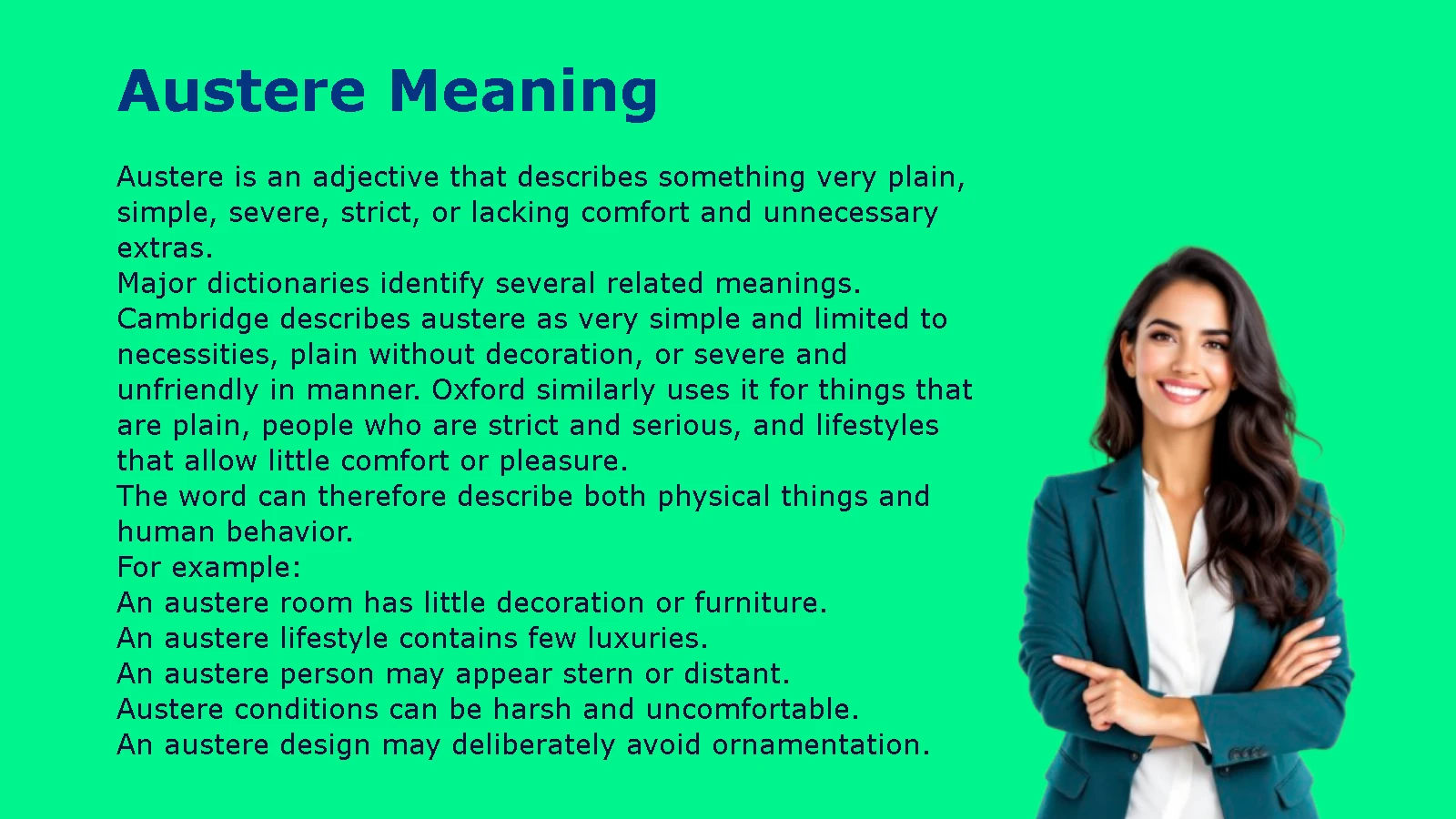
Austere is an adjective that describes something very plain, simple, severe, strict, or lacking comfort and unnecessary extras.
Major dictionaries identify several related meanings. Cambridge describes austere as very simple and limited to necessities, plain without decoration, or severe and unfriendly in manner. Oxford similarly uses it for things that are plain, people who are strict and serious, and lifestyles that allow little comfort or pleasure.
The word can therefore describe both physical things and human behavior.
For example:
- An austere room has little decoration or furniture.
- An austere lifestyle contains few luxuries.
- An austere person may appear stern or distant.
- Austere conditions can be harsh and uncomfortable.
- An austere design may deliberately avoid ornamentation.
Austere Meaning in Simple Words
In simple English, austere means very plain, strict, or without much comfort or decoration.
Think of it this way:
Austere = stripped down to the essentials.
Imagine two bedrooms. One has soft rugs, colorful artwork, decorative pillows, plants, and comfortable furniture. The other has a narrow bed, a wooden chair, bare walls, and almost nothing else.
The second room could be called austere.
The important point is that austere often suggests more than ordinary simplicity. A simple room may feel pleasant and cozy. An austere room may feel bare, severe, cold, or intentionally restrained.
Austere Definition
| Word | Part of Speech | Basic Meaning |
| Austere | Adjective | Very plain, strict, severe, or lacking comfort and unnecessary decoration |
| Austerely | Adverb | In a plain, severe, or restrained way |
| Austerity | Noun | A condition or practice involving strict simplicity or limited spending |
As an adjective, austere usually appears before a noun or after a linking verb.
Before a noun:
- an austere building
- an austere lifestyle
- an austere professor
- an austere environment
After a linking verb:
- The room looked austere.
- His manner seemed austere.
- Their lifestyle was austere.
The word doesn’t always carry the same emotional force. Context matters.
How to Pronounce Austere
In American English, austere is commonly pronounced approximately like:
uh STEER
Cambridge gives the US pronunciation as /ɑːˈstɪr/, while Oxford’s American dictionary gives /ɔˈstɪr/. The final sound rhymes closely with steer.
The stress falls on the second syllable:
aus + TEER
A useful way to remember it is to think of the phrase:
“Austere” → “uh STEER.”
What Does Austere Mean in Different Contexts?
The meaning becomes much easier to understand when you look at the noun that follows it.
Austere Meaning for a Room or Building
When austere describes a room, house, building, or interior, it usually means plain, bare, undecorated, or lacking unnecessary details.
For example:
The apartment had an austere interior with white walls and only a few pieces of furniture.
The sentence doesn’t necessarily mean the apartment looks bad. It simply emphasizes the lack of decoration and excess.
An austere building might have:
- Bare or minimally decorated walls
- Simple furniture
- Few decorative objects
- Plain materials
- Strong geometric shapes
- Little visual clutter
- A functional rather than luxurious appearance
That’s why austere often appears in discussions of architecture and interior design.
Austere Meaning for a Lifestyle
An austere lifestyle involves living with few comforts, luxuries, or unnecessary possessions.
For example:
After years of extravagant spending, he adopted an austere lifestyle.
This could mean that he stopped buying expensive clothing, eating at costly restaurants, traveling for luxury, or filling his home with unnecessary possessions.
Oxford defines this sense in terms of a way of life that allows little or nothing that gives pleasure or comfort.
An austere lifestyle might involve:
- Buying only necessities
- Owning very few possessions
- Eating simple meals
- Avoiding luxury
- Following strict routines
- Limiting entertainment
- Practicing strong self discipline
However, austere doesn’t automatically mean poor. Someone can deliberately choose an austere lifestyle even when they have plenty of money.
Austere Meaning for a Person
When austere describes a person, it usually refers to someone who appears stern, serious, strict, reserved, or unfriendly.
For example:
The austere professor rarely smiled and expected everyone to follow the rules.
Here, austere doesn’t mean that the professor owns very little. It describes the person’s manner and appearance.
An austere person might seem:
- Stern
- Serious
- Reserved
- Formal
- Cold
- Strict
- Distant
- Unapproachable
Cambridge specifically notes that an austere person may not seem friendly, while Oxford describes the person sense as strict and serious in appearance and behavior.
Austere Meaning for Conditions
Austere can also describe an environment or set of conditions that provides little comfort or few resources.
For example:
The researchers worked for several weeks in an austere environment with limited food, water, and shelter.
In this use, the word suggests that people have to operate with limited resources.
You’ll often see this sense in descriptions of:
- Remote environments
- Harsh climates
- Military settings
- Emergency situations
- Isolated locations
- Economically difficult periods
Here, austere comes close to words such as harsh, spartan, and inhospitable.
Austere Examples in Sentences
Seeing the word in different sentences makes its range much clearer.
Everyday Examples
- The cabin had an austere interior with only a bed and a wooden table.
- She prefers an austere lifestyle and owns very few unnecessary possessions.
- The office looked austere after the furniture was removed.
- His apartment was comfortable but deliberately austere.
- The restaurant’s austere design relied on bare walls and simple furniture.
About People
- The judge had an austere manner during the hearing.
- His austere expression made him seem difficult to approach.
- The principal appeared austere, although students later discovered that she was kind.
- Her austere personality reflected years of strict discipline.
- The old professor had a reputation for being austere and demanding.
Lifestyle
- The monks followed an austere way of life.
- He adopted an austere lifestyle after deciding to focus on saving money.
- Their home reflected their austere approach to living.
- The family endured an austere existence during the difficult period.
Examples About Design
- The architect created an austere building with almost no ornamentation.
- The gallery’s austere interior kept attention on the artwork.
- The designer chose an austere style based on simple forms and natural materials.
- The painting has an austere beauty that becomes more noticeable the longer you look at it.
Examples About Conditions
- The expedition faced austere conditions in the remote mountains.
- Workers operated in an austere environment with limited equipment.
- The community experienced an austere period after resources became scarce.
- The soldiers trained under austere conditions far from modern facilities.
Austere vs. Simple: What’s the Difference?
Austere and simple overlap, but they aren’t perfect synonyms.
Simple usually means uncomplicated, plain, or not elaborate. It can have a strongly positive meaning.
Austere suggests something more extreme. It can imply a lack of comfort, decoration, warmth, or pleasure.
Compare these sentences:
She decorated the room in a simple style.
This sounds neutral or even positive.
She decorated the room in an austere style.
This suggests that the room is especially bare, restrained, or severe.
| Word | Meaning | Typical Feeling |
| Simple | Not complicated or elaborate | Neutral or positive |
| Austere | Very plain, restrained, or lacking comfort | Often serious or stark |
| Minimalist | Deliberately reduced to essentials | Often positive |
| Spartan | Extremely plain and lacking comfort | Often severe |
| Stark | Bare, severe, or sharply plain | Often dramatic |
The distinction matters when you want your writing to communicate a precise impression.
Austere vs. Spartan
Austere and spartan are close in meaning, especially when describing living conditions.
A spartan room contains very little furniture or comfort. An austere room can mean almost the same thing.
However, austere has a wider range.
You can describe someone’s personality as austere:
He had an austere manner.
You wouldn’t normally use spartan in the same way.
Likewise, austere can describe a style, expression, piece of writing, or artistic quality. Spartan tends to emphasize the absence of comfort or luxury.
Quick Comparison
Austere: plain, severe, restrained, or without comfort.
Spartan: extremely simple and lacking physical comfort.
Both can describe a room. Austere simply has a broader emotional and stylistic range.
Austere Synonyms
The best synonym depends on which meaning of austere you want.
Synonyms for Austere Meaning “Plain”
- Simple
- Bare
- Stark
- Unadorned
- Unornamented
- Plain
- Minimal
- Severe
For example:
The building has an austere appearance.
Each choice creates a slightly different impression.
Synonyms for Austere Meaning “Without Comfort”
- Spartan
- Bare
- Basic
- Ascetic
- Frugal
- Self denying
- Uncomfortable
These words aren’t interchangeable in every situation.
Frugal, for example, focuses heavily on careful use of money. Ascetic often suggests deliberate rejection of pleasure, especially for moral or spiritual reasons.
Synonyms for Austere Meaning “Strict”
- Strict
- Stern
- Severe
- Rigorous
- Rigid
- Harsh
- Demanding
Consider:
The school followed an austere set of rules.
You could replace austere with strict, but the nuance changes. Strict focuses directly on rules and discipline. Austere can suggest a broader atmosphere of severity and restraint.
Synonyms for Austere Meaning “Unfriendly”
- Stern
- Cold
- Reserved
- Distant
- Severe
- Formal
- Unapproachable
- Forbidding
The word forbidding works particularly well when someone’s appearance or manner makes others reluctant to approach them.
Austere Antonyms
The opposite of austere changes according to context.
| Austere Meaning | Possible Antonym |
| Plain | Ornate |
| Undecorated | Elaborate |
| Without luxury | Luxurious |
| Without comfort | Comfortable |
| Strict | Lenient |
| Severe | Gentle |
| Unfriendly | Warm |
| Reserved | Approachable |
| Bare | Lavish |
For example:
The room was austere.
Possible opposite:
The room was lavish.
But if you’re talking about someone’s personality, lavish makes no sense as an antonym. You might instead say:
The austere manager seemed distant.
The warm manager welcomed everyone.
This is why context matters more than memorizing a single antonym.
Word Forms Related to Austere
The word family includes austere, austerely, and austerity.
Austerely Meaning
Austerely is the adverbial form of austere. It means in a plain, restrained, severe, or unfriendly way.
For example:
The room was austerely furnished.
Here, austerely explains how the room was furnished.
Another example:
She dressed austerely, choosing simple clothing without decoration.
Cambridge lists austerely with the meanings of acting in a very simple or plain way, having only necessities, or behaving in a severe and unfriendly manner.
Austerity Meaning
Austerity is the noun related to austere.
It can refer to strict simplicity or a lifestyle with limited comforts. In economics, however, austerity has a more specialized meaning related to policies intended to reduce government spending or control public finances.
For example:
The monks practiced austerity as part of their religious discipline.
In an economic context:
The government introduced austerity measures to reduce public spending.
The two uses share the underlying idea of restriction and restraint, but the economic meaning has become a distinct term.
Austereness Meaning
Austereness is also a recognized noun meaning the quality or state of being austere. Merriam Webster lists austereness as a noun.
Still, austerity is much more familiar and useful in everyday English.
Where Does the Word Austere Come From?
The history of austere helps explain why its modern meanings involve severity and restraint.
Merriam Webster traces the word through Middle English and Anglo French to Latin austerus, which came from Greek austēros, meaning harsh or severe. Merriam Webster records the first known English use in the 14th century.
The older Latin word also had a literal connection with harsh or sour taste. A historical Latin dictionary records austerus in descriptions of harsh, sour, or tart taste before showing its figurative development toward meanings such as severe, strict, stern, and serious.
That development is fascinating because the modern meanings still carry a sense of something that isn’t soft or indulgent.
A useful historical progression is:
harsh or sour → severe → strict → restrained → plain or without luxury
The modern English word now works comfortably in contexts ranging from architecture to personality and lifestyle.
Is Austere Positive or Negative?
Austere can be positive, negative, or neutral.
That flexibility makes it an interesting word.
When someone writes:
The prison had an austere interior.
The word probably carries a negative feeling. The room sounds cold and uncomfortable.
But consider:
The photographer captured the austere beauty of the desert.
Here, austere isn’t necessarily criticism. It describes the landscape’s stark, stripped down beauty.
The word can even suggest admiration:
The building’s austere design gives it a powerful sense of order.
In this sentence, the lack of decoration becomes a deliberate artistic strength.
How Context Changes the Tone
| Example | Likely Tone |
| An austere prison | Negative |
| An austere childhood | Often negative |
| An austere lifestyle | Neutral or positive |
| An austere building | Neutral |
| Austere beauty | Often positive |
| An austere professor | Neutral or negative |
| Austere economic conditions | Negative |
| An austere design | Neutral or positive |
So, austere doesn’t automatically mean bad. It means that something lacks softness, excess, decoration, comfort, or warmth in some way.
Austere in Art, Architecture, and Design
Artists, architects, and critics often use austere to describe work that deliberately avoids excess.
An austere design might feature:
- Simple shapes
- Bare surfaces
- Limited decoration
- Restrained materials
- Strong geometric forms
- Open space
- Functional furniture
- A limited visual palette
However, austere doesn’t mean ugly.
A building can look austere and still be elegant. In fact, removing decorative elements can make structural details more noticeable.
Think of a gallery with white walls, concrete floors, simple lighting, and almost no furniture. Its lack of decoration may make the artwork feel more important.
That’s different from a room that simply looks unfinished.
Austere vs. Minimalist Design
The two styles overlap, but the emotional effect can differ.
Minimalist design usually emphasizes intentional simplicity and functionality.
Austere design emphasizes starkness, restraint, or a lack of ornamentation.
A minimalist room can feel warm, comfortable, and inviting. An austere room may feel colder and more severe.
That distinction explains why a designer might describe a space as “austere but elegant.”
The apparent contradiction makes sense. The room can lack decoration while still having beauty and purpose.
Austere Lifestyle Meaning
An austere lifestyle deliberately limits comfort, luxury, or pleasure.
For some people, this can mean owning fewer possessions. For others, it can mean following strict religious or philosophical practices.
Imagine someone who owns a small home, buys only necessary clothing, cooks basic meals, avoids luxury purchases, and spends little money on entertainment. That person could be described as living an austere lifestyle.
However, the motivation matters.
An austere lifestyle can result from:
- Personal choice
- Religious discipline
- Philosophical beliefs
- Financial necessity
- Social conditions
- Limited resources
- A desire to avoid excess
This distinction helps separate austere from frugal.
A frugal person tries to spend money wisely.
An austere person may go further by deliberately limiting comfort and pleasure, not merely spending.
Case Study: Simple vs. Austere in Everyday Writing
Consider this description:
The writer worked in a simple office with a desk, chair, lamp, and bookshelf.
The word simple tells you that the office isn’t elaborate.
Now change one word:
The writer worked in an austere office with a desk, chair, lamp, and bookshelf.
The second sentence creates a different image. You may imagine bare walls, little decoration, hard surfaces, and a serious atmosphere.
Nothing physical changed in the sentence except one adjective.
That’s the power of precise word choice.
If you want to communicate plainness without severity, use simple.
If you want to communicate plainness plus restraint or starkness, austere may be the better choice.
How to Use Austere Correctly
The easiest structure is:
austere + noun
Common combinations include:
- austere lifestyle
- austere conditions
- austere environment
- austere design
- austere architecture
- austere room
- austere building
- austere appearance
- austere manner
- austere expression
- austere beauty
- austere style
- austere writing
- austere diet
- austere existence
Example Sentences
The hotel had an austere design that emphasized function over decoration.
They lived an austere lifestyle despite having enough money for luxury.
The judge’s austere expression made the courtroom feel even more serious.
The expedition team faced austere conditions in the remote region.
The painting has an austere beauty that comes from its limited colors and empty space.
Each sentence uses the same adjective, but the context supplies a slightly different shade of meaning.
Common Mistakes With Austere
Mistake: Thinking Austere Always Means Simple
Austere can mean simple, but simple doesn’t capture every meaning.
If you say:
She lives a simple life.
You might mean that she avoids complexity.
If you say:
She lives an austere life.
You suggest stronger restraint and fewer comforts.
Mistake: Assuming Austere Means Poor
An austere lifestyle may involve very little money, but the word doesn’t directly mean poor.
A wealthy person can choose an austere lifestyle.
Likewise, an expensive building can have an austere design.
Mistake: Treating Austere as Always Negative
The phrase austere beauty shows why this doesn’t work.
Here, the word highlights a stark quality that can actually enhance the beauty of something.
Mistake: Confusing Austere With Austerity
Austere is an adjective.
Austerity is a noun.
Correct:
The building has an austere design.
Correct:
The monks practiced austerity.
Incorrect:
The building has an austerity design.
The forms aren’t interchangeable.
Mistake: Calling Every Minimalist Thing Austere
A minimalist design can feel warm, polished, and inviting.
Austere adds a stronger sense of severity or starkness.
Therefore:
Minimalist ≠ automatically austere.
Austere vs. Similar Words
Several words overlap with austere, but each emphasizes something different.
| Word | Core Meaning | Main Difference |
| Austere | Plain, severe, restrained, or lacking comfort | Broadest combination of plainness and severity |
| Simple | Not complicated or elaborate | More neutral |
| Spartan | Very plain and lacking comfort | Strong focus on physical comfort |
| Stark | Bare, severe, or sharply clear | Often creates a dramatic or bleak impression |
| Severe | Very serious, harsh, or strict | Focuses more on seriousness or harshness |
| Frugal | Careful with money and resources | Focuses on spending |
| Minimalist | Reduced to essentials | Often intentional and positive |
| Ascetic | Avoiding pleasure or comfort | Often connected with discipline or spirituality |
Knowing these differences makes your vocabulary more precise.
For instance, calling someone frugal suggests careful spending. Calling someone austere may suggest a stern personality or restrained lifestyle. Calling someone ascetic can suggest deliberate rejection of worldly pleasures.
Is Austere the Same as Minimalist?
No.
The words overlap, especially in design and lifestyle discussions, but they emphasize different ideas.
Minimalist usually suggests intentional reduction. It often carries a positive sense of clarity, order, and simplicity.
Austere can suggest something harsher.
Compare:
She designed a minimalist living room.
This sounds modern and intentional.
She designed an austere living room.
This sounds more stark, bare, or severe.
A minimalist room might contain a comfortable sofa, warm lighting, plants, and carefully chosen artwork.
An austere room might contain only the furniture needed for basic use.
The difference isn’t absolute, but the emotional tone is important.
What Does Austere Mean When Describing a Person?
When austere describes a person, it usually means that the person appears stern, serious, strict, reserved, or unfriendly.
For example:
The austere principal rarely showed emotion.
This doesn’t necessarily mean the principal is actually unkind. The word describes how that person appears or behaves.
Someone can look austere because they:
- Rarely smile
- Speak formally
- Maintain strict standards
- Avoid casual conversation
- Dress in a restrained way
- Display little emotion
- Have a serious expression
That nuance matters. Austere describes an impression as much as a personality.
Someone who seems austere from across a room might turn out to be warm and funny once you get to know them.
Is Austere a Good Word to Use in Formal Writing?
Yes. Austere works particularly well in descriptive, academic, literary, historical, architectural, and analytical writing.
It lets you communicate several ideas with one precise adjective.
Instead of writing:
The building was very plain and didn’t have much decoration and felt serious.
You could write:
The building had an austere design.
The second version is shorter and more precise.
However, precision matters more than sounding sophisticated. If plain communicates your idea better, use plain.
Good writing isn’t about choosing the fanciest word. It’s about choosing the exact word the reader needs.
Quick Guide to Austere Meaning
| If “austere” describes… | It usually means… |
| A room | Plain and undecorated |
| A building | Stark and minimally ornamented |
| A lifestyle | Without many luxuries |
| A person | Stern, serious, or unfriendly |
| A personality | Reserved or severe |
| Conditions | Harsh or lacking comfort |
| A design | Restrained and unadorned |
| Art | Stark, serious, or stripped down |
| Beauty | Simple, stark, and sometimes haunting |
| A diet | Restrained or lacking indulgence |
Frequently Asked Questions About Austere Meaning
What is the simple meaning of austere?
Austere means very plain, strict, severe, or without unnecessary comfort or decoration. The exact meaning depends on context.
Does austere mean strict?
Yes. When austere describes a person, rule, discipline, or manner, it can mean strict or severe.
For example:
The school followed an austere code of conduct.
Does austere mean poor?
Not exactly. Austere means lacking comfort, luxury, or unnecessary extras, but it doesn’t necessarily describe someone’s financial situation.
A wealthy person can deliberately live an austere life.
What is an example of an austere lifestyle?
Someone who owns few possessions, avoids luxury purchases, eats simple food, and deliberately limits personal comforts could be described as living an austere lifestyle.
What is the opposite of austere?
The best opposite depends on the context.
- Ornate for decoration
- Luxurious for comfort
- Lavish for abundance
- Warm for personality
- Lenient for strictness
What is the noun form of austere?
The most common noun form is austerity.
For example:
The monks practiced austerity.
Austereness also exists as a noun, but austerity is much more established and useful in ordinary English. Merriam Webster lists both forms.
Is austere positive or negative?
It can be positive, negative, or neutral.
Austere conditions usually sound negative.
Austere beauty can sound positive.
An austere design may simply be descriptive.
What does austere mean when describing a person?
It means the person appears stern, serious, strict, reserved, cold, or unfriendly.
Is austere the same as minimalist?
No. Minimalist usually emphasizes intentional simplicity and reduction. Austere often adds a sense of severity, starkness, or lack of comfort.
What is the pronunciation of austere?
In American English, austere is pronounced approximately uh STEER, with the stress on the second syllable. Cambridge gives the US pronunciation as /ɑːˈstɪr/.
Final Takeaway: Austere Meaning in One Sentence
The austere meaning is very plain, restrained, severe, or lacking unnecessary comfort and decoration.
The word becomes more precise when you look at its context. An austere room is bare and undecorated. An austere lifestyle avoids luxury. Austere conditions offer little comfort. An austere person may seem stern or unfriendly. And austere beauty describes something whose stark simplicity has its own appeal.
The key distinction is simple: austere goes beyond ordinary simplicity. It often suggests restraint, severity, starkness, or a deliberate absence of excess.
Once that idea clicks, the word becomes much easier to recognize and use naturally.