Have you ever heard a word or phrase and wondered whether it means exactly what it says? That is where Literal Meaning comes into play. While the term may seem straightforward, understanding literal meaning can help you tell the difference between direct language and expressions that have a deeper or figurative meaning.
Literal meaning refers to the exact, direct meaning of a word, phrase, or sentence without exaggeration, symbolism, or hidden interpretation. It describes what the words actually say rather than what they might suggest.
Examples:
- The glass is full of water.
- She opened the door.
The confusion is understandable. People often search for what does literal mean, literal meaning definition, literal meaning in a sentence, or literal meaning vs figurative meaning because words can sometimes have both direct and implied meanings. And here’s the kicker: understanding whether language is literal or figurative can completely change how you interpret a sentence.
In this guide, you’ll learn the complete Literal Meaning, its definition, pronunciation, correct usage, and examples in sentences. You’ll also discover literal meaning in language, how to identify literal statements, and the difference between literal and figurative meaning.
What Does Literal Meaning Mean?
Literal meaning refers to the direct, basic, or original meaning of a word, phrase, or sentence. In a literal interpretation, you take the language according to what it normally states rather than assigning a metaphorical or symbolic meaning to it.
Cambridge Dictionary defines the literal meaning of a word as its “original, basic meaning.” It also contrasts literal meaning with figurative language, which uses words beyond their basic meaning.
In simple terms:
Literal meaning is what the words directly say.
Consider this sentence:
“The dog is under the table.”
The literal meaning is that a dog occupies a position beneath a table. The sentence describes a physical location.
Now compare it with:
“My boss has me under his thumb.”
If you interpret that sentence literally, you might imagine someone’s thumb physically resting on an employee. That isn’t what the speaker means. The phrase is figurative. It suggests that the boss has control over the employee.
The words remain the same kind of building blocks in both sentences. Context determines how you understand them.
Literal Meaning in Simple Words
If you’re looking for the simplest possible definition, think of literal meaning as taking words at face value.
When a sentence has a literal meaning:
- The words express their direct sense.
- The statement describes something as it actually occurs or is presented.
- The language doesn’t depend on a metaphor.
- The reader doesn’t need to replace the words with an implied comparison.
- The surrounding context usually supports the direct interpretation.
For example:
“Maria opened the window.”
The literal meaning is that Maria physically moved the window into an open position.
Likewise:
“The child dropped the ball.”
The sentence describes an actual physical action.
That doesn’t mean literal language must sound dull. A writer can use vivid and interesting literal descriptions. The key difference is that the words describe their intended subject directly.
Literal Meaning Examples
The easiest way to understand literal meaning is to see it in action.
| Sentence | Literal meaning |
| “The baby is sleeping.” | The baby is actually asleep. |
| “The soup is hot.” | The soup has a high temperature. |
| “He ran five miles.” | He traveled five miles by running. |
| “The door is locked.” | The door has been secured and cannot normally be opened. |
| “She opened the book.” | She physically opened a book. |
| “The glass broke.” | The glass cracked or separated into pieces. |
| “The cat is on the sofa.” | The cat is physically positioned on the sofa. |
| “The meeting starts at nine.” | The meeting begins at 9:00. |
| “The child kicked the ball.” | The child physically struck the ball with a foot. |
| “The store closes at six.” | The store stops operating for customers at 6:00. |
These examples share an important feature: the direct interpretation makes sense without inventing an additional comparison.
Literal Meaning in Everyday Conversation
You use literal language constantly, often without noticing it.
Imagine someone asks:
“Where are your keys?”
You answer:
“They’re on the kitchen counter.”
That’s literal language. You’re giving a direct description of the keys’ location.
Or imagine a friend asks:
“What time does the movie start?”
You say:
“It starts at 7:30.”
Again, the statement has a direct meaning.
Literal language becomes especially useful when accuracy matters. Instructions, measurements, schedules, directions, warnings, and factual descriptions often depend on readers understanding words directly.
Literal Meaning in Writing
Writers use literal language when they want readers to understand information clearly.
You commonly find it in:
- Instruction manuals
- Scientific writing
- Technical documentation
- News reports
- Academic writing
- Legal documents
- Recipes
- Directions
- Workplace communication
- Everyday descriptions
A recipe might say:
“Bake the bread at 375°F for 30 minutes.”
The instruction has a direct meaning. The reader shouldn’t interpret “375°F” as a metaphor for enthusiasm or “30 minutes” as an approximation for a long time.
In technical writing, this directness becomes even more important. A vague or figurative instruction can create confusion when someone needs to perform a precise task.
Literal Meaning vs. Figurative Meaning
The most important distinction to understand is the difference between literal meaning and figurative meaning.
Literal language uses words in their direct or basic sense. Figurative language uses words in a nonliteral or imaginative sense to communicate an idea, create an image, emphasize a point, or produce a particular effect. Cambridge describes figurative language as language that uses words and phrases beyond their basic meaning.
| Literal meaning | Figurative meaning |
| Direct meaning | Extended or imaginative meaning |
| Usually describes something directly | Often creates an image or comparison |
| Doesn’t require a metaphorical interpretation | Often relies on metaphor, idiom, symbolism, or exaggeration |
| “The child is swimming in the pool.” | “He is swimming in money.” |
| “The room is cold.” | “She gave me a cold look.” |
| “The glass broke.” | “His heart broke.” |
The distinction becomes clearer when you compare the same word in two different contexts.
Literal Example vs. Figurative Example
Consider the verb swimming.
Literal:
“The children are swimming in the pool.”
Here, swimming describes an actual physical activity in water.
Figurative:
“The company is swimming in money.”
The company isn’t physically floating through a pool filled with cash. The phrase suggests that the company has a very large amount of money.
The word swimming hasn’t suddenly lost its original meaning. Instead, the second sentence uses the idea associated with swimming to create a stronger image.
How Context Changes Meaning
Context acts like a traffic signal for meaning. It helps you decide which interpretation makes sense.
Consider:
“He has cold feet.”
Taken literally, this could mean his feet have a low temperature.
For example:
“After standing outside in the snow for an hour, he has cold feet.”
Here, the literal interpretation makes perfect sense.
But consider:
“He had cold feet before asking her to marry him.”
Now the phrase usually means that he became nervous or uncertain about getting married.
The words haven’t changed. The context has.
That is why you shouldn’t interpret every sentence word by word without considering the surrounding text.
How to Identify Literal Meaning
When you’re unsure whether a phrase has a literal meaning, use a simple process.
Read the Complete Sentence
Don’t isolate one unusual word too quickly.
For example:
“The runner broke the record.”
The word broke can literally mean damaged something. However, in this sentence, the context tells you that the runner exceeded a previous record.
The meaning of a word depends partly on how it functions within the sentence.
Ask What the Words Mean Directly
Try the most straightforward interpretation first.
If someone says:
“The book is on the desk,”
the direct interpretation is probably correct.
You don’t need to search for a symbolic meaning unless the context gives you a reason to do so.
Look for Figurative Language
Certain expressions often signal nonliteral meaning.
Watch for:
- Metaphors
- Similes
- Idioms
- Hyperbole
- Personification
- Symbolism
- Irony
- Comparisons
For example:
“The news hit me like a truck.”
The speaker probably wasn’t struck by a vehicle. The phrase uses figurative language to communicate the emotional force of the news.
Check Whether the Literal Interpretation Makes Sense
Ask yourself:
“Could this actually happen as described?”
This question can help, although it isn’t a perfect test.
Consider:
“The classroom was a zoo.”
A literal interpretation would mean an actual zoo occupied the classroom. If the surrounding context describes noisy students, the figurative interpretation becomes obvious.
Consider the Surrounding Context
Context can override your first impression.
Take:
“She was on fire.”
In a safety report, this could describe an actual emergency.
In a sports article, it might mean that she was performing exceptionally well.
The same words can support different meanings because the situation changes.
Literal Language vs. Figurative Language
Literal language communicates directly. Figurative language adds another layer.
Here’s a quick comparison:
| Feature | Literal language | Figurative language |
| Main purpose | Direct communication | Adds imagery, comparison, emphasis, or suggestion |
| Meaning | Basic or direct | Beyond the basic meaning |
| Common in | Instructions and factual descriptions | Literature, conversation, speeches, and creative writing |
| Interpretation | Usually straightforward | Often requires context |
| Example | “The child is very tired.” | “The child is running on empty.” |
Neither form is automatically better.
A scientist writing a procedure generally needs literal language. A novelist describing heartbreak might deliberately choose figurative language.
Good communication depends on choosing the right tool.
Common Examples of Literal and Figurative Language
“I’m Drowning in Work”
Literal meaning: Someone is physically submerged in water and struggling to survive.
Figurative meaning: Someone has an overwhelming amount of work.
Example:
“I can’t meet tonight. I’m drowning in work.”
The speaker is probably describing a heavy workload rather than an aquatic emergency.
“She Has a Heart of Gold”
Literal meaning: Her heart would literally consist of gold.
Figurative meaning: She is exceptionally kind, generous, or caring.
The expression uses the value of gold as a comparison for the person’s character.
“He Has Cold Feet”
Literal meaning: His feet feel cold.
Figurative meaning: He feels nervous or uncertain about something.
Context makes the distinction clear:
“He wore sandals in December, so he literally had cold feet.”
versus:
“He had cold feet before signing the contract.”
The first sentence describes temperature. The second expresses hesitation.
“The Classroom Was a Zoo”
Literal meaning: The classroom was an actual zoo.
Figurative meaning: The classroom was extremely noisy, chaotic, or difficult to control.
The phrase creates a comparison between a chaotic classroom and the lively activity associated with a zoo.
“The Sun Is Rising”
This sentence can work literally when it describes the visible movement of the sun across the sky from an observer’s perspective.
However, scientific explanations may describe the event more precisely in terms of Earth’s rotation. This example shows an important point: literal meaning and technical precision aren’t always identical.
A sentence can communicate its ordinary literal meaning while a specialized field uses more precise terminology.
Why Literal Meaning Matters
Literal meaning matters because communication breaks down when readers and speakers don’t share the same interpretation.
Imagine an instruction that says:
“Turn the valve clockwise two full rotations.”
Someone shouldn’t interpret “two full rotations” creatively. The instruction provides a direct action and a precise measurement.
Now imagine a motivational speaker saying:
“It’s time to break through your walls.”
The speaker probably doesn’t expect the audience to start knocking holes in concrete. The phrase uses figurative language to describe overcoming barriers.
The difference matters because the consequences of misunderstanding depend on the situation.
Literal Meaning Improves Clarity
When you communicate important information, direct language can reduce confusion.
Literal wording works especially well for:
- Directions
- Deadlines
- Measurements
- Safety instructions
- Technical explanations
- Definitions
- Rules
- Factual statements
Literal Meaning Helps With Reading Comprehension
Readers who can distinguish literal from figurative language can interpret texts more accurately.
A student reading:
“The author’s words were a knife.”
should recognize that the author isn’t describing an actual knife. The sentence uses an image to communicate the sharp or painful effect of the words.
Understanding that distinction prevents unnecessary confusion.
Literal Meaning Supports Accurate Communication
Literal language can make a message easier to verify.
Compare:
“The shipment arrived at 2:15 p.m.”
with:
“The shipment arrived sometime in the afternoon.”
The first statement gives specific information. The second gives a broader description.
Literal language doesn’t automatically make a statement true. It simply expresses the intended meaning directly.
Literal Meaning in Reading and Literature
Literature often mixes literal and figurative language.
A novel might say:
“Rain fell against the windows all night.”
That can be a literal description.
A few lines later, the author might write:
“The storm mirrored her anger.”
Now the storm has a figurative role. It reflects an emotional state rather than simply describing weather.
Strong readers don’t assume that every literary sentence must be interpreted literally. Instead, they examine:
- The words themselves
- The surrounding sentences
- The genre
- The speaker
- The situation
- The author’s purpose
- Repeated imagery or symbols
A poem, for example, often compresses meaning into images and comparisons. A technical manual generally doesn’t.
Literal and Symbolic Meaning Can Exist Together
A story may describe an actual object while also giving it symbolic importance.
Imagine a character repeatedly carries an old key.
Literal level: The character owns a physical key.
Symbolic level: The key might represent freedom, access, memory, or opportunity.
The object remains real within the story. Its meaning simply extends beyond its physical function.
That distinction helps explain why literal meaning doesn’t eliminate deeper interpretation. A text can communicate more than one layer at once.
Literal Meaning in Translation
The word literal also appears in discussions of translation.
A literal translation generally follows the source text closely, sometimes translating individual words or structures with minimal adjustment. Cambridge notes that a literal translation can become unnatural when it focuses on individual words instead of how those words work together in a phrase or sentence.
That creates an important distinction:
Literal meaning is about what language means.
Literal translation is about how language gets transferred from one language to another.
Those aren’t the same thing.
Consider an English idiom such as:
“It’s raining cats and dogs.”
A literal interpretation would suggest that cats and dogs are falling from the sky.
But the established meaning is simply:
It is raining very heavily.
If a translator mechanically translated every word into another language, the result could sound bizarre. A skilled translator considers the expression’s actual meaning and chooses a natural equivalent.
Why Word for Word Isn’t Always Best
Languages don’t package ideas in identical ways.
A phrase that sounds perfectly natural in English may sound strange if each word gets translated separately into another language.
This is why translation requires more than vocabulary knowledge. The translator must understand:
- Context
- Idioms
- Grammar
- Cultural conventions
- Tone
- Intended meaning
- Figurative expressions
In other words, literal meaning doesn’t always equal word for word meaning.
Literal Meaning vs. Literal Translation
These concepts often appear together, but they describe different things.
| Term | Meaning |
| Literal meaning | The direct or basic meaning of a word, phrase, or statement |
| Literal language | Language that uses words in their direct sense |
| Literal translation | A translation approach that follows the source wording closely |
| Figurative meaning | A meaning that extends beyond the basic sense |
| Figurative language | Language that uses imaginative or nonliteral meanings |
This distinction becomes especially useful when you’re studying English vocabulary or learning another language.
A phrase can have a clear literal meaning while a translator still decides not to translate it word for word.
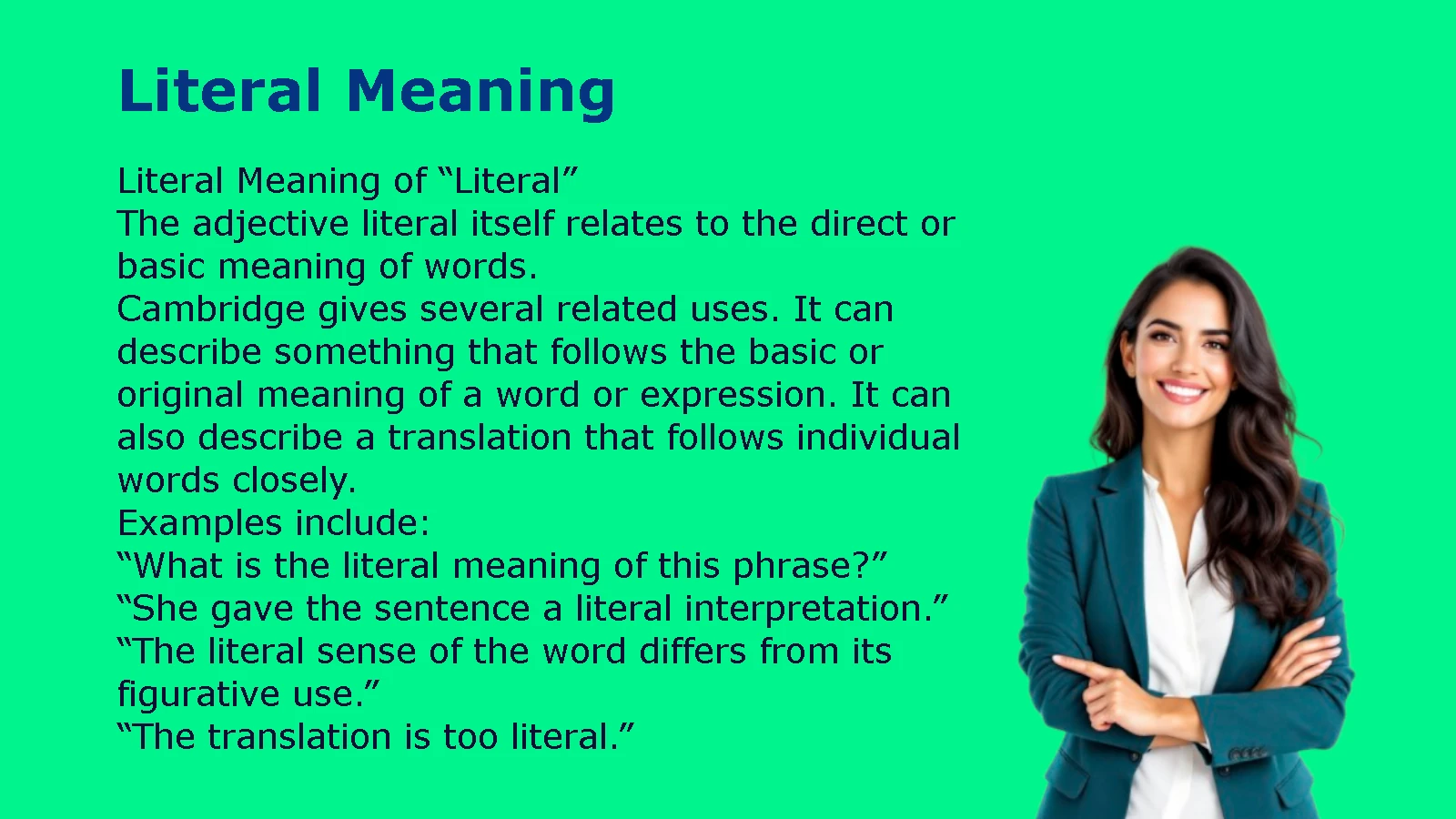
Literal Meaning of “Literal”
The adjective literal itself relates to the direct or basic meaning of words.
Cambridge gives several related uses. It can describe something that follows the basic or original meaning of a word or expression. It can also describe a translation that follows individual words closely.
Examples include:
- “What is the literal meaning of this phrase?”
- “She gave the sentence a literal interpretation.”
- “The literal sense of the word differs from its figurative use.”
- “The translation is too literal.”
The word can also appear in phrases such as:
“in the literal sense”
This phrase signals that the speaker means something in its direct or actual sense rather than metaphorically.
Literal vs. Literally
Although literal and literally come from the same word, they perform different grammatical jobs.
Literal is an adjective.
“That is the literal meaning.”
Literally is an adverb.
“The statement should be interpreted literally.”
The adverb literally traditionally refers to using the real or original meaning of a word or phrase. Modern English also uses literally informally as an intensifier. Cambridge records both the original meaning and this informal emphatic use.
For example:
“There were literally hundreds of people at the event.”
Here, literally reinforces the actual quantity.
But people also say:
“I literally died laughing.”
In ordinary informal speech, this usually doesn’t mean the person actually died. It emphasizes how intensely funny something seemed.
That informal use has become widespread enough for major dictionaries to document it.
Should You Use “Literally” for Emphasis?
That depends on your audience and purpose.
In casual conversation, emphatic literally is common.
In formal writing, use it carefully. If the statement is not actually true, another intensifier may communicate the idea more precisely.
For example, instead of:
“I literally waited forever.”
you could write:
“I waited for what felt like forever.”
The second version clearly signals exaggeration.
Common Mistakes With Literal Meaning
Confusing Literal and Figurative Meaning
One of the most common mistakes involves treating a figurative expression as though it describes a physical event.
For example:
“He broke her heart.”
The literal interpretation suggests that he physically damaged her heart.
The normal figurative interpretation means that his actions caused her deep emotional pain.
Assuming Every Phrase Has a Literal Interpretation
Some expressions become so familiar that speakers use them as fixed idioms.
For example:
“Hit the books.”
Nobody normally means physically striking books.
The phrase means to study seriously.
If you translate or interpret each word separately, the intended meaning disappears.
Treating Literal as a Synonym for “Boring”
Some people use literal casually to describe a person who interprets language very directly.
However, literal doesn’t simply mean boring, unimaginative, or unintelligent.
A literal interpretation concerns meaning. A person can understand literal language very well while also appreciating metaphors, jokes, symbolism, and irony.
Confusing Literal Meaning With Truth
This distinction matters.
A statement can have a literal meaning without being true.
For example:
“The moon is made of cheese.”
The sentence has a literal interpretation. It presents a direct claim about the moon.
That doesn’t make the claim factually correct.
So remember:
Literal describes how a statement means something. It doesn’t automatically prove that the statement is true.
Literal Meaning vs. Exact Meaning
The words literal and exact overlap in some situations, but they’re not perfect synonyms.
Literal focuses on the direct or basic sense of language.
Exact focuses on accuracy or precision.
For example:
“What is the literal meaning of this idiom?”
asks about the direct sense of the words or expression.
Meanwhile:
“What is the exact time?”
asks for a precise time.
You can describe an answer as both literal and exact, but the two words highlight different qualities.
Literal Meaning vs. Denotation
Denotation is another related concept.
In language studies, denotation generally refers to the direct or dictionary associated meaning of a word. Connotation, by contrast, concerns additional feelings, associations, or ideas connected with that word.
Consider the word home.
Its direct meaning can refer to the place where someone lives.
But the word may also carry associations such as:
- Safety
- Family
- Comfort
- Belonging
- Childhood
- Stability
Those emotional associations go beyond the basic reference.
This gives you another useful distinction:
| Concept | Main focus |
| Literal meaning | Direct or basic meaning |
| Denotation | Direct reference or dictionary associated meaning |
| Connotation | Associated feelings and ideas |
| Figurative meaning | Extended or nonliteral meaning |
These concepts overlap in language study, but they aren’t interchangeable in every context.
Case Study: Understanding a Workplace Message
Consider this message:
“Please send the report by 5 p.m. today.”
A literal interpretation is simple:
- There is a report.
- The recipient needs to send it.
- The deadline is 5 p.m.
- The deadline applies today.
Now imagine the manager writes:
“We’re running against the clock.”
This sentence doesn’t mean the employees are physically running alongside a clock.
It means they have limited time.
The first sentence uses direct language because the manager needs a clear deadline. The second uses an idiomatic expression to emphasize urgency.
Lesson From the Example
The same workplace conversation can contain both literal and figurative language.
Literal language communicates the exact task.
Figurative language adds tone or emphasis.
Good readers need to recognize both.
Case Study: Understanding a Literary Sentence
Consider:
“The night swallowed the town.”
A literal interpretation would suggest that the night physically consumed a town.
That isn’t normally the intended meaning.
The figurative interpretation suggests that darkness covered the town or that the night made the town disappear from view.
Now compare:
“Darkness covered the town after sunset.”
That sentence can be read literally as a straightforward description.
The difference demonstrates why writers choose figurative language. The first sentence creates a stronger image. The second gives information directly.
Neither approach is automatically superior.
How to Use “Literal” in a Sentence
Here are natural examples showing how literal works in everyday English:
- “What is the literal meaning of this phrase?”
- “The literal meaning differs from the figurative meaning.”
- “She interpreted his statement literally.”
- “The sentence has both literal and figurative meanings.”
- “Don’t take that expression literally.”
- “The literal translation sounds unnatural in English.”
- “The writer uses the word in its literal sense.”
- “His literal interpretation caused some confusion.”
- “The literal meaning is easier to understand from the context.”
- “The phrase isn’t meant to be taken literally.”
These examples also show how closely literal, literally, and literal meaning connect in real communication.
A Quick Test for Literal Meaning
When you encounter a confusing phrase, use this checklist:
- Read the entire sentence.
- Look at the surrounding context.
- Ask what the words mean directly.
- Check whether the direct interpretation makes sense.
- Look for an idiom, metaphor, simile, or exaggeration.
- Consider who is speaking and why.
- Compare the literal interpretation with the likely intended meaning.
For example:
“The test was a piece of cake.”
Step one: Read the sentence.
Step two: Consider the context. You’re probably talking about an exam.
Step three: Ask whether the test was physically a piece of cake.
Obviously not.
Step four: Recognize the idiom.
Meaning: The test was very easy.
Example:
“The box contains twelve books.”
The sentence makes a straightforward claim about the contents of a box.
Figurative Language
Figurative language moves beyond the basic meaning of words.
Example:
“Her voice was music to his ears.”
The speaker doesn’t mean that the voice literally consisted of musical notes. The phrase describes how pleasant the voice sounded.
Symbolic Language
Symbolic language gives an object, action, or image an additional meaning.
For example, a broken chain can literally be a physical object while also symbolizing freedom in a particular context.
The physical object and symbolic meaning can coexist.
Idiomatic Language
Idioms are expressions whose established meanings aren’t always predictable from their individual words.
Examples include:
- Break the ice
- Hit the books
- Spill the beans
- Under the weather
- Piece of cake
- Bite the bullet
If you interpret these expressions word for word, you may miss the intended meaning.
When Literal Language Works Best
Literal language is especially valuable when misunderstanding could cause problems.
Use direct wording for:
- Safety warnings
- Medical instructions
- Technical procedures
- Measurements
- Financial information
- Legal requirements
- Deadlines
- Directions
- Scientific observations
- Workplace instructions
For example:
“Wear protective gloves before handling the chemical.”
That’s clearer than a figurative alternative such as:
“Treat this chemical like a sleeping dragon.”
The second phrase might grab attention, but it doesn’t provide the same direct instruction.
When Figurative Language Works Best
Figurative language has its own strengths.
It can:
- Create vivid mental images.
- Make writing memorable.
- Communicate emotion.
- Add personality.
- Simplify abstract ideas.
- Make stories more engaging.
- Give speeches greater impact.
Compare:
Literal:
“Her speech made the audience feel hopeful.”
Figurative:
“Her speech lit a spark of hope in the audience.”
The second sentence creates an image. Hope becomes something like a small flame that can grow.
That’s the power of figurative language.
Frequently Asked Questions About Literal Meaning
What is the literal meaning?
Literal meaning is the direct, basic, or original meaning of a word, phrase, or sentence. It doesn’t require a metaphorical or symbolic interpretation.
What is an example of literal meaning?
In “The cat is on the chair,” the literal meaning is that a cat is physically positioned on a chair.
The sentence describes an actual situation directly.
What is the opposite of literal meaning?
The most useful contrast is figurative meaning. Figurative meaning goes beyond a word’s basic or direct sense to communicate an idea through imagery, comparison, symbolism, idiom, or another nonliteral device.
What does literal meaning mean in simple words?
It means the words mean what they directly say.
For example, “The water is cold” literally means that the water has a low temperature.
What is the difference between literal and figurative meaning?
Literal meaning gives the direct sense of the words.
Figurative meaning uses the words to communicate an additional or imaginative idea.
For example:
Literal: “He is carrying a heavy box.”
Figurative: “He is carrying a heavy burden.”
The second sentence may refer to emotional or personal difficulties rather than a physical box.
Is literal the same as exact?
Not always.
Literal refers to direct or basic meaning, while exact emphasizes accuracy or precision.
The two words can overlap, but they answer different questions.
Does literal mean true?
No.
A sentence can have a literal meaning without being factually true.
For example:
“The ocean is made of lemonade.”
The statement has a literal interpretation. However, its factual claim is false.
Literal meaning describes how the language is intended to mean something, not whether the claim itself is true.
What does “literally” mean?
Literally traditionally means using the real or original meaning of a word or phrase. In informal modern English, it can also emphasize a statement even when the speaker isn’t using the word in its strict literal sense. Major dictionaries document both uses.
What is literal language?
Literal language uses words in their direct or ordinary sense.
For example:
“The car is parked outside.”
The statement directly describes where the car is.
What is a literal interpretation?
A literal interpretation understands a statement according to its direct or basic meaning rather than treating it as a metaphor, symbol, or other figure of speech.
Can a sentence have both literal and figurative meaning?
Yes.
A word can have a literal use in one context and a figurative use in another. A text can also contain literal descriptions alongside figurative ideas.
For example, a storm can literally occur in a story while the writer also uses that storm figuratively to represent emotional conflict.
Is literal language always better than figurative language?
No.
The best choice depends on your purpose.
Use literal language when clarity and precision matter most. Use figurative language when you want imagery, emotion, emphasis, or creative expression.
Literal Meaning: Key Takeaways
Literal meaning is the direct, basic, or original meaning of a word, phrase, or sentence. It forms one of the simplest ways to understand language because it focuses on what the words directly communicate.
The biggest challenge comes from distinguishing literal meaning from figurative meaning. Words don’t always operate in isolation. Context, idioms, metaphors, tone, and purpose can change how you should interpret a statement.
Keep these points in mind:
- Literal meaning communicates the direct or basic sense.
- Figurative meaning extends beyond that basic sense.
- Context helps determine which interpretation makes sense.
- A literal statement isn’t necessarily true.
- Literal meaning isn’t the same as word for word translation.
- Literal is an adjective, while literally is an adverb.
- Literal language works especially well when clarity and precision matter.
- Figurative language works well when writers want imagery, emotion, comparison, or emphasis.
- A single word can have both literal and figurative uses depending on context.
When you’re unsure how to interpret a phrase, start with the direct meaning. Then look at the context. If the literal interpretation doesn’t fit the situation, check whether the writer uses an idiom, metaphor, exaggeration, symbolism, or another form of figurative language.
That simple habit can make difficult sentences much easier to understand.