Have you ever heard someone described as bellicose and wondered what the word really means? While Bellicose Meaning may sound complicated at first, it is a useful word for describing someone or something that seems aggressive, hostile, or eager to fight.
Bellicose is an adjective used to describe a person, attitude, statement, or behavior that is warlike, combative, or ready to argue or fight. It often suggests a strong desire for conflict rather than simply being angry or upset.
Examples:
- The bellicose man started an argument with a stranger.
- The leader gave a bellicose speech during the conflict.
The confusion is understandable. People often search for what does bellicose mean, bellicose meaning in a sentence, bellicose definition, or bellicose synonym because the word can describe different forms of aggression. And here’s the kicker: someone can have a bellicose attitude without actually starting a physical fight.
In this guide, you’ll learn the complete Bellicose Meaning, its definition, pronunciation, synonyms, antonyms, and correct usage. You’ll also discover how to use bellicose in a sentence, understand its meaning in different contexts, and distinguish it from similar words such as aggressive, hostile, and combative.
What Does Bellicose Mean?
Bellicose is an adjective that means inclined or eager to fight, quarrel, or engage in war. Merriam Webster defines it as “favoring or inclined to start quarrels or wars,” while Oxford describes it as having or showing a desire to argue or fight.
In simple terms, bellicose means ready to fight.
The word can describe both literal and figurative conflict. In international politics, for example, a government may adopt a bellicose foreign policy. In everyday life, a person may become bellicose during an argument.
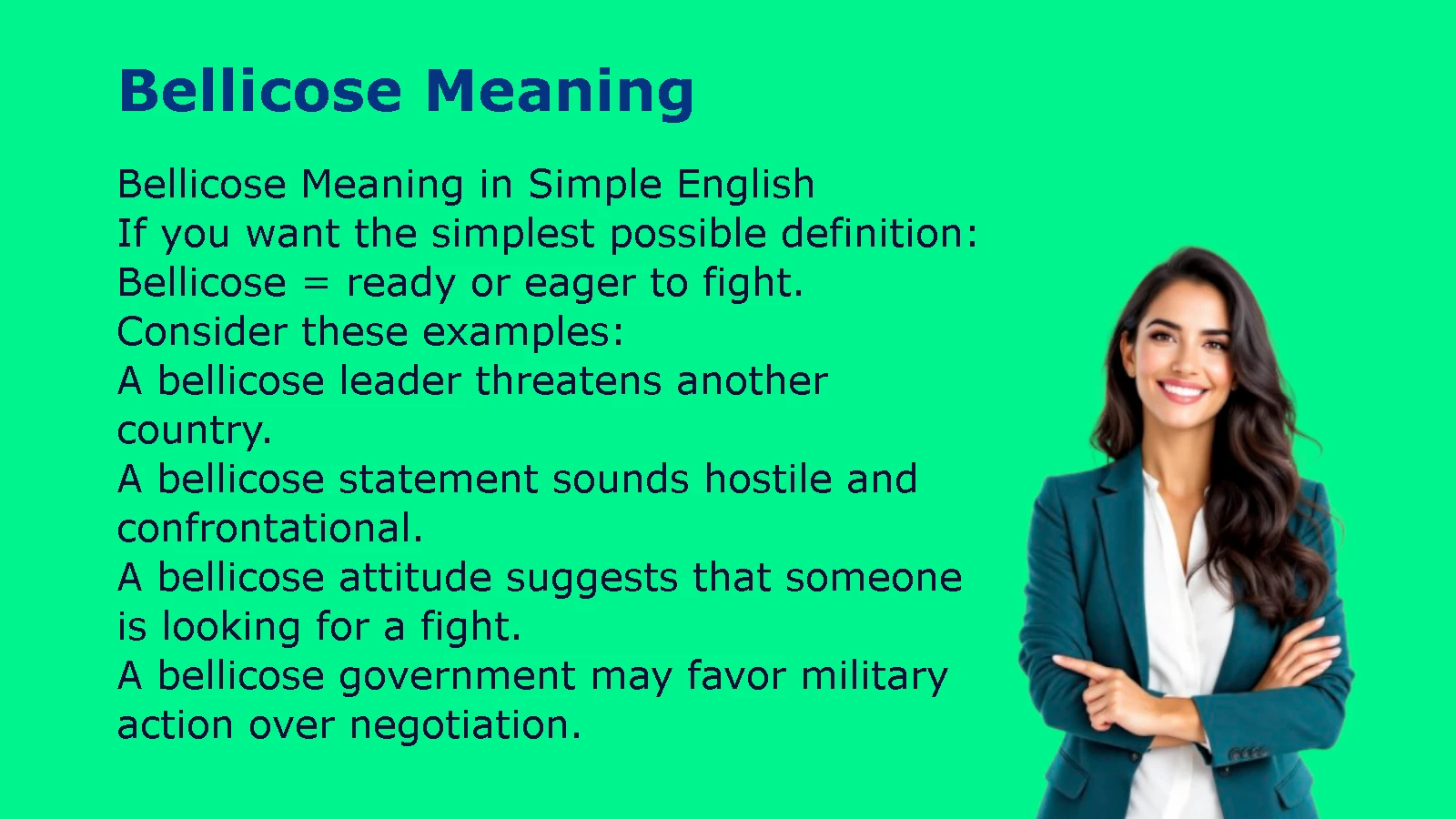
Bellicose Meaning in Simple English
If you want the simplest possible definition:
Bellicose = ready or eager to fight.
Consider these examples:
- A bellicose leader threatens another country.
- A bellicose statement sounds hostile and confrontational.
- A bellicose attitude suggests that someone is looking for a fight.
- A bellicose government may favor military action over negotiation.
The word carries a stronger meaning than simply being upset or assertive. It points toward conflict and confrontation.
Bellicose Definition at a Glance
| Feature | Details |
| Word | Bellicose |
| Part of speech | Adjective |
| Simple meaning | Ready or inclined to fight |
| Pronunciation in US English | /ˈbel.ə.koʊs/ |
| Main idea | Aggressive willingness to fight or quarrel |
| Common contexts | Politics, war, arguments, sports, literature |
| Synonyms | Aggressive, belligerent, combative, pugnacious, warlike |
| Antonyms | Peaceful, conciliatory, cooperative, pacific |
| Related noun | Bellicosity |
| Word origin | Latin bellicosus, from bellum, meaning “war” |
Cambridge gives the US pronunciation as /ˈbel.ə.koʊs/ and defines the word as wishing to fight or start a war.
How Do You Pronounce Bellicose?
In US English, bellicose is pronounced:
BEL-uh-kohss
Its pronunciation is written as /ˈbel.ə.koʊs/. The first syllable receives the main stress.
Bellicose Pronunciation Breakdown
You can divide it into three parts:
BEL + uh + KOHSS
The word sounds roughly like:
BEL-uh-kohss
British English commonly uses /ˈbel.ɪ.kəʊs/. The vowel sounds differ slightly between American and British pronunciation.
Is Bellicose a Noun or an Adjective?
Bellicose is an adjective.
It describes a person, thing, attitude, action, statement, or policy.
For example:
- bellicose leader
- bellicose behavior
- bellicose rhetoric
- bellicose statement
- bellicose policy
- bellicose nation
- bellicose response
- bellicose attitude
Notice how bellicose comes before a noun in these examples. It tells you something about the character or nature of that noun.
Examples of Bellicose as an Adjective
The senator gave a bellicose speech.
His bellicose attitude made negotiations difficult.
The country adopted a more bellicose foreign policy.
The player’s bellicose behavior led to a confrontation.
In each sentence, the adjective communicates a tendency toward conflict, hostility, or fighting.
Bellicose Examples in Sentences
The best way to understand a formal vocabulary word is to see it in different settings.
Everyday Examples
His bellicose attitude turned a small disagreement into a heated argument.
The customer became bellicose when the manager refused his request.
Her normally calm brother became surprisingly bellicose during the debate.
These examples use the word in a personal or social context. No actual war needs to occur. The person simply shows a strong willingness to argue or fight.
Political Examples
The senator criticized the administration’s bellicose rhetoric.
The president’s bellicose statements worried neighboring countries.
Voters questioned the government’s increasingly bellicose foreign policy.
Political writing uses bellicose frequently because governments can signal a willingness to use force through speeches, policies, threats, or military actions.
Military Examples
The general made several bellicose statements about the country’s military strength.
The nation’s bellicose policy raised concerns among its neighbors.
Diplomats struggled to respond to the government’s bellicose demands.
Cambridge itself gives an example involving a general making bellicose statements about military strength.
Sports Examples
The team’s bellicose style made every match intensely physical.
The player became bellicose after the referee rejected his complaint.
Sports writing sometimes uses bellicose figuratively. The competition doesn’t involve actual warfare, but an athlete’s behavior can resemble a fighting attitude.
Literary Examples
The novel introduces him as a bellicose warrior who distrusts every rival.
Her bellicose nature made peaceful negotiations almost impossible.
Writers often choose bellicose when they want a character to appear combative, hostile, or eager for confrontation.
What Is a Bellicose Person?
A bellicose person is someone who appears eager or ready to fight, argue, or confront others.
That doesn’t necessarily mean the person physically attacks people. The behavior might appear through:
- threatening language
- hostile comments
- constant arguments
- aggressive challenges
- confrontational behavior
- threats of violence
- a willingness to escalate disagreements
- an eagerness to engage in conflict
For example, imagine two people disagree about a business decision. One calmly explains a different opinion. The other starts making threats and challenges everyone in the room.
The second person’s behavior could be described as bellicose.
The key idea is not simply anger. It’s the readiness to turn hostility into confrontation.
Is Bellicose Always About War?
No.
Although bellicose has a strong connection to war, dictionaries also recognize its broader use for people who are inclined to argue or fight. Oxford specifically includes the desire to argue or fight in its definition.
This gives the word two closely related uses.
Literal Use
A literal use involves military conflict or war:
The government adopted a bellicose foreign policy.
Here, bellicose suggests a willingness to engage in military confrontation.
Broader or Figurative Use
A broader use involves personal arguments or aggressive behavior:
His bellicose attitude made a simple disagreement much worse.
Nobody needs to be preparing for war. The person’s behavior simply suggests a strong appetite for confrontation.
That’s why bellicose works in both political reporting and descriptions of personal behavior.
Bellicose Synonyms
Several English words overlap with bellicose, but they don’t all carry exactly the same meaning.
The closest synonyms include:
- aggressive
- belligerent
- combative
- pugnacious
- warlike
- hostile
- confrontational
- quarrelsome
- militant
Merriam Webster groups bellicose with words such as belligerent, pugnacious, quarrelsome, and contentious, while explaining that each word emphasizes a slightly different type of aggressive behavior.
Bellicose vs. Aggressive
Aggressive is broader than bellicose.
An aggressive person may push strongly for something, behave forcefully, or act hostilely. The behavior doesn’t necessarily involve fighting.
For example:
The company launched an aggressive marketing campaign.
That sentence sounds natural.
You wouldn’t normally say:
The company launched a bellicose marketing campaign.
Why? Because bellicose carries a strong association with fighting or conflict.
| Word | Main idea |
| Bellicose | Inclined to fight or start conflict |
| Aggressive | Forceful, hostile, or assertive |
| Difference | Bellicose has a stronger fighting or warlike sense |
Bellicose vs. Belligerent
These words are close enough to cause confusion.
Bellicose emphasizes a disposition or willingness to fight.
Belligerent can describe hostility, but it may also suggest that someone or something is actually engaged in conflict. Merriam Webster makes this distinction directly in its synonym discussion.
Compare:
The leader made a bellicose speech.
The speech signals a willingness to fight.
The belligerent nations entered into open conflict.
Here, belligerent can point to actual hostilities.
A useful shortcut is:
Bellicose = wants or appears ready to fight.
Belligerent = hostile and potentially already involved in conflict.
Bellicose vs. Combative
Combative means ready or inclined to fight or argue.
It often works well for people:
She became increasingly combative during the discussion.
Bellicose overlaps with this meaning, but it often sounds more formal and can carry a stronger connection to warfare.
Cambridge lists combative as a synonym of bellicose.
Bellicose vs. Pugnacious
Pugnacious describes someone who is eager or quick to fight.
The pugnacious boxer never backed down from a challenge.
The word often focuses on an individual’s personality.
Bellicose can describe individuals too, but it works especially well for leaders, nations, policies, speeches, and political rhetoric.
Bellicose vs. Warlike
Warlike has an especially direct connection to war.
The kingdom developed a warlike culture.
Bellicose often describes the attitude or behavior that shows a desire for conflict.
The two words overlap significantly, but warlike can describe a culture or character shaped by war, while bellicose more strongly emphasizes an active tendency toward fighting.
Bellicose Antonyms
The opposite of bellicose depends on the context.
Common antonyms include:
- peaceful
- peaceable
- pacific
- conciliatory
- cooperative
- diplomatic
- nonviolent
- amicable
- calm
The strongest opposite isn’t always peaceful. If the original sentence focuses on arguing, conciliatory may work better because it describes an effort to reduce conflict.
How to Use Bellicose in a Sentence
Because bellicose is a formal word, it appears most naturally in contexts involving conflict, politics, war, arguments, or hostility.
Bellicose + Noun
This is one of the easiest structures.
The country issued a bellicose statement.
The senator used bellicose language.
The general adopted a bellicose tone.
His bellicose attitude surprised everyone.
Subject + Be + Bellicose
You can also use bellicose after a linking verb.
The leader was bellicose during the negotiations.
His response became increasingly bellicose.
The two groups remained bellicose toward each other.
Bellicose in Formal Writing
Because dictionaries label the word as formal, it works particularly well in:
- news reports
- political analysis
- academic writing
- historical writing
- literary criticism
- diplomatic discussions
- military analysis
Oxford and Cambridge both identify bellicose as a formal word.
In casual conversation, aggressive or ready to fight will often sound more natural.
Common Collocations With Bellicose
A collocation is a combination of words that commonly appear together.
Knowing these combinations can help you use bellicose naturally.
| Collocation | Example |
| bellicose attitude | His bellicose attitude ended the discussion. |
| bellicose behavior | The player’s bellicose behavior drew attention. |
| bellicose statement | Officials condemned the bellicose statement. |
| bellicose rhetoric | The speech contained bellicose rhetoric. |
| bellicose language | Diplomats criticized the bellicose language. |
| bellicose leader | The bellicose leader threatened retaliation. |
| bellicose nation | The bellicose nation expanded its military presence. |
| bellicose policy | The government abandoned its bellicose policy. |
| bellicose tone | His response took a bellicose tone. |
| bellicose response | The group issued a bellicose response. |
| bellicose speech | The general delivered a bellicose speech. |
| bellicose rhetoric | The candidate’s rhetoric became increasingly bellicose. |
These phrases also reveal something important about the word: bellicose often describes signals of aggression rather than physical fighting itself.
A speech can be bellicose. A policy can be bellicose. A tone can be bellicose. None of these things physically fight.
Bellicose Meaning in Politics
Politics provides one of the clearest contexts for bellicose.
Political writers often use the word when describing leaders who threaten military action, reject diplomacy, or use language that suggests a willingness to escalate conflict.
For example:
The president’s bellicose rhetoric raised concerns among neighboring countries.
The sentence doesn’t necessarily say that war has begun. Instead, it says the president’s words signal a willingness to fight.
Merriam Webster notes that bellicose commonly applies to nations and their leaders because the word can describe an attitude that favors actual war.
Why “Bellicose” Works So Well in Political Writing
Political conflict often develops in stages:
Disagreement → hostile rhetoric → threats → military preparation → confrontation
Bellicose can describe the stage where someone’s words or policies begin signaling a willingness to escalate.
That’s why phrases such as these are common:
- bellicose rhetoric
- bellicose foreign policy
- bellicose statements
- bellicose leaders
- bellicose threats
- bellicose approach
The word gives readers more information than simply saying angry.
Bellicose Meaning in Personal Behavior
The word also applies to ordinary human behavior.
Imagine a meeting where someone disagrees with a proposal. At first, they calmly explain their concerns. Then their voice becomes hostile. They interrupt others. They challenge everyone who disagrees with them and appear eager to turn the disagreement into a confrontation.
You could describe their behavior as bellicose.
However, don’t use the word for every disagreement.
Someone who says, “I strongly disagree with you,” isn’t necessarily bellicose.
Someone who says, “If you don’t agree with me, we’ll settle this outside,” is much closer to the meaning.
The distinction comes down to hostility and willingness to fight or confront.
Bellicose Meaning in Sports
Sports writers sometimes use bellicose to describe an athlete, team, or playing style that seems unusually aggressive.
For example:
The team’s bellicose approach intimidated its opponents.
The striker adopted a bellicose attitude after the controversial call.
This use is often figurative. The players aren’t necessarily preparing for literal warfare. Instead, the writer uses the word to emphasize intense aggression and confrontation.
For ordinary sports writing, however, aggressive, physical, or combative may sound more natural.
Bellicose Meaning in Literature
Authors can use bellicose to reveal personality without explaining everything directly.
Consider:
The young captain had a bellicose nature and treated every disagreement as a challenge.
The adjective immediately creates an impression of someone who doesn’t shy away from conflict.
It can also establish the mood of a scene:
The room fell silent as the bellicose commander entered.
The reader expects tension.
That’s one reason precise vocabulary matters. A single adjective can change the emotional temperature of an entire passage.
The Origin and Etymology of Bellicose
The history of bellicose explains why the word remains so closely connected to war.
The word entered English from Latin bellicosus, meaning warlike or given to fighting. That word comes from Latin bellicus, meaning “of war,” which comes from Latin bellum, meaning “war.” Merriam Webster dates the first known English use of bellicose to the 15th century.
The basic path is:
Latin bellum → bellicus → bellicosus → English bellicose
Etymology Online likewise traces bellicose to the early 15th century and Latin bellicosus.
That history helps explain why the word still feels more intense than a general adjective such as assertive.
At its root, the word is connected to war.
What Is Bellicosity?
Bellicosity is the noun form related to bellicose.
It means the quality, behavior, or manner of being inclined to fight or start a war. Cambridge defines it as the behavior or manner of someone who wants to fight or start a war.
Compare the two:
| Word | Part of speech | Meaning |
| Bellicose | Adjective | Inclined to fight or argue |
| Bellicosity | Noun | The quality or behavior of being bellicose |
Examples of Bellicosity
The senator’s bellicosity worried his political opponents.
Diplomats were concerned about the government’s growing bellicosity.
His bellicosity made peaceful negotiations difficult.
The noun focuses on the quality or behavior, while the adjective describes the person, action, attitude, or thing itself.
Other Forms of Bellicose
Several related forms appear in dictionaries.
| Form | Part of speech | Meaning |
| bellicose | Adjective | Inclined to fight |
| bellicosity | Noun | Quality of being bellicose |
| bellicosely | Adverb | In a bellicose manner |
| bellicoseness | Noun | State or quality of being bellicose |
Collins lists bellicosely and bellicosity as derived forms.
In everyday writing, bellicose and bellicosity are much more useful than the less common forms.
Common Mistakes When Using Bellicose
Because bellicose sounds sophisticated, it’s tempting to use it wherever you see aggression. That can lead to awkward sentences.
Mistake: Treating Bellicose as a Synonym for Angry
Being angry doesn’t automatically make someone bellicose.
Angry: She was angry about the decision.
Bellicose: She openly threatened to confront anyone who opposed her.
The second sentence shows a clear willingness to fight or confront.
Mistake: Using Bellicose for Any Confident Person
Confidence and aggression aren’t the same thing.
A confident speaker can disagree firmly while remaining respectful.
A bellicose speaker is more likely to push toward confrontation.
Mistake: Assuming Bellicose Means “Currently Fighting”
This is another important distinction.
Bellicose often describes a disposition or willingness to fight.
Someone can be bellicose before any physical conflict begins.
For example:
The country’s bellicose rhetoric alarmed its neighbors.
The sentence doesn’t say that war has already started. It describes language that suggests a willingness to fight.
Mistake: Using Bellicose When Aggressive Is Better
Sometimes aggressive simply fits better.
The company used an aggressive sales strategy.
That’s natural.
The company used a bellicose sales strategy.
That sounds strange because selling products doesn’t normally involve the type of fighting or conflict associated with bellicose.
Mistake: Confusing Bellicose With Belligerent
These words overlap heavily, but they aren’t interchangeable in every sentence.
Remember:
Bellicose emphasizes an inclination to fight.
Belligerent can suggest actual hostility or involvement in conflict.
Bellicose vs. Related Words
A quick comparison makes the distinctions easier to remember.
| Word | Core meaning | Typical emphasis |
| Bellicose | Inclined to fight | Willingness to engage in conflict |
| Aggressive | Forceful or hostile | Broad range of behavior |
| Belligerent | Hostile or engaged in conflict | Active hostility |
| Combative | Ready to fight or argue | Arguments and confrontation |
| Pugnacious | Eager to fight | Personal fighting spirit |
| Quarrelsome | Inclined to argue | Frequent disputes |
| Contentious | Argumentative or disputatious | Enjoyment of arguing |
| Warlike | Related to or favoring war | Military character |
| Hostile | Unfriendly or antagonistic | General opposition |
Merriam Webster specifically notes that pugnacious can suggest a disposition that takes pleasure in personal combat, while quarrelsome emphasizes a readiness to fight without good cause. Contentious focuses more strongly on arguing and quarreling.
A Practical Case Study: Choosing the Right Word
Consider this situation:
A government announces that it will not tolerate attacks from a neighboring country. Its officials issue increasingly aggressive statements and begin discussing possible military action.
Which word works best?
Option 1: Aggressive
The government adopted an aggressive approach.
Correct. It’s broad and natural.
Option 2: Bellicose
The government adopted a bellicose approach.
Also correct. This version gives the sentence a stronger connection to war and willingness to fight.
Option 3: Belligerent
The government became belligerent.
This can work when the government displays active hostility or becomes involved in conflict.
Option 4: Combative
The government took a combative approach.
Correct, although it sounds somewhat broader and less specifically connected to war.
Best choice when the focus is a willingness to start or enter a war: bellicose.
That’s the central distinction worth remembering.
Quick Facts About the Word Bellicose
- Bellicose is an adjective.
- It generally means inclined or eager to fight.
- It can describe people, governments, nations, policies, statements, rhetoric, attitudes, and behavior.
- It often appears in formal writing.
- Its US pronunciation is /ˈbel.ə.koʊs/.
- Its roots trace back to Latin words associated with war.
- English has used the word since the 15th century.
- Bellicosity is its related noun form.
- Close synonyms include aggressive, belligerent, combative, pugnacious, and warlike.
- Common antonyms include peaceful, conciliatory, cooperative, and nonviolent.
Bellicose Meaning: Quick Answer
Bellicose means aggressive or inclined to fight, argue, or start a war. It usually describes someone or something that shows a willingness to engage in conflict.
For example:
The leader’s bellicose rhetoric worried neighboring countries.
In this sentence, bellicose means that the leader’s language showed a readiness or desire for conflict.
The word is especially common in formal discussions of politics, military affairs, international relations, arguments, and aggressive behavior.
Frequently Asked Questions About Bellicose Meaning
What does bellicose mean in simple words?
Bellicose means ready or eager to fight. It can also describe someone who is inclined to argue or behave aggressively.
Is bellicose a positive or negative word?
Bellicose is generally negative. It suggests hostility, aggression, or a willingness to fight.
For example:
The government’s bellicose rhetoric alarmed its neighbors.
The word signals that the behavior creates concern rather than admiration.
What is a synonym for bellicose?
Common synonyms include aggressive, belligerent, combative, pugnacious, hostile, and warlike.
The best synonym depends on the context.
What is the opposite of bellicose?
Common antonyms include peaceful, conciliatory, cooperative, diplomatic, pacific, and nonviolent.
How do you pronounce bellicose?
In US English, pronounce it approximately:
BEL-uh-kohss
The Cambridge pronunciation is /ˈbel.ə.koʊs/.
Is bellicose a noun or adjective?
Bellicose is an adjective.
It describes nouns such as leader, statement, policy, attitude, and behavior.
What is the noun form of bellicose?
The related noun is bellicosity.
It refers to the quality or behavior of being inclined to fight or start a war.
Can bellicose describe a person?
Yes.
The bellicose politician refused to back down.
The adjective describes someone who appears eager or ready to confront others.
Can bellicose describe a country?
Yes. This is one of the word’s most common formal uses.
The bellicose government threatened military action.
It can describe a country’s leaders, foreign policy, military rhetoric, or actions.
Is bellicose the same as aggressive?
Not exactly.
Aggressive has a much broader meaning. Bellicose specifically suggests an inclination toward fighting, quarreling, or war.
What is the difference between bellicose and belligerent?
Bellicose emphasizes a willingness or tendency to fight. Belligerent can emphasize active hostility or actual involvement in conflict.
What does bellicose attitude mean?
A bellicose attitude is an attitude that shows hostility or a willingness to argue, confront, or fight.
For example:
His bellicose attitude made compromise almost impossible.
Final Takeaway: Bellicose Meaning
The easiest way to remember bellicose is to connect it with one simple idea:
A bellicose person or group is ready to fight.
The word goes beyond ordinary anger. It suggests hostility, confrontation, or a willingness to engage in conflict. That’s why writers commonly use it for leaders, governments, nations, military policies, political rhetoric, and people who seem eager to argue or fight.
If you remember the distinction between bellicose and aggressive, you’ll also have a much better sense of when to use the word. Aggressive covers a wide range of forceful behavior. Bellicose carries a sharper edge. It points toward fighting, quarrels, or war.
So when you encounter a phrase such as “bellicose rhetoric,” “bellicose leader,” or “bellicose policy,” think:
Ready for conflict.
That single idea captures the heart of the bellicose meaning.