Better ways to say “that’s fine” can help you sound more natural, polite, reassuring, or professional depending on the situation. While “that’s fine” is a common phrase used to show acceptance, agreement, or reassurance, it can sometimes sound too casual, vague, or even slightly dismissive depending on your tone and context.
The phrase “that’s fine” can mean several things, including “that’s okay,” “no problem,” “I agree,” “that works for me,” “don’t worry about it,” or “I accept that.” The best alternative depends on what you actually want to communicate. For example, “That works for me” sounds natural when agreeing to a plan, while “No worries” is better for reassuring someone after an apology.
In this guide, you’ll learn better ways to say “that’s fine” in different situations, including professional emails, casual conversations, responses to apologies, accepting suggestions, agreeing to plans, and reassuring someone. You’ll also see useful alternatives such as “That works for me,” “No problem,” “That’s perfectly okay,” “I’m fine with that,” “Sounds good,” and “No worries.”
By the end, you’ll know which alternative to “that’s fine” fits each situation and how to use these expressions naturally and appropriately in everyday and professional communication.
What Does “That’s Fine” Mean?
“That’s fine” is a common English expression used to show that you accept, approve of, or are satisfied with something. Depending on the situation and tone, it can mean “That’s okay,” “That’s acceptable,” “No problem,” or “I agree.”
For example:
“Can we meet tomorrow instead?”
“That’s fine.”
Here, the speaker is saying that the proposed change is acceptable.
The expression can also reassure someone that their action or mistake is not a problem:
“Sorry I’m a few minutes late.”
“That’s fine. Don’t worry about it.”
English dictionaries recognize this use of fine as an expression of agreement or acceptance. Oxford gives examples such as “That’s fine by me,” while Cambridge describes “that’s fine” as a way to agree with a suggestion, idea, or decision.
However, “that’s fine” does not always communicate exactly the same feeling. In some situations, it sounds warm and reassuring. In others, especially when spoken with a flat tone, it can sound reluctant, dismissive, or even annoyed.
That is why choosing a more specific alternative can make your English clearer.
“That’s Fine” in Everyday English
In everyday conversations, “that’s fine” is extremely flexible.
You can use it when someone asks for permission:
“Is it okay if I leave early today?”
“That’s fine.”
You can use it when someone suggests a plan:
“How about we meet at 6 instead?”
“That’s fine.”
You can use it to reassure someone:
“Sorry, I forgot to bring the documents.”
“That’s fine. You can send them later.”
You can also use it to accept an option:
“Would you like tea instead of coffee?”
“That’s fine.”
The problem is that fine is broad. It tells the listener that something is acceptable, but it does not always explain why you accept it or how enthusiastic you are.
Compare these responses:
| Response | Likely feeling |
| That’s fine. | Neutral acceptance |
| That’s okay. | Neutral, friendly acceptance |
| No problem. | Reassurance |
| Sounds good. | Positive agreement |
| That works for me. | Agreement with a plan |
| I’m happy with that. | Stronger positive approval |
| That’s perfect. | Enthusiastic approval |
| I don’t mind. | Lack of objection |
| I can live with that. | Reluctant acceptance |
| That’s acceptable. | Formal or impersonal acceptance |
The right alternative depends on the relationship, situation, and emotion behind your response.
Other Ways to Say “That’s Fine”
There are many alternatives to “that’s fine,” but they are not all interchangeable. Some are better for professional communication, while others sound more natural with friends.
Here are 27 useful alternatives.
That’s Okay
“That’s okay” is probably the closest everyday alternative to “that’s fine.”
It works when you want to accept a suggestion, reassure someone, or indicate that something is not a problem.
Example:
“I can’t finish it today.”
“That’s okay. Tomorrow is fine.”
It is particularly natural in casual conversations.
Best for: everyday conversations, friendly messages, and informal workplace communication.
That’s All Right
“That’s all right” is another direct alternative.
It can communicate acceptance or reassurance:
“Sorry I made a mistake.”
“That’s all right.”
It can sound slightly more traditional than “that’s okay,” but it remains perfectly natural English.
Best for: everyday English, polite conversations, and reassurance.
No Problem
“No problem” is one of the most common alternatives when you want to tell someone that something does not bother you.
“Would it be okay if I called you later?”
“No problem.”
It is especially useful after an apology or request:
“Sorry for keeping you waiting.”
“No problem.”
However, “no problem” and “that’s fine” are not always identical. “No problem” emphasizes the absence of difficulty or inconvenience, while “that’s fine” can simply express acceptance.
It’s Okay
“It’s okay” works well when you are reassuring someone.
“I’m sorry I forgot.”
“It’s okay. These things happen.”
It can also indicate that a situation is acceptable:
“If you need to leave early, it’s okay.”
This expression is warm and natural, although context and tone still matter.
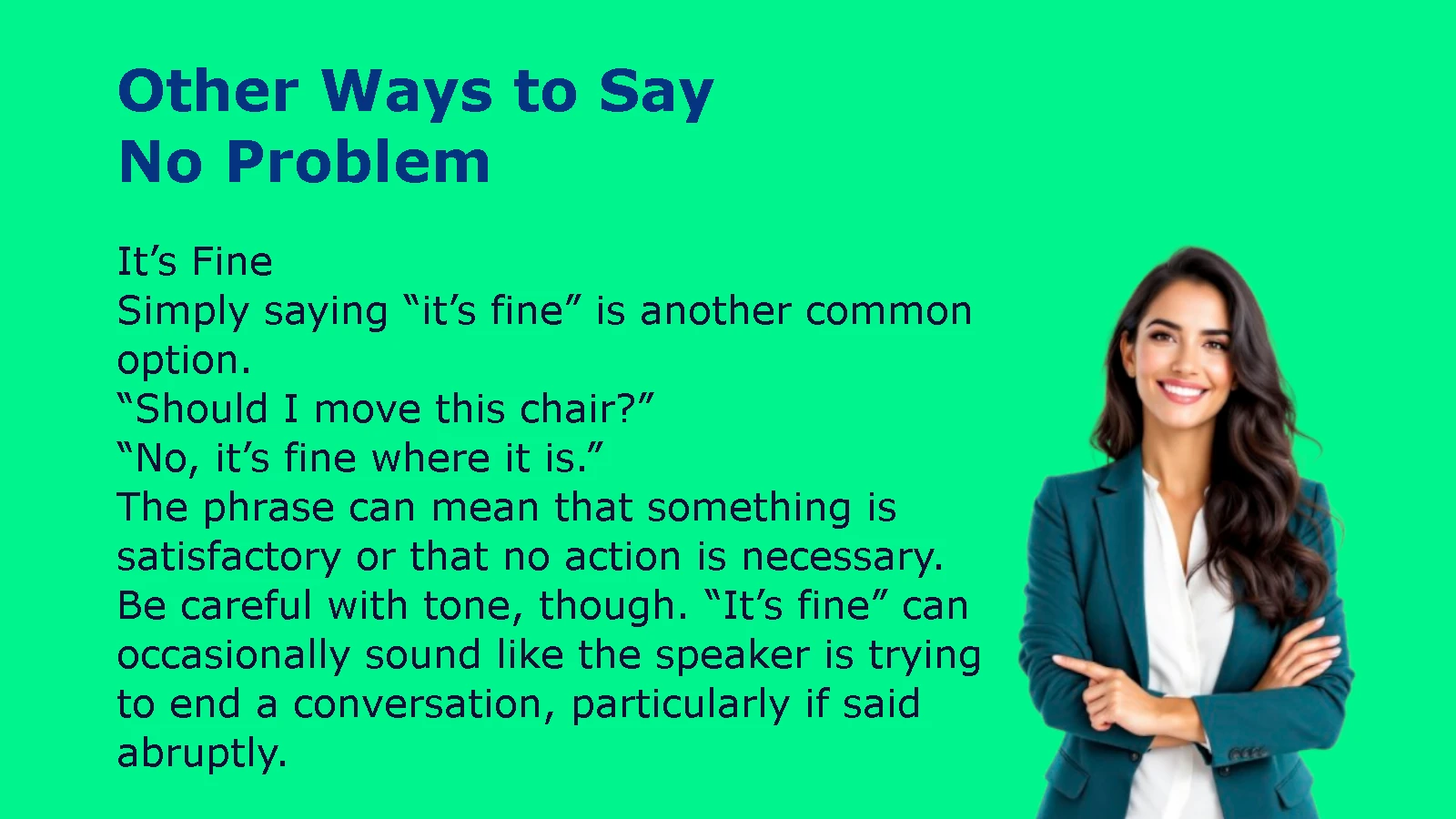
It’s Fine
Simply saying “it’s fine” is another common option.
“Should I move this chair?”
“No, it’s fine where it is.”
The phrase can mean that something is satisfactory or that no action is necessary.
Be careful with tone, though. “It’s fine” can occasionally sound like the speaker is trying to end a conversation, particularly if said abruptly.
That Works for Me
“That works for me” is excellent when you are agreeing to a plan, schedule, proposal, or arrangement.
“Would Friday at 2 p.m. work for you?”
“Yes, that works for me.”
This is often more precise than “that’s fine” because it clearly communicates that the proposed arrangement suits you.
Best for: workplace conversations, scheduling, meetings, and professional emails.
Sounds Good
“Sounds good” expresses positive agreement with a suggestion.
“Let’s meet after lunch.”
“Sounds good.”
Compared with “that’s fine,” it generally sounds more enthusiastic.
Use it when you genuinely like the proposed idea rather than merely accepting it.
Best for: casual conversations, messages, team chats, and friendly workplace communication.
No Worries
“No worries” is a relaxed way to reassure someone that something is not a problem.
“Sorry I forgot to call.”
“No worries.”
It is particularly natural after apologies, small inconveniences, or requests.
It is more casual than “that’s fine,” so it may not be the best choice in every formal business setting.
That’s Acceptable
“That’s acceptable” communicates that something meets a required standard or is satisfactory.
“Would this revised version be acceptable?”
“Yes, that’s acceptable.”
It is more formal and can sound somewhat detached.
For ordinary conversations, “that’s fine” or “that works for me” usually sounds more natural.
Best for: formal communication, evaluations, policies, negotiations, and professional contexts.
I’m Okay With That
“I’m okay with that” makes your personal acceptance explicit.
“We could move the meeting to Thursday.”
“I’m okay with that.”
It is useful when someone wants to know whether you personally agree with a proposal.
I Don’t Mind
“I don’t mind” means that you have no objection.
“Would you rather sit outside?”
“I don’t mind.”
This expression is slightly different from “that’s fine.” It focuses on the absence of a preference rather than enthusiastic agreement.
For example:
“Which restaurant should we choose?”
“I don’t mind.”
That may mean, “Either option is okay with me.”
That Will Do
“That will do” means that something is sufficient or good enough for the purpose.
“Is this amount of information enough?”
“Yes, that will do.”
It can sound more authoritative than “that’s fine,” particularly when someone is evaluating another person’s work.
Because of that, use it carefully in situations where you want to sound warm and collaborative.
That’s Perfect
“That’s perfect” is a stronger and more enthusiastic alternative.
“I can send the report by Friday.”
“That’s perfect.”
Unlike “that’s fine,” this response clearly communicates satisfaction.
Use it when the proposed option is exactly what you want.
Works for Me
“Works for me” is a shorter, conversational version of “that works for me.”
“Let’s meet at 3.”
“Works for me.”
It is natural in workplace chats and casual conversations.
It is less suitable for very formal correspondence.
I’m Fine With That
“I’m fine with that” is a direct way to express personal acceptance.
“We may need to change the deadline.”
“I’m fine with that.”
It can sound neutral rather than enthusiastic.
If you want to sound more positive, use:
“I’m happy with that.”
That’s Totally Fine
“That’s totally fine” adds emphasis to the reassurance.
“Sorry, I need to reschedule.”
“That’s totally fine.”
It is friendly and conversational.
For formal emails, a phrase such as “That works for me” or “That would be perfectly acceptable” may be more appropriate.
That’s Quite All Right
“That’s quite all right” is a more formal or somewhat old-fashioned alternative.
“I apologize for the inconvenience.”
“That’s quite all right.”
It works particularly well when you want to sound polite and composed.
No Issue
“No issue” means that you do not see a problem with something.
“Can I submit the form tomorrow?”
“No issue.”
It is common in workplace communication, although “No problem” or “That’s fine” may sound more natural in some contexts.
That’s Not a Problem
“That’s not a problem” is useful when someone is concerned that they have caused an inconvenience.
“I need to change our appointment.”
“That’s not a problem.”
It provides reassurance while directly addressing the possible concern.
I Can Live With That
“I can live with that” is an informal expression meaning that you can accept a situation, even though it may not be your preferred option.
“We can’t get the larger conference room, but we can use the smaller one.”
“I can live with that.”
This phrase can imply reluctant acceptance, so it is not always a positive substitute for “that’s fine.”
I’m Good With That
“I’m good with that” is a casual American English expression meaning that you agree or have no objection.
“We can order pizza instead.”
“I’m good with that.”
It is natural in informal conversations and workplace chats but may sound too casual for formal correspondence.
That’s Understandable
“That’s understandable” is useful when you are responding to someone’s explanation, difficulty, or decision.
“I wasn’t able to finish because I was dealing with an emergency.”
“That’s understandable.”
It does not simply mean “that’s fine.” Instead, it communicates that you understand why something happened.
I Have No Objection
“I have no objection” is a formal way to communicate acceptance.
“Would you like to proceed with the proposed changes?”
“I have no objection.”
It is appropriate for formal documents, official correspondence, and situations where an explicit objection matters.
That’s Acceptable to Me
“That’s acceptable to me” makes your position clear.
“Would the revised timeline be acceptable to you?”
“Yes, that’s acceptable to me.”
This sounds more formal and deliberate than “that’s fine.”
I’m Happy With That
“I’m happy with that” is a warmer alternative.
“We can finish the project on Friday.”
“I’m happy with that.”
It suggests genuine satisfaction rather than simple tolerance.
This makes it especially useful when you want your response to sound positive.
That’s Fine by Me
“That’s fine by me” is one of the closest alternatives to the original phrase.
It clearly means that you agree with or accept a particular arrangement.
“Would you prefer to start at 10?”
“That’s fine by me.”
Cambridge specifically defines “be all right/fine by someone” as indicating agreement that something can happen.
Sure, That’s Fine
“Sure, that’s fine” adds a friendly acknowledgment to the original expression.
“Can I bring my colleague?”
“Sure, that’s fine.”
It works well in ordinary conversations and informal workplace situations.
Professional Alternatives to “That’s Fine”
In professional communication, the best alternative depends on what you are agreeing to.
Instead of repeatedly using “that’s fine,” consider these choices:
| Situation | Better professional alternative |
| Agreeing to a meeting time | That works for me. |
| Approving a proposal | That sounds good. |
| Accepting a change | I’m okay with that. |
| Confirming requirements | That’s acceptable. |
| Showing enthusiasm | I’m happy with that. |
| Giving permission | That’s fine with me. |
| Reassuring someone | No problem at all. |
| Confirming a schedule | That works well for me. |
| Accepting a reasonable request | Certainly, that’s fine. |
| Formal approval | I have no objection. |
For example, instead of:
“That’s fine. We can have the meeting Thursday.”
A more professional response could be:
“Thursday works well for me. I’ll see you then.”
The second version communicates agreement more precisely and sounds proactive.
Formal Alternatives to “That’s Fine”
When writing a formal email, report, letter, or official response, you may want something more polished than “that’s fine.”
Good choices include:
- That is acceptable.
- That would be satisfactory.
- I have no objection.
- That arrangement is acceptable to me.
- I am comfortable with that arrangement.
- I am happy to proceed on that basis.
- That would be perfectly acceptable.
- I have no concerns with that approach.
Consider this example:
“Can we extend the deadline until Monday?”
Casual:
“That’s fine.”
Professional:
“Monday works for me.”
Formal:
“The revised deadline would be acceptable.”
The meaning is similar, but the tone changes considerably.
Casual Alternatives to “That’s Fine”
For friends, family, text messages, and casual conversations, you have more freedom.
Natural choices include:
- That’s okay.
- No worries.
- No problem.
- Sounds good.
- Works for me.
- I’m good with that.
- Sure.
- Absolutely.
- That’s all right.
- I’m okay with that.
- All good.
- Sure, no problem.
For example:
“Can we grab dinner at 7 instead?”
“Sounds good!”
Or:
“Sorry I forgot to text you.”
“No worries!”
The important point is that the best synonym depends on what you are actually trying to communicate.
Alternatives to “That’s Fine” in a Work Email
Writing “that’s fine” in a work email is not grammatically wrong. However, a more specific response can make your message clearer and more professional.
If You Agree With a Meeting Time
Instead of:
“That’s fine.”
Write:
“That time works well for me.”
If You Accept a Change
Instead of:
“That’s fine with me.”
Write:
“I’m happy to proceed with the revised plan.”
If You Want to Reassure Someone
Instead of:
“That’s fine, don’t worry.”
Write:
“No problem at all. Please don’t worry about it.”
If You Approve a Proposal
Instead of:
“That’s fine.”
Write:
“That approach works for me.”
If You Need to Sound Formal
Instead of:
“That’s fine with me.”
Write:
“That arrangement is acceptable to me.”
The goal is not to eliminate “that’s fine.” It is to choose a phrase that communicates your exact intention.
“That’s Okay” vs. “That’s Fine”
“That’s okay” and “that’s fine” are often interchangeable.
“Can we meet tomorrow?”
“That’s okay.”
“Can we meet tomorrow?”
“That’s fine.”
Both responses can mean that you accept the proposal.
However, “okay” often sounds more conversational, while “fine” can sound slightly more neutral.
There is another important difference: “fine” can sometimes carry an unintended emotional undertone.
Compare:
“Sure, that’s fine!”
with:
“Fine.”
The first sounds agreeable. The second can sound irritated or reluctant.
That means punctuation, surrounding words, and especially tone matter.
“That’s All Right” vs. “That’s Fine”
“That’s all right” is another close synonym.
Both can communicate:
- acceptance
- permission
- reassurance
- satisfaction
For example:
“I’m sorry I made a mistake.”
“That’s all right.”
You could also say:
“That’s fine.”
The difference is mostly one of style and context rather than basic meaning.
“No Problem” vs. “That’s Fine”
These phrases overlap, but they emphasize different things.
“That’s fine” usually emphasizes acceptance.
“No problem” emphasizes that something does not cause difficulty or inconvenience.
Consider:
“Can I change the meeting time?”
“That’s fine.”
Here, you are accepting the change.
Now:
“Sorry for changing the meeting time.”
“No problem.”
Here, you are reassuring the person that the change has not caused a problem.
Reversing them would not always sound as natural.
“Sounds Good” vs. “That’s Fine”
“Sounds good” is generally more positive.
“Let’s meet at 5.”
“Sounds good.”
This suggests that you like the proposal.
By contrast:
“Let’s meet at 5.”
“That’s fine.”
This may simply mean that you accept it.
If you want to sound enthusiastic, “sounds good” is usually stronger.
“Works for Me” vs. “That’s Fine”
“Works for me” is particularly useful when discussing plans, schedules, and arrangements.
“How about Tuesday afternoon?”
“That works for me.”
It clearly tells the other person that the proposal fits your schedule or needs.
“That’s fine” is broader and can be used for many other situations.
For workplace communication, “That works for me” is often an excellent replacement.
“No Worries” vs. “That’s Fine”
Both can reassure someone, but “no worries” is more casual.
“Sorry I forgot to attach the file.”
“No worries. Send it when you can.”
This sounds relaxed and friendly.
In a formal email, however, you may prefer:
“No problem. Please send it when convenient.”
Or:
“That’s perfectly fine. Please send it when you have a chance.”
“Nowadays” vs. “That’s Fine”
These two expressions are not synonyms.
This is an important distinction because “fine” has several meanings.
“That’s fine” communicates acceptance or satisfaction.
“Nowadays” refers to the present period of time.
For example:
“Can we change the meeting?”
“That’s fine.”
But:
“Nowadays, many people work remotely.”
Therefore, “nowadays” should never be used as a replacement for “that’s fine.”
How to Choose the Right Alternative to “That’s Fine”
The easiest way to choose the right expression is to identify what you actually mean.
If You Mean “I Agree”
Use:
- That’s okay.
- That’s fine by me.
- Sounds good.
- I agree.
- Works for me.
If You Mean “There Is No Problem”
Use:
- No problem.
- No worries.
- That’s not a problem.
- It’s okay.
- Don’t worry about it.
If You Mean “I Approve”
Use:
- That’s acceptable.
- I approve.
- That works for me.
- I’m happy with that.
- I have no objection.
If You Mean “I Am Satisfied”
Use:
- I’m happy with that.
- That’s perfect.
- That works well.
- I’m satisfied with that.
If You Mean “I Don’t Have a Preference”
Use:
- I don’t mind.
- Either is fine.
- I’m okay with either option.
- Whatever works for you.
If You Mean “I Accept It, Although It Isn’t Ideal”
Use:
- I can live with that.
- That will do.
- I suppose that works.
- That’s acceptable.
This last category is especially important because “I can live with that” has a different emotional meaning from “That’s perfect.”
How Tone Changes the Meaning of “That’s Fine”
One of the most interesting features of “that’s fine” is that the words alone do not always tell you how the speaker feels.
Compare:
“That’s fine!”
with:
“That’s fine.”
And:
“Fine.”
The first can sound enthusiastic. The second is neutral. The third can sound irritated or reluctant.
The surrounding conversation also matters.
Consider this exchange:
“I can’t make it tonight.”
“That’s fine.”
The speaker may genuinely mean that the cancellation is not a problem.
But imagine:
“I canceled your reservation without asking.”
“That’s fine.”
Depending on the speaker’s tone, the response could mean genuine acceptance or suppressed frustration.
This is why written communication can sometimes create misunderstandings. Without vocal tone or facial expression, “that’s fine” can be interpreted in more than one way.
If you want to remove ambiguity, use a more specific expression:
“No problem at all.”
or:
“I’m completely okay with that.”
or:
“That works perfectly for me.”
Case Study: Choosing the Right Alternative
Imagine a manager asks an employee:
“Would it be okay if we moved tomorrow’s meeting from 10 a.m. to 2 p.m.?”
The employee could answer:
Neutral:
“That’s fine.”
Friendly:
“Sure, that works for me.”
Positive:
“Sounds great.”
Professional:
“2 p.m. works well for me.”
Formal:
“The revised meeting time is acceptable to me.”
Each response communicates acceptance, but the tone and level of precision are different.
This illustrates an important principle:
The best alternative to “that’s fine” is not always the closest synonym. It is the phrase that communicates your intended attitude most accurately.
Common Mistakes When Using “That’s Fine”
Using “That’s Fine” When You Mean “That’s Excellent”
If something genuinely impresses you, “that’s fine” may sound too lukewarm.
Instead of:
“Your presentation was fine.”
Say:
“Your presentation was excellent.”
or:
“Your presentation was really strong.”
“Fine” can mean satisfactory, but it does not necessarily communicate enthusiasm.
Using “No Problem” for Every Situation
“No problem” is useful, but it does not replace every meaning of “that’s fine.”
For example:
“Which design do you prefer?”
“No problem.”
This sounds strange because the question asks about preference, not whether something is a problem.
A better response would be:
“Either design is fine with me.”
Using “I Don’t Mind” When You Actually Have a Preference
“I don’t mind” means you have no objection.
If you actually prefer one option, say so.
Instead of:
“I don’t mind.”
Say:
“I’d prefer the earlier meeting, but the later one works too.”
That gives the listener useful information.
Common Questions
What Are Other Ways to Say “That’s Fine”?
Some of the best alternatives are “That’s okay,” “That’s all right,” “No problem,” “Sounds good,” “That works for me,” “No worries,” “I’m okay with that,” and “That’s fine by me.”
The best choice depends on whether you want to express agreement, reassurance, approval, or satisfaction.
What Is a Professional Way to Say “That’s Fine”?
Professional alternatives include:
- That works for me.
- That sounds good.
- I’m happy to proceed with that.
- That is acceptable.
- I have no objection.
- That arrangement works well for me.
For most workplace situations, “That works for me” is a particularly natural choice.
What Is a Formal Way to Say “That’s Fine”?
Formal alternatives include “That is acceptable,” “That would be satisfactory,” “I have no objection,” and “That arrangement is acceptable to me.”
Choose the expression based on how formal the situation is.
What Is a Casual Way to Say “That’s Fine”?
Casual alternatives include “That’s okay,” “No worries,” “Sounds good,” “Works for me,” “I’m good with that,” and “No problem.”
“Sounds good” and “no worries” are especially natural in friendly conversations.
What Can I Say Instead of “That’s Fine” in an Email?
For a professional email, you can write:
“That works for me.”
“I’m happy with that arrangement.”
“That sounds good to me.”
“I’m happy to proceed with the proposed plan.”
“That would be perfectly acceptable.”
The best option depends on whether you are confirming a schedule, approving a proposal, or reassuring someone.
Is “That’s Okay” the Same as “That’s Fine”?
Usually, yes. Both can express acceptance or agreement.
However, “that’s okay” often sounds slightly more conversational, while “that’s fine” can sound more neutral.
Is “That’s All Right” a Good Replacement for “That’s Fine”?
Yes. “That’s all right” can express acceptance or reassurance and is a natural alternative to “that’s fine.”
For example:
“Sorry I’m late.”
“That’s all right.”
Is “No Problem” the Same as “That’s Fine”?
Not always.
“No problem” usually emphasizes that something does not cause difficulty or inconvenience. “That’s fine” can simply indicate acceptance.
For example:
“Can we reschedule?”
“That’s fine.”
But after an apology:
“Sorry about the delay.”
“No problem.”
What Is Another Word for “That’s Fine”?
There is no single replacement that works in every situation. Depending on the context, you could use okay, acceptable, satisfactory, all right, suitable, or good.
As a complete expression, alternatives include “That’s okay,” “No problem,” “That works for me,” and “Sounds good.”
What Is the Difference Between “That’s Fine” and “That’s Okay”?
They are often interchangeable.
“That’s fine.”
and
“That’s okay.”
can both mean that you accept something.
However, “okay” can sound slightly more conversational, while “fine” can sometimes sound more neutral or restrained.
What Is the Difference Between “That’s Fine” and “Sounds Good”?
“That’s fine” usually communicates acceptance.
“Sounds good” usually communicates positive agreement.
Compare:
“We can meet at 4.”
“That’s fine.”
This means 4 p.m. is acceptable.
“We can meet at 4.”
“Sounds good!”
This sounds more enthusiastic.
What Is the Difference Between “That’s Fine” and “Works for Me”?
“Works for me” specifically communicates that a proposal or arrangement suits you.
“Let’s meet on Friday.”
“Works for me.”
“That’s fine” has a wider range of uses and can also reassure someone or indicate that something is satisfactory.
What Is the Difference Between “That’s Fine” and “Nowadays”?
They have completely different meanings.
“That’s fine” expresses acceptance or satisfaction.
“Nowadays” refers to the current period of time.
For example:
“Can I submit it tomorrow?”
“That’s fine.”
But:
“Nowadays, many companies offer flexible working arrangements.”
They should not be treated as synonyms.
What Is the Difference Between “That’s Fine” and “In the Meantime”?
Again, these expressions have unrelated meanings.
“That’s fine” means something is acceptable.
“In the meantime” refers to the period between two events.
For example:
“Can we postpone the meeting?”
“That’s fine.”
But:
“The report will be ready tomorrow. In the meantime, you can review the summary.”
Final Thoughts
“That’s fine” is a useful and versatile English expression, but it is not always the clearest or most expressive choice.
If you simply want to show acceptance, “that’s okay” or “that’s all right” works well.
If you want to reassure someone, try “no problem,” “no worries,” or “that’s not a problem.”
For professional communication, phrases such as “I’m happy with that,” “that works for me,” and “that is acceptable” can sound more deliberate and polished.
The key is to think about the message behind the words. Are you agreeing? Reassuring someone? Approving a proposal? Saying that you have no preference? Or expressing genuine enthusiasm?
Once you identify that intention, choosing the right alternative becomes much easier.
In short, there is nothing wrong with saying “that’s fine.” It is grammatically correct, natural, and widely used. But using a more specific expression can make your English sound clearer, warmer, more professional, or more precise depending on the situation.













