Other ways to say “no problem” are useful when you want to respond to thanks, reassure someone, accept an apology, or let someone know that something is not an inconvenience. If you’ve come across the phrase “no problem” and wondered what other expressions can convey the same idea, the best alternative depends on the context, tone, relationship, and level of formality.
The phrase “no problem” can mean “you’re welcome,” “it’s okay,” “don’t worry about it,” “that’s fine,” or “I’m happy to help.” However, these meanings are not always interchangeable. Expressions such as you’re welcome, no worries, not at all, my pleasure, anytime, don’t mention it, it’s all good, and happy to help can have slightly different uses and tones.
In this guide, you’ll learn the best ways to say “no problem,” when to use each alternative, and how different expressions work in casual, professional, friendly, and polite conversations. You’ll also see clear examples to help you choose the right phrase for different situations.
By the end, you’ll know exactly what to say instead of “no problem” and how to use natural alternatives that fit the situation without sounding repetitive or awkward.
What Does “No Problem” Mean?
“No problem” is an informal expression used to say that something is acceptable, easy to do, or not an inconvenience. It can also be used as a response to “thank you” to indicate that the favor or assistance required little effort.
Dictionaries recognize several common uses of the expression. Collins, for example, defines “no problem” as a conventional response to a request or as an expression of confirmation, affirmation, or gratitude.
Consider these examples:
“Can you send me the report by Friday?”
“No problem.”
Here, “no problem” means yes, I can do that.
Now consider:
“Thanks for helping me with the presentation.”
“No problem.”
Here, it means something closer to you’re welcome; it was not an inconvenience.
It can also reassure someone:
“Sorry I’m a few minutes late.”
“No problem.”
In this situation, the expression means it’s okay; don’t worry about it.
So, although “no problem” looks simple, it performs several conversational functions.
“No Problem” in Everyday English
In everyday American English, “no problem” is extremely common in spoken conversation.
You might hear it between friends, coworkers, family members, customers and employees, or acquaintances.
For example:
- “Can you grab me a coffee?” — “No problem.”
- “Thanks for picking me up.” — “No problem.”
- “Sorry about the delay.” — “No problem.”
- “Would you mind waiting five minutes?” — “No problem.”
- “Thanks for sending that over.” — “No problem.”
The expression is generally informal and conversational. Collins specifically labels several of its uses as informal and spoken.
That does not mean “no problem” is rude. In ordinary conversation, it is usually perfectly friendly. However, some people prefer “you’re welcome” in more formal situations because it more directly acknowledges another person’s gratitude.
Other Ways to Say “No Problem”
There are many ways to replace “no problem,” but they are not perfect synonyms in every situation. Some express gratitude, some reassurance, some willingness, and others emphasize that helping was enjoyable.
Here are some of the most useful alternatives.
“You’re Welcome”
“You’re welcome” is one of the safest alternatives to “no problem” when someone says “thank you.”
It directly acknowledges the person’s gratitude and works in casual, professional, and formal situations.
Example:
“Thank you for helping me prepare the presentation.”
“You’re welcome. I’m glad I could help.”
It is particularly useful when you want to sound polite without being overly casual.
Best for:
- Professional conversations
- Customer service
- Workplace communication
- Formal situations
- Everyday conversation
If you are unsure which response to choose after someone thanks you, “you’re welcome” is usually the safest option.
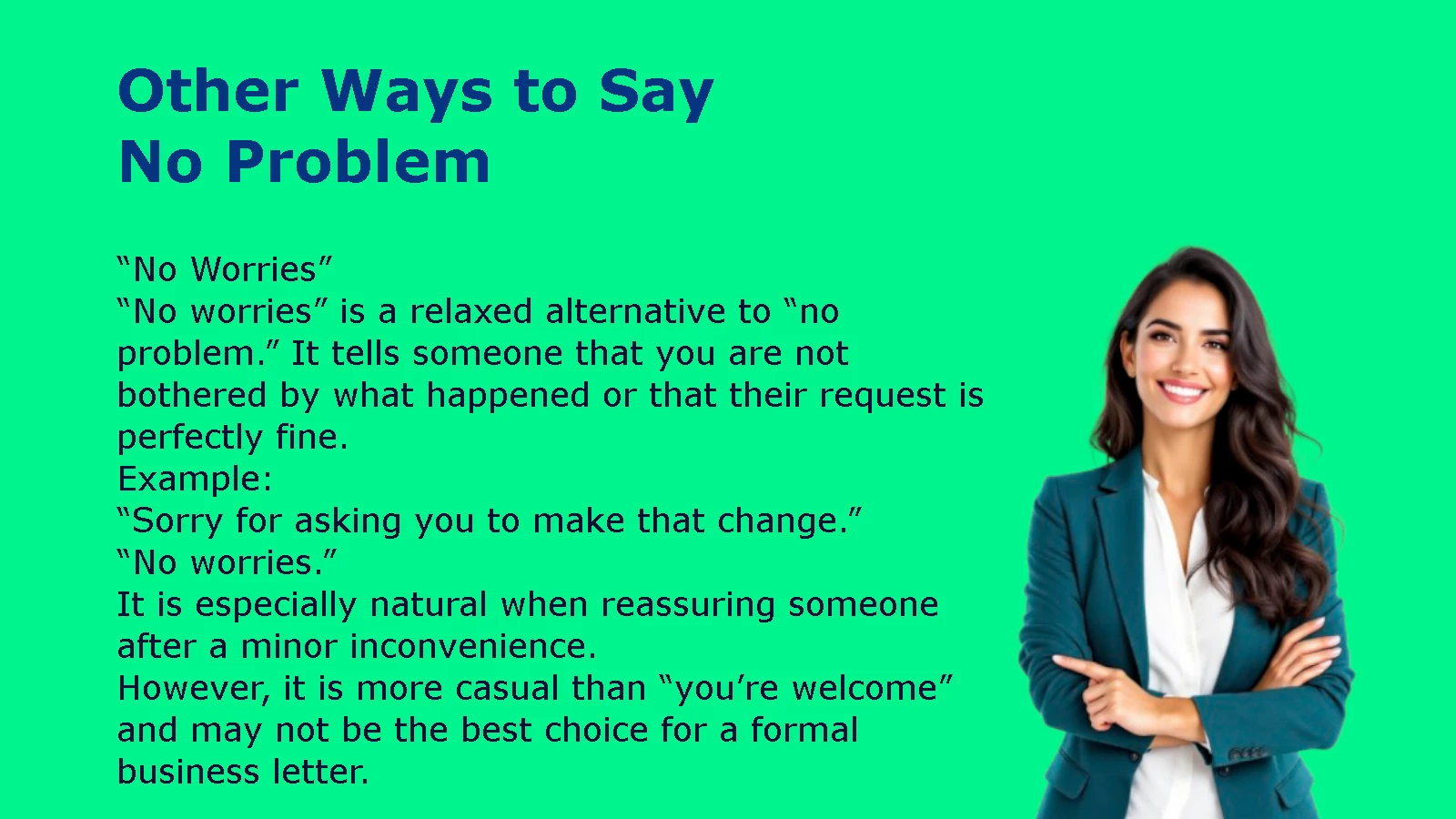
“No Worries”
“No worries” is a relaxed alternative to “no problem.” It tells someone that you are not bothered by what happened or that their request is perfectly fine.
Example:
“Sorry for asking you to make that change.”
“No worries.”
It is especially natural when reassuring someone after a minor inconvenience.
However, it is more casual than “you’re welcome” and may not be the best choice for a formal business letter.
“Not a Problem”
“Not a problem” is extremely close to “no problem” in meaning.
It can indicate that a request is acceptable or that something did not inconvenience you.
Example:
“Could you update the spreadsheet?”
“Not a problem. I’ll take care of it.”
It can also respond to thanks:
“Thanks for staying late.”
“Not a problem.”
The expression is conversational and slightly more explicit than the shorter “no problem.”
“My Pleasure”
“My pleasure” is warmer and more polished than “no problem.”
It communicates that you were happy to help, rather than merely saying that helping you caused no inconvenience.
Example:
“Thank you for taking the time to explain everything.”
“My pleasure.”
This is especially effective in:
- Customer service
- Professional communication
- Hospitality
- Formal conversations
- Situations involving significant assistance
If someone has gone out of their way to thank you, “my pleasure” can sound more appreciative than “no problem.”
“Anytime”
“Anytime” suggests that you would be willing to help again in the future.
Example:
“Thanks for helping me move.”
“Anytime.”
It works particularly well with friends, family members, and close coworkers.
Because it is short and informal, it may sound too casual in a highly formal setting.
“Of Course”
“Of course” can mean that the request was completely reasonable or that you were naturally willing to help.
Example:
“Thanks for sending me the file.”
“Of course.”
It can also respond to a request:
“Could you take a look at this?”
“Of course.”
This expression is useful because it can sound both friendly and professional, depending on context.
“Absolutely”
“Absolutely” expresses strong agreement or willingness.
Example:
“Can you help me with this report?”
“Absolutely.”
It is more enthusiastic than “no problem” and works well when you want your response to sound positive and confident.
“Don’t Mention It”
“Don’t mention it” means that the person does not need to thank you.
Example:
“Thank you for helping me yesterday.”
“Don’t mention it.”
It has a somewhat traditional feel and can sound more polished than “no problem.”
However, it may sound slightly old-fashioned in some casual conversations.
“Glad to Help”
“Glad to help” directly communicates that you were happy to provide assistance.
Example:
“Thanks for walking me through the process.”
“Glad to help.”
This is an excellent professional alternative because it sounds friendly without being overly casual.
“Happy to Help”
“Happy to help” is one of the strongest alternatives to “no problem” in workplace communication.
Example:
“Thanks for answering all my questions.”
“Happy to help.”
It communicates willingness, friendliness, and professionalism at the same time.
“Sure Thing”
“Sure thing” is an informal way to agree to a request.
Example:
“Can you send me the address?”
“Sure thing.”
It is natural among friends and coworkers but should generally be avoided in very formal communication.
“No Trouble at All”
“No trouble at all” emphasizes that the request or favor caused no inconvenience.
Example:
“Sorry for making you wait.”
“No trouble at all.”
It is particularly useful when someone apologizes for taking your time.
“It’s All Good”
“It’s all good” is a very casual reassurance.
Example:
“Sorry, I forgot to bring the documents.”
“It’s all good.”
It works well in relaxed conversations but is generally unsuitable for formal business writing.
“No Big Deal”
“No big deal” tells someone that you consider something minor or unimportant.
Example:
“Thanks for picking that up for me.”
“No big deal.”
Be careful with this expression when the other person is expressing serious gratitude. Calling a significant favor “no big deal” can unintentionally minimize the effort involved.
“Not at All”
“Not at all” is a polite way to say that something caused no inconvenience.
Example:
“Sorry to bother you.”
“Not at all.”
It can sound more formal and polished than “no problem,” particularly in British English and formal conversational settings.
“Certainly”
“Certainly” is a formal and professional alternative when you are agreeing to a request.
Example:
“Could you please provide the revised document?”
“Certainly. I’ll send it this afternoon.”
Unlike “no problem,” it sounds more businesslike and deliberate.
“It’s Nothing”
“It’s nothing” minimizes the effort involved in helping someone.
Example:
“Thanks for carrying that for me.”
“It’s nothing.”
It is usually appropriate for small favors but can sound dismissive if the other person has expressed gratitude for something substantial.
“Think Nothing of It”
“Think nothing of it” means that the person should not feel obligated to thank you or worry about the favor.
Example:
“Thank you for staying late to help me.”
“Think nothing of it.”
It is polite but somewhat traditional, so it may sound less natural in casual modern conversation than “no worries” or “happy to help.”
“You Got It”
“You got it” is a casual way to confirm that you will do something.
Example:
“Could you send me the updated file?”
“You got it.”
It is excellent for informal workplace communication and everyday conversation.
“I’m Happy to Help”
“I’m happy to help” makes your response warmer and more personal.
Example:
“Thank you for helping me solve this issue.”
“I’m happy to help.”
It is particularly useful when you want to reassure a customer, client, colleague, or new acquaintance.
“No Need to Thank Me”
This phrase directly tells the other person that you do not feel a thank-you is necessary.
Example:
“Thanks for helping me with the move.”
“No need to thank me. I was happy to help.”
This works best when you have a friendly relationship with the person.
“It Was My Pleasure”
“It was my pleasure” is a polished alternative that emphasizes that you enjoyed helping.
Example:
“Thank you for your assistance.”
“It was my pleasure.”
This is especially appropriate in formal customer service, hospitality, and professional settings.
“Of Course, Anytime”
Combining “of course” and “anytime” creates a warm and enthusiastic response.
“Thanks for helping me with the presentation.”
“Of course, anytime.”
It works best when you genuinely want to communicate that the person can ask you for help again.
“Don’t Worry About It”
“Don’t worry about it” is useful when someone apologizes or feels guilty about a minor inconvenience.
“I’m sorry I forgot to call.”
“Don’t worry about it.”
It is less suitable as a direct response to a formal thank-you.
“Absolutely, Anytime”
This phrase combines enthusiasm with an offer of future help.
“Thanks for helping me with that.”
“Absolutely, anytime.”
It is friendly and energetic, making it a good choice for casual professional relationships.
“No Sweat”
“No sweat” means that something was easy or caused no trouble.
“Thanks for helping me move the boxes.”
“No sweat.”
It is highly informal. Save it for relaxed conversations rather than formal emails.
Professional Alternatives to “No Problem”
In professional communication, “no problem” is not necessarily wrong. However, a more specific response can make you sound more polished.
Consider these options:
| Alternative | Tone | Best use |
| You’re welcome | Polite | General professional use |
| Happy to help | Warm and professional | Clients and coworkers |
| Glad to assist | Professional | Customer service |
| My pleasure | Warm and polished | Clients and customers |
| Certainly | Formal | Requests |
| Of course | Friendly professional | Coworkers and clients |
| I’m happy to help | Warm | Customer-facing communication |
| It was my pleasure | Formal/warm | Significant assistance |
| Absolutely | Positive | Agreeing to requests |
| Not an issue | Neutral | Workplace requests |
For example, instead of:
“No problem. I can send that over.”
you could write:
“Certainly. I’ll send that over shortly.”
Or:
“Of course. I’m happy to help.”
The second versions communicate the same basic willingness while sounding more intentional.
Formal Alternatives to “No Problem”
If you are writing to a senior executive, client, professor, official, or unfamiliar professional contact, choose language that clearly conveys respect.
Good formal alternatives include:
- Certainly.
- Of course.
- You’re very welcome.
- My pleasure.
- It was my pleasure.
- I’m glad I could assist.
- I’m happy to assist.
- Not at all.
- I’d be happy to help.
For example:
“Thank you for your assistance with the proposal.”
A polished response would be:
“You’re very welcome. I’m glad I could assist.”
This is generally safer than simply responding:
“No problem.”
Casual Alternatives to “No Problem”
When talking with friends or close coworkers, you have much more freedom.
Natural casual alternatives include:
- No worries.
- Sure thing.
- Anytime.
- You got it.
- Absolutely.
- No sweat.
- It’s all good.
- No big deal.
- Of course.
- Don’t worry about it.
For example:
“Sorry I made you wait.”
You could say:
“No worries.”
Or:
“It’s all good.”
Both sound much more relaxed than “You’re welcome.”
Friendly Alternatives to “No Problem”
If your goal is to sound warm rather than merely polite, try phrases that emphasize your willingness to help.
“Happy to Help”
“Thanks for helping me figure this out.”
“Happy to help!”
“Anytime”
“Thanks for covering for me.”
“Anytime!”
“My Pleasure”
“Thanks for taking care of that.”
“My pleasure.”
“Of Course”
“Thanks for coming with me.”
“Of course.”
These alternatives make the conversation feel more personal.
Alternatives to “No Problem” in a Work Email
Email requires slightly more care because the reader cannot hear your tone of voice.
A short “No problem” can be perfectly understandable, but depending on the context, it may sound abrupt.
Instead of:
No problem.
consider:
You’re welcome.
Or:
Happy to help.
Or:
Of course. Please let me know if you need anything else.
For client communication, you could write:
I’m glad I could assist. Please don’t hesitate to reach out if you need anything else.
When Someone Thanks You
Casual:
Thanks for sending this over.
No problem!
Professional:
Thank you for sending this over.
You’re welcome. I’m glad I could help.
Warm professional:
Thank you for your assistance.
My pleasure. I’m happy to help.
When Someone Asks for a Favor
Instead of:
No problem, I can do that.
you could write:
Certainly. I’ll take care of it.
Or:
Of course. I’ll have that ready by Friday.
This gives the reader useful information instead of merely confirming willingness.
When Someone Apologizes
If someone says:
“Sorry for the inconvenience.”
“No problem” is natural, but these alternatives can be even clearer:
- No worries.
- Not at all.
- Don’t worry about it.
- It’s completely fine.
- There’s no need to apologize.
For professional situations:
“Not at all. I understand.”
sounds more polished than:
“No problem.”
Ways to Say “No Problem” After Someone Thanks You
The right response depends on the amount of effort involved.
| Situation | Best response |
| Holding a door | No problem |
| Sending a simple file | You’re welcome |
| Helping a coworker | Happy to help |
| Helping a customer | My pleasure |
| Completing a major favor | It was my pleasure |
| Helping a close friend | Anytime |
| Small inconvenience | No worries |
| Formal business request | Certainly |
A useful rule is:
The more formal or significant the situation, the more specific your response should become.
Ways to Say “No Problem” When Accepting an Apology
“No problem” is particularly natural after a minor apology.
“Sorry I’m five minutes late.”
“No problem.”
But you can adjust the tone:
- Casual: “No worries.”
- Friendly: “It’s all good.”
- Reassuring: “Don’t worry about it.”
- Professional: “Not at all.”
- Formal: “There’s no need to apologize.”
The important distinction is that “no problem” here means the incident did not cause significant difficulty, rather than “you’re welcome.”
Ways to Say “No Problem” When Agreeing to Help
When someone makes a request, “no problem” means you are willing to do it.
For example:
“Could you review this document?”
“No problem.”
Possible alternatives include:
- Certainly.
- Of course.
- Absolutely.
- Sure thing.
- You got it.
- I’d be happy to.
- I’d be glad to.
- Consider it done.
For professional communication, “I’d be happy to” is particularly useful:
“Could you review the proposal?”
“I’d be happy to. I’ll send you my feedback this afternoon.”
This is clearer and more useful than simply saying “No problem.”
“You’re Welcome” vs. “No Problem”
The two expressions overlap, but they are not identical in tone.
“You’re welcome” directly responds to gratitude. “No problem” emphasizes that the favor or action was not an inconvenience.
Compare:
“Thanks for holding the door.”
“You’re welcome.”
This acknowledges the person’s thanks.
Now:
“Thanks for holding the door.”
“No problem.”
This emphasizes that holding the door was easy and required little effort.
Linguistic discussions of the two expressions often highlight this distinction between acknowledging gratitude and minimizing the burden of the favor.
Neither expression is inherently wrong. Context and tone matter.
“No Worries” vs. “No Problem”
These phrases are very close.
“No problem” tends to emphasize that something is not difficult or inconvenient.
“No worries” places more emphasis on reassurance.
Compare:
“Can you help me tomorrow?”
“No problem.”
versus:
“Sorry I forgot to tell you earlier.”
“No worries.”
The first accepts a request. The second reassures someone after a minor mistake.
“My Pleasure” vs. “No Problem”
These expressions create very different impressions.
“No problem” says:
It wasn’t an inconvenience.
“My pleasure” says:
I was happy to do it.
For a customer or client, “my pleasure” can therefore sound warmer.
For a friend who thanks you for passing the salt, “my pleasure” might sound unnecessarily formal or theatrical.
The best choice depends on the scale of the favor.
“Not a Problem” vs. “No Problem”
“Not a problem” is almost interchangeable with “no problem.”
“Could you change the meeting time?”
“Not a problem.”
The longer version can sometimes sound slightly more deliberate, while “no problem” feels shorter and more conversational.
Both are common in spoken English.
“Happy to Help” vs. “No Problem”
These phrases communicate different attitudes.
“No problem” focuses on the absence of difficulty.
“Happy to help” focuses on your positive attitude toward helping.
Compare:
“Thanks for answering my questions.”
“No problem.”
with:
“Thanks for answering my questions.”
“Happy to help.”
The second response sounds more intentionally warm, which makes it particularly useful in customer service and workplace communication.
How to Choose the Right Alternative to “No Problem”
Choosing the right phrase becomes easy when you identify the purpose of your response.
If Someone Thanks You
Use:
- You’re welcome
- My pleasure
- Happy to help
- Glad to help
- Anytime
If Someone Apologizes
Use:
- No worries
- No problem
- Not at all
- Don’t worry about it
- It’s completely fine
If Someone Makes a Request
Use:
- Certainly
- Of course
- Absolutely
- I’d be happy to
- Sure thing
If You Are Writing a Formal Email
Use:
- You’re very welcome
- My pleasure
- I’m glad I could assist
- I’d be happy to help
- Certainly
If You Are Talking to a Friend
Use:
- No worries
- Anytime
- Sure thing
- You got it
- No sweat
- It’s all good
A simple decision rule is:
Match the phrase to the situation, not just the dictionary meaning.
That is especially important because two expressions can technically mean the same thing while creating very different impressions.
Is “No Problem” Rude?
Generally, no. “No problem” is a normal and widely used English expression.
However, some people prefer “you’re welcome” because “no problem” can sound as if the favor was insignificant or as if the speaker is dismissing the person’s gratitude.
The concern is usually about pragmatics and social expectations, not grammar.
For example:
“Thank you for staying up all night to help me finish this project.”
Responding:
“No problem.”
could sound slightly dismissive because the favor clearly required substantial effort.
A warmer response would be:
“Of course. I’m glad I could help.”
Or:
“My pleasure. I was happy to help.”
For a much smaller favor, however, “no problem” sounds completely natural:
“Thanks for passing me the pen.”
“No problem.”
So the issue is not that the phrase is inherently rude. Context, relationship, tone, and the size of the favor all influence how it is received.
Common Questions
What Are Other Ways to Say “No Problem”?
Common alternatives include “you’re welcome,” “no worries,” “not a problem,” “my pleasure,” “happy to help,” “glad to help,” “of course,” “anytime,” “certainly,” and “don’t mention it.”
The best choice depends on whether you are responding to thanks, accepting a request, or reassuring someone.
What Is a Professional Way to Say “No Problem”?
Some of the best professional alternatives are “you’re welcome,” “happy to help,” “glad to assist,” “my pleasure,” “certainly,” and “I’d be happy to help.”
For example:
“Thank you for your assistance.”
“You’re very welcome. I’m glad I could assist.”
What Is a Formal Way to Say “No Problem”?
For formal communication, consider:
- Certainly.
- Of course.
- You’re very welcome.
- My pleasure.
- It was my pleasure.
- Not at all.
- I’m glad I could assist.
These expressions generally sound more polished than the casual “no problem.”
What Is a Casual Way to Say “No Problem”?
Casual alternatives include “no worries,” “sure thing,” “anytime,” “you got it,” “no sweat,” “it’s all good,” and “no big deal.”
These are most appropriate for friends, family, and relaxed workplace relationships.
What Can I Say Instead of “No Problem” in an Email?
For a professional email, try:
- You’re welcome.
- Happy to help.
- My pleasure.
- I’m glad I could assist.
- Of course.
- Certainly.
- I’d be happy to help.
For example:
“You’re very welcome. I’m glad I could help. Please let me know if you need anything else.”
This sounds warmer and more professional than simply writing “No problem.”
Is “Currently” the Same as “No Problem”?
No. These expressions have completely different meanings.
“Currently” refers to something happening or being true at the present time, while “no problem” indicates that something is acceptable, easy, or not an inconvenience.
Is “No Worries” the Same as “No Problem”?
They are often interchangeable, especially when reassuring someone.
“Sorry I’m late.”
“No worries.”
“Sorry I’m late.”
“No problem.”
Both reassure the person that the delay is acceptable.
However, “no worries” emphasizes reassurance, while “no problem” can also emphasize ease or willingness.
Is “My Pleasure” a Good Replacement for “No Problem”?
Yes, especially when responding to thanks.
“Thank you for helping me.”
“My pleasure.”
It sounds warmer and more polished than “no problem” and works especially well in professional or customer-facing situations.
What Is Another Word for “No Problem”?
There is no single word that replaces every use of “no problem.”
Depending on context, you could use:
- Certainly
- Absolutely
- Anytime
- Agreed
- Sure
- Welcome
However, a phrase is usually more natural because “no problem” has several different meanings.
What Is the Difference Between “No Problem” and “Not a Problem”?
They are nearly synonymous.
“No problem” is slightly shorter and very common in casual speech.
“Not a problem” is a little more explicit:
“Can you stay late?”
“Not a problem.”
Both indicate that the request is acceptable.
What Is the Difference Between “No Problem” and “No Worries”?
“No problem” can mean that is easy, acceptable, or not inconvenient.
“No worries” usually means don’t worry; everything is fine.
For example:
“Can you send that tomorrow?”
“No problem.”
“Sorry I forgot to send it today.”
“No worries.”
The distinction is subtle, but the second expression is especially natural after an apology.
What Is the Difference Between “No Problem” and “You’re Welcome”?
“You’re welcome” directly acknowledges someone’s thanks.
“No problem” suggests that the favor was not difficult or inconvenient.
Both can respond to “thank you,” but “you’re welcome” is generally the safer choice when you want a neutral or formal response.
What Is the Best Professional Alternative to “No Problem”?
For most professional situations, “happy to help” is an excellent choice.
It is friendly, positive, and professional without sounding overly formal.
For example:
“Thank you for helping me resolve this issue.”
“Happy to help. Please let me know if there’s anything else you need.”
For more formal situations, “I’m glad I could assist” or “It was my pleasure” may be better.
Final Thoughts
“No problem” is a useful and natural English expression, but it is not the best choice for every situation.
The key is to think about what you are actually trying to communicate.
- Want to acknowledge gratitude? Use “you’re welcome.”
- Want to sound warm and professional? Use “happy to help.”
- Want to emphasize that helping was enjoyable? Use “my pleasure.”
- Want to reassure someone? Use “no worries.”
- Want to accept a request formally? Use “certainly.”
- Want to sound casual? Use “sure thing” or “anytime.”
- Want a safe everyday response? “No problem” is perfectly natural.
There is no single “best” replacement for “no problem.” The strongest expression is the one that matches the relationship, context, level of formality, and reason for the conversation.
When in doubt, “you’re welcome” works well after thanks, while “of course” or “certainly” works well when accepting a request. For professional relationships, “happy to help” offers an especially useful middle ground between warmth and professionalism.













