Big talk is more than just speaking confidently—it refers to bold, boastful, or exaggerated statements, especially when someone talks about what they can do, what they will accomplish, or how successful they are. If you’ve come across the phrase “big talk” and wondered what it means, how it is used, or why someone might be described as talking big, the expression is closely connected to boasting, confidence, promises, bragging, claims, challenges, and self-assurance.
The big talk meaning refers to confident or boastful speech that often involves impressive claims, ambitious promises, or statements about a person’s abilities. Depending on the context, big talk can be used positively to describe confidence and ambition or negatively to suggest that someone is making exaggerated claims without enough action to support them. Related expressions such as talking big, all talk, bragging, boasting, and empty promises can have similar meanings but are not always interchangeable.
In this guide, you’ll learn what “big talk” means, how the phrase is used in sentences, when it describes confidence versus boasting, and how “big talk” differs from related expressions such as “big promises,” “bragging,” and “all talk.” You’ll also see clear examples to make the meaning easy to understand.
By the end, you’ll know exactly what big talk means and how to use this common expression naturally and correctly.
Quick Answer: What Does “Big Talk” Mean?
Big talk most commonly means boasting, bragging, or making exaggerated claims.
For example:
“He does a lot of big talk, but he rarely follows through.”
Here, big talk suggests that the person’s words sound impressive, but their actions do not match them.
The phrase can also have other context-dependent meanings:
| Meaning | Example | What it means |
| Boasting or exaggeration | “That’s big talk for someone with no experience.” | An impressive or boastful claim |
| Important conversation | “We need to have a big talk tonight.” | A serious discussion |
| Major topic of discussion | “The big talk was the upcoming election.” | The main subject people were discussing |
| Deep, meaningful conversation | “We had some Big Talk about our dreams.” | A newer usage contrasting with small talk |
The boasting sense is the established dictionary definition. Dictionary.com defines big talk as “exaggeration; bragging,” while Collins similarly defines it as bragging or boasting talk.
What Does “Big Talk” Mean?
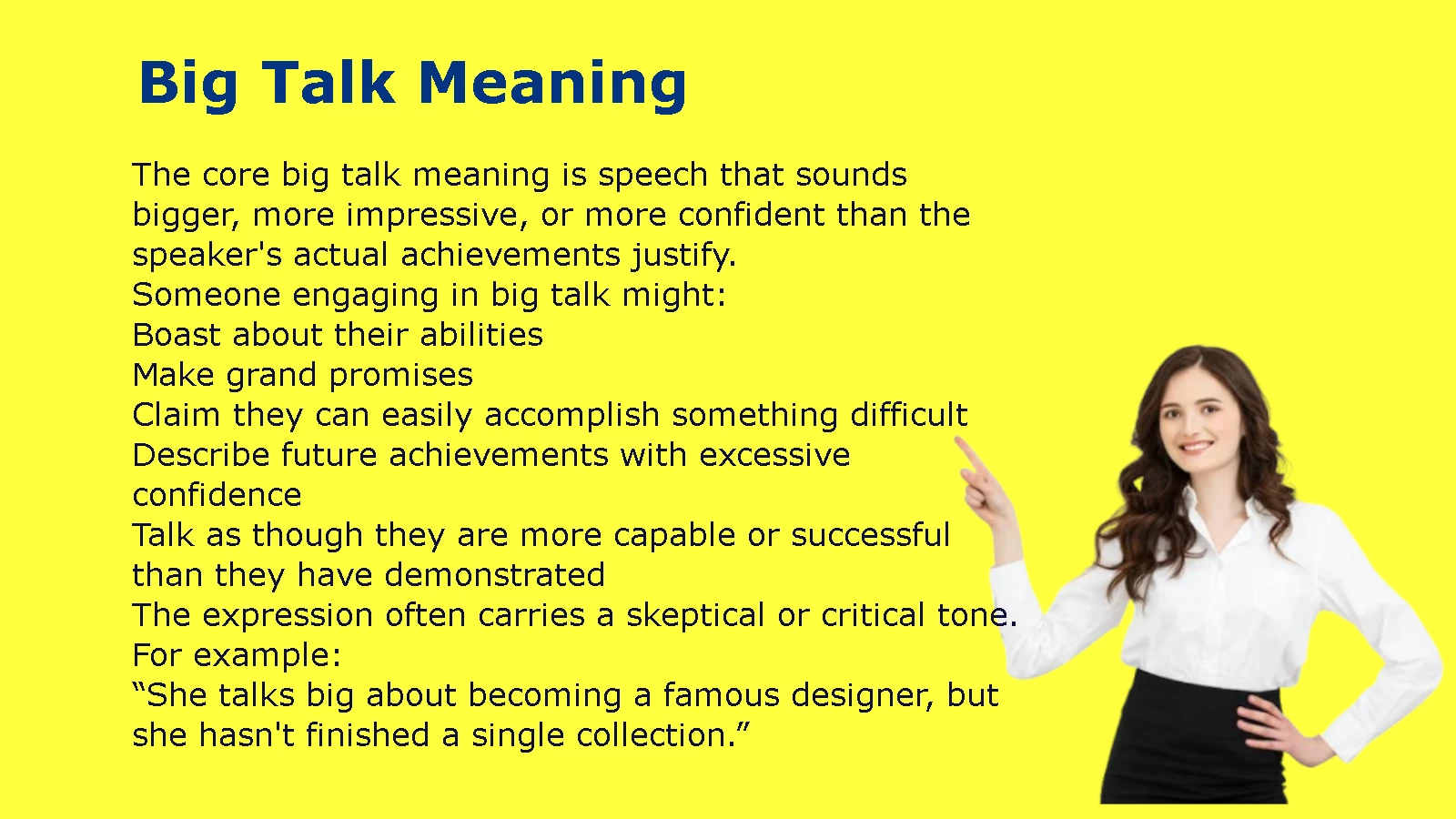
The core big talk meaning is speech that sounds bigger, more impressive, or more confident than the speaker’s actual achievements justify.
Someone engaging in big talk might:
- Boast about their abilities
- Make grand promises
- Claim they can easily accomplish something difficult
- Describe future achievements with excessive confidence
- Talk as though they are more capable or successful than they have demonstrated
The expression often carries a skeptical or critical tone.
For example:
“She talks big about becoming a famous designer, but she hasn’t finished a single collection.”
The speaker is not simply saying that she discusses fashion. They are suggesting that her claims are larger than her demonstrated actions.
Dictionary.com classifies big talk as an informal American noun meaning exaggeration or bragging. Collins likewise gives bragging or boasting talk as its definition and dates the American expression to approximately 1855–1860.
Big Talk Does Not Always Mean Lying
Calling something big talk does not necessarily mean that the person is lying.
A person may genuinely believe a claim and still be described as engaging in big talk because the statement seems exaggerated, overly ambitious, or unsupported.
Compare these examples:
- “I hope to build a successful company someday.” — An ordinary ambition.
- “I’ll build the biggest company in the country within six months.” — Potentially big talk because the claim is unusually grand.
- “I’ve already built three successful companies.” — A factual claim if it can be supported; it is not automatically big talk.
The phrase therefore often expresses the listener’s judgment about the scale or credibility of someone’s words, rather than proving that the speaker is deliberately dishonest.
Big Talk Meaning in Different Contexts
Context is especially important because big talk does not have just one possible interpretation.
Big Talk as Boasting or Empty Promises
This is the most established sense.
Someone uses big talk when another person’s statements seem boastful, exaggerated, or unsupported by action.
For example:
“There was plenty of big talk before the competition, but the results were disappointing.”
The phrase contrasts words with performance.
This is why big talk frequently appears near expressions such as:
- no action
- empty promises
- big claims
- all talk
- talk is cheap
- walk the talk
Collins provides examples in which big talk is contrasted with modest achievements or actual performance.
Big Talk as a Serious Conversation
There is another common construction:
“We need to have a big talk.”
Here, big does not necessarily mean boastful.
Instead, the phrase can mean that two or more people need to discuss something important, difficult, or emotionally significant.
For example:
“We need to have a big talk about where this relationship is going.”
The speaker is talking about a serious discussion, not bragging.
This sense is often created by the surrounding grammar. “Big talk” by itself may suggest boasting, while “have a big talk about…” commonly signals an important discussion.
Big Talk as a Major Topic of Conversation
A less common but documented sense is a major topic of conversation or current discussion.
For example:
“The big talk in the office was the company’s upcoming merger.”
Here, the big talk means something like the main topic everyone was discussing.
Historical examples recorded by Wiktionary include big talk meaning a major topic of conversation or current gossip.
This construction is less likely to be what someone means when they simply say:
“That’s big talk.”
The exact sentence matters.
What Does “Big Talk” Mean in Chat?
In texting, big talk usually depends heavily on the surrounding message.
If someone writes:
“Big talk 😂”
they are probably challenging, teasing, or mocking a boastful statement.
For example:
Person A: “I’m going to beat everyone in the tournament.”
Person B: “Big talk 😂”
The second person is essentially saying:
That’s a bold claim. Now let’s see if you can back it up.
Another example:
Person A: “I’ll finish this entire project tonight.”
Person B: “That’s big talk.”
Again, the phrase questions whether the speaker’s claim is realistic.
“Big Talk” vs. “We Need to Have a Big Talk” in Texting
These two constructions can communicate very different things.
| Text | Likely meaning |
| “Big talk.” | A bold, boastful, or exaggerated claim |
| “That’s big talk.” | Your claim sounds ambitious or boastful |
| “Big talk, no action.” | Words are not being supported by behavior |
| “We need to have a big talk.” | We need an important or serious conversation |
| “Had a big talk with my brother.” | Had a significant discussion |
The safest way to interpret a text is to examine the words immediately before and after “big talk.”
Big Talk Examples in Sentences
Here are examples showing the major ways the expression can be used.
Example 1: Boasting
“That’s big talk from someone who has never competed professionally.”
The speaker considers the person’s claim overly confident.
Example 2: Ambitious Promise
“He made big talk about transforming the company in one year.”
The phrase suggests that his claims were ambitious or exaggerated.
Example 3: Challenge
“You say you can beat me easily? That’s big talk.”
Here, big talk challenges someone to prove what they have claimed.
Example 4: Lack of Action
“There was plenty of big talk, but nobody actually volunteered.”
The words were not followed by action.
Example 5: Serious Discussion
“My parents and I had a big talk about my future.”
Here, big talk means an important conversation.
Example 6: Relationship Conversation
“We need to have a big talk about our plans.”
The phrase signals that an important issue needs to be discussed.
Example 7: Main Topic
“The big talk at work today was the new management policy.”
In this context, the big talk refers to the main topic of conversation.
Example 8: Informal Chat
“You’re going to finish all that by Friday? Big talk.”
The speaker is skeptical about the claim.
Is “Big Talk” Positive or Negative?
The traditional big talk meaning is usually negative or skeptical, but the phrase is not inherently negative in every context.
When it means boasting or exaggeration, it commonly suggests that someone is talking beyond what their actions justify.
For example:
“He’s full of big talk.”
That is clearly critical.
By contrast:
“We had a big talk about our future.”
is not negative. It simply describes an important discussion.
There is also a newer usage in which Big Talk refers to meaningful conversation rather than boasting. Communication resources such as Preply describe this usage as a move beyond surface-level small talk toward deeper conversations and active listening.
So the phrase’s emotional meaning depends on which sense is being used.
Big Talk as Meaningful Conversation
A modern communication usage treats Big Talk as the opposite of small talk.
In this framework, big talk means conversations that explore subjects such as:
- Values
- Goals
- Personal experiences
- Dreams
- Relationships
- Passions
- Life lessons
- Hopes and fears
- Experiences that shaped someone
Preply describes this form of big talk as moving beyond surface-level conversation toward deeper and more genuine interaction.
Kalina Silverman’s Big Talk approach similarly focuses on asking open-ended, story-eliciting questions that can encourage more meaningful connections. Penguin Random House’s 2026 excerpt from Silverman’s work describes Big Talk as a communication approach designed to move beyond small talk and encourage deeper conversations.
This is an important distinction for anyone searching “big talk meaning.”
Traditional dictionary meaning: boasting or exaggeration.
Modern communication usage: deeper, more meaningful conversation.
The second meaning is real and increasingly visible, but it should not be presented as though it replaces the established dictionary definition.
Big Talk vs. Small Talk
The difference between big talk and small talk depends on the sense of big talk being discussed.
When big talk means meaningful conversation, the contrast is about depth and purpose.
| Big Talk | Small Talk |
| Often explores meaningful subjects | Usually covers everyday subjects |
| Can involve personal experiences | Usually requires little personal disclosure |
| May explore values or ambitions | Often focuses on neutral topics |
| Can encourage deeper connection | Often establishes social comfort |
| Usually requires more openness | Usually carries less personal risk |
Small talk can involve weather, weekend plans, work routines, or other low-stakes subjects.
Big Talk, in the newer communication sense, might ask:
“What is something you’ve always wanted to accomplish?”
Instead of:
“What are you doing this weekend?”
Neither type of conversation is automatically better. Small talk often serves as a social bridge, while deeper conversation becomes more appropriate when people have enough comfort and context.
Preply similarly notes that small talk can establish rapport and create an opening for deeper conversations rather than being inherently useless.
Big Talk Synonyms and Similar Phrases
The best synonym depends on which meaning you intend.
Synonyms for Big Talk Meaning “Boasting”
Useful alternatives include:
- Bragging
- Boasting
- Bravado
- Bluster
- Bombast
- Big words
- Grand claims
- Empty promises
- Hot air
- All talk
Cambridge’s thesaurus associates big talk with terms including bravado, swagger, braggadocio, boasting, bombast, bluster, and bragging.
These words are not perfect substitutes in every sentence.
For example, bragging specifically focuses on someone praising themselves, while bluster can emphasize loud, forceful, or threatening speech. Empty promises focus more directly on commitments that are not fulfilled.
Synonyms for Big Talk Meaning “Serious Conversation”
When the expression refers to an important discussion, alternatives include:
- Serious conversation
- Important discussion
- Heart-to-heart
- Deep conversation
- Frank discussion
- Meaningful conversation
For example:
“We need to have a serious conversation.”
can communicate much the same idea as:
“We need to have a big talk.”
The second is generally more informal.
Big Talk vs. Big Deal vs. Big Words
These expressions look similar but have different meanings.
| Expression | Meaning |
| Big talk | Boasting, exaggeration, or, in some contexts, an important/deep conversation |
| Big deal | Something considered important, significant, or noteworthy; it can also be sarcastic |
| Big words | Impressive or difficult language; can also mean boastful claims depending on context |
Consider:
“That’s big talk.”
This questions someone’s claims.
“That’s a big deal.”
This says that something is important or significant.
“Those are big words.”
This can suggest that someone has made a strong claim or used language that requires support.
They are related in some contexts but are not interchangeable.
Common Expressions With “Big Talk”
“That’s Big Talk”
“That’s big talk” is often used to challenge a confident claim.
Example:
“You think you can finish the marathon without training? That’s big talk.”
The speaker is effectively saying:
“That’s a very confident claim. Now prove it.”
“Big Talk, No Action”
This expression highlights the difference between what someone says and what they actually do.
Example:
“There was big talk about improving the neighborhood, but no action followed.”
The phrase is closely related to the idea behind “talk is cheap.”
“Talk Is Cheap”
“Talk is cheap” means that saying something is easy, while actually doing it can be much harder.
That makes it closely related to big talk when the latter means boastful or unsupported claims.
For example:
“He says he’ll finish the job tomorrow, but talk is cheap.”
The speaker is emphasizing the need for action rather than promises.
“Walk the Talk”
“Walk the talk” means to act in accordance with what you say or claim.
This creates a useful contrast:
Big talk: impressive claims without convincing action.
Walk the talk: actions that demonstrate that the claims are genuine.
Is “Big Talk” a Slang Term?
The answer depends on the sense.
Collins labels big talk as slang in one of its entries and defines it as bragging or boasting talk. Dictionary.com, meanwhile, classifies it as an informal noun meaning exaggeration or bragging.
For everyday writing, the safest description is therefore informal language or an informal expression, especially when referring to boastful speech.
It is not appropriate to assume that every occurrence of big talk is slang.
For example:
“We had a big talk about our future.”
is ordinary informal English describing a serious discussion.
Is “Big Talk” Grammatically Correct?
Yes. Big talk is a grammatically valid noun phrase.
It normally consists of:
- big — adjective
- talk — noun
The phrase is generally written as two separate words:
big talk
Not:
bigtalk
And normally not:
big-talk
when it is being used as the noun phrase.
Common Sentence Patterns
You may see big talk in structures such as:
“That’s big talk.”
“You think you’ll win easily? That’s big talk.”
“There was big talk about…”
“There was big talk about expanding the business.”
“He made big talk about…”
“He made big talk about his future plans.”
“We had a big talk about…”
“We had a big talk about our finances.”
“The big talk was…”
“The big talk was the team’s upcoming expansion.”
The surrounding words help determine the intended meaning.
How to Use “Big Talk” Correctly
Use big talk when you want to describe unusually bold, boastful, or exaggerated claims.
“That’s big talk for someone who has never done it before.”
Use it for a serious conversation when the phrase appears in a construction such as:
“We need to have a big talk.”
Use Big Talk with capitalization when referring specifically to a named communication approach or project rather than the ordinary expression. Kalina Silverman’s Big Talk project, for example, uses capitalization as part of its name.
When Not to Use “Big Talk”
Avoid it when you simply mean ordinary conversation.
If you mean a casual conversation about the weather, weekend plans, or daily activities, small talk is usually more precise.
Real-World Examples of Big Talk
Example: Friends
Alex: “I’m going to beat everyone at the tournament.”
Jordan: “That’s big talk.”
Here, Jordan is skeptical of Alex’s confidence.
Example: Workplace
“Management made big talk about improving customer service, but employees saw few changes.”
The phrase suggests a gap between promises and results.
Example: Texting
Friend 1: “I’ll finish the whole project tonight.”
Friend 2: “Big talk 😂”
The emoji makes the teasing tone especially clear.
Example: Relationship
“We need to have a big talk about what we both want.”
Here, big talk means a serious or important conversation.
Example: Family
“My father and I finally had a big talk about my plans for the future.”
Again, the expression refers to an important discussion rather than boasting.
Example: Competition
“He spent the week making big talk about how easily he would win.”
The phrase suggests boastful confidence.
Example: Major Topic
“The big talk around town was the proposed development.”
Here, the big talk refers to the main subject people were discussing.
A Simple Way to Identify the Meaning
When you encounter big talk, look at the grammatical construction.
If someone says “That’s big talk”
It probably means:
“That’s a bold, boastful, or exaggerated claim.”
If someone says “We need to have a big talk”
It probably means:
“We need to have an important or serious conversation.”
If someone says “The big talk was about…”
It can mean:
“The main topic of discussion was…”
If someone uses “Big Talk” as a named concept
It may refer to the modern idea of meaningful conversation that goes beyond small talk.
This quick test prevents one of the most common mistakes: assuming that every use of big talk has the same definition.
Common Mistakes When Interpreting “Big Talk”
Assuming It Always Means Boasting
The dictionary meaning is important, but context can produce a different interpretation.
“That’s big talk.”
and
“We need to have a big talk.”
do not normally mean the same thing.
Assuming It Always Means Deep Conversation
The newer Big Talk concept is useful in communication contexts, but it does not replace the established meaning of boasting or exaggeration.
Confusing Big Talk With Small Talk
The two expressions are not simply opposites in every context.
Small talk is a well-established term for light social conversation. Big talk has a traditional meaning related to boasting and a newer usage associated with deeper conversation.
Treating Big Talk as Proof of Dishonesty
Calling someone’s statement big talk expresses skepticism or criticism. It does not establish that the person is lying.
Ignoring Tone
In text messages, “Big talk 😂” can be playful teasing, while “That’s big talk” in an argument can sound confrontational.
Tone, punctuation, emojis, and the relationship between the speakers all matter.
Big Talk Meaning: Key Facts to Remember
Here are the most important points:
- Big talk traditionally means boasting, bragging, or exaggerated speech.
- Dictionary.com classifies the traditional expression as informal and dates it to around 1855–60.
- Collins also defines it as bragging or boasting talk.
- “That’s big talk” usually challenges or questions someone’s bold claim.
- “Big talk, no action” highlights a gap between words and behavior.
- “We need to have a big talk” usually means an important or serious conversation.
- Big talk can also refer to a major topic of conversation in some uses.
- A newer communication usage treats Big Talk as deeper, more meaningful conversation in contrast with small talk.
- Big talk is normally written as two words.
- The intended meaning should be determined from context rather than the phrase alone.
Big Talk Meaning FAQs
What does big talk mean in texting?
In texting, big talk often means a bold, boastful, or exaggerated claim. If someone responds “Big talk” after you make a confident statement, they may be teasing you or challenging you to prove it.
For example:
“I can beat you in five minutes.”
“Big talk.”
The response suggests that the speaker thinks the claim is overly confident.
What does big talk mean in English?
The traditional English meaning of big talk is boasting, bragging, or exaggerated speech. In other contexts, it can refer to an important conversation or a major topic of discussion. Contemporary communication resources also use Big Talk for deeper conversations that go beyond small talk.
What does “That’s big talk” mean?
“That’s big talk” means that someone’s statement sounds bold, boastful, exaggerated, or difficult to back up.
It can be serious or playful depending on tone.
What does “big talk, no action” mean?
“Big talk, no action” describes someone who makes impressive claims or promises but does not take meaningful action to support them.
It is similar to saying:
“The words sound impressive, but where are the results?”
Is big talk a slang word?
Big talk is generally best described as an informal expression. Collins labels its traditional boastful sense as slang, while Dictionary.com labels it informal.
Is big talk positive or negative?
When big talk means boasting, it is usually negative or skeptical. When it refers to an important conversation, it can be neutral. In the newer Big Talk communication sense, it generally refers positively to meaningful interaction.
What is another word for big talk?
For the boastful sense, possible alternatives include bragging, boasting, bravado, bluster, bombast, big words, and grand claims. Cambridge lists several related terms, including bravado, braggadocio, boasting, bombast, and bluster.
For the serious-conversation sense, alternatives include serious conversation, important discussion, heart-to-heart, and meaningful conversation.
What is the difference between big talk and small talk?
Small talk usually refers to light, low-stakes social conversation. Big talk can mean boastful speech in its traditional sense, but in the newer communication sense it refers to deeper, more meaningful conversations.
Does big talk always mean bragging?
No. “Big talk” traditionally means bragging or exaggeration, but context can give it another meaning.
For example:
“We need to have a big talk.”
usually means that an important conversation needs to happen.
What does “we need to have a big talk” mean?
It usually means:
“We need to discuss something important or serious.”
The subject could involve a relationship, family issue, finances, plans, work, or another significant matter.
Is “big talk” the same as “talking big”?
They are closely related when both refer to boastful speech, but they are not identical grammatical constructions.
Big talk is a noun phrase:
“That’s a lot of big talk.”
Talk big is a verb phrase:
“He likes to talk big about his achievements.”
Both can describe confident or exaggerated claims.
Conclusion: Big Talk Meaning Explained
The most established big talk meaning is boasting, bragging, or making exaggerated claims. When someone says “That’s big talk,” they are usually suggesting that another person’s statement is unusually bold and may not be supported by their actions.
However, context creates important differences. “We need to have a big talk” generally refers to a serious or important conversation, while “the big talk” can sometimes refer to the main subject people are discussing.
There is also a newer communication use of Big Talk that contrasts it with small talk. In that context, the expression refers to deeper conversations about values, experiences, ambitions, relationships, and other meaningful subjects.
So when you see big talk, don’t automatically assign one definition to it. Look at the sentence around it.
“That’s big talk” usually signals skepticism about a boast.
“We need to have a big talk” usually signals an important conversation.
“The big talk was about…” can identify the main topic of discussion.
Understanding those distinctions makes the phrase much easier to interpret and use naturally in English.













