A good sport is more than just someone who enjoys playing sports—it’s a person who handles winning, losing, teasing, or competition with a positive and respectful attitude. If you’ve come across the phrase “good sport” and wondered what it means, how it is used, or why someone might be called a good sport, the expression is closely connected to sportsmanship, fairness, patience, friendliness, competition, and good humor.
The good sport meaning refers to a person who accepts the outcome of a game, competition, joke, or difficult situation without becoming upset, angry, or resentful. The phrase can describe someone who plays fairly, accepts defeat gracefully, takes teasing well, or cooperates willingly, depending on the context. Terms such as good sport, good sportsman, good sportswoman, gracious loser, team player, and good-natured person are related but can have slightly different uses.
In this guide, you’ll learn what “good sport” means, how the phrase is used in sentences, what qualities make someone a good sport, and how “good sport” differs from related expressions such as “good sportsmanship” and “gracious loser.” You’ll also see clear examples to make the meaning easy to understand.
By the end, you’ll know exactly what good sport means and how to use this common English expression naturally and correctly.
Good Sport Meaning: Quick Answer
Good sport means a person who behaves pleasantly, fairly, and generously in a difficult, competitive, or potentially embarrassing situation. A good sport usually accepts winning or losing gracefully, does not complain unnecessarily, and can take harmless teasing or participate in something inconvenient without becoming unpleasant.
For example:
Even though Maya lost the game, she congratulated the winner and laughed about it. She was a good sport.
The expression isn’t limited to actual sports. Someone can be a good sport when they lose a board game, accept a harmless joke, agree to wear a silly costume, or help with something inconvenient.
Dictionaries support both sides of this meaning. Cambridge defines a good sport as a pleasant, positive, generous person who doesn’t complain about things they’re asked to do or about games they lose. Oxford similarly describes be a good sport as being generous, cheerful, and pleasant, especially in a difficult situation or after losing a game.
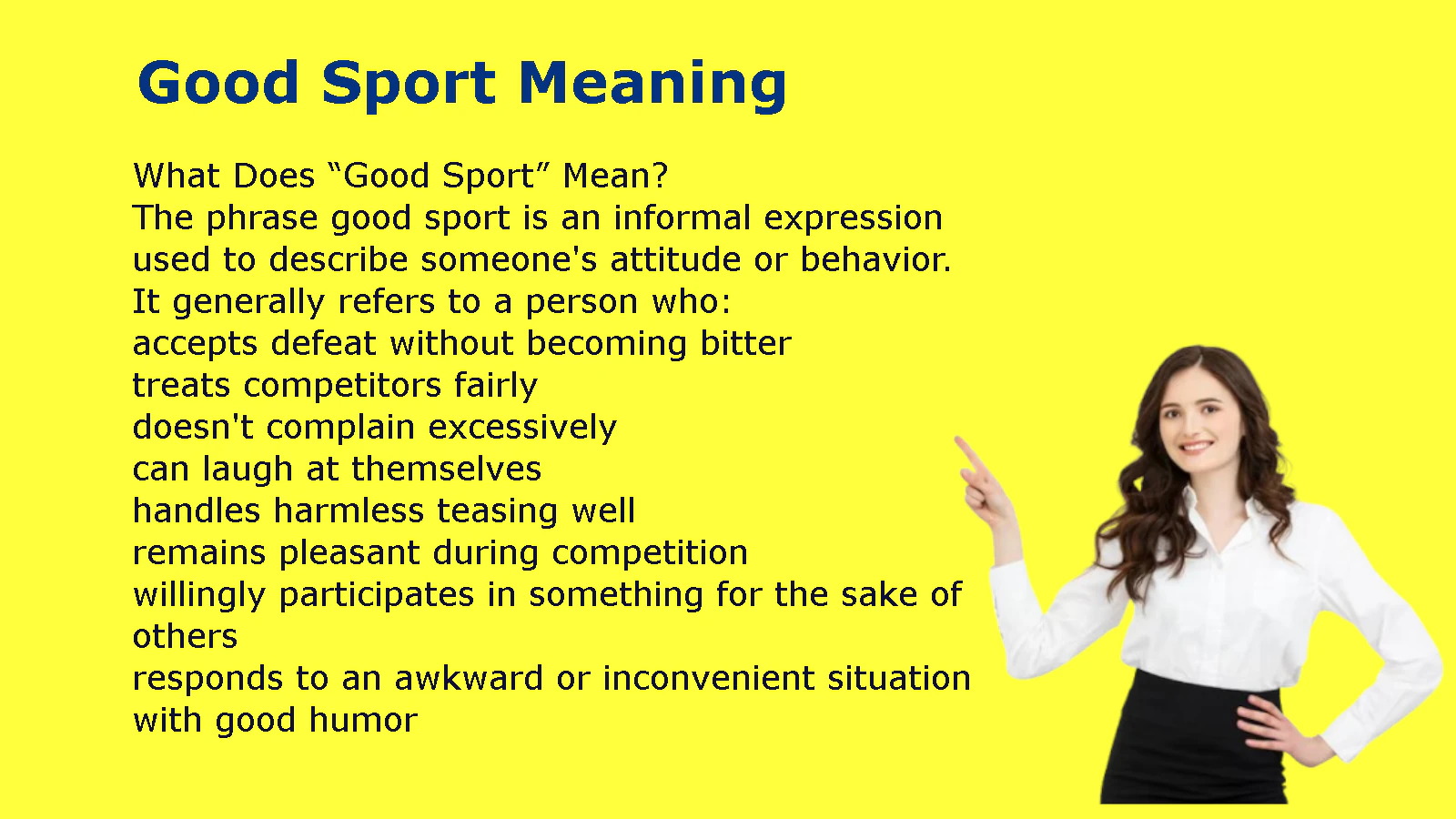
What Does “Good Sport” Mean?
The phrase good sport is an informal expression used to describe someone’s attitude or behavior.
It generally refers to a person who:
- accepts defeat without becoming bitter
- treats competitors fairly
- doesn’t complain excessively
- can laugh at themselves
- handles harmless teasing well
- remains pleasant during competition
- willingly participates in something for the sake of others
- responds to an awkward or inconvenient situation with good humor
The important idea is how someone reacts when things don’t go exactly their way.
A person doesn’t have to enjoy losing to be a good sport. They can feel disappointed, frustrated, or embarrassed. What matters is how they handle those feelings and behave toward other people.
Good Sport Definition
A simple definition is:
A good sport is someone who handles competition, disappointment, teasing, or an inconvenient situation with good humor and a positive attitude.
The phrase can therefore apply to both competition and everyday social situations.
Consider these two examples:
Daniel lost the chess match but shook his opponent’s hand and congratulated her. He’s a good sport.
Here, the expression refers to his reaction to losing.
Now consider:
I know you don’t like dancing, but thanks for being a good sport and joining us.
There is no competition in this sentence. Instead, good sport means someone who willingly goes along with something despite not particularly wanting to do it.
That broader meaning is important because limiting the expression to sports competitions misses a common use of the phrase.
What Does “You’re a Good Sport” Mean?
“You’re a good sport” is generally a compliment.
Someone might say it after you:
- lose a competition without complaining
- accept a joke at your expense
- agree to participate in something silly
- help someone even though it’s inconvenient
- accept an unfavorable outcome calmly
For example:
“I know that wasn’t the result you wanted, but you congratulated everyone. You’re a good sport.”
The speaker is praising the person’s attitude, not necessarily their performance.
That’s an important distinction.
If someone says:
“You’re good at sports.”
they’re talking about athletic ability.
If someone says:
“You’re a good sport.”
they’re talking about behavior, attitude, or temperament.
Those two expressions sound similar but mean very different things.
What Does “Not a Good Sport” Mean?
Not a good sport means someone reacts poorly to competition, teasing, disappointment, or an unfavorable situation.
The person might:
- complain about losing
- blame other people
- make excuses
- insult the winner
- refuse to accept the result
- become angry over harmless teasing
- spoil the experience for everyone else
For example:
Tom stopped talking to everyone after losing the game. He wasn’t being a good sport.
A stronger expression is bad sport.
Nobody wanted to play with him because he was such a bad sport.
Oxford defines bad sport as someone who is unpleasant or unhelpful, particularly in a difficult situation or after losing a game.
Good Sport Meaning in Different Contexts
The exact shade of meaning depends on the situation. Understanding the context makes the expression much easier to interpret.
Good Sport in Competition
The most obvious use occurs during games, contests, and competitions.
A good sport respects the basic spirit of competition. They want to win, but winning isn’t an excuse to humiliate other people.
For example:
After winning the final, Olivia congratulated her opponent and thanked her for the match. Olivia was a good sport.
Being competitive doesn’t prevent someone from being a good sport.
In fact, a person can be extremely competitive and still behave like a good sport. The distinction is between wanting to win and behaving badly when the outcome isn’t favorable.
A good competitor can say:
“I really wanted to win, but you played better today.”
That response acknowledges disappointment without turning it into hostility.
Good Sport After Losing
This is one of the clearest uses of the expression.
Someone who loses gracefully might:
- congratulate the winner
- acknowledge mistakes
- avoid making excuses
- remain friendly
- accept the result
- continue enjoying the activity
For example:
Although James lost the tennis match 6–2, 6–4, he congratulated his opponent and stayed to watch the next match. He was a good sport.
Notice that being a good sport doesn’t mean pretending that losing feels good.
James can be disappointed. He simply doesn’t allow that disappointment to turn into rude behavior.
This is why good sport and good loser are related but not identical expressions.
Good Sport When Being Teased or Pranked
The phrase also applies when someone becomes the subject of harmless teasing or a joke.
For example:
Everyone laughed when Priya discovered that the birthday cake was actually a joke cake. She laughed too and was a good sport about it.
Here, no game has taken place.
The person is a good sport because they take the situation in good humor.
However, context matters. Calling someone a good sport doesn’t mean that they are expected to tolerate genuinely harmful, abusive, or humiliating behavior.
A harmless joke and serious mistreatment aren’t the same thing.
Good Sport in Everyday Situations
Someone can also be a good sport simply by cooperating when something isn’t especially convenient.
For example:
“Thanks for being a good sport and driving us to the airport.”
The person isn’t competing with anyone. The phrase means that they willingly helped despite the inconvenience.
Cambridge specifically includes situations where someone is asked to do something as part of its definition of good sport, which confirms that the expression extends beyond competition.
Good Sport Meaning in Texting and Casual Conversation
Good sport is perfectly natural in casual messages and everyday conversation.
Suppose your friend reluctantly agrees to join a karaoke night:
You: “I know karaoke isn’t your thing, so thanks for coming!”
Friend: “I’ll survive.”
You: “You’re a good sport 😂”
The expression is usually understood as praise for someone’s willingness to participate.
Another example:
“You wore that ridiculous hat for the whole party? You’re such a good sport.”
Again, there’s no athletic competition. The phrase describes the person’s willingness to tolerate an unusual or embarrassing situation with good humor.
Is “Good Sport” Slang?
Good sport is better described as an informal idiomatic expression than as specialized slang.
Cambridge labels the noun expression US informal or UK old-fashioned, while Oxford identifies be a (good) sport as informal.
That means you’ll commonly encounter it in:
- conversations
- texts
- informal emails
- social media
- friendly workplace conversations
- sports discussions
- entertainment
It isn’t normally the best choice for highly formal or technical writing.
Good Sport Examples in Sentences
Seeing the phrase in different situations makes its meaning clearer.
Examples About Competition
Sarah lost the race but congratulated the winner. She was a good sport.
Mark never complains when he loses, which makes him a good sport.
Even after the other team scored the winning goal, our players shook hands and showed good sportsmanship.
He didn’t win the tournament, but he remained cheerful and proved he was a good sport.
Examples About Teasing
Emma was a good sport when her friends surprised her with the silly costume.
He laughed at the joke instead of getting offended and showed that he was a good sport.
She knows how to take a joke, so she’s always a good sport at parties.
Examples About Helping
Thanks for being a good sport and helping us move the furniture.
He was a good sport and drove everyone home after the concert.
My brother was a good sport and let me choose the movie.
Examples in Casual Conversation
“Come on, be a good sport and play one more round.”
“You’re a good sport for agreeing to wear that costume.”
“She’s such a good sport. She never takes harmless jokes personally.”
“Don’t be a bad sport just because you lost.”
Good Sport vs. Bad Sport
The easiest way to understand the phrase is to compare it with its opposite.
| Expression | Meaning |
| Good sport | Handles competition, teasing, or inconvenience pleasantly |
| Bad sport | Reacts unpleasantly to competition, teasing, or an unfavorable situation |
| Good loser | Accepts defeat gracefully |
| Sore loser | Reacts angrily or resentfully after losing |
| Sportsmanlike | Fair and respectful in competition |
A good sport generally has a broader meaning than a good loser.
Someone can be a good sport without losing anything.
For example:
“Thanks for being a good sport and helping me paint the room.”
There is no winner or loser here.
Likewise, someone can be a good sport when participating in a joke or unusual activity.
Good Sport Synonyms
The best synonym depends on which aspect of the expression you want to emphasize.
Synonyms for Someone Who Handles Losing Well
- good-natured
- gracious
- sportsmanlike
- fair-minded
- gracious loser
For example:
She was gracious after losing the competition.
This is close to:
She was a good sport after losing the competition.
Synonyms for Someone Who Goes Along With Something
When the phrase means someone is willing to cooperate, possible alternatives include:
- agreeable
- cooperative
- accommodating
- easygoing
- willing
- good-natured
For example:
Thanks for being so accommodating.
This can sometimes replace:
Thanks for being a good sport.
However, the two expressions aren’t exact synonyms. Good sport often carries an additional sense of cheerful acceptance, especially when something is inconvenient, competitive, or potentially embarrassing.
Good Sport vs. Similar Expressions
Several expressions overlap with good sport, but each emphasizes something different.
Good Sport vs. Good-Natured
Good-natured describes someone who generally has a pleasant and easygoing disposition.
Good sport is more situational.
Anna is good-natured.
This suggests a general personality trait.
Anna was a good sport about losing the game.
This focuses on her response to a particular situation.
Good Sport vs. Good Loser
A good loser specifically accepts defeat gracefully.
A good sport can do that, too, but the expression has a wider range.
Compare:
He was a good loser after the election.
with:
He was a good sport and agreed to participate in the silly challenge.
The first concerns an unfavorable result. The second concerns willingness to participate.
Good Sport vs. Sportsmanlike
Sportsmanlike is strongly associated with fair and respectful conduct during competition.
The player displayed sportsmanlike behavior.
Good sport sounds more conversational:
The player was a good sport after losing.
Both can describe fair behavior, but their style and range differ.
Good Sport vs. Easygoing
Easygoing usually describes someone’s general personality.
Mike is easygoing and rarely gets upset.
Good sport normally arises in a situation where someone’s reaction is being evaluated.
Mike was a good sport when we teased him about his mistake.
Good Sport vs. Good Person
These expressions should not be treated as interchangeable.
Calling someone a good person makes a broad judgment about their character.
Calling someone a good sport refers to a particular type of behavior or attitude.
Someone might be a good sport about losing a game without that phrase making any claim about every other aspect of their personality.
Is “Good Sport” a Compliment?
Usually, yes.
When someone says:
“You’re a good sport.”
they are generally praising your ability to remain pleasant, cooperative, or good-humored.
The expression can, however, become sarcastic depending on tone.
Genuine use
“You didn’t get the promotion, but you congratulated the person who did. You’re a good sport.”
Potentially sarcastic use
“Oh, you’re such a good sport,” she said after he reluctantly agreed to clean up.
Written text can make sarcasm harder to identify because the speaker’s tone isn’t available. That’s why surrounding context matters.
Is “Good Sport” Formal or Informal?
Good sport is mainly informal.
Oxford labels be a (good) sport as informal, while Cambridge identifies good sport as US informal or UK old-fashioned.
Here’s how the expression generally fits different settings:
| Setting | Use of “good sport” |
| Casual conversation | Natural |
| Text messages | Natural |
| Social media | Natural |
| Friendly workplace conversation | Usually natural |
| Formal academic essay | Usually avoid |
| Legal writing | Usually avoid |
| Technical documentation | Usually avoid |
In formal writing, choose a more precise word when appropriate.
Instead of:
He was a good sport after the defeat.
you could write:
He responded graciously to the defeat.
Instead of:
She was a good sport about the request.
you could write:
She responded positively to the request.
The informal expression isn’t incorrect. It simply has a more conversational register.
Good Sport in a Sentence: Common Usage Patterns
The expression appears in several common grammatical patterns.
“Be a Good Sport”
This is one of the most common forms.
Be a good sport and give your sister a turn.
Here, the speaker is asking someone to cooperate.
Oxford specifically lists “be a sport” as an informal expression used when asking someone to help.
“You’re a Good Sport”
This form usually praises someone.
You’re a good sport for coming with us even though you’re tired.
“She’s a Good Sport”
This describes another person.
She’s a good sport and never complains when her friends tease her.
“A Good Sport About Something”
This pattern is particularly useful when discussing someone’s response to a specific event.
He was a good sport about losing the match.
She was a good sport about having to wear the costume.
They were good sports about the unexpected change of plans.
The phrase “good sport about” connects the person’s positive attitude with the situation they are handling.
What Does “Be a Good Sport” Mean?
“Be a good sport” is a request to respond positively or cooperatively to a situation.
Depending on context, it can mean:
- accept the result gracefully
- stop complaining
- cooperate with someone
- take a joke
- participate willingly
- accept an inconvenience without making a fuss
For example:
“Be a good sport and let your brother choose the game this time.”
The speaker isn’t talking about athletic ability.
They’re asking the person to cooperate and accept the situation pleasantly.
Another example:
“Be a good sport and try the dessert. You might actually like it.”
Here, the phrase means something closer to “be willing to go along with this.”
What Does “Thanks for Being a Good Sport” Mean?
“Thanks for being a good sport” expresses appreciation for someone’s willingness to tolerate or participate in something.
For example:
“Thanks for being a good sport and taking those ridiculous photos with us.”
The speaker recognizes that the activity may not have been the person’s first choice.
Another example:
“Thanks for being a good sport about the schedule change.”
The person handled an inconvenience without making the situation unnecessarily difficult.
This usage is especially common in friendly conversation because it combines gratitude with praise.
Common Mistakes With “Good Sport”
Assuming It Only Refers to Sports
The biggest misunderstanding is taking the phrase literally.
A good sport doesn’t have to be an athlete.
Someone can be a good sport about:
- a joke
- a costume
- a favor
- an inconvenience
- losing a board game
- a friendly competition
- an embarrassing situation
The dictionaries themselves demonstrate this broader usage by defining the expression around both requested actions and losing games.
Confusing “Good Sport” With “Good at Sports”
These sentences have different meanings:
David is good at sports.
This means David performs well in athletic activities.
David is a good sport.
This means David behaves well when dealing with competition, teasing, inconvenience, or similar situations.
Someone can be:
- good at sports but a bad sport
- bad at sports but a good sport
- good at sports and a good sport
- neither particularly athletic nor particularly sportsmanlike
Athletic ability and attitude are separate concepts.
Assuming a Good Sport Must Be Happy About Losing
That’s another common mistake.
A good sport can be genuinely disappointed.
Suppose a runner trains for months and finishes second. Saying:
“She was a good sport.”
doesn’t mean:
“She didn’t care about losing.”
It means she handled the disappointment appropriately.
She might still think:
“I’m disappointed, but congratulations. You ran a great race.”
That distinction is central to the expression.
Good Sport Meaning and Sportsmanship
The phrase good sport is closely related to sportsmanship, particularly when competition is involved.
Sportsmanship involves ideas such as:
- fairness
- respect
- self-control
- following rules
- accepting results
- treating opponents appropriately
A good sport therefore often demonstrates sportsmanlike behavior.
However, good sport is broader in everyday English because it can describe someone who isn’t involved in sports at all.
For instance:
“Thanks for being a good sport and helping me move.”
That sentence has nothing to do with athletic competition.
So the relationship can be summarized this way:
| Term | Main focus |
| Good sport | Positive, gracious, or cooperative behavior |
| Sportsmanship | Fairness and respectful conduct in competition |
| Good loser | Graceful acceptance of defeat |
| Good-natured | Generally pleasant personality |
| Easygoing | Relaxed attitude toward life and situations |
Good Sport Meaning in Real-Life Situations
Consider a few practical scenarios.
Case Study: Losing a Board Game
Four friends play a board game.
Alex loses by a single point. Instead of accusing the winner of cheating or refusing to play again, Alex says:
“That was close. Nice game!”
Alex is demonstrating the good sport meaning associated with accepting defeat gracefully.
The person doesn’t have to be delighted about losing. The important point is the response.
Case Study: Being the Subject of a Joke
A group of friends gives Maria a harmless surprise by presenting her with an intentionally ridiculous birthday hat.
She laughs and wears it for the rest of dinner.
Someone might say:
“Maria is such a good sport.”
The expression describes her ability to take the joke in good humor.
Case Study: Agreeing to Help
A friend needs someone to accompany them to an early appointment.
You don’t particularly want to wake up early, but you agree to go.
Your friend might say:
“Thanks for being a good sport.”
Here, the expression means willing and accommodating, not competitive.
Good Sport Meaning in The Great Gatsby
A related search often causes confusion because sport also appears in the expression “old sport” in F. Scott Fitzgerald’s The Great Gatsby.
These expressions should not be treated as synonyms.
In The Great Gatsby, old sport functions as a familiar form of address associated particularly with Jay Gatsby. It is closer to a term such as friend, pal, or fellow in its conversational function.
An academic discussion of Fitzgerald’s use of the expression notes that Gatsby’s repeated use of “old sport” contributes to the way he presents himself and that Nick even observes the formulaic nature of the expression.
That is different from:
She is a good sport.
Here, good sport describes someone’s behavior or attitude.
The distinction is useful:
| Expression | Meaning |
| good sport | A person who handles situations graciously or cooperatively |
| bad sport | A person who reacts poorly to competition or difficult situations |
| old sport | An old-fashioned form of address meaning roughly friend, fellow, or pal |
So if you’re studying The Great Gatsby, don’t automatically interpret sport as referring to athletic competition.
Why the Word “Sport” Appears in “Good Sport”
The expression makes more sense when you consider the older meanings associated with sport.
Oxford traces the noun sport to Middle English, where it developed from a word associated with pastime and entertainment. The word later acquired its familiar meanings connected with games, recreation, and competition. Oxford also records older meanings involving pleasure and joking.
That broader history helps explain why sport can appear in expressions concerning someone’s attitude toward fun, competition, and social situations.
The phrase good sport isn’t simply saying that someone is physically good at playing sports.
Instead, it uses the broader idea of sport as play, competition, or a shared activity to describe someone who handles such situations well.
Good Sport vs. Good Winner
People often associate the phrase with losing, but being a good sport can apply to winners too.
A person who wins and then:
- mocks the loser
- boasts excessively
- refuses to acknowledge the opponent’s effort
- deliberately humiliates others
may not be considered a good sport.
By contrast, a good winner can say:
“You played really well. That was a close game.”
This is why the concept goes beyond simply being a good loser.
The broader idea is gracious participation, regardless of the outcome.
Good Sport: What the Expression Really Communicates
The phrase carries several related ideas rather than one rigid definition.
At its core, good sport communicates that someone can put the situation into perspective.
They may lose.
Yet they remain reasonably pleasant and cooperative.
That’s why the phrase works in so many everyday situations.
The central qualities of a good sport include:
- Grace: accepting an unfavorable outcome without unnecessary hostility
- Good humor: being able to laugh at harmless situations
- Fairness: respecting other participants
- Cooperation: being willing to help or participate
- Self-control: avoiding an excessive negative reaction
- Perspective: understanding that a game, joke, or inconvenience isn’t the end of the world
Not every good sport will display every quality equally. Context determines which aspect the speaker has in mind.
Frequently Asked Questions About Good Sport Meaning
What does “good sport” mean in slang?
Good sport is an informal idiomatic expression rather than specialized slang. It describes someone who behaves pleasantly and generously, especially when losing, dealing with teasing, or being asked to do something inconvenient.
What does “you are a good sport” mean?
It means the speaker appreciates your positive, cooperative, or good-humored attitude.
For example:
“You didn’t want to play, but you joined us anyway. You’re a good sport.”
What does “she is a good sport” mean?
It means she handles difficult, competitive, humorous, or inconvenient situations pleasantly.
The exact meaning depends on context.
What does “not a good sport” mean?
It means someone reacts poorly to competition, teasing, losing, or another unfavorable situation.
For example:
He complained about the rules after every loss, so people thought he wasn’t a good sport.
What is the opposite of a good sport?
The most direct opposite is bad sport.
Other context-dependent opposites include:
- sore loser
- poor sport
- unsporting person
- unpleasant competitor
What is a synonym for good sport?
Depending on context, alternatives include good-natured, gracious, sportsmanlike, cooperative, accommodating, and easygoing.
No single synonym works in every sentence because good sport has more than one related use.
Is “good sport” the same as “good loser”?
No.
A good loser specifically handles defeat gracefully.
A good sport can also describe someone who cooperates, accepts teasing, or willingly participates in an inconvenient or unusual situation.
What does “be a good sport” mean?
It usually means be cooperative, cheerful, or gracious about something, particularly when the person might otherwise complain or object.
“Be a good sport and let her choose the movie.”
What does “thanks for being a good sport” mean?
It means:
“Thank you for being willing to go along with this and for handling the situation positively.”
The phrase is often used after someone helps, participates, tolerates teasing, or accepts an inconvenience.
How do you use “good sport” in a sentence?
You can use it to describe someone’s reaction to competition or an everyday situation:
He lost the match but congratulated the winner, proving he was a good sport.
Or:
Thanks for being a good sport and helping us clean up.
Is “good sport” formal?
Generally, no. It is an informal expression. Oxford explicitly labels the related idiom be a (good) sport informal, while Cambridge labels good sport US informal or UK old-fashioned.
For formal writing, alternatives such as gracious, cooperative, accommodating, or sportsmanlike may be more appropriate.
Good Sport Meaning: Key Facts to Remember
If you only need the essential points, remember these:
- Good sport describes a person who handles competition, disappointment, teasing, or inconvenience pleasantly.
- The expression is not limited to athletic sports.
- A good sport often accepts losing gracefully.
- Someone can also be a good sport when they agree to participate in something inconvenient or silly.
- “You’re a good sport” is normally a compliment.
- “Be a good sport” is often a request for cooperation or good humor.
- Bad sport is a common opposite.
- Good loser is narrower because it specifically concerns accepting defeat.
- Good sport is different from good at sports.
- The expression is generally informal.
- “Good sport” and “old sport” have different meanings, even though both use the word sport.
Conclusion
The good sport meaning goes beyond simply being good at games. A good sport is someone who responds to competition, disappointment, teasing, or an inconvenient situation with reasonable grace and good humor.
The expression is especially common when someone accepts defeat without complaining, congratulates an opponent, or takes a harmless joke well. But it can also describe someone who willingly helps or participates in something they don’t particularly want to do.
That’s why these two sentences can both be correct:
He lost the match but was a good sport.
and
Thanks for being a good sport and coming with us.
The first focuses on graceful behavior after competition. The second emphasizes willingness and cooperation.













