Have you ever come across the word exacerbate and wondered what it actually means? Exacerbate is a useful English word, but its meaning can be confusing because it’s often used to describe a problem, situation, or negative condition that becomes more severe, intense, or difficult.
Exacerbate means to make something bad or unpleasant worse. You can use it when an action, event, or condition increases the severity of an existing problem rather than creating a completely new one. For example, a lack of sleep can exacerbate stress, while heavy rain can exacerbate flooding.
Examples:
- Lack of sleep can exacerbate stress and anxiety.
- The heavy rain exacerbated the flooding in the area.
The confusion is understandable. People often search for exacerbate meaning, exacerbate definition, what does exacerbate mean, exacerbate synonym, or how to use exacerbate in a sentence because the word sounds formal and can be easy to confuse with similar terms such as aggravate and worsen. And here’s the key: exacerbate usually refers to making an existing problem or negative situation more serious.
In this guide, you’ll learn the complete meaning of exacerbate, including its definition, pronunciation, origin, synonyms, antonyms, and usage. You’ll also see clear examples of exacerbate in a sentence and learn how to use the word naturally in everyday and formal English.
What Does Exacerbate Mean?
Exacerbate means to make an existing problem, condition, or negative situation worse or more severe.
In simple English:
Exacerbate = make worse.
The important part is existing. You generally use exacerbate when something is already unpleasant, difficult, harmful, or problematic.
Consider these two examples:
- The storm caused flooding.
- The storm exacerbated the flooding.
The first sentence says the storm created the flooding. The second says flooding was already present and the storm made it worse.
Cambridge defines exacerbate as making something that is already bad worse. Oxford gives a similar definition and specifically notes its use with diseases and problems.
Exacerbate Meaning in Simple Words
If you want the easiest possible explanation, remember this:
To exacerbate something is to make a bad situation worse.
For example:
- Lack of sleep can exacerbate stress.
- The delay exacerbated the problem.
- His angry response exacerbated the conflict.
- Dust can exacerbate allergy symptoms.
In each case, something negative already exists. Another factor increases its severity.
Exacerbate Definition and Dictionary Meaning
Major English dictionaries agree on the central meaning of the word.
| Dictionary | Core meaning |
| Cambridge Dictionary | To make something that is already bad even worse |
| Oxford Learner’s Dictionaries | To make something worse, especially a disease or problem |
| Collins Dictionary | To make a problem or bad situation worse |
| Dictionary.com | To increase the severity or intensity of something |
The wording varies slightly, but the underlying idea remains the same: something negative becomes more severe because of another action, condition, or event.
You can explore the dictionary entries directly:
- Cambridge Dictionary: exacerbate
- Oxford Learner’s Dictionaries: exacerbate
- Collins Dictionary: exacerbate
How to Pronounce Exacerbate
The US pronunciation is:
/ɪɡˈzæs.ɚ.beɪt/
The stress falls on the second syllable. Cambridge gives the US pronunciation as /ɪɡˈzæs.ɚ.beɪt/ and the UK pronunciation as /ɪɡˈzæs.ə.beɪt/.
The word has three main syllables:
- ex
- ac
- erbate
Don’t let the spelling intimidate you. Once you recognize the stressed middle syllable, the pronunciation becomes much easier to remember.
Exacerbate as a Verb
Exacerbate is a transitive verb. That means it normally acts on something.
You don’t usually say:
The problem exacerbated.
Instead, you say:
The delay exacerbated the problem.
The verb needs an object that becomes worse.
Common patterns include:
Subject + exacerbate + object
- The heat exacerbated the symptoms.
- The argument exacerbated tensions.
- The shortage exacerbated the crisis.
You can also use different verb forms:
- The policy exacerbates the problem.
- The policy exacerbated the problem.
- The policy is exacerbating the problem.
- The policy has exacerbated the problem.
Oxford lists exacerbate, exacerbates, exacerbated, and exacerbating as the main forms.
Exacerbate in Sentences
Seeing the word in context makes its meaning much clearer.
Everyday Examples
- The delay exacerbated the problem.
- His comments exacerbated the argument.
- Lack of communication exacerbated the situation.
- The loud noise exacerbated her headache.
- Heavy traffic exacerbated the delays.
- Poor planning exacerbated the confusion.
More Formal Examples
- The economic downturn exacerbated existing financial difficulties.
- The shortage of staff exacerbated pressure on the remaining employees.
- The storm exacerbated already severe flooding.
- The decision could exacerbate tensions between the two groups.
- Rising costs have exacerbated the company’s financial problems.
The word fits particularly well when you want to describe an existing difficulty becoming more serious.
Exacerbate Meaning in Different Contexts
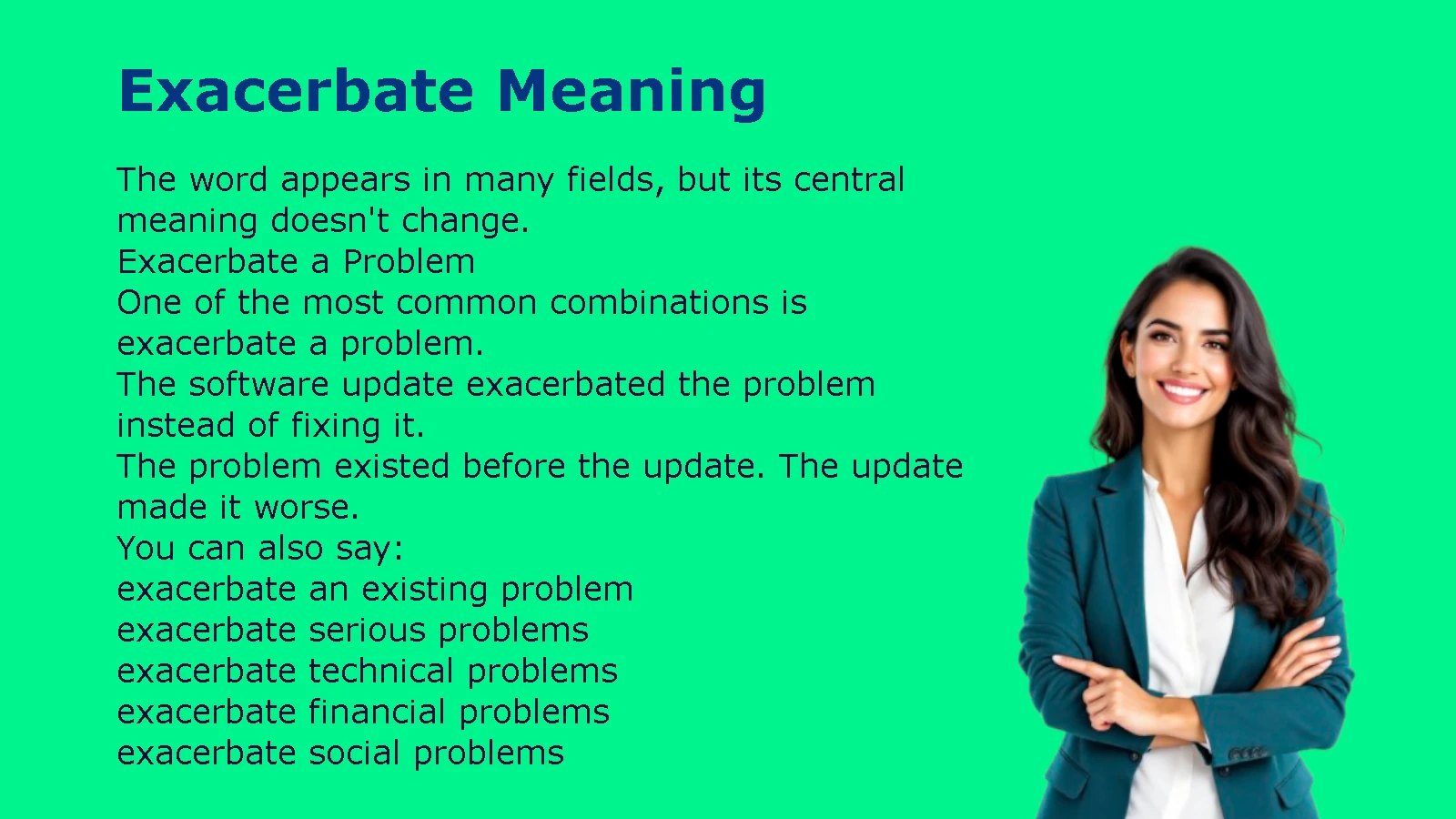
The word appears in many fields, but its central meaning doesn’t change.
Exacerbate a Problem
One of the most common combinations is exacerbate a problem.
The software update exacerbated the problem instead of fixing it.
The problem existed before the update. The update made it worse.
You can also say:
- exacerbate an existing problem
- exacerbate serious problems
- exacerbate technical problems
- exacerbate financial problems
- exacerbate social problems
Exacerbate a Situation
Exacerbate a situation means to make an already difficult situation worse.
Arguing with the customer only exacerbated the situation.
This phrase works particularly well when a person’s actions add to an existing difficulty.
For example, imagine that two coworkers already disagree. A third person makes a sarcastic comment that causes the argument to become more heated. The comment exacerbated the situation.
Exacerbate Symptoms
The word appears frequently in health-related writing.
Certain environmental factors may exacerbate symptoms.
Here, the symptoms already exist. Something makes them more noticeable or severe.
Cambridge gives the example of an allergy being exacerbated by dust. Oxford also lists the use of exacerbate with symptoms and medical conditions.
Other common combinations include:
- exacerbate pain
- exacerbate symptoms
- exacerbate inflammation
- exacerbate a condition
- exacerbate anxiety
- exacerbate an illness
Exacerbate Tensions
You can also exacerbate tensions between people or groups.
The controversial statement exacerbated tensions between the two sides.
The phrase works because tension already exists. The statement increases it.
This construction appears frequently in formal reporting and analytical writing.
Exacerbate Conflict
Similarly, an event or action can exacerbate conflict.
The aggressive response exacerbated the conflict.
The verb doesn’t necessarily mean that the action started the conflict. It means the conflict became worse because of it.
Exacerbate an Issue
Exacerbate an issue means to make an existing issue more serious or difficult.
The lack of clear instructions exacerbated the issue.
In everyday conversation, made the issue worse may sound more natural. In formal writing, exacerbated can provide a more precise and compact alternative.
Common Collocations With Exacerbate
A collocation is a combination of words that commonly appear together.
Some of the most useful combinations with exacerbate include:
| Collocation | Example |
| exacerbate a problem | The delay exacerbated the problem. |
| exacerbate the situation | His reaction exacerbated the situation. |
| exacerbate symptoms | Heat may exacerbate symptoms. |
| exacerbate tensions | The decision exacerbated tensions. |
| exacerbate conflict | The comments exacerbated conflict. |
| exacerbate a crisis | The shortage exacerbated the crisis. |
| exacerbate inequality | The change could exacerbate inequality. |
| exacerbate an issue | Poor communication exacerbated the issue. |
| exacerbate existing problems | The policy exacerbated existing problems. |
| further exacerbate | The new development could further exacerbate the crisis. |
The phrase further exacerbate deserves attention because it appears often in formal writing. It emphasizes that a situation has already worsened and may become even worse.
Exacerbate vs. Worsen
Exacerbate and worsen are close synonyms, but they don’t always sound equally natural.
Worsen is the simpler and more common everyday word.
Exacerbate is more formal and often appears in academic, professional, medical, and journalistic writing.
Compare:
The heat worsened the problem.
The heat exacerbated the problem.
Both sentences work. The second sounds more formal.
Quick Comparison
| Word | Style | Main idea |
| worsen | Everyday and general | Become or make worse |
| exacerbate | Formal | Make an existing problem or condition worse |
| make worse | Very common | Plain-language expression |
If you’re talking with a friend, make worse or worsen may be the most natural choice. If you’re writing a formal report, exacerbate can fit better.
Exacerbate vs. Aggravate
Exacerbate and aggravate overlap heavily when they mean make something worse.
For example:
The delay exacerbated the problem.
The delay aggravated the problem.
Both mean that the problem became worse.
However, aggravate has additional uses. In everyday English, it can also mean to annoy or irritate someone.
His constant interruptions aggravated me.
You can’t normally replace aggravated with exacerbated in that sentence if the intended meaning is simply “annoyed me.”
So remember:
- Exacerbate a problem = make a problem worse.
- Aggravate a problem = make a problem worse.
- Aggravate a person = annoy or irritate a person.
Exacerbate vs. Intensify
Intensify means to become or make something stronger, more extreme, or more intense.
It doesn’t always involve something negative.
For example:
The colors intensified as the sun went down.
That doesn’t involve a problem getting worse.
By contrast:
The heat exacerbated the drought.
Here, an already difficult condition became worse.
The distinction is simple:
Intensify has a broader meaning. Exacerbate usually focuses on worsening something problematic or harmful.
Exacerbate vs. Escalate
These words sometimes appear in similar sentences, but their focus differs.
Escalate means to increase in level, size, intensity, or seriousness.
The argument escalated quickly.
Exacerbate means to make an existing bad situation worse.
His comments exacerbated the argument.
Think of it this way:
- A conflict can escalate.
- An action can exacerbate the conflict.
The first describes the conflict becoming more intense. The second identifies something that contributes to making it worse.
Exacerbate vs. Exasperate
This is one of the most important distinctions to learn because the two words look and sound somewhat similar.
Exacerbate
Exacerbate means to make something worse.
The delay exacerbated the problem.
Exasperate
Exasperate means to make someone extremely annoyed or frustrated.
The repeated delays exasperated the customers.
The difference becomes easier when you focus on what changes:
| Word | Meaning | Example |
| exacerbate | Make something worse | The delay exacerbated the problem. |
| exasperate | Frustrate or annoy someone greatly | The delay exasperated the customers. |
A useful memory trick is:
Exacerbate → a bad situation gets worse.
Exasperate → a person gets frustrated.
Don’t confuse the two simply because their spellings look related. They perform different jobs in a sentence.
Synonyms for Exacerbate
Several words can replace exacerbate, although each carries slightly different shades of meaning.
Worsen
The closest everyday alternative.
The rain worsened the flooding.
Aggravate
A close synonym when it means to make a problem worse.
The delay aggravated the situation.
Intensify
Useful when something becomes stronger or more extreme.
The argument intensified.
Compound
Often used when one problem adds to another.
The shortage compounded the company’s difficulties.
Magnify
Emphasizes making something appear or become larger in effect.
The media attention magnified the controversy.
Heighten
Often describes an increase in tension, awareness, emotion, or concern.
The announcement heightened public concern.
Not every synonym works in every sentence. Worsen is usually the safest plain-English substitute, while the other choices depend more heavily on context.
Antonyms for Exacerbate
An antonym expresses the opposite idea: making a problem less severe.
Common opposites include:
- alleviate
- ease
- relieve
- mitigate
- lessen
- reduce
- improve
For example:
The treatment alleviated the symptoms.
This contrasts with:
The treatment did not exacerbate the symptoms.
Another useful pair is:
The new measures mitigated the problem.
The new measures did not exacerbate the problem.
Exacerbate vs. Mitigate
These two words often appear in the same discussions because they describe opposite effects.
Exacerbate = make a problem worse.
Mitigate = make a problem less severe or harmful.
| Word | Meaning |
| Exacerbate | Make worse |
| Mitigate | Make less severe |
| Alleviate | Relieve or reduce discomfort or difficulty |
| Worsen | Make worse |
| Ease | Reduce intensity or difficulty |
Think of them as two directions on the same scale:
Problem → exacerbate → more severe
Problem → mitigate → less severe
Word Forms of Exacerbate
Understanding the different forms helps you use the word correctly.
| Form | Part of Speech | Example |
| exacerbate | Base verb | This could exacerbate the problem. |
| exacerbates | Third-person singular | The policy exacerbates inequality. |
| exacerbated | Past tense/past participle | The storm exacerbated the flooding. |
| exacerbating | Present participle | The delay is exacerbating the problem. |
| exacerbation | Noun | The change caused an exacerbation of symptoms. |
Oxford lists the standard verb forms, while Collins also identifies exacerbation as the related noun.
Exacerbated
Exacerbated is the past tense and past participle.
The drought exacerbated water shortages.
It also works in passive constructions:
The water shortage was exacerbated by the drought.
Exacerbating
Exacerbating is the -ing form.
The shortage is exacerbating existing problems.
It can also describe an action as part of a longer phrase:
The company introduced a policy that was exacerbating employee frustration.
Exacerbation
Exacerbation is the noun form.
The treatment prevented an exacerbation of the condition.
In simple terms, an exacerbation is a worsening or increase in severity.
Common Mistakes With Exacerbate
The word isn’t difficult once you understand its core idea. Most mistakes come from using it too broadly.
Using Exacerbate When Something Isn’t Getting Worse
The word normally describes a negative change.
This sounds natural:
The delay exacerbated the problem.
This does not:
The new software exacerbated the improvement.
An improvement isn’t normally something that becomes worse because of the software. The context doesn’t fit.
Confusing Exacerbate With Exasperate
As discussed earlier:
The delay exacerbated the problem.
The problem became worse.
The delay exasperated the manager.
The manager became extremely frustrated.
Changing one letter can completely change the meaning.
Using Exacerbate When You Mean Cause
These verbs describe different relationships.
The accident caused the traffic jam.
This means the accident created the problem.
The accident exacerbated the traffic jam.
This suggests traffic congestion already existed and the accident made it worse.
The distinction matters when precision is important.
Treating Exacerbate as a Noun
Exacerbate is a verb.
Don’t write:
The exacerbation of the problem was caused by the delay. ❌
Actually, this sentence is grammatically possible because exacerbation is the noun. The mistake would be using exacerbate itself as the noun:
The exacerbate of the problem… ❌
Use:
The exacerbation of the problem…
or simply:
The problem was exacerbated…
Forgetting the Object
Because exacerbate is normally transitive, it usually needs something that becomes worse.
Better:
The heat exacerbated the drought.
Better:
The comments exacerbated tensions.
Less natural:
The heat exacerbated.
When the object matters to the meaning, include it.
Is Exacerbate a Formal Word?
Yes. Exacerbate is generally considered a formal word. Oxford labels it “formal,” and Collins also marks its use as formal.
That doesn’t mean you shouldn’t use it in conversation. It simply means that everyday speakers often choose simpler alternatives.
For example:
Formal:
The decision could exacerbate existing financial difficulties.
Everyday:
The decision could make the financial problems worse.
Both are correct. The first is more compact and formal. The second sounds more conversational.
When Exacerbate Works Well
Use it when writing:
- academic papers
- business reports
- professional documents
- news analysis
- research summaries
- formal essays
- medical or scientific writing
- policy discussions
For casual conversation, make worse or worsen may feel more natural.
Is Exacerbate a Negative Word?
In normal modern usage, exacerbate has a negative meaning because it describes making something bad or problematic worse.
You might see it with:
- problems
- symptoms
- disease
- conflict
- tensions
- inequality
- poverty
- shortages
- crises
- risks
- difficulties
- concerns
For example:
The shortage exacerbated the crisis.
The word doesn’t necessarily describe an evil intention. Someone can exacerbate a problem accidentally.
His attempt to help actually exacerbated the situation.
The person may have intended to help. The result still made the situation worse.
That distinction is useful. Exacerbate describes the effect of an action rather than necessarily the person’s intention.
A Closer Look at the Meaning: Existing Problem + Worsening Factor
The easiest way to understand exacerbate is to break its meaning into two parts.
Step One: Something Is Already Wrong
There is an existing:
- problem
- illness
- conflict
- difficulty
- shortage
- crisis
- tension
- negative condition
Step Two: Something Makes It Worse
Another factor increases its severity.
For example:
Existing problem: The road is already congested.
New factor: An accident blocks another lane.
Result: Traffic becomes even worse.
So you could say:
The accident exacerbated the traffic problem.
This pattern appears again and again in real English.
Case Study: Why Context Changes the Best Word
Consider a workplace where employees already face heavy workloads.
A manager introduces a complicated reporting system. Employees now spend even more time on administrative tasks.
You could say:
The new reporting system caused problems.
That’s possible, but it doesn’t tell the full story.
A more precise sentence would be:
The new reporting system exacerbated existing workload problems.
Why?
Because the workload problem was already there. The new system made it worse.
Now imagine a different situation. A company introduces a new system and employees experience workload problems for the first time.
In that case:
The new system caused workload problems.
That distinction shows why exacerbate isn’t simply a fancy replacement for cause.
How to Decide Whether to Use Exacerbate
Before using the word, ask yourself four quick questions:
- Is there already a problem or negative condition?
- Did something make that condition worse?
- Am I describing the worsening effect?
- Would “make worse” fit the sentence?
If the answer to all four is yes, exacerbate is probably a good fit.
Quick Test
Original idea:
The lack of sleep made his stress worse.
Replace “made worse” with exacerbated:
The lack of sleep exacerbated his stress.
The meaning remains clear.
Now try:
The lack of sleep created his stress.
That’s a different claim. Created says something about the origin of the stress. Exacerbated says the stress already existed and became worse.
Exacerbate in Formal vs. Everyday English
The following comparison shows how the same idea can sound in different registers.
| Formal English | Everyday English |
| The delay exacerbated the problem. | The delay made the problem worse. |
| The policy exacerbated existing difficulties. | The policy made existing problems worse. |
| Heat can exacerbate symptoms. | Heat can make symptoms worse. |
| His comments exacerbated tensions. | His comments made things more tense. |
| The shortage exacerbated the crisis. | The shortage made the crisis worse. |
Neither style is automatically better.
The best choice depends on your audience. Exacerbate is useful when you want concise, formal wording. Make worse is often clearer for a general audience.
Origin and Etymology of Exacerbate
The history of exacerbate goes back to Latin.
Oxford traces it to the Latin exacerbatus, related to exacerbare, with connections to the idea of making something harsh or bitter. Oxford dates the English word to the mid-17th century.
Collins similarly traces the word to Latin exacerbāre and connects it with acerbus, meaning bitter.
The modern English meaning developed around the idea of making something more severe, harsh, or unpleasant.
That historical sense still fits the modern word surprisingly well: when something exacerbates a problem, it adds to its severity.
Real-World Usage of Exacerbate
The word appears across many types of formal writing because it describes cause-and-effect relationships efficiently.
Dictionary examples show exacerbate being used with problems, symptoms, tensions, costs, conditions, and other negative circumstances.
For example:
The symptoms may be exacerbated by certain drugs.
Oxford uses this structure to illustrate how the verb can describe something that increases the severity of an existing medical condition.
Cambridge likewise gives examples involving allergies, pollution, tense relationships, recruitment problems, and social or economic difficulties.
The broader pattern is easy to spot:
Existing difficulty + worsening factor = exacerbation
That pattern explains why the word works in so many fields.
Frequently Asked Questions About Exacerbate
What does exacerbate mean in simple words?
Exacerbate means to make something that is already bad or difficult worse.
A simple synonym is worsen.
What is an example of exacerbate?
Heavy rain exacerbated the flooding.
The flooding already existed. The rain made it more severe.
Is exacerbate positive or negative?
Exacerbate normally has a negative meaning. It describes an increase in the severity of an existing problem, difficulty, condition, or other negative situation.
What is another word for exacerbate?
The closest everyday synonym is worsen. Other alternatives include aggravate, intensify, compound, magnify, and heighten, depending on context.
What is the difference between exacerbate and aggravate?
Both can mean make something worse.
However, aggravate also commonly means to annoy or irritate someone.
The delay aggravated the problem.
The delay aggravated the manager.
The first means made the problem worse. The second can mean annoyed the manager.
What is the difference between exacerbate and exasperate?
Exacerbate means make something worse.
Exasperate means frustrate or annoy someone greatly.
The delay exacerbated the problem.
The delay exasperated the customers.
Is exacerbate a verb?
Yes. Exacerbate is a verb, specifically a transitive verb that normally takes an object.
The storm exacerbated the flooding.
What is the past tense of exacerbate?
The past tense is exacerbated.
The storm exacerbated the flooding.
The past participle is also exacerbated.
The flooding was exacerbated by the storm.
Can exacerbate mean make worse?
Yes. Make worse is the simplest way to understand exacerbate. Cambridge, Oxford, and Collins all center their definitions on this idea.
Is exacerbate a formal word?
Yes. Major dictionaries classify it as a formal word. It’s especially common in academic, professional, medical, scientific, and journalistic writing.
What is the opposite of exacerbate?
Common opposites include mitigate, alleviate, ease, lessen, reduce, and relieve.
The exact choice depends on context.
How do you pronounce exacerbate?
In US English, Cambridge gives the pronunciation /ɪɡˈzæs.ɚ.beɪt/. The stress falls on the second syllable.
Exacerbate Meaning in a Nutshell
Exacerbate means to make an existing problem, bad situation, condition, or difficulty worse.
The most important point is that the problem usually already exists. Something else increases its severity.
Remember these examples:
- Rain exacerbated the flooding.
- The delay exacerbated the problem.
- Heat exacerbated the symptoms.
- His comments exacerbated tensions.
- Poor communication exacerbated the conflict.
If you need a simple replacement, use worsen or make worse. If you’re writing in a more formal style, exacerbate offers a precise way to describe how an existing problem becomes more severe.
The easiest distinction to remember is this:
Exacerbate = make an existing bad situation worse.
Once that idea clicks, the word becomes much easier to recognize and use correctly.













