Loose cannon means a person who behaves unpredictably and may cause trouble or problems because they act without thinking about the consequences. The phrase often describes someone who is difficult to control and whose actions could create unexpected risks.
If you’re searching for “loose cannon meaning,” “what does loose cannon mean,” or “loose cannon definition,” you’re likely looking for its simple meaning and how to use it in a sentence. In modern English, loose cannon usually describes a person who acts impulsively, ignores instructions, or says and does unexpected things. It often has a negative meaning because the person can create problems for others.
| Question | Answer |
|---|---|
| What does loose cannon mean? | An unpredictable person who may cause trouble or problems. |
| What is the meaning of loose cannon? | Someone who acts without thinking and can be difficult to control. |
| Is loose cannon a negative phrase? | Yes, it usually describes unpredictable or reckless behavior. |
| What is a synonym for loose cannon? | Wild card, risk taker, troublemaker, or unpredictable person. |
What Does “Loose Cannon” Mean?
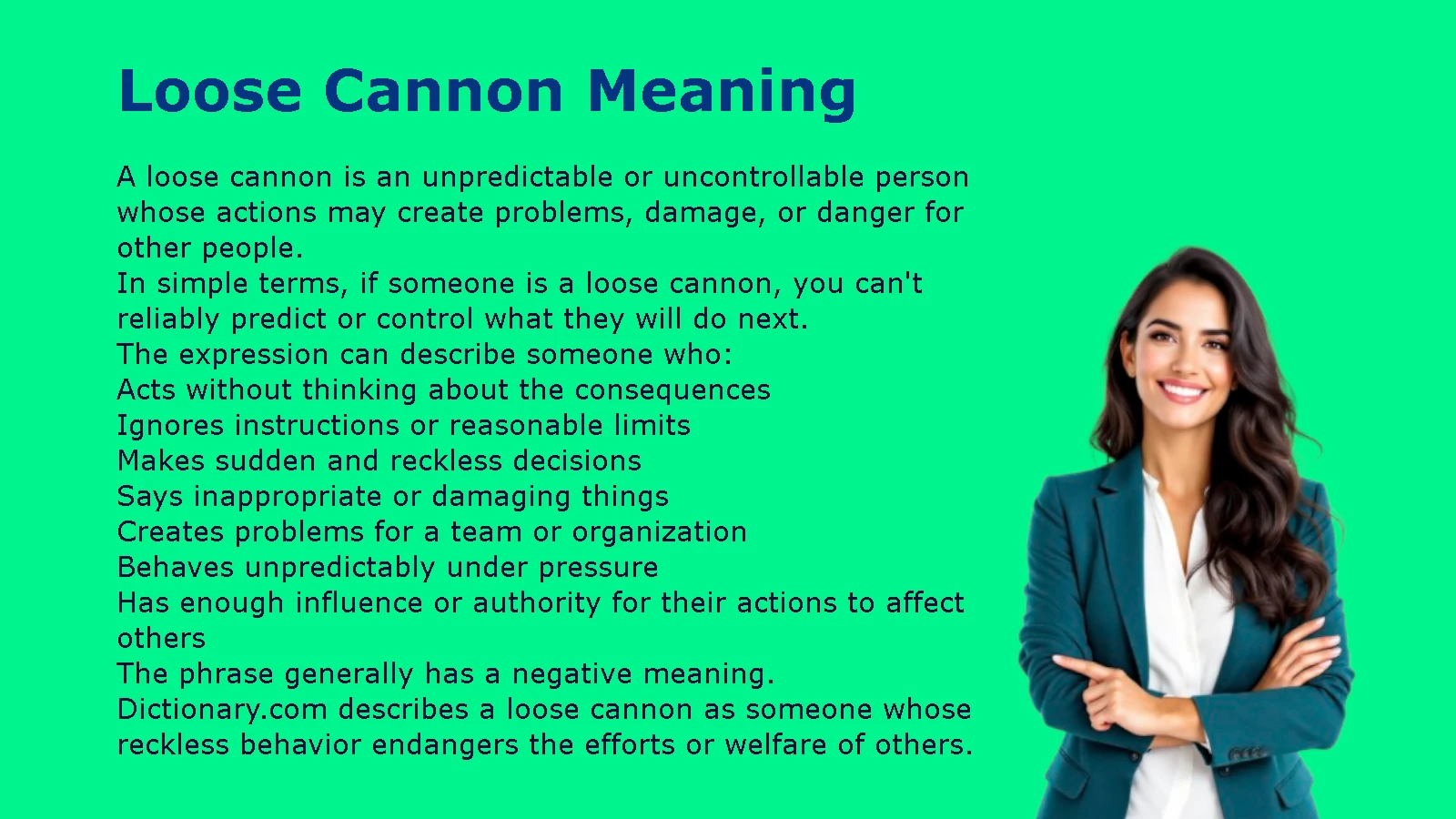
A loose cannon is an unpredictable or uncontrollable person whose actions may create problems, damage, or danger for other people.
In simple terms, if someone is a loose cannon, you can’t reliably predict or control what they will do next.
The expression can describe someone who:
- Acts without thinking about the consequences
- Ignores instructions or reasonable limits
- Makes sudden and reckless decisions
- Says inappropriate or damaging things
- Creates problems for a team or organization
- Behaves unpredictably under pressure
- Has enough influence or authority for their actions to affect others
The phrase generally has a negative meaning. Dictionary.com describes a loose cannon as someone whose reckless behavior endangers the efforts or welfare of others.
Loose Cannon Meaning in Simple English
Loose cannon: An unpredictable person who may cause trouble or harm because they are difficult to control.
For example:
Everyone likes Marcus, but he’s a loose cannon when he’s angry.
This means Marcus may act recklessly or unpredictably when he becomes angry. His behavior could create problems for himself or other people.
Another example:
The company can’t afford to have a loose cannon speaking to the press.
Here, the concern isn’t necessarily physical danger. The person could make careless statements that damage the company’s reputation.
That’s an important point. A loose cannon doesn’t have to be violent. The danger can come from words, decisions, impulsive behavior, public statements, or poor judgment.
What Is the Loose Cannon Definition?
The core definition has three important parts:
| Element | What it means |
| Unpredictability | You can’t easily anticipate what the person will do. |
| Lack of control | The person doesn’t reliably follow rules, plans, or guidance. |
| Potential consequences | Their behavior can create trouble, damage, or risk. |
All three ideas matter.
Calling someone a loose cannon simply because they’re unusual doesn’t quite work. Likewise, a person who makes one mistake isn’t automatically a loose cannon.
The expression suggests a pattern or quality of behavior that makes the person difficult to manage.
What Makes Someone a Loose Cannon?
Imagine a manager who regularly changes important decisions without telling the team. One week, she promises a client one thing. The next week, she announces something completely different. When employees question her decisions, she becomes angry and acts without consulting anyone.
She isn’t merely disorganized.
She may be described as a loose cannon because her unpredictable decisions can affect everyone around her.
The same idea applies in politics, sports, business, entertainment, families, and many other settings.
Why Is Someone Called a “Loose Cannon”?
The expression comes from the literal image of a cannon that has broken free from its restraints.
Historic sailing warships carried heavy cannons on wheeled carriages. These guns had to deal with enormous recoil when fired, and the movement of the ship added another layer of danger. A cannon that became detached could move violently around the deck.
The metaphor is straightforward:
Controlled cannon → predictable and useful
Loose cannon → uncontrolled and dangerous
That physical image became a powerful way to describe people whose behavior could suddenly cause damage.
However, the popular story needs an important qualification. There is good evidence for the literal nautical image, but there is not strong evidence that sailors regularly used “loose cannon” as an established everyday idiom during the sailing era. Phrase Finder notes that the expression’s nautical connection owes much to literary imagination rather than clear evidence of routine sailor usage.
That distinction makes the history more interesting, not less.
The Origin of “Loose Cannon”
The history of “loose cannon” reaches back further than the modern expression might suggest.
Victor Hugo and Ninety-Three
One of the most important pieces of the story appears in Victor Hugo’s 1874 novel Ninety-Three.
Hugo describes a cannon that has broken loose aboard a ship. The cannon becomes almost like a living creature as it rolls, crashes, and destroys things across the deck.
The English text describes it as a cannon that had “become loose” and portrays it as one of the most terrifying dangers that could occur at sea.
Hugo’s description captures the metaphor perfectly. The cannon has tremendous power but no conscious purpose. It doesn’t choose its victims. It simply moves according to the motion of the ship, the sea, and the wind.
That is remarkably close to the modern figurative meaning.
A person described as a loose cannon can behave in much the same way. Their actions may not follow a clear plan. Their behavior can instead seem driven by impulse, anger, ego, or circumstances.
Henry Kingsley’s 1875 Use
The phrase appeared in English soon after Hugo’s novel.
Phrase Finder identifies Henry Kingsley’s 1875 novel Number Seventeen as an early English use of the exact expression “loose cannon.” Kingsley referred to Hugo’s famous scene when describing a dangerous situation aboard a ship.
That detail matters because it challenges a common oversimplification.
The phrase wasn’t necessarily born as ordinary sailor slang. Instead, a dramatic literary image helped turn a literal nautical danger into a memorable metaphor.
The 1889 Figurative Use
By 1889, the expression had moved into clearly figurative territory.
Phrase Finder cites an 1889 example from The Galveston Daily News that used “a loose cannon in a storm-tossed ship” metaphorically.
That example shows the metaphor doing what good idioms often do: taking a concrete image and applying it to a complicated human or political situation.
Instead of explaining several sentences about someone whose actions could disrupt an entire group, a writer could simply call that person a loose cannon.
The picture did the heavy lifting.
Theodore Roosevelt and the Loose Cannon Image
The expression also became associated with Theodore Roosevelt.
Phrase Finder records a recollection in which Roosevelt reportedly described himself as “the old cannon loose on the deck in the storm.”
This wording is slightly different from the modern idiom, but the underlying metaphor is the same: a powerful force operating without restraint.
The Roosevelt connection is useful historical context. However, it shouldn’t be presented as proof that Roosevelt invented the phrase. The evidence places the expression and its metaphorical development earlier.
When Did “Loose Cannon” Become a Modern Idiom?
The Online Etymology Dictionary records the figurative noun “loose cannon” by 1896, defining it in terms of a wildly irresponsible person or a powerful person or thing freed from normal restraint. It also connects the figurative usage to Hugo’s literary scene.
Different dictionaries use different criteria for their “first known use” dates. For that reason, it’s better to distinguish between early documented appearances and the date when the expression became common in modern English.
The important timeline looks like this:
| Year | Development |
| 1874 | Victor Hugo describes a terrifying loose cannon in Ninety-Three. |
| 1875 | Henry Kingsley uses the expression “loose cannon” in Number Seventeen. |
| 1889 | A figurative use appears in The Galveston Daily News. |
| 1896 | Etymonline records the figurative noun in English. |
| 20th century onward | The expression becomes established as a general metaphor for an uncontrollable person or force. |
The exact dating of an idiom can vary by source because dictionaries track different kinds of evidence. Still, the broader history is clear: the metaphor is much older than its modern popularity.
What Does “Loose Cannon” Mean in Different Contexts?
The meaning stays broadly consistent across situations, but the type of damage can change.
Loose Cannon at Work
In a workplace, a loose cannon may be an employee, manager, executive, or spokesperson who acts without considering how their decisions affect others.
For example:
The director is a loose cannon who keeps making promises to clients without consulting the project team.
The person doesn’t simply make mistakes. Their behavior creates uncertainty for everyone else.
A workplace loose cannon might:
- Make unauthorized promises
- Reveal confidential information
- Ignore company procedures
- Send inflammatory emails
- Make sudden decisions
- Publicly criticize colleagues
- Create unnecessary conflicts
Loose Cannon in Politics
Politics provides an especially common setting for this expression.
A politician may earn the label if they repeatedly make unexpected statements or take actions that conflict with their own party, administration, or campaign.
For example:
The senator became known as a loose cannon after several unexpected public statements.
The phrase works because political organizations depend heavily on coordination. One person’s unpredictable behavior can affect an entire campaign or administration.
Loose Cannon in Sports
A player can also become a loose cannon when emotional or reckless behavior repeatedly creates problems for a team.
For example:
The midfielder is a talented player, but his temper can turn him into a loose cannon during close matches.
Here, the person might have genuine skill. That’s an important nuance.
Being a loose cannon doesn’t mean someone is incompetent.
In fact, the person may be highly capable. The problem is that their talent comes with behavior that others cannot reliably control.
Loose Cannon in a Family
The idiom also works in ordinary social situations.
Uncle James is the family’s loose cannon. You never know what he’ll say at dinner.
This use may be less serious than a political or workplace example.
Someone might be called a loose cannon because they make shocking comments, start arguments, or behave unpredictably.
The phrase can therefore be serious or somewhat humorous depending on context.
Loose Cannon Examples
Here are several natural examples showing how the phrase works in real sentences.
| Situation | Example |
| Workplace | Our new supervisor is a loose cannon who changes the schedule without warning. |
| Politics | Party leaders worry that the candidate is becoming a loose cannon. |
| Sports | His aggressive behavior on the field makes him a loose cannon. |
| Business | Investors don’t want a loose cannon making major financial decisions. |
| Family | Everyone knows Mia is the loose cannon at family gatherings. |
| School | The student wasn’t dangerous, but teachers considered him a loose cannon because he often acted without thinking. |
| Media | The network hesitated to put him on live television because they considered him a loose cannon. |
| Friendship | He’s fun to travel with, but he’s also a bit of a loose cannon. |
Notice how the expression always suggests unpredictability with consequences.
When Should You Call Someone a “Loose Cannon”?
The phrase works best when a person’s behavior creates a genuine problem for the people around them.
A person may be a loose cannon if they:
- Repeatedly act on impulse
- Ignore reasonable instructions
- Make risky decisions without consultation
- Create conflict unexpectedly
- Say things that damage relationships or reputations
- Cannot be trusted to follow an agreed plan
- Have enough power or influence to make their behavior consequential
For example, an employee who occasionally forgets a deadline probably isn’t a loose cannon.
An employee who repeatedly ignores instructions, makes unauthorized commitments, and creates major problems for clients might be.
Being Unusual Isn’t Enough
This distinction is easy to miss.
A person can be eccentric without being a loose cannon.
Someone might wear unusual clothes, have strange hobbies, or hold unconventional opinions. None of those qualities automatically make that person a loose cannon.
The idiom focuses on behavior that is uncontrolled, unpredictable, and potentially disruptive.
Being Outspoken Isn’t Enough Either
An outspoken person isn’t necessarily a loose cannon.
A journalist who asks difficult questions can be outspoken while remaining disciplined and professional.
A politician who openly disagrees with party leaders can be outspoken without being reckless.
The phrase becomes appropriate when the person’s unpredictability creates a serious risk of trouble.
Is “Loose Cannon” Always Negative?
Usually, yes.
Cambridge Dictionary labels the expression disapproving, which reflects its normal tone.
Calling someone a loose cannon generally means that you see their behavior as a problem.
However, context can soften the phrase.
For example:
He’s a bit of a loose cannon, but that’s what makes his comedy so entertaining.
Here, the speaker recognizes the person’s unpredictability but isn’t necessarily condemning them.
Even in this softer use, though, the basic idea remains: you don’t know what the person will do next.
Can “Loose Cannon” Describe a Thing?
Yes.
Although the expression most often describes people, dictionaries also allow it to refer to a thing or force that is difficult to control and potentially damaging. Dictionary.com gives both person and thing related definitions.
For example:
The outdated software became a loose cannon inside the company’s network.
Or:
That machine is a loose cannon if nobody checks its safety settings.
This use is less common than the personal sense, but it follows the original metaphor naturally.
A thing can be a loose cannon when it has power, unpredictable effects, and insufficient control.
Loose Cannon vs. Wild Card
These expressions overlap, but they aren’t identical.
| Expression | Main idea | Typical tone |
| Loose cannon | An unpredictable person who may cause trouble or damage | Negative |
| Wild card | A person or factor whose behavior or result is difficult to predict | Neutral to negative |
| Reckless person | Someone who takes risks without proper care | Negative |
| Volatile person | Someone likely to change suddenly, especially emotionally | Negative |
| Troublemaker | Someone who causes problems | Negative |
| Unpredictable person | Someone whose behavior is difficult to anticipate | Neutral |
Loose Cannon vs. Wild Card
The difference is subtle but important.
A wild card is unpredictable.
A loose cannon is unpredictable and potentially disruptive or dangerous.
For example:
The rookie is a wild card.
This could mean the rookie might unexpectedly perform extremely well.
But:
The rookie is a loose cannon.
This suggests the rookie may make reckless decisions or cause problems for the team.
So a wild card isn’t necessarily bad.
A loose cannon usually is.
Loose Cannon Synonyms
No synonym matches the idiom perfectly in every situation. Still, several words and phrases come close.
Unpredictable person
This is the broadest alternative.
It emphasizes uncertainty but doesn’t necessarily imply danger.
Reckless person
This focuses on careless risk taking.
Someone can be reckless without being unpredictable. Likewise, someone can be unpredictable without taking reckless risks.
Volatile person
This often describes someone whose emotions or behavior can change suddenly.
It’s particularly useful when anger or emotional instability drives the person’s actions.
Troublemaker
This focuses on the problems someone causes.
A troublemaker doesn’t have to be unpredictable, though.
Wild card
This is probably the closest common expression in terms of unpredictability. However, wild card lacks the stronger sense of potential harm that comes with loose cannon.
Uncontrollable person
This emphasizes the lack of control directly.
It’s accurate but less colorful than the idiom.
Antonyms of “Loose Cannon”
The opposite of a loose cannon is someone who is predictable, responsible, and dependable.
Useful alternatives include:
- Reliable person
- Dependable person
- Responsible person
- Steady hand
- Level headed person
- Disciplined person
- Predictable person
- Calm decision maker
The phrase “steady hand” makes an especially useful contrast.
A loose cannon creates uncertainty.
A steady hand creates stability.
How to Use “Loose Cannon” in a Sentence
“Loose cannon” is a noun phrase. You can use it after verbs such as be, become, seem, consider, and call.
Common sentence patterns
Someone is a loose cannon.
He’s a loose cannon when he’s under pressure.
Someone is becoming a loose cannon.
The executive is becoming a loose cannon after several controversial decisions.
Someone is considered a loose cannon.
She is considered a loose cannon by several members of the team.
Someone has a reputation for being a loose cannon.
The coach has a reputation for being a loose cannon during interviews.
Someone acts like a loose cannon.
He acted like a loose cannon after the announcement.
These structures let you describe both a person’s general reputation and a particular period of unpredictable behavior.
Is “Loose Cannon” Formal or Informal?
“Loose cannon” is an established English idiom, but it has a conversational and figurative quality.
You can find it in:
- Journalism
- Political commentary
- Business writing
- Sports writing
- Interviews
- Everyday conversation
- Opinion pieces
- Entertainment coverage
Still, the phrase may sound too informal for certain technical or highly formal documents.
Instead of:
The employee is a loose cannon.
A formal report might say:
The employee’s unpredictable conduct presents a significant operational risk.
The second version sounds more objective and professional.
The first is shorter and more vivid.
That’s the great strength of idioms: a few words can carry an entire picture.
Common Mistakes With “Loose Cannon”
Mistake: Writing “lose cannon”
The correct spelling is:
loose cannon
Not:
lose cannon
The words loose and lose have different meanings.
- Loose means not firmly attached, restrained, or controlled.
- Lose means to no longer have something or to fail to win or keep something.
Because the idiom comes from the idea of something becoming loose, the correct expression is “loose cannon.”
Mistake: Using It for Every Careless Person
A careless person isn’t automatically a loose cannon.
Consider these two situations:
Jake forgot to send the email.
That’s a mistake.
Jake repeatedly ignores instructions, makes unauthorized decisions, and creates problems for clients.
That behavior could justify calling Jake a loose cannon.
The difference is pattern, unpredictability, and potential consequences.
Mistake: Assuming It Means “Violent Person”
A loose cannon doesn’t have to be physically dangerous.
Someone can be a loose cannon because they:
- Leak information
- Make reckless business decisions
- Start public arguments
- Say offensive things
- Ignore instructions
- Make unpredictable political statements
- Create unnecessary conflicts
The danger can be social, financial, professional, political, or reputational.
Mistake: Treating “Loose Cannon” and “Wild Card” as Exact Synonyms
They’re close, but the emotional force differs.
A wild card might unexpectedly save the day.
A loose cannon is more likely to make everyone reach for the emergency brake.
A Simple Case Study: Why the Metaphor Works
Imagine a five person project team preparing an important presentation.
Four members agree on the plan. They know who will speak, what data they will present, and which promises they can make to the client.
The fifth member is highly talented.
However, during the meeting, that person suddenly announces a new deadline without consulting anyone. They promise features that the company hasn’t built. Then they criticize another team member in front of the client.
The team now has several problems.
The person’s skill isn’t the issue.
Their unpredictability is.
The team can’t confidently plan around them because their next action could create another problem.
That’s precisely why “loose cannon” works as a metaphor.
The person has power, but the group can’t control how that power gets used.
Why the Loose Cannon Metaphor Is So Effective
The expression survives because it compresses a complicated idea into a striking image.
Compare these two sentences:
The manager often behaves unpredictably and makes decisions without considering how they affect the rest of the organization.
That’s clear, but it’s long.
Now consider:
The manager is a loose cannon.
The second sentence immediately creates a picture.
You can almost see the cannon rolling across the deck.
That image communicates several ideas at once:
- Movement without control
- Power without restraint
- Unpredictability
- Danger
- Risk to allies as well as opponents
- Difficulty stopping the problem once it begins
That’s what makes a good idiom memorable. It doesn’t merely define an idea. It gives the idea a shape.
Loose Cannon in Modern English
Today, the phrase appears in many areas of public and private life.
Dictionary.com examples show the expression continuing to appear in modern journalism and commentary, including discussions involving politics, sports, law enforcement, and public figures.
The idiom remains useful because modern organizations still face the same basic problem: one unpredictable person can affect an entire group.
A loose cannon might be:
- A politician making unexpected statements
- A company executive making risky decisions
- An athlete losing control during competition
- A celebrity making impulsive public comments
- An employee ignoring established procedures
- A friend making reckless decisions during a group trip
- A team member who repeatedly acts without consulting others
The setting changes.
The metaphor doesn’t.
What Is the Difference Between a Loose Cannon and a Reckless Person?
A reckless person takes unnecessary risks without enough concern for the consequences.
A loose cannon is broader.
The person may be reckless, but the defining feature is that their behavior is unpredictable and difficult to control, especially when that behavior threatens others or a shared goal.
For example:
He drove recklessly through the city.
This tells you about one type of behavior.
He’s a loose cannon.
This suggests a broader pattern. You might expect unpredictable decisions in several situations, not just behind the wheel.
What Is the Difference Between a Loose Cannon and a Troublemaker?
A troublemaker deliberately or repeatedly causes problems.
A loose cannon doesn’t necessarily intend to cause trouble.
That’s an important distinction.
A person might create serious problems through impulsive behavior without wanting to hurt anyone.
The metaphor often suggests unintentional or uncontrolled damage, which is one reason it differs from troublemaker.
What Is the Difference Between a Loose Cannon and a Volatile Person?
A volatile person is often emotionally unpredictable, especially prone to sudden anger or intense reactions.
A loose cannon doesn’t have to be emotional.
Someone can calmly make reckless decisions and still qualify as a loose cannon.
For example:
The executive isn’t emotional, but she’s a loose cannon because she makes major decisions without warning anyone.
That sentence makes the distinction clear.
Volatile often points toward emotional instability.
Loose cannon points toward uncontrolled consequences.
Frequently Asked Questions About Loose Cannon Meaning
What does “loose cannon” mean in simple words?
A loose cannon is an unpredictable person who may cause trouble or damage because they are difficult to control.
Is “loose cannon” an idiom?
Yes. “Loose cannon” is an English idiom because its figurative meaning goes beyond the literal image of a cannon that has come loose.
Is “loose cannon” positive or negative?
It is generally negative or disapproving. The expression suggests that someone’s unpredictable behavior creates risk or problems. Cambridge specifically labels the term as disapproving.
Is calling someone a loose cannon an insult?
It can be. The phrase usually criticizes someone’s behavior or reliability. However, speakers sometimes use it humorously for a person who is unpredictable without being seriously dangerous.
Can a woman be called a loose cannon?
Yes. “Loose cannon” is gender neutral.
For example:
She’s a loose cannon when negotiations become tense.
Can an object be a loose cannon?
Yes. The expression can describe a thing or force that has become difficult to control and may cause damage.
What is another word for loose cannon?
Depending on the context, alternatives include unpredictable person, reckless person, volatile person, uncontrollable person, troublemaker, and wild card.
None is a perfect substitute in every sentence.
What is the opposite of a loose cannon?
Possible opposites include reliable person, responsible person, dependable person, disciplined person, and steady hand.
What is the difference between “loose cannon” and “wild card”?
A wild card is mainly unpredictable. A loose cannon is unpredictable in a way that is likely to create trouble, damage, or risk.
Where did the phrase “loose cannon” come from?
The expression draws on the danger of a cannon breaking free aboard a sailing ship. Its documented figurative history is closely connected with Victor Hugo’s 1874 novel Ninety-Three, followed by an English use of the exact phrase in Henry Kingsley’s 1875 novel Number Seventeen.
Did sailors invent the phrase “loose cannon”?
There isn’t strong evidence that sailors routinely used the exact expression as established slang during the sailing era. The nautical image is real, but surviving evidence points to literary usage playing an important role in the phrase’s development.
When was “loose cannon” first used figuratively?
The Online Etymology Dictionary records the figurative noun by 1896, while earlier literary and newspaper examples show the metaphor developing during the late 19th century.
Final Thoughts on the Loose Cannon Meaning
The loose cannon meaning is simple at its core: an unpredictable and difficult to control person whose behavior may cause trouble or damage.
The expression gets its force from a vivid maritime image. A cannon that breaks free from its restraints can move unpredictably across a ship, putting people and equipment in danger. That physical danger became a powerful metaphor for human behavior.
The history is more nuanced than the familiar claim that sailors simply coined the phrase. Victor Hugo’s Ninety-Three contains a dramatic description of a cannon that has broken loose, and Henry Kingsley’s Number Seventeen used the exact English expression soon afterward. Later figurative examples helped establish the phrase in English.
In everyday English, use “loose cannon” when unpredictability and potential trouble go hand in hand. Don’t use it merely for someone who is unusual, outspoken, or occasionally careless.
A wild card may surprise you.
A reckless person may take unnecessary risks.
A troublemaker may deliberately cause problems.
But a loose cannon is something more specific: a person whose lack of control makes everyone wonder what might happen next.