Have you ever come across the phrase fair dinkum and wondered what it actually means? This distinctly Australian expression can sound confusing if you haven’t heard it before, but its meaning becomes clear once you understand how Australians use it in everyday conversation.
Fair dinkum usually means genuine, honest, authentic, or true. It can describe a person who is trustworthy, something that is real or legitimate, or a situation that is exactly as someone says. Depending on the context, fair dinkum can also express surprise, disbelief, or agreement, making it a flexible phrase in Australian English.
Examples:
- He’s a fair dinkum bloke who always keeps his word.
- Fair dinkum? You really won the competition?
The phrase can be confusing because people often search for fair dinkum meaning, what does fair dinkum mean, fair dinkum definition, or fair dinkum Australian meaning after hearing it in a conversation, movie, or Australian TV show. And here’s the interesting part: fair dinkum doesn’t always carry exactly the same tone. Its meaning can shift depending on the speaker, sentence, and situation.
In this guide, you’ll learn the complete fair dinkum meaning, including its definition, pronunciation, origin, usage, and meaning in Australian English. You’ll also see clear examples that show how Australians use this expression in real conversations, along with common phrases and contexts to help you understand it naturally.
What Does Fair Dinkum Mean?
Fair dinkum means genuine, honest, real, or true. In conversation, however, it can also work as an exclamation meaning “Really?”, “Seriously?”, or “Is that actually true?”
The intended meaning becomes much easier to understand when you look at the sentence around it.
| Use of fair dinkum | Meaning | Example |
| Describing something | Genuine or authentic | “That’s a fair dinkum Australian product.” |
| Describing a person | Honest, sincere, or genuine | “He’s a fair dinkum bloke.” |
| Emphasizing truth | Truly or honestly | “I’m fair dinkum telling you.” |
| Asking a question | Really? Is that true? | “Fair dinkum?” |
| Expressing surprise | Seriously? You’re not joking? | “Fair dinkum? You actually met him?” |
| Expressing approval or fairness | Fair or reasonable | “That’s fair dinkum for the work involved.” |
The phrase therefore doesn’t translate neatly into one English word.
For example, “fair dinkum” might mean genuine in one sentence and really? in another. A dictionary definition alone doesn’t capture that conversational range.
Fair Dinkum Meaning in Simple Words
If you want the simplest explanation, think of fair dinkum as a way of emphasizing that something is real, honest, genuine, or true.
When someone asks:
“Fair dinkum?”
they’re essentially asking:
“Really?”
When someone says:
“He’s fair dinkum.”
they could mean:
“He’s genuine and honest.”
When someone says:
“That’s a fair dinkum story.”
the meaning is closer to:
“That’s a genuine or true story.”
The phrase can also carry a distinctly Australian conversational flavor. That’s important because replacing it with a dictionary synonym can remove some of its tone and cultural identity.
Fair Dinkum Meaning in Different Contexts
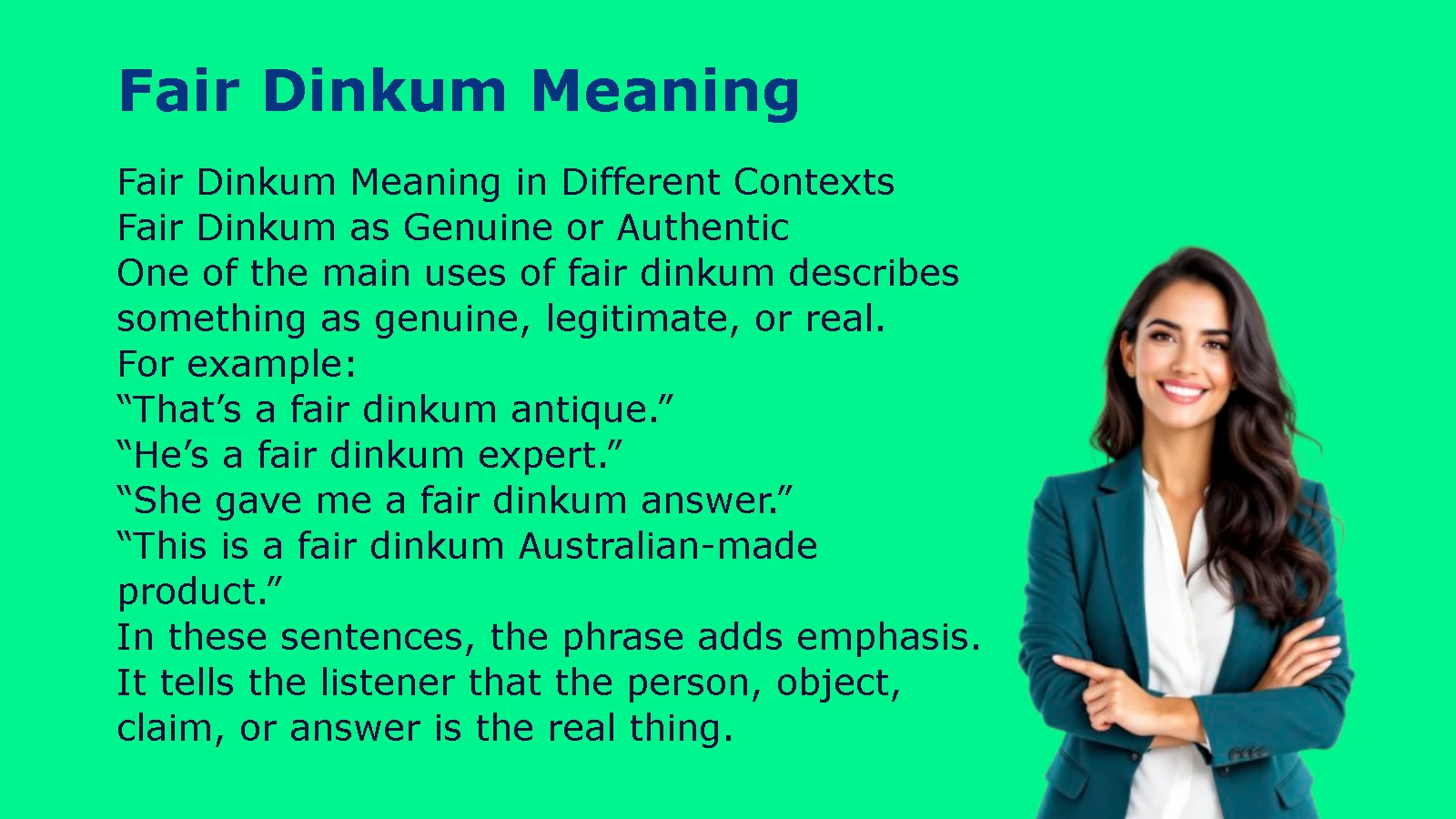
Fair Dinkum as Genuine or Authentic
One of the main uses of fair dinkum describes something as genuine, legitimate, or real.
For example:
- “That’s a fair dinkum antique.”
- “He’s a fair dinkum expert.”
- “She gave me a fair dinkum answer.”
- “This is a fair dinkum Australian-made product.”
In these sentences, the phrase adds emphasis. It tells the listener that the person, object, claim, or answer is the real thing.
This use is close to words such as genuine, authentic, legitimate, and sincere.
However, the exact replacement depends on what you’re describing. Calling a person fair dinkum can suggest honesty or straightforwardness. Calling an object fair dinkum can suggest authenticity.
Fair Dinkum as “Really?” or “Seriously?”
The question “Fair dinkum?” has a different feel.
Suppose someone tells a friend:
“I just won a new car.”
The friend might respond:
“Fair dinkum?”
Here, the speaker wants confirmation. The phrase can communicate surprise, skepticism, or genuine curiosity.
It can therefore overlap with:
- Really?
- Seriously?
- Is that true?
- For real?
- No kidding?
- You’re serious?
Cambridge specifically notes that fair dinkum can function as an exclamation used to verify a dubious statement.
Fair Dinkum as an Emphasis of Truth
The expression can also strengthen a statement.
Consider:
“I’m being fair dinkum with you.”
The speaker is emphasizing that they’re being straightforward and honest.
In this setting, fair dinkum doesn’t simply mean “fair.” It reinforces the speaker’s claim that they’re telling the truth or speaking sincerely.
That’s one reason translating the phrase word for word doesn’t work very well.
Fair Dinkum Examples in Sentences
Seeing the phrase in different situations makes its meaning much clearer.
Examples Meaning Genuine or True
- He’s a fair dinkum professional who takes his work seriously.
- That’s a fair dinkum Australian tradition.
- She gave us a fair dinkum explanation.
- You can trust him because he’s fair dinkum.
- That’s a fair dinkum story, not something he made up.
- The shop sells fair dinkum local products.
- He seems like a fair dinkum bloke.
- They wanted a fair dinkum answer instead of excuses.
In these examples, the expression generally points toward genuineness, honesty, or authenticity.
Examples Meaning “Really?” or “Seriously?”
- “I met the prime minister yesterday.” “Fair dinkum?”
- “She bought the house in cash.” “Fair dinkum?”
- “They drove all the way across the country.” “Fair dinkum?”
- “He finished the marathon without training.” “Fair dinkum?”
- “The concert sold out in ten minutes.” “Fair dinkum?”
Here, the expression doesn’t describe a person or object. Instead, it reacts to information.
Examples in Casual Conversation
The phrase becomes even clearer in short dialogues.
Example 1:
“Tom just quit his job and moved to Queensland.”
“Fair dinkum? I thought he loved that job.”
The second speaker expresses surprise and asks for confirmation.
Example 2:
“Is Jack fair dinkum about helping us?”
“Yeah. He’ll be here first thing tomorrow.”
Here, fair dinkum refers to Jack’s sincerity.
Example 3:
“This old ute still runs perfectly.”
“Fair dinkum. How old is it?”
Here, the response expresses genuine surprise or interest.
Is Fair Dinkum Positive or Negative?
Fair dinkum isn’t inherently positive or negative. Its tone depends on how the speaker uses it.
When describing someone as fair dinkum, the phrase is usually positive:
“She’s a fair dinkum person.”
That suggests the person is genuine, honest, or trustworthy.
However, “Fair dinkum?” can sound skeptical.
For example:
“You expect me to believe that? Fair dinkum?”
In that situation, the speaker may doubt the claim.
Tone matters, too. A warm “Fair dinkum?” can show pleasant surprise. A sharp “Fair dinkum?” can sound like disbelief.
Think of it like “Seriously?” in American English. The same words can express excitement, curiosity, disbelief, or irritation depending on the speaker’s voice.
Is Fair Dinkum Formal or Informal?
Fair dinkum is informal.
It belongs naturally in:
- Casual conversation
- Informal Australian English
- Friendly dialogue
- Interviews and everyday speech
- Informal writing
- Australian cultural discussions
- Fictional dialogue involving Australian characters
It generally doesn’t belong in formal academic or professional writing unless the writer is discussing the expression itself.
For example, instead of writing:
“The company’s fair dinkum commitment to environmental protection was demonstrated by its annual report.”
a formal report would normally use:
“The company’s genuine commitment to environmental protection was demonstrated by its annual report.”
The Australian expression adds personality, but formal writing usually benefits from more neutral vocabulary.
Oxford lists fair dinkum as informal Australian and New Zealand English.
Fair Dinkum Origin and History
The origin of fair dinkum is more interesting than the phrase’s unusual sound suggests.
The Australian National Dictionary Centre at Australian National University explains that dinkum means “reliable; genuine; honest; true” and describes fair dinkum as a phrase that comes from British dialect. The center traces the compound fair dinkum to Lincolnshire, where it was recorded with the sense of fair and equitable dealing.
The historical evidence is important because a popular alternative theory often claims that fair dinkum came from Chinese gold miners in Australia.
That explanation is attractive because Chinese immigrants played an important role in Australia’s nineteenth-century gold-rush history. However, the evidence doesn’t support treating the Chinese-origin story as established fact.
The British Dialect Connection
The strongest documented explanation connects dinkum with British dialect vocabulary.
The Australian National Dictionary Centre reports that fair dinkum meaning fair dealing was recorded in Lincolnshire in 1881. It also identifies the expression as equivalent to the West Yorkshire dialect phrase fair doos, which carried a similar meaning of fair dealing.
The word dinkum itself has an even older and more complicated history.
Historical dialect evidence associates dinkum with meanings connected to work or labor, especially in Derbyshire and Lincolnshire dialects. Over time, its meaning in Australian English developed toward genuine, honest, and true.
The Australian National Dictionary Centre records fair dinkum in Australian use from around 1890 and dinkum as a standalone expression from the early twentieth century.
Was Fair Dinkum Really Chinese?
A well-known story claims that Chinese gold miners used a Cantonese expression that sounded like “din gum” and meant “real gold.”
It’s a memorable explanation. It also makes intuitive sense when placed against the history of Australia’s gold fields.
The problem is that the historical evidence does not establish this as the origin of fair dinkum.
World Wide Words describes the Chinese explanation as an example of folk etymology and points instead toward older English dialect evidence.
That distinction matters. An appealing origin story isn’t automatically a documented origin.
When Did Fair Dinkum Enter Australian English?
The expression became established in Australian English during the late nineteenth century.
The historical record is especially interesting because early Australian examples appear before some of the popular explanations for the phrase’s origin.
The Australian National Dictionary Centre notes that fair dinkum was current by the 1890s in Australian English.
A historical newspaper example from 1879 has also been identified in the Australian press, although its exact sense differs from the modern everyday meaning. This shows that the phrase was already appearing in Australian usage during the nineteenth century.
Fair Dinkum and Australian English
Few expressions are as closely associated with Australian English as fair dinkum.
The phrase reflects a broader feature of Australian vocabulary: everyday speech often favors expressions that sound informal, direct, and conversational.
That doesn’t mean every Australian constantly says fair dinkum. Like any colloquial expression, its frequency varies by speaker, age, region, setting, and personal style.
Still, the phrase has become a recognizable marker of Australian English.
The Australian National Dictionary Centre describes dinkum as Australian vocabulary meaning reliable, genuine, honest, or true.
Why Do Australians Say Fair Dinkum?
The phrase developed around ideas of genuineness, fair dealing, sincerity, and truthfulness.
Those meanings help explain why it can describe both a person and a statement.
For example:
“He’s fair dinkum.”
can suggest that the person is genuine and trustworthy.
Meanwhile:
“Fair dinkum?”
asks whether a statement is genuine or true.
The two uses aren’t as far apart as they first appear. Both center on the same basic question:
Is this real?
That common thread helps explain the phrase’s flexibility.
Is Fair Dinkum a Slang Expression?
Yes, it is commonly treated as Australian slang or informal Australian English.
However, labels such as slang, colloquialism, and idiom can overlap.
Cambridge identifies fair dinkum specifically as Australian English informal. Oxford labels it Australian English and New Zealand English informal. Other references describe it as Australian slang.
For most readers, the simplest description is:
Fair dinkum is an informal Australian English expression meaning genuine, true, honest, or really?
That’s more useful than getting stuck on a technical label.
Fair Dinkum vs. Similar Expressions
Several English expressions can replace fair dinkum, but they don’t all work in exactly the same situations.
| Fair dinkum meaning | Possible alternative | Best use |
| Genuine | Authentic | Objects, claims, products |
| Genuine | Real | Everyday speech |
| Honest | Sincere | People, feelings, statements |
| True | Truthful | Claims and statements |
| Really? | Seriously? | Surprise or disbelief |
| Really? | Is that true? | Direct confirmation |
| For real? | For real? | Very casual conversation |
| Fair dinkum | The real deal | Informal emphasis on authenticity |
The biggest difference is cultural flavor.
“Genuine” is neutral. “Authentic” is more formal. “Seriously?” is common across many varieties of English.
Fair dinkum, by contrast, immediately carries an Australian or Australasian flavor.
Fair Dinkum vs. Fair Go
Both sound similar, but they don’t mean the same thing.
Fair dinkum usually relates to genuineness, truth, sincerity, or confirmation.
Fair go refers to fair treatment, a reasonable opportunity, or a chance to succeed.
Consider these examples:
“He’s a fair dinkum bloke.”
This describes the person’s character.
“Give her a fair go.”
This asks someone to give her a fair opportunity or treat her fairly.
The two expressions may appear in discussions about fairness and Australian culture, but they’re not interchangeable.
Common Mistakes When Using Fair Dinkum
Because the phrase looks like ordinary English words, learners sometimes misinterpret it.
Mistake: Treating It Literally
Fair dinkum doesn’t normally mean simply “fair” plus another ordinary adjective.
It’s an established expression whose meaning developed beyond the literal meanings of its individual words.
Mistake: Assuming It Always Means Honest
Honesty is one important sense, but it isn’t the only one.
When someone asks:
“Fair dinkum?”
they usually aren’t describing an honest person. They’re asking for confirmation.
Mistake: Ignoring Tone
The phrase can sound friendly, surprised, skeptical, or emphatic.
Context matters just as much as the words themselves.
Mistake: Using It in Formal Writing
A report, research paper, or legal document would normally use genuine, authentic, truthful, or legitimate instead.
Mistake: Treating It as a Universal Australian Stereotype
Although fair dinkum is strongly associated with Australia, that doesn’t mean every Australian speaker uses it frequently.
Language varies between individuals and generations.
How to Use Fair Dinkum in a Sentence
The easiest way to use the expression correctly is to decide what you mean first.
When You Mean Genuine
Use fair dinkum to emphasize that something is real or authentic.
“That’s a fair dinkum antique.”
Here, fair dinkum means genuine.
When You Mean Honest
Use it to describe someone’s sincerity or straightforwardness.
“She’s fair dinkum about helping us.”
The phrase emphasizes that she genuinely means what she says.
When You Mean “Really?”
Use it as a short question.
“Fair dinkum?”
This can mean:
- “Really?”
- “Seriously?”
- “Is that true?”
- “You’re serious?”
When You Want to Emphasize Truth
The expression can strengthen a statement.
“I’m fair dinkum telling you what happened.”
The speaker is stressing that the account is genuine.
Fair Dinkum Synonyms and Alternatives
The best synonym depends on the meaning.
When Fair Dinkum Means Genuine
Use:
- Genuine
- Authentic
- Real
- Legitimate
- Sincere
- Honest
- True
For example:
“He’s a fair dinkum person.”
could become:
“He’s a genuine person.”
The replacement is straightforward, but it loses the Australian flavor.
When Fair Dinkum Means “Really?”
Use:
- Really?
- Seriously?
- For real?
- Is that true?
- No kidding?
- You’re serious?
Again, context determines which alternative sounds most natural.
Fair Dinkum Meaning in American English
American English doesn’t commonly use fair dinkum in everyday conversation.
An American encountering the phrase may understand it from Australian media, travel, movies, television, or online content. However, genuine, seriously, really, and for real will usually sound more natural in ordinary American conversation.
The best translation depends on the sentence.
| Australian expression | Natural US English equivalent |
| “He’s fair dinkum.” | “He’s genuine.” |
| “That’s fair dinkum.” | “That’s real.” |
| “Fair dinkum?” | “Really?” |
| “Fair dinkum?” | “Seriously?” |
| “I’m being fair dinkum.” | “I’m being honest.” |
| “A fair dinkum product.” | “A genuine product.” |
So, if an Australian speaker says “Fair dinkum?”, an American listener shouldn’t automatically translate it as “fair.”
The natural meaning is usually “Really?”
Fair Dinkum Meaning in British English
British English has several ways to express the same basic ideas, although fair dinkum itself remains strongly associated with Australia.
Depending on context, a British speaker might use:
- Really?
- Seriously?
- Genuine
- Authentic
- Honestly
- For real?
- The real deal
The historical connection between fair dinkum and British dialect is particularly interesting because the expression became strongly associated with Australian English despite its documented dialect roots in Britain. The Australian National Dictionary Centre traces the compound to Lincolnshire dialect usage.
Fair Dinkum in New Zealand English
The phrase isn’t exclusively Australian.
Oxford lists Australian English and New Zealand English as contexts for fair dinkum.
That said, its cultural identity remains especially strong in Australia.
This is a useful reminder that English expressions don’t always stay inside national borders. Words and phrases can travel through migration, media, military history, trade, and everyday contact.
A Closer Look at “Dinkum”
The word dinkum can stand on its own in Australian English.
The Australian National Dictionary Centre defines it with meanings including reliable, genuine, honest, and true. It also explains that the word is a shortening of fair dinkum.
Historical Australian usage also produced related expressions.
For example, “dinkum oil” referred to genuine or reliable information. The Australian National Dictionary Centre’s historical glossary records dinkum as good, genuine, and honest and notes its use in expressions such as fair dinkum and dinkum oil.
That history shows how the central idea of genuineness became attached to dinkum itself.
Fair Dinkum and Australian Identity
Language can carry cultural identity in ways that a dictionary definition can’t fully capture.
Fair dinkum is a good example. The phrase communicates more than the bare idea of truth or authenticity. It can also signal an informal Australian conversational style.
The expression has appeared in historical discussions of Australian identity, including writing about Australian soldiers during World War I. The Australian National University glossary records historical use of dinkum among Australian military vocabulary and documents the phrase in descriptions of Australians as “real” or genuine.
That doesn’t mean the expression has one fixed cultural message today. Modern speakers can use it simply as an everyday colloquial phrase.
Still, its history helps explain why fair dinkum has become one of the expressions most closely associated with Australian English.
What Does “Are You Fair Dinkum?” Mean?
The question “Are you fair dinkum?” usually asks whether someone is being genuine or truthful.
Depending on the situation, it can mean:
- Are you serious?
- Are you telling the truth?
- Do you really mean that?
- Are you being honest with me?
- Is this for real?
For example:
“You’re leaving tomorrow?”
“Yeah.”
“Are you fair dinkum?”
The speaker wants confirmation.
The expression can also challenge someone’s sincerity:
“You expect me to believe that? Are you fair dinkum?”
Here, the speaker sounds skeptical.
What Does “Fair Dinkum Aussie” Mean?
The phrase “fair dinkum Aussie” combines the expression with Aussie, the informal word for an Australian.
In context, it generally means a genuine or stereotypically authentic Australian, although the exact tone depends on the speaker.
For example:
“He’s a fair dinkum Aussie.”
The phrase may suggest that the person strongly embodies qualities associated with Australian identity or culture.
However, such descriptions can be playful or stereotypical. The expression shouldn’t be treated as a precise definition of what an Australian person is supposed to be.
Fair Dinkum: Meaning at a Glance
| Question | Answer |
| What does fair dinkum mean? | Genuine, honest, real, or true |
| What does “fair dinkum?” mean? | Really? Seriously? Is that true? |
| Is fair dinkum Australian? | Yes. It is strongly associated with Australian English. |
| Is fair dinkum formal? | No. It’s informal and conversational. |
| Can fair dinkum describe a person? | Yes. It can suggest that someone is genuine or honest. |
| Can fair dinkum describe an object? | Yes. It can emphasize that something is genuine or authentic. |
| Is fair dinkum slang? | It is commonly classified as Australian informal language or slang. |
| Does fair dinkum mean fair go? | No. The two expressions have different meanings. |
| Is fair dinkum used in New Zealand? | Yes, although it is especially associated with Australia. |
| Is the Chinese-origin theory proven? | No. Historical evidence points toward British dialect origins instead. |
Frequently Asked Questions About Fair Dinkum
What does fair dinkum mean?
Fair dinkum means genuine, honest, real, or true. As an exclamation, “Fair dinkum?” can mean “Really?”, “Seriously?”, or “Is that true?”
Is fair dinkum Australian slang?
Yes. Fair dinkum is an informal expression strongly associated with Australian English. Oxford also records its use in New Zealand English.
What does “fair dinkum?” mean?
When used as a question, “fair dinkum?” usually means “Really?”, “Seriously?”, or “Is that true?” The speaker may be surprised, skeptical, or simply seeking confirmation.
Does fair dinkum mean honest?
It can. When describing a person or statement, fair dinkum can emphasize honesty, sincerity, or genuineness.
Is fair dinkum still used?
Yes. The expression remains a recognized part of Australian English. Modern dictionary sources continue to classify and define it as an informal Australian expression.
Is fair dinkum offensive?
No, the expression itself is not generally offensive. Its tone can vary, though. A sarcastic or confrontational delivery can make the speaker sound doubtful or challenging.
What is another word for fair dinkum?
Depending on context, alternatives include genuine, authentic, honest, real, sincere, seriously, really, and for real.
Is fair dinkum used in America?
It isn’t a normal everyday expression in American English. Americans are more likely to say “really?”, “seriously?”, “for real?”, or “genuine.”
What is the origin of fair dinkum?
The strongest documented explanation connects the phrase to British dialect, particularly Lincolnshire. The Australian National Dictionary Centre records fair dinkum as a term for fair and equitable dealing in Lincolnshire in 1881 and traces its Australian use to the late nineteenth century.
Did Chinese gold miners invent fair dinkum?
There is a popular theory connecting the phrase to Chinese gold miners and a supposed expression meaning “real gold.” However, this explanation isn’t established by the historical evidence. Researchers have instead pointed to older British dialect evidence.
Final Takeaway
The fair dinkum meaning is simple at its core: genuine, honest, real, or true. Yet the expression becomes more interesting when you see how Australians actually use it.
As a statement, “fair dinkum” can emphasize sincerity or authenticity. As a question, “Fair dinkum?” can mean “Really?”, “Seriously?”, or “Is that true?”
Its history also deserves attention. Although several colorful origin stories circulate, Australian language research connects the expression to British dialect, with documented Australian use emerging in the late nineteenth century.
Most importantly, context determines the meaning. If someone calls a person fair dinkum, they’re likely praising that person’s genuineness or honesty. If someone responds “Fair dinkum?” to surprising news, they’re probably asking whether the story is really true.
That’s what makes the expression so useful—and so unmistakably Australian.













