Have you ever heard someone say “fair point” during a discussion and wondered what they really mean? The phrase Fair Point is commonly used when you want to acknowledge that someone has made a reasonable, valid, or convincing argument, even if you don’t completely agree with everything they said.
Fair point means that what someone has said is reasonable or worth considering. You can use it when another person makes an observation or argument that you recognize as valid. The phrase often shows that you are willing to consider another perspective rather than simply dismissing it.
Examples:
- “You’re right, I didn’t consider the cost. Fair point.”
- “Fair point. We should look at the situation from their perspective.”
The confusion is understandable. People often search for fair point meaning, what does fair point mean, fair point meaning in English, or fair point meaning in a conversation because the phrase can sound vague when you hear it for the first time. It doesn’t necessarily mean that the speaker completely agrees with you. Instead, it usually means they accept that your argument or observation has some merit.
In this guide, you’ll learn the complete meaning of Fair Point, including its definition, usage, tone, origin, and examples. You’ll also discover how to use fair point in conversations, texts, and professional situations, along with similar phrases you can use when you want to acknowledge someone’s argument.
What Does Fair Point Mean?
Fair point means that someone has made a reasonable, valid, or worthwhile observation or argument.
In simple terms, it can mean:
- “That’s reasonable.”
- “You have a valid argument.”
- “I see what you mean.”
- “That’s something worth considering.”
- “You’re making a good point.”
- “I hadn’t looked at it that way.”
The key idea is acknowledgment.
When you say “fair point,” you recognize that the other person’s statement has some merit. You don’t necessarily surrender your own position. Instead, you show that you’re willing to recognize a sensible part of their argument.
That distinction matters.
Suppose two coworkers disagree about whether a project should launch on Friday.
Alex: “Friday gives us more time to prepare, but customers may not be available to test the new system over the weekend.”
Jordan: “Fair point. Monday might be safer.”
Jordan isn’t simply saying, “I agree with everything you said.” Instead, Jordan accepts one specific argument as reasonable and adjusts the discussion accordingly.
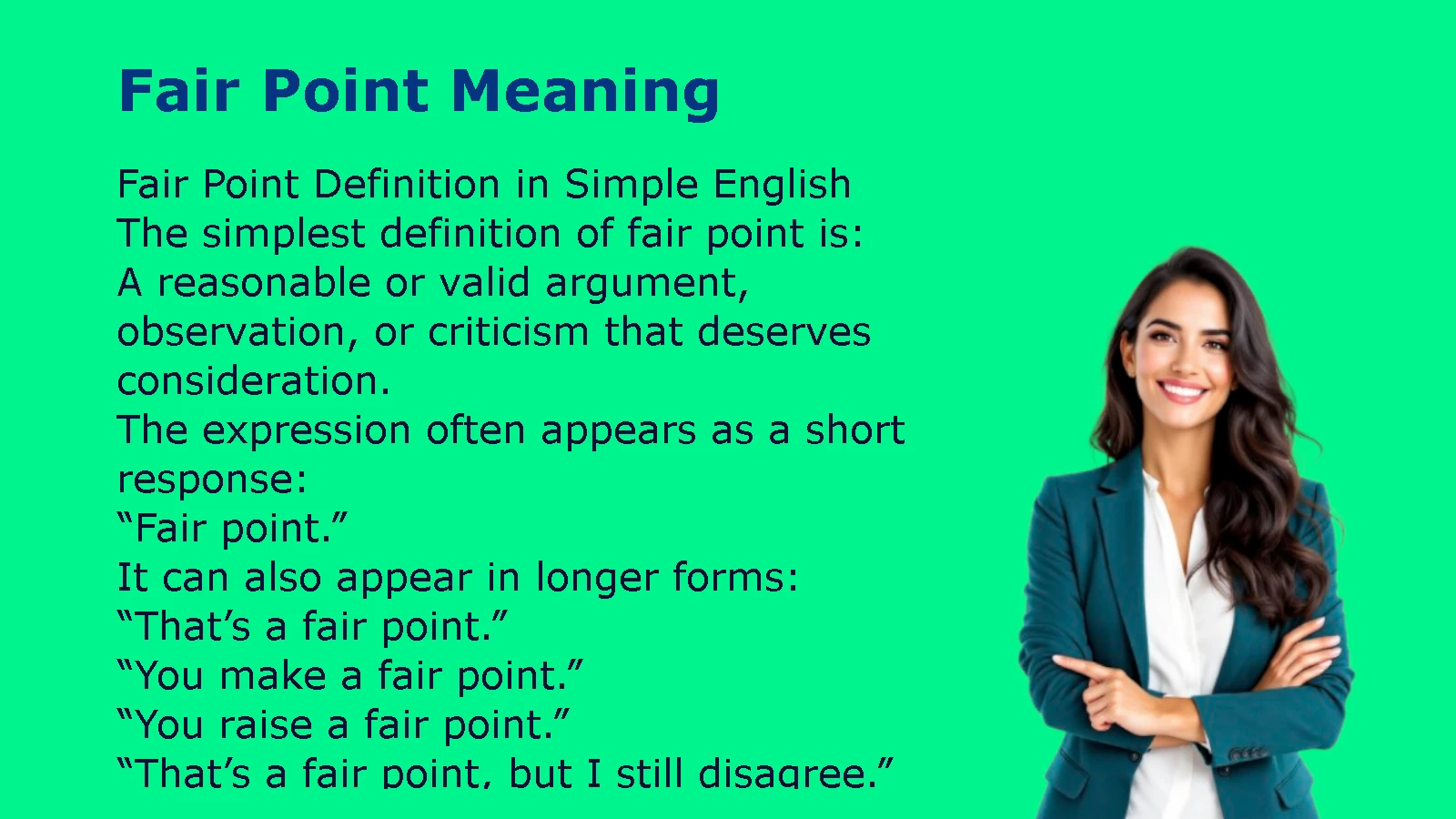
Fair Point Definition in Simple English
The simplest definition of fair point is:
A reasonable or valid argument, observation, or criticism that deserves consideration.
The expression often appears as a short response:
“Fair point.”
It can also appear in longer forms:
“That’s a fair point.”
“You make a fair point.”
“You raise a fair point.”
“That’s a fair point, but I still disagree.”
These forms carry essentially the same core idea, although their tone and emphasis can differ slightly.
What Does “Fair Point” Mean in a Conversation?
In conversation, fair point usually signals that you’re willing to give the other person’s argument some credit.
Imagine someone says:
“You want us to save money, but you’re also suggesting we buy new equipment.”
You might respond:
“Fair point. I hadn’t considered the upfront cost.”
The phrase helps prevent the conversation from becoming unnecessarily confrontational. Instead of immediately rejecting the criticism, you acknowledge that it makes sense.
This makes fair point especially useful when people disagree.
Fair Point Can Mean Partial Agreement
One of the most important things to understand about fair point meaning is that the expression doesn’t necessarily communicate total agreement.
Consider this exchange:
Sam: “The new apartment is farther from work, but it’s $400 cheaper each month.”
Taylor: “Fair point. I still think the commute would be too long.”
Taylor agrees that the lower rent is a legitimate consideration. However, Taylor hasn’t changed their overall opinion.
That’s why fair point often works well in disagreements. It allows you to acknowledge one part of someone’s reasoning without abandoning your own position.
Fair Point Can Acknowledge Criticism
The phrase also works when someone points out a mistake.
Manager: “You asked everyone to arrive at 8:00, but you arrived at 8:20.”
Employee: “Fair point. I should’ve arrived earlier.”
Here, the speaker accepts the criticism because it is reasonable.
The phrase can therefore communicate a small concession:
“You’re right about this particular issue.”
That doesn’t necessarily mean:
“You’re right about everything.”
How to Use “Fair Point”
You can use fair point in several common sentence patterns.
“Fair Point.”
This is the shortest and most conversational form.
“The cheaper laptop doesn’t have as much storage.”
“Fair point.”
This version works particularly well in informal speech, texting, online conversations, and quick discussions.
“That’s a Fair Point.”
This version sounds slightly fuller while remaining natural.
“We could save money by taking the train instead of flying.”
“That’s a fair point.”
It directly identifies the other person’s statement as reasonable.
“You Make a Fair Point.”
This construction focuses more strongly on the quality of the person’s argument.
“You make a fair point about the lack of evidence.”
It’s useful when responding to a detailed argument or criticism.
“You Raise a Fair Point.”
This version often appears in professional, academic, or formal discussions.
“You raise a fair point about the project’s long-term costs.”
It emphasizes that someone has brought an important issue into the discussion.
“That’s a Fair Point, But…”
This may be the most useful structure when you partly agree but still disagree overall.
“That’s a fair point, but we don’t have enough time to change the entire plan.”
The first part acknowledges the other person’s reasoning. The second part introduces your counterargument.
This structure keeps disagreement constructive instead of making it sound like a personal rejection.
Fair Point Examples
The meaning becomes clearer when you see how the phrase behaves in different situations.
Example in a Workplace Conversation
Mia: “We should delay the launch until we’ve tested the payment system properly.”
Daniel: “Fair point. A rushed launch could create bigger problems later.”
Here, Daniel acknowledges the risk.
Example Between Friends
Chris: “You said you didn’t want to spend much this weekend, but you just bought concert tickets.”
Jamie: “Fair point. Those tickets were an impulse purchase.”
The speaker accepts the criticism without needing to make a long explanation.
Example During a Debate
A: “The policy may reduce costs, but it could also create problems for smaller businesses.”
B: “That’s a fair point. However, the current system has its own serious problems.”
B acknowledges one weakness in the opposing argument while continuing to defend a different position.
Example About Education
Teacher: “Students shouldn’t rely entirely on AI tools because they still need to develop their own writing skills.”
Student: “Fair point. Using a tool doesn’t automatically mean understanding the material.”
The response recognizes the teacher’s concern without necessarily rejecting technology altogether.
Example About Travel
Person 1: “Let’s take the early flight. It’s cheaper.”
Person 2: “Fair point, but we’d have to leave home at 3 a.m.”
The second speaker accepts the price argument while introducing another consideration.
Example in an Online Discussion
“You make a fair point about the product’s price. However, the warranty also adds value.”
This usage is common when someone wants to disagree without dismissing the other person’s argument.
What Does “Fair Point” Mean in Texting?
In texting, fair point usually means:
“I understand your argument, and you’ve made a reasonable observation.”
Because texting lacks facial expressions and vocal tone, the phrase can sometimes carry different shades of meaning depending on the surrounding message.
For example:
“Fair point 😂”
might sound lighthearted.
Meanwhile:
“Fair point. I hadn’t thought about that.”
usually sounds sincere and thoughtful.
A short:
“Fair point.”
can be completely genuine. In some contexts, though, it may also signal that the person doesn’t want to continue arguing.
Context does the heavy lifting.
Is “Fair Point” Positive or Negative?
Fair point is generally neutral to positive.
It gives the other person’s argument some credit. The speaker is saying that the argument deserves consideration rather than dismissing it outright.
However, tone can change the effect.
Compare:
“Fair point. I hadn’t considered that.”
with:
“Oh, fair point.”
The first sounds clearly sincere. The second could be sincere, amused, reluctant, or even sarcastic depending on how the speaker delivers it.
In writing, additional words usually make the intended tone clearer.
“That’s a fair point. I’ll need to think about that.”
sounds respectful.
“Fine. Fair point.”
can sound irritated or reluctant.
Can “Fair Point” Be Sarcastic?
Yes.
Like many short conversational expressions, fair point can become sarcastic when the speaker’s tone contradicts the literal words.
For example:
“Fair point, if we’re pretending the facts don’t matter.”
The phrase itself acknowledges an argument, but the rest of the sentence clearly attacks it.
Another example:
“Yeah, fair point. Because that’s definitely how reality works.”
Here, fair point doesn’t express genuine agreement. The surrounding language signals sarcasm.
Therefore, don’t judge the meaning of the phrase in isolation. Look at the entire sentence and conversation.
Does “Fair Point” Mean “I Agree”?
Not necessarily.
This is one of the biggest differences between fair point and I agree.
When someone says:
“I agree.”
they normally indicate that they accept the statement or opinion.
When someone says:
“Fair point.”
they acknowledge that the other person has made a reasonable argument or observation.
That argument may affect the discussion without completely changing their mind.
Consider this example:
Alex: “The car is expensive, but it has excellent fuel efficiency.”
Morgan: “Fair point. I still don’t think I can afford it.”
Morgan accepts the fuel-efficiency argument. Morgan doesn’t agree that buying the car makes sense.
The distinction can be summarized like this:
| Expression | Main idea |
| Fair point | Your argument is reasonable. |
| I agree | I share or accept your position. |
| You’re right | Your statement is correct. |
| Good point | You made a useful or convincing observation. |
| I see your point | I understand your reasoning. |
| That makes sense | Your explanation is logical or understandable. |
So, if someone says “fair point,” don’t automatically assume they’ve changed their mind.
Fair Point vs. Good Point
Fair point and good point overlap, but they aren’t always identical.
A good point usually praises an observation because it is useful, insightful, relevant, or persuasive.
A fair point places more emphasis on reasonableness or validity.
Compare:
“Good point. We should add that information to the report.”
This suggests that the observation is useful.
Now consider:
“Fair point. We haven’t explained where those numbers came from.”
This emphasizes that the criticism is justified.
The difference is subtle, and native speakers can use the expressions interchangeably in many situations. Still, fair point often works especially well during disagreement because it acknowledges the other person’s argument without necessarily endorsing their entire position.
Fair Point vs. I See Your Point
These expressions also have slightly different shades of meaning.
“I see your point” focuses on understanding.
“I see your point, but I don’t think the plan will work.”
The speaker understands the reasoning.
“Fair point” goes one step further by suggesting that the argument itself has some merit.
“Fair point. The plan does have a weakness there.”
You can understand someone’s argument without considering it reasonable. That’s why the two expressions aren’t always interchangeable.
Fair Point vs. Fair Enough
Although fair point and fair enough sometimes appear in similar conversations, they don’t have exactly the same function.
Fair point specifically acknowledges an argument, observation, criticism, or idea.
“The restaurant is expensive, but the portions are large.”
“Fair point.”
Fair enough can express acceptance of a situation, decision, explanation, or request.
“I’m going to take the bus because parking is impossible.”
“Fair enough.”
The second speaker isn’t necessarily evaluating an argument. They are accepting the person’s reasoning or decision.
A useful way to remember the difference is:
- Fair point → “Your argument makes sense.”
- Fair enough → “Your decision or explanation seems reasonable.”
The expressions can overlap in some conversations, but they aren’t perfect substitutes.
Fair Point vs. You Have a Point
“You have a point” means that someone’s argument contains some truth or merit.
“You have a point. We haven’t looked at the long-term costs.”
This is close to fair point.
However, you have a point can sometimes sound more cautious. It may suggest that the speaker has found one valid aspect of an otherwise questionable argument.
“You have a point about the price, but the quality is much better.”
Similarly:
“That’s a fair point, but the quality is much better.”
Both sentences acknowledge the same basic idea.
Fair Point vs. You’re Right
“You’re right” generally expresses stronger agreement.
“You’re right. I should have checked the figures first.”
The speaker accepts that the other person’s statement is correct.
By contrast:
“Fair point. I should have checked the figures first.”
can sound slightly less absolute. It acknowledges the criticism without necessarily suggesting that every part of the other person’s position is correct.
That subtle difference makes fair point useful in debates and negotiations.
Is “Fair Point” Formal or Informal?
Fair point is conversational and widely understood.
It’s particularly natural in:
- Everyday conversations
- Text messages
- Online discussions
- Workplace conversations
- Meetings
- Interviews
- Debates
- Informal presentations
It can also appear in professional writing, especially when the writing reflects natural dialogue or quoted speech.
The Oxford English Dictionary treats fair point as an established phrase and records examples from published sources, including journalism and books.
For highly formal academic writing, however, you may prefer expressions such as:
- This is a valid argument.
- This is a reasonable observation.
- This raises a valid concern.
- This argument has merit.
The choice depends on the audience and context.
How to Use “Fair Point” in Professional English
The phrase can work well at work because it lets you acknowledge disagreement without turning the conversation into a contest.
For example:
“That’s a fair point about the timeline. We may need another week for testing.”
This response does three things:
- It acknowledges the concern.
- It avoids becoming defensive.
- It moves the discussion toward a practical solution.
That makes fair point particularly useful during meetings, negotiations, reviews, and collaborative problem-solving.
Workplace Example
Imagine a team discussing whether to release a new product.
Manager: “The product is ready from a technical standpoint.”
Designer: “Fair point, but the onboarding process still confuses new users.”
Manager: “You’re right about the onboarding. Let’s review that before launch.”
The first speaker doesn’t reject the manager’s argument. Instead, the response identifies a legitimate concern that needs attention.
This is a good example of how fair point can make disagreement more productive.
How “Fair Point” Works in an Argument
Arguments don’t always have to produce a winner and a loser.
Sometimes the strongest response is to identify the part of an opposing argument that deserves recognition.
That’s where fair point becomes useful.
Imagine two people arguing about remote work:
Person A: “Working from home saves commuting time and can help employees focus.”
Person B: “Fair point, but some employees struggle to separate work from personal life when they work from home.”
Neither person needs to completely surrender their position.
Instead, each person recognizes a legitimate factor.
This makes fair point a useful phrase for balanced discussion because it creates room for nuance.
A Simple Conversation Pattern
A very common structure is:
Acknowledge → qualify → counter
For example:
“That’s a fair point, but…”
Or:
“You make a fair point. However…”
Or:
“Fair point. At the same time…”
This structure works because it shows that you heard the other person before presenting your own view.
Common Sentence Patterns With Fair Point
Here are several natural structures you can use:
| Pattern | Example |
| Fair point. | “Fair point. I hadn’t considered the cost.” |
| That’s a fair point. | “That’s a fair point about the deadline.” |
| That’s a fair point, but… | “That’s a fair point, but we can’t delay the launch.” |
| You make a fair point. | “You make a fair point about accessibility.” |
| You raise a fair point. | “You raise a fair point about the budget.” |
| A fair point is that… | “A fair point is that the current system costs less.” |
| That’s a perfectly fair point. | “That’s a perfectly fair point, and we should consider it.” |
The first five are especially natural in everyday English.
Realistic “Fair Point” Dialogue Examples
Discussing Money
A: “We could buy the cheaper model and use the savings for accessories.”
B: “Fair point. We don’t necessarily need the more expensive version.”
Discussing Time
A: “If we leave at six, we’ll avoid most of the traffic.”
B: “That’s a fair point. Let’s leave early.”
Responding to Criticism
A: “You asked me to finish the report today, but you didn’t send the figures until this afternoon.”
B: “Fair point. I should’ve sent them earlier.”
During a Disagreement
A: “The movie was too long.”
B: “Fair point, but I thought the ending made the extra time worthwhile.”
Discussing a Purchase
A: “The expensive phone gets longer software support.”
B: “You make a fair point, but I don’t think I’ll keep it long enough for that to matter.”
In a Meeting
A: “If we change the process now, the team will need additional training.”
B: “That’s a fair point. We should include training in the rollout plan.”
Why People Say “Fair Point”
The phrase does more than acknowledge information. It can also help manage the social side of disagreement.
A blunt response such as:
“You’re wrong.”
creates immediate conflict.
A response such as:
“Fair point, but I see it differently.”
does something more constructive. It recognizes the other person’s reasoning while preserving room for disagreement.
That makes the expression useful when you want to be respectful without pretending to agree.
The Phrase Can Signal Intellectual Honesty
Admitting that another person has a valid point can make a discussion more credible.
Instead of ignoring an inconvenient argument, you acknowledge it.
For example:
“Fair point. The data does support that conclusion in this case. However, the sample size is too small to generalize.”
This approach is stronger than pretending the opposing evidence doesn’t exist.
Common Mistakes With “Fair Point”
Although the expression is simple, learners can misunderstand its purpose.
Mistake: Assuming It Always Means Complete Agreement
Incorrect assumption:
“She said fair point, so she must agree with me.”
Not necessarily.
She may simply recognize that one part of your argument is reasonable.
Mistake: Using It Without a Relevant Argument
The phrase normally responds to an idea, observation, criticism, or argument.
For example:
“I’m going to wear blue today.”
“Fair point.”
This sounds strange unless there is some surrounding reason or disagreement.
The phrase works better when someone has actually presented a point worth evaluating.
Mistake: Treating “Fair Point” and “Fair Enough” as Identical
They overlap, but their uses differ.
If someone explains why they made a particular decision, fair enough may fit better.
If someone presents an argument or criticism, fair point is usually more precise.
Mistake: Thinking It Always Ends the Discussion
It doesn’t.
You can say:
“Fair point, but…”
and continue the debate.
In fact, this is one of the most common ways to use the expression.
Synonyms and Alternatives for Fair Point
The best alternative depends on exactly what you want to communicate.
Casual Alternatives
- Good point.
- True.
- That’s true.
- You have a point.
- I see what you mean.
- I can see that.
Neutral Alternatives
- That’s reasonable.
- That’s a valid point.
- You make a good argument.
- I understand your point.
- That’s worth considering.
More Formal Alternatives
- That is a valid argument.
- You raise a valid concern.
- That is a reasonable observation.
- That argument has merit.
- That is a legitimate consideration.
Not every alternative carries exactly the same tone.
For example, “You raise a valid concern” sounds more formal than “Fair point.” Meanwhile, “Good point” sounds more enthusiastic in many situations.
Fair Point in Different Tones
The phrase can change meaning slightly depending on what comes after it.
Friendly
“Fair point! I hadn’t thought about that.”
This sounds open and positive.
Neutral
“That’s a fair point.”
This simply acknowledges the argument.
Reluctant
“Fair point. I suppose you’re right about that.”
This suggests the speaker wasn’t eager to concede.
Respectful Disagreement
“That’s a fair point, but I still think we should wait.”
This acknowledges the argument while maintaining a different conclusion.
Sarcastic
“Fair point, if that’s what we’re going with.”
The words appear agreeable, but the context can make the meaning dismissive.
A Quick Guide to Choosing the Right Expression
If you’re unsure which phrase to use, consider what you want to communicate.
| What you want to say | Best expression |
| Your argument is reasonable | Fair point |
| Your observation is useful | Good point |
| I understand your reasoning | I see your point |
| I agree with you | I agree |
| Your statement is correct | You’re right |
| Your decision is reasonable | Fair enough |
| Your concern deserves attention | You raise a valid concern |
| Your argument deserves consideration | That argument has merit |
This distinction makes your English sound more precise.
Frequently Asked Questions About Fair Point Meaning
What does “fair point” mean?
Fair point means that someone has made a reasonable, valid, or worthwhile argument or observation. It often acknowledges part of another person’s reasoning without necessarily expressing complete agreement.
Does “fair point” mean “you’re right”?
Sometimes, but not always. Fair point usually means that the person’s argument has merit. You’re right generally expresses stronger agreement with the statement itself.
Can you say “fair point” when you disagree?
Yes. In fact, that’s one of its most useful functions.
“Fair point, but I still think we need more evidence.”
This means the speaker accepts one part of the argument while maintaining a different overall position.
Is “fair point” polite?
Yes. It often sounds polite because it recognizes the other person’s reasoning instead of immediately dismissing it.
However, tone matters. A sarcastic delivery can make the phrase sound dismissive.
Is “fair point” formal?
It’s best described as conversational and neutral. It’s common in everyday English and works in many workplace discussions. More formal alternatives include “That is a valid argument” and “You raise a valid concern.”
What is another way to say “fair point”?
Depending on the context, you can say:
- Good point
- You have a point
- That’s reasonable
- I see your point
- That’s a valid point
- You make a good argument
- That’s worth considering
What is the difference between “fair point” and “good point”?
Fair point emphasizes that an argument is reasonable or valid. Good point often emphasizes that an observation is useful, insightful, or convincing. They overlap significantly in everyday English.
Can “fair point” be used in writing?
Yes. You can use it in informal writing, emails, messages, online discussions, and dialogue. For highly formal or academic writing, a phrase such as “This is a valid argument” may fit better.
Final Takeaway: Fair Point Meaning
The phrase “fair point” means that someone has made a reasonable, valid, or worthwhile argument or observation. It often signals that you recognize the strength of what the other person has said.
Most importantly, fair point does not automatically mean complete agreement.
You can say:
“Fair point, but I still disagree.”
That sentence captures the phrase’s central purpose perfectly. You acknowledge that the other person has a legitimate argument while keeping your own position.
In everyday English, fair point is a useful phrase for handling disagreement with balance. It can soften criticism, recognize a good argument, and keep a conversation moving without turning every difference of opinion into a battle.
When someone gives you a reason that deserves consideration, “fair point” is often the simple, natural response that says, I hear you, and you’ve got a point worth considering.













