Have you ever come across the unusual word “Frabjous” and wondered what it means? While Frabjous Meaning may seem confusing at first, this playful word has a cheerful and exciting meaning. It is often used to describe something wonderful, joyful, or delightful.
Frabjous is an adjective that means wonderful, joyful, delightful, or full of happiness. The word is best known from Lewis Carroll’s famous poem Jabberwocky, where it appears in the line “O frabjous day! Callooh! Callay!”
Examples:
- What a frabjous day for a picnic!
- She had a frabjous time at the celebration.
The confusion is understandable. People often search for what does frabjous mean, frabjous meaning in English, frabjous definition, or frabjous meaning in a sentence because it is an uncommon and playful word. And here’s the kicker: although frabjous sounds like a regular English adjective, it was actually coined by Lewis Carroll as a nonsense word with a wonderfully positive meaning.
In this guide, you’ll learn the complete Frabjous Meaning, its definition, pronunciation, origin, correct usage, and examples in sentences. You’ll also discover where the word frabjous comes from, what it means in Jabberwocky, and how you can use this fun word in everyday writing.
What Does Frabjous Mean?
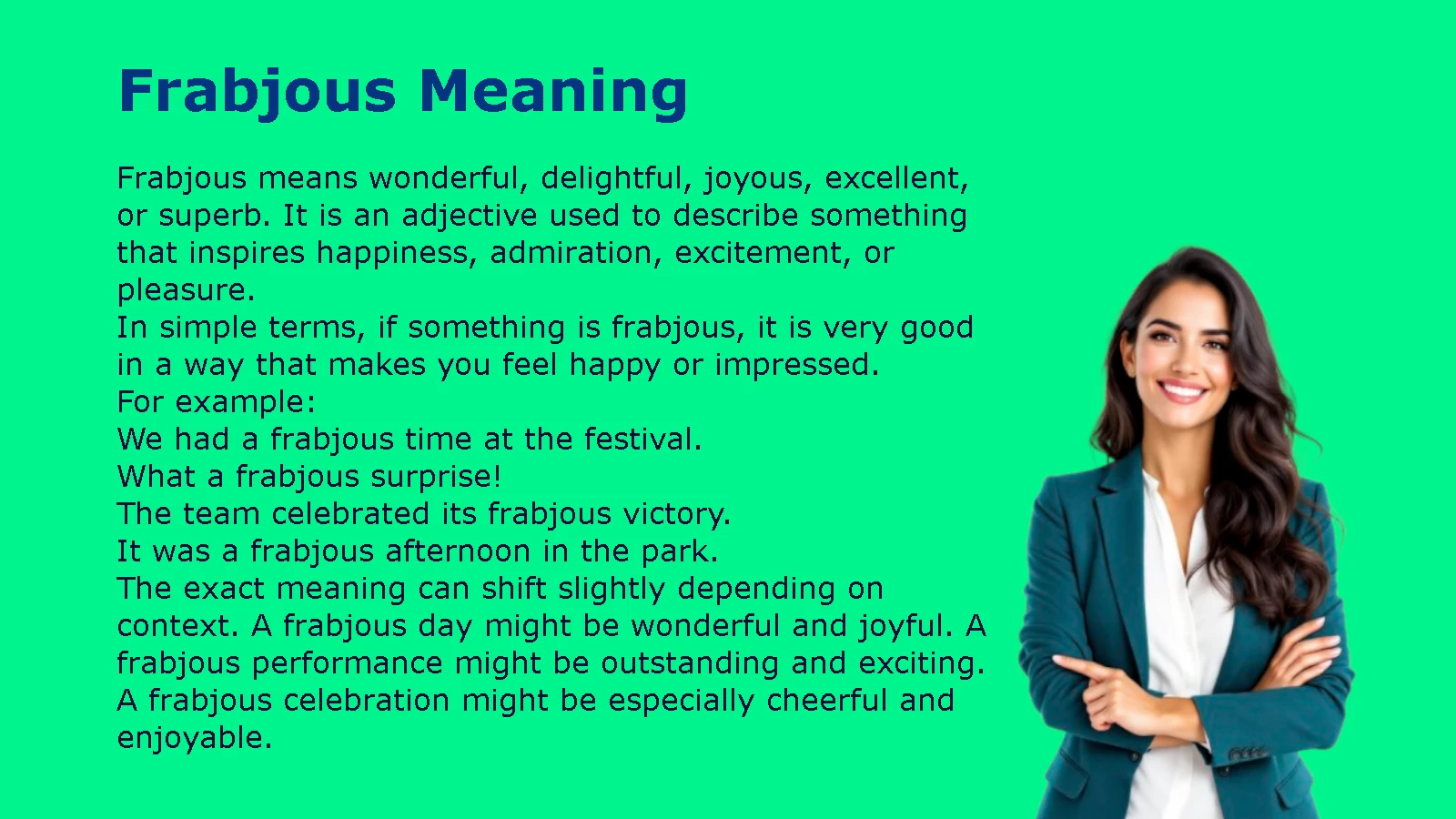
Frabjous means wonderful, delightful, joyous, excellent, or superb. It is an adjective used to describe something that inspires happiness, admiration, excitement, or pleasure.
In simple terms, if something is frabjous, it is very good in a way that makes you feel happy or impressed.
For example:
- We had a frabjous time at the festival.
- What a frabjous surprise!
- The team celebrated its frabjous victory.
- It was a frabjous afternoon in the park.
Dictionary.com defines frabjous with meanings including “wonderful, elegant, superb, or delicious.” It also identifies the word as an adjective and traces its origin to Lewis Carroll.
Frabjous Meaning in Simple Words
Frabjous = wonderful, joyful, delightful, or excellent.
Think of it as a more unusual and whimsical way to say “wonderful.”
| Word | Meaning | Part of Speech |
| Frabjous | Wonderful, delightful, joyous, or excellent | Adjective |
| Wonderful | Very good or pleasing | Adjective |
| Joyous | Full of happiness | Adjective |
| Delightful | Very pleasant or enjoyable | Adjective |
| Superb | Extremely good | Adjective |
| Fabulous | Extremely good or impressive | Adjective |
One important point matters here: frabjous does not normally describe something negative. Its emotional direction is strongly positive.
Frabjous Definition and Word Class
The frabjous definition is straightforward: something frabjous is wonderful, joyous, fabulous, or otherwise highly pleasing.
Grammatically, frabjous is an adjective. That means it modifies a noun.
For example:
- a frabjous day
- a frabjous celebration
- a frabjous experience
- a frabjous victory
- a frabjous occasion
The word can also appear after a linking verb:
- The celebration was frabjous.
- The whole experience felt frabjous.
Wiktionary records frabjous as an adjective meaning “fabulous, joyous; great, wonderful.” It also gives the comparative form more frabjous and the superlative most frabjous, although those forms are uncommon in ordinary use.
Frabjous at a Glance
| Feature | Detail |
| Word | Frabjous |
| Part of speech | Adjective |
| Basic meaning | Wonderful, joyous, delightful, excellent |
| Pronunciation | FRAB-jus |
| IPA | /ˈfræbdʒəs/ |
| Origin | Lewis Carroll’s “Jabberwocky” |
| First literary use | 19th century |
| Tone | Playful, whimsical, literary |
| Common synonym | Wonderful |
How Do You Pronounce Frabjous?
The usual frabjous pronunciation is:
FRAB-jus
The stress falls on the first syllable.
The IPA pronunciation is /ˈfræbdʒəs/.
You can break it down like this:
frab + jous
The first part sounds roughly like “frab.” The second part sounds like “jus.”
So:
FRAB-jus
It does not sound as though the final part should be pronounced like house. Instead, the ending has the soft j sound heard in words such as just.
Example of Frabjous Pronunciation
Try saying:
“What a frabjous day!”
The phrase should sound natural when spoken with excitement. That fits the word’s original context because the speaker in Jabberwocky uses it to celebrate a victory.
What Is the Origin of Frabjous?
The origin of frabjous goes back to Lewis Carroll, the pen name of English writer and mathematician Charles Lutwidge Dodgson.
Carroll coined frabjous for his poem “Jabberwocky.” The poem appears in Through the Looking-Glass, and What Alice Found There, the 1871 book that is commonly dated 1872 on its title page. The Poetry Foundation notes that Through the Looking-Glass was published in 1871 but dated 1872.
Carroll’s invented vocabulary was not an accidental part of the poem. He deliberately played with language, sound, rhythm, and familiar word patterns.
That experiment produced words that feel strange while still giving readers clues about their meanings.
Frabjous is a perfect example.
You may never have encountered it before, yet the phrase “O frabjous day!” strongly suggests happiness. The exclamation, the surrounding celebration, and the hero’s victory all point in the same direction.
Who Invented the Word Frabjous?
Lewis Carroll invented the word frabjous.
Carroll published Jabberwocky as part of Through the Looking-Glass. The poem tells the story of a dangerous creature called the Jabberwock and a hero who goes out to confront it.
After the hero kills the creature, the speaker celebrates:
“O frabjous day!”
The Poetry Foundation reproduces the poem and places this expression immediately after the Jabberwock’s defeat.
That context gives frabjous its positive emotional force.
What Does Frabjous Mean in “Jabberwocky”?
In “Jabberwocky,” frabjous means wonderful, joyous, or glorious.
The word appears near the end of the poem. The hero has faced the Jabberwock, killed it with his sword, and returned carrying its head. His family or companions then celebrate his success.
The relevant sequence moves from danger to victory:
- The hero encounters the Jabberwock.
- He fights the creature.
- His sword kills the Jabberwock.
- He returns with the creature’s head.
- His companions celebrate his achievement.
- The speaker calls it a “frabjous day.”
The meaning becomes almost impossible to miss.
In modern English, the line could be expressed as:
“What a wonderful day!”
Other natural interpretations include:
- “What a joyful day!”
- “What an amazing day!”
- “What a glorious day!”
- “What a fantastic day!”
The word’s unusual shape adds something that a plain synonym cannot quite reproduce. Frabjous sounds invented, energetic, and exuberant, which matches the strange world of Jabberwocky.
“O Frabjous Day!” Meaning
The phrase “O frabjous day!” means approximately:
“What a wonderful and joyful day!”
It expresses strong happiness after a major success.
The phrase works especially well because the word does more than provide a dictionary meaning. It also creates a particular mood. Wonderful tells you what the day is like. Frabjous makes the celebration feel whimsical and almost fantastical.
How Was the Word Frabjous Formed?
The exact construction of frabjous is not completely certain.
A commonly suggested explanation connects the word with elements or sounds associated with fair, fabulous, and joyous. Wiktionary describes it as probably a blend of fair + fabulous + joyous.
Dictionary.com takes a more cautious approach, saying the word may have been intended to suggest fabulous or joyous.
That distinction matters.
It is reasonable to discuss these possible influences, but it would be misleading to state that Carroll definitely constructed the word by combining three specific words. The available evidence does not justify that level of certainty.
Why Does Frabjous Sound Familiar?
Part of the word’s appeal comes from its resemblance to familiar English vocabulary.
Consider these words:
- fabulous
- joyous
- fair
- fabulousness
- glorious
Even without knowing frabjous, readers may sense that it describes something positive.
This is one of Carroll’s clever tricks. An invented word doesn’t have to be completely alien. By using familiar sounds and patterns, a writer can make a new word feel understandable.
Is Frabjous a Real Word?
Yes, frabjous is a real English word.
However, its history is unusual.
Lewis Carroll invented the word for a literary work. It began as a coined word in Jabberwocky. Over time, people adopted it outside the original poem, and dictionaries began recording it with a recognized meaning.
That creates an important distinction:
Invented does not necessarily mean meaningless.
English contains many words that began as deliberate creations. Some remain tied closely to their original source. Others become part of everyday language.
Carroll produced several famous examples. Chortle and galumph, both associated with Jabberwocky, have developed recognized meanings beyond the poem. Dictionary.com specifically notes Carroll’s creation of words such as galumph, chortle, and burble in connection with Jabberwocky.
So calling frabjous a made up word is historically correct, but incomplete. Today, dictionaries recognize it as a word with a defined meaning.
Is Frabjous a Nonsense Word?
Frabjous originated as a nonsense or invented word, but it is not meaningless.
That distinction is crucial.
Jabberwocky is famous for its nonsense vocabulary. Carroll creates words that do not always have familiar dictionary definitions. Yet readers can often infer their meanings from grammar, sound, context, and surrounding events.
Take frabjous as an example.
You see:
“O frabjous day!”
Then you learn that the hero has defeated a terrifying creature.
The word is surrounded by celebration. Another character rejoices. The hero returns victorious.
You don’t need a dictionary to guess that frabjous means something positive.
This is a powerful lesson in how language works. Context can carry meaning even when vocabulary is unfamiliar.
Frabjous Examples in a Sentence
The easiest way to understand frabjous meaning is to see how the word works in actual sentences.
Everyday Frabjous Examples
- We had a frabjous afternoon at the beach.
- What a frabjous surprise to see everyone waiting for her!
- The children called the festival a frabjous adventure.
- It was a frabjous celebration after the team’s victory.
- She described the concert as a frabjous experience.
- The sunny weather made it a frabjous morning.
- Winning the championship turned the day into a frabjous occasion.
- The garden looked particularly frabjous in the spring sunshine.
- They planned a frabjous party for the final night of the trip.
- His return home made the evening feel completely frabjous.
These examples use frabjous in a playful way. In normal conversation, most speakers would probably choose wonderful, fantastic, or delightful instead.
Literary Frabjous Examples
The word fits especially well in creative writing.
- Beyond the golden hills stood a frabjous kingdom.
- The travelers reached the village on a frabjous summer evening.
- After years of struggle, the reunion felt like a frabjous moment.
- The children danced beneath the lights in a frabjous display of joy.
Here, frabjous adds personality. It sounds more imaginative than the ordinary word wonderful.
Frabjous in a Playful Context
You can also use the word humorously:
- The pizza arrived hot, crispy, and utterly frabjous.
- After three cups of coffee, he declared the morning frabjous.
- Finding an empty parking spot right outside the store was a frabjous miracle.
That playful quality is part of the word’s charm.
When Should You Use Frabjous?
Use frabjous when you want your writing to sound whimsical, literary, humorous, or deliberately unusual.
It can work particularly well in:
- Creative writing
- Poetry
- Children’s literature
- Literary discussions
- Humorous writing
- Playful descriptions
- Discussions of Lewis Carroll
- Word games and vocabulary activities
For ordinary professional writing, however, a more familiar word will usually communicate your meaning faster.
For example:
Less natural in a business email:
We had a frabjous meeting regarding the quarterly results.
More natural:
We had an excellent meeting about the quarterly results.
The first sentence isn’t grammatically wrong. It simply sounds intentionally quirky.
Good Uses of Frabjous
| Situation | How Well It Fits | Why |
| Poetry | Excellent | Adds rhythm and whimsy |
| Creative writing | Excellent | Creates a distinctive voice |
| Children’s stories | Excellent | Sounds playful |
| Literary analysis | Excellent | Connects naturally to Carroll |
| Casual humor | Good | Deliberately unusual |
| Social media | Good | Can add personality |
| Business writing | Limited | May sound too playful |
| Technical writing | Poor | Plain language is clearer |
| Legal writing | Poor | Precision matters more than whimsy |
The basic rule is simple: use frabjous when the unusual sound is part of the point.
Frabjous Synonyms
The closest everyday synonyms for frabjous include:
- Wonderful
- Joyous
- Delightful
- Excellent
- Superb
- Fabulous
- Fantastic
- Magnificent
- Glorious
- Splendid
- Amazing
- Pleasant
However, these words are not perfect substitutes in every situation.
| Synonym | Main Emphasis | Tone |
| Wonderful | Very good or pleasing | Common |
| Joyous | Full of happiness | Emotional |
| Delightful | Pleasant and enjoyable | Warm |
| Excellent | Very high quality | Neutral |
| Superb | Outstanding quality | Strong |
| Fabulous | Extraordinary or excellent | Informal |
| Fantastic | Extremely good or exciting | Informal |
| Magnificent | Impressive or grand | Strong |
| Glorious | Splendid or triumphant | Literary |
| Splendid | Excellent or impressive | Slightly formal |
What Is the Closest Synonym for Frabjous?
Wonderful is probably the simplest everyday synonym.
If the context emphasizes happiness, joyous may be better.
If it emphasizes pleasure, delightful works well.
Antonyms of Frabjous
Because frabjous expresses something positive, its opposite can be described with words such as:
- Terrible
- Dreadful
- Miserable
- Unpleasant
- Disappointing
- Joyless
- Awful
- Depressing
- Gloomy
The best antonym depends on the noun being described.
For example:
- frabjous day → miserable day
- frabjous experience → unpleasant experience
- frabjous celebration → gloomy gathering
- frabjous victory → disappointing defeat
There isn’t one exact opposite in every context.
Frabjous vs. Fabulous
Frabjous and fabulous overlap in meaning, but they aren’t interchangeable in tone.
Fabulous is a normal English adjective used widely in everyday speech. It can mean excellent, wonderful, extraordinary, or impressive.
Frabjous, by contrast, has a much more whimsical and literary personality.
Compare:
We had a fabulous vacation.
This sounds completely ordinary.
We had a frabjous vacation.
This sounds playful, eccentric, or intentionally literary.
The resemblance between the two words is also interesting from an etymological perspective. Some accounts suggest that fabulous may have influenced the formation or sound of frabjous, although the precise construction remains uncertain.
Quick Comparison
| Feature | Frabjous | Fabulous |
| Meaning | Wonderful, joyous, excellent | Wonderful, extraordinary, excellent |
| Origin | Lewis Carroll’s coined vocabulary | Older established English word |
| Everyday use | Uncommon | Very common |
| Tone | Whimsical, literary | Casual to enthusiastic |
| Best known connection | Jabberwocky | General English |
| Typical use | Creative or playful writing | Everyday conversation |
Frabjous vs. Joyous
The words frabjous and joyous are also close in meaning, but they emphasize different things.
Joyous specifically describes strong happiness or joy.
Frabjous has a broader sense. It can mean wonderful, excellent, delightful, or joyous.
For example:
The wedding was joyous.
This focuses on the happiness of the people involved.
The wedding was frabjous.
This suggests that the entire occasion was wonderful and delightful.
So, joyous is more specific, while frabjous has a broader and more playful emotional range.
Why Did Lewis Carroll Invent Words Like Frabjous?
Carroll’s language in Jabberwocky demonstrates how much meaning can come from sound and context.
The poem begins with lines packed with unfamiliar vocabulary:
“’Twas brillig, and the slithy toves”
Words such as brillig, slithy, and toves immediately make the fictional world feel strange.
Yet the poem remains surprisingly understandable.
That is one reason Jabberwocky remains such an important example of playful language.
Carroll’s Other Famous Coinages
Several words associated with Carroll have become recognizable beyond the poem.
| Word | Meaning |
| Frabjous | Wonderful, joyous, excellent |
| Chortle | A laugh combining a chuckle and a snort |
| Galumph | To move heavily or clumsily |
| Frumious | Extremely angry |
Frumious, for example, is traditionally explained as a blend of fuming and furious.
The poem itself contains all four words in memorable contexts. The Poetry Foundation’s text shows frumious describing the Bandersnatch, galumphing describing the hero’s return, and chortled describing his joyful reaction.
This makes frabjous part of a larger experiment in word creation rather than an isolated curiosity.
A Closer Look at Frabjous in “Jabberwocky”
The meaning of frabjous becomes even clearer when you follow the poem’s emotional structure.
At the beginning, the poem establishes an unfamiliar and potentially threatening world. The narrator warns the young hero about the Jabberwock and other creatures.
The middle of the poem builds tension as the Jabberwock approaches.
Then everything changes.
The hero attacks and kills the creature. He returns triumphantly. The emotional atmosphere shifts from fear to celebration.
That is exactly where frabjous appears.
This placement matters. Carroll could have chosen an ordinary adjective such as happy or wonderful. Instead, he created a word that feels as strange and energetic as the world around it.
The word’s meaning and sound work together.
That is one of the most effective features of Carroll’s nonsense poetry.
Why Frabjous Still Works Today
A word created in the 19th century might seem destined for a museum shelf. Frabjous has avoided that fate because it remains useful in a particular kind of writing.
It gives writers something ordinary words cannot quite provide.
Compare:
- a wonderful day
- a fantastic day
- a joyous day
- a frabjous day
The first three are familiar. The fourth immediately feels unusual.
That unusual quality can be valuable.
A children’s author might use frabjous to make a character sound eccentric. A poet might choose it for its rhythm. A humor writer might use it precisely because readers don’t expect to see it.
In other words, frabjous carries both meaning and personality.
A Practical Case Study: Replacing “Wonderful” With “Frabjous”
Consider this sentence:
It was a wonderful day.
The sentence is clear, but ordinary.
Now change it:
It was a frabjous day.
The basic meaning stays almost the same. The personality changes dramatically.
The second version feels:
- more playful
- more literary
- more unusual
- more imaginative
- more connected to Carroll’s style
That makes frabjous useful when the writer wants the word choice itself to attract attention.
However, if the purpose is simply to communicate information quickly, wonderful remains the better choice.
This distinction is useful for writers: the best synonym isn’t always the most interesting word. It’s the word that fits the purpose.
Is Frabjous Formal or Informal?
Frabjous is generally informal and literary rather than formal.
It can appear in serious writing, but its unusual origin gives it a playful quality.
You might encounter it in:
- Literary criticism
- Newspaper writing
- Opinion pieces
- Creative essays
- Humor
- Poetry
- Pop culture discussions
It would be unusual in highly technical or bureaucratic language.
For example, a scientific report would normally say:
The experiment produced excellent results.
It would not normally say:
The experiment produced frabjous results.
The second sentence is grammatically understandable, but the tone would be conspicuously playful.
What Makes Frabjous Different From “Wonderful”?
At first glance, the two words seem interchangeable.
Their connotations, however, differ.
Wonderful is neutral enough to use almost anywhere. It can describe a person, place, event, object, experience, or result.
Frabjous carries an extra layer of literary playfulness.
Think of it this way:
Wonderful tells you what something is like. Frabjous also tells you something about the speaker’s style.
That extra layer explains why the word survives despite having many simpler alternatives.
Interesting Facts About the Word Frabjous
Here are several useful facts worth remembering:
- Frabjous is an adjective.
- Lewis Carroll coined the word.
- It appears in “Jabberwocky.”
- Jabberwocky appears in Through the Looking-Glass, and What Alice Found There.
- The word means wonderful, joyous, excellent, or delightful.
- Its pronunciation is roughly FRAB-jus.
- The IPA form is /ˈfræbdʒəs/.
- The exact etymological construction is uncertain.
- Suggested influences include fair, fabulous, and joyous.
- The famous phrase is “O frabjous day!”
- The word describes the joyful celebration after the Jabberwock is defeated.
- Modern dictionaries recognize frabjous as an English adjective.
- The word remains more common in literary, playful, and humorous contexts than in everyday speech.
Frequently Asked Questions About Frabjous Meaning
What does frabjous mean in simple words?
Frabjous means wonderful, delightful, joyful, or excellent. It describes something that inspires strong happiness or admiration.
Is frabjous a real English word?
Yes. Frabjous is a recognized English adjective. Lewis Carroll originally coined it for Jabberwocky, but the word later developed a recognized meaning beyond its original literary setting.
Who invented the word frabjous?
Lewis Carroll invented frabjous for his poem “Jabberwocky.”
Where does the word frabjous come from?
The word comes from Carroll’s Jabberwocky. Its precise construction is uncertain, although dictionaries and reference works commonly associate it with words such as fabulous, joyous, and possibly fair.
What does “O frabjous day” mean?
“O frabjous day!” means something like “What a wonderful or joyful day!” The phrase appears after the hero defeats the Jabberwock and celebrates his victory.
Is frabjous positive or negative?
Frabjous is positive. It describes something wonderful, delightful, joyful, or excellent.
Is frabjous a synonym for fabulous?
They can have similar meanings. Fabulous is a common everyday word, while frabjous has a more whimsical and literary tone.
How do you pronounce frabjous?
Pronounce it approximately FRAB-jus. Its IPA pronunciation is /ˈfræbdʒəs/.
Is frabjous a nonsense word?
It originated as an invented word in a nonsense poem, but it is not meaningless. Its meaning became established through context and later usage.
Can you use frabjous in everyday conversation?
Yes, but it will sound unusual or playful. If you simply mean wonderful, that word will usually sound more natural.
What is the closest synonym for frabjous?
Wonderful is probably the closest general synonym. Depending on context, joyous, delightful, fabulous, excellent, or superb can also work.
What is the opposite of frabjous?
Possible opposites include terrible, unpleasant, miserable, dreadful, disappointing, and joyless. The best choice depends on the context.
Final Takeaway: Frabjous Meaning
The frabjous meaning is simple even though the word itself is unusual: wonderful, delightful, joyous, excellent, or superb.
Lewis Carroll coined frabjous for “Jabberwocky,” where it appears in the celebratory phrase “O frabjous day!” after the hero defeats the Jabberwock.
Its exact word formation remains uncertain, although fair, fabulous, and joyous are commonly suggested influences.
Today, frabjous is a recognized English adjective. Still, it isn’t an ordinary replacement for wonderful. Its real strength lies in its whimsical, literary, and playful character.
So, when you want a word that means wonderful but sounds a little more magical, eccentric, and Carrollian, frabjous fits the bill.