Have you ever come across the word “febrile” and wondered what it means? While Febrile Meaning may seem unfamiliar at first, this word is commonly used in medical and health related contexts to describe something connected with a fever or an abnormally high body temperature.
Febrile is an adjective that means relating to, caused by, or characterized by fever. It is often used to describe a person who has a fever, a condition associated with fever, or a state in which the body temperature is elevated.
Examples:
- The patient was febrile throughout the night.
- The doctor suspected a febrile illness.
The confusion is understandable. People often search for what does febrile mean, febrile meaning in medical terms, febrile meaning in a sentence, or febrile meaning in English because the word is less common in everyday conversation. And here’s the kicker: febrile doesn’t simply mean “sick.” It specifically relates to fever or a feverish state.
In this guide, you’ll learn the complete Febrile Meaning, its definition, pronunciation, part of speech, correct usage, and examples in sentences. You’ll also discover common synonyms for febrile, its medical meaning, and the difference between febrile and similar words such as feverish.
What Does Febrile Mean?
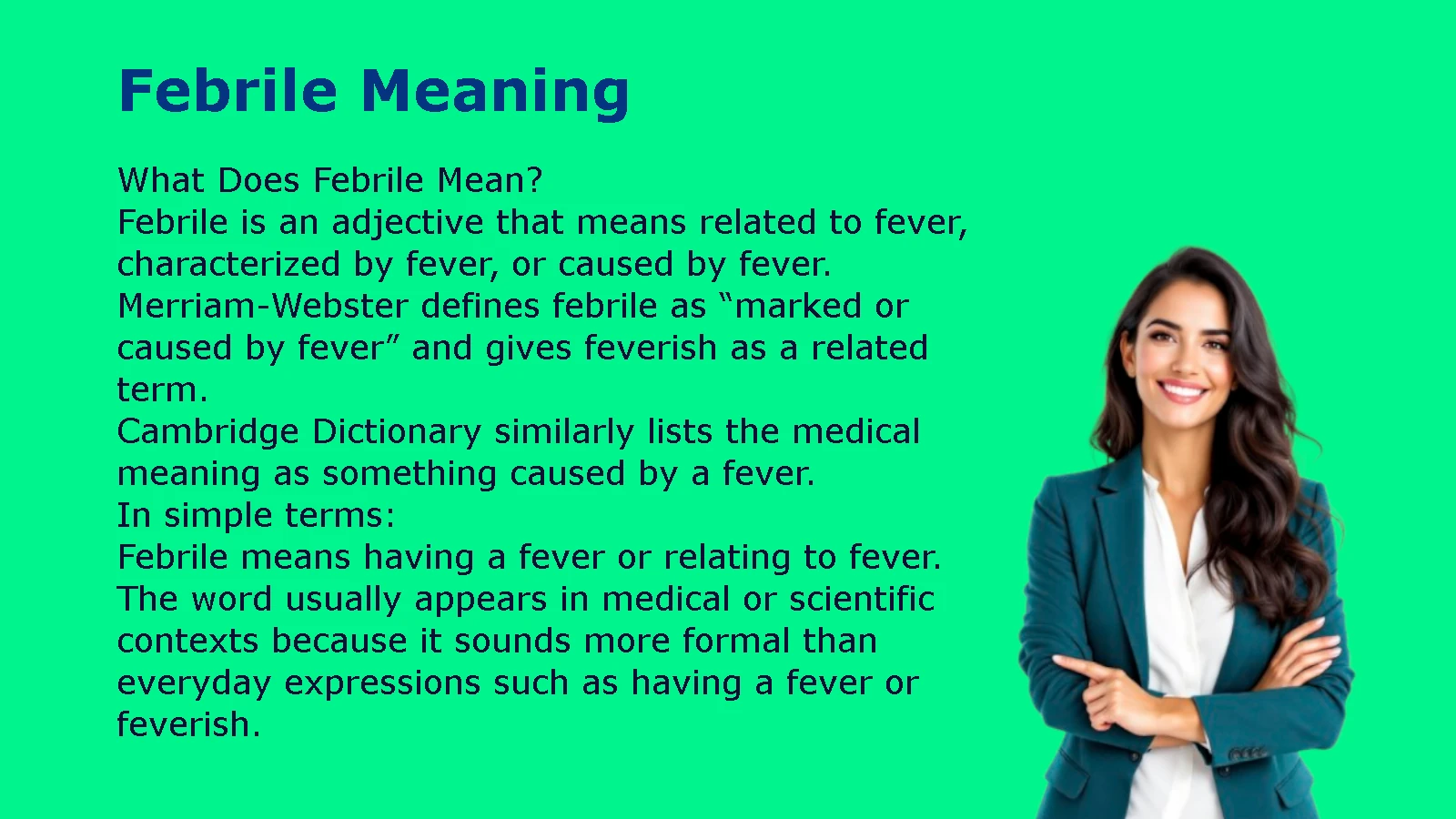
Febrile is an adjective that means related to fever, characterized by fever, or caused by fever.
Merriam-Webster defines febrile as “marked or caused by fever” and gives feverish as a related term.
Cambridge Dictionary similarly lists the medical meaning as something caused by a fever.
In simple terms:
Febrile means having a fever or relating to fever.
The word usually appears in medical or scientific contexts because it sounds more formal than everyday expressions such as having a fever or feverish.
Febrile Meaning in Simple English
Think of febrile as a formal adjective built around the idea of fever.
| Word | Simple meaning |
| Fever | A higher-than-normal body temperature |
| Febrile | Related to or marked by fever |
| Feverish | Having or seeming to have a fever |
| Afebrile | Without a fever |
For example:
- The child has a fever. — Everyday wording.
- The child is febrile. — More formal medical wording.
- The child is feverish. — Common descriptive wording.
- The child is afebrile. — The child does not have a fever.
So, when you see febrile in a medical document, you can usually connect it directly to fever.
Febrile Definition in Medical Terms
In medicine, febrile describes a state, symptom, reaction, illness, or event associated with fever.
A fever isn’t simply the same thing as feeling warm. Medical sources describe fever as an elevation in body temperature associated with a change in the body’s temperature regulation. Merck Manual explains that fever occurs when the hypothalamic temperature set point rises, most often in response to infection.
That distinction matters because fever and hyperthermia aren’t identical.
During a fever, the body actively adjusts its temperature set point. Hyperthermia, by contrast, involves an elevated body temperature without that same reset of the body’s thermostat.
This is one reason the word febrile works best when you keep the surrounding medical context in mind.
What Is a Febrile Patient?
A febrile patient is a patient who has a fever.
For example:
The patient remained febrile overnight.
This means the patient continued to have a fever during the night.
A medical professional might record the patient’s temperature, symptoms, vital signs, test results, and treatment response to determine what may be causing the fever.
What Is a Febrile Illness?
A febrile illness is an illness associated with fever.
Many different conditions can cause fever, including infections. MedlinePlus notes that infections are the most common cause of fever, although medicines, heat illness, cancers, autoimmune diseases, and some vaccines can also cause fever.
Because febrile illness describes a feature rather than one specific disease, the phrase doesn’t tell you exactly what caused the fever.
For example:
- A viral infection can cause a febrile illness.
- A bacterial infection can cause a febrile illness.
- Certain inflammatory conditions can involve fever.
- Some medications can contribute to fever.
In other words, febrile describes the fever-related state; it doesn’t automatically provide the diagnosis.
What Is a Febrile Temperature?
A febrile temperature is a temperature that meets the clinical definition of fever in the relevant context.
The exact threshold can depend on factors such as age, measurement site, and clinical circumstances. MedlinePlus gives different reference points for children depending on whether temperature is measured rectally, orally, or under the arm.
For adults, Merck Manual’s current consumer guidance identifies 100.4°F (38°C) as a fever threshold while also emphasizing that normal body temperature varies among people and throughout the day.
This is why febrile shouldn’t be treated as a universal synonym for “temperature above exactly one number.”
Why Body Temperature Isn’t Always the Same
Your body temperature naturally changes throughout the day. Physical activity, emotions, clothing, room temperature, humidity, medications, and other factors can also affect it.
That makes the clinical context important.
A single temperature reading doesn’t always tell the whole story. Healthcare professionals consider the person’s age, symptoms, medical history, measurement method, and other findings.
Febrile vs. Feverish
Febrile and feverish overlap in meaning, but they don’t always sound natural in the same situations.
Feverish is more common in everyday conversation. It can describe someone who has symptoms of a fever or feels unusually hot.
Merriam-Webster defines feverish in several related ways, including having symptoms of a fever, indicating or relating to fever, and, in another sense, showing intense activity or emotion.
Compare these sentences:
The patient was febrile on admission.
The patient felt feverish after lunch.
Both sentences can relate to fever. However, the first sounds like clinical documentation, while the second sounds more natural in everyday conversation.
Febrile vs. Feverish: Quick Comparison
| Feature | Febrile | Feverish |
| Part of speech | Adjective | Adjective |
| Main medical meaning | Related to or marked by fever | Having or showing symptoms of fever |
| Tone | Formal, technical | Everyday and conversational |
| Common in medical records | Yes | Sometimes |
| Common in casual speech | Less common | Very common |
| Figurative use | Yes | Yes |
If you’re talking to a friend, feverish will usually sound more natural.
If you’re reading a clinical report, febrile may be the word you encounter.
Febrile vs. Afebrile
The opposite of febrile in medical terminology is often afebrile.
Afebrile means not having a fever. Cambridge Dictionary classifies it as a specialized medical adjective and gives examples such as a patient being afebrile with stable vital signs.
The prefix a- often means “without” or “not,” which makes afebrile easier to remember.
Febrile and Afebrile Examples
The patient was febrile when admitted.
This means the patient had a fever.
The patient became afebrile after treatment.
This means the patient no longer had a fever.
Here’s the difference at a glance:
| Term | Meaning | Example |
| Febrile | Having or relating to fever | The patient remained febrile. |
| Afebrile | Without fever | The patient was afebrile by morning. |
A useful memory trick is simple:
febrile = fever present
afebrile = fever absent
Febrile and Hyperthermic: Are They the Same?
Not always.
This distinction becomes important in medical contexts because fever and hyperthermia involve elevated body temperature through different mechanisms.
Merck Manual explains that fever involves a raised hypothalamic temperature set point. Hyperthermia refers to elevated body temperature that does not result from resetting that set point.
For example, severe environmental heat exposure can produce hyperthermia. Certain drugs and medical conditions can also cause dangerous temperature elevations without producing a conventional fever response.
Therefore, replacing febrile with hyperthermic can change the meaning.
Simple Comparison
| Term | Core idea |
| Febrile | Related to or characterized by fever |
| Afebrile | Without fever |
| Hyperthermic | Abnormally high body temperature without the typical fever mechanism |
| Feverish | Feeling or appearing to have a fever |
The words may all appear in discussions about body temperature, but they aren’t interchangeable in every medical situation.
Examples of Febrile in a Sentence
Seeing the word in context makes its meaning much easier to understand.
Medical Examples
- The patient was febrile when she arrived at the clinic.
Here, febrile means she had a fever. - The child developed a febrile illness after several days of coughing.
The illness was associated with fever. - Doctors monitored the patient for additional febrile episodes.
The team watched for further periods of fever. - The patient remained febrile despite treatment.
The fever continued despite treatment. - The infection triggered a febrile response.
The body’s response included fever. - The medical team documented a febrile temperature.
The recorded temperature met the relevant definition of fever. - The patient had no further febrile episodes overnight.
No additional periods of fever occurred. - The child was afebrile during the examination.
The child did not have a fever at that time.
Everyday Context
Although febrile sounds medical, you may encounter it in general writing:
The patient appeared febrile and exhausted.
A simpler version would be:
The patient appeared feverish and exhausted.
Both communicate a similar idea, but the second sounds more conversational.
Common Medical Phrases With Febrile
The word febrile often appears as part of a larger medical expression. Understanding these combinations can make medical articles and records much easier to read.
Febrile Illness
A febrile illness is an illness associated with fever.
It doesn’t automatically identify the cause. The cause might be infectious, inflammatory, medication-related, or connected to another condition.
Febrile Episode
A febrile episode refers to a period during which a person experiences fever.
Doctors may use the phrase when a patient experiences recurring episodes over time.
For example:
The patient experienced three febrile episodes during the month.
The sentence doesn’t tell you why the episodes occurred. It simply describes the fever-related events.
Febrile Response
A febrile response refers to the body’s fever response.
Fever can form part of the body’s response to infection. MedlinePlus describes fever as a temporary increase in body temperature in response to disease or illness.
Febrile Seizure
A febrile seizure is a seizure associated with fever in a young child.
This is one of the most important medical phrases containing febrile. The word febrile tells you that fever is part of the context.
The National Institute of Neurological Disorders and Stroke explains that febrile seizures occur when a child has an illness that causes a high fever. It also notes that the risk of later non-febrile seizures is generally low unless certain risk factors are present.
Medical references commonly place febrile seizures in early childhood. NCBI’s clinical reference describes them as typically occurring between 6 months and 5 years and notes that they are associated with fever without a central nervous system infection or another defined seizure-provoking cause.
Febrile seizures can be frightening to witness, but the word itself doesn’t mean that a child has epilepsy.
MedlinePlus notes that most febrile seizures end quickly and do not mean a child has epilepsy.
Important: A seizure in a child requires appropriate medical evaluation, particularly when the event is prolonged, repeated, or accompanied by other concerning symptoms.
Why Does Fever Happen?
Understanding fever adds useful context to the febrile meaning.
Fever is not itself a disease. It is generally a sign or physiological response associated with another process.
MedlinePlus explains that infections cause most fevers, although several noninfectious causes can also produce fever.
At the physiological level, fever involves changes in the body’s temperature regulation. The hypothalamus acts as a central control point for temperature. During a typical fever response, inflammatory signals help raise the body’s temperature set point.
That explains why someone with a fever may initially feel cold.
When the body’s temperature set point rises, the person may experience chills or shivering while the body works toward the new target temperature. Later, once the set point returns toward normal, sweating can help release excess heat.
The word febrile describes this fever-related state. It doesn’t describe every sensation that happens during the process.
Is Febrile a Medical Word?
Yes. Febrile is especially common in medical and scientific contexts.
You might encounter it in:
- Medical records
- Hospital notes
- Research papers
- Clinical guidelines
- Medical textbooks
- Laboratory reports
- Health articles
- Scientific discussions
For example:
The patient remained febrile for 48 hours.
That sentence sounds like clinical documentation.
In casual conversation, someone would more likely say:
The patient still had a fever.
Neither sentence is wrong. The difference lies mainly in register and context.
Is Febrile an Adjective?
Yes. Febrile is an adjective.
An adjective modifies or describes a noun.
For example:
- febrile illness
- febrile patient
- febrile response
- febrile episode
- febrile seizure
In each case, febrile gives additional information about the noun.
You can remember the basic structure like this:
febrile + medical noun = something connected with fever
Related Word Forms
| Word | Part of speech | Meaning |
| Fever | Noun | Elevated body temperature |
| Febrile | Adjective | Related to or marked by fever |
| Feverish | Adjective | Having or showing signs of fever |
| Afebrile | Adjective | Without fever |
How Do You Pronounce Febrile?
Febrile has more than one accepted pronunciation.
Cambridge gives U.S. pronunciations including /ˈfeb.rəl/ and /ˈfiː.brəl/.
Merriam-Webster gives pronunciations beginning with either “feb-” or “feeb-.”
A simple pronunciation guide is:
FEB-rul
or
FEE-brul
The exact pronunciation can vary by speaker and region.
If you’re learning the word for professional or academic use, listening to a reputable dictionary’s audio pronunciation is the easiest way to hear the difference.
Where Does the Word Febrile Come From?
The history of febrile reaches back to Latin.
Merriam-Webster traces the word to Medieval Latin febrilis, from Latin ** febris **, meaning “fever.” The dictionary lists 1651 as the first known use of febrile in English.
Interestingly, fever has the same deeper Latin connection.
Merriam-Webster traces fever through Middle English and Old English to Latin febris.
So the relationship isn’t accidental:
Latin febris → febrile → fever-related vocabulary
This Latin connection also helps explain why febrile sounds more technical than the everyday word fever.
Does Febrile Have a Nonmedical Meaning?
Yes.
Although the medical meaning is the one most relevant to health and medicine, febrile can also describe intense activity, excitement, emotion, or instability.
Cambridge lists a literary sense meaning extremely active or too excited, imaginative, or emotional.
For example:
The campaign entered a febrile period before the election.
Here, febrile doesn’t mean that anyone has a fever. It means the atmosphere is highly charged, tense, or intensely active.
Merriam-Webster also notes figurative uses such as “a febrile atmosphere.”
Medical vs. Figurative Febrile
| Context | Meaning | Example |
| Medical | Related to fever | The patient was febrile. |
| Medical | Caused by fever | The child experienced a febrile seizure. |
| Figurative | Extremely intense or excited | The debate created a febrile atmosphere. |
| Literary | Highly emotional or imaginative | The novel has a febrile energy. |
Context acts like a signpost. It tells you which meaning to use.
Febrile Synonyms
The best synonym depends on the sentence.
Medical or General Synonyms
- Feverish
- Fevered
- Pyretic in specialized contexts
However, don’t assume that every synonym works perfectly in every sentence.
For example:
The patient was febrile.
can naturally become:
The patient was feverish.
But replacing febrile seizure with an unrelated temperature term could make the medical phrase inaccurate.
Context beats a thesaurus.
Febrile vs. Fevered
Fevered can mean affected by fever, but it can also have figurative meanings involving intense emotion or activity.
Febrile tends to sound more technical when it appears in medical writing.
Febrile vs. Pyretic
Pyretic is another technical word associated with fever. It appears more often in specialized medical or scientific contexts.
For ordinary writing, feverish is usually easier for readers to understand.
Common Mistakes When Using Febrile
A few mistakes can make the word sound awkward or change its meaning.
Treating Febrile as a Synonym for Sick
Someone can be sick without being febrile.
The word specifically points toward fever, not illness in general.
So this:
The patient was febrile.
doesn’t simply mean:
The patient was sick.
It means the patient had a fever or was in a fever-related state.
Assuming Febrile Identifies the Cause
Febrile tells you about the relationship to fever. It doesn’t automatically tell you what caused it.
A febrile illness might have an infectious or noninfectious cause.
Using Febrile in Casual Conversation
You can use febrile outside medical writing, but it may sound overly formal.
Instead of:
I felt febrile yesterday.
Most people would naturally say:
I had a fever yesterday.
Or:
I felt feverish yesterday.
Confusing Febrile With Hyperthermic
An elevated body temperature isn’t always a fever.
As Merck Manual explains, fever and hyperthermia involve different physiological mechanisms.
This distinction matters in medical writing.
A Practical Case Study: Understanding Febrile in Context
Imagine a medical report says:
“The patient was febrile on admission and developed a second febrile episode overnight.”
At first glance, the wording may seem complicated. It actually communicates two straightforward facts.
First: the patient had a fever when admitted.
Second: the patient experienced another period of fever during the night.
The report doesn’t necessarily tell you why the patient had a fever. Additional information would be needed to determine the cause.
Now consider a different sentence:
“The child experienced a febrile seizure during a viral illness.”
Here, febrile again connects the event with fever. The phrase febrile seizure has a specific medical meaning rather than simply meaning “a seizure that happened while the child felt warm.”
That difference illustrates why medical terms shouldn’t be interpreted word by word in isolation.
Quick Facts About Febrile Meaning
- Part of speech: Adjective
- Primary meaning: Related to or marked by fever
- Common field: Medicine
- Simple synonym: Feverish
- Opposite medical term: Afebrile
- U.S. pronunciation: Commonly heard as FEB-rul or FEE-brul
- Latin root: febris, meaning “fever”
- First known English use: 1651, according to Merriam-Webster
- Common phrase: Febrile illness
- Important medical term: Febrile seizure
- Figurative meaning: Intensely active, excited, emotional, or unstable
Merriam-Webster’s current entry confirms the word’s fever-related meaning, Latin origin, first known use, and figurative development.
Febrile vs. Related Medical Terms
The following table puts the most useful distinctions in one place:
| Term | Meaning | Typical context |
| Febrile | Related to or marked by fever | Medical |
| Afebrile | Without fever | Medical |
| Feverish | Having or showing signs of fever | Everyday and medical |
| Fevered | Affected by fever; sometimes intensely emotional | General/literary |
| Hyperthermic | Having abnormally high body temperature without the typical fever mechanism | Medical |
| Pyretic | Related to or associated with fever | Technical |
The key takeaway is simple: similar words can carry different clinical meanings.
Frequently Asked Questions About Febrile Meaning
What does febrile mean?
Febrile means related to, marked by, or caused by fever. It is an adjective used especially in medical contexts.
Does febrile mean fever?
Not exactly. Fever is the condition or elevated body temperature, while febrile is an adjective that describes something associated with fever.
For example, febrile illness means an illness associated with fever.
What is an example of febrile?
A simple example is:
The patient was febrile when admitted.
This means the patient had a fever at the time of admission.
What is the opposite of febrile?
Afebrile is the standard medical term meaning without a fever.
Is febrile a medical term?
Yes. Febrile is widely used in medical and scientific writing. It can also appear in literary or figurative writing.
Is febrile the same as feverish?
They have closely related meanings, but febrile sounds more formal and technical. Feverish is more common in everyday speech.
What does febrile illness mean?
A febrile illness is an illness associated with fever. The phrase doesn’t identify the specific cause of the illness.
What does afebrile mean?
Afebrile means not having a fever. It is commonly used in medical contexts.
How do you pronounce febrile?
Common U.S. pronunciations include FEB-rul and FEE-brul. Cambridge lists both forms in its U.S. pronunciation information.
Is febrile an adjective?
Yes. Febrile is an adjective used to describe nouns such as illness, patient, episode, response, reaction, and seizure.
Final Takeaway: Febrile Meaning
The febrile meaning is easier to remember than it may first appear.
Febrile means related to or marked by fever.
In medical writing, you’ll see it in phrases such as febrile illness, febrile episode, febrile response, and febrile seizure. The word doesn’t automatically identify the cause of a fever. Instead, it tells you that fever is part of the situation.
The closest everyday word is feverish, while the medical opposite is afebrile, meaning without fever.
There’s also a figurative side to the word. In literary or general writing, febrile can describe an atmosphere, imagination, debate, or period of activity that feels unusually intense or emotionally charged.
Once you connect febrile → fever, the word becomes much easier to recognize. Whether you find it in a medical chart or a newspaper article, the surrounding context will usually tell you which sense applies.