Have you ever heard a sound, complaint, or question that just keeps going without stopping? If so, you may have encountered something incessant. While Incessant Meaning is fairly straightforward, this word can describe different situations depending on the context, tone, and type of action being repeated.
Incessant means continuing without stopping or seeming to stop, especially when something happens repeatedly for a long time. It is often used to describe noise, talking, activity, demands, or actions that continue with little or no break.
Examples:
- The incessant rain ruined our plans for the weekend.
- Her incessant questions made it difficult to concentrate.
The confusion is understandable. People often search for what does incessant mean, incessant meaning in text, incessant meaning in a sentence, or incessant synonym because the word can describe both neutral and annoying situations. And here’s the kicker: incessant doesn’t always mean something happens literally every second. It often suggests that something feels continuous because there are very few or no noticeable breaks.
In this guide, you’ll learn the complete Incessant Meaning, its definition, pronunciation, synonyms, antonyms, and correct usage. You’ll also discover how to use incessant in sentences, what it means in different contexts, and the difference between incessant, constant, continuous, and other similar words.
Incessant Meaning
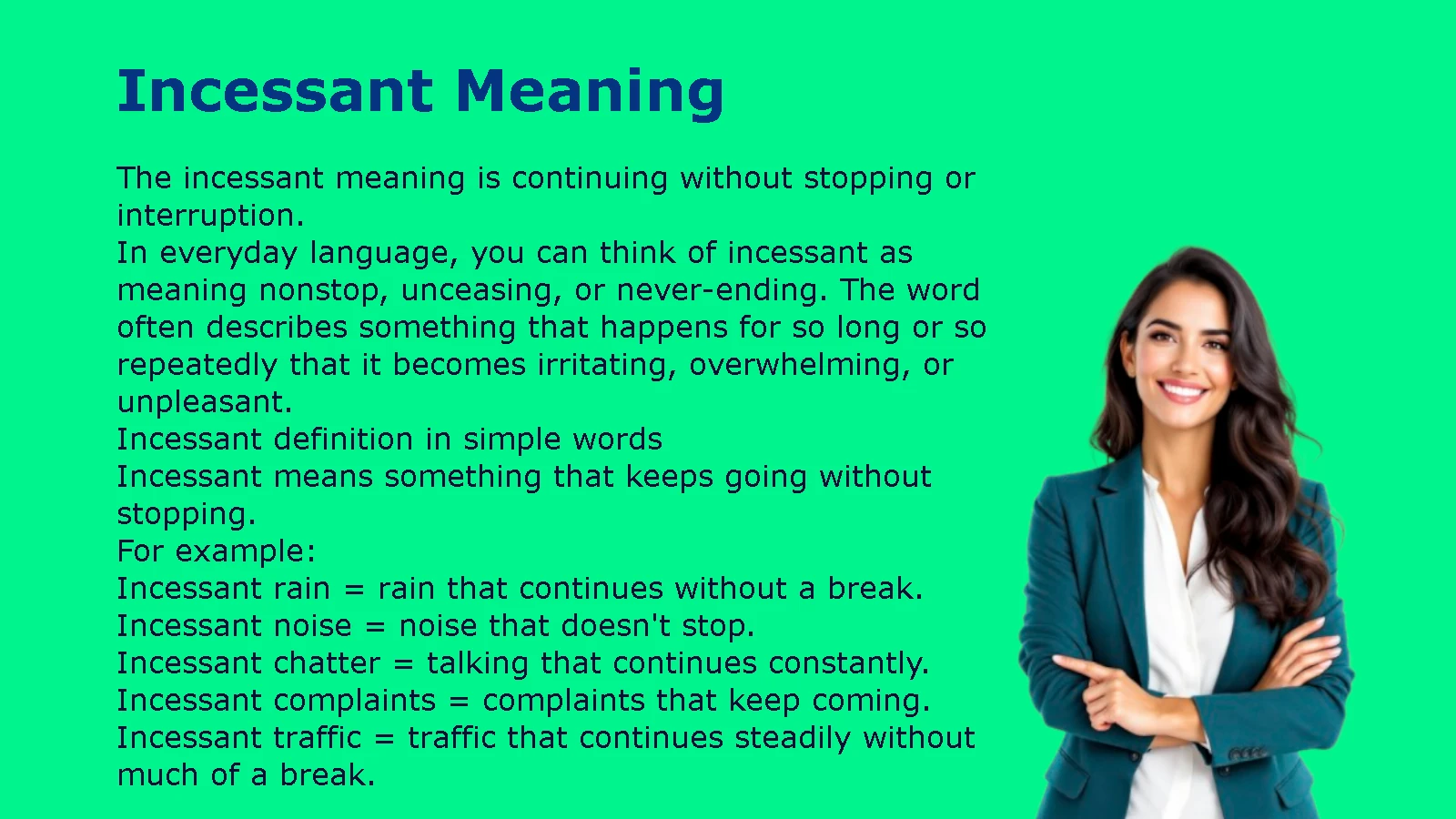
The incessant meaning is continuing without stopping or interruption.
In everyday language, you can think of incessant as meaning nonstop, unceasing, or never-ending. The word often describes something that happens for so long or so repeatedly that it becomes irritating, overwhelming, or unpleasant.
Incessant definition in simple words
Incessant means something that keeps going without stopping.
For example:
- Incessant rain = rain that continues without a break.
- Incessant noise = noise that doesn’t stop.
- Incessant chatter = talking that continues constantly.
- Incessant complaints = complaints that keep coming.
- Incessant traffic = traffic that continues steadily without much of a break.
Merriam-Webster defines incessant as “continuing or following without interruption.” It also explains that the word implies ceaseless or uninterrupted activity.
The key idea is simple: something keeps happening.
However, incessant usually adds another layer of meaning. The nonstop activity often feels excessive.
Compare these two sentences:
- “She received constant support from her family.”
- “She endured incessant criticism from her coworkers.”
Both sentences describe something that continues. Yet constant support sounds positive or reassuring, while incessant criticism suggests something unwanted and exhausting.
That difference in tone matters.
What Does Incessant Mean in Everyday English?
In everyday English, incessant usually means nonstop or never-ending, especially when something continues long enough to become bothersome.
Imagine sitting beside a dripping faucet.
One drip isn’t a problem. Ten drips might barely register. But if the faucet keeps dripping hour after hour, the sound starts to get under your skin.
That is the feeling incessant often captures.
Examples of the meaning of incessant
| Phrase | Meaning |
| Incessant rain | Rain that keeps falling without stopping |
| Incessant noise | Noise that continues without a break |
| Incessant questions | Questions that keep coming |
| Incessant talking | Talking that doesn’t seem to stop |
| Incessant traffic | A continuous flow of traffic |
| Incessant complaints | Complaints that continue repeatedly |
| Incessant buzzing | Buzzing that continues without relief |
| Incessant pressure | Pressure that continues persistently |
The word doesn’t require the situation to last for days or weeks. Context determines what counts as incessant. A person’s questions might feel incessant during a five minute conversation, while rain might be described as incessant after continuing for hours or days.
Incessant Pronunciation
The US pronunciation of incessant is:
/ɪnˈses.ənt/
A simple pronunciation guide is:
in-SES-uhnt
The stress falls on the second syllable: SES.
Cambridge gives the US pronunciation as /ɪnˈses.ənt/.
Break the word into syllables
in + ces + sant
When saying the word naturally, the middle syllable receives the strongest stress:
in-SES-uhnt
Don’t pronounce it as though it were related to insistent. The two words look somewhat similar, but they have different meanings.
- Incessant = continuing without stopping.
- Insistent = demanding attention or refusing to give up on a request or position.
For example:
“The incessant rain lasted all afternoon.”
versus:
“She was insistent that we leave early.”
The first sentence focuses on continuation. The second focuses on persistence or determination.
What Part of Speech Is Incessant?
Incessant is an adjective.
An adjective describes or modifies a noun. When you use incessant, it usually comes directly before the noun it describes.
Common grammatical pattern
incessant + noun
Examples include:
- incessant noise
- incessant rain
- incessant chatter
- incessant pressure
- incessant demands
- incessant complaints
- incessant questions
- incessant traffic
For example:
“The incessant barking kept the neighbors awake.”
Here, incessant describes barking.
You can also use a related form, incessantly, when you need an adverb.
“The dog barked incessantly.”
In the first sentence, incessant modifies a noun or noun phrase. In the second, incessantly modifies the verb barked.
Cambridge lists incessantly as the adverbial form of incessant.
The Origin and Etymology of Incessant
The history of incessant helps explain why its modern meaning centers on something that doesn’t stop.
Merriam-Webster traces the word to Middle English incessaunt and ultimately to Late Latin incessant-, related to Latin cessare, meaning “to delay” or “to cease.” Its first known use in the modern English record dates to the 15th century.
Oxford gives a closely related history. It traces incessant through Old French to Late Latin and explains the connection between in-, meaning “not,” and a form related to ceasing.
So the basic historical idea fits the modern meaning neatly: not ceasing.
That connection also makes the word easier to remember.
Think:
incessant → doesn’t cease → doesn’t stop
Is Incessant Positive or Negative?
Although incessant technically describes continuation, it often has a negative or disapproving tone.
Oxford marks the word as usually disapproving, while Cambridge emphasizes that it commonly describes something annoying or unpleasant.
That’s why these phrases sound natural:
- incessant complaints
- incessant noise
- incessant interruptions
- incessant rain
- incessant demands
- incessant criticism
They describe things people usually don’t want to experience.
However, context can soften or change the emotional effect.
For example:
“Her incessant curiosity led her to explore new ideas.”
Here, the writer uses incessant to emphasize that her curiosity never seems to stop. The word still suggests intensity, but the overall sentence can sound admiring.
Similarly:
“His incessant efforts eventually paid off.”
The phrase emphasizes persistence. It can sound positive because the effort produced a good result.
A useful rule
Incessant is usually negative when the nonstop activity bothers someone. Context can make it neutral or even positive when the continuation represents persistence, energy, or dedication.
Incessant vs. Constant
Incessant and constant overlap, but they aren’t always interchangeable.
Constant usually describes something that remains steady or happens persistently. It doesn’t necessarily suggest that the situation is annoying.
Incessant puts more emphasis on the fact that something doesn’t stop and often suggests that the continuation has become excessive.
Merriam-Webster explains that constant can imply uniform or persistent occurrence, while incessant specifically implies ceaseless or uninterrupted activity.
| Word | Main idea | Typical tone | Example |
| Incessant | Keeps going without stopping | Often negative | The incessant noise was distracting. |
| Constant | Continues or occurs regularly | Often neutral | She received constant support. |
Consider these examples:
“He experienced constant pain.”
This simply tells you that the pain persisted.
“He experienced incessant interruptions.”
This suggests that interruptions repeatedly prevented him from continuing normally.
The second sentence carries a stronger sense of irritation.
Can you replace constant with incessant?
Sometimes.
“The constant noise was annoying.”
can become:
“The incessant noise was annoying.”
The meaning remains close.
But this replacement doesn’t work equally well everywhere.
“Her constant support helped me succeed.”
Changing constant to incessant would make the support sound excessive or possibly irritating.
So don’t treat synonyms as interchangeable puzzle pieces. Tone matters.
Incessant vs. Continuous
The difference between incessant and continuous is subtle but useful.
Continuous generally emphasizes an uninterrupted flow or extension. Merriam-Webster defines it in terms of uninterrupted extension in space, time, or sequence.
Incessant, on the other hand, emphasizes that something keeps going and often carries a sense of annoyance or excess.
Compare:
“The machine ran continuously for six hours.”
This sounds factual and technical.
“The machine made an incessant buzzing sound.”
This sounds more subjective. The writer wants you to notice how irritating the buzzing became.
Quick comparison
| Word | Focus | Tone |
| Continuous | No interruption | Usually neutral |
| Incessant | No stopping, often annoyingly | Often negative |
| Constant | Persistent or steady | Neutral or varied |
In technical, scientific, or formal writing, continuous may be the more precise choice when the writer simply wants to describe uninterrupted operation.
In descriptive writing, incessant works well when the continuation itself matters to the reader’s experience.
Incessant vs. Continual
Continual causes confusion because it can describe repeated events and, in some contexts, uninterrupted continuation.
Oxford gives continual meanings that include both repeated many times and continuing without interruption.
Merriam-Webster makes a similar point and notes that modern usage often favors continual for recurring events, although the word has also long been used for uninterrupted continuation.
A practical distinction is:
- Incessant → keeps going without stopping.
- Continual → happens repeatedly, often with short intervals between occurrences.
- Continuous → continues without interruption.
For example:
“The continual interruptions made it difficult to finish the report.”
The interruptions happen again and again.
“The incessant noise made it difficult to concentrate.”
The noise seems to continue without relief.
The distinction isn’t absolute. English has plenty of overlap between these words. Still, this guideline helps you choose the most natural option.
Incessant vs. Relentless
Relentless is another close synonym, but it adds a different shade of meaning.
Incessant emphasizes not stopping.
Relentless emphasizes not easing or backing off, often with a sense of pressure, intensity, or aggression.
Compare:
“The incessant rain continued throughout the night.”
The rain simply doesn’t stop.
“The relentless heat made outdoor work unbearable.”
The heat feels intense and unforgiving.
You can use relentless for things that seem to attack, pressure, or wear someone down:
- relentless pressure
- relentless criticism
- relentless competition
- relentless attacks
- relentless pursuit
You can use incessant for a broader range of ongoing things:
- incessant rain
- incessant chatter
- incessant noise
- incessant questions
- incessant traffic
Synonyms for Incessant
The best incessant synonyms include:
- ceaseless
- unceasing
- constant
- continuous
- never-ending
- perpetual
- unremitting
- unrelenting
- relentless
- nonstop
- uninterrupted
- endless
Cambridge lists ceaseless, constant, never-ending, perpetual, unceasing, and unremitting among related synonyms.
Merriam-Webster’s thesaurus also includes words such as continuous, continual, nonstop, uninterrupted, unceasing, ceaseless, and unremitting.
Incessant synonyms by tone
| Synonym | What it emphasizes | Example |
| Nonstop | No break | nonstop traffic |
| Ceaseless | Never ending | ceaseless activity |
| Unceasing | Never stopping | unceasing effort |
| Continuous | Uninterrupted flow | continuous operation |
| Constant | Persistent presence | constant pressure |
| Relentless | Intensity and persistence | relentless criticism |
| Perpetual | Lasting or recurring indefinitely | perpetual conflict |
| Unremitting | No reduction in intensity | unremitting pressure |
| Endless | Seems to have no end | endless complaints |
Which synonym should you choose?
Antonyms of Incessant
The opposite of incessant describes something that stops, pauses, or happens only from time to time.
Useful antonyms include:
- intermittent
- occasional
- sporadic
- infrequent
- periodic
- interrupted
- temporary
The strongest contrast is often intermittent.
Incessant vs. intermittent
Incessant = continuing without stopping.
Intermittent = starting and stopping at intervals.
For example:
“The incessant rain lasted all night.”
The rain doesn’t give you much of a break.
“The intermittent rain came and went throughout the afternoon.”
There are clear periods when the rain stops.
This contrast makes the two words easy to remember:
Incessant = no break.
Intermittent = repeated breaks.
Common Collocations With Incessant
A collocation is a combination of words that naturally appear together. Learning collocations makes your vocabulary sound more natural because native speakers don’t choose words randomly.
Oxford specifically gives common combinations such as incessant noise, incessant rain, incessant chatter, and incessant meetings.
Here are some useful combinations:
Incessant noise
“The incessant noise from the construction site made it hard to work.”
This is one of the most common uses because noise can quickly become irritating when it never stops.
Incessant rain
“The region experienced weeks of incessant rain.”
Here, the word emphasizes the duration and lack of relief.
Incessant chatter
“His incessant chatter made it difficult for everyone to focus.”
The phrase suggests talking that continues beyond what the listener wants.
Incessant complaints
“The manager grew tired of the customer’s incessant complaints.”
The complaints keep coming and become burdensome.
Incessant questions
“The child’s incessant questions kept the teacher busy.”
This doesn’t necessarily mean the child literally asks questions every second. It means the questions come so frequently that they seem never-ending.
Incessant traffic
“Residents complained about the incessant traffic outside their homes.”
The word highlights an almost continuous flow of vehicles.
How to Use Incessant in a Sentence
The easiest structure is:
incessant + noun
For example:
“The incessant rain flooded the streets.”
You can also place the phrase after a linking verb:
“The noise was incessant throughout the night.”
However, the first structure is more common in everyday descriptive writing.
Incessant sentence examples
Weather
The incessant rain canceled the outdoor event.
Noise
The incessant construction noise disrupted the meeting.
Conversation
Her incessant chatter made it hard to concentrate.
Questions
The student’s incessant questions showed genuine curiosity.
Traffic
Incessant traffic turned the short drive into a long commute.
Work
The team struggled under the incessant pressure to meet deadlines.
Technology
Incessant notifications can make it difficult to focus on one task.
Complaints
The manager finally addressed the customer’s incessant complaints.
Music
The incessant beat continued late into the night.
Demands
The employee felt overwhelmed by the incessant demands of the job.
Notice that incessant works particularly well with things that can continue over a period of time.
Incessantly Meaning and Usage
Incessantly is the adverb form of incessant.
It means continuously, without stopping, or repeatedly without a meaningful break.
The difference is grammatical:
- Incessant describes a noun.
- Incessantly describes an action.
Compare:
“The incessant barking disturbed the neighborhood.”
“The dog barked incessantly.”
In the first sentence, incessant describes barking. In the second, incessantly tells you how the dog barked.
Cambridge gives the example of someone who “talks incessantly,” illustrating how the adverb modifies an action.
More examples of incessantly
- The phone rang incessantly.
- The baby cried incessantly.
- The machine hummed incessantly.
- He talked incessantly during the flight.
- The rain fell incessantly throughout the night.
- The alarm beeped incessantly until someone switched it off.
A useful test is simple:
If you’re describing a thing, use “incessant.” If you’re describing how an action happens, “incessantly” may be the right choice.
Common Mistakes With Incessant
Even though incessant has a straightforward definition, several mistakes can change its meaning or make a sentence sound unnatural.
Using incessant for occasional events
Incorrect:
“We had incessant rain for ten minutes, followed by several hours of sunshine.”
If the rain stopped and remained absent for hours, incessant doesn’t accurately describe the entire period.
Better:
“We had heavy rain for ten minutes.”
Or:
“We had intermittent rain throughout the day.”
Confusing incessant with insistent
These words look similar but mean different things.
Incessant means continuing without stopping.
Insistent means demanding attention or strongly maintaining a request, opinion, or position.
Compare:
“The incessant rain delayed the flight.”
“She was insistent that the flight should be delayed.”
One describes continuation. The other describes determination.
Using incessantly as an adjective
Incorrect:
“The incessantly noise kept me awake.”
Correct:
“The incessant noise kept me awake.”
Or:
“The noise continued incessantly.”
The adjective goes with the noun. The adverb modifies the action.
Assuming incessant always means constant
The words overlap, but incessant often carries more emotional weight.
“He received constant encouragement.”
sounds positive.
“He endured incessant criticism.”
sounds negative.
Replacing one with the other can change the feeling of the sentence even when the basic idea remains similar.
Is Incessant Always Negative?
No. Incessant usually sounds negative, but context can change the tone.
Oxford labels the word “usually disapproving,” which is an important distinction. It doesn’t say that every use must be negative.
Consider:
“The incessant noise kept everyone awake.”
Clearly negative.
Now consider:
“Her incessant curiosity pushed her to learn something new every day.”
Here, the word emphasizes how strongly and continuously her curiosity operates. The surrounding context gives it a positive direction.
Another example:
“His incessant efforts eventually changed the organization.”
The effort sounds admirable because it produced a meaningful result.
Still, if you want an unmistakably positive word, persistent, dedicated, or determined may fit better.
That distinction matters because incessant can imply too much of something, even when the writer doesn’t intend a harsh criticism.
Real World Examples of Incessant
The word appears naturally in many areas of life.
Incessant weather
Weather is one of the clearest contexts.
“The incessant rain caused flooding across the region.”
The word doesn’t simply mean “a lot of rain.” It emphasizes continued rain with little or no relief.
Incessant technology
Modern life provides another useful example:
“The incessant stream of notifications made it difficult to focus.”
Here, the notifications may arrive frequently enough that the person feels constantly interrupted.
Incessant work pressure
In professional settings:
“Employees faced incessant pressure to meet increasingly tight deadlines.”
The word conveys more than ordinary workplace pressure. It suggests pressure that doesn’t let up.
Incessant conversation
In social situations:
“The incessant chatter made it difficult to hear the presentation.”
The speaker isn’t simply saying that people talked. The talking continued so persistently that it interfered with something else.
Incessant traffic
In a busy city:
“Residents complained about the incessant traffic noise.”
Again, the word emphasizes the lack of quiet periods.
A Practical Case Study: Choosing the Right Word
Imagine a person writing about a busy office.
The office receives frequent phone calls. Employees talk throughout the day. Messages arrive constantly. Construction is happening outside.
Which word should the writer choose?
Situation one: Phone calls
“The office received constant phone calls.”
This is neutral. It tells the reader that calls came regularly.
Situation two: Construction noise
“The office endured incessant construction noise.”
This is stronger. The writer wants to show that the noise continued and became difficult to tolerate.
Situation three: Internet connection
“The office experienced intermittent internet problems.”
This means the problems came and went.
Situation four: Machine operation
“The machine operated continuously for eight hours.”
This sounds technical and factual.
The lesson
All four words describe ongoing situations, but they focus on different ideas:
| Situation | Best word | Why |
| Frequent phone calls | Constant | Emphasizes persistent occurrence |
| Annoying construction noise | Incessant | Emphasizes nonstop and bothersome activity |
| Internet problems with breaks | Intermittent | Emphasizes stopping and starting |
| Machine running without interruption | Continuous | Emphasizes uninterrupted operation |
This is why knowing the nuance behind a word matters more than memorizing a one word synonym.
Incessant vs. Similar Words at a Glance
| Word | Meaning | Breaks possible? | Common tone |
| Incessant | Continues without stopping | No meaningful breaks | Often negative |
| Constant | Persists or occurs regularly | Sometimes, depending on context | Neutral |
| Continuous | Continues without interruption | No | Neutral |
| Continual | Repeated frequently or continuously | Often yes when used for recurrence | Neutral or negative |
| Ceaseless | Never stops | No | Strong or emphatic |
| Relentless | Continues with intensity | Usually no relief | Often negative |
| Intermittent | Starts and stops | Yes | Neutral |
| Sporadic | Happens irregularly | Yes | Neutral |
| Occasional | Happens from time to time | Yes | Neutral |
Merriam-Webster’s treatment of these terms also highlights an important distinction: continuous tends to emphasize uninterrupted flow, constant persistent occurrence, continual recurrence, and incessant ceaseless activity.
How to Remember the Meaning of Incessant
A simple memory trick can make the word stick.
Think of incessant as:
“It doesn’t cease.”
The words are closely connected in meaning:
incessant → doesn’t cease → doesn’t stop
Picture a phone that keeps ringing.
No break.
That’s incessant.
Now picture a phone that rings once, stops, rings again, and then stays quiet for ten minutes.
That’s intermittent.
This simple mental contrast makes the difference much easier to remember.
Incessant Meaning: Quick Facts
| Fact | Answer |
| Word | Incessant |
| Part of speech | Adjective |
| Basic meaning | Continuing without stopping |
| US pronunciation | /ɪnˈses.ənt/ |
| Simple synonym | Nonstop |
| Common tone | Usually negative or disapproving |
| Adverb | Incessantly |
| Strong antonym | Intermittent |
| Common collocations | Incessant noise, rain, chatter, complaints |
| First known use | 15th century |
| Word origin | Middle English, from Late Latin through Old French |
The pronunciation and definition are supported by Cambridge, while the word history and first known use come from Merriam-Webster.
Frequently Asked Questions About Incessant Meaning
What does incessant mean in simple words?
Incessant means continuing without stopping. It often describes something that keeps happening so continuously that it becomes annoying, tiring, or unpleasant.
Does incessant mean nonstop?
Yes. Nonstop is one of the simplest ways to understand incessant. However, incessant often carries a stronger suggestion that the nonstop activity is excessive or bothersome.
Is incessant positive or negative?
It is usually negative or disapproving, especially when it describes noise, complaints, interruptions, rain, or demands. However, context can make the word more neutral or even positive.
What is a synonym for incessant?
Common synonyms include nonstop, ceaseless, unceasing, continuous, constant, never-ending, perpetual, and unremitting. The best choice depends on the context and tone.
What is the opposite of incessant?
Intermittent is one of the clearest opposites. Something intermittent starts and stops instead of continuing without interruption. Other opposites include occasional, sporadic, infrequent, and interrupted.
What is the difference between incessant and constant?
Both words can describe something persistent. Incessant emphasizes uninterrupted continuation and often suggests annoyance. Constant is broader and can describe something persistent without implying that it is unpleasant.
For example:
“She received constant support.”
sounds positive.
“She endured incessant criticism.”
sounds negative.
What is the difference between incessant and continuous?
Continuous generally emphasizes uninterrupted flow or extension and often sounds neutral. Incessant also suggests a lack of interruption but often adds a feeling of irritation or excess.
What does incessantly mean?
Incessantly means continuously or without stopping. It is the adverb form of incessant.
Example:
“The alarm rang incessantly.”
How do you pronounce incessant?
In US English, incessant is pronounced /ɪnˈses.ənt/, approximately in-SES-uhnt.
Is incessant a noun or adjective?
Incessant is an adjective.
You can say:
“The incessant noise was distracting.”
You can’t normally use incessant as the noun itself. The related noun incessancy exists, although it is much less common in everyday English.
Can incessant describe a person?
Usually, it describes an action, behavior, sound, condition, or activity associated with a person rather than the person directly.
Natural:
“His incessant talking annoyed everyone.”
Less natural:
“He was incessant.”
The first version clearly identifies what is continuing.
Can incessant be used for positive things?
Yes, although the word often has a negative shade.
For example:
“Her incessant curiosity drove her to keep learning.”
The surrounding context makes the quality sound admirable. If the goal is clearly positive, however, words such as persistent, dedicated, tireless, or determined may communicate the intended meaning more precisely.
Final Takeaway: What Does Incessant Mean?
The simplest answer to “What does incessant mean?” is:
Incessant means continuing without stopping or interruption.
The word usually describes something that happens so continuously that it becomes annoying, tiring, excessive, or difficult to ignore. That’s why phrases such as incessant noise, incessant rain, incessant chatter, and incessant complaints sound so natural.