Have you ever seen something that looked fancy, decorative, or stylish but seemed completely unnecessary? That is where Frippery Meaning comes into play. This uncommon word describes things that are showy, decorative, or ornamental but have little practical value.
Frippery is a noun used to describe unnecessary decorations, fancy clothing, or other elaborate things added mainly for appearance. It can also refer to something superficial or lacking real usefulness.
Examples:
- The room was filled with expensive frippery that served no real purpose.
- She preferred simple clothes without unnecessary frippery.
The confusion is understandable. People often search for what does frippery mean, frippery definition, frippery meaning in English, or how to use frippery in a sentence because the word isn’t common in everyday conversation. Depending on the context, it can describe clothing, decorations, writing, behavior, or anything else that feels unnecessarily elaborate.
In this guide, you’ll learn the complete Frippery Meaning, its definition, pronunciation, origin, synonyms, antonyms, and correct usage. You’ll also discover clear frippery examples in sentences, related words, and how to understand this unusual word in different contexts.
What Does Frippery Mean?
Frippery means unnecessary decoration, showy ornament, fancy extras, or something considered superficial and nonessential.
The word can describe physical things, such as clothing and decorations, but it can also describe less tangible forms of display. For example, a person might criticize the frippery in a speech if the speaker uses elaborate language without adding useful information.
Merriam Webster gives several related senses, including finery, something showy or nonessential, and ostentation. Cambridge defines it as a silly decoration or another unnecessary object.
In simple terms:
Frippery is something fancy or decorative that someone considers unnecessary, excessive, or superficial.
For example:
The designer removed the unnecessary frippery and kept the room simple.
Here, frippery doesn’t simply mean decoration. It suggests that the decoration wasn’t needed.
Frippery Meaning in Simple English
A simple way to remember the meaning is:
Frippery = fancy extras that aren’t really necessary.
Imagine a plain jacket with a useful zipper and pockets. Now imagine covering that jacket with oversized bows, glitter, tassels, jewels, and decorative buttons. Someone who dislikes excessive ornament might describe those additions as frippery.
The same idea can apply outside fashion.
- Unnecessary decorations can be frippery.
- Excessive accessories can be frippery.
- Showy but impractical features can be frippery.
- Unnecessary flourishes in writing can be frippery.
- Empty displays of elegance or importance can be frippery.
The important point is judgment. Calling something frippery usually means the speaker believes it has little practical or serious value.
Frippery Definition
A dictionary style definition of frippery is:
Frippery: showy, decorative, frivolous, or unnecessary clothing, objects, ornamentation, or display.
The exact shade of meaning depends on the context.
| Meaning | Explanation | Example |
| Showy clothing | Elaborate or decorative dress | The costume was covered in fashionable frippery. |
| Decorative extras | Ornament that isn’t necessary | The room had little practical value in all its frippery. |
| Ostentation | A showy display intended to impress | He avoided the frippery of wealth. |
| Trifles | Small or unimportant things | The discussion focused on facts rather than frippery. |
| Verbal ornament | Unnecessary flourishes in language | The speech had plenty of rhetorical frippery. |
Cambridge marks frippery as disapproving, while Oxford labels it old fashioned and disapproving in its American English entry. That tone matters because the word usually expresses an opinion rather than offering a neutral description.
Frippery Pronunciation
The American pronunciation of frippery is:
FRIP uh ree
IPA:
/ˈfrɪp.ɚ.i/
The British pronunciation is commonly represented as:
/ˈfrɪp.ər.i/
The stress falls on the first syllable:
FRIP-uh-ree
Oxford and Cambridge both list the pronunciation with primary stress on the first syllable.
How to Say Frippery Naturally
Break the word into three parts:
frip + uh + ree
It sounds similar to:
FRIP-uh-ree
The first part rhymes roughly with trip.
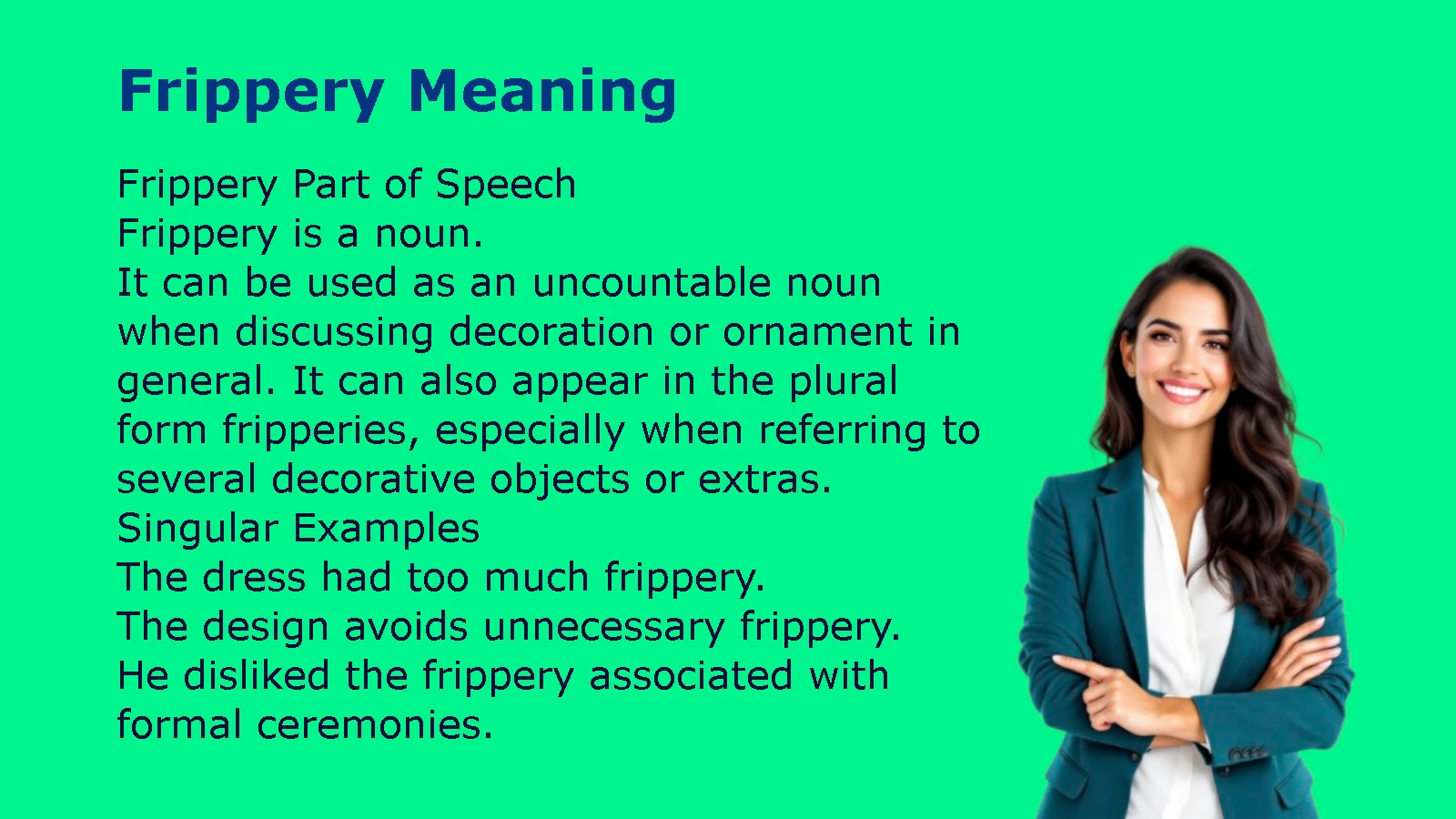
Frippery Part of Speech
Frippery is a noun.
It can be used as an uncountable noun when discussing decoration or ornament in general. It can also appear in the plural form fripperies, especially when referring to several decorative objects or extras.
Singular Examples
- The dress had too much frippery.
- The design avoids unnecessary frippery.
- He disliked the frippery associated with formal ceremonies.
Plural Examples
- The shop sells fashionable fripperies.
- She spent too much money on decorative fripperies.
- The designer removed several unnecessary fripperies from the collection.
Oxford lists frippery as countable, usually plural, and uncountable. Merriam Webster gives fripperies as its plural form.
Frippery Etymology and Word Origin
The history of frippery takes an interesting turn.
The word entered English in the 16th century. Oxford dates its origin to the mid 16th century, when it referred to old or secondhand clothes. The word came through French friperie and Old French freperie, related to frepe, meaning a rag or old garment.
Merriam Webster gives 1568 as the first known use of frippery in English and traces it through Middle French friperie to Old French frepe, meaning an old garment.
Over time, the meaning moved beyond old clothing. It came to describe finery, showiness, decorative excess, and things considered trivial or unnecessary.
That shift explains something important about the modern word. Frippery can suggest both ornament and lack of substance.
A Short History of the Word
| Period | Sense |
| 16th century | Old or secondhand clothing |
| Later usage | Clothing or finery with a showy or tawdry quality |
| Modern usage | Unnecessary decoration, showiness, superficial extras, or trivial things |
Etymological sources also connect the French forms with old clothes, rags, and worn material. The exact deeper origin is uncertain.
How to Use Frippery in a Sentence
The easiest way to use frippery correctly is to remember that it usually describes something considered unnecessary, excessive, or showy.
Examples With Clothing
The gown was elegant without unnecessary frippery.
This sentence suggests that the gown looks attractive without excessive ornament.
She rejected the lace, ribbons, and other fripperies.
Here, fripperies refers to decorative clothing details.
Examples With Interior Design
The apartment’s clean design leaves little room for decorative frippery.
The word suggests that the decorations would add little value.
Examples With Writing
The editor removed the literary frippery and kept the argument clear.
In this case, frippery refers to unnecessary stylistic flourishes rather than physical objects.
Examples With Speech
His presentation was direct and contained none of the usual rhetorical frippery.
The speaker avoids unnecessary verbal display.
Examples With General Ideas
The proposal focuses on practical improvements rather than expensive frippery.
Here, frippery means unnecessary extras.
Frippery Examples
Context makes the meaning much easier to understand. Consider these examples:
| Sentence | What “frippery” means |
| She prefers simple clothes without frippery. | Excessive clothing decoration |
| The room contains little decorative frippery. | Unnecessary ornament |
| The writer avoids literary frippery. | Unnecessary stylistic flourishes |
| The speech was free of rhetorical frippery. | Empty or excessive verbal display |
| He spends little on fashionable fripperies. | Nonessential fashionable items |
| The product works well without technological frippery. | Unnecessary features |
| They focused on the main issue rather than political frippery. | Superficial extras |
| The ceremony had all the usual royal frippery. | Elaborate ceremonial display |
Notice the pattern. Frippery doesn’t simply mean “something attractive.” It usually suggests that the speaker thinks the attractive or elaborate feature isn’t important enough to justify the attention, cost, or space it receives.
Frippery Synonyms
Several words overlap with frippery, but they don’t all carry the same tone.
| Synonym | Basic meaning | Tone compared with frippery |
| Decoration | Something added to make something attractive | More neutral |
| Ornament | An object or detail added for appearance | Usually neutral |
| Adornment | Something that makes a person or thing more attractive | Often positive or neutral |
| Embellishment | An added decorative or explanatory detail | Neutral to positive |
| Finery | Elegant or elaborate clothing | Often positive |
| Frills | Extra features that aren’t essential | Very close |
| Ostentation | Excessive display intended to impress | More strongly negative |
| Trinkets | Small decorative or valuable objects | Often mildly dismissive |
| Trifles | Things of little importance | More focused on insignificance |
| Flummery | Empty or insincere words or behavior | More focused on lack of substance |
Merriam Webster lists finery and ostentation among related senses, while Collins includes terms such as frills, nonsense, finery, and ostentation among its synonyms.
Is “Decoration” the Same as Frippery?
Not quite.
Decoration is neutral. Frippery is judgmental.
Consider these two sentences:
The room has colorful decorations.
This sentence simply describes the room.
The room has colorful frippery.
This sentence suggests that the decorations are excessive, unnecessary, or silly.
That difference makes frippery a more expressive word.
Frippery vs. Decoration
The distinction becomes clearer when you compare their typical uses.
| Frippery | Decoration |
| Usually carries a negative or dismissive tone | Usually neutral |
| Suggests unnecessary ornament | Simply describes ornament |
| Can imply excess or superficiality | Doesn’t imply excess |
| Can describe abstract things such as speech | Usually refers to something added for appearance |
| Often expresses the speaker’s judgment | Usually makes no judgment |
For example:
The cake had beautiful decorations.
The sentence praises or neutrally describes the cake.
The cake was buried beneath layers of sugary frippery.
Now the writer suggests that the decoration has gone too far.
Frippery is therefore more than decoration. It’s decoration viewed through a critical lens.
Frippery vs. Embellishment
Embellishment means an added detail that makes something more attractive, interesting, or elaborate.
It doesn’t automatically suggest that the addition has no value.
For example:
The author added historical details as an embellishment to the story.
That could be positive.
By contrast:
The author filled the story with unnecessary literary frippery.
This suggests that the additions distract from the main point.
Quick Difference
- Embellishment: an added detail.
- Frippery: an added detail viewed as unnecessary or excessive.
An embellishment can improve something. Frippery usually makes you question why the extra detail exists in the first place.
Frippery vs. Finery
Finery usually refers to elegant or elaborate clothing, jewelry, or other attractive possessions.
Unlike frippery, finery doesn’t necessarily criticize the thing being described.
She wore her finest finery to the wedding.
This sounds positive.
She considered the elaborate costume mere frippery.
This sounds dismissive.
Merriam Webster recognizes finery as one sense of frippery, but the words don’t always carry the same attitude.
A useful shortcut is:
Finery = fancy things.
Frippery = fancy things viewed as unnecessary or showy.
Is Frippery a Negative Word?
Yes, frippery usually has a negative or dismissive connotation.
Cambridge labels the word disapproving, while Oxford describes it as old fashioned and disapproving in its American English entry.
However, the strength of the criticism depends on the sentence.
Compare:
The palace was filled with royal frippery.
This may sound mildly critical or playful.
We have no time for such frippery.
This sounds much more dismissive.
The speaker isn’t necessarily saying the thing is ugly. Instead, the speaker is saying that it doesn’t matter enough to deserve attention.
That’s a subtle but important distinction.
Frippery in Clothing and Fashion
Fashion provides one of the clearest uses of frippery.
The word can describe clothing or accessories that look overly ornate, elaborate, flashy, or impractical. Dictionary sources include showy clothing and finery among its meanings.
Possible examples include:
- Excessive ribbons
- Decorative bows
- Elaborate lace
- Oversized ornaments
- Flashy accessories
- Highly ornate costumes
- Decorative details with little practical purpose
For example:
The designer favored clean lines and avoided unnecessary frippery.
The sentence contrasts simplicity with excessive ornament.
However, calling a particular fashion detail frippery expresses an opinion. A person who loves elaborate clothing might see the same detail as beautiful rather than unnecessary.
That subjective quality is part of the word’s meaning.
Frippery in Writing and Speech
One of the most useful figurative applications of frippery involves language.
Writing can contain unnecessary decoration just as clothing can. A writer might use long descriptions, ornate phrases, dramatic flourishes, or complicated expressions that add style without adding meaning.
That kind of language can become literary frippery.
For example:
The report avoids literary frippery and presents the findings directly.
The sentence suggests that the report values clarity over elaborate prose.
The same idea applies to speech:
The speaker dropped the rhetorical frippery and addressed the problem directly.
Here, frippery means verbal ornament or empty display.
Frippery in Writing: A Practical Example
Consider two versions of the same idea.
Simple:
The plan failed because it cost too much.
With unnecessary ornament:
The grand and ambitious undertaking ultimately encountered the formidable obstacle of excessive financial demands.
The second version isn’t automatically bad. In the right literary context, elaborate language can create a particular effect. But if the goal is a short business report, the extra wording may feel like frippery.
The key question is simple:
Does the extra style add meaning, or does it merely add show?
Common Phrases and Collocations With Frippery
Certain combinations make the word sound especially natural.
“Without frippery”
This phrase emphasizes simplicity.
The restaurant’s menu is elegant without frippery.
“Mere frippery”
This phrase strongly dismisses something as unnecessary.
He regarded expensive accessories as mere frippery.
“Decorative frippery”
This combination emphasizes unnecessary decoration.
The designer removed the decorative frippery from the room.
“Literary frippery”
This refers to unnecessary stylistic decoration in writing.
The editor wanted clear prose without literary frippery.
“Fashion fripperies”
This phrase refers to decorative or nonessential fashion items.
Cambridge specifically gives fashion fripperies as an example of the word’s use.
“Unnecessary frippery”
This is almost a direct expression of the word’s central idea.
The software focuses on essential tools rather than unnecessary frippery.
Common Mistakes When Using Frippery
Because frippery is relatively uncommon, several mistakes can easily occur.
Using Frippery as a Completely Neutral Word
Don’t automatically replace decoration with frippery.
If you’re simply describing something attractive, decoration is usually safer.
The room has floral decorations.
If you want to criticize those decorations as unnecessary:
The room is overloaded with decorative frippery.
Assuming Frippery Only Refers to Clothes
Historically, clothing played an important role in the word’s development. Modern frippery, however, can refer to much more than fashion.
It can describe:
- Objects
- Decorations
- Clothing
- Speech
- Writing
- Ceremonial display
- Superficial extras
- Trivial considerations
Cambridge examples demonstrate uses involving clothes, objects, spending, and broader unnecessary features.
Assuming Frippery Always Means Something Ugly
It doesn’t.
Something can be beautiful and still be called frippery if the speaker considers it unnecessary or excessively decorative.
That’s why the word expresses attitude, not merely appearance.
Confusing Frippery With Frivolity
The two words overlap, but they’re not identical.
Frivolity generally refers to a lack of seriousness or behavior focused on pleasure rather than serious matters.
Frippery focuses more strongly on showy decoration, unnecessary extras, or superficial display.
Frippery Meaning in Different Contexts
The meaning becomes clearer when you see how the word behaves in different settings.
| Context | Frippery meaning | Example |
| Fashion | Showy or unnecessary clothing details | The outfit contained too much frippery. |
| Jewelry | Nonessential decorative pieces | She avoided expensive frippery. |
| Interior design | Excess ornament | The room has no unnecessary frippery. |
| Writing | Unnecessary stylistic flourishes | The essay contains little literary frippery. |
| Speech | Empty verbal display | His argument needs facts, not rhetorical frippery. |
| Ceremonies | Elaborate formal display | The event avoided traditional ceremonial frippery. |
| Technology | Nonessential features | The device focuses on function rather than frippery. |
| Everyday life | Extras considered unnecessary | They chose necessities over frippery. |
This flexibility explains why frippery can be a useful word even though it’s relatively uncommon.
Frippery in Formal and Informal English
Frippery tends to sound literary, formal, old fashioned, or deliberately expressive.
Oxford’s American English entry labels it old fashioned, while the British entry presents it as a disapproving noun.
You probably wouldn’t use frippery in every casual conversation.
For example, instead of saying:
Don’t spend your money on unnecessary frippery.
A casual speaker might say:
Don’t waste your money on stuff you don’t need.
Both sentences communicate a similar idea. The first simply sounds more distinctive.
When Frippery Works Well
Use it when you want a sentence to sound:
- Precise
- Literary
- Slightly witty
- Critical
- Expressive
- Formal
When Simpler Words Work Better
Choose extras, decoration, frills, or unnecessary stuff when your audience may not know the word.
Good writing isn’t about using the rarest word available. It’s about choosing the word that delivers the exact meaning.
Case Study: Frippery in Fashion
Imagine two formal dresses.
The first has a simple shape, clean stitching, and one small decorative detail. The second has layers of lace, large bows, sequins, ribbons, gemstones, and elaborate sleeves.
Someone who values minimalism might call the second dress frippery.
Someone who loves ornate fashion might call it elegant or beautiful.
The physical object hasn’t changed. The speaker’s evaluation has.
That’s why frippery carries a strong element of judgment.
What This Shows
The word can communicate three ideas at once:
- Something looks elaborate.
- The elaboration isn’t necessary.
- The speaker doesn’t particularly value that excess.
That combination gives frippery more force than simply saying decoration.
Case Study: Frippery in Writing
Now imagine an article explaining how to fix a broken faucet.
A useful sentence might say:
Turn off the water supply before removing the valve.
A writer could surround that instruction with several paragraphs of dramatic description about the faucet, the history of plumbing, and the beauty of flowing water.
Those details might entertain readers in a feature article. In a repair guide, however, they could distract from the task.
A reader might reasonably describe such material as frippery.
The lesson isn’t that descriptive writing is bad. Instead, frippery depends on purpose.
A detail becomes unnecessary when it fails to serve the goal of the communication.
Frippery and the Idea of “Less Is More”
The concept behind frippery connects with a familiar principle: sometimes extra isn’t better.
A product can have dozens of features that few people use. A room can have so many decorations that its useful space disappears. A speech can contain so many flourishes that the central argument gets lost.
In each case, the problem isn’t necessarily the quality of the extras. The problem is excess.
That’s why the word often appears in discussions of simplicity, practicality, restraint, and efficiency.
Good design doesn’t always need more. Sometimes it needs less.
This doesn’t mean every decorative element lacks value. Art, fashion, celebration, and entertainment often depend on decoration. Frippery becomes the right word when the speaker believes the decoration has crossed from useful or meaningful into unnecessary excess.
What Is the Opposite of Frippery?
There isn’t one perfect antonym in every context.
Depending on what you mean, possible opposites include:
- Simplicity
- Practicality
- Necessity
- Substance
- Functionality
- Essentiality
- Restraint
- Utility
For example:
The design emphasizes simplicity rather than frippery.
Or:
The proposal focuses on substance rather than superficial frippery.
The best opposite depends on the specific sense of the word.
Frippery vs. Frills
Frills and frippery often overlap.
A frill can mean an unnecessary extra feature, especially one that adds decoration or convenience without being essential.
For example:
The car has plenty of useful features but few unnecessary frills.
You could sometimes replace frills with frippery:
The design has little frippery.
However, frills sounds much more natural in everyday American English.
Frippery has a more literary or old fashioned feel and can carry a stronger sense of showiness or ostentation.
Frippery vs. Ostentation
Ostentation means excessive display designed to attract attention or demonstrate wealth, importance, or status.
For example:
The mansion’s enormous entrance seemed designed for ostentation.
Frippery can overlap with this meaning, but it has a broader range.
Frippery may describe small decorative objects, clothing, literary flourishes, or unnecessary extras. Ostentation more directly involves showing off.
A useful distinction is:
- Frippery: unnecessary or showy extras.
- Ostentation: excessive display intended to impress.
Frippery vs. Trinkets
A trinket is a small ornament or object of little practical value.
A collection of decorative souvenirs might contain many trinkets.
Those objects could also be called frippery if the speaker wants to emphasize their unnecessary or showy nature.
However, trinket identifies the object more directly. Frippery evaluates it.
Why Frippery Can Sound Witty
One reason the word remains useful is its slightly playful sound.
Calling something frippery can criticize it without sounding as blunt as saying it’s worthless.
Compare:
That decoration is useless.
with:
That decoration is pure frippery.
The second has more personality. It sounds pointed, but it can also sound humorous or lightly theatrical.
That quality makes the word useful in essays, reviews, commentary, and literary writing.
Frequently Asked Questions About Frippery
What is the simple meaning of frippery?
Frippery means unnecessary or excessive decoration, fancy extras, showy clothing, or superficial display. It usually carries a dismissive or disapproving tone.
Is frippery a negative word?
Yes. Frippery is usually mildly negative or disapproving. It suggests that something is showy, unnecessary, superficial, or trivial. Cambridge and Oxford both identify this disapproving sense.
What is an example of frippery?
The designer removed the unnecessary frippery from the room.
Here, frippery means decorative features that the designer considers unnecessary.
What is a synonym for frippery?
Depending on the context, synonyms include frills, finery, ornament, decoration, embellishment, ostentation, trinkets, and trifles. The closest choice depends on whether you want a neutral or negative tone.
Does frippery mean decoration?
Sometimes, but frippery is more specific than decoration. It usually refers to decoration or extras that someone considers unnecessary, excessive, silly, or showy.
How do you pronounce frippery?
In American English, frippery is pronounced approximately FRIP uh ree, /ˈfrɪp.ɚ.i/.
Is frippery still used today?
Yes. Although it isn’t among the most common everyday words, modern dictionaries continue to record it. Recent dictionary examples show the word used for fashion, design, decorative features, and unnecessary extras.
What is the plural of frippery?
The plural is fripperies.
Example:
The store was filled with fashionable fripperies.
Is frippery formal or informal?
Frippery is relatively formal, literary, and somewhat old fashioned. It works especially well when you want to express criticism of unnecessary decoration or showiness.
Can frippery describe writing?
Yes. Literary frippery or rhetorical frippery can describe unnecessary flourishes, elaborate language, or verbal decoration that adds style without enough substance.
What is the difference between frippery and finery?
Finery generally means elegant or elaborate clothing or possessions. Frippery can mean finery too, but it often suggests that the finery is excessive, showy, or unnecessary.
What is the difference between frippery and frivolity?
Frivolity concerns a lack of seriousness or importance. Frippery focuses more on unnecessary decoration, showiness, or superficial extras.
Final Takeaway: Frippery Meaning
The simplest way to remember frippery meaning is unnecessary or showy decoration, ornament, clothing, or extras.
The word can describe much more than fashion. You can use it for decorative objects, elaborate clothing, excessive features, ceremonial display, literary flourishes, rhetorical language, and superficial extras.
Its most important feature is its tone. When someone calls something frippery, they usually aren’t simply describing it. They’re suggesting that the thing has more show than substance or more decoration than practical value.
The word also has a fascinating history. Frippery entered English in the 16th century with a meaning connected to old or secondhand clothing. Over the centuries, its meaning expanded toward showy finery, ostentation, and unnecessary ornament.
So, when you see or use frippery, think:
Fancy, showy, unnecessary extras.
That’s the heart of the word.