Other ways to say calm down include “take a deep breath,” “take it easy,” “let’s take a step back,” and “let’s talk this through.” The best synonym for calm down depends on the situation, your relationship with the person, and how they feel. A supportive phrase can ease tension, while a blunt command may make an angry or overwhelmed person feel dismissed.
Whether you’re looking for polite ways to say calm down, professional expressions for work, funny alternatives for friends, or comforting words for someone experiencing stress, choosing the right phrase makes a difference. Some expressions encourage relaxation, while others help resolve arguments, manage frustration, or set healthy boundaries.
This guide covers 55 alternatives to calm down, with meanings, examples, text messages, and practical tips to help you choose words that fit the moment.
What Are Some Other Ways to Say Calm Down?
Some common alternatives to calm down include relax, take it easy, take a deep breath, keep your cool, slow down, take a moment, and let’s work through this together. Use gentle expressions when someone feels upset, casual phrases with friends, and professional language during tense workplace conversations.
Quick List of Alternatives to Calm Down
Here are 20 useful alternatives for different situations:
| Alternative | Tone | Best Use |
| Relax | Neutral | Everyday conversations |
| Take it easy | Friendly | Casual situations |
| Take a deep breath | Supportive | Stressful moments |
| Let’s slow down | Collaborative | Difficult discussions |
| Don’t stress | Casual | Minor worries |
| Keep your cool | Direct | Frustrating situations |
| Take a moment | Gentle | Emotional conversations |
| Let’s talk this through | Reassuring | Arguments or disagreements |
| Give yourself a second | Supportive | Moments of frustration |
| Let’s take a step back | Neutral | Conflict resolution |
| Chill out | Informal | Friends and familiar people |
| Take a breather | Encouraging | Stress or exhaustion |
| Ease up | Direct | When someone needs to reduce intensity |
| Let’s pause for a minute | Respectful | Heated conversations |
| There’s no rush | Reassuring | Pressure or anxiety |
| Let’s regroup | Professional | Team discussions |
| One thing at a time | Comforting | Overwhelming situations |
| Cool your jets | Playful | Lighthearted frustration |
| Let’s find a solution | Constructive | Problem-solving |
| I’m here for you | Caring | Emotional distress |
These phrases aren’t interchangeable in every context. For example, “chill out” might sound natural between close friends but dismissive during a serious disagreement. Meanwhile, “let’s take a step back” can help two coworkers discuss a problem without escalating tension.
Which Alternative to Calm Down Should You Use?
Choose an expression based on the person’s emotional state and the result you want. If someone feels overwhelmed, offer reassurance. If you’re resolving an argument, suggest a pause.
| Situation | Recommended phrase | Why it works |
| An angry friend | “Let’s talk this through.” | Encourages communication |
| A stressed colleague | “Let’s take this one step at a time.” | Makes the problem feel manageable |
| An anxious partner | “I’m here for you.” | Offers emotional support |
| A frustrated customer | “Let’s work together to resolve this.” | Focuses on a solution |
| A joking conversation | “Cool your jets!” | Adds humor without unnecessary formality |
| A heated argument | “Let’s pause for a minute.” | Creates space to think |
| An overwhelmed student | “You don’t have to do everything at once.” | Reduces pressure |
| Someone shouting | “I’d like us to lower our voices.” | Sets a clear boundary |
The most effective phrase often changes the focus from controlling someone’s emotions to helping them handle the situation.
Polite Ways to Say Calm Down
Polite alternatives to calm down acknowledge the other person’s feelings while encouraging a more manageable response. Phrases such as “let’s take a moment,” “I understand why you’re upset,” and “we can work through this” sound less commanding because they communicate respect and cooperation.
Gentle Ways to Encourage Someone to Relax
These expressions work well when you want to help someone settle their thoughts without making them feel judged.
- “Take a moment to breathe.” Encourages the person to pause before reacting.
- “Let’s take this one step at a time.” Helps when several problems feel overwhelming.
- “It’s okay to pause for a moment.” Gives someone permission to slow down.
- “Give yourself a little time.” Recognizes that emotions may need time to settle.
- “Let’s take a minute to regroup.” Suggests a short break before continuing.
- “There’s no need to rush.” Reassures someone who feels pressured.
- “Let’s approach this calmly.” Encourages a more constructive conversation.
- “We don’t have to figure everything out right now.” Reduces the pressure to solve a problem immediately.
Example:
Instead of saying, “Calm down. You’re making this worse,” try:
“ I can see this is frustrating. Let’s take a minute and figure out what happened.”
The second response acknowledges frustration and offers a practical next step. It avoids criticizing the person’s reaction.
Respectful Alternatives That Don’t Sound Rude
Sometimes, a person needs to feel heard before they’ll consider slowing down. Use language that recognizes their concern rather than telling them their feelings are wrong.
- “I understand why you’re upset.”
- “Let’s work through this together.”
- “We can figure this out.”
- “I hear what you’re saying.”
- “Let’s focus on what we can do next.”
- “I want to understand your perspective.”
- “Can we take a step back and look at the situation?”
- “Let’s see what options we have.”
These expressions are especially useful when you’re dealing with someone who feels ignored, treated unfairly, or misunderstood.
For example, if a friend becomes upset because you canceled plans, saying “Relax, it’s not a big deal” might make the disagreement worse. Saying “I understand why you’re disappointed. Can we talk about it?” shows that you take the person’s concern seriously.
Examples of Polite Alternatives in Conversations
With a friend
Friend: “Nothing is working out today. I’m so frustrated.”
You: “That sounds exhausting. Want to take a breather and talk about it?”
With a family member
Family member: “Nobody listens to what I’m saying!”
You: “I want to hear you. Let’s slow down so I can understand what you’re telling me.”
With a colleague
Colleague: “This entire project is falling apart!”
You: “I understand the concern. Let’s review the biggest issues and decide what to tackle first.”
Each response uses a slightly different approach, but all three communicate the same message: you recognize the problem and want to move forward constructively.
Professional Ways to Say Calm Down at Work
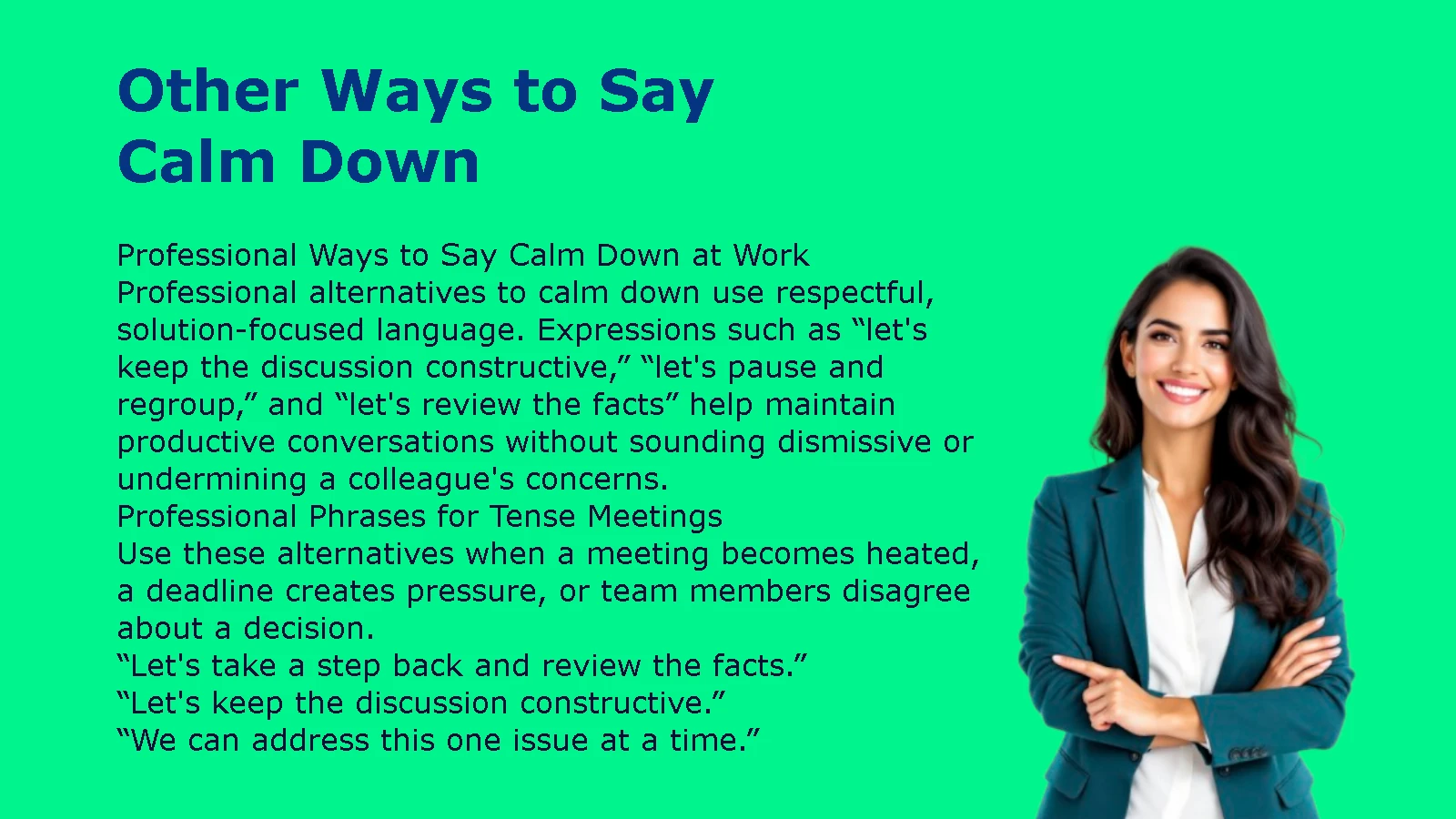
Professional alternatives to calm down use respectful, solution-focused language. Expressions such as “let’s keep the discussion constructive,” “let’s pause and regroup,” and “let’s review the facts” help maintain productive conversations without sounding dismissive or undermining a colleague’s concerns.
Professional Phrases for Tense Meetings
Use these alternatives when a meeting becomes heated, a deadline creates pressure, or team members disagree about a decision.
- “Let’s take a step back and review the facts.”
- “Let’s keep the discussion constructive.”
- “We can address this one issue at a time.”
- “Let’s pause and regroup.”
- “I’d like us to focus on finding a solution.”
- “Let’s make sure everyone has a chance to speak.”
- “Can we revisit the main concern?”
- “Let’s separate the immediate problem from the bigger picture.”
- “We have a few options to consider.”
- “Let’s work toward a practical next step.”
The goal is to redirect the discussion without suggesting that someone has no right to feel frustrated.
For example, if two employees disagree over a project deadline, “Let’s separate the scheduling issue from the question of who is responsible” gives them a concrete way to move forward.
By contrast, “Everyone needs to calm down” may sound like a reprimand and shift the meeting away from the actual problem.
Alternatives to Calm Down in Emails and Workplace Messages
Written communication requires extra care because readers can’t hear your tone of voice. A phrase that sounds harmless in person may seem cold or patronizing in an email.
Consider these professional alternatives:
- “I suggest we revisit this once we’ve had time to reflect.”
- “Let’s discuss this when we can give it our full attention.”
- “I understand your concerns, and I’d like to work through them.”
- “Could we take a moment to consider our options?”
- “I’d appreciate the opportunity to discuss this constructively.”
- “Let’s review the details before deciding on the next steps.”
- “I think a brief pause would help us approach this more productively.”
Example email:
Instead of writing:
“Please calm down and stop sending angry emails.”
Write:
“ I understand that this issue is frustrating. I’d like us to review the facts and agree on a practical next step. Could we schedule a brief conversation to work through the outstanding concerns?”
The revised message identifies a path forward without attacking the recipient.
How to De-escalate a Difficult Conversation Professionally
When tensions rise at work, use a simple three-step approach.
Acknowledge the concern. Recognize the issue before offering advice. For example, say, “I can see why the missed deadline concerns you.”
Redirect the discussion. Bring attention back to the problem. Try, “Let’s identify what caused the delay and what we can change.”
Agree on a next step. End with an action rather than an instruction about how someone should feel. For example, “Let’s revise the timeline and assign the remaining tasks.”
This approach works because it gives the other person something useful to respond to. It also helps you maintain your own composure during a difficult exchange.
Casual and Informal Ways to Say Calm Down
Casual alternatives to calm down are useful in everyday conversations with friends, siblings, partners, and people you know well. Expressions such as “chill out,” “take it easy,” “keep your cool,” and “take a breather” sound natural in informal settings, although some can seem dismissive when emotions run high.
Common Casual Alternatives
Here are 10 everyday expressions you can use instead of calm down.
- Take it easy. Relax and avoid putting too much pressure on yourself.
- Chill out. Become more relaxed; usually informal.
- Keep your cool. Stay composed when something frustrating happens.
- Take a breather. Pause briefly to rest or collect your thoughts.
- Ease up. Reduce the intensity of your reaction or behavior.
- Just breathe. Pause and focus on breathing.
- Slow down. Reduce your pace or intensity.
- Don’t get worked up. Avoid becoming increasingly upset.
- Give it a minute. Allow some time before reacting.
- Let’s take five. Take a short break.
Example:
Your friend is getting increasingly annoyed over a video game.
You could say, “Take a breather. It’s only one match.”
However, if your friend is angry because someone insulted them, that same comment could sound insensitive. A better choice might be, “I get why you’re annoyed. Want to talk about what happened?”
The relationship matters, but so does the seriousness of the situation.
Slang Expressions for Calm Down
Slang can make a conversation sound more relaxed, humorous, or direct. These expressions usually suit informal settings rather than professional or sensitive conversations.
- Chill. A very brief, informal request to relax.
- Relax, dude. A casual expression often used among friends.
- Cool your jets. Slow down or reduce your excitement or frustration.
- Take a chill pill. Stop getting so worked up; often humorous or sarcastic.
- Slow your roll. Don’t rush or get ahead of yourself.
- Don’t blow a fuse. Don’t become extremely angry.
- Keep it together. Try to remain composed.
- Hold your horses. Wait or slow down before acting.
Some expressions carry a sharper tone than others. “Hold your horses” often works when someone is rushing into a decision. “Take a chill pill,” however, can sound like you’re mocking their emotions.
Choose slang only when you have a good sense of how the other person will interpret it.
Examples of Casual Alternatives in Texts and Conversations
In a group chat
Friend: “Why is everyone taking so long? We should’ve left already!”
You: “Easy, we’re almost ready. No need to rush.”
With a sibling
Sibling: “You used my headphones again!”
You: “Okay, let’s not blow a fuse. I’ll put them back.”
With a friend before an exam
Friend: “I’m going to fail this test. I know it.”
You: “Take a breath. You’ve studied, and you’ve still got time to review.”
Notice that the third response offers reassurance instead of dismissing the concern. Even casual language works better when it addresses what the person actually needs.
Funny Ways to Say Calm Down
Funny alternatives to calm down use humor to lower the tension in a lighthearted situation. Phrases such as “cool your jets,” “easy there, tiger,” and “let’s lower the drama levels” can make friends laugh, but they’re best reserved for situations where the other person is comfortable joking.
Funny Expressions to Tell Someone to Relax
Try these playful alternatives when someone is mildly annoyed, overly excited, or making a small problem bigger than it needs to be.
- “Cool your jets!”
- “Easy there, tiger.”
- “Let’s turn the drama down a notch.”
- “Put the brakes on for a second.”
- “Let’s lower the volume on this situation.”
- “Hit the emotional pause button.”
- “Don’t blow a gasket.”
- “Let’s not set off the fireworks just yet.”
- “Take the scenic route back to calm.”
- “Let’s save some energy for the sequel.”
- “Whoa there, speed racer!”
- “Let’s bring the temperature down a few degrees.”
These phrases work best when everyone understands that you’re joking.
For example, if a friend starts passionately debating which pizza topping is best, “Easy there, tiger. We can agree to disagree on pineapple” might get a laugh.
If that friend is upset about a serious personal issue, humor may make them feel that you aren’t listening. Read the room before choosing a funny expression.
Sarcastic Ways to Say Calm Down
Sarcastic alternatives can communicate impatience or point out that a reaction seems excessive. They can also make an argument worse, so use them carefully.
- “Let’s take the intensity down a few notches.”
- “Let’s not turn this into a full-blown saga.”
- “The situation may not need quite this much drama.”
- “Let’s save the grand finale for another day.”
- “We might be getting a little ahead of ourselves.”
- “Let’s put the emergency soundtrack on pause.”
These phrases can work among friends who regularly joke with each other. In a tense argument, however, sarcasm often feels like criticism disguised as humor.
If your goal is to resolve a disagreement, choose a direct but respectful alternative instead.
When Funny Alternatives Are Appropriate
Humor can help people relax when they already feel safe and understood. It tends to work best when the problem is minor, the relationship is comfortable, and nobody feels personally attacked.
Avoid funny expressions when someone is:
- Dealing with grief or a painful experience.
- Experiencing intense anxiety or distress.
- Angry about a genuine violation of trust.
- Trying to explain a serious concern.
- Feeling embarrassed or publicly criticized.
A useful rule: If you’re unsure whether the person will find the joke funny, choose a supportive phrase. You can always return to humor once the tension has passed.
Supportive Ways to Tell Someone to Calm Down When They’re Angry
Supportive alternatives to calm down help an angry person feel heard while creating space for a more productive conversation. Phrases such as “I can see that you’re frustrated,” “I’m listening,” and “let’s talk about what happened” address the issue without treating anger itself as the problem.
What to Say to Someone Who Is Angry
When someone is angry, start by recognizing what they’re experiencing. You don’t have to agree with every accusation or interpretation to acknowledge their frustration.
Try these expressions:
- “I can see that you’re frustrated.”
- “I want to understand what’s bothering you.”
- “Let’s talk about what happened.”
- “I’m listening.”
- “We don’t have to solve everything right now.”
- “I understand this matters to you.”
- “Let’s figure out what needs to change.”
- “I want us to find a way forward.”
Example:
Your friend feels ignored because you didn’t respond to an important message.
A dismissive response would be, “Calm down. I was busy.”
A more thoughtful response would be, “I can see why you felt ignored. I was busy and should have let you know I’d reply later.”
The second response recognizes the other person’s feelings and explains your actions without dismissing their experience.
Phrases That Help De-escalate an Argument
When an argument starts going in circles, choose language that encourages both people to pause, listen, and focus on the actual disagreement.
- “Let’s focus on understanding each other.”
- “Can we pause before this gets worse?”
- “I don’t want this to turn into a fight.”
- “Let’s discuss the issue without attacking each other.”
- “I think we both need a moment.”
- “Let’s stick to what happened rather than guessing each other’s intentions.”
- “Can we each explain our perspective without interrupting?”
- “Let’s figure out what we can agree on.”
These expressions work because they establish a shared objective: resolving the disagreement rather than winning it.
For example, two partners arguing about household responsibilities might say, “Let’s focus on what needs to get done this week instead of arguing about who does more.”
That shift gives both people a concrete issue to discuss.
What Not to Say to an Angry Person
Some familiar phrases can make anger worse because they sound dismissive, controlling, or judgmental.
| Avoid saying | Why it can backfire | Better alternative |
| “Calm down right now.” | Sounds like a command | “Let’s take a moment.” |
| “You’re overreacting.” | Dismisses the person’s perspective | “Help me understand what upset you.” |
| “Stop being so dramatic.” | Attacks the person rather than the issue | “Let’s focus on what happened.” |
| “It’s not a big deal.” | Minimizes something that matters to them | “I can see this matters to you.” |
| “You’re always like this.” | Uses an accusation that invites defensiveness | “I’m concerned about what’s happening right now.” |
| “You’re being irrational.” | Makes the conversation personal | “Let’s look at the facts together.” |
A better response doesn’t mean accepting insults, threats, or inappropriate behavior. You can acknowledge someone’s frustration while maintaining your own boundaries.
For instance, say, “I understand you’re angry, but I won’t continue this conversation while we’re shouting. Let’s take a break.”
That statement recognizes the emotion and sets a clear limit on the behavior.
Ways to Say Calm Down to Someone Who Is Anxious or Overwhelmed
When someone feels anxious or overwhelmed, comforting alternatives to calm down should offer reassurance, reduce pressure, and provide manageable next steps. Expressions such as “you don’t have to figure everything out right now” and “we can take this one step at a time” sound more supportive than commands to relax.
Reassuring Phrases for Someone Who Is Stressed
Stress can make even ordinary tasks feel difficult. Offer encouragement without assuming that the person’s concerns are unimportant.
Try these phrases:
- “You’re allowed to take a break.”
- “You don’t have to figure everything out right now.”
- “Let’s take this one step at a time.”
- “I’m here if you need me.”
- “We can handle one thing at a time.”
- “You don’t need to solve the whole problem today.”
- “Let’s start with what’s most urgent.”
- “It’s okay to ask for help.”
For example, if a colleague feels overwhelmed by an approaching deadline, saying “Don’t stress” may offer little practical comfort.
Instead, try, “Let’s list what still needs to be done and decide which task comes first.”
The second phrase turns vague anxiety into a problem you can begin to manage together.
Gentle Phrases for Someone Having a Difficult Moment
These expressions work when someone needs a little space, reassurance, or practical support.
- “Let’s take a few slow breaths together.”
- “Would it help to sit somewhere quiet?”
- “Take the time you need.”
- “You don’t have to rush.”
- “What would help you feel more comfortable right now?”
- “Would you like me to stay with you?”
- “We can pause and come back to this later.”
- “You can tell me what’s going on when you’re ready.”
Notice how several phrases ask a question instead of assuming what the person needs. This gives them some control over the situation.
Someone who feels overwhelmed may appreciate company. Another person may prefer a quiet space. Asking is often more helpful than telling them what to do.
How to Support Someone Without Minimizing Their Feelings
You can support someone without agreeing with every fear or assuming you know exactly how they feel.
Use these practical steps:
Listen before offering advice. Let the person explain what has happened. Interrupting with solutions too early can make them feel unheard.
Acknowledge the difficulty. Say, “That sounds like a lot to handle,” rather than “You’re worrying over nothing.”
Offer specific help. Instead of asking only, “Can I help?” you might say, “Would it help if I took care of dinner while you finish your work?”
Avoid unrealistic promises. “Everything will definitely be fine” may sound reassuring, but you can’t always guarantee the outcome. Try, “I don’t know exactly how this will turn out, but we can work through the next step.”
Respect their need for space. Support doesn’t always mean talking. Sometimes the most helpful response is to stay nearby or give the person time alone.
The purpose isn’t to force someone to stop feeling anxious. It’s to help them feel supported while they decide what to do next.
Ways to Say Calm Down in a Text Message
Good alternatives to calm down in a text message are short, natural, and easy to understand. Messages such as “I’m here for you,” “let’s slow down for a second,” and “we can figure this out together” provide reassurance without making the recipient feel that their emotions are a problem.
Short Text Messages to Help Someone Relax
Use these messages when you want to offer quick reassurance.
- “Take a breath. I’m here.”
- “Hey, let’s slow down for a second.”
- “It’s okay. One thing at a time.”
- “Want to talk about it?”
- “Let’s figure this out together.”
- “Take a minute. There’s no rush.”
- “You don’t have to handle everything alone.”
- “Let’s give this a little time.”
- “I’m listening whenever you’re ready.”
- “We’ll work through the next step.”
Short messages work well because they don’t demand a long response from someone who may already feel overwhelmed.
However, consider your relationship before sending them. A brief “Take a breath” may feel caring from a close friend but overly familiar from a manager.
Polite Text Alternatives for Difficult Conversations
Text messages can create misunderstandings because the recipient can’t hear your tone. Use clear language that acknowledges their concern and explains what you want to do next.
To a friend:
“I hear you, and I want to understand. Can we talk this through?”
To a partner:
“I know we’re both upset. I’d like us to take a break and talk when we’re ready.”
To a coworker:
“I understand your concerns. Let’s review the details and agree on the next steps.”
To a family member:
“I don’t want us to misunderstand each other. Can we slow down and talk about what happened?”
To someone who keeps sending angry messages:
“I want to resolve this, but I think we’ll have a better conversation if we pause and talk later.”
These messages don’t guarantee that the other person will respond positively. They do, however, make your intention clearer and leave less room for unnecessary provocation.
Examples of Calm Down Messages for Different Situations
| Situation | Message you can send |
| An angry friend | “I understand why you’re upset. Want to talk about what happened?” |
| A stressed partner | “You have a lot on your plate. Let’s take it one thing at a time.” |
| An upset coworker | “I hear your concerns. Let’s work out a practical solution together.” |
| Someone facing a deadline | “Let’s identify the most urgent task first. We don’t need to do everything at once.” |
| A friend worried about an exam | “Take a breath. You’ve prepared, and you can focus on one question at a time.” |
| Someone in an argument with you | “I want to understand your side. Can we pause and talk without interrupting each other?” |
Tip: If a conversation becomes more heated over text, consider switching to a phone call or an in-person discussion when appropriate. Written messages can make sarcasm, frustration, and unintended criticism harder to interpret.
Stronger and More Direct Ways to Say Calm Down
Direct alternatives to calm down are useful when you need to reduce disruptive behavior, protect your boundaries, or keep a conversation respectful. Phrases such as “let’s lower our voices,” “please give me a moment to respond,” and “I won’t continue if we keep shouting” communicate clear expectations without insulting the other person.
Assertive Alternatives to Calm Down
Use these expressions when a gentle suggestion isn’t enough or when someone’s behavior prevents a productive conversation.
- “Let’s lower our voices.”
- “I want to discuss this respectfully.”
- “Please give me a moment to respond.”
- “We need to pause this conversation.”
- “I won’t continue if we keep shouting.”
- “Let’s keep this conversation focused on the issue.”
- “I’m willing to discuss this, but not if we insult each other.”
- “Please let me finish before responding.”
- “We can continue when we’re both ready to listen.”
Being assertive means communicating your needs clearly. You don’t need to insult the person or demand that they stop feeling angry.
For example, if a customer begins shouting at an employee, the employee might say, “I want to help resolve this, but I need us to speak respectfully.”
This statement keeps the focus on acceptable behavior and the possibility of solving the problem.
How to Set Boundaries Without Escalating Conflict
A healthy boundary explains what you will accept and what you will do if the situation continues.
Use this simple framework:
Describe the behavior. Be specific rather than labeling the person. Say, “We’re interrupting each other,” rather than “You’re impossible to talk to.”
State your boundary. Explain what needs to change. For example, “I need us to stop shouting so we can continue.”
Explain your next step. Make the action clear and realistic. Try, “If we can’t speak calmly right now, I’ll take a break and return to the discussion later.”
Follow through. If the conversation continues to escalate, take the break you described when it is safe to do so.
Here’s how it works in a real-life example:
Instead of saying, “Calm down or I’m done with you,” try, “I want to hear what you’re saying, but I won’t stay in a conversation where we’re insulting each other. Let’s pause and try again later.”
The second version is direct without using humiliation or threats.
What Is the Difference Between Calm Down, Relax, Chill Out, and Settle Down?
Calm down, relax, chill out, and settle down all relate to reducing tension, but they differ in tone and usage. “Calm down” often addresses agitation, “relax” suggests easing tension, “chill out” sounds informal, and “settle down” can suggest becoming quieter, less agitated, or more orderly.
Relax vs. Calm down
Calm down usually suggests moving from an agitated, emotional, or excited state to a more composed one. Relax more broadly means reducing tension or becoming less worried.
Examples:
- “Let’s calm down and discuss what happened.” This addresses a heated situation.
- “Relax. We have another hour before the event starts.” This encourages someone not to worry unnecessarily.
- “Take a few breaths to calm down before responding.” This focuses on reducing immediate agitation.
- “Put your phone away and relax for a while.” This suggests resting rather than managing an argument.
Although people sometimes use the expressions interchangeably, “relax” often sounds softer. Both phrases can still seem dismissive if you use them to shut down someone’s concerns.
Calm Down vs. Chill Out
Chill out is an informal alternative that often sounds casual or playful. Calm down works in a wider range of contexts, although it can sound commanding when directed at another person.
Compare these examples:
- “Chill out, we’re only five minutes late.” Casual and familiar.
- “Let’s calm down and figure out why we’re late.” More focused on resolving a problem.
- “Chill out and enjoy the music.” Relaxed and informal.
- “Please take a moment before responding.” More suitable for a serious conversation.
Use “chill out” with people who are comfortable with your informal style. Avoid it when someone needs reassurance or feels that you’re taking their concern lightly.
Calm Down vs. Settle Down
Settle down can refer to becoming quieter, less agitated, or more controlled. It can also mean establishing a stable lifestyle or making a place more orderly, depending on context.
Examples:
- “Let’s settle down and begin the meeting.” This asks a group to become quieter and focus.
- “Give him a minute to calm down after the argument.” This focuses on his emotional state.
- “The children settled down after the game.” This describes a change in activity or behavior.
- “We should settle down and discuss our options.” This encourages a more composed discussion.
The phrase “settle down” can sound like an instruction to behave, especially when directed at children or someone who is already upset. Choose a gentler expression when emotional support matters more than restoring order.
Calm Down vs. Take It Easy
Take it easy usually sounds friendly and relaxed. It can mean reducing stress, avoiding unnecessary worry, resting, or not overdoing something. Calm down more directly addresses a person’s emotional state.
For example:
- “Take it easy this weekend. You’ve been working hard.” This encourages rest.
- “Let’s take a moment to calm down before we continue.” This addresses tension.
- “Take it easy. The repair can wait until tomorrow.” This reduces pressure.
- “Let’s take a step back before this argument gets worse.” This addresses conflict.
“Take it easy” is often a good everyday alternative when the situation isn’t especially serious.
Comparison Table of Common Alternatives
| Phrase | General Meaning | Tone | Best Situation |
| Calm down | Become less agitated | Direct or neutral | Emotional tension |
| Relax | Reduce stress or tension | Neutral or reassuring | Worry and pressure |
| Chill out | Relax or stop getting worked up | Informal | Casual conversations |
| Settle down | Become quieter or more composed | Direct | Groups or restless situations |
| Take it easy | Avoid unnecessary stress or effort | Friendly | Everyday situations |
| Keep your cool | Remain composed | Encouraging or firm | Frustration or pressure |
| Take a breather | Pause to recover or regroup | Supportive | Stressful moments |
| Take a step back | Pause and reconsider | Neutral or professional | Disagreements |
| Ease up | Reduce intensity or pressure | Direct | Tense interactions |
| Regroup | Pause and organize a response | Professional | Teams and problem-solving |
How to Choose the Right Alternative to Calm Down
The best alternative to calm down depends on the person’s emotional state, your relationship, and what needs to happen next. Consider whether the person needs reassurance, space, practical assistance, humor, or a firm boundary before choosing a phrase.
Consider the Person’s Emotional State
Different emotions call for different responses.
When someone is angry: Acknowledge their frustration and invite a constructive conversation. Try, “I can see you’re upset. Let’s talk about what happened.”
When someone is anxious: Offer reassurance without dismissing the concern. Say, “You don’t have to figure everything out right now.”
When someone is overwhelmed: Reduce the pressure by focusing on one manageable task. For example, “Let’s start with the most urgent thing.”
When someone is frustrated with a minor problem: A casual phrase such as “Take it easy” might be enough.
When someone’s behavior crosses a boundary: Be clear and assertive. Try, “I’m willing to discuss this, but we need to stop shouting.”
The important distinction is that anger, anxiety, frustration, and excitement aren’t the same experience. A phrase that suits one situation may feel inappropriate in another.
Match Your Words to the Relationship
Your relationship with the other person affects how your words will sound.
| Relationship | Recommended approach | Example phrase |
| Friends | Casual and supportive | “Let’s take a breather.” |
| Family members | Patient and understanding | “I want to hear you. Let’s talk this through.” |
| Romantic partners | Reassuring and collaborative | “We’re on the same side. Let’s work this out.” |
| Coworkers | Neutral and solution-focused | “Let’s review the issue and decide on the next step.” |
| Managers and direct reports | Respectful and clear | “Let’s pause and make sure we understand the concerns.” |
| Customers and clients | Calm and professional | “I understand the frustration. Let’s find a solution.” |
| Children | Simple and reassuring | “Let’s take a breath together.” |
Don’t assume that familiarity gives you permission to use harsh language. A close friend may appreciate a joke in one moment and need sincere support in the next.
Consider Your Tone and Timing
Even the right words can sound wrong when you deliver them impatiently.
Use a calm speaking voice, allow the other person to finish, and avoid interrupting whenever possible. In a written message, choose wording that clearly communicates your intentions because the recipient can’t hear your tone.
It also helps to think about timing. Someone who is still shouting may not be ready to discuss the details of an argument. A short break can make a later conversation more productive.
Before speaking, ask yourself:
- Am I trying to help the person or simply stop them from expressing emotion?
- Have I acknowledged their main concern?
- Would my phrase sound respectful if someone said it to me?
- Does the situation call for reassurance, practical help, humor, or a boundary?
These questions help you choose words that reduce tension rather than add to it.
Conclusion: Choose a Phrase That Helps, Not One That Escalates
The best other ways to say calm down depend on what the person is experiencing and how you want the conversation to proceed. “Take it easy” works well in casual situations, “let’s take a step back” suits difficult discussions, and “I’m here for you” offers reassurance when someone feels overwhelmed.
When emotions run high, acknowledge the person’s concern before suggesting a pause. When you need to maintain boundaries, be direct about the behavior you can and cannot accept. Save funny and sarcastic alternatives for moments when everyone understands the joke.
Your next step is simple: choose one phrase that fits the situation instead of automatically telling someone to calm down. A few thoughtful words can help keep a difficult conversation respectful, clear, and productive.
Frequently Asked Questions
What Is a Polite Way to Say Calm Down?
A polite way to say calm down is “Let’s take a moment” or “Let’s work through this together.” These expressions encourage someone to slow down without making them feel criticized or controlled.
Other polite alternatives include:
- “I understand why you’re upset.”
- “Let’s take a breath.”
- “We can figure this out.”
- “There’s no need to rush.”
- “Let’s talk this through.”
Choose a phrase that recognizes the person’s concern instead of suggesting their feelings are unreasonable.
What Is a Professional Way to Say Calm Down?
A professional way to say calm down is “Let’s take a step back and review the situation.” This wording encourages people to approach a problem thoughtfully without sounding dismissive.
Other suitable alternatives include “Let’s keep the discussion constructive,” “Let’s pause and regroup,” and “I’d like us to focus on finding a solution.”
These phrases work well during meetings, workplace disagreements, and difficult conversations with colleagues or clients.
What Is a Funny Way to Say Calm Down?
A funny way to say calm down is “Cool your jets!” Other playful alternatives include “Easy there, tiger,” “Don’t blow a gasket,” and “Let’s turn the drama down a notch.”
Use these phrases with friends or in lighthearted situations where everyone is comfortable joking. Avoid sarcasm when someone is seriously upset, embarrassed, or dealing with a personal problem.
How Do You Tell Someone to Calm Down Without Being Rude?
To tell someone to calm down without being rude, acknowledge their feelings first and suggest a respectful next step. For example, say, “I can see you’re frustrated. Let’s take a moment and talk this through.”
Avoid phrases such as “You’re overreacting” or “Stop being dramatic.” These comments can make the person feel dismissed and shift attention away from the problem.
What Can I Say Instead of Calm Down in a Text?
You can say “I’m here for you,” “Let’s take this one step at a time,” or “Want to talk about it?” instead of calm down in a text.
For a difficult conversation, try “I hear you, and I want to understand” or “Let’s pause and talk when we’re ready.” Short, supportive messages usually work better than commands when someone feels overwhelmed.
Why Can Saying Calm Down Make Someone Angrier?
Saying calm down can make someone angrier because it may sound like you’re dismissing their feelings, criticizing their reaction, or telling them how they’re allowed to feel. The person may become defensive instead of focusing on the original problem.
A better approach is to acknowledge the concern, listen to what happened, and suggest a pause when necessary. For example, “I can see this matters to you. Let’s talk about it” communicates respect while leaving room for a productive conversation.













