Other ways to say excuse me include pardon me, sorry to interrupt, may I pass, could you repeat that, and may I have a moment? The best alternative depends on what you want to communicate, whether you’re speaking to a friend, approaching a stranger, interrupting a meeting, or apologizing for a mistake.
Some polite alternatives to excuse me help you get someone’s attention without sounding demanding. Others work better in professional conversations, crowded spaces, or situations where you didn’t hear what someone said. Choosing the right expression can make everyday communication feel more natural and respectful.
This guide covers 75 alternatives to excuse me, explains their meanings, and provides practical examples so you can choose the right phrase for any situation.
Quick Answer: What Are Other Ways to Say Excuse Me?
The best alternatives to excuse me include pardon me, sorry to interrupt, may I ask you something, could I get past you, I didn’t quite catch that, and may I have a moment? Use a phrase that matches your intention rather than replacing the expression with a random synonym.
Here are some common alternatives and when to use them:
| Alternative | Best situation | Tone |
| Pardon me | Passing someone or requesting clarification | Polite |
| Sorry to interrupt | Joining an ongoing conversation | Respectful |
| May I ask you something? | Getting someone’s attention | Friendly and polite |
| Could I get past you, please? | Moving through a crowded space | Courteous |
| Do you have a moment? | Speaking to a coworker | Professional |
| Could you repeat that, please? | Asking someone to say something again | Polite |
| Sorry about that | Apologizing for a small mistake | Casual |
| May I jump in for a moment? | Contributing to a meeting | Professional |
| Can I squeeze by? | Passing someone in a narrow space | Casual |
| I didn’t quite catch that | Clarifying something you didn’t hear | Respectful |
Polite Ways to Say Excuse Me
Polite alternatives to excuse me help you approach strangers, ask for assistance, or enter a conversation without sounding abrupt. Expressions such as “pardon me,” “if you don’t mind,” and “could I trouble you for a moment?” communicate consideration, although some sound more formal than others.
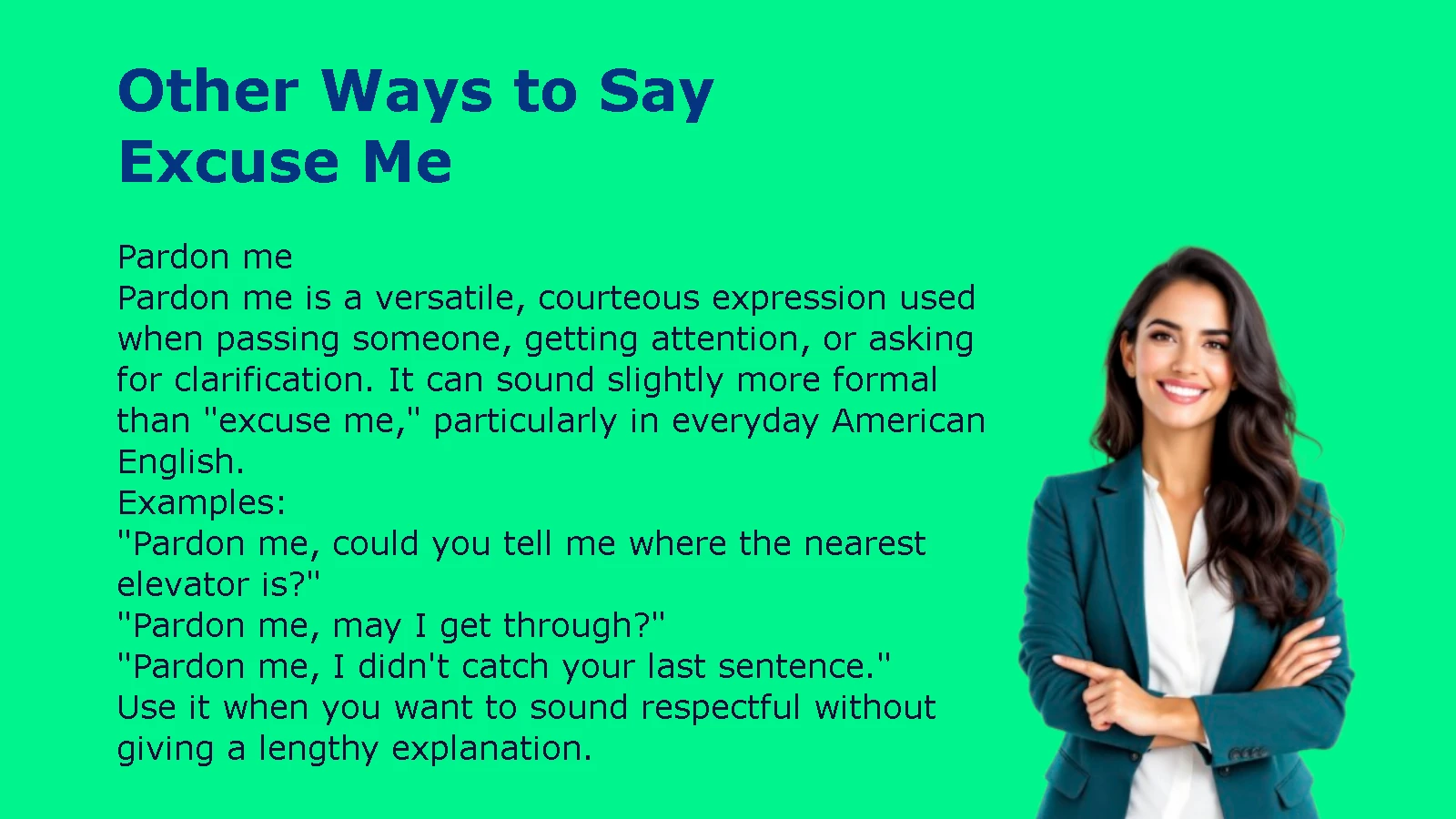
Pardon me
Pardon me is a versatile, courteous expression used when passing someone, getting attention, or asking for clarification. It can sound slightly more formal than “excuse me,” particularly in everyday American English.
Examples:
- “Pardon me, could you tell me where the nearest elevator is?”
- “Pardon me, may I get through?”
- “Pardon me, I didn’t catch your last sentence.”
Use it when you want to sound respectful without giving a lengthy explanation.
Sorry
Sorry is a short, natural alternative when you need to interrupt someone, move past them, or acknowledge a minor inconvenience.
Examples:
- “Sorry, could I get past you?”
- “Sorry, can I ask you a quick question?”
- “Sorry, I didn’t hear the last part.”
This expression works in casual and professional settings. However, if you have made a serious mistake, a more specific apology may communicate greater sincerity.
I beg your pardon
I beg your pardon is a formal expression that can signal a request for repetition, an apology, or surprise. Its meaning depends heavily on the speaker’s tone.
Examples:
- “I beg your pardon. Could you repeat that?”
- “I beg your pardon, but I believe there’s been a misunderstanding.”
Be careful with this phrase. A sharp or forceful delivery can make it sound confrontational, especially when someone has said something offensive.
If you don’t mind
If you don’t mind softens a request by acknowledging that the other person may have a preference. It works particularly well when you need a small favor.
Examples:
- “If you don’t mind, could I sit here?”
- “Could you move your bag if you don’t mind?”
- “If you don’t mind, I’d like to ask a question.”
The expression is most effective when you follow it with a clear request. On its own, it may leave the listener wondering what you need.
May I?
May I? is a concise, polite way to ask permission when the situation already makes your intention clear.
Examples:
- “May I come in?”
- “May I sit here?”
- “May I pass?”
Because the phrase is short, context matters. If the other person cannot tell what you’re asking, add a few words to clarify your request.
Could I trouble you for a moment?
This expression politely asks someone to give you a little time or assistance. It suits formal interactions, customer service, and conversations with people you don’t know well.
Examples:
- “Could I trouble you for a moment? I need help finding this office.”
- “Could I trouble you for a moment to review this document?”
It can sound overly formal for a quick chat with a close friend. In that situation, “Do you have a second?” usually feels more natural.
Would you mind?
Would you mind? introduces a request in a courteous way. It is especially useful when asking someone to change what they’re doing.
Examples:
- “Would you mind moving over a little?”
- “Would you mind lowering your voice?”
- “Would you mind repeating that?”
Remember that “Would you mind?” often needs a complete request. Also, a question such as “Would you mind opening the window?” normally invites the person to open it, not refuse to do so.
I hope I’m not disturbing you
Use this expression when you approach someone who appears busy or occupied.
Examples:
- “I hope I’m not disturbing you, but I have a quick question.”
- “I hope I’m not disturbing you. Could we discuss the schedule?”
It recognizes the other person’s time and attention. However, you don’t need to apologize for every ordinary interaction. A simple “Do you have a moment?” may sound more confident.
May I have your attention, please?
This phrase is appropriate when addressing a group or asking people to focus on an announcement.
Examples:
- “May I have your attention, please? The presentation will begin shortly.”
- “May I have your attention for a moment? We have an important update.”
It sounds more formal than a typical conversation opener, so reserve it for meetings, presentations, classrooms, and organized gatherings.
Could I ask you something?
This expression invites someone into a brief conversation without sounding demanding.
Examples:
- “Could I ask you something about the assignment?”
- “Could I ask you something? I’m looking for the customer service desk.”
It works well with coworkers, acquaintances, and strangers. If the question may take more than a minute, give the person an opportunity to decline or suggest a better time.
Professional Ways to Say Excuse Me at Work
Professional alternatives to excuse me should respect other people’s time while making your purpose clear. Phrases such as “sorry to interrupt,” “may I jump in for a moment?” and “do you have a moment?” help you participate in meetings, approach colleagues, and communicate with clients.
Sorry to interrupt
Sorry to interrupt acknowledges that someone is already speaking or concentrating on something.
Examples:
- “Sorry to interrupt, but the client is ready for the call.”
- “Sorry to interrupt. Could I clarify one point?”
- “Sorry to interrupt, but I have an update on the deadline.”
This phrase is particularly useful when timing matters. If the interruption is not urgent, consider waiting for a natural pause instead.
May I jump in for a moment?
This expression signals that you want to contribute to an ongoing discussion. It sounds collaborative rather than demanding.
Examples:
- “May I jump in for a moment? I have an idea for the campaign.”
- “May I jump in here? I think we may have another option.”
It works well in meetings and brainstorming sessions. The phrase also gives other participants a clear signal that you want to speak.
If I could add something
Use this phrase when you want to build on someone else’s point rather than change the subject.
Examples:
- “If I could add something, the revised timeline would give us more flexibility.”
- “If I could add something to that point, we should also consider the support team’s workload.”
It communicates respect for the existing discussion while allowing you to contribute a new idea.
Could I get your input?
This expression invites another person’s opinion or expertise. It is useful when approaching a manager, teammate, or subject-matter expert.
Examples:
- “Could I get your input on the new proposal?”
- “Could I get your input before I send this to the client?”
Unlike a generic “excuse me,” it explains why you are approaching the person. That clarity makes the interaction more efficient.
Do you have a moment?
Do you have a moment? is a natural professional opener when you need a brief conversation.
Examples:
- “Do you have a moment to review the figures?”
- “Do you have a moment? I’d like to discuss tomorrow’s presentation.”
If the matter is not urgent, you can make the request even more considerate: “Do you have a moment later this afternoon?”
May I have a quick word with you?
This expression asks for a short, often private conversation.
Examples:
- “May I have a quick word with you after the meeting?”
- “Could I have a quick word with you about the revised schedule?”
It works well in formal workplaces. However, the phrase can sound ominous when used without context. If the topic is ordinary, briefly explain it to avoid unnecessary anxiety.
When you have a moment
Use this expression when you don’t need an immediate response.
Examples:
- “When you have a moment, could you check the attached file?”
- “When you have a moment, I’d appreciate your feedback on the draft.”
It gives the recipient flexibility and reduces pressure. In email or workplace chat, it can be more appropriate than interrupting someone in person.
I’d like to ask a quick question
This direct opener tells the listener exactly what you need.
Examples:
- “I’d like to ask a quick question about the invoice.”
- “I’d like to ask a quick question before we finalize the report.”
The phrase works well when you want to be polite without sounding overly apologetic.
Could I briefly interject?
Could I briefly interject? is a formal way to request a chance to speak during a discussion.
Examples:
- “Could I briefly interject? I think we should revisit the budget.”
- “Could I briefly interject before we move to the next item?”
Use it in structured meetings or formal discussions. In a casual team conversation, “Can I jump in?” may sound more natural.
Thank you for your time
Although this is not a direct synonym for “excuse me,” it is a useful expression when ending an interaction or acknowledging someone’s attention.
Examples:
- “Thank you for your time. I appreciate your help.”
- “Thank you for taking a moment to walk me through the process.”
It works especially well in customer service, interviews, business meetings, and conversations with people who have helped you.
Casual and Informal Ways to Say Excuse Me
Casual alternatives to excuse me work best in relaxed conversations and everyday situations. Phrases such as “hey, sorry,” “my bad,” and “can I squeeze by?” sound natural with friends, family, or people in informal settings, but they may be too relaxed for some professional interactions.
Hey, sorry
This expression combines a casual attention-getter with a brief apology.
Examples:
- “Hey, sorry, is anyone sitting here?”
- “Hey, sorry, could I get through?”
- “Hey, sorry, did you say the store closes at six?”
It is friendly and flexible. With strangers, use a calm tone so the opening doesn’t sound impatient.
My bad
My bad is an informal way to admit responsibility for a small mistake.
Examples:
- “My bad, I didn’t realize you were waiting.”
- “My bad! I thought this seat was available.”
- “My bad, I sent you the wrong file.”
This phrase is not a universal replacement for “excuse me.” It works best when acknowledging a minor error among people who are comfortable with casual language.
Oops, sorry
Use “Oops, sorry” when you make a small accidental mistake.
Examples:
- “Oops, sorry. I didn’t see your bag.”
- “Oops, sorry, I clicked the wrong button.”
- “Oops, sorry! I thought you were finished.”
The expression sounds light and spontaneous. For a serious mistake, use a clearer apology instead of relying on a casual reaction.
Sorry about that
This phrase acknowledges an inconvenience that has already happened.
Examples:
- “Sorry about that. I didn’t mean to interrupt.”
- “Sorry about that. I’ll move my chair.”
- “Sorry about that—I misunderstood the directions.”
It is useful because it recognizes the problem without requiring a long explanation.
Can I squeeze by?
Use this question when you need to pass someone in a narrow space.
Examples:
- “Can I squeeze by? I need to get to the counter.”
- “Can I squeeze by you to reach my seat?”
It sounds casual and friendly. In a more formal setting, use “Could I get past you, please?”
Mind if I get through?
This expression politely asks permission to move past someone.
Examples:
- “Mind if I get through? My train is about to leave.”
- “Mind if I get through to the other side?”
It works in crowded stores, busy hallways, and informal gatherings. Add “please” if you want to soften the request further.
One second, please
This phrase asks someone to pause briefly or wait for a moment.
Examples:
- “One second, please. I’m almost finished.”
- “One second, please—I need to check the address.”
It can also help you regain someone’s attention. However, it is not ideal when you are interrupting someone who deserves to finish speaking.
Hang on a moment
Hang on a moment is a casual request for someone to wait.
Examples:
- “Hang on a moment. I want to show you something.”
- “Hang on a moment—did you say we’re meeting at noon?”
It is common in informal speech. For clients, senior colleagues, or unfamiliar people, “Could you give me a moment?” sounds more courteous.
Sorry, can I get your attention?
This phrase combines an apology with a direct request.
Examples:
- “Sorry, can I get your attention for a second?”
- “Sorry, can I get your attention? I have something to share.”
It suits informal groups and quick conversations. In a large meeting, “May I have everyone’s attention, please?” may be more appropriate.
Whoops, didn’t mean to interrupt
This phrase acknowledges that you entered a conversation at the wrong moment.
Examples:
- “Whoops, didn’t mean to interrupt. Go ahead.”
- “Whoops, didn’t mean to interrupt—I’ll wait until you’re finished.”
It sounds friendly and relaxed. It also gives the other person room to continue speaking.
Other Ways to Say Excuse Me to Get Someone’s Attention
When you need someone’s attention, choose a phrase that makes your request clear without demanding an immediate response. “Could I have a moment?” works well in professional settings, while “Can I ask you something?” suits everyday conversations.
Excuse me for a second
This phrase signals that you need a brief moment of someone’s attention.
Examples:
- “Excuse me for a second. I need to confirm the room number.”
- “Excuse me for a second—could you help me with this?”
It remains close to the original expression but specifies that the interaction should be brief.
Could I have a moment?
This is a polite way to ask someone to pause and listen.
Examples:
- “Could I have a moment to explain the situation?”
- “Could I have a moment before you leave?”
It works well when the matter deserves more than a passing comment.
Can I ask you something?
Use this phrase to begin a question or conversation.
Examples:
- “Can I ask you something about the application?”
- “Can I ask you something? I’m trying to find the correct platform.”
It is direct, friendly, and easy to understand.
Do you have a minute?
This expression asks whether someone has time for a short conversation.
Examples:
- “Do you have a minute to help me?”
- “Do you have a minute to discuss the schedule?”
If you expect the conversation to take longer, avoid describing it as a minute. Giving an accurate estimate helps the other person decide whether they can talk.
Could you help me, please?
This phrase works when your main goal is to ask for assistance.
Examples:
- “Could you help me, please? I can’t find my reservation.”
- “Could you help me locate the right department?”
It is more useful than a vague attention-getter because it immediately communicates what you need.
Hello, may I ask you a question?
This expression is suitable when approaching someone you don’t know.
Examples:
- “Hello, may I ask you a question? I’m looking for the visitor entrance.”
- “Hello, may I ask you a question about this product?”
It is particularly useful in stores, reception areas, and public buildings.
Sorry to bother you
Use this expression when you think the other person may be busy.
Examples:
- “Sorry to bother you, but could you point me toward the exit?”
- “Sorry to bother you. I have a question about my order.”
Don’t overuse it. Asking a reasonable question doesn’t automatically mean you’re bothering someone.
When you get a chance
This phrase indicates that the request does not require immediate attention.
Examples:
- “When you get a chance, could you send me the updated document?”
- “When you get a chance, I’d appreciate your help with this form.”
It is especially useful in workplace messages because it communicates flexibility.
Could I speak with you briefly?
Use this expression when you need a short conversation, especially in a professional or semi-formal setting.
Examples:
- “Could I speak with you briefly about the schedule?”
- “Could I speak with you briefly after the presentation?”
If the topic is sensitive, consider asking whether the person has time and privacy before beginning.
May I get your attention for a moment?
This phrase works when addressing one person or a group.
Examples:
- “May I get your attention for a moment? I have an announcement.”
- “May I get your attention before we begin?”
It is more formal than “Hey, everyone” and fits presentations, classrooms, and organized meetings.
Other Ways to Say Excuse Me When Interrupting Someone
The most effective alternatives for interrupting someone acknowledge the conversation already in progress. Phrases such as “sorry to cut in,” “may I jump in here?” and “if I may add something” help you contribute without dismissing the other speaker.
Sorry to cut in
Use this expression when you need to interrupt briefly.
Examples:
- “Sorry to cut in, but the meeting room has changed.”
- “Sorry to cut in—I have one detail to add.”
It works best when you have a relevant point or a time-sensitive update.
May I jump in here?
This phrase requests permission to participate in an active discussion.
Examples:
- “May I jump in here? I think there’s another way to approach the problem.”
- “May I jump in here before we finalize the plan?”
It sounds collaborative and works particularly well in team discussions.
Can I add something?
Use this phrase when you want to contribute information rather than take over the conversation.
Examples:
- “Can I add something to that point?”
- “Can I add something before we move on?”
It is simple and direct. A respectful tone helps ensure the phrase sounds like an invitation to collaborate rather than a demand for the floor.
Before we move on
This expression helps you introduce a final point before a discussion changes topics.
Examples:
- “Before we move on, I’d like to clarify one detail.”
- “Before we move on, can we confirm the deadline?”
It works best when the group is already wrapping up a topic.
Could I interject for a moment?
This is a formal alternative for meetings, interviews, and structured discussions.
Examples:
- “Could I interject for a moment? There’s an important distinction here.”
- “Could I interject before we make the final decision?”
Because “interject” sounds formal, it may feel unnatural in casual conversations.
I hate to interrupt, but…
This phrase acknowledges that your interruption may be inconvenient.
Examples:
- “I hate to interrupt, but your next appointment has arrived.”
- “I hate to interrupt, but we need to submit the report now.”
Use it when the interruption is justified. If you use it for every small comment, the expression can become unnecessarily apologetic.
If I may, I’d like to add something
This phrase combines a request for permission with a clear intention to contribute.
Examples:
- “If I may, I’d like to add something about the proposed budget.”
- “If I may, I’d like to offer a different perspective.”
It suits formal discussions and situations where you want to show respect for the current speaker.
Can I pause you there for a second?
Use this phrase when you need to clarify or address a point before the speaker continues.
Examples:
- “Can I pause you there for a second? I want to make sure I understand.”
- “Can I pause you there? I think we have different figures.”
It is direct, so tone matters. In a sensitive conversation, “Could I ask a quick question about that point?” may sound less abrupt.
Sorry, just one quick point
This expression signals that your contribution should be brief.
Examples:
- “Sorry, just one quick point before we finish.”
- “Sorry, just one quick point about the delivery date.”
Keep the contribution short. If you introduce a lengthy argument after promising one quick point, people may feel that you have taken advantage of their patience.
Could I briefly respond to that?
This phrase is useful when you want to address a statement, question, or suggestion.
Examples:
- “Could I briefly respond to that concern?”
- “Could I briefly respond before we make a decision?”
It is especially appropriate in professional discussions where people need to exchange views without talking over each other.
Other Ways to Say Excuse Me When Passing Through
When you need to move past someone, a clear request usually works better than a vague apology. “Could I get past you, please?” is courteous, while “can I squeeze past?” sounds more casual. The right phrase depends on the space and the formality of the situation.
Could I get past you, please?
This expression is a clear, polite request to pass someone.
Examples:
- “Could I get past you, please? My seat is near the window.”
- “Could I get past you? I need to reach the exit.”
It is suitable for public transportation, restaurants, theaters, and crowded hallways.
May I get through?
This short question asks permission to pass.
Examples:
- “May I get through, please?”
- “May I get through to the other side of the counter?”
Use it when the other person can easily understand where you want to go.
Coming through, please
This phrase alerts people that you are moving through a crowded area.
Examples:
- “Coming through, please. I need to reach the door.”
- “Coming through—thank you!”
It is more of an announcement than a question. Use it when you need to make your movement clear, but avoid shouting unless the environment requires it.
Could you make a little room?
Use this expression when you need someone to create additional space.
Examples:
- “Could you make a little room, please?”
- “Could you make a little room so everyone can sit down?”
It is polite when delivered calmly. If the situation is crowded, a brief “Could we make a little room?” may sound more cooperative because it addresses the group.
Would you mind moving over a little?
This phrase asks someone to shift position slightly.
Examples:
- “Would you mind moving over a little? I’d like to sit beside my friend.”
- “Would you mind moving over so people can get through?”
It is courteous, though a shorter request may be easier to understand in a noisy environment.
Can I squeeze past?
This is a casual way to ask permission to pass through a narrow gap.
Examples:
- “Can I squeeze past you to get to the aisle?”
- “Can I squeeze past? I need to grab my coat.”
It works well among friends, at events, and in crowded shops.
Sorry, I need to get by
Use this phrase when you need to pass and want to acknowledge the inconvenience.
Examples:
- “Sorry, I need to get by to reach my seat.”
- “Sorry, I need to get by. My train is leaving.”
It is direct but not inherently rude. A friendly tone and a little patience make a difference.
Could I slip through here?
This expression is suitable when you see a small opening and want to move through it.
Examples:
- “Could I slip through here to reach the other side?”
- “Could I slip through? I don’t want to block the doorway.”
It sounds gentle and conversational, particularly at social gatherings.
Pardon me, coming through
This combines a polite opener with a clear announcement.
Examples:
- “Pardon me, coming through.”
- “Pardon me, coming through to reach the counter.”
It suits situations where people may not notice you approaching. Keep your voice calm and avoid pushing past others.
May I pass, please?
This expression is courteous and slightly formal.
Examples:
- “May I pass, please?”
- “May I pass you to reach the stairs?”
It works well when speaking to strangers or in a more formal environment.
Other Ways to Say Excuse Me When You Didn’t Hear Something
When you miss what someone said, use a phrase that directly requests repetition or clarification. “Could you repeat that, please?” is polite and clear, while “I didn’t quite catch that” sounds natural in conversation. These expressions help avoid misunderstandings without making the other person feel blamed.
Could you repeat that, please?
This is a clear, polite way to ask someone to say something again.
Examples:
- “Could you repeat that, please? I couldn’t hear you over the noise.”
- “Could you repeat the last instruction, please?”
It works in professional and everyday conversations.
Sorry, what was that?
This is a casual way to ask someone to repeat a statement.
Examples:
- “Sorry, what was that? The bus was too loud.”
- “Sorry, what was that last word?”
With a friendly tone, it sounds natural. If you are speaking to a client or someone in a formal setting, use the more complete version.
Could you say that again?
This phrase is simple, direct, and suitable for most situations.
Examples:
- “Could you say that again? I want to make sure I understood.”
- “Could you say the address again, please?”
It asks for repetition without suggesting that the speaker did anything wrong.
I didn’t quite catch that
Use this expression when you heard someone speak but missed part or all of the message.
Examples:
- “I didn’t quite catch that. Did you say Tuesday or Thursday?”
- “Sorry, I didn’t quite catch the last part.”
It is especially useful because it explains the problem without blaming the other person.
Would you mind repeating yourself?
This expression is more formal than “Could you say that again?”
Examples:
- “Would you mind repeating yourself? I missed the deadline.”
- “Would you mind repeating the final number?”
It suits professional conversations, although “Would you mind repeating that?” may sound slightly more natural in many everyday situations.
Sorry, I missed the last part
Use this phrase when you heard most of the message but missed a specific detail.
Examples:
- “Sorry, I missed the last part. Which room did you mention?”
- “I missed the last part—could you repeat the instructions?”
It helps the other person understand exactly what needs clarification.
Could you speak up a little?
This phrase asks someone to increase their volume.
Examples:
- “Could you speak up a little? I’m having trouble hearing you.”
- “Could you speak up a little? The room is noisy.”
It is most appropriate when volume is the issue. If you heard the words but didn’t understand them, ask for clarification instead.
What was that last part?
This is a casual request for a specific portion of a statement.
Examples:
- “What was that last part about the schedule?”
- “What was that last part? I heard the first instruction.”
It works well with people you know. In formal settings, add “Could you repeat” or “please” to soften the request.
Could you clarify what you said?
Use this phrase when you heard the words but aren’t sure what they mean.
Examples:
- “Could you clarify what you meant by the revised deadline?”
- “Could you clarify what you said about the payment terms?”
Repeating and clarifying are different tasks. Repetition helps when you didn’t hear the words. Clarification helps when you heard them but need a clearer explanation.
I’m sorry, could you run that by me again?
This conversational expression asks someone to explain or repeat something once more.
Examples:
- “I’m sorry, could you run that by me again? I was taking notes.”
- “Could you run the figures by me again? I want to check the total.”
It works well in informal workplaces and everyday discussions.
Ways to Say Excuse Me When Apologizing or Expressing Surprise
When you make a mistake, choose an expression that accepts responsibility. When someone says something unexpected, choose a phrase that communicates surprise without creating unnecessary conflict. “I’m sorry about that” suits apologies, while “Wait, what?” works in casual conversations.
I’m sorry about that
This expression acknowledges a mistake or inconvenience.
Examples:
- “I’m sorry about that. I didn’t realize I was blocking the doorway.”
- “I’m sorry about that. I sent the wrong attachment.”
It works in personal and professional settings. For a serious mistake, explain what happened and how you’ll correct it.
I apologize
I apologize is a direct, somewhat formal expression of regret.
Examples:
- “I apologize for interrupting the meeting.”
- “I apologize for the confusion regarding your appointment.”
It works well in customer service, formal communication, and professional settings. Add a specific reason when the other person needs to understand what you’re apologizing for.
Please forgive me
This phrase asks someone to forgive a mistake or hurtful action.
Examples:
- “Please forgive me for speaking over you.”
- “Please forgive me. I should have checked the information first.”
It is more emotionally serious than “sorry.” Reserve it for situations where you genuinely seek forgiveness rather than a minor everyday inconvenience.
Wait, what?
This is a casual expression of surprise or confusion.
Examples:
- “Wait, what? The event is tomorrow?”
- “Wait, what? I thought we had already agreed on that.”
It can sound abrupt, especially in formal conversations. If you want to express surprise politely, try “Sorry, could you explain that again?” instead.
Are you serious?
This phrase expresses disbelief, surprise, or doubt.
Examples:
- “Are you serious? They changed the meeting again?”
- “Are you serious? I didn’t expect that announcement.”
It is not a direct synonym for “excuse me.” Use it when you react to unexpected information, and be mindful that it can sound skeptical or confrontational depending on your tone.
Best Alternatives to Excuse Me by Situation
The best alternative depends on your purpose, relationship with the listener, and setting. A phrase that works with a friend may sound too casual in a meeting. A formal expression may feel stiff in a crowded store. Use the following table to find a phrase that fits the moment.
| Situation | Recommended phrase | Tone | Example |
| Getting a stranger’s attention | “Pardon me” | Polite | “Pardon me, where is the entrance?” |
| Interrupting a meeting | “Sorry to interrupt” | Professional | “Sorry to interrupt, but I have an update.” |
| Adding an idea | “May I jump in?” | Collaborative | “May I jump in? I have another suggestion.” |
| Passing through a crowd | “Could I get past you, please?” | Courteous | “Could I get past you to reach my seat?” |
| Asking for repetition | “Could you repeat that, please?” | Respectful | “Could you repeat that, please? I missed the address.” |
| Approaching a busy coworker | “Do you have a moment?” | Professional | “Do you have a moment to review this?” |
| Making a small mistake | “Sorry about that” | Friendly | “Sorry about that. I didn’t see your bag.” |
| Asking a stranger for help | “Could you help me, please?” | Polite | “Could you help me find this office?” |
| Responding to a surprising comment | “I’m sorry, what do you mean?” | Neutral | “I’m sorry, what do you mean by that?” |
| Asking someone to move | “Would you mind moving over?” | Courteous | “Would you mind moving over a little?” |
| Speaking to a group | “May I have your attention, please?” | Formal | “May I have your attention, please? We are about to begin.” |
| Requesting a private conversation | “Could I speak with you briefly?” | Professional | “Could I speak with you briefly after lunch?” |
How to choose the right phrase
Consider these factors before choosing an alternative:
- Your purpose: Are you apologizing, interrupting, asking for help, or requesting space?
- Your relationship: Friends usually accept casual expressions. Strangers and professional contacts may appreciate more courteous wording.
- The setting: A busy street, quiet office, classroom, and formal meeting each call for different language.
- The urgency: If something is urgent, explain the reason briefly rather than using a long apology.
- Your tone: Even a polite expression can sound rude if you deliver it impatiently.
For example, imagine that you need to pass a coworker who is standing in a narrow doorway. “Move!” sounds like a command. “Excuse me” signals that you need attention but doesn’t explain what you need. “Could I get past you, please?” communicates both your intention and your request.
That small difference makes the interaction clearer and more considerate.
How to Choose the Right Alternative to Excuse Me
Choosing an alternative becomes easier when you identify what you want the other person to do. Instead of memorizing dozens of synonyms, learn a few expressions for common communication needs.
Consider how formal the situation is
Formal settings generally call for complete, courteous phrases. Casual settings allow shorter expressions.
| Formality | Useful expressions |
| Formal | “I beg your pardon,” “May I have your attention, please?” |
| Professional | “Sorry to interrupt,” “Do you have a moment?” |
| Neutral | “Pardon me,” “Could I ask you something?” |
| Casual | “Hey, sorry,” “Can I squeeze by?” |
| Very informal | “My bad,” “Wait, what?” |
These categories are guidelines, not strict rules. A friendly coworker may welcome casual language, while a formal workplace may require more careful wording.
Decide whether you’re interrupting, apologizing, or requesting space
Many expressions sound similar but serve different purposes.
- Interrupting: “Sorry to interrupt” acknowledges that someone is already speaking.
- Apologizing: “I’m sorry about that” recognizes a mistake.
- Requesting space: “Could I get past you?” explains what you need.
- Getting attention: “Could I have a moment?” opens a conversation.
- Seeking repetition: “Could you say that again?” requests the information you missed.
- Expressing surprise: “I beg your pardon?” or “Wait, what?” signals a reaction.
Using the right category prevents misunderstandings. If you bump into someone, “Could I get past you?” doesn’t acknowledge the collision. If you simply didn’t hear a word, “I’m sorry for interrupting” may be unnecessary.
Use a direct request when you need someone to move
Direct requests often save time because they explain what the listener can do to help.
Compare these examples:
- Vague: “Excuse me.”
- Clearer: “Excuse me, could I get past?”
- Direct and polite: “Could I get past you, please?”
The first phrase may work if the other person immediately understands the situation. The other versions reduce uncertainty.
Directness does not equal rudeness. A calm voice, a courteous expression, and a reasonable request can make direct language sound respectful.
Choose softer language when speaking to strangers
When you don’t know someone, you cannot assume that they understand your tone or intentions.
Useful openers include:
- “Pardon me, could you help me?”
- “Excuse me, do you know where the station is?”
- “Sorry to bother you, but could you point me toward the entrance?”
You don’t need to apologize excessively. One courteous opener followed by a clear question is usually enough.
Adjust your wording for spoken conversations and written messages
Some expressions work better aloud than in writing.
In spoken conversation:
- “Hey, sorry, can I ask you something?”
- “Pardon me, could I get by?”
- “Sorry to interrupt—one quick question.”
In professional email or chat:
- “When you have a moment, could you review this?”
- “I’d like to ask a quick question about the schedule.”
- “Could we briefly discuss the updated proposal?”
Written messages lack vocal tone and facial expressions. A clear request can prevent your message from sounding abrupt or demanding.
Phrases to Avoid When You Want to Sound Polite
Some expressions communicate your intention but can sound abrupt, confrontational, or dismissive. The problem often comes from the wording, the setting, or the tone of delivery rather than the phrase alone.
Why “Move!” can sound rude
“Move!” is a command that gives the other person little context or courtesy.
Instead, try:
- “Could you move over a little, please?”
- “May I get past you?”
- “Would you mind making a little room?”
A direct command may be appropriate in an emergency, but ordinary situations usually allow time for a polite request.
When “What?” may seem abrupt
A short “What?” can communicate confusion, but it may also sound impatient.
Consider these alternatives:
- “Sorry, could you repeat that?”
- “I didn’t quite catch that.”
- “Could you explain what you mean?”
These expressions make your intention clearer and reduce the chance that the other person will interpret your response as irritation.
Why “I beg your pardon” can sound overly formal or confrontational
Although the phrase can be polite, its meaning changes with context and delivery.
Compare:
- Neutral: “I beg your pardon. Could you repeat that?”
- Confrontational: “I beg your pardon?”
The second version may signal disbelief or offense, especially after a rude remark. If you want to clarify a statement without escalating tension, ask a direct question such as “Could you explain what you mean?”
How tone of voice changes the meaning of common expressions
Words alone do not determine whether an expression sounds polite. Volume, facial expression, timing, and body language also influence how people interpret it.
For example, “Can I get through?” can sound courteous when spoken calmly. The same words can sound demanding when shouted impatiently.
To make your wording more respectful:
- Use a calm, audible voice.
- Make your request specific.
- Avoid talking over someone unnecessarily.
- Give the other person time to respond.
- Say “please” or “thank you” when appropriate.
- Acknowledge a mistake directly when an apology is needed.
The goal isn’t to make every sentence formal. It is to communicate your intention clearly without creating unnecessary friction.
Examples of Excuse Me Alternatives in Real Conversations
Short dialogues show how different expressions work in context. Notice how each speaker chooses wording based on the situation rather than replacing “excuse me” with the same phrase every time.
At work or during a meeting
Scenario: A colleague is explaining a project, and you need to clarify an important detail.
You: “Sorry to interrupt, but could I clarify one point about the deadline?”
Colleague: “Of course. Which part?”
You: “Are we submitting the final version on Thursday or Friday?”
Why it works: You acknowledge the interruption, explain your purpose, and ask a focused question.
Another option is “May I jump in for a moment?” when you want to contribute an idea rather than request clarification.
While walking through a crowded place
Scenario: Someone is standing between you and the exit.
You: “Sorry, could I get past you, please?”
Other person: “Oh, sure.”
You: “Thank you.”
Why it works: The request is clear and courteous. You don’t need a lengthy explanation when the situation is obvious.
When approaching a stranger
Scenario: You’re looking for a particular building.
You: “Pardon me, could you tell me where the main entrance is?”
Stranger: “It’s just around the corner, next to the parking area.”
You: “Thanks for your help.”
Why it works: “Pardon me” politely gets attention, and the question tells the stranger exactly what you need.
When interrupting a friend
Scenario: Your friend is telling a long story, and you want to add a detail.
You: “Sorry to cut in, but wasn’t that the restaurant we visited last month?”
Friend: “Yes, exactly!”
Why it works: You acknowledge the interruption without making the exchange overly formal. With close friends, a lighter “Can I add something?” may work just as well.
When asking someone to repeat themselves
Scenario: You are talking on the phone, and background noise makes an address difficult to hear.
You: “Sorry, I didn’t quite catch that. Could you repeat the street name?”
Other person: “It’s Maple Street.”
You: “Thanks. I have it now.”
Why it works: You explain what you missed and ask for the exact information you need.
When accidentally bumping into someone
Scenario: You accidentally bump shoulders with another person in a crowded store.
You: “I’m sorry about that. Are you okay?”
Other person: “I’m fine.”
You: “Sorry again.”
Why it works: You acknowledge the mistake directly. In this situation, an apology is more appropriate than simply asking the person to move.
A practical comparison: choosing the right opener
Imagine that you need to speak to a busy manager about a small mistake in a report. You have several options:
- “Excuse me.” — Polite, but vague.
- “Sorry to bother you.” — Considerate, but slightly apologetic.
- “Do you have a moment to discuss an error in the report?” — Clear and professional.
- “I need to talk to you right now.” — Direct, but unnecessarily forceful unless the issue is urgent.
The third option often works best because it identifies the topic and lets the manager judge whether they can talk immediately.
The lesson: Choose the phrase that communicates your purpose, not simply the phrase that sounds the most formal.
Frequently Asked Questions
What is the most polite way to say excuse me?
“Pardon me” and “excuse me, please” are polite choices in many everyday situations. When interrupting a conversation, “Sorry to interrupt” may be more appropriate because it acknowledges that someone is already speaking. The best option depends on what you want to communicate.
What is a professional way to say excuse me?
Professional alternatives include “Sorry to interrupt,” “Do you have a moment?” “May I jump in for a moment?” and “Could I speak with you briefly?” Use the phrase that matches your purpose. For example, ask for a moment when approaching a colleague and acknowledge the interruption when joining an ongoing discussion.
How do you say excuse me without saying sorry?
You can say “Pardon me,” “May I pass?” “Could I ask you a question?” “Would you mind moving over?” or “Could I have a moment?” These phrases communicate your request without requiring an apology. Choose a direct, courteous expression when you haven’t actually made a mistake.
What is a casual way to say excuse me?
Casual alternatives include “Hey, sorry,” “Can I squeeze by?” “Mind if I get through?” and “One second, please.” These expressions work well with friends, acquaintances, and people in relaxed settings. For professional situations or unfamiliar people, a more complete request may sound more considerate.
What can I say instead of excuse me when interrupting?
Use “Sorry to interrupt,” “Sorry to cut in,” “May I jump in here?” or “Can I add something?” These expressions acknowledge the existing conversation while giving you a chance to speak. If your point isn’t urgent, wait for a natural pause whenever possible.
Is “pardon me” more polite than “excuse me”?
Both expressions can be polite, and neither is automatically better in every situation. “Pardon me” may sound slightly more formal in American English, while “excuse me” is a versatile everyday expression. Your tone and the context matter more than the small difference in wording.
Conclusion: Choose an Alternative That Fits the Situation
Learning other ways to say excuse me helps you communicate with greater clarity, confidence, and courtesy. You don’t need to memorize all 75 phrases. Start with a handful that cover your most common situations.
Use “pardon me” when approaching a stranger, “sorry to interrupt” when entering an ongoing conversation, “could I get past you, please?” when you need space, and “could you repeat that?” when you haven’t heard someone clearly.
For professional conversations, choose expressions that respect the other person’s time and explain your purpose. In casual situations, shorter phrases often sound more natural. When you’ve made a mistake, offer a direct apology instead of using a general attention-getter.













