Other ways to say congratulations include well done, kudos, way to go, hats off to you, bravo, and you deserve it. The best expression depends on what you’re celebrating, your relationship with the person, and the tone you want to convey. Whether you’re writing a professional email, celebrating an engagement, welcoming a new baby, or recognizing an achievement, the right words make your message more personal.
A thoughtful congratulations message does more than acknowledge good news. It recognizes someone’s effort, celebrates a milestone, and shows that you care. You might choose a formal expression for a colleague’s promotion, a heartfelt message for a close friend, or a playful phrase for a social media post. You can also explore congratulations synonyms, translations in different languages, and creative text styles to make your message stand out.
This guide covers more than 45 ways to say congratulations, with practical examples, occasion-specific messages, and clear advice on choosing the right words.
45+ Other Ways to Say Congratulations
There are many alternatives to congratulations, but each carries a slightly different meaning. Some phrases celebrate a major milestone, while others praise hard work, express excitement, or offer encouragement. Choose a phrase that fits the achievement and sounds natural coming from you.
Common Ways to Say Congratulations
These familiar expressions work in everyday conversations, text messages, greeting cards, and many professional situations.
- Well done! — A simple way to recognize someone’s effort or success.
- Way to go! — An enthusiastic expression of praise.
- Great job! — Ideal for acknowledging a task completed successfully.
- Kudos to you! — Acknowledges an achievement and shows admiration.
- You did it! — Celebrates reaching a goal after effort or persistence.
- Hats off to you! — Shows respect for someone’s impressive accomplishment.
- Bravo! — Expresses admiration for an excellent performance or result.
- Fantastic work! — Praises the quality of someone’s work.
- You deserve it! — Suggests that someone has earned a reward or opportunity.
- What an achievement! — Highlights the importance of a particular accomplishment.
Example: Your friend has spent months preparing for a professional certification. Instead of sending only “Congratulations,” you could write, “You did it! All those hours of studying paid off. Well deserved!”
The extra detail makes the message feel more personal because it connects the praise to the person’s effort.
Short and Casual Ways to Say Congratulations
Use these alternatives when you want to sound friendly, relaxed, and enthusiastic.
- Amazing work!
- That’s awesome!
- Good for you!
- So happy for you!
- You nailed it!
- Proud of you!
- Cheers to your success!
- Look at you go!
- That’s a big win!
- You crushed it!
These expressions suit text messages, group chats, casual workplace conversations, and social media comments.
For example, if a friend shares news about getting a new job, you might say, “That’s awesome! You’re going to do great things there.” This sounds warmer than a generic congratulatory phrase because it combines excitement with encouragement.
Keep your audience in mind, though. “You crushed it!” works well with a close friend or teammate, but it may sound too casual in a formal letter to a senior executive.
Heartfelt Ways to Say Congratulations
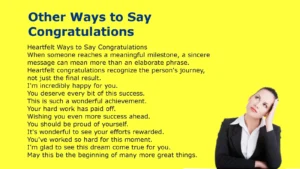
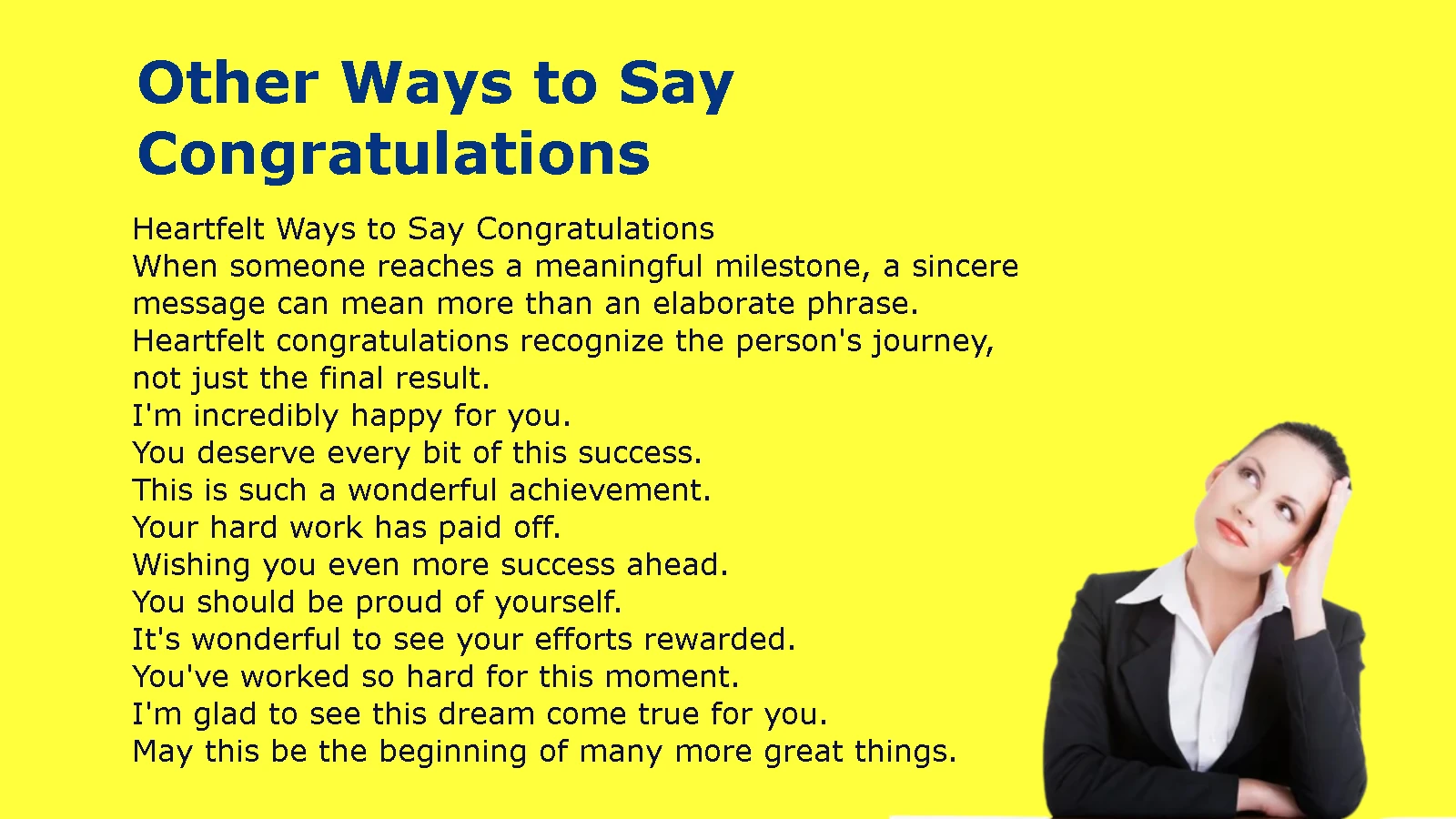
When someone reaches a meaningful milestone, a sincere message can mean more than an elaborate phrase. Heartfelt congratulations recognize the person’s journey, not just the final result.
- I’m incredibly happy for you.
- You deserve every bit of this success.
- This is such a wonderful achievement.
- Your hard work has paid off.
- Wishing you even more success ahead.
- You should be proud of yourself.
- It’s wonderful to see your efforts rewarded.
- You’ve worked so hard for this moment.
- I’m glad to see this dream come true for you.
- May this be the beginning of many more great things.
Example message:
“I’m incredibly happy for you! I’ve seen how much time and effort you’ve put into reaching this goal. You deserve every bit of this success, and I can’t wait to see what you accomplish next.”
This message works because it identifies the effort behind the achievement and expresses genuine interest in the person’s future.
Formal and Professional Alternatives to Congratulations
Professional congratulations should communicate respect without sounding stiff or overly familiar. These expressions work well in business emails, workplace announcements, client communications, and formal cards.
- Please accept my warmest congratulations.
- Congratulations on this well-deserved achievement.
- Your accomplishment is truly impressive.
- Wishing you continued success.
- Your dedication has paid off.
- This is a significant milestone worth celebrating.
- I commend you on this outstanding achievement.
- Your success is a testament to your hard work.
- Best wishes for your continued growth and success.
- Congratulations on reaching this important professional milestone.
For example, when a colleague receives a promotion, you could write:
“Congratulations on your well-deserved promotion. Your dedication and consistent contributions have made a real difference to the team. I wish you continued success in your new role.”
The message stays professional while recognizing the person’s contribution.
Unique and Creative Ways to Say Congratulations
Sometimes, a familiar phrase doesn’t capture the excitement of the moment. Creative alternatives help your message sound memorable without requiring complicated wording.
- Here’s to your next big adventure!
- You’ve given us another reason to celebrate.
- The world is your oyster!
- You’ve made something wonderful happen.
- Onward and upward!
- Here’s to bigger and better things!
- You’ve turned a goal into reality.
- Your next chapter is off to a brilliant start.
- This calls for a celebration!
- You’ve earned your moment in the spotlight.
These expressions are particularly useful for graduation cards, retirement celebrations, business milestones, creative achievements, and social media captions.
For instance, someone who has launched a small business might appreciate this message: “You’ve turned an idea into reality. Here’s to your next big adventure and all the exciting things ahead!”
The wording celebrates both the accomplishment and the possibilities it creates.
How to Say Congratulations in Different Situations
The best way to congratulate someone changes with the occasion. A message for a new parent should sound different from one celebrating a colleague’s promotion. Before choosing your words, consider the achievement, your relationship with the recipient, and how formal the situation feels.
How to Say Congratulations Professionally
Professional congratulations recognize success while maintaining a respectful tone. Mention the achievement directly, offer sincere praise, and keep the message appropriate for the workplace.
Here are some examples for common professional situations.
For a coworker’s promotion:
“Congratulations on your promotion! Your hard work and commitment have truly paid off. Wishing you every success in your new position.”
For a manager or team leader:
“Congratulations on this well-deserved milestone. Your leadership and dedication continue to make a positive impact on the team.”
For a client who has reached a business milestone:
“Congratulations on this exciting achievement. It’s wonderful to see your business continue to grow, and I wish you continued success.”
For a team that has completed a challenging project:
“Congratulations to everyone involved in the project. Your collaboration, persistence, and attention to detail made this result possible.”
For a colleague who has earned a qualification:
“Congratulations on earning your certification. Your commitment to professional development is impressive, and I hope this achievement opens new opportunities for you.”
A useful rule is to recognize the result and the contribution behind it. Instead of saying only “Great work,” mention the successful launch, promotion, certification, or project that makes the achievement meaningful.
How to Congratulate Someone on Success or Achievement
When someone accomplishes something important, focus your message on what they achieved and why it matters. A specific compliment usually feels more sincere than a broad statement.
Use these examples for different milestones:
- Academic achievement: “Congratulations on your outstanding results! Your dedication to your studies has paid off.”
- Award or competition: “Well deserved! Your talent and preparation really showed.”
- Personal goal: “You set a goal and followed through. You should be incredibly proud of yourself.”
- Successful project: “Fantastic work bringing this project across the finish line. Your persistence made a difference.”
- Creative accomplishment: “Congratulations on completing your book! I hope you’re proud of everything you’ve created.”
- Athletic achievement: “What an incredible performance! Your training and determination are paying off.”
- Business success: “Congratulations on reaching this milestone. Here’s to continued growth and even bigger opportunities.”
How to Say Congratulations for an Engagement
Engagement congratulations should celebrate the couple’s happiness and the commitment they’re making. Choose a message that reflects how well you know them, whether you’re writing a quick text or a card for a family celebration.
Short engagement wishes:
- “Congratulations on your engagement!”
- “So happy for you both!”
- “Here’s to a lifetime of love and happiness.”
- “Wishing you both a beautiful future together.”
- “What wonderful news! Congratulations to you both.”
Heartfelt engagement messages:
- “Congratulations on finding someone to share life’s adventures with. Wishing you both endless love and happiness.”
- “I’m so excited for you two! May this new chapter bring you countless wonderful memories.”
- “Your love is such a joy to see. Congratulations on taking this beautiful next step together.”
Formal engagement message:
“Please accept my warmest congratulations on your engagement. I wish you both a lifetime of happiness, understanding, and shared success.”
If you know one partner better than the other, make an effort to address both people. Engagement messages celebrate the couple, so inclusive wording is usually the safest choice.
Other Ways to Say Congratulations for a New Baby
Welcoming a baby is a personal milestone, so warm and thoughtful language usually works best. You can congratulate the parents, welcome the baby, or express excitement about their growing family.
Short messages for new parents:
- “Congratulations on your beautiful new arrival!”
- “Wishing your growing family lots of love and happiness.”
- “Welcome to the world, little one!”
- “So happy for your family!”
- “Wishing you many precious moments with your new baby.”
Heartfelt messages:
- “Congratulations on this wonderful new chapter. May your home be filled with love, laughter, and unforgettable memories.”
- “Sending your family so much love as you welcome your little one. Wishing you happiness in every stage of this new adventure.”
- “What wonderful news! I hope these early days bring you plenty of joy and special moments together.”
Gender-neutral congratulations:
- “Congratulations on your new arrival! Wishing your family health, happiness, and lots of love.”
- “Your family has a beautiful new reason to smile. Congratulations!”
- “Wishing you all the best as you begin this exciting chapter of parenthood.”
Avoid assuming that every birth experience has been easy or that every parent feels the same way. A gentle, supportive message is often better than a joke about sleepless nights, especially if you don’t know the family well.
How to Congratulate Someone on a New Job or Promotion
A new job or promotion marks professional progress. Your message should acknowledge the opportunity and, when appropriate, recognize the effort that helped the person reach it.
For a new job:
“Congratulations on your new role! I hope this opportunity brings exciting challenges, great colleagues, and plenty of room to grow.”
For a promotion:
“Congratulations on the promotion! Your commitment and hard work have earned this opportunity. Wishing you every success as you take on your new responsibilities.”
For a friend changing careers:
“That’s fantastic news! It takes courage to pursue a new direction, and I’m excited to see where this next chapter takes you.”
For a colleague joining a leadership team:
“Congratulations on your new leadership role. Your experience and dedication will be valuable assets to the team.”
If the person has been searching for work for a long time, you can acknowledge the milestone without drawing unwanted attention to the difficulties they faced. “I’m so happy this opportunity came your way” keeps the focus on the good news.
How to Congratulate Someone on a Wedding or Graduation
Weddings and graduations mark important transitions. Wedding messages often focus on love and a shared future, while graduation messages recognize effort and the opportunities ahead.
Wedding congratulations:
- “Congratulations to you both! Wishing you a lifetime of love and happiness.”
- “May your marriage bring you years of laughter, friendship, and beautiful memories.”
- “Wishing you both a wonderful life together as you begin this new chapter.”
Graduation congratulations:
- “Congratulations on your graduation! Your hard work has brought you to an exciting new beginning.”
- “You’ve earned this moment. Wishing you success in everything that comes next.”
- “Congratulations on reaching this important milestone. May your next adventure be even more rewarding.”
For either occasion, personal details can make the message more meaningful. If you know the graduate’s intended career, mention the possibilities ahead. If you know the couple well, include a warm wish that reflects your relationship with them.
How to Write a Congratulations Message
A strong congratulations message doesn’t need to be long. It needs to identify the achievement, communicate genuine enthusiasm, and make the recipient feel recognized.
A Simple Formula for Writing Congratulations
Use this three-part formula to write a message for almost any occasion:
Achievement + Personal Praise + Positive Wish
Step one: Name the achievement. Be specific about what happened. For example, mention the promotion, graduation, award, engagement, or successful project.
Step two: Add a personal observation. Recognize the recipient’s effort, talent, persistence, or contribution when you can do so sincerely.
Step three: End with a positive wish. Express hope for future success, happiness, or exciting opportunities.
Here’s how the formula works in practice:
| Situation | Example message |
| Promotion | “Congratulations on your promotion! Your dedication has really paid off. Wishing you success in your new role.” |
| Graduation | “Congratulations on graduating! Your hard work brought you here. I hope the next chapter brings exciting opportunities.” |
| Engagement | “Congratulations on your engagement! You make a wonderful couple. Wishing you a lifetime of happiness together.” |
| Business launch | “Congratulations on launching your business! Your vision and determination are inspiring. Here’s to a successful journey ahead.” |
You don’t need all three elements every time. A quick text can simply say, “Congratulations on the new job! I’m so happy for you.” Use the longer formula when the occasion calls for a more thoughtful message.
Congratulations Message Examples for Different Relationships
Your relationship with the recipient affects how personal, formal, or enthusiastic your message should sound.
For a close friend:
“You did it! I know how much this means to you, and I’m so proud of everything you’ve accomplished. Let’s celebrate soon!”
For a family member:
“Congratulations! Seeing you reach this milestone makes me so happy. You’ve worked hard for this, and you deserve to enjoy every moment.”
For a coworker:
“Congratulations on your achievement. Your dedication and teamwork have made a real difference. It’s great to see your efforts recognized.”
For a boss or client:
“Congratulations on this impressive milestone. I appreciate the opportunity to work with you and wish you continued success.”
For someone you don’t know well:
“Congratulations on your achievement! Wishing you all the best as you move forward.”
The closer your relationship, the more room you have for humor, personal memories, and emotional language. For professional contacts or acquaintances, keep the message specific but measured.
Short Congratulations Messages for Texts and Social Media
Short messages work well when the news arrives through a text, a group chat, or a social media post. You can communicate excitement in one or two sentences without making the response feel impersonal.
Quick messages to copy:
- “Huge congratulations! You earned this.”
- “Amazing news. So happy for you!”
- “Well deserved! Enjoy every moment.”
- “What a fantastic achievement!”
- “Cheers to your next chapter!”
- “Proud of you and all you’ve accomplished.”
- “Congratulations! Here’s to even more success.”
- “You worked for this, and it shows!”
- “Such exciting news. Wishing you the best!”
- “A big win worth celebrating!”
For social media, you can add an emoji if it fits your style. For example, “Congratulations on the big achievement! 🎉” works for many celebrations. A professional announcement may call for a simple comment without decorative text or multiple emojis.
Mistakes to Avoid When Writing Congratulations
Even a positive message can feel awkward if it ignores the situation. Keep these common mistakes in mind:
- Being too generic: “Congrats” is fine for a quick reaction, but a personal detail can make the message more meaningful.
- Overdoing the praise: Keep compliments believable. Exaggerated language may sound insincere.
- Using the wrong tone: A slang-heavy message may not suit a formal business announcement.
- Making the message about yourself: Focus on the recipient’s achievement rather than shifting attention to your own experience.
- Assuming the person’s feelings: Someone may have mixed emotions about a new job, graduation, or family milestone. Let your wording reflect what you know about their situation.
- Forgetting the actual accomplishment: Mentioning the achievement shows that you understand why the moment matters.
A useful test is to read your message aloud. If it sounds like something you would naturally say to the person, you’re probably on the right track.
Another Word for Congratulations on Success
Several words and phrases can replace congratulations, but they don’t all mean exactly the same thing. Some express praise, some acknowledge merit, and others celebrate a successful result. Understanding these differences helps you choose a more accurate expression.
Synonyms for Congratulations
Here are common synonyms and related terms, along with the situations in which they work best.
| Word or phrase | Meaning and best use | Example |
| Felicitations | Formal expression of congratulations | “Felicitations on your appointment.” |
| Commendations | Recognition or praise for merit | “She received commendations for her service.” |
| Praise | Approval of someone’s effort or performance | “Your work deserves praise.” |
| Acclaim | Public recognition for an achievement | “The film received widespread acclaim.” |
| Kudos | Informal recognition of an accomplishment | “Kudos on completing the project.” |
| Compliments | Expressions of admiration or approval | “My compliments on your presentation.” |
| Applause | Approval or appreciation, sometimes literal | “The team deserves a round of applause.” |
| Recognition | Acknowledgment of effort or achievement | “Your contribution deserves recognition.” |
These words overlap with congratulations, but they are not always interchangeable. For example, you can praise someone for consistently doing good work without congratulating them on a specific milestone. Similarly, acclaim often suggests broader public recognition rather than a personal message.
Words and Phrases That Celebrate Achievement
If your goal is to highlight a successful result rather than directly congratulate someone, consider these alternatives:
- Triumph: A major success, often after difficulty.
- Success: The achievement of a desired result.
- Achievement: Something accomplished through effort or ability.
- Bravo: An expression of admiration, often for a performance.
- Well deserved: Recognition that someone has earned a positive outcome.
- Outstanding accomplishment: A formal description of impressive success.
- Milestone: An important stage in a longer journey.
- Victory: Success in a competition, conflict, or challenge.
For example, “What a triumph!” emphasizes overcoming a challenge, while “That’s a major milestone” recognizes progress. “Well deserved” focuses on the person’s effort or merit.
Choose the phrase that communicates your intended meaning rather than swapping words just to avoid repetition.
Congratulations vs. Well Done vs. Kudos
These three expressions often appear in similar situations, but each emphasizes something different.
| Expression | Main purpose | Tone | Example |
| Congratulations | Celebrate good news or a milestone | Neutral to warm | “Congratulations on your graduation!” |
| Well done | Praise effort or performance | Encouraging | “Well done on completing the project.” |
| Kudos | Recognize a noteworthy accomplishment | Casual to professional | “Kudos to the team for the successful launch.” |
| Bravo | Celebrate an impressive performance | Enthusiastic | “Bravo on a wonderful presentation!” |
| Felicitations | Offer formal congratulations | Very formal | “Felicitations on your appointment.” |
| Hats off to you | Show admiration | Friendly | “Hats off to you for reaching your goal.” |
Which phrase should you choose? Use congratulations when someone shares good news. Choose “well done” when you want to praise how someone performed. Use “kudos” when you want to recognize a contribution, particularly in a team or workplace setting.
These distinctions are useful when writing professional emails, public announcements, performance reviews, and personal messages.
Congratulations in Different Languages
Saying congratulations in another language can make your message feel more personal, especially when you’re celebrating with someone from a different cultural or linguistic background. Some languages use one common expression for many occasions, while others have different phrases for achievements, celebrations, and personal milestones.
How to Say Congratulations in Spanish
Spanish speakers commonly use ¡Felicidades! to congratulate someone on achievements, birthdays, and happy occasions. In Spain, ¡Enhorabuena! is also widely used when someone accomplishes something.
Examples:
- ¡Felicidades por tu graduación! — Congratulations on your graduation!
- ¡Enhorabuena por tu nuevo trabajo! — Congratulations on your new job!
- ¡Muchas felicidades a los dos! — Many congratulations to you both!
Use felicidades as a versatile choice across many Spanish-speaking communities. Enhorabuena is especially associated with celebrating an achievement in Spain.
How to Say Congratulations in French
The standard French expression is Félicitations ! It works for professional achievements, graduations, engagements, and many other milestones.
Examples:
- Félicitations pour votre réussite ! — Congratulations on your success!
- Félicitations pour vos fiançailles ! — Congratulations on your engagement!
- Toutes mes félicitations ! — My warmest congratulations!
Use votre when addressing someone formally or speaking to more than one person. The expression toutes mes félicitations adds a slightly more personal or formal touch.
How to Say Congratulations in German
In German, Herzlichen Glückwunsch! is a common way to offer congratulations. The expression is suitable for achievements and many personal milestones.
Examples:
- Herzlichen Glückwunsch zum Abschluss! — Congratulations on your graduation or completion!
- Herzlichen Glückwunsch zur Beförderung! — Congratulations on your promotion!
- Herzlichen Glückwunsch euch beiden! — Congratulations to both of you!
The exact wording can change with the event because German often uses different grammatical forms after zum and zur.
How to Say Congratulations in Italian
Italian speakers commonly use Congratulazioni! to recognize accomplishments and important milestones.
Examples:
- Congratulazioni per la laurea! — Congratulations on your graduation!
- Congratulazioni per il nuovo lavoro! — Congratulations on the new job!
- Tanti auguri a entrambi! — Best wishes to both of you!
The phrase congratulazioni directly expresses congratulations. Tanti auguri means something closer to “best wishes” and is commonly used for celebrations, including weddings and birthdays.
How to Say Congratulations in Other Languages
The following expressions provide a starting point for congratulating someone in several other languages.
| Language | Expression | English meaning |
| Portuguese | Parabéns! | Congratulations! |
| Arabic | مبروك! | Congratulations! |
| Hindi | बधाई हो! | Congratulations! |
| Mandarin Chinese | 恭喜! | Congratulations! |
| Japanese | おめでとうございます! | Congratulations! |
| Korean | 축하합니다! | Congratulations! |
| Dutch | Gefeliciteerd! | Congratulations! |
| Russian | Поздравляю! | Congratulations! |
A cultural tip: Translation isn’t always word-for-word. The most natural phrase may depend on whether you’re celebrating a wedding, a birth, a professional achievement, or another event. When writing to someone in another language, choose the expression that fits the occasion rather than relying on a literal translation alone.
Congratulations in Different Fonts and Text Styles
Stylized congratulations text can make a greeting card, social media caption, or digital invitation look more festive. Some styles use decorative Unicode characters rather than ordinary letters, so the text may look different from a conventional font.
Fancy Congratulations Text
Here are several ways to present a congratulatory message with different visual effects.
- Bold: 𝗖𝗼𝗻𝗴𝗿𝗮𝘁𝘀!
- Italic: 𝘊𝘰𝘯𝘨𝘳𝘢𝘵𝘴!
- Script-style: 𝓒𝓸𝓷𝓰𝓻𝓪𝓽𝓼!
- Double-struck: 𝕮𝕠𝕟𝕘𝕣𝕒𝕥𝕤!
- Monospace: 𝙲𝚘𝚗𝚐𝚛𝚊𝚝𝚜!
- Decorative: ✨ Congratulations! ✨
- Celebration style: 🎉 𝓒𝓸𝓷𝓰𝓻𝓪𝓽𝓼! 🎉
These examples can work in social media captions, digital greeting cards, party invitations, and celebratory messages.
How to Use Stylish Congratulations Text
Choose a style that matches the occasion.
For social media: Use bold or decorative lettering to make a short message stand out in a caption or comment.
For greeting cards: Combine an easy-to-read heading with a personal message underneath. A decorative title such as “Congratulations!” can create a festive look without making the entire card difficult to read.
For engagement or graduation announcements: Pair stylized text with the person’s name or the achievement being celebrated.
For digital invitations: Use decorative lettering for the main heading and ordinary text for dates, locations, and other details.
Remember that these examples use special characters, not necessarily standard font formatting. Some devices may display them differently, and screen readers may not interpret them as ordinary text. Keep important information in plain text so everyone can read it easily.
When to Avoid Fancy Fonts
Stylized text isn’t appropriate for every situation.
- Professional emails: Standard text looks clearer and more polished.
- Accessibility-sensitive content: Decorative characters can make messages harder for screen readers to interpret.
- Searchable content: Special characters may interfere with text searches or copying.
- Formal announcements: A clean, readable design often communicates respect more effectively than elaborate lettering.
Use decorative text as an accent, not as a replacement for a clear message.
What Does “Way to Go” Mean?
“Way to go” is an informal expression used to praise someone for doing something well or achieving a goal. It communicates approval, excitement, or encouragement. People commonly use it after a successful performance, a personal accomplishment, or a task completed with skill.
The phrase is especially common in conversation and casual writing. Although it can appear in friendly workplace messages, it generally sounds less formal than “Congratulations on this achievement.”
Examples of “Way to Go” in a Sentence
Here are some natural examples of how to use the expression:
- “Way to go on passing your final exams!”
- “You handled that presentation brilliantly. Way to go!”
- “You reached your fundraising goal. Way to go!”
- “Way to go, team! We finished the project ahead of schedule.”
- “You stuck with your training and completed the race. Way to go!”
The phrase can stand alone or follow a description of the achievement. An exclamation mark often fits because the expression usually communicates enthusiasm.
Important distinction: “Way to go” can also be sarcastic, depending on context and tone. For example, someone might say it after another person makes an obvious mistake. In ordinary congratulatory messages, pair it with clear, positive wording to avoid misunderstanding.
Other Expressions Similar to “Way to Go”
If you want to express the same enthusiasm with slightly different wording, consider these alternatives:
| Expression | Best use |
| You nailed it! | A task completed very well |
| Great work! | Praise for effort or performance |
| Well done! | Success in personal or professional situations |
| You crushed it! | Casual, enthusiastic praise |
| Keep it up! | Encouragement to continue performing well |
| You did it! | Reaching an important goal |
| Fantastic job! | Strong approval of a result |
| That’s the spirit! | Encouraging a positive attitude |
Choose “keep it up” when you want someone to continue doing well. Choose “you did it” when they have reached a goal. Use “you crushed it” with people who appreciate an informal, energetic tone.
Congratulations in a Sentence
The word congratulations expresses pleasure or approval when someone experiences a success or happy milestone. It commonly appears in greetings, emails, speeches, cards, and everyday conversations.
Examples help explain how the word works in different contexts and how to use it naturally.
Examples in Everyday Conversation
- “Congratulations on your graduation!”
- “Congratulations! You earned this opportunity.”
- “Please accept my congratulations on your achievement.”
- “Congratulations to both of you on your engagement.”
- “Congratulations on completing such a challenging project.”
- “My congratulations to the entire team for a job well done.”
The word often appears at the beginning of a sentence because it immediately acknowledges the good news. You can follow it with a short explanation or a personal wish.
For example, “Congratulations on your graduation! I hope your next chapter brings exciting opportunities” combines recognition with encouragement.
Examples in Professional Writing
Professional messages usually benefit from direct wording and a specific reference to the achievement.
- “Congratulations on your promotion to senior manager.”
- “Congratulations to the entire team on a successful product launch.”
- “We extend our congratulations on this important milestone.”
- “Please accept my congratulations on your appointment to the board.”
- “Congratulations on completing the certification program.”
- “My sincere congratulations on your outstanding performance.”
In formal writing, avoid unnecessary exaggeration. A concise message that names the achievement and expresses genuine appreciation often works better than a long string of superlatives.
Is It Correct to Say “Congratulations For” or “Congratulations On”?
“Congratulations on” is the standard construction when naming the achievement or event. Use “congratulations to” to identify the person receiving the praise. The word for can appear in some contexts, but “congratulations on your promotion” is generally the more natural choice.
Compare these examples:
| Construction | Example | Purpose |
| Congratulations on | Congratulations on your new job! | Identifies the achievement |
| Congratulations to | Congratulations to Maria! | Identifies the recipient |
| Congratulations to someone on something | Congratulations to Maria on her promotion! | Identifies both the recipient and achievement |
| Congratulations for | Congratulations for standing up for yourself. | Can emphasize an action or behavior, depending on context |
For most milestone messages, use congratulations on:
- Congratulations on your engagement.
- Congratulations on passing your exam.
- Congratulations on the successful launch.
- Congratulations on your new baby.
You can combine the constructions when necessary: “Congratulations to the whole team on completing the project.”
How to Respond to Congratulations
When someone congratulates you, a simple and sincere thank-you is usually enough. You don’t need an elaborate response. Acknowledge their kindness, express appreciation, and add a personal detail if it feels natural.
Simple Ways to Say Thank You
These expressions work well for everyday messages and casual conversations:
- Thank you so much!
- I really appreciate it.
- Thanks for your kind words.
- That means a lot to me.
- Thanks! I’m really excited about it.
- I appreciate you thinking of me.
- Thank you for celebrating with me.
For example, if a friend congratulates you on a promotion, you might reply, “Thank you so much! I’m excited to see what this new role brings.”
The response acknowledges the message and gives the other person a little insight into how you feel.
Professional Responses to Congratulations
In professional settings, express appreciation while maintaining a respectful tone.
- “Thank you for your support and encouragement.”
- “I appreciate your kind wishes.”
- “Thank you. I’m grateful to be part of this team.”
- “Thank you for recognizing this achievement.”
- “I appreciate your thoughtful message.”
- “Thank you for your congratulations and continued support.”
If a manager congratulates you on completing a project, you could respond, “Thank you for the kind words. I appreciate the team’s support throughout the project.”
This response accepts the recognition while acknowledging the people who helped you succeed.
Heartfelt Responses to Congratulations
When the person congratulating you has supported you personally, a warmer response may feel more appropriate.
- “Thank you for celebrating this moment with me.”
- “Your support means the world to me.”
- “I’m so grateful you thought of me.”
- “Thank you for believing in me.”
- “It means so much to share this moment with you.”
- “I’m lucky to have your support.”
A personal response is especially meaningful when someone has helped you through a difficult period or encouraged you to pursue a goal. Mentioning that support can turn a routine thank-you into a genuine expression of gratitude.
Frequently Asked Questions
What Are the Best Other Ways to Say Congratulations?
Some of the best alternatives are well done, kudos, way to go, bravo, hats off to you, and you deserve it. Use “well done” to praise performance, “kudos” to recognize an accomplishment, and “you deserve it” when you want to emphasize that someone has earned their success.
How Can I Say Congratulations in a Unique Way?
Make your message personal by mentioning the achievement and the effort behind it. Instead of writing only “Congratulations,” try “You’ve worked so hard for this moment, and I’m thrilled to see your efforts pay off.” You can also add a personal memory or a warm wish for the person’s next chapter.
How Do You Say Congratulations Professionally?
Use respectful, direct wording such as “Congratulations on this well-deserved achievement,” “Wishing you continued success,” or “Please accept my warmest congratulations.” Mention the specific accomplishment when possible, and avoid overly casual expressions unless they suit your workplace culture.
What Is Another Word for Congratulations on Success?
Useful alternatives include kudos, commendations, praise, acclaim, bravo, and well done. Each has a slightly different emphasis. “Praise” recognizes good work, “acclaim” often suggests broader recognition, and “kudos” is a versatile choice for acknowledging an accomplishment.
How Do You Write a Short Congratulations Message?
Name the achievement and add a warm phrase. For example, “Congratulations on your promotion! Well deserved.” For a graduation, you could write, “Congratulations on graduating! Wishing you success in everything ahead.” A short message feels personal when it refers directly to the recipient’s news.
How Do You Say Congratulations in Different Languages?
Common translations include Spanish ¡Felicidades!, French Félicitations !, German Herzlichen Glückwunsch!, Italian Congratulazioni!, and Portuguese Parabéns!. The most natural expression can vary by occasion and region, so choose a phrase suited to the specific milestone.
Choose the Right Words to Make Your Congratulations Meaningful
The best alternatives to congratulations depend on the moment you’re celebrating. “Well done” works when you want to praise someone’s effort, “kudos” recognizes an accomplishment, and “way to go” adds enthusiasm to a casual message. For important personal milestones, a heartfelt note can make the recipient feel genuinely appreciated.
Before sending your message, consider three things: what the person achieved, how well you know them, and what tone fits the situation. Then choose a phrase that sounds natural and add a specific detail whenever possible.