Other ways to say see you then can help you sound more natural, friendly, or professional, depending on whom you’re speaking to and when you’ll meet again. Whether you’re confirming a meeting, replying to a text, writing a formal email, or arranging plans with friends, the right expression makes your message clearer.
The phrase see you then confirms a future meeting at an agreed time. However, it differs from see you there, which focuses on a location, and talk to you then, which usually refers to a future conversation. Understanding these differences helps you choose the right words for casual conversations, workplace communication, and formal correspondence.
This guide covers more than 25 alternatives to see you then, explains the phrase’s meaning, compares common grammar mistakes, and provides practical examples for emails, text messages, and everyday conversations.
What Does See You Then Mean?
See you then means that you expect to meet someone at a previously agreed time or occasion. People commonly use it to end a conversation after arranging an appointment, meeting, class, or social event. The phrase sounds friendly and natural in most everyday situations.
For example:
“Let’s meet at the coffee shop at 4 PM.”
“Sounds good. See you then!”
In this conversation, both people understand when they plan to meet. The word then refers to the agreed time.
Definition of See You Then
The expression see you then is an informal or neutral way to acknowledge a future meeting. Although it literally suggests seeing someone, it can also refer to attending a scheduled event together.
The phrase has three basic elements:
- See: Refers to meeting or being with someone.
- You: Identifies the person you’re addressing.
- Then: Points to a previously established time or occasion.
Together, these words create a short, natural way to confirm plans without repeating the entire schedule.
For example:
- “Your interview is on Tuesday at 10 AM? Great, see you then.”
- “We’re meeting after class tomorrow. See you then!”
- “The webinar starts at noon. I’ll see you then.”
The phrase works because the conversation already establishes the relevant time. Without that context, the listener might not know which occasion you mean.
When to Use See You Then
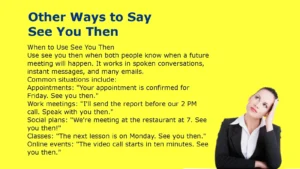
Use see you then when both people know when a future meeting will happen. It works in spoken conversations, instant messages, and many emails.
Common situations include:
- Appointments: “Your appointment is confirmed for Friday. See you then.”
- Work meetings: “I’ll send the report before our 2 PM call. Speak with you then.”
- Social plans: “We’re meeting at the restaurant at 7. See you then!”
- Classes: “The next lesson is on Monday. See you then.”
- Online events: “The video call starts in ten minutes. See you then.”
The expression doesn’t usually need a precise date or time in the same sentence. However, the conversation should make the intended occasion clear.
Is See You Then Friendly, Casual, or Formal?
See you then is generally friendly and neutral. It suits everyday interactions and familiar professional relationships, but it may sound too casual for certain formal letters or high-stakes business situations.
| Context | Is it appropriate? | Better option when needed |
| Friends and family | Yes | Catch you then |
| Text messages | Yes | Sounds good, see you then |
| Coworkers | Yes | Speak with you then |
| Clients | Usually | I look forward to our meeting |
| Job interviews | Acceptable, depending on context | I look forward to meeting with you |
| Formal business correspondence | Sometimes | I look forward to speaking with you |
The key is to match your wording to the relationship. You don’t need formal language for every workplace interaction, but a little extra polish can help when communicating with a new client or senior executive.
25+ Other Ways to Say See You Then
The best alternative to see you then depends on your purpose. Some expressions confirm a scheduled meeting, while others express enthusiasm, end a conversation, or sound more professional.
The following alternatives cover casual, friendly, professional, and formal situations.
Casual and Everyday Alternatives to See You Then
These expressions work well with friends, classmates, relatives, and people you know reasonably well.
1. Catch you then
This phrase is a relaxed alternative that confirms you’ll meet or reconnect at the agreed time.
Example: “We’re playing basketball at 6 PM, right? Catch you then!”
2. See you later
Use this expression when you expect to see someone later that day or at another understood time.
Example: “I’m heading to the store now. See you later!”
Unlike see you then, this phrase doesn’t necessarily refer to a specific appointment.
3. See you soon
This option sounds warm and friendly. It works when you expect to meet again soon but may not have a precise time.
Example: “It was great catching up. See you soon!”
4. Talk to you then
Choose this phrase when you expect to speak with someone rather than meet them in person.
Example: “I’ll call you after the presentation. Talk to you then.”
It’s particularly useful for phone calls, video meetings, and scheduled conversations.
5. See you in a bit
This phrase suggests a short wait before the next meeting.
Example: “I’ll grab us a table. See you in a bit.”
It’s most natural when the other person expects to see you shortly.
6. See you around
Use this expression when you expect to encounter someone again but haven’t arranged a specific meeting.
Example: “I’m leaving campus now. See you around!”
This phrase is less definite than see you then because it doesn’t confirm a particular time.
Friendly and Warm Alternatives to See You Then
Choose these phrases when you want to sound welcoming or show enthusiasm about an upcoming meeting.
7. Looking forward to seeing you
This expression communicates that you’re pleased about the upcoming meeting. It works in personal messages and professional communication.
Example: “Thanks for making time this weekend. Looking forward to seeing you!”
8. Can’t wait to see you
This phrase conveys strong enthusiasm. It usually suits friends, family members, and people with whom you have a close relationship.
Example: “It’s been months since we last met. Can’t wait to see you!”
It may sound overly familiar in a formal business email.
9. See you there!
Use this expression when the location or event matters more than the time.
Example: “The concert starts at 8 PM. I’ll meet you at the main entrance. See you there!”
Remember that there refers to a place, while then refers to a time.
10. Until then
This phrase emphasizes the time between now and the next meeting. It often works well as a closing sentence.
Example: “I’ll send you the final details tomorrow. Until then, have a great week!”
It can sound slightly more polished than a casual goodbye.
11. Hope to see you soon
This expression communicates goodwill without making a firm promise that you’ll meet at a specific time.
Example: “Thanks for inviting me to the event. Hope to see you soon!”
Use it when another meeting is possible but hasn’t been firmly arranged.
Professional Alternatives to See You Then
Professional alternatives help you confirm plans while maintaining a courteous tone. You can use these expressions with coworkers, managers, clients, recruiters, and business partners.
12. Speak with you then
This phrase works when you’ve scheduled a phone call, video conference, or other conversation.
Example: “I’ve booked our call for Thursday at 11 AM. Speak with you then.”
It sounds natural in a professional email without becoming unnecessarily formal.
13. I look forward to our meeting
Use this expression to acknowledge a scheduled business meeting and communicate a positive attitude.
Example: “Thank you for confirming the appointment. I look forward to our meeting on Wednesday.”
It’s especially useful when communicating with clients or people you haven’t met before.
14. I look forward to speaking with you
This is a strong option for interviews, consultations, sales calls, and professional discussions.
Example: “Thank you for reviewing my application. I look forward to speaking with you next week.”
The phrase communicates anticipation while keeping the tone respectful.
15. I’ll see you at the scheduled time
Choose this expression when you want to emphasize that you’ve confirmed the appointment.
Example: “I’ve added the meeting to my calendar. I’ll see you at the scheduled time.”
It works best when the schedule is already clear. In a relaxed conversation, it may sound unnecessarily stiff.
16. I look forward to connecting
This expression is common in business communication, especially when people plan to discuss an issue or exchange ideas.
Example: “Thank you for arranging the introduction. I look forward to connecting on Friday.”
It works for both in-person and remote meetings.
17. Talk to you at the agreed time
This alternative is useful when you’ve established a specific time for a future conversation.
Example: “I’ll review the documents before our call. Talk to you at the agreed time.”
It emphasizes the schedule and works particularly well in practical, task-focused communication.
Formal Alternatives for Emails and Business Correspondence
Formal alternatives are useful when communicating with clients, senior leaders, interviewers, or people you don’t know well.
18. I look forward to meeting with you
This expression is polite and professional. It works well when you expect to meet someone in person or attend a scheduled appointment.
Example: “Thank you for confirming the interview. I look forward to meeting with you on Monday.”
19. I look forward to our scheduled meeting
Use this phrase when you want to acknowledge a confirmed appointment in a formal email.
Example: “I appreciate your confirmation. I look forward to our scheduled meeting next Thursday.”
It reinforces the arrangement without repeating every detail.
20. Thank you, and I look forward to speaking with you then
This option combines gratitude with a clear reference to the planned conversation.
Example: “Thank you for confirming your availability. I look forward to speaking with you then.”
It works well when replying to a client or professional contact who has confirmed a date.
21. I look forward to meeting with you at the agreed time
This longer expression emphasizes the appointment and sounds courteous.
Example: “Thank you for sharing your availability. I look forward to meeting with you at the agreed time.”
Use it when the exact appointment matters. For routine internal emails, a shorter phrase usually sounds more natural.
Short Alternatives for Text Messages
Short replies work best when the conversation already contains the necessary details. You don’t have to write a complete formal sentence every time.
22. See you!
Example:
“Meet me outside the library at 3.”
“Perfect. See you!”
23. Sounds good, see you then
This phrase confirms both the plan and your agreement.
Example: “Let’s have lunch tomorrow at noon.”
“Sounds good, see you then!”
24. Perfect, talk soon
Choose this response when you expect to reconnect but don’t need to emphasize a particular meeting time.
Example: “I’ll send you the link before the call.”
“Perfect, talk soon!”
25. Great, see you there
This phrase acknowledges a plan involving a particular location or event.
Example: “The workshop is at the downtown office.”
“Great, see you there!”
26. Okay, catch you then
This expression sounds casual and relaxed.
Example: “Let’s meet after the lecture at 4.”
“Okay, catch you then.”
27. All right, speak soon
Use this phrase to close a conversation when you expect to speak again shortly.
Example: “I’ll call you once I finish work.”
“All right, speak soon!”
Quick Comparison of Alternatives to See You Then
| Alternative | Tone | Best use |
| Catch you then | Casual | Friends and familiar coworkers |
| See you soon | Friendly | An upcoming but not precisely timed meeting |
| Talk to you then | Neutral | Scheduled conversations |
| Looking forward to seeing you | Warm | Personal and professional meetings |
| I look forward to our meeting | Professional | Business appointments |
| I look forward to speaking with you | Formal | Interviews and client calls |
| See you there | Casual or neutral | Confirming a location |
| Until then | Neutral | Closing a message before a future occasion |
| I’ll see you at the scheduled time | Formal or practical | Confirmed appointments |
How to Say See You Then Professionally
To say see you then professionally, choose wording that acknowledges the agreed appointment and suits your relationship with the other person. Phrases such as “I look forward to our meeting” and “Speak with you then” work well because they sound courteous without adding unnecessary formality.
When Confirming a Meeting With a Colleague
When messaging a coworker, you can usually keep your language simple. The goal is to confirm the arrangement, not make an ordinary meeting sound like a formal ceremony.
Examples include:
- “Thanks for confirming. See you then.”
- “Great, speak with you at 2 PM.”
- “Sounds good. I’ll see you at the meeting.”
- “Perfect. Talk to you then.”
Practical example:
Your colleague asks whether you can review a report on Thursday afternoon. After agreeing on a time, you could reply:
“Thursday at 3 PM works for me. Thanks, and see you then.”
This message sounds professional because it confirms the schedule and closes the conversation naturally.
When Speaking With a Client or Manager
A client-facing message often benefits from a little more courtesy. However, you don’t need to use complicated vocabulary or excessively formal language.
Consider these examples:
- “Thank you for confirming. I look forward to our meeting.”
- “I appreciate your time. I look forward to speaking with you on Friday.”
- “Thanks for arranging the call. Speak with you then.”
- “Thank you for the confirmation. I’ll see you at the scheduled time.”
Choose the phrase based on the situation. “Speak with you then” suits a familiar client, while “I look forward to our meeting” may work better when establishing a new business relationship.
When Confirming an Interview or Business Appointment
Job interviews and formal appointments often call for a clear, courteous response.
For example:
“Thank you for confirming the interview details. I look forward to meeting with you on Tuesday at 10 AM.”
This message works because it acknowledges the confirmation, repeats the important appointment details, and ends positively.
For a shorter response, you could write:
“Thank you for the confirmation. I look forward to speaking with you then.”
Avoid adding unnecessary details if the other person has already provided a complete schedule.
Professional Example Sentences
| Situation | Recommended phrase | Example |
| Team meeting | Speak with you then | Thanks for confirming. Speak with you then at 2 PM. |
| Client call | I look forward to our call | I look forward to our call tomorrow afternoon. |
| Job interview | I look forward to meeting with you | Thank you for the details. I look forward to meeting with you on Monday. |
| Business appointment | I’ll see you at the agreed time | Thank you for confirming. I’ll see you at the agreed time. |
| Project discussion | I look forward to connecting | I look forward to connecting with you on Thursday. |
A useful rule: If the meeting is already confirmed, acknowledge it briefly. If the other person still needs to approve the time, ask for confirmation instead of assuming the meeting is settled.
How to Use See You Then in a Formal Email
You can use see you then in an email, but the best wording depends on your audience. It sounds natural in casual workplace messages, while expressions such as “I look forward to our meeting” often suit formal business correspondence better.
Formal Email Examples for Confirming a Meeting
Here are three ready-to-use examples for common professional situations.
Example: Confirming a business meeting
Subject: Meeting Confirmation
Hello Jordan,
Thank you for confirming our meeting for Thursday at 11 AM. I’ve added it to my calendar and look forward to discussing the project with you.
Best regards,
Alex
Example: Responding to a scheduled interview
Subject: Interview Confirmation
Dear Ms. Taylor,
Thank you for sharing the interview details. I confirm my availability for Tuesday at 10 AM and look forward to meeting with you.
Best regards,
Morgan Lee
Example: Acknowledging a client appointment
Subject: Appointment Confirmation
Hello Mr. Davis,
Thank you for confirming the appointment. I look forward to speaking with you on Friday at 2 PM.
Best regards,
Sam
These examples use specific dates and times because clarity matters in professional scheduling. When you don’t need to repeat the details, a short closing sentence may be enough.
Professional Email Closings That Replace See You Then
The best closing depends on whether you want to confirm an appointment, express enthusiasm, or simply end the conversation.
- I look forward to speaking with you. Use this for a scheduled call or discussion.
- I look forward to our meeting. Choose this for a confirmed business appointment.
- Thank you for your time. Use this when you want to acknowledge the recipient’s effort.
- I look forward to connecting on Thursday. This works well for a professional conversation.
- Speak with you then. Choose this for a familiar professional contact.
- Thank you, and I’ll see you at the meeting. Use this when you want a direct, friendly confirmation.
Remember that an email closing sentence and an email sign-off serve different purposes. “I look forward to our meeting” is a closing sentence, while “Best regards” or “Sincerely” is a sign-off.
Is See You Then Appropriate in a Work Email?
Yes. See you then is appropriate in many work emails, especially when you already have a friendly relationship with the recipient and the meeting time is clear.
For example:
“Thanks for moving the meeting to 3 PM. See you then!”
This sounds natural between coworkers.
However, consider a more polished alternative when contacting a new client, applying for a job, or communicating in a particularly formal setting.
For example:
“Thank you for confirming the appointment. I look forward to meeting with you on Thursday.”
The difference isn’t grammatical correctness. Both expressions are correct. The choice comes down to tone, context, and professional expectations.
See You Then or Than: Which Is Correct?
See you then is correct when you mean that you’ll meet someone at a future time. The word then refers to time or sequence, while than introduces a comparison. Therefore, you should write “See you then,” not “See you than,” when confirming a meeting.
Meaning and Usage of Then
The word then has several uses, but it often refers to a particular time or the next step in a sequence.
Examples:
- “The class starts at 9 AM. See you then.”
- “Finish the report, then send it to me.”
- “I lived in Chicago back then.”
- “If you’re free on Friday, I’ll see you then.”
In the expression see you then, the word refers to the time already mentioned or understood.
Meaning and Usage of Than
The word than connects two things in a comparison. It commonly appears after comparative words such as better, taller, faster, and more expensive.
Examples:
- “This meeting is longer than the previous one.”
- “Monday works better than Tuesday.”
- “The new office is closer than the old one.”
- “I’d rather call than send another email.”
Because than expresses comparison, it doesn’t fit the meaning of a future meeting.
See You Then vs. See You Than: Examples
| Sentence | Correct? | Explanation |
| Our call starts at noon. See you then. | Correct | Then refers to the scheduled time. |
| I’ll meet you at the station at 6. See you then. | Correct | The time is already established. |
| Our call starts at noon. See you than. | Incorrect | Than doesn’t refer to a future time. |
| This meeting is shorter than yesterday’s meeting. | Correct | Than introduces a comparison. |
Memory tip: If you can replace the word with “at that time,” use then. If you’re comparing two things, use than.
See You Then or See You There?
See you then refers to a time or occasion, while see you there refers to a place or event location. Both expressions confirm future plans, but they emphasize different details. Choose then when the time matters and there when the location matters.
What Does See You There Mean?
See you there means that you expect to meet someone at a particular place or event.
Examples:
- “The conference is at the convention center. See you there!”
- “We’re meeting outside the library. See you there.”
- “The wedding reception starts at 6 PM at the hotel. See you there!”
The phrase works particularly well when both people already know the location.
When to Use See You Then
Use see you then when you want to emphasize a scheduled time.
Examples:
- “Our appointment is at 10 AM tomorrow. See you then.”
- “The online meeting starts at 4 PM. Talk to you then.”
- “I’ll meet you after class on Friday. See you then.”
You can use this phrase even when the meeting will happen online. The important detail is the agreed time, not the physical location.
Can You Say See You Then and There?
Yes. You can use then and there when you want to refer to a particular time and place together, although the expression often emphasizes a specific occasion.
Example:
“Let’s meet at the main entrance at 5 PM. I’ll see you there then.”
That sentence is understandable, but it may sound awkward in ordinary conversation. A more natural version is:
“Let’s meet at the main entrance at 5 PM. See you there!”
When both the time and location matter, simply state them clearly before closing the conversation.
What Does See You Guys Then Mean?
See you guys then means that the speaker expects to meet a group of people at an agreed future time. The word guys addresses the group, while then refers to the scheduled occasion. The expression is informal and common in friendly conversations and group messages.
Meaning of See You Guys Then
People use this phrase when arranging plans with several friends, classmates, or familiar coworkers.
Examples:
- “We’re meeting at the restaurant at 7 PM. See you guys then!”
- “The group project starts on Monday. See you guys then.”
- “I’ll bring the presentation slides to class. See you guys then!”
The expression sounds natural when speaking to a group that understands the plan.
Is See You Guys Then Informal?
Yes. See you guys then usually sounds casual and conversational. It may suit a friendly workplace team, but a more neutral expression can work better in formal settings.
Alternatives include:
- See you all then. A friendly option that addresses everyone.
- I’ll see everyone then. A neutral way to confirm a group meeting.
- I look forward to seeing you all. A warmer, more polished alternative.
- See you at the meeting. A concise option that focuses on the event.
For example, you might tell your friends, “See you guys then!” but write to a group of clients, “I look forward to seeing you all at Thursday’s meeting.”
What Does Thank You, See You Then Mean?
Thank you, see you then combines gratitude with confirmation of a future meeting. The speaker thanks the other person and acknowledges the planned occasion. The expression works in everyday conversations and informal professional messages, although formal emails may benefit from a more polished version.
Meaning and Tone of Thank You, See You Then
The phrase usually communicates two things:
- Thank you: The speaker appreciates the other person’s help, confirmation, or arrangements.
- See you then: The speaker acknowledges the future meeting.
For example:
“Your appointment is confirmed for Wednesday at 3 PM.”
“Thank you, see you then!”
The reply is short and natural. It acknowledges the confirmation without repeating the full appointment details.
More Natural Ways to Say Thank You, See You Then
Choose an alternative based on the level of formality you need.
Casual:
“Thanks for confirming. See you then!”
Friendly and warm:
“Thank you! Looking forward to seeing you.”
Professional:
“Thank you for confirming the meeting. Speak with you then.”
Formal:
“Thank you for confirming the appointment. I look forward to meeting with you on Wednesday.”
Punctuation can also affect readability. A comma or full stop separates the expressions clearly, while an exclamation point adds enthusiasm. In a formal email, a full stop usually provides a more restrained tone.
How to Say See You Then in Tagalog
The best Tagalog translation of see you then depends on what the speaker means by then. If the phrase refers to seeing someone later, Kita tayo mamaya is a natural option. If it refers to a specific future time, a more explicit expression may communicate the meaning more clearly.
Common Tagalog Translations
Here are useful expressions for different situations.
| Tagalog expression | English meaning | Typical use |
| Kita tayo mamaya. | See you later. | Meeting later the same day |
| Kita tayo bukas. | See you tomorrow. | Confirming plans for tomorrow |
| Kita tayo sa oras na iyon. | See you at that time. | Referring to a specific time |
| Kita tayo roon. | See you there. | Referring to a place |
| Hanggang sa muli. | Until next time. | A more general farewell |
For example:
English: “Let’s meet after class at 4 PM. See you then!”
Tagalog: “Magkita tayo pagkatapos ng klase nang alas-kuwatro. Kita tayo!”
The most natural translation may change with the situation and the speaker’s preferred wording. A literal translation isn’t always the best choice for an everyday conversation.
Casual vs. Polite Tagalog Expressions
When speaking to friends, simple expressions such as Kita tayo mamaya sound natural.
For a more polite interaction, you can use a respectful form of address or state the appointment more explicitly.
For example:
Casual conversation
“Magkita tayo bukas.”
“See you tomorrow.”
Polite conversation
“Salamat po. Magkita po tayo bukas.”
“Thank you. See you tomorrow.”
The word po adds politeness in many Filipino conversations. Use it when the relationship or situation calls for a respectful tone.
How to Choose the Best Alternative to See You Then
The best phrase isn’t always the most formal one. You should consider the purpose of the message, your relationship with the recipient, and how clearly you’ve established the time or location.
Choose Based on Formality
Use this guide to select an appropriate expression.
| Level | Recommended phrase | Example situation |
| Casual | Catch you then | Talking with a friend |
| Friendly | Looking forward to seeing you | Arranging a social gathering |
| Neutral | Talk to you then | Confirming a phone call |
| Professional | I look forward to our meeting | Communicating with a client |
| Formal | I look forward to meeting with you | Confirming a job interview |
You don’t have to avoid see you then in professional settings. If the other person uses a relaxed tone, matching that tone can make your response sound more natural.
Choose Based on the Situation
First, identify what you’re confirming.
- A specific time: “See you then.”
- A location: “See you there.”
- A future phone call: “Talk to you then.”
- A professional meeting: “I look forward to our meeting.”
- An informal gathering: “Catch you then.”
- An uncertain future meeting: “Hope to see you soon.”
This distinction prevents small misunderstandings. For example, if someone has confirmed a location but not the time, saying see you then may imply that the time is already settled.
Choose Based on Your Relationship With the Reader
Your relationship affects how formal your message needs to be.
When speaking with a close friend, a short reply such as “Perfect, see you then!” is usually enough. With a coworker, “Thanks for confirming. Speak with you then” may sound more appropriate.
For a client or recruiter, consider a complete sentence that acknowledges the appointment. “Thank you for confirming. I look forward to speaking with you on Friday” communicates the same intention with a more professional tone.
The goal is to sound clear and respectful, not unnecessarily stiff.
Quick Reference Table of the Best Alternatives
| Communication goal | Best alternative |
| Casual conversation | Catch you then |
| Friendly and enthusiastic | Looking forward to seeing you |
| Professional meeting | Speak with you then |
| Formal email | I look forward to our meeting |
| Confirming a location | See you there |
| Confirming a scheduled time | I’ll see you at the agreed time |
| Confirming a group meeting | See you all then |
| Ending a phone conversation | Talk to you then |
| Expressing gratitude | Thank you, and I look forward to our meeting |
| Meeting someone soon without a fixed time | See you soon |
A Practical Example: Choosing the Right Phrase
Imagine you’ve arranged three meetings for the following week.
Situation A: Meeting a friend
Your friend texts, “Coffee on Saturday at 11?”
A natural reply is: “Sounds good, see you then!”
Situation B: Speaking with a coworker
A teammate writes, “I’ve scheduled our project review for Tuesday at 2 PM.”
You reply: “Thanks for setting it up. Speak with you then.”
Situation C: Confirming a client meeting
A client emails, “Your consultation is confirmed for Thursday at 10 AM.”
You respond: “Thank you for confirming the appointment. I look forward to speaking with you on Thursday.”
All three replies confirm future plans, but each matches a different relationship and level of formality.
Conclusion: Find the Right Way to Say See You Then
There are many natural alternatives to see you then, from casual expressions such as “catch you then” to professional phrases such as “I look forward to our meeting.” The right choice depends on your audience, the situation, and whether you’re confirming a time, a place, or a future conversation.
Remember the key distinctions: then refers to time, there refers to place, and than introduces comparisons. Use these differences to avoid common grammar mistakes and make your messages clearer.
For everyday conversations, keep it simple. In professional emails, choose a courteous expression that fits the relationship without sounding overly formal.
Your next step: Choose two or three alternatives from this guide and practice using them in texts, emails, and workplace conversations. You’ll build a more flexible vocabulary and communicate with greater confidence.
Frequently Asked Questions
Is See You Then Grammatically Correct?
Yes, see you then is grammatically correct. People use it to confirm a future meeting at an agreed time or occasion. For example, “Our call starts at noon. See you then!”
Is See You Then Professional?
Yes, see you then can sound professional in everyday workplace conversations, especially among familiar colleagues. For clients, recruiters, or formal correspondence, “I look forward to our meeting” may sound more polished.
What Is a More Formal Way to Say See You Then?
A more formal alternative is I look forward to meeting with you. You can also write “I look forward to speaking with you” when confirming a call or “I look forward to our scheduled meeting” for a business appointment.
Should I Write See You Then or See You Than?
Write see you then when referring to a future meeting. The word then relates to time, while than introduces a comparison, as in “This meeting is longer than the last one.”
What Is the Difference Between See You Then and See You There?
See you then emphasizes a time, while see you there emphasizes a location or event. For example, “The class starts at 9 AM. See you then” confirms the time, while “The class is in Room 12. See you there” highlights the location.
Can I Use See You Then at the End of an Email?
Yes. See you then works well in casual and familiar professional emails when the meeting details are clear. In formal correspondence, you may prefer “I look forward to our meeting” or “I look forward to speaking with you.”