Other ways to say “I’m on my way” include “I’m heading over,” “I’ll be there soon,” “I’m en route,” and “I’m making my way there.” The best expression depends on whether you’re texting a friend, updating a coworker, running late, or looking for a funny reply that makes someone laugh.
You can also use funny ways to say on my way, elegant expressions, Spanish translations, and medieval-inspired phrases to make an ordinary message more interesting. Some expressions tell people you’ve already started traveling, while others simply mean you’re getting ready to leave. Choosing the right wording helps you communicate clearly without sounding repetitive, overly formal, or unintentionally misleading.
What Are Other Ways to Say “I’m on My Way”?
Other ways to say “I’m on my way” are expressions that tell someone you’re traveling toward a destination or preparing to arrive. Common alternatives include “I’m heading over,” “I’m coming now,” “I’ll be there shortly,” and “I’m en route.” Each phrase communicates movement, but the tone and timing can differ.
Quick Alternatives to “I’m on My Way”
Here are 15 useful alternatives you can copy and use in everyday conversations.
| Alternative | Tone | Best situation |
| I’m heading over. | Casual | Visiting a friend |
| I’ll be there soon. | Friendly | Confirming an upcoming arrival |
| I’m coming now. | Direct | Responding to someone waiting |
| I’m en route. | Professional | Updating a colleague |
| I’m on the way. | Neutral | Everyday conversation |
| I’m heading your way. | Friendly | Visiting someone’s location |
| I’m making my way there. | Conversational | Describing ongoing travel |
| I’m leaving now. | Clear | Confirming your departure |
| I’ll be there shortly. | Polite | Professional or personal messages |
| I’m on the road. | Casual | Traveling by road |
| See you in a bit. | Relaxed | Meeting someone soon |
| I’m almost there. | Reassuring | Approaching the destination |
| I’m setting off now. | Natural | Announcing your departure |
| I’m coming over. | Casual | Visiting someone’s home |
| I’m getting closer. | Informal | Providing a progress update |
Quick tip: Use “I’m leaving now” when you haven’t departed yet, “I’m on my way” when your journey has begun, and “I’m almost there” when you’re close to your destination.
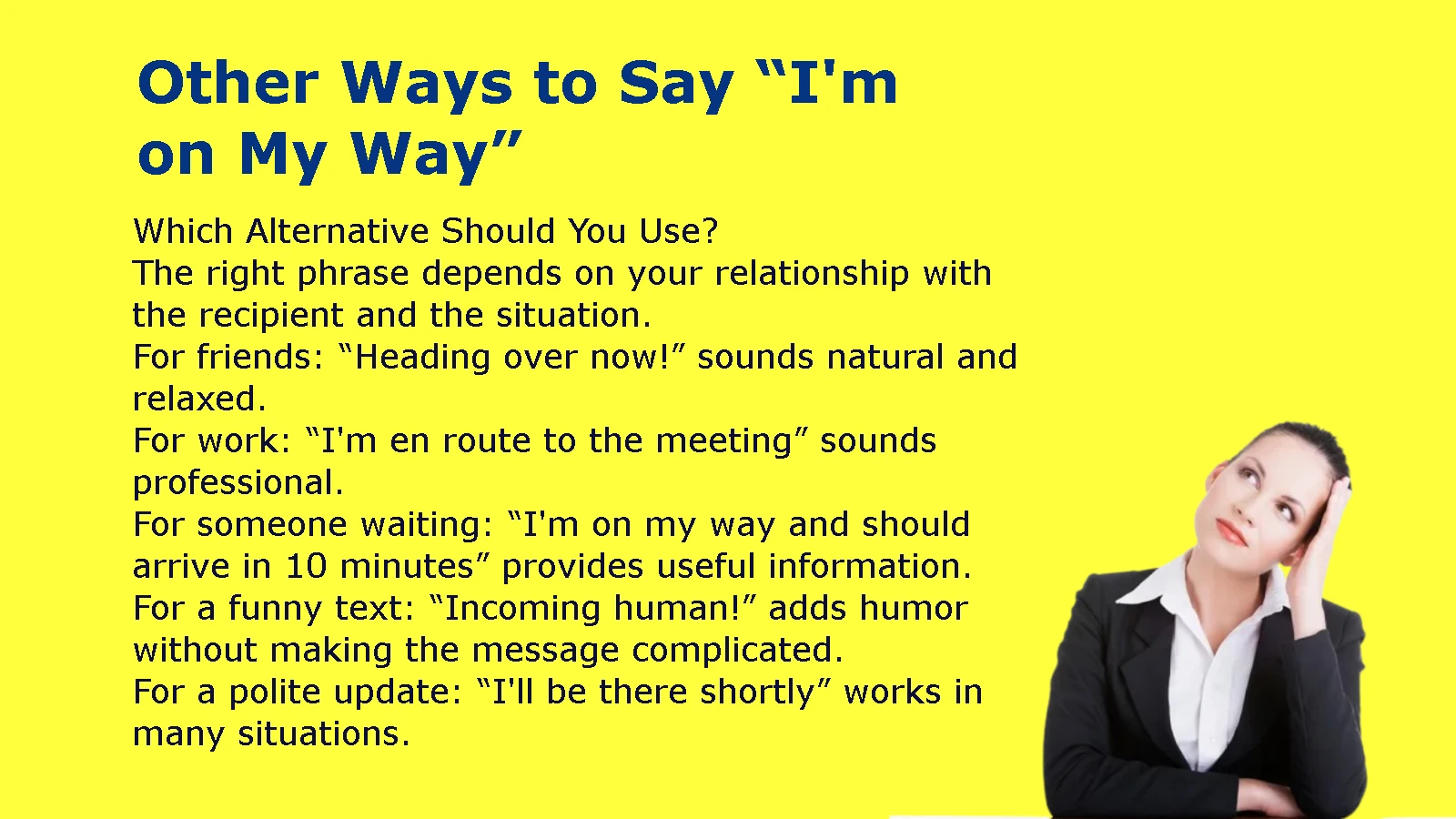
Which Alternative Should You Use?
The right phrase depends on your relationship with the recipient and the situation.
- For friends: “Heading over now!” sounds natural and relaxed.
- For work: “I’m en route to the meeting” sounds professional.
- For someone waiting: “I’m on my way and should arrive in 10 minutes” provides useful information.
- For a funny text: “Incoming human!” adds humor without making the message complicated.
- For a polite update: “I’ll be there shortly” works in many situations.
Remember that these phrases aren’t always interchangeable. Saying “I’m almost there” suggests you’re close to arriving, while “I’m getting ready to leave” means you haven’t started the journey.
Common and Natural Ways to Say “I’m on My Way”
Everyday alternatives to “I’m on my way” help you avoid repeating the same phrase in texts and conversations. Expressions such as “I’m heading out,” “I’m coming over,” and “See you soon” sound natural when they match your actual situation. The most useful option communicates your progress without creating confusion about your arrival.
Casual Alternatives for Everyday Conversations
Use these expressions when you’re talking to friends, relatives, neighbors, or people you know well.
- I’m heading over now. You’re traveling to the person’s location.
- Be there soon. You expect to arrive shortly.
- I’m coming over. You’re going to someone’s home or another place they’re visiting.
- I’m on my way now. You want to confirm that you’ve started moving.
- See you in a bit. You expect to meet the person soon.
- I’m heading your way. You’re traveling toward their location.
- I’m almost there. You’re close to arriving.
- I’m making my way over. You’re traveling toward the destination, perhaps at a relaxed pace.
Example conversation:
Friend: Are you coming to the party?
You: Yep, I’m heading over now. Save me some pizza!
This message sounds friendly because it answers the question directly and adds a little personality.
Alternatives for Texting and Messaging
Short messages are especially useful when you’re walking, commuting, or replying quickly.
| Text message | Meaning |
| OMW! | I’m on my way. |
| Leaving now! | I’m starting my journey. |
| On my way now. | I’m confirming that I’m coming. |
| Be there soon! | I expect to arrive shortly. |
| Heading out. | I’m departing. |
| See you soon! | We’ll meet shortly. |
| ETA: 10 mins. | I expect to arrive in 10 minutes. |
| Almost there! | I’m close to the destination. |
OMW is a common abbreviation for “on my way.” It works well in informal texts, group chats, and quick replies.
For example:
Friend: We’re already at the restaurant. Where are you?
You: OMW! ETA 10 mins.
This response gives your friend two useful details: you’re coming, and you expect to arrive in about 10 minutes. Only use a specific ETA when you have a reasonable basis for it.
Ways to Say You’re on Your Way When You’re Still Preparing to Leave
Sometimes people send “I’m on my way” before they’ve actually left. If you’re still getting dressed, finding your keys, or packing your bag, choose wording that accurately describes your progress.
Try these alternatives:
- I’m getting ready to leave.
- I’ll head out in a minute.
- I’m just grabbing my things.
- I’m about to leave.
- I’ll be on my way shortly.
- Just finishing up here.
- I’m nearly ready to go.
- Give me a few minutes, and I’ll head out.
Consider this example:
Roommate: Are you coming to dinner?
You: I’m just grabbing my things. I’ll head out in five minutes.
This message sets a clearer expectation than “I’m on my way” when you haven’t left home yet.
Ways to Say You’re Already Traveling
If you’ve started your journey, these phrases describe your movement more precisely.
- I’m on the road. Best when you’re traveling by road.
- I’m heading there now. A general, natural update.
- I’m halfway there. Use this when you’ve covered roughly half the journey.
- I’m getting closer. Useful when someone asks for an update.
- I’m making my way over. A relaxed way to describe your progress.
- I’m on the move. Emphasizes that you’re moving.
- I’m coming up on your location. Useful when approaching a particular place.
- I’m just around the corner. Use this when you’re genuinely very close.
For example, if you’re five minutes from a friend’s house, you could text, “I’m just around the corner. See you in a minute!”
However, avoid using “I’m almost there” when you’re still across town. A small, accurate update builds more trust than an optimistic estimate that keeps changing.
Funny Ways to Say “On My Way”
Funny ways to say “on my way” turn a routine update into an entertaining message. You can exaggerate your journey, joke about traffic, or announce your arrival as though you’re a celebrity. These expressions work best with people who understand your humor, especially friends, partners, and group chats.
Funny Text Messages to Tell Someone You’re Coming
Use these original lines when a simple “I’m coming” feels too ordinary.
- My arrival is loading. Please stand by.
- Prepare yourself. I have begun the journey.
- Your favorite person is officially in transit.
- I’m on my way. Roll out the imaginary red carpet.
- The journey has begun. The snacks better be ready.
- I have left the comfort of my home for you. Appreciate the sacrifice.
- Incoming human. Please clear the landing zone.
- My transportation saga is underway.
- I’m approaching with questionable punctuality and excellent intentions.
- The mission to reach your location is now active.
These messages work because they exaggerate an ordinary activity. A trip to a friend’s house becomes a mission, and arriving for dinner becomes a grand event.
Sarcastic Ways to Say “I’m on My Way”
Sarcastic expressions add a playful edge to your message. Use them with friends who enjoy teasing rather than with people who need a serious arrival update.
- I’m basically there in another dimension.
- Tell the welcoming committee to prepare.
- My presence is currently in transit.
- I’m coming. Try to contain your excitement.
- Time is relative, and so is my arrival.
- I’m moving toward you at a speed approved by nobody.
- The road and I are having a disagreement.
- I’m on my way, assuming the universe cooperates.
- You may begin your celebration of my arrival.
- I’m approaching with the urgency of a sleepy turtle.
Example:
Friend: You’ve been saying you’re on your way for 20 minutes.
You: I’m on my way spiritually. My physical form is still negotiating with traffic.
The joke works in a casual conversation, but it wouldn’t be suitable for a client who’s waiting for an appointment.
Funny Excuses and Playful Updates
When something delays you, a humorous update can make the wait less awkward. Just make sure the joke doesn’t hide information the other person needs.
- I’m fighting traffic and traffic is winning.
- My GPS and I are currently in couples therapy.
- I was ready to leave until my keys started playing hide-and-seek.
- I’m one minor inconvenience away from arriving tomorrow.
- I’m getting there. The plot just needs another few minutes.
- My journey has encountered an unexpected side quest.
- I left on time, but apparently time had other plans.
- My shoes are on. My motivation is catching up.
- I’m almost ready to become a person who arrives places.
- The departure process has suffered a technical difficulty.
Here’s a useful rule: give the real update first and the joke second when someone genuinely needs to know when you’ll arrive.
For example, “Traffic has slowed me down, so I’ll be there in 15 minutes. My GPS has clearly chosen chaos today.”
Short, Funny “OMW” Alternatives
Need a quick response for a group chat? Try one of these:
- OMW-ish.
- En route, allegedly.
- Incoming human!
- ETA: classified.
- Arrival mission activated.
- The traveler approaches.
- Loading destination…
- Movement has commenced.
- Departure: finally achieved.
- On my way, with dramatic music.
These short lines work well when the conversation is already playful. If the other person is waiting outside in bad weather, however, send a real arrival estimate instead.
Fancy Ways to Say “I’m on My Way”
Fancy ways to say “I’m on my way” range from polished expressions such as “I am en route” to theatrical lines such as “I shall soon grace you with my presence.” Formal wording suits professional settings, while elaborate language works better as a joke, caption, or creative message.
Elegant and Sophisticated Expressions
Choose these alternatives when you want to sound composed, professional, or slightly more refined.
- I am en route.
- I am making my way to you.
- I am proceeding to your location.
- I shall arrive shortly.
- I am presently on my way.
- I am heading to the designated location.
- I have begun my journey.
- I expect to arrive shortly.
- I am on my way to meet you.
- I will join you soon.
Not every formal expression sounds natural in every situation. “I am proceeding to your location” might work in a procedural update, but it can sound stiff in a message to a friend.
For workplace communication, “I’m en route and expect to arrive in 15 minutes” usually strikes a better balance between professionalism and clarity.
Dramatic and Poetic Ways to Announce Your Arrival
If you want to sound like a character in a fantasy novel or an old adventure film, try these creative alternatives.
- My journey toward you has begun.
- I draw ever closer to your doorstep.
- The road leads me to your door.
- I shall soon grace you with my presence.
- My arrival is but a matter of time.
- The winds of destiny carry me your way.
- I advance toward our appointed meeting.
- Prepare yourself, for I am approaching.
- My travels shall soon bring me to you.
- The distance between us is shrinking.
Example message:
“Fear not, dear friend. My journey has begun, and I shall soon grace your doorstep with my presence.”
This sounds deliberately dramatic, making it ideal for a playful text or a caption. In an ordinary conversation, it would probably earn you a laugh rather than a serious response.
Fancy “I’m on My Way” Meme Captions
A fancy way to say “on my way” can become even funnier when it sounds unnecessarily grand. These lines suit memes, social posts, and exaggerated group-chat announcements.
- Pray prepare for my arrival.
- The traveler approaches.
- My presence shall soon be bestowed upon you.
- Summon the welcoming committee.
- Make way, for my journey is underway.
- I have commenced my noble expedition.
- The royal carriage of questionable reliability is approaching.
- I shall arrive when the stars permit.
- Let it be known that I am in transit.
- The long-awaited guest has begun the voyage.
You can pair these captions with a picture of someone walking dramatically, a royal portrait, or a character riding into battle.
For example, a meme showing a person walking slowly toward a door could use the caption: “Make way, peasants. My arrival is imminent.”
The humor comes from the contrast between the grand announcement and the ordinary journey.
When to Use Fancy or Dramatic Wording
Fancy language works best when the situation allows room for humor or creativity.
| Situation | Recommended phrase |
| Work meeting | I’m en route to the meeting. |
| Dinner with friends | I shall arrive shortly. |
| Group-chat joke | The traveler approaches. |
| Social media meme | Pray prepare for my arrival. |
| Romantic message | My journey toward you has begun. |
| Creative writing | I draw ever closer to your doorstep. |
Use elaborate phrases sparingly in professional messages. Clear communication matters more than decorative language when someone needs your location or arrival time.
Professional Ways to Say “I’m on My Way”
Professional alternatives to “I’m on my way” communicate that you’re traveling, attending a meeting, or heading to a work location. Phrases such as “I’m en route to the meeting” and “I expect to arrive in 15 minutes” sound polite and clear. When delays occur, provide an honest update rather than a vague promise.
Professional Alternatives for Emails and Work Messages
Use these expressions when updating a manager, client, coworker, or business contact.
- I’m on my way to the office.
- I’m heading to the meeting now.
- I’m currently en route to the location.
- I’ll be there shortly.
- I’ve left and am on my way.
- I’m traveling to the appointment now.
- I’m on my way and will update you if my ETA changes.
- I expect to arrive at approximately 2:30 p.m.
- I’m heading over now. Thank you for your patience.
- I’ve started my journey and look forward to meeting you.
Example email:
Subject: Update on My Arrival
Hi Jordan,
I’m on my way to the meeting and currently expect to arrive at 2:30 p.m. I’ll let you know if anything affects my arrival time.
Thank you for your patience.
Best,
Alex
The message works because it gives the recipient a clear status and a realistic estimate without unnecessary explanation.
Polite Ways to Update Someone About Your Arrival
If someone is waiting for you, use a phrase that sounds considerate and gives them helpful information.
- I’m leaving now and will keep you updated.
- I’m on my way and should arrive soon.
- I’ve set off and will let you know if anything changes.
- I’m heading over now. Thank you for waiting.
- I’m on my way and expect to arrive in about 10 minutes.
- I’ve started traveling and will message you when I’m close.
Consider the difference between these two messages:
Vague: “I’ll be there soon.”
Clear: “I’ve left the office and expect to arrive in about 20 minutes.”
The second message gives the recipient something useful to plan around. You don’t need an exact ETA for every situation, but a reasonable estimate helps when meetings, reservations, or appointments depend on your arrival.
How to Communicate Delays Professionally
When you’re running late, acknowledge the delay and explain what the recipient should expect next.
| Situation | Professional message |
| Traffic delay | Traffic is slowing me down. I expect to arrive in 15 minutes. |
| Leaving later than planned | I’m running behind schedule and expect to leave in 10 minutes. |
| Uncertain arrival time | I’m delayed and will send an updated ETA as soon as I can. |
| Missed appointment time | I apologize for the delay. I’m on my way and expect to arrive at 3:15 p.m. |
| Meeting someone outside | I’m approaching the location and will message you when I arrive. |
Avoid saying “I’m almost there” simply to reassure someone if you have a long journey remaining. A brief, accurate update shows respect for the other person’s time.
How to Say “On My Way” in Spanish
The most common Spanish translations of “I’m on my way” include “Voy en camino,” “Estoy en camino,” “Ya voy,” and “Voy para allá.” The best choice depends on the context and regional usage. Some expressions emphasize that you’re traveling, while others simply mean you’re coming or leaving shortly.
Common Spanish Translations of “I’m on My Way”
| Spanish phrase | English meaning | Typical use |
| Voy en camino. | I’m on my way. | General use |
| Estoy en camino. | I’m on my way. | Emphasizing the journey |
| Ya voy. | I’m coming now. | Casual conversation |
| Voy para allá. | I’m heading over there. | Traveling toward someone’s location |
| Ya estoy yendo. | I’m already going. | Context-dependent conversational use |
| Voy hacia allí. | I’m heading that way. | Describing direction |
| Estoy llegando. | I’m arriving / I’m getting there. | When nearing the destination |
“Voy en camino” is a useful general translation. However, “Ya voy” often sounds more natural when someone calls you from another room or asks you to come immediately.
Which Spanish Expression Sounds Most Natural?
The context helps you choose the right phrase.
Voy en camino communicates that you’re on your way. You can use it in many everyday situations.
Example:
- Spanish: “¿Dónde estás?”
- English: “Where are you?”
- Spanish: “Voy en camino.”
- English: “I’m on my way.”
Ya voy is shorter and more immediate. It often works when someone is waiting for you or asking you to hurry.
Example:
- Spanish: “¡Te estamos esperando!”
- English: “We’re waiting for you!”
- Spanish: “¡Ya voy!”
- English: “I’m coming!”
Voy para allá means you’re heading toward the other person’s location. It sounds natural in many informal conversations, although preferences vary by region.
Example:
- Spanish: “¿Vienes a mi casa?”
- English: “Are you coming to my house?”
- Spanish: “Sí, voy para allá.”
- English: “Yes, I’m heading over.”
Examples of “I’m on My Way” in Spanish Conversations
Here are a few practical exchanges you can adapt.
Meeting a friend
- Friend: “¿Ya saliste?”
- Translation: “Have you left yet?”
- You: “Sí, ya salí. Voy en camino.”
- Translation: “Yes, I’ve already left. I’m on my way.”
Running late
- Friend: “¿Cuánto tardas?”
- Translation: “How long will you take?”
- You: “Unos quince minutos.”
- Translation: “About 15 minutes.”
Coming over
- Friend: “Te espero en casa.”
- Translation: “I’ll wait for you at home.”
- You: “Perfecto, voy para allá.”
- Translation: “Perfect, I’m heading over.”
Casual Spanish Texting Alternatives
Short Spanish expressions work well in messages with friends and family.
- Ya voy. — I’m coming.
- Voy en camino. — I’m on my way.
- Voy para allá. — I’m heading over there.
- Ya salí. — I’ve already left.
- Estoy llegando. — I’m arriving or getting close.
Choose the phrase that accurately describes your situation. For example, “Ya salí” confirms that you’ve left, while “Ya voy” can mean you’re coming without necessarily confirming that you’ve departed.
How to Say “I’m on My Way” in Medieval Times
To express “I’m on my way” in a medieval-inspired style, use phrases such as “I shall make haste toward thee,” “I ride forth at once,” or “The traveler approaches.” These expressions create an old-fashioned atmosphere, although many are modern imitations rather than verified quotations from medieval English.
Medieval-Inspired Ways to Announce Your Arrival
Try these phrases for fantasy dialogue, role-playing games, themed parties, or humorous messages.
- I shall make haste toward thee.
- I am bound for thy hall.
- I shall be there anon.
- I ride forth at once.
- Make ready, for I approach.
- I shall soon arrive at thy dwelling.
- My journey hath begun.
- I travel forthwith to meet thee.
- Fear not, for I am approaching.
- I shall join thee presently.
These lines evoke the language often associated with knights, royal messengers, and fantasy stories. They don’t all reflect the same historical period or writing style, so treat them as creative alternatives rather than exact historical records.
Old-Fashioned Expressions That Sound Medieval
You can also use older-sounding words and constructions to make an ordinary update more dramatic.
- I shall depart forthwith. — I will leave immediately.
- I shall arrive anon. — I will arrive soon.
- I make haste. — I am hurrying.
- I am bound for thy dwelling. — I am traveling to your home.
- I shall soon be upon thee. — I will reach you soon; the wording can sound threatening in some contexts.
- I am on my way, good sir. — A deliberately old-fashioned announcement.
- Prepare thyself, for I approach. — Get ready because I’m coming.
Words such as “anon,” “forthwith,” and “thee” can create an archaic tone, but they don’t belong to one uniform period. Modern fantasy writing often combines historical elements with invented language for dramatic effect.
Authentic Historical Language vs. Fantasy Dialogue
It’s useful to distinguish a historical style from actual historical English.
| Style | Example | What it communicates |
| Modern English | I’m on my way. | Direct, everyday meaning |
| Formal English | I shall arrive shortly. | Polite or elevated tone |
| Archaic-inspired English | I shall arrive anon. | An old-fashioned flavor |
| Fantasy dialogue | I ride forth to thy hall! | Dramatic, medieval-inspired language |
If you’re writing historical fiction, consider the setting’s period, location, and social context before choosing archaic wording. Medieval English changed significantly over time, and genuine Middle English can look very different from the language used in modern fantasy films.
For a funny text to a friend, though, historical accuracy isn’t the goal. “Good news, noble companion! I have commenced my journey” gets the joke across without requiring a history lesson.
Synonyms for “Way” and Related Expressions
Synonyms for “way” include route, path, road, direction, course, and journey, depending on the meaning. However, these words don’t all replace “way” in the expression “on my way.” If you want a natural alternative, phrases such as “en route,” “heading over,” and “making my way there” usually work better than replacing one word in isolation.
Synonyms for “Way” When Talking About Travel
The word “way” has several meanings. In travel-related contexts, it can refer to a route, direction, or journey.
| Synonym | Meaning | Example |
| Route | A path from one place to another | I’m taking a different route. |
| Path | A way or track to follow | We’re following the path home. |
| Road | A route for vehicles or travel | I’m on the road now. |
| Journey | Travel from one place to another | My journey has begun. |
| Course | A direction or planned route | We’re staying on course. |
| Direction | The way someone or something moves | I’m heading in your direction. |
| Passage | A route or means of moving through a place | The passage leads to the exit. |
| Transit | Movement from one place to another | I’m currently in transit. |
These words describe related ideas, but their grammatical roles differ. You can say “I’m on the road” or “I’m in transit,” but “I’m on my journey” may sound less natural when you’re simply confirming that you’re coming over.
Expressions Similar to “On My Way”
If you want a complete phrase rather than a single-word synonym, consider these options.
- En route: A concise expression for traveling toward a destination.
- In transit: Useful when you’re moving between places.
- Heading over: Casual and natural for visiting someone.
- Making my way: Describes gradual movement toward a destination.
- On the road: Common when traveling by road.
- Coming your way: Suggests you’re heading toward someone.
- Bound for: Indicates your destination, often with a slightly formal tone.
- On the move: Emphasizes movement rather than a specific destination.
For example, “I’m en route to the office” and “I’m heading to the office” communicate nearly the same basic idea. The first sounds more formal, while the second feels more conversational.
“On My Way” vs. “Coming” vs. “En Route”
These phrases overlap, but each has a slightly different emphasis.
| Expression | Main emphasis | Tone | Example |
| On my way | Traveling toward a destination | Neutral | I’m on my way to your house. |
| Coming | Moving toward the speaker or destination | Casual | I’m coming now. |
| En route | Traveling toward a specified destination | Formal | I’m en route to the office. |
| Heading over | Going to a nearby or familiar location | Casual | I’m heading over now. |
| Leaving now | Starting the journey | Direct | I’m leaving now. |
| Almost there | Nearing the destination | Reassuring | I’m almost there. |
| In transit | Currently traveling between places | Neutral or formal | I’m in transit until noon. |
The key difference is timing. “Leaving now” refers to departure, “on my way” generally indicates that travel is underway, and “almost there” suggests you’re close to arriving.
Examples of “I’m on My Way” in Real-Life Situations
The most effective alternative is the one that gives the recipient the right information in the right tone. A message to a friend can be playful, but a work update should focus on timing and reliability. The following examples show how to adapt the same basic message to different situations.
Texting a Friend
Keep your message short and relaxed.
- “Heading over now. See you soon!”
- “I’m on my way. Save me a seat.”
- “Leaving now. Don’t start the movie without me.”
- “Almost there! What should I bring?”
- “On my way. I’m trusting you with the snacks.”
These messages sound natural because they combine a status update with a detail that fits the relationship.
Replying to Someone Who’s Waiting
When someone is already waiting, clarity matters more than creativity.
- “I’ve left and should arrive in about 10 minutes.”
- “I’m on my way now. I’ll text you when I’m close.”
- “I’m about five minutes away.”
- “I’m running a little late, but I’m on my way.”
- “I’m approaching the entrance now.”
Give a realistic ETA whenever possible. If you aren’t sure how long the journey will take, say so rather than promising an arrival time you can’t meet.
Updating a Manager or Colleague
Professional messages should sound respectful and provide useful information.
- “I’m en route to the office and expect to arrive at 9:15 a.m.”
- “I’ve left for the meeting and will update you if my ETA changes.”
- “I’m heading to the client site now.”
- “I’m running behind schedule due to traffic and expect to arrive in 20 minutes.”
- “I’m on my way to the conference room.”
Avoid unnecessary slang in formal settings. “OMW” might be fine in a casual team chat, but a full sentence often works better in an email or client update.
Sending a Funny Message to a Partner
A playful message can make a routine update feel more personal.
- “I’m on my way to bother you affectionately.”
- “Your favorite human is approaching.”
- “Prepare the hugs. Arrival is imminent.”
- “I’m coming over, so hide the snacks. Actually, save me some.”
- “The distance between us is about to become your problem.”
Choose wording that fits your relationship. A funny message should feel affectionate rather than dismissive, especially when the other person is waiting for you.
Choosing the Right Phrase When You’re Running Late
If you’re delayed, combine three elements: acknowledge the delay, give your current status, and provide a realistic estimate.
Example situation: You planned to meet a friend at 6:00 p.m., but traffic means you’ll arrive at 6:20 p.m.
A useful message would be:
“Sorry, traffic is heavier than expected. I’m on my way and should arrive around 6:20. I’ll keep you updated if that changes.”
A playful version for a close friend might be:
“Traffic has defeated my original plan. I’m still on my way and should be there around 6:20. Please tell the pizza to remain calm.”
The first version suits most situations. The second adds humor without hiding the important detail.
Frequently Asked Questions
What Is Another Word for “I’m on My Way”?
Common alternatives include “I’m heading over,” “I’m coming now,” “I’m en route,” “I’m making my way there,” and “I’ll be there shortly.” Choose the expression that matches your progress and the level of formality you need.
What Is a Funny Way to Say “I’m on My Way”?
Try “Incoming human,” “My arrival is loading,” or “The traveler approaches.” These playful expressions work well in casual texts, memes, and group chats. If someone needs to know when you’ll arrive, include a realistic ETA.
What Does OMW Mean in Texting?
OMW stands for “on my way.” People use it in texts, messaging apps, and group chats to confirm that they’re coming or traveling toward a destination. For example, “OMW, see you in 10!” means the sender is on the way and expects to arrive in about 10 minutes.
How Do You Say “I’m on My Way” in Spanish?
A common translation is “Voy en camino.” You can also say “Estoy en camino,” “Ya voy,” or “Voy para allá,” depending on the context. “Ya voy” often works well when someone is waiting for you or asking you to come.
What Is a More Formal Way to Say “I’m on My Way”?
“I’m currently en route” and “I’m heading to the meeting now” are useful professional alternatives. For a clearer update, include your estimated arrival time, such as “I’m en route and expect to arrive at 2:30 p.m.”
Is “On My Way” the Same as “I’m Coming”?
The phrases often communicate a similar idea, but context affects their meaning. “I’m on my way” generally confirms that you’re traveling toward a destination, while “I’m coming” can simply mean you’re responding to someone’s request to come. Neither phrase automatically tells the recipient how close you are.
Conclusion: Choose the Right Way to Say “I’m on My Way”
You have plenty of options when you want to say “I’m on my way” without repeating the same words. “I’m heading over” works for everyday conversations, “I’m en route” suits professional updates, and “Incoming human!” adds humor to a casual text. You can also use Spanish translations or medieval-inspired expressions when the situation calls for something different.













