If you’re looking for other ways to say “have a safe trip,” you have plenty of natural options. The best choice depends on who you’re talking to, where they’re going, and whether you want to sound casual, professional, warm, or playful.
Some phrases are almost exact substitutes, such as “Safe travels” and “Travel safely.” Others shift the emphasis slightly. “Have a smooth trip” focuses on an easy journey, while “Enjoy your trip” emphasizes having a good time. For a flight, “Have a safe flight” sounds more natural than a generic travel wish.
The guide below gives you 35 practical alternatives, plus examples and advice for texts, emails, coworkers, clients, friends, family, road trips, flights, and other situations.
Quick Answer: What Can You Say Instead of “Have a Safe Trip”?
The closest and most useful alternatives include:
- Safe travels!
- Travel safely!
- Have a safe journey.
- Have a smooth trip.
- Wishing you safe travels.
- Have a safe trip home.
- Get there safely.
- Take care on your journey.
- Have a safe flight.
- Drive safely!
- Have a pleasant journey.
- Enjoy your trip and stay safe.
- Wishing you a safe and smooth journey.
- Hope you get there safely.
- Have a wonderful and safe trip.
“Safe travels” is probably the most versatile choice. It works in a text to a friend, a conversation with a coworker, or a professional email.
| Alternative | Tone | Formality | Best For | Example |
| Safe travels! | Warm, neutral | Neutral | Almost anyone | “Safe travels! See you when you get back.” |
| Travel safely! | Caring, direct | Neutral | Friends, family, coworkers | “Travel safely and text me when you land.” |
| Have a safe journey. | Polite | Moderate | Longer trips | “Have a safe journey home.” |
| Have a smooth trip. | Warm, positive | Neutral | Work or personal travel | “Have a smooth trip to Chicago.” |
| Wishing you safe travels. | Warm, polished | Professional | Emails, clients | “Wishing you safe travels to Boston.” |
| Get there safely. | Caring, direct | Casual | Friends, family | “Get there safely and let me know when you arrive.” |
| Have a safe flight. | Friendly | Neutral | Air travel | “Have a safe flight!” |
| Drive safely! | Caring | Casual | Road trips | “Drive safely. The roads may be icy.” |
| Have a pleasant journey. | Polite | Formal | Professional writing | “Have a pleasant journey home.” |
| Enjoy your trip and stay safe. | Friendly | Neutral | Vacations | “Enjoy your trip and stay safe!” |
What Does “Have a Safe Trip” Mean?
“Have a safe trip” is a farewell expression that communicates a simple wish: you hope someone travels without harm, serious problems, or unnecessary trouble.
It doesn’t necessarily imply that you think the trip is dangerous. In everyday American English, people use it routinely before flights, road trips, vacations, business travel, and even short drives.
For example:
“Have a safe trip! Send me a picture when you get there.”
The phrase combines two ideas:
- Safety: You want the person to arrive without problems.
- Goodwill: You’re showing that you care about their journey.
That’s why the expression works with almost anyone. You can say it to your sister driving home, a coworker flying to a conference, or a client traveling overseas.
You may still want another expression when the situation calls for a more specific tone. “Safe travels” sounds concise and polished. “Drive safely” fits a road trip better. “Have a safe flight” sounds natural at an airport.
Best Other Ways to Say “Have a Safe Trip”
The strongest alternatives aren’t simply different combinations of the same words. Each one gives you a slightly different tone or emphasis.
Safe Travels
“Safe travels” is one of the closest and most versatile alternatives to “have a safe trip.”
It works for almost any type of journey and with almost any relationship. You can use it in conversation, text messages, greeting cards, workplace communication, and emails.
Tone: Friendly, neutral, warm
Formality: Neutral
Best for: Friends, family, coworkers, clients, acquaintances
Examples:
- “Safe travels! I hope you have an amazing time.”
- “Wishing you safe travels to California.”
- “Safe travels, and we’ll see you next week.”
- “Thanks again for coming. Safe travels home!”
If you want one phrase that rarely feels out of place, this is a strong choice.
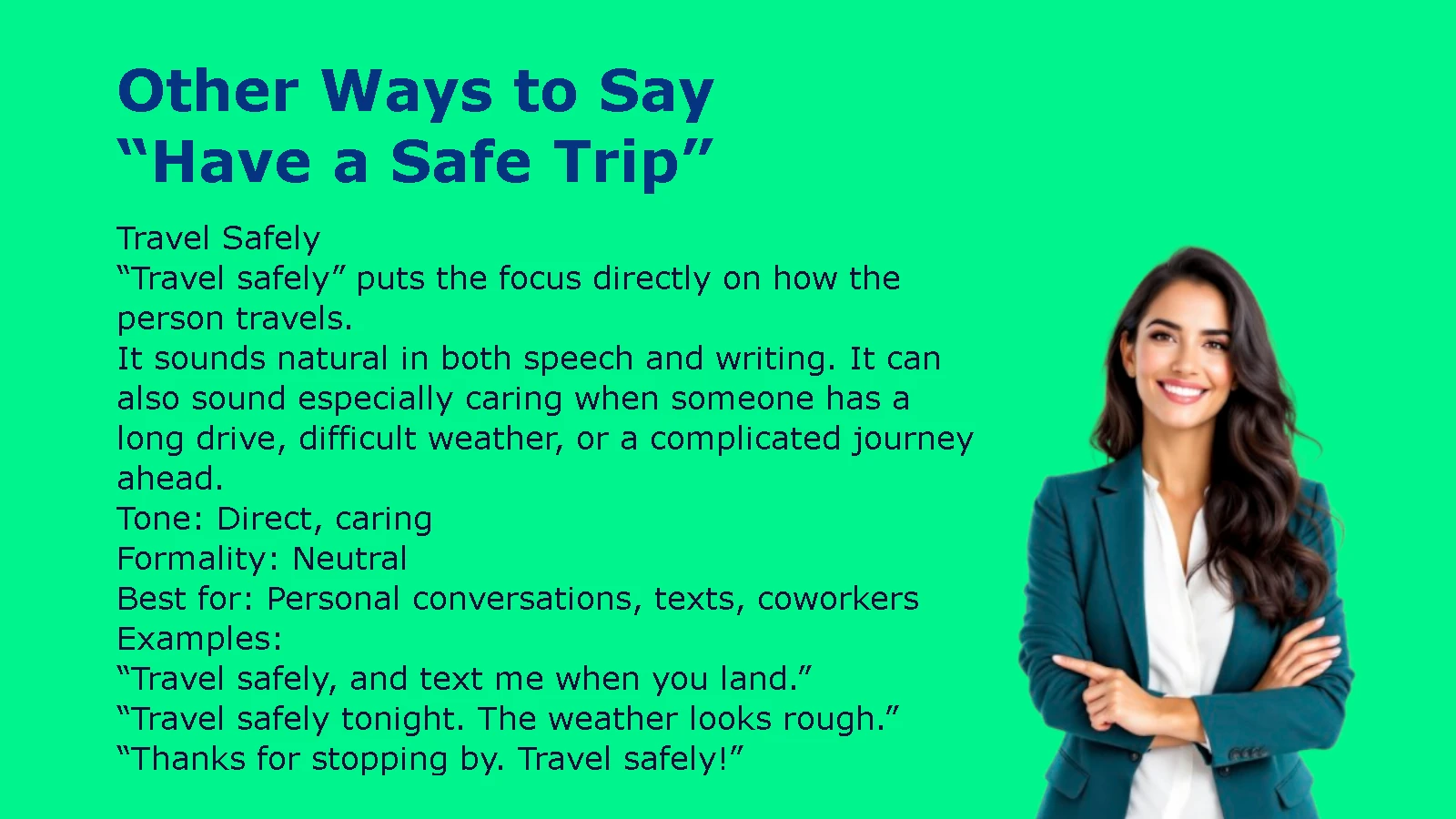
Travel Safely
“Travel safely” puts the focus directly on how the person travels.
It sounds natural in both speech and writing. It can also sound especially caring when someone has a long drive, difficult weather, or a complicated journey ahead.
Tone: Direct, caring
Formality: Neutral
Best for: Personal conversations, texts, coworkers
Examples:
- “Travel safely, and text me when you land.”
- “Travel safely tonight. The weather looks rough.”
- “Thanks for stopping by. Travel safely!”
Have a Safe Journey
“Have a safe journey” carries almost the same meaning as the original phrase.
The main difference is journey. In American English, “trip” often sounds more everyday and conversational. “Journey” can feel slightly more formal, thoughtful, or literary.
Tone: Warm, thoughtful
Formality: Moderate
Best for: Long trips, formal messages, family farewells
Examples:
- “Have a safe journey home.”
- “I hope you have a safe journey.”
- “Have a safe journey and enjoy your time abroad.”
Have a Smooth Trip
“Have a smooth trip” wishes someone an easy journey with as few problems as possible.
The word smooth changes the emphasis. Instead of focusing only on physical safety, you’re wishing for easy connections, manageable traffic, good weather, and an overall hassle-free experience.
Examples:
- “Have a smooth trip to Denver!”
- “I hope you have a smooth trip and an easy flight.”
- “Have a smooth trip home. Call me when you arrive.”
Wishing You Safe Travels
This version sounds a little more polished than simply saying “Safe travels.”
It’s especially useful in writing because it fits naturally into professional emails, cards, business messages, and farewell notes.
Examples:
“Wishing you safe travels and a successful conference.”
“Wishing you safe travels home. It was great working with you.”
Get There Safely
“Get there safely” feels personal and direct.
You aren’t merely wishing the person a pleasant trip. You’re expressing concern about their arrival.
It’s particularly natural with close friends and family.
Examples:
- “Get there safely and call me when you arrive.”
- “Take your time and get there safely.”
- “Get there safely! I’ll see you tomorrow.”
Take Care on Your Trip
“Take care” adds a personal touch to a basic travel wish.
The phrase doesn’t specifically mean “have a safe trip,” but in a travel context it clearly communicates concern for the person’s well-being.
Examples:
- “Take care on your trip and enjoy the vacation.”
- “Take care out there and let me know when you arrive.”
- “Have fun, and take care!”
Have a Safe Flight
For air travel, specificity usually makes a message sound more natural.
“Have a safe flight” works especially well when someone is heading to the airport or boarding a plane.
Examples:
- “Have a safe flight to Seattle!”
- “Have a safe flight. Text me when you land.”
- “Thanks for visiting. Have a safe flight home.”
Have a Smooth Flight
If you want to focus on comfort and convenience rather than safety alone, use “Have a smooth flight.”
It works well when someone has a long flight, several connections, or a stressful travel schedule.
Example:
“Have a smooth flight and an easy connection in Atlanta.”
Have a Safe Drive
For someone traveling by car, “have a safe drive” is more specific than the general phrase.
It’s useful before a commute, road trip, or long drive.
Examples:
- “Have a safe drive home.”
- “Have a safe drive tonight.”
- “Thanks for coming over. Have a safe drive!”
Drive Safely
“Drive safely” is one of the most natural options when someone is behind the wheel.
It works particularly well when road conditions matter.
Examples:
- “Drive safely! The roads are wet.”
- “It’s getting late, so drive safely.”
- “Drive safely and text me when you’re home.”
Travel Safe
“Travel safe” is common in casual American speech and texting.
Traditionally, “safely” is the adverbial form. However, informal expressions such as “drive safe” and “travel safe” are widely heard and understood in everyday conversation.
For a formal email, “travel safely” is the safer stylistic choice.
Have a Pleasant Trip
“Have a pleasant trip” sounds polite and somewhat more formal than “have a good trip.”
It works particularly well when you don’t know someone very well or when you’re writing professional correspondence.
Examples:
- “Have a pleasant trip to New York.”
- “We hope you have a pleasant journey home.”
- “Have a pleasant trip, and we look forward to seeing you again.”
Enjoy Your Trip
“Enjoy your trip” is related to “have a safe trip,” but the two aren’t exact synonyms.
The difference matters.
“Have a safe trip” emphasizes safety.
“Enjoy your trip” emphasizes pleasure and experience.
Use it when someone is going on vacation, visiting an exciting destination, or taking a leisure trip.
Example:
“Enjoy your trip to Italy! I can’t wait to see your pictures.”
Enjoy the Journey
This phrase sounds warmer and slightly more reflective.
It’s particularly effective when the journey itself matters, such as a long road trip, train journey, or extended adventure.
Example:
“Enjoy the journey and make some great memories along the way.”
Wishing You a Safe and Smooth Trip
This phrase combines two useful ideas: safety and convenience.
It’s an excellent choice when you want to sound thoughtful without becoming overly sentimental.
Example:
“Wishing you a safe and smooth trip to London. I hope everything goes well.”
Wishing You a Safe Journey Home
Use this when someone is returning home.
The added “home” makes the message more personal and specific.
Examples:
- “Wishing you a safe journey home.”
- “It was wonderful seeing you. Have a safe journey home.”
- “Wishing you a safe journey home and an easy flight.”
Have a Safe Trip Home
This is one of the most natural variations when someone has finished visiting you.
Example:
“Thanks for coming by. Have a safe trip home!”
Take Care and Get There Safely
For close friends and family, this combination sounds caring without becoming overly dramatic.
Example:
“Take care and get there safely. Give me a call when you arrive.”
Take Care on the Road
Use this for drivers and road travelers.
It can sound especially appropriate when someone is driving at night or during poor weather.
Example:
“Take care on the road tonight. Give me a call when you get home.”
Hope You Have a Smooth Trip
This sounds conversational and friendly.
Example:
“Hope you have a smooth trip and don’t run into any delays.”
Hope You Get There Safely
This is particularly natural in texts and personal conversations.
Example:
“Hope you get there safely! Let me know when you arrive.”
Have a Wonderful and Safe Trip
This combines warmth, enthusiasm, and concern.
It works well for vacations and important journeys.
Example:
“Have a wonderful and safe trip to Hawaii!”
Have a Great Trip and Travel Safely
This phrase balances enjoyment and safety.
It’s useful when someone is taking a vacation but you still want to express genuine concern.
Example:
“Have a great trip and travel safely. Can’t wait to hear about it!”
Safe Journey
“Safe journey” is concise and understandable, although “safe travels” or “have a safe trip” often sounds more conversational in everyday American English.
Example:
“Safe journey home!”
Wishing You a Safe Journey
This is a polished written alternative.
It works particularly well in cards, professional emails, and messages where you want a respectful tone.
Example:
“Wishing you a safe journey and a successful week ahead.”
Bon Voyage
“Bon voyage” is a French expression traditionally used as a farewell to someone who is traveling.
English speakers commonly recognize it, and it can add a playful, stylish, or slightly dramatic touch.
However, don’t treat it as a perfect synonym for “have a safe trip.” Its emphasis is closer to “have a good journey” or a cheerful travel farewell.
Example:
“Bon voyage! Bring back some good stories.”
Safe Passage
“Safe passage” is more formal and less common in ordinary American conversation.
It can work in serious, literary, historical, or ceremonial contexts. It usually sounds too formal for a quick text to a friend.
Example:
“Wishing you safe passage on your journey.”
Journey Well
“Journey well” has a poetic quality, but it’s not a standard everyday American farewell.
Use it when you deliberately want a more literary or heartfelt tone.
Example:
“Journey well, and I hope the road brings you some wonderful memories.”
Have a Good Trip
This phrase deserves a place on the list because it’s extremely natural, even though it doesn’t specifically emphasize safety.
“Have a good trip” focuses more on the person’s overall experience.
Example:
“Have a good trip to Miami! Enjoy the beach.”
Professional Ways to Say “Have a Safe Trip”
Professional travel messages don’t need complicated language. In fact, simple phrases usually sound more confident and natural.
Good choices include:
- Wishing you safe travels.
- Have a safe and pleasant journey.
- Wishing you a smooth trip.
- Have a safe trip and a successful meeting.
- I hope you have a smooth journey.
- Safe travels, and we look forward to seeing you next week.
How to Say “Have a Safe Trip” to a Coworker
For coworkers, you can stay friendly without becoming too personal.
Examples:
“Safe travels! See you when you’re back.”
“Have a smooth trip to Chicago. Good luck with the conference.”
“Wishing you safe travels and a productive week.”
How to Say It to Your Boss
With a manager or boss, choose something polite and straightforward.
Examples:
“Wishing you safe travels to Boston.”
“Have a safe trip, and I hope the conference goes well.”
“Have a smooth journey. We’ll see you when you get back.”
There’s no need to make the message excessively formal. “Have a safe trip” itself is perfectly appropriate in a professional setting.
How to Say It to a Client or Customer
For customers and clients, slightly polished wording works well.
Examples:
“Wishing you safe travels and a pleasant stay.”
“Have a safe journey home. It was a pleasure meeting with you.”
“We hope you have a smooth and enjoyable trip.”
Casual Ways to Say “Have a Safe Trip”
With friends, siblings, and close acquaintances, shorter phrases usually feel more natural.
Try:
- Safe travels!
- Travel safe!
- Drive safe!
- Get there safely!
- Have a safe one!
- Take care out there!
- Have a smooth trip!
- Text me when you get there!
- Have fun and stay safe!
- Take care and enjoy the trip!
A casual message doesn’t need to sound like a greeting card.
“Safe travels! Send pics.”
can feel more natural than:
“I sincerely wish you a safe and pleasant journey.”
Context does the heavy lifting.
Warm and Caring Ways to Say “Have a Safe Trip”
Sometimes you aren’t looking for a more sophisticated synonym. You simply want your message to show more care.
Try:
- Take care and get there safely.
- Please travel safely.
- Let me know when you arrive.
- Text me when you land.
- Take care on the road.
- I hope you have a smooth trip.
- Have a safe trip home.
- Stay safe and enjoy yourself.
- Get there safely, okay?
Notice that “Text me when you land” isn’t technically a synonym for “have a safe trip.” Yet it often communicates the same underlying concern.
That’s useful in real conversations. Sometimes the most natural way to show you care is to mention what you want the person to do rather than repeat a standard farewell.
Short Ways to Say “Have a Safe Trip” in a Text
When you’re texting, brevity usually wins.
Very short
- Safe travels!
- Travel safe!
- Drive safe!
- Safe trip!
- Have a safe flight!
- Get there safely!
- Take care!
Slightly warmer
- Safe travels! Text me when you land.
- Have a safe trip! Have fun!
- Drive safely and let me know when you’re home.
- Have a smooth trip!
- Stay safe and enjoy the trip!
For a close friend, you can make the message even more personal:
“Safe travels! Don’t forget to send me pics 😂”
The point isn’t to sound impressive. It’s to sound like you actually know the person.
Travel-Specific Alternatives to “Have a Safe Trip”
The best phrase often depends on the method of travel.
For a Flight
Use:
- Have a safe flight.
- Have a smooth flight.
- Safe travels!
- Enjoy the flight.
- Have a pleasant flight.
- Text me when you land.
Example:
“Have a smooth flight to Denver. Text me when you land!”
For a Road Trip
Use:
- Drive safely.
- Have a safe drive.
- Take care on the road.
- Get there safely.
- Travel safe.
- Have a great road trip!
Example:
“Drive safely tonight. The weather looks rough.”
For a Long Journey
Choose something that acknowledges the length of the trip:
- Have a safe journey.
- Wishing you a smooth journey.
- Travel safely.
- Take care along the way.
- Wishing you safe travels.
For Someone Returning Home
The word home adds emotional context.
Try:
- Have a safe trip home.
- Have a safe journey home.
- Get home safely.
- Safe travels home.
- Wishing you a safe journey home.
Example:
“It was great seeing you. Have a safe trip home!”
For International Travel
For international trips, you can combine safety with excitement:
- Safe travels abroad!
- Have a safe and enjoyable trip.
- Wishing you a smooth journey overseas.
- Enjoy your trip and stay safe.
- Have a wonderful trip!
“Have a Safe Trip” vs. Similar Phrases
Not every travel-related expression means exactly the same thing. Knowing the difference helps you choose the phrase that actually fits.
| Phrase | Main Focus | Tone | Best Context |
| Have a safe trip | Safety | Neutral | Almost any situation |
| Safe travels | Safety | Warm, neutral | Almost anyone |
| Travel safely | Safe behavior | Direct | Personal or professional |
| Have a good trip | Enjoyment | Cheerful | Vacations, leisure |
| Have a smooth trip | Ease | Warm | Flights, business travel |
| Enjoy your trip | Fun | Upbeat | Vacations |
| Take care | General well-being | Caring | Friends, family |
| Bon voyage | Travel farewell | Playful/stylish | Informal or celebratory |
| Drive safely | Road safety | Direct | Drivers |
| Have a safe flight | Flight safety | Friendly | Air travel |
“Have a Safe Trip” vs. “Safe Travels”
These are very close in meaning.
“Have a safe trip” sounds like a complete sentence.
“Safe travels” is shorter and works especially well as a farewell.
Both are natural.
“Have a Safe Trip” vs. “Travel Safely”
The difference is subtle.
“Have a safe trip” describes the desired experience.
“Travel safely” focuses more directly on the act of traveling.
Both work in everyday conversation.
“Have a Safe Trip” vs. “Have a Good Trip”
The key difference is the adjective.
Safe = you want the person to avoid harm or trouble.
Good = you want the person to enjoy the overall experience.
If your friend is flying to a beach vacation, either works. If they’re driving through a snowstorm, “Drive safely” makes more sense.
“Have a Safe Trip” vs. “Have a Smooth Trip”
A smooth trip doesn’t necessarily mean a safe trip.
It suggests that you hope everything goes easily:
- no major delays
- easy connections
- light traffic
- comfortable travel
- no unexpected problems
That’s why the two expressions can work nicely together:
“Have a safe and smooth trip!”
“Have a Safe Trip” vs. “Enjoy Your Trip”
These expressions serve different purposes.
Use “enjoy your trip” when the main idea is pleasure.
Use “have a safe trip” when safety is the main concern.
You can also combine them:
“Enjoy your trip and stay safe!”
Is “Have a Safe Trip” Professional and Correct?
Yes. “Have a safe trip” is natural, polite, and grammatically correct.
You can use it with:
- a boss
- a coworker
- a client
- a customer
- a friend
- a family member
- a business partner
- someone you barely know
There’s no grammatical problem with the expression.
The choice between it and another phrase usually comes down to tone and context, not correctness.
For a client, you might write:
“Wishing you safe travels and a successful conference.”
For a close friend, you might text:
“Safe travels! Text me when you land.”
For someone driving home:
“Drive safely!”
All three communicate goodwill. They simply fit different situations.
How Native American English Speakers Use These Phrases
Small usage differences matter when you’re trying to sound natural.
“Safe Travels”
This is highly versatile in American English. It works in casual and professional contexts and is common in both speech and writing.
“Travel Safely”
This sounds direct and natural.
It’s particularly useful when you want to make safety the central idea.
“Travel Safe”
You may hear “travel safe” in casual American conversation and texting.
Traditional grammar favors “travel safely” because safely functions as the adverb modifying travel. However, informal English often uses safe in these constructions.
The same pattern appears in:
“Drive safe.”
You may hear it constantly even though “drive safely” is the traditional grammatical form.
For a professional email, choose “travel safely.” For a casual text, “travel safe” can sound perfectly natural.
“Drive Safely”
This is a particularly useful phrase because it directly matches the travel method.
If someone is driving, there’s little reason to use a vague phrase when you can say exactly what you mean.
“Have a Safe Journey”
This is perfectly understandable in American English, although “have a safe trip” tends to sound more everyday.
“Journey” can feel more formal, thoughtful, or literary depending on context.
“Bon Voyage”
English speakers recognize this phrase, but it has more personality than “safe travels.”
It can sound playful, elegant, or slightly theatrical. That’s part of its appeal.
Natural Examples for Real-Life Situations
Workplace Conversation
“Have a safe trip to Chicago. Good luck with the presentation.”
“Safe travels! See you when you’re back.”
“Have a smooth flight. I hope the conference goes well.”
Professional Email
“Wishing you safe travels and a successful conference.”
“Have a safe and pleasant journey home. It was a pleasure meeting with you.”
“I hope you have a smooth trip and an enjoyable stay.”
Customer or Client Message
“Thank you for visiting us. We hope you have a safe journey home.”
“Wishing you safe travels and a pleasant stay.”
Text Message
“Safe travels! ❤️”
“Have a safe flight. Text me when you land.”
“Drive safe! Let me know when you’re home.”
“Have fun and stay safe!”
Phone Call
“All right, I’ll let you go. Have a safe trip!”
“Take care and get there safely.”
Friend Leaving for Vacation
“Have an amazing trip! Safe travels!”
“Enjoy the vacation and stay safe.”
“Safe travels! Don’t forget to send pictures.”
Family Member Driving Home
“Drive safely. Call me when you get home.”
“Have a safe trip home!”
Someone You Love
“Take care and get there safely. Text me when you land.”
“Have a safe trip, love. I can’t wait to hear from you.”
The most effective personal messages often add one specific detail. Mentioning the destination, flight, road trip, or arrival makes the message feel less automatic.
Which Alternative Should You Use?
If you’re stuck between several choices, use this quick guide:
| Situation | Best Choice | Why |
| General farewell | Safe travels! | Versatile and natural |
| Friend | Safe travels! | Warm without being formal |
| Family | Take care and get there safely. | Personal and caring |
| Coworker | Have a safe trip. | Neutral and natural |
| Boss | Wishing you safe travels. | Polished and respectful |
| Client | Wishing you a safe and pleasant journey. | Professional |
| Partner | Have a safe trip. Text me when you land. | Caring and personal |
| Road trip | Drive safely! | Specific and natural |
| Flight | Have a safe flight! | Matches the situation |
| Text | Safe travels! | Short and effortless |
| Formal email | Wishing you safe travels. | Professional |
| Return home | Have a safe trip home. | Specific |
| Long journey | Have a safe journey. | Thoughtful |
| Vacation | Enjoy your trip and stay safe. | Combines fun and care |
| Difficult weather | Travel safely. | Direct and appropriate |
FAQ About Other Ways to Say “Have a Safe Trip”
What is another way to say “Have a safe trip”?
The closest alternatives are “Safe travels,” “Travel safely,” “Have a safe journey,” and “Wishing you safe travels.” For specific situations, you can say “Have a safe flight” or “Drive safely.”
What is a professional way to say “Have a safe trip”?
“Wishing you safe travels” is an excellent professional alternative. You can also use “Have a safe and pleasant journey” or “Wishing you a smooth and successful trip.”
How do you say “Have a safe trip” casually?
For casual conversations, try “Safe travels,” “Travel safe,” “Drive safe,” “Get there safely,” or “Take care!” A text such as “Safe travels! Text me when you land” sounds natural and friendly.
Is “Safe travels” the same as “Have a safe trip”?
Yes, they communicate essentially the same basic wish. “Safe travels” is shorter and works particularly well as a farewell in both casual and professional settings.
Is “Travel safe” or “Travel safely” correct?
“Travel safely” follows traditional standard grammar because safely is the adverb. However, “travel safe” is common informal American English, especially in speech and texts.
What can I say instead of “Have a safe trip” in an email?
For a professional email, consider:
- “Wishing you safe travels.”
- “Have a safe and pleasant journey.”
- “Wishing you a smooth trip.”
- “I hope you have a safe journey home.”
Choose the phrase based on how formal your relationship is.
How do you say “Have a safe trip” to a coworker?
“Safe travels!” is an easy choice. You can also say “Have a smooth trip” or “Have a safe trip to the conference.”
How do you say “Have a safe trip” to a friend?
Keep it relaxed:
“Safe travels!”
“Have a safe trip! Text me when you get there.”
“Have fun and stay safe!”
What is a sweet way to say “Have a safe trip”?
“Take care and get there safely” sounds warm and sincere. If you’re close to the person, adding something like “Text me when you arrive” makes the message more personal.
What can I say to someone before a flight?
Use “Have a safe flight,” “Have a smooth flight,” “Safe travels,” or “Text me when you land.” The last option isn’t a direct synonym, but it naturally communicates care.
Final Takeaway
There isn’t one perfect replacement for “have a safe trip.” The best phrase depends on the person, the journey, and the tone you want.
For an everyday all-purpose option, choose “Safe travels.” For a professional email, “Wishing you safe travels” sounds polished without becoming stiff. If someone is flying, “Have a safe flight” is more specific. For a road trip, “Drive safely” fits naturally. And when you’re speaking to someone close to you, “Take care and get there safely” adds a warmer touch.
The biggest lesson is simple: don’t choose an alternative just because it sounds different. Choose one that matches the situation. A two-word “Safe travels!” can be perfect for a coworker, while a heartfelt “Text me when you get there” may say more to a close friend.
That small shift from generic wording to context-aware language is what makes a travel farewell sound natural rather than copied from a phrase list.













