Looking for other ways to say “Have a Good Day”? You have plenty of natural options, but the best phrase depends on who you are speaking to, how well you know them, and whether you are writing an email, sending a text, talking to a customer, or ending an everyday conversation.
Some alternatives are simple and universally appropriate, such as “Have a great day” and “Enjoy your day.” Others are more casual, like “Have a good one,” while phrases such as “Wishing you a pleasant day” sound more formal.
The key is not to replace “Have a good day” with a random synonym. Instead, choose an expression that matches the tone, relationship, situation, and communication channel.
| Alternative | Tone | Formality | Best For |
| Have a great day | Friendly | Neutral | Almost any situation |
| Enjoy your day | Polite | Neutral | Customers, coworkers, everyday conversations |
| Have a good one | Casual | Informal | Friends and coworkers |
| Have a wonderful day | Warm | Neutral | Friends, customers, professional conversations |
| Enjoy the rest of your day | Polite | Neutral | Work and afternoon conversations |
| Hope you have a great day | Warm | Neutral | Friends, coworkers, emails |
| Take care | Caring | Neutral | Friends, family, coworkers |
| Wishing you a great day | Warm | Slightly formal | Emails and professional messages |
| Have a pleasant day | Formal | Formal | Customer service and formal communication |
| Hope your day goes well | Caring | Neutral | Someone with a busy day ahead |
What Is Another Way to Say “Have a Good Day”?
Some of the most natural alternatives to “Have a Good Day” are:
- Have a great day.
- Enjoy your day.
- Have a good one.
- Have a wonderful day.
- Enjoy the rest of your day.
- Hope you have a great day.
- Hope your day goes well.
- Wishing you a great day.
- Have a pleasant day.
- Take care.
- Have an amazing day.
- Have a fantastic day.
“Have a good day” itself is perfectly natural. You do not need to replace it because it is incorrect or outdated. The reason to choose an alternative is usually variety or tone.
For example, “Have a great day” sounds slightly more enthusiastic, while “Take care” feels more personal. “Enjoy the rest of your day” works particularly well when it is already afternoon.
30 Natural Alternatives to “Have a Good Day”
The following phrases cover everyday, professional, casual, warm, and situation-specific uses. Not every expression is an exact synonym, so the explanations point out where the meaning or tone changes.
Have a Great Day
“Have a great day” is probably the closest everyday alternative to “Have a good day.”
The word great adds a little more enthusiasm without making the expression overly emotional. That makes it suitable for strangers, coworkers, customers, friends, and acquaintances.
Best for:
- Everyday conversations
- Customer service
- Coworkers
- Professional emails
- Friends
- Phone calls
Examples:
“Thanks for stopping by. Have a great day!”
“I’ll send the report this afternoon. Have a great day.”
If you need one replacement that works in almost any ordinary situation, this is a strong choice.
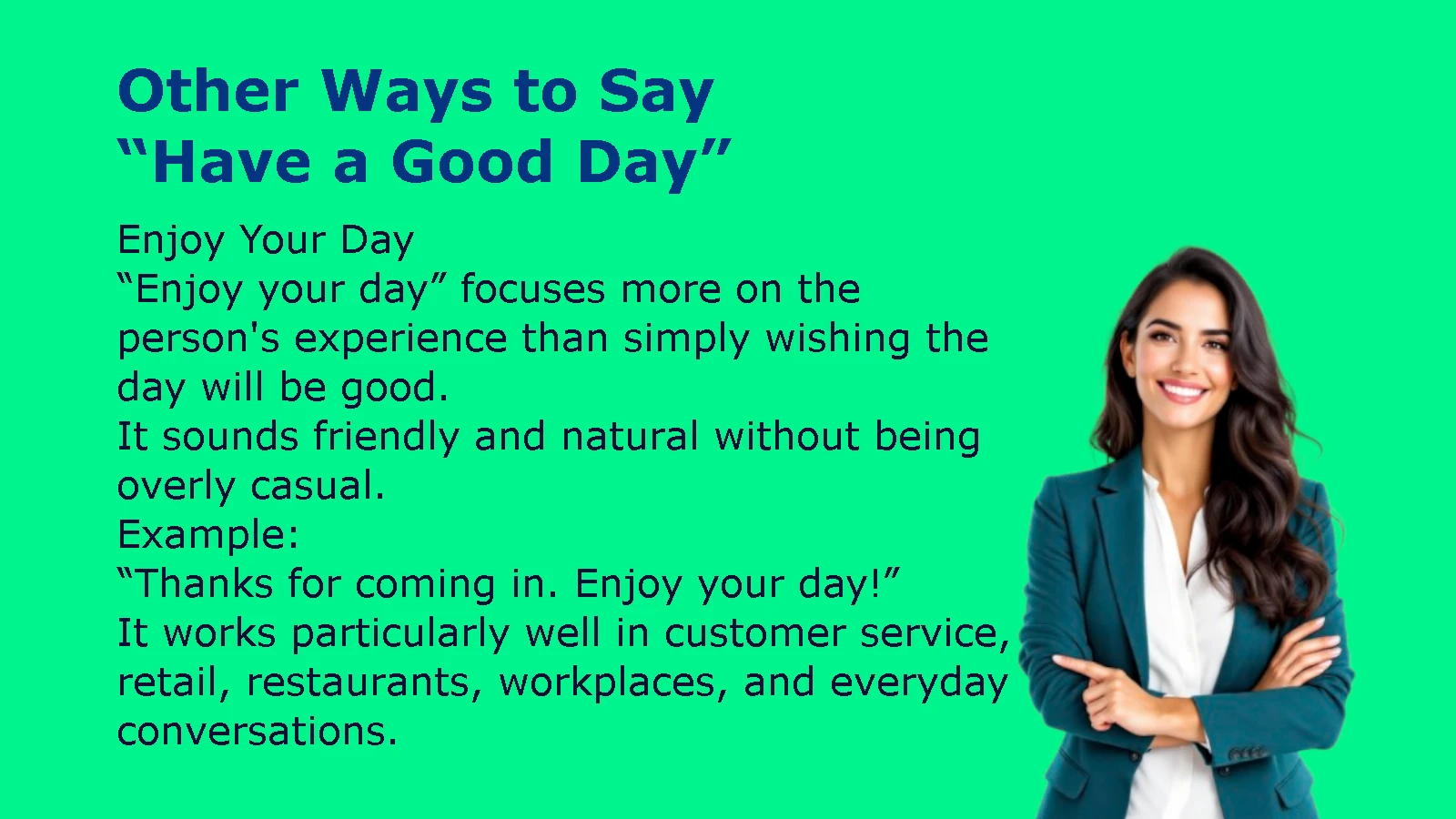
Enjoy Your Day
“Enjoy your day” focuses more on the person’s experience than simply wishing the day will be good.
It sounds friendly and natural without being overly casual.
Example:
“Thanks for coming in. Enjoy your day!”
It works particularly well in customer service, retail, restaurants, workplaces, and everyday conversations.
Have a Good One
“Have a good one” is a casual American English alternative to “Have a good day.”
The word one refers implicitly to the day or the period ahead. It is shorter and more relaxed than the original phrase.
Examples:
“Thanks for your help. Have a good one!”
“See you tomorrow. Have a good one.”
Use it freely with friends and familiar coworkers. It may be too casual for a highly formal business letter.
Have a Wonderful Day
“Have a wonderful day” sounds warmer and more enthusiastic than “Have a good day.”
It works especially well when you want your closing to feel genuinely positive.
Examples:
“It was wonderful speaking with you. Have a wonderful day!”
“Thank you for your patience. Have a wonderful day.”
It can work with customers, clients, coworkers, friends, and acquaintances.
Enjoy the Rest of Your Day
This is one of the most useful alternatives when you are speaking to someone after the day has already started.
For example, if you talk to someone at 2 p.m., “Enjoy the rest of your day” can sound more contextually appropriate than simply “Have a good day.”
Examples:
“Thanks for meeting with me. Enjoy the rest of your day.”
“I’ve sent the documents over. Enjoy the rest of your day.”
This phrase is especially natural in professional communication and customer service.
Hope You Have a Great Day
Adding “hope” makes the expression sound slightly more conversational and personal.
Compare:
“Have a great day!”
with:
“Hope you have a great day!”
The second version feels more like a personal good wish than a standard farewell.
It works well in texts, emails, workplace messages, and conversations with friends.
Hope Your Day Goes Well
“Hope your day goes well” is especially useful when you know someone has something important, stressful, or demanding ahead.
For example:
“Good luck with your presentation. Hope your day goes well!”
The phrase acknowledges the person’s circumstances rather than offering a generic farewell.
Have a Lovely Day
“Have a lovely day” is warm and pleasant, although it can sound somewhat more characteristic of British English than everyday American English.
In American English, it is still understandable and perfectly acceptable, but “Have a great day” is usually the more ordinary choice.
Example:
“It was nice talking with you. Have a lovely day.”
Have a Fantastic Day
It works well when the conversation is already upbeat.
Example:
“Congratulations on the promotion! Have a fantastic day!”
It may sound excessive in a very formal or serious interaction.
Have an Amazing Day
This is another enthusiastic alternative.
It is particularly common in friendly conversations, texts, social interactions, and upbeat customer-service settings.
Example:
“Thanks for coming by. Have an amazing day!”
For formal business communication, however, “Have a great day” or “Enjoy the rest of your day” usually sounds more restrained.
Wishing You a Great Day
“Wishing you a great day” has a slightly more polished, written quality than “Have a great day.”
That makes it useful in emails, messages, cards, and professional communication.
Example:
“Thank you for getting back to me. Wishing you a great day.”
It sounds warm without being excessively formal.
Wishing You a Wonderful Day
This expression adds warmth and sincerity.
It works well when you want your message to feel more thoughtful than a routine closing.
Example:
“Thank you for your continued support. Wishing you a wonderful day.”
Have a Pleasant Day
“Have a pleasant day” is more formal than “Have a good day.”
It can work well in customer service, formal correspondence, reception settings, and professional situations where you want to sound courteous.
Example:
“Thank you for contacting our office. Have a pleasant day.”
However, it can sound somewhat stiff in a casual conversation with a close friend.
I Hope You Have a Great Day
This longer form feels more conversational and personal.
Example:
“Thanks again for your help. I hope you have a great day.”
It is particularly useful in emails when you want a friendly closing without sounding too casual.
I Hope You Have a Wonderful Day
This is warmer than the previous version.
It can work in personal messages as well as professional communication where a friendly tone is appropriate.
Example:
“It was a pleasure speaking with you. I hope you have a wonderful day.”
Hope You Enjoy Your Day
This expression focuses on enjoyment rather than simply wishing someone well.
Example:
“You’ve got some fun plans today. Hope you enjoy your day!”
It is particularly natural when the person has something enjoyable planned.
Have a Great Rest of Your Day
This is a highly practical workplace phrase.
It sounds natural after a meeting, phone call, or customer interaction that happens in the middle of the day.
Example:
“Thanks for your time today. Have a great rest of your day.”
Have a Wonderful Afternoon
When you know it is afternoon, a time-specific expression can sound more thoughtful.
Example:
“I’ll send you the updated file shortly. Have a wonderful afternoon.”
It works well in professional and everyday communication.
Enjoy Your Afternoon
This is shorter and more conversational.
Example:
“Thanks for stopping by. Enjoy your afternoon!”
It is particularly useful in workplaces, stores, restaurants, and customer-service interactions.
Enjoy Your Evening
This becomes more natural toward the end of the workday.
Example:
“Thanks for coming in. Enjoy your evening!”
It is a natural choice when you are saying goodbye after work or later in the day.
Hope Your Day Is Going Well
This expression is different because it can be used during an ongoing conversation, not just when saying goodbye.
For example:
“I hope your day is going well. I wanted to follow up about the meeting.”
It is useful in emails, texts, and professional messages.
Make the Most of Your Day
This phrase is more motivational than “Have a good day.”
It encourages the person to use the day well rather than simply wishing them a pleasant experience.
Example:
“You’ve got a lot planned today. Make the most of your day!”
It works better with friends, family, and encouraging messages than with formal customer-service communication.
Have a Beautiful Day
“Have a beautiful day” is warm and expressive.
It is more personal than the neutral “Have a good day,” so it works especially well with friends, family, or someone you care about.
Example:
“Thanks for always being there. Have a beautiful day!”
Hope Today Treats You Well
This is a more creative alternative.
It does not literally mean “have a good day,” but it communicates a similar positive wish.
Example:
“Good luck with everything today. Hope today treats you well.”
It is best for personal messages rather than highly formal business communication.
Take Care
“Take care” is one of the most common alternatives people use when ending conversations, but it is important to understand the difference.
It does not specifically wish someone a good day. Instead, it expresses a general wish for their well-being and safety.
Example:
“Thanks for catching up. Take care!”
Use it with friends, family, acquaintances, and familiar coworkers.
Stay Safe
“Stay safe” is even more context-dependent.
It makes sense when safety is relevant, such as when someone is traveling, driving in bad weather, working late, or heading into a potentially difficult situation.
Example:
“The roads are getting icy. Stay safe!”
It would be strange to use it as a universal replacement for “Have a good day.”
Take It Easy
“Take it easy” is relaxed and informal.
It can imply that you hope someone gets a chance to relax.
Example:
“It’s been a long week. Take it easy this weekend.”
It is best suited to friends and familiar coworkers rather than clients or formal business contacts.
Professional Ways to Say “Have a Good Day”
Professional communication does not always require extremely formal language. In fact, overly formal expressions can sound unnatural in everyday workplace communication.
The goal is to be polite, clear, and appropriate to the relationship.
Current professional-focused examples commonly recommend expressions such as “Enjoy the rest of your day,” “Wishing you a great day,” “Have a productive day,” and “Wishing you a pleasant day.”
Professional Alternatives
| Phrase | Formality | Warmth | Best Use |
| Have a great day | Medium | High | General workplace |
| Enjoy the rest of your day | Medium | Medium | Emails and meetings |
| Wishing you a great day | Medium | High | Professional emails |
| Have a pleasant day | High | Medium | Formal customer communication |
| Wishing you a productive day | Medium | Medium | Work-focused messages |
| Hope your day goes well | Medium | High | Coworkers and clients |
| Have a wonderful day | Medium | High | Warm professional relationships |
Have a Great Day at Work
You can make a professional phrase more specific when you know the recipient’s situation.
“I hope the meeting goes well. Have a great day at work!”
This is more personal than simply repeating a generic farewell.
Wishing You a Productive Day
This works especially well when the conversation concerns work, deadlines, meetings, or projects.
“I’ve attached the final report. Wishing you a productive day.”
It would sound less natural in a personal text because “productive” has a distinctly work-oriented tone.
Wishing You a Pleasant Day
This is a polished alternative for formal correspondence.
“Thank you for contacting our office. Wishing you a pleasant day.”
It is courteous, but it can sound more formal than ordinary American workplace speech.
Ways to Say “Have a Good Day” to a Coworker
Your relationship with a coworker determines how casual you can be.
For someone you rarely interact with:
“Have a great day.”
For a familiar teammate:
“Have a good one!”
For someone dealing with a busy schedule:
“Hope the rest of your day goes smoothly.”
For someone you have just finished a meeting with:
“Great talking with you. Enjoy the rest of your day.”
The important distinction is that professional does not mean cold.
A coworker you have known for years may find “Wishing you a pleasant day” unnecessarily formal, while “Have a good one” may be perfectly natural.
Ways to Say “Have a Good Day” to Your Boss or Manager
When speaking to a manager, choose something respectful without sounding stiff.
Good options include:
- Have a great day.
- Enjoy the rest of your day.
- Hope you have a great afternoon.
- Have a wonderful day.
- Hope the rest of your day goes well.
For example:
“Thanks for reviewing the proposal. Have a great day.”
This is simple, professional, and natural.
You generally do not need an elaborate phrase just because someone is your boss.
Ways to Say “Have a Good Day” to a Customer or Client
Customer-facing language should usually be warm but neutral.
Strong choices include:
- Have a great day.
- Enjoy the rest of your day.
- Have a wonderful day.
- We appreciate your business. Have a great day.
- Thank you for your time. Enjoy the rest of your day.
For example:
“Thank you for contacting our support team. We’re glad we could help. Enjoy the rest of your day!”
This works because it combines appreciation with a natural farewell.
Casual Ways to Say “Have a Good Day”
Casual conversations give you more freedom.
Try:
- Have a good one!
- Have a great one!
- Have a great day!
- Take care!
- Take it easy!
- Have an awesome day!
- Enjoy!
- Have fun!
- Hope today is a good one!
“Have a Good One” vs. “Have a Good Day”
These expressions are extremely close in everyday meaning.
Have a good day is neutral.
Have a good one is more casual and conversational.
Compare:
“Thank you for contacting our office. Have a good day.”
with:
“Thanks for your help. Have a good one!”
The second sounds more relaxed.
Short Alternatives for Texting
Text messages usually benefit from brevity.
Instead of typing the full phrase every time, you can use:
- Have a great day!
- Have a good one!
- Enjoy!
- Take care!
- Stay safe!
- Have fun!
- Have an awesome day!
- Enjoy the rest of your day!
- Hope you have a great day!
Texting Examples
Friend:
“Good luck at work today! Have a great one 😊”
Coworker:
“Thanks for sending that over. Have a good one!”
Family member:
“Hope everything goes well today. Take care!”
Someone traveling:
“Have fun and stay safe!”
Notice that the best choice depends on the situation. “Stay safe” makes sense for travel, while “Have fun” works when someone is going somewhere enjoyable.
Ways to Say “Have a Good Day” in an Email
Email requires slightly more thought because the closing contributes to the overall tone.
Professional Email
“Thank you for your time today. I appreciate your help. Have a great day.”
Warm Professional Email
“Thanks again for your quick response. Enjoy the rest of your day.”
Friendly Coworker Email
“Thanks for taking care of that. Have a good one!”
Client Email
“Thank you for your continued partnership. Wishing you a wonderful day.”
Afternoon Email
“I’ve attached the revised document. Enjoy the rest of your afternoon.”
The strongest approach is to connect the closing to the message rather than adding a completely unrelated phrase.
Ways to Say “Have a Good Day” to Friends and Family
Personal relationships give you room to be warmer and more expressive.
To a Friend
- Have a great day!
- Have a good one!
- Take care!
- Have an awesome day!
- Hope today treats you well!
- Enjoy your day!
Example:
“Good luck with the interview! Hope today treats you well.”
To a Family Member
- Have a great day!
- Take care!
- Stay safe!
- Hope you have a wonderful day!
- Enjoy your day!
Example:
“Drive safely and have a great day!”
To Someone You Love
You can make the expression more personal:
- Have a beautiful day, love.
- Hope you have an amazing day.
- Have the best day!
- I hope today is wonderful for you.
- Hope today treats you well.
- Have a great day, sweetheart.
The important point is relationship and authenticity. A romantic expression should sound like something you would actually say to that person.
Cute and Romantic Ways to Say “Have a Good Day”
A romantic message can add affection without becoming overly dramatic.
Try:
“Hope you have an amazing day, love.”
“Have a beautiful day. You deserve it.”
“Go have a wonderful day, and don’t work too hard.”
“Hope today gives you plenty of reasons to smile.”
“Have the best day!”
These are not formal substitutes for “Have a good day.” They are relationship-specific variations.
Cheerful and Positive Alternatives
If you want your message to feel more energetic, use stronger adjectives or a more encouraging construction.
Examples include:
- Have an amazing day!
- Have a fantastic day!
- Have an awesome day!
- Make the most of your day!
- Hope today is a great one!
- Have a beautiful day!
- Hope today treats you well!
Use these when the surrounding conversation already has an upbeat tone.
For example:
“Congratulations on the new job! Have an amazing day!”
would sound natural.
By contrast:
“Thank you for submitting your tax documents. Have an amazing day!”
could sound unnecessarily enthusiastic in some professional contexts.
Funny and Playful Alternatives
Humor can work with close friends and informal coworkers, but it should not be confused with a standard replacement for “Have a good day.”
Examples:
- Go make today a good one!
- Have a ridiculously good day!
- Go enjoy yourself!
- Make today count!
- Go have some fun!
- Try not to have too much fun without me!
A playful phrase should fit the existing relationship.
For example:
“I’m heading out. Go make today a good one!”
works naturally between friends.
A phrase such as:
“Have a ridiculously good day!”
would be inappropriate in a formal customer-service email.
“Have a Good Day” vs. Similar Phrases
Many alternatives look interchangeable but carry slightly different meanings.
Have a Good Day vs. Have a Great Day
Both are natural.
Have a great day is simply more enthusiastic.
- Good = neutral positive
- Great = stronger positive
For most everyday situations, either one works.
Have a Good Day vs. Have a Good One
The meaning is nearly identical, but “Have a good one” is more casual.
Use “Have a good one” when the conversation already has an informal tone.
Have a Good Day vs. Enjoy Your Day
“Have a good day” expresses a wish for the day to be good.
“Enjoy your day” focuses on the person’s experience and enjoyment.
That makes “Enjoy your day” especially natural when someone has leisure time or enjoyable plans.
Have a Good Day vs. Take Care
These are not exact synonyms.
Have a good day = I hope your day is good.
Take care = I hope you stay well or safe.
“Take care” therefore feels somewhat more personal.
Have a Good Day vs. Have a Wonderful Day
“Have a wonderful day” has more warmth and enthusiasm.
It can be a better choice when you want to sound especially positive.
Have a Good Day vs. Enjoy the Rest of Your Day
The key difference is time.
“Have a good day” works throughout the day.
“Enjoy the rest of your day” specifically refers to the portion of the day that remains.
Which Alternative Should You Use?
If you’re unsure, use the situation as your guide.
| Situation | Best Choice | Why |
| Everyday conversation | Have a great day | Natural and versatile |
| Professional email | Enjoy the rest of your day | Polite without sounding stiff |
| Boss or manager | Have a great day | Respectful and natural |
| Coworker | Have a good one | Friendly and casual |
| Customer | Have a great day | Warm and professional |
| Client | Wishing you a great day | Polished and friendly |
| Friend | Have a good one | Casual |
| Family | Take care | Caring |
| Romantic partner | Hope you have an amazing day | Warm and personal |
| Text message | Have a great day! | Short and natural |
| Formal correspondence | Wishing you a pleasant day | More formal |
| Busy coworker | Hope your day goes smoothly | Context-specific |
| Traveler | Stay safe | Safety-focused |
| Someone with fun plans | Enjoy your day | Situation-specific |
The best alternative is not necessarily the fanciest one. Natural and appropriate beats impressive.
Is “Have a Good Day” Still Natural?
Yes.
There is nothing grammatically wrong or outdated about “Have a good day.” It remains a standard, polite English expression used in everyday conversations, customer interactions, emails, and workplace communication. Current language-reference articles also describe it as a common and generally appropriate phrase.
You should not feel that you need to replace it every time.
The purpose of alternatives is mainly to help you:
- Avoid repetition
- Match the tone
- Sound warmer
- Sound more casual
- Sound more professional
- Make a message more specific
- Adapt to the time of day
- Reflect your relationship with the listener
Sometimes “Have a good day” is actually the best choice because it is simple, neutral, and universally understood.
How Americans Actually Use These Expressions
American English favors relatively simple, conversational expressions in everyday interactions.
“Have a Good Day”
Neutral and widely appropriate.
“Have a Great Day”
Very common and slightly more enthusiastic.
“Have a Good One”
Casual and conversational.
“Enjoy Your Day”
Friendly and straightforward.
“Enjoy the Rest of Your Day”
Especially natural when the day is already underway.
“Take Care”
Friendly and somewhat more personal.
“Take It Easy”
Informal and relaxed.
One important lesson is that native speakers do not always choose the most formal phrase available. They usually choose something that fits the social situation.
For example, a coworker might say:
“All right, I’m heading out. Have a good one.”
That sounds completely natural.
The same coworker might sound unusually formal if they said:
“I wish you a pleasant remainder of the day.”
The second sentence is understandable, but it is not the way most people would normally speak.
Common Mistakes When Choosing an Alternative
Treating Every Goodbye as a Synonym
“See you later,” “Catch you later,” and “Peace out” can end a conversation, but they do not literally wish someone a good day.
That distinction matters.
A strong alternative should either express a positive wish for the person’s day or perform that function naturally in context.
Using Casual Expressions in Formal Emails
Expressions such as:
- Have a good one
- Take it easy
- Catch you later
- Later!
can be perfectly natural with friends but may be inappropriate for a formal client email.
Making Every Message More Enthusiastic
“Have an amazing day!” is not automatically better than “Have a good day.”
If the situation is formal, serious, or routine, a neutral expression may sound more professional.
Using “Take Care” as an Exact Replacement
“Take care” is related but not identical.
It focuses on well-being rather than the quality of someone’s day.
Ignoring the Time of Day
If it is 4 p.m., “Enjoy the rest of your day” may sound more natural than “Have a good day.”
If it is evening, “Enjoy your evening” can be even more appropriate.
Practical Examples by Situation
Workplace Conversation
Before:
“Thanks for helping me with this. Have a good day.”
Alternative:
“Thanks for helping me with this. Enjoy the rest of your day.”
The second version sounds especially natural if the workday is already underway.
Customer Service
Before:
“Thank you for contacting us. Have a good day.”
Alternative:
“Thank you for contacting us. We’re glad we could help. Have a great day!”
Adding a brief acknowledgment makes the closing feel less automated.
Email to a Coworker
“Thanks for sending the figures over. I’ll review them this afternoon. Have a good one!”
This is casual but still perfectly appropriate for a familiar coworker.
Email to a Client
“Thank you for your time today. I appreciate the opportunity to discuss the project. Wishing you a great day.”
The phrase is warmer while maintaining professional boundaries.
Text to a Friend
“Good luck with everything today! Have a great one!”
Short, natural, and friendly.
Message to Someone You Love
“Hope everything goes well today. Have an amazing day, love!”
The wording is more personal because the relationship allows it.
Someone Heading Into a Busy Day
“You’ve got a lot on your plate today. Hope your day goes smoothly.”
This is more thoughtful than a generic farewell because it responds directly to the person’s circumstances.
Frequently Asked Questions
What is another way to say “Have a Good Day”?
Natural alternatives include “Have a great day,” “Enjoy your day,” “Have a good one,” “Have a wonderful day,” “Enjoy the rest of your day,” and “Hope you have a great day.” The best option depends on your relationship with the person and the tone you want.
What is the most natural alternative to “Have a Good Day”?
“Have a great day” is one of the most natural alternatives because it works in casual, professional, customer-service, and everyday situations without sounding unusual.
What is a professional way to say “Have a Good Day”?
Try “Enjoy the rest of your day,” “Wishing you a great day,” “Have a pleasant day,” or “Wishing you a productive day.” For ordinary workplace communication, “Have a great day” is also completely professional.
How do you say “Have a Good Day” casually?
You can say “Have a good one,” “Have a great one,” “Take care,” “Take it easy,” or simply “Have a great day!” “Have a good one” is especially common in casual American English.
What can I say instead of “Have a Good Day” in an email?
For a professional email, try “Enjoy the rest of your day,” “Wishing you a great day,” “I hope you have a wonderful day,” or “Wishing you a pleasant day.” Choose the phrase based on how formal your relationship is.
What is a warm way to say “Have a Good Day”?
Warm alternatives include “Have a wonderful day,” “Hope you have a great day,” “Hope your day goes well,” “Have a beautiful day,” and “Hope today treats you well.”
Is “Have a Good One” the same as “Have a Good Day”?
They are very similar in everyday conversation. “Have a good one” usually refers to the day or the period ahead, but it sounds more casual and conversational than “Have a good day.”
Is “Enjoy Your Day” a good alternative to “Have a Good Day”?
Yes. “Enjoy your day” is natural and polite. It is especially useful when someone has plans or is about to spend time doing something enjoyable.
How do you say “Have a Good Day” to a customer?
Use a warm but neutral expression such as “Have a great day,” “Enjoy the rest of your day,” or “Have a wonderful day.” These phrases are friendly without becoming overly familiar.
How do you say “Have a Good Day” to a coworker?
For a general workplace relationship, “Have a great day” is an easy choice. With a coworker you know well, “Have a good one” sounds more relaxed and conversational.
What is a cute way to say “Have a Good Day”?
For someone close to you, try “Have a beautiful day,” “Hope you have an amazing day,” “Have the best day,” or “Hope today gives you plenty of reasons to smile.”
Is “Take Care” the same as “Have a Good Day”?
Not exactly. “Take care” is a general expression of concern for someone’s well-being, while “Have a good day” specifically wishes them a pleasant day. They can both work as friendly conversation closings, but their meanings are slightly different.
Conclusion
There are many other ways to say “Have a Good Day,” but the best alternative depends on the situation.
For most everyday situations, “Have a great day” is the easiest replacement. If you want something casual, try “Have a good one.” For professional communication, “Enjoy the rest of your day” or “Wishing you a great day” can sound polished without becoming stiff.
If you want to sound warmer, use “Have a wonderful day” or “Hope your day goes well.” When talking to someone close to you, “Take care,” “Have a beautiful day,” or a more personal message may fit better.
Most importantly, remember that “Have a good day” is already perfectly natural. You do not need to replace it simply because you have used it before. The goal is to choose words that fit the relationship, setting, and tone.
The right phrase is usually the one that sounds natural, sincere, and appropriate for the person you’re speaking to.













