Other ways to say “I don’t mind” help you express agreement, flexibility, or a lack of preference without repeating the same phrase. Whether you’re chatting with a friend, replying to a coworker, writing a professional email, or answering a polite question, the right expression can make your meaning clearer.
Common alternatives include “It’s fine with me,” “Either works for me,” “I have no preference,” and “I’m amenable to that.” However, these phrases don’t all mean exactly the same thing. Some show friendly acceptance, others communicate neutrality, and a few sound more formal or reserved. Understanding these differences will help you choose words that fit the situation.
What Does “I Don’t Mind” Mean?
“I don’t mind” means that something doesn’t bother you, that you have no objection to it, or that you feel comfortable accepting a particular choice. People use it to show flexibility, respond to suggestions, and let others know that a decision is acceptable. The exact meaning depends on the situation and the speaker’s tone.
The Main Meanings of “I Don’t Mind”
The phrase has three common meanings.
1. Expressing acceptance
You use “I don’t mind” when someone suggests something that you’re willing to accept.
Example:
“Would you mind if we moved the meeting to Friday?”
“I don’t mind. Friday works for me.”
The response tells the other person that the change is acceptable.
2. Showing that you have no preference
You can also use the phrase when two or more choices seem equally suitable.
Example:
“Would you rather eat at home or go to a restaurant?”
“I don’t mind. Either option is fine.”
Here, you’re allowing the other person to choose because you don’t strongly prefer one option.
3. Saying that something doesn’t bother you
Sometimes, the phrase means that an activity or situation causes you no inconvenience.
Example:
“Do you mind waiting for another ten minutes?”
“No, I don’t mind waiting.”
This response means that waiting is acceptable to you.
“I Don’t Mind” in Everyday Conversation
People commonly use the phrase when making plans, discussing preferences, or responding to requests.
Here are a few natural examples:
- “Do you mind opening the window?” — “Not at all.”
- “Would you like tea or coffee?” — “I don’t mind either way.”
- “Can we meet a little later?” — “That’s fine with me.”
- “Do you mind if I borrow your pen?” — “Go ahead.”
- “Would you mind helping me with this?” — “Sure, no problem.”
Notice that the best response changes with the question. “Go ahead” grants permission, while “That’s fine with me” accepts a suggestion. Both can communicate a similar attitude without being interchangeable in every situation.
Is “I Don’t Mind” Positive, Neutral, or Negative?
“I don’t mind” is usually neutral or mildly positive. It communicates acceptance without necessarily showing excitement. However, your tone and the surrounding conversation can change how people interpret it.
Compare these responses:
- Neutral: “I don’t mind which movie we watch.”
- Positive: “I’d be happy to watch either movie.”
- Reluctant: “I don’t mind, I guess.”
The first response shows flexibility. The second sounds more enthusiastic. The third may suggest that the speaker has reservations.
If you want to sound genuinely interested, use “That sounds great” or “I’d love to.” If you simply want to communicate that a choice is acceptable, “I don’t mind” works well.
35+ Other Ways to Say “I Don’t Mind”
The best alternative depends on whether you want to sound casual, professional, polite, enthusiastic, or neutral. The expressions below cover everyday conversations, workplace communication, and situations where you want to avoid sounding indifferent.
Common and Casual Alternatives to “I Don’t Mind”
These phrases work well with friends, family members, classmates, and coworkers you know well.
1. It’s fine with me
Use this phrase to accept a suggestion without making a big deal out of it.
Example: “We can order pizza tonight if that’s fine with everyone.”
Response: “It’s fine with me. Let’s do that.”
2. I’m okay with that
This expression communicates acceptance in a relaxed, conversational way.
Example: “Would you be okay with starting at nine instead of eight?”
“I’m okay with that.”
3. That’s fine by me
This phrase means that a proposed plan or decision is acceptable to you.
Example: “We’ll take the earlier train.”
“That’s fine by me.”
4. Works for me
Use this short, natural expression when a plan or suggestion suits your schedule or preferences.
Example: “Let’s meet outside the library at noon.”
“Works for me!”
5. No problem
This phrase is especially useful when someone asks for permission, help, or flexibility.
Example: “Could you send me the notes tomorrow?”
“No problem. I’ll send them in the morning.”
6. That’s all right with me
This expression communicates acceptance without sounding overly formal.
Example: “We may need to postpone the call until Thursday.”
“That’s all right with me.”
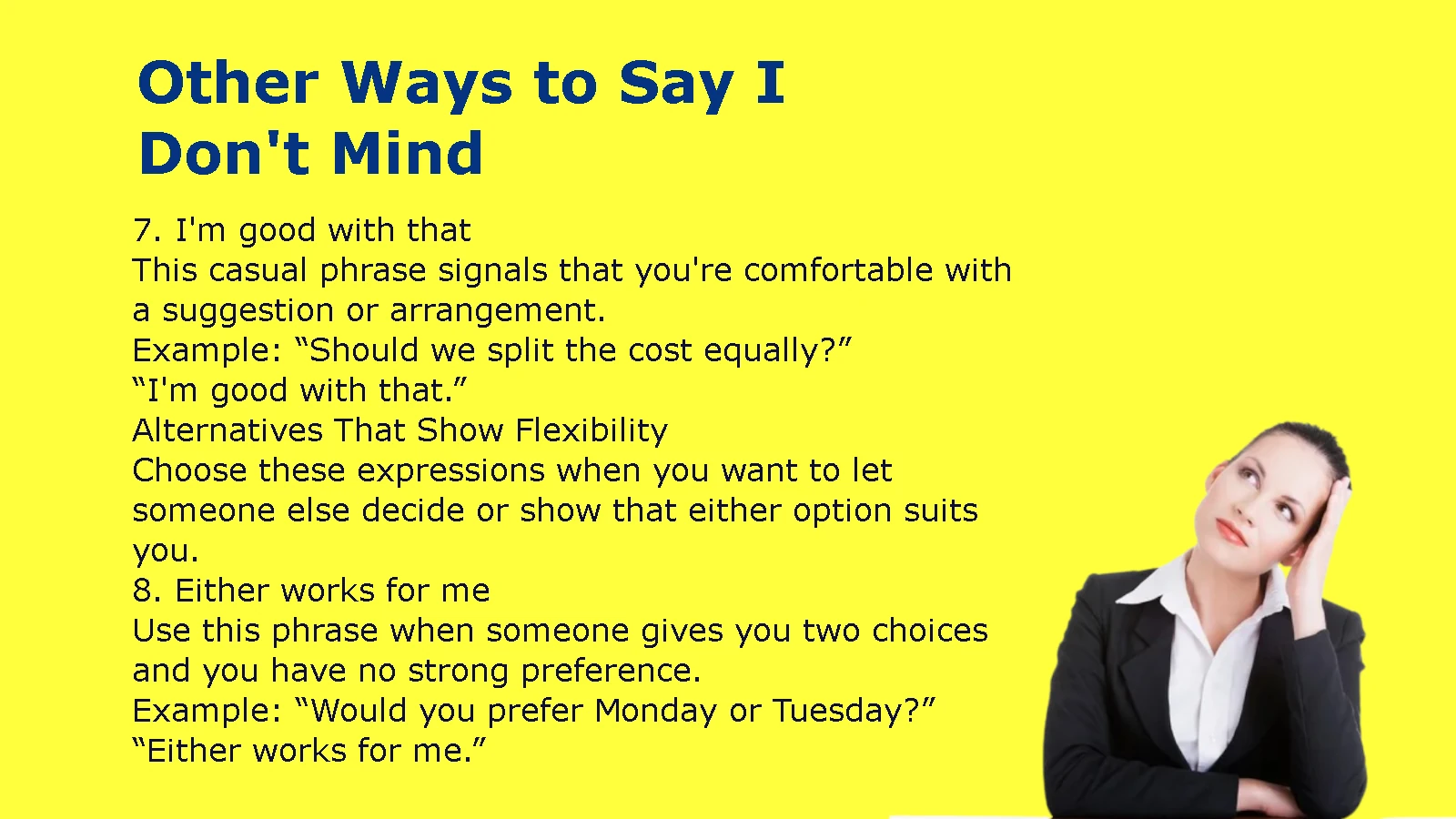
7. I’m good with that
This casual phrase signals that you’re comfortable with a suggestion or arrangement.
Example: “Should we split the cost equally?”
“I’m good with that.”
Alternatives That Show Flexibility
Choose these expressions when you want to let someone else decide or show that either option suits you.
8. Either works for me
Use this phrase when someone gives you two choices and you have no strong preference.
Example: “Would you prefer Monday or Tuesday?”
“Either works for me.”
9. I’m happy either way
This expression sounds friendly and reassuring. It tells the other person that they don’t need to worry about choosing the option you prefer.
Example: “We can celebrate at home or go out for dinner.”
“I’m happy either way. Whatever you prefer is fine.”
10. I don’t have a preference
This is a clear way to explain that you don’t favor one option over another.
Example: “Do you want the blue folder or the black one?”
“I don’t have a preference.”
11. Whatever works best for you
Use this phrase when you want the other person to choose the most convenient option for them.
Example: “I can call you this afternoon or tomorrow morning.”
“Whatever works best for you.”
12. I’m flexible
This phrase suggests that you’re willing to adjust your plans or preferences.
Example: “What time should we schedule the interview?”
“I’m flexible, so any time after lunch is fine.”
13. Both options suit me
This expression works well when two choices meet your needs.
Example: “Would you like to attend the morning session or the afternoon one?”
“Both options suit me.”
14. I could go either way
This phrase means that you’re undecided or equally comfortable with the available choices.
Example: “Are you in the mood for a comedy or a thriller?”
“I could go either way.”
It can sound slightly less committed than “I’m happy either way,” so use it when you genuinely have no strong preference.
Alternatives That Show Acceptance or Agreement
These expressions emphasize that you accept a suggestion, proposal, or arrangement.
15. I have no objection
This phrase communicates that you don’t oppose a particular action or decision. It often sounds more formal than “I don’t mind.”
Example: “Would you object to sharing the presentation with another team?”
“I have no objection to that.”
16. That sounds fine
Use this phrase to acknowledge a suggestion and indicate that you’re comfortable with it.
Example: “I’ll send the revised document by the end of the day.”
“That sounds fine.”
17. I’m fine with either option
This expression makes your lack of preference clear.
Example: “Would you like the standard package or the premium one?”
“I’m fine with either option, provided both include the features we discussed.”
18. I can go along with that
This phrase means that you’re willing to accept a proposal or plan. Depending on your tone, it can suggest agreement without strong enthusiasm.
Example: “The team wants to move the deadline to Wednesday.”
“I can go along with that.”
19. That works just as well
Use this expression when an alternative is as suitable as the original choice.
Example: “We could meet at the café instead of the office.”
“That works just as well.”
20. I’m comfortable with that
This phrase emphasizes that you have no concerns about a decision or arrangement.
Example: “Would you be comfortable with us sharing the draft with the client?”
“Yes, I’m comfortable with that.”
21. I have no issue with it
This expression communicates that you see no problem with a suggestion.
Example: “The designer wants to change the color scheme.”
“I have no issue with it, as long as the new design remains readable.”
It sounds natural in everyday workplace conversations, though “I have no objection” may suit formal writing better.
Polite Alternatives to “I Don’t Mind”
These phrases are useful when you want to sound considerate or respond to a request without creating unnecessary tension.
22. That’s perfectly fine
This expression reassures someone that their suggestion or request is acceptable.
Example: “I’m sorry, but I’ll be five minutes late.”
“That’s perfectly fine. Take your time.”
23. Please feel free
Use this phrase to give someone permission or encourage them to act without hesitation.
Example: “May I contact you if I have more questions?”
“Please feel free to contact me.”
Unlike “I don’t mind,” this expression actively invites the other person to proceed.
24. I wouldn’t mind
This phrase indicates that you would be willing to do something or that you would welcome a particular possibility.
Example: “Would you like to take a short walk after lunch?”
“I wouldn’t mind.”
Depending on the context, it can sound more open to an idea than the neutral “I don’t mind.”
25. Not at all
This is a common response when someone asks whether an action bothers you.
Example: “Do you mind if I sit here?”
“Not at all. Go ahead.”
Be careful with the question’s wording. In response to “Do you mind if I sit here?”, “Not at all” means that you don’t object.
26. Go ahead
Use this expression when you want to grant permission.
Example: “Would you mind if I used your charger?”
“Go ahead.”
It works best when the other person asks whether they may do something. It doesn’t always replace “I don’t mind” when you’re discussing preferences.
27. By all means
This phrase gives permission in a polite, sometimes formal or enthusiastic way.
Example: “May I ask a follow-up question?”
“By all means.”
It sounds more deliberate than “Sure” or “No problem,” making it useful in professional conversations.
Alternatives for Expressing Indifference
These expressions help when you genuinely don’t care which option someone chooses. Some sound more neutral than others.
28. It makes no difference to me
This phrase means that the available options are equally acceptable from your perspective.
Example: “Should we use the blue template or the green one?”
“It makes no difference to me. Choose whichever fits the presentation.”
29. I don’t feel strongly either way
Use this expression when you have an opinion but don’t feel strongly about it.
Example: “What do you think about moving the event outdoors?”
“I don’t feel strongly either way, but we should check the weather.”
30. I’m neutral on that
This expression communicates that you don’t favor or oppose a particular choice.
Example: “What’s your position on changing the meeting format?”
“I’m neutral on that. Both formats could work.”
31. It’s all the same to me
This means that you consider the available options equally acceptable. However, your tone can make it sound dismissive.
Example: “Would you like to watch the first movie or the sequel?”
“It’s all the same to me.”
If you want to sound warmer, say, “I’m happy with either one.”
32. I’m not particular
This phrase suggests that you don’t have strict preferences about something.
Example: “Do you prefer a window seat or an aisle seat?”
“I’m not particular.”
It often works well when discussing food, seating, or other everyday choices.
Formal Synonyms for “I Don’t Mind”
Formal alternatives help you communicate acceptance or flexibility in professional emails, business meetings, academic discussions, and official correspondence. The best choice depends on whether you’re approving a proposal, expressing no preference, or showing willingness to cooperate.
33. I have no objection to that
Use this phrase when you want to communicate that you don’t oppose a proposal.
Example:
“Would you object to extending the review period by two days?”
“I have no objection to that change.”
The phrase sounds professional and measured. However, it can also sound reserved because it communicates the absence of opposition rather than active enthusiasm.
34. That would be acceptable
This expression confirms that a proposal meets your requirements.
Example:
“Could we move the consultation to Thursday afternoon?”
“Yes, that would be acceptable.”
Use it when you’re evaluating whether an arrangement works. In friendly workplace communication, “Thursday afternoon works for me” may sound warmer.
35. I’m amenable to that
“Amenable” means willing to agree, cooperate, or consider a proposal favorably.
Example:
“Would you consider adjusting the project timeline?”
“I’m amenable to that, provided we can maintain the quality standards.”
This phrase suits professional discussions and negotiations. It communicates openness without promising unconditional agreement.
36. I would be comfortable with that arrangement
Use this expression when you want to confirm that a proposed arrangement raises no concerns.
Example:
“If we divide the presentation into two sections, would that work for you?”
“I would be comfortable with that arrangement.”
This phrase sounds thoughtful and professional, especially when discussing responsibilities, schedules, or procedures.
Discover other ways to say I don’t mind, including formal synonyms, casual alternatives, meanings, and examples for everyday conversations.. I have no preference
This is a concise way to communicate neutrality between options.
Example:
“Would you prefer to review the report on Tuesday or Wednesday?”
“I have no preference. Either day is suitable.”
It works particularly well in scheduling emails and workplace discussions.
Professional Examples of “I Don’t Mind”
The following examples show how to choose a phrase based on the situation.
| Situation | Less effective response | More suitable alternative |
| A colleague suggests another meeting time | I don’t mind | “That time works for me.” |
| A manager asks about two assignments | Whatever | “I have no preference between the two.” |
| A client requests a small change | I guess that’s fine | “That would be acceptable.” |
| A coworker proposes a new approach | I don’t care | “I’m open to considering that approach.” |
| A teammate needs schedule flexibility | It’s all the same to me | “I’m happy to accommodate your schedule.” |
| A client asks which format you prefer | I don’t mind | “Either format would be suitable.” |
Which Formal Synonym Should You Choose?
Use this quick guide to match the phrase to your intention.
| Expression | Best use | Tone |
| I have no objection | Approving a proposal | Formal, reserved |
| I’m amenable to that | Showing willingness to agree | Formal, cooperative |
| That would be acceptable | Confirming suitability | Formal, neutral |
| I have no preference | Expressing flexibility | Neutral, professional |
| I’m happy to accommodate that | Offering flexibility | Polite, helpful |
| Either option would be suitable | Accepting two alternatives | Formal, precise |
A useful rule is to choose “I have no preference” when you don’t favor one option, “I’m amenable to that” when you’re willing to consider a proposal, and “That would be acceptable” when you want to confirm that an arrangement meets your needs.
Another Way to Say “If You Don’t Mind Me Asking”
“If you don’t mind me asking” is a polite expression used before a question that might feel personal, sensitive, or unexpected. Alternatives such as “May I ask you something?” and “If you’re comfortable sharing” help you ask respectfully while giving the other person room to decline.
Polite Alternatives for Personal Questions
Choose an expression that matches the sensitivity of your question.
May I ask you something?
This is a straightforward and polite way to introduce a question.
Example: “May I ask you something about your career change?”
Would you mind if I asked?
This phrase checks whether the other person is comfortable with your question.
Example: “Would you mind if I asked how you got started in this field?”
If it’s not too personal…
Use this phrase when you recognize that the topic might cross a personal boundary.
Example: “If it’s not too personal, what made you decide to move?”
May I ask a quick question?
This expression works well when you want to ask something brief.
Example: “May I ask a quick question about the schedule?”
If you’re comfortable sharing…
This is especially useful when asking about sensitive experiences or personal circumstances.
Example: “If you’re comfortable sharing, what helped you make that decision?”
Formal Alternatives for Professional Settings
In workplace conversations, you can sound polite without using an overly elaborate introduction.
- “May I ask a question?” — Suitable for meetings and presentations.
- “If you don’t mind my asking…” — A more formal version of the familiar expression.
- “Could I ask you about…?” — Useful for requesting information directly.
- “If you’re willing to share…” — Appropriate when the information may be personal or confidential.
- “Would you be comfortable discussing…?” — Helpful when the topic requires care or discretion.
Examples:
“May I ask a question about the proposed budget?”
“If you don’t mind my asking, what prompted the change in your timeline?”
“Would you be comfortable discussing the challenges you faced during the project?”
Examples of How to Use These Expressions
The following scenarios show how a small wording change can make a question feel more respectful.
Asking about someone’s job
Instead of asking, “What do you earn?” immediately, you could say:
“If you’re comfortable sharing, may I ask about the salary range for that role?”
The introduction recognizes that compensation is personal and gives the other person a chance to decline.
Asking for clarification in a meeting
“Could I ask you to explain how you arrived at that estimate?”
This phrasing is professional and focuses on the information you need.
Asking about a sensitive experience
“If you don’t mind talking about it, what was the biggest challenge you faced?”
This expression acknowledges that the other person may not want to discuss the experience.
How to Ask Politely Without Sounding Intrusive
Polite wording helps, but it doesn’t automatically make every question appropriate.
Follow these guidelines:
- Explain the purpose: Give a brief reason when the question might seem unexpected.
- Respect boundaries: Accept it if the person doesn’t want to answer.
- Avoid unnecessary pressure: Don’t repeat a sensitive question after someone declines.
- Choose direct language: Too many disclaimers can make a simple question feel awkward.
- Match the relationship: A close friend may welcome a casual question that would feel inappropriate from a new coworker.
For example, “If you’re comfortable sharing, what inspired your career change?” sounds considerate. However, if the person declines, a simple “No worries” is better than asking again.
What Is Another Word for “Don’t Mind Either Way”?
Another way to say “I don’t mind either way” is “Either works for me,” “I’m happy with either,” or “I have no preference.” These expressions show that you don’t strongly favor one option. Choose a warmer phrase when you want to reassure someone and a neutral phrase when clarity matters most.
Best Expressions for Having No Preference
Either is fine
A short, natural response when both choices are acceptable.
Example: “Should we meet at the office or the café?”
“Either is fine.”
Either works for me
Use this phrase when both options suit your schedule or needs.
Example: “We can talk on Monday or Tuesday.”
“Either works for me.”
I’m happy with either
This sounds friendly and reassures the other person that they can choose freely.
Example: “Would you like the window seat or the aisle seat?”
“I’m happy with either.”
I don’t mind either way
This is the direct expression of having no strong preference.
Example: “Do you want to order food or cook at home?”
“I don’t mind either way.”
I have no preference
This expression sounds neutral and works well in formal settings.
Example: “Which report format should we use?”
“I have no preference, provided the final version includes the required data.”
I’m indifferent to either option
This phrase communicates neutrality but sounds more formal or analytical. In casual conversation, “I’m happy with either” is usually more natural.
Example: “I’m indifferent to either option, as both meet the project’s requirements.”
“I Don’t Mind Either Way” vs. “I Don’t Care Either Way”
These phrases may seem interchangeable, but they can create different impressions.
| Expression | Typical meaning | Possible impression |
| I don’t mind either way | Both options are acceptable | Flexible, neutral |
| I don’t care either way | Neither option matters much to me | Neutral or dismissive |
| I’m happy with either | Both options are welcome | Friendly, positive |
| I have no preference | I don’t favor one option | Clear, professional |
| Whatever you prefer | The other person can choose | Considerate, flexible |
Imagine that a friend asks where you’d like to eat.
“I don’t mind either way” reassures your friend that you can enjoy either option.
“I don’t care either way” may suggest that you’re uninterested in the decision or the activity itself.
Your tone matters, but “I’m happy with either” is a useful choice when you want to communicate flexibility without sounding indifferent.
Examples Involving Plans and Decisions
Choosing a restaurant
“Would you prefer Italian or Mexican food?”
“I’m happy with either. You choose.”
Picking a meeting time
“Does 10 a.m. or 11 a.m. work better?”
“Either time works for me.”
Deciding between activities
“Should we go hiking or watch a movie?”
“I could go either way. Both sound good.”
Choosing a work format
“Would you prefer a written summary or a short presentation?”
“I have no preference, so use whichever format is more useful for the team.”
Each response communicates flexibility, but the wording also reveals your attitude. “Both sound good” suggests interest, while “I have no preference” focuses on neutrality.
What Does “Amenable” Mean, and Can It Replace “I Don’t Mind”?
Amenable means willing to agree, cooperate, or consider a suggestion favorably. It can replace “I don’t mind” in formal or professional situations when you want to show openness to a proposal. However, it doesn’t simply mean that something doesn’t bother you; it often implies a willingness to cooperate.
The Meaning of “Amenable”
The adjective “amenable” describes someone who is willing to respond positively to a suggestion, request, or proposed arrangement.
For example:
“I’m amenable to changing the meeting time.”
This sentence means that you’re willing to consider or accept the change.
Compare it with:
“I don’t mind changing the meeting time.”
This sentence focuses more on the fact that the change doesn’t bother you.
The difference is subtle but useful. “Amenable” emphasizes willingness to cooperate, while “I don’t mind” emphasizes acceptance or lack of objection.
When to Use “Amenable” Instead of “I Don’t Mind”
Use “amenable” when the situation involves a proposal, negotiation, or potential adjustment.
Workplace arrangements
“The team is amenable to adopting the revised schedule.”
This communicates that the team is open to the proposed arrangement.
Business negotiations
“We’re amenable to discussing alternative payment terms.”
This shows willingness to negotiate without promising agreement to every possible term.
Project changes
“I’m amenable to revising the design if the new version improves usability.”
This communicates openness while identifying a condition.
Scheduling
“I’m amenable to moving the meeting to Thursday.”
This sounds more formal than “Thursday works for me.”
Examples of “Amenable” in Sentences
Here are additional examples showing how the word functions in different contexts.
- “The manager is amenable to flexible working hours.”
- “We’re amenable to reviewing the proposal again.”
- “The client seemed amenable to the revised terms.”
- “I’m amenable to either approach, provided we meet the deadline.”
- “The committee is amenable to considering additional suggestions.”
Notice the common pattern: amenable to + noun or gerund (-ing form).
Correct: “I’m amenable to changing the schedule.”
Incorrect: “I’m amenable to change the schedule.”
You can also use “amenable to” when discussing a person’s willingness to consider an idea or work with others.
“Amenable” vs. “Agreeable” vs. “Flexible”
These words overlap, but each emphasizes something different.
| Word | Meaning | Example |
| Amenable | Willing to agree or cooperate | “I’m amenable to revising the plan.” |
| Agreeable | Pleasant or acceptable; sometimes willing to agree | “The proposed schedule is agreeable.” |
| Flexible | Able to adapt to changes | “I’m flexible about the meeting time.” |
| Accommodating | Willing to help or adjust for others | “She’s accommodating when schedules change.” |
| Receptive | Open to hearing or considering ideas | “The manager is receptive to feedback.” |
Choose “amenable” when discussing willingness to consider a proposal, “flexible” when discussing adaptability, and “accommodating” when emphasizing consideration for other people.
What Does “Please Don’t Mind” Mean?
“Please don’t mind” generally asks someone not to be bothered, offended, or concerned by something. However, the expression can sound unnatural without enough context. Depending on your intention, phrases such as “I hope you don’t mind,” “Please don’t be offended,” or “Please excuse…” may communicate your meaning more clearly.
The Meaning of “Please Don’t Mind”
The phrase asks someone not to take offense or not to let something bother them. Its exact meaning depends on what follows and what the speaker wants the listener to overlook.
For example:
“Please don’t mind the mess. We’re still unpacking.”
Here, the speaker asks the listener not to be bothered by the untidy room.
Another example:
“Please don’t mind my asking, but could you explain that again?”
This sentence attempts to soften a question. However, “If you don’t mind my asking” is generally the more natural expression when introducing a potentially sensitive question.
Is “Please Don’t Mind” Natural English?
The phrase is understandable, but it isn’t the best choice in every situation. English speakers often use a more specific expression to explain what they want the other person to overlook.
| Intended meaning | More natural expression | Example |
| Don’t be bothered by the mess | Please excuse the mess | “Please excuse the mess; we’re renovating.” |
| Don’t take offense | Please don’t be offended | “Please don’t be offended by my question.” |
| I hope my action is acceptable | I hope you don’t mind | “I hope you don’t mind that I opened the window.” |
| Ignore a minor inconvenience | Don’t worry about it | “Don’t worry about the noise.” |
| Ask a personal question politely | If you don’t mind my asking | “If you don’t mind my asking, how long have you worked here?” |
The key is to identify what you want the listener to do. Do you want them to overlook a problem, forgive an inconvenience, or feel comfortable answering a question? The more precisely you express that intention, the more natural your English will sound.
Examples of “Please Don’t Mind” in Conversation
When apologizing for a messy room
Less natural: “Please don’t mind my room.”
More natural: “Please excuse the mess in my room.”
The revised version clearly identifies what the listener should overlook.
When asking someone to overlook a comment
“If my wording sounded harsh, please don’t take it personally.”
This is clearer than a vague request not to mind.
When explaining an inconvenience
“I hope you don’t mind the noise. The workers should finish soon.”
This expression checks whether the inconvenience bothers the listener.
“Please Don’t Mind” vs. “I Hope You Don’t Mind”
These expressions are related but serve different purposes.
“Please don’t mind” asks the listener to disregard something or not be bothered by it.
Example: “Please don’t mind the boxes by the door.”
“I hope you don’t mind” expresses concern that an action or situation might inconvenience the listener.
Example: “I hope you don’t mind that I invited another guest.”
The second expression often sounds more natural when you want to acknowledge the effect of your own action on someone else.
Never Mind Synonyms and the Difference Between “Never Mind” and “I Don’t Mind”
“Never mind” often means “forget what I said,” “don’t worry about it,” or “that isn’t important anymore.” In contrast, “I don’t mind” means that something doesn’t bother you or that you have no objection. Although the phrases share the word “mind,” they perform different functions in conversation.
Common Synonyms for “Never Mind”
Use these alternatives when you want someone to disregard a statement, stop worrying about something, or move on from a minor issue.
Forget it
This can mean that the matter is no longer important. Depending on your tone, it can sound impatient.
Example: “Could you help me find the file? Actually, forget it. I’ve found it.”
Don’t worry about it
Use this expression to reassure someone that a mistake or inconvenience isn’t a problem.
Example: “I’m sorry I forgot to reply.”
“Don’t worry about it.”
It’s nothing
This phrase minimizes the importance of an event or problem.
Example: “Thanks for staying late to help me.”
“It’s nothing. I’m glad I could help.”
No need to bother
Use this expression when someone doesn’t need to take an additional action.
Example: “I can pick up the documents myself. There’s no need to bother.”
Leave it
This phrase asks someone to stop discussing or dealing with something. It can sound abrupt, so use it carefully.
Example: “We don’t need to discuss that issue right now. Let’s leave it.”
Disregard that
This is a more formal way to tell someone to ignore previously shared information.
Example: “Please disregard my previous message. I’ve attached the corrected file.”
It doesn’t matter
This expression means that something isn’t important to the current situation.
Example: “I’m sorry I chose the wrong color.”
“It doesn’t matter. We can exchange it.”
“Never Mind” vs. “I Don’t Mind”
The distinction becomes clearer when you compare complete sentences.
| Expression | Meaning | Example |
| Never mind | Forget or disregard something | “Never mind; I found the answer.” |
| I don’t mind | Something doesn’t bother me | “I don’t mind waiting.” |
| I wouldn’t mind | I’d be willing to do or have something | “I wouldn’t mind taking a break.” |
| Don’t worry about it | A mistake or inconvenience isn’t a problem | “Don’t worry about being late.” |
| It doesn’t matter | The detail isn’t important | “It doesn’t matter which color we use.” |
Consider this exchange:
“Could you bring me a glass of water?”
“Never mind. I’ve got one.”
The speaker no longer needs the water.
Now compare:
“Would you mind bringing me a glass of water?”
“I don’t mind.”
The second speaker is willing to help.
The words look similar, but the meanings differ because “never mind” dismisses or withdraws something, while “I don’t mind” expresses acceptance.
When “Never Mind” Can Sound Rude
“Never mind” isn’t inherently rude, but it can sound dismissive when someone uses it abruptly.
For example:
“Can you explain what you meant?”
“Never mind.”
This reply may suggest frustration or unwillingness to continue.
A softer alternative would be:
“It’s okay. I’ll explain it another time.”
Similarly, “Forget it” can sound impatient when someone feels ignored. If you want to end a discussion politely, try “Let’s leave that for now” or “We can come back to that later.”
“I Don’t Mind” vs. Similar Expressions
Several English phrases communicate acceptance or neutrality, but they differ in tone and intent. Understanding those differences helps you avoid sounding uninterested when you mean to be flexible or sounding overly formal when a simple response would work.
“I Don’t Mind” vs. “I Don’t Care”
“I don’t care” can mean that you have no preference, but it can also suggest that you’re uninterested or unconcerned.
Example:
“Would you like to sit inside or outside?”
“I don’t mind. Either is fine.”
This sounds flexible.
“I don’t care. Choose wherever.”
Depending on your tone, the second response may sound impatient.
Practical tip: Use “I have no preference” when you want to communicate neutrality without risking the dismissive tone of “I don’t care.”
“I Don’t Mind” vs. “It’s Up to You”
“I don’t mind” tells someone that a choice is acceptable to you. “It’s up to you” gives the other person responsibility for making the decision.
Example:
“Should we watch a comedy or a documentary?”
“I don’t mind. Both sound good.”
This communicates that you accept either option.
“It’s up to you.”
This gives the other person the final say, but it doesn’t necessarily reveal whether you like both options.
Use “It’s up to you” when you want someone else to decide. Use “I don’t mind” when you want to express acceptance or a lack of objection.
“I Don’t Mind” vs. “Whatever”
“Whatever” can mean that any option is acceptable, but it often sounds dismissive when spoken without warmth.
Compare these replies:
- “I don’t mind. You can choose.”
- “Whatever.”
The first explicitly communicates flexibility. The second leaves the listener to interpret your attitude.
In casual conversation, “Whatever works for you” usually sounds more considerate than a standalone “Whatever.”
“I Don’t Mind” vs. “I’m Fine With It”
“I’m fine with it” directly communicates that you accept a specific situation or proposal.
Example:
“Would it be okay if we moved your desk closer to the window?”
“I’m fine with it.”
By contrast, “I don’t mind” focuses on the absence of objection.
Both phrases are natural. However, “I’m fine with it” can sound more definite when you want to confirm that a particular arrangement is acceptable.
“I Don’t Mind” vs. “I’m Easy”
In some varieties of English, especially informal British and Australian usage, “I’m easy” means that you’re flexible about a choice.
Example:
“Where shall we go for lunch?”
“I’m easy. Anywhere nearby is fine.”
However, the phrase can have other meanings in different contexts. Some listeners may interpret it differently depending on the conversation.
For a clearer alternative, especially in international or professional communication, use “I’m flexible,” “Either works for me,” or “I have no preference.”
How to Choose the Best Alternative to “I Don’t Mind”
The most suitable expression depends on your audience, your purpose, and the impression you want to create. A short casual reply can work with friends, while professional emails often benefit from more precise wording. Sensitive questions call for language that respects the other person’s boundaries.
For Casual Conversations
Choose phrases that sound natural and relaxed.
Good options include:
- “Works for me.”
- “I’m okay with that.”
- “Either is fine.”
- “I’m happy either way.”
- “No problem.”
- “You choose.”
Example:
Friend: “Should we grab lunch at noon or one?”
You: “Either works for me.”
The reply is brief and friendly. It also answers the question directly.
For Professional Emails
In professional writing, clarity matters more than using impressive vocabulary.
Consider these examples:
Accepting a meeting time
“Thursday afternoon works for me.”
Expressing no preference
“I have no preference between the two proposed times.”
Approving an adjustment
“That would be acceptable. Please send the revised schedule when it’s ready.”
Showing willingness to cooperate
“I’m amenable to the proposed changes, provided we can meet the original deadline.”
These responses tell the recipient exactly what you mean. They also avoid the possibility that “I don’t mind” might sound reluctant or vague.
For Sensitive Conversations
Choose phrases that allow the other person to decide how much they want to share.
Useful expressions include:
- “If you’re comfortable sharing…”
- “If you don’t mind my asking…”
- “May I ask you something?”
- “You don’t have to answer if you’d rather not.”
- “Would you be comfortable discussing this?”
For example:
“If you’re comfortable sharing, I’d like to understand what led to the decision.”
This sentence communicates interest without demanding an answer.
When You Want to Sound Enthusiastic Rather Than Indifferent
Sometimes “I don’t mind” is too neutral. If you actually like an idea, choose a phrase that shows it.
Instead of “I don’t mind going to the concert,” say:
- “That sounds great!”
- “I’d love to.”
- “I’m looking forward to it.”
- “I’d be happy to join.”
- “That works perfectly for me.”
Consider this situation:
A friend invites you to a weekend trip.
“I don’t mind going” sounds as if you’re merely willing to tolerate the trip.
“I’d love to go” clearly communicates enthusiasm.
The difference matters because people often interpret your level of interest from your word choice.
Common Mistakes to Avoid
Using “I don’t care” when you mean “I have no preference”
“I don’t care” can sound dismissive. Use “Either works for me” when both options are acceptable.
Using “never mind” when you mean “I don’t mind”
“Never mind” often tells someone to disregard something. It doesn’t usually communicate that you accept a suggestion.
Using overly formal phrases in casual conversation
“I have no objection to that arrangement” may sound stiff when a friend asks whether you want pizza. “Pizza works for me” is more natural.
Using “I’m amenable” without understanding the meaning
“Amenable” suggests willingness to agree or cooperate. It doesn’t simply mean that you feel indifferent.
Giving a neutral answer when you actually have a preference
If you strongly prefer one option, say so politely. For example, “I’d prefer Tuesday, but Wednesday would also work” communicates both your preference and your flexibility.
A Practical Example: Choosing the Right Phrase at Work
Imagine that a manager asks an employee whether the team can move a project meeting from Tuesday to Wednesday.
The employee has several possible responses.
“I don’t care.”
This may sound uninterested in the meeting.
“Whatever works.”
This is casual but may not communicate much enthusiasm.
“I have no preference. Wednesday works just as well.”
This sounds clear and professional.
“I’m amenable to moving the meeting to Wednesday.”
This sounds formal and communicates willingness to cooperate.
The best choice depends on the workplace culture and the employee’s intention. In most routine work messages, “Wednesday works for me” is direct, polite, and natural.
Frequently Asked Questions
What Is the Best Synonym for “I Don’t Mind”?
“It’s fine with me” is a versatile everyday synonym for “I don’t mind.” You can also say “Either works for me” when choosing between options or “I have no objection” when responding to a proposal. Choose the phrase that matches your intended meaning.
What Is a Formal Way to Say “I Don’t Mind”?
Formal alternatives include “I have no objection,” “I have no preference,” “That would be acceptable,” and “I’m amenable to that.” Use “I have no preference” when you don’t favor either option, and use “I’m amenable to that” when you want to show willingness to consider a proposal.
Does “I Don’t Mind” Mean Yes or No?
“I don’t mind” usually means that something is acceptable or that you have no objection. In response to a request, it often functions as a positive answer. However, it doesn’t necessarily mean you’re enthusiastic. If you want to express clear approval, say “Yes, that works for me.”
What Does “I Don’t Mind Either Way” Mean?
“I don’t mind either way” means that you have no strong preference between the available options. For example, if someone asks whether you’d prefer to meet on Monday or Tuesday, the phrase communicates that both days are acceptable. “Either works for me” is a shorter alternative.
Is “I Don’t Care” the Same as “I Don’t Mind”?
No. “I don’t mind” usually communicates acceptance or a lack of objection, while “I don’t care” can suggest indifference or disinterest. If you want to sound neutral without appearing dismissive, use “I have no preference” or “I’m happy with either option.”
What Is the Difference Between “Never Mind” and “I Don’t Mind”?
“Never mind” usually means to disregard something, stop worrying about it, or forget a previous request. “I don’t mind” means that something doesn’t bother you or that you accept it. For example, “Never mind, I found my keys” differs from “I don’t mind waiting.”
Conclusion: Choose an Alternative That Matches Your Meaning
The best way to replace “I don’t mind” is to decide what you want to communicate. If you want to sound casual, say “Works for me” or “It’s fine with me.” For professional conversations, choose “I have no preference,” “That would be acceptable,” or “I’m amenable to that.” When you want to sound friendly and flexible, “I’m happy either way” is a natural option.
Remember that similar expressions can carry different meanings. “I don’t care” may sound dismissive, “never mind” usually asks someone to disregard something, and “amenable” emphasizes willingness to cooperate. Choosing the right phrase helps you communicate your intention without confusing or offending the listener.













