Other ways to say “as discussed” include as previously discussed, as agreed, following our conversation, as mentioned earlier, and further to our discussion. These phrases help you write clearer professional emails, follow up after meetings, confirm decisions, and refer to previous conversations without repeating the same words.
The best alternative depends on what you want to communicate. Use “as discussed” to refer to an earlier conversation, “as agreed” to confirm a decision, and “following our conversation” to introduce an update or next step. You can also choose more formal expressions for business correspondence or precise verbs for academic essays.
This guide covers professional email synonyms, the meaning of “as discussed,” alternatives for phone calls and meetings, common grammar mistakes, and practical examples you can adapt to your own writing.
What Does As Discussed Mean?
“As discussed” means that you are referring to a topic, idea, plan, or decision that you and another person talked about previously. Writers commonly use this phrase in emails, reports, meeting summaries, and business messages to connect an earlier conversation with the information they are sharing now.
For example:
“As discussed, I have attached the revised project proposal for your review.”
This sentence tells the recipient that the proposal relates to a previous conversation. It also provides context without requiring the writer to explain the entire discussion again.
As Discussed Meaning in Simple Words
The phrase “as discussed” means “as we talked about earlier” or “in reference to our previous conversation.”
It reminds the reader of an earlier exchange and introduces information related to that exchange. The conversation might have happened in person, over the phone, during a meeting, or through another communication channel.
Here are a few examples:
- As discussed, the project deadline is Friday.
- As discussed earlier, I will send you the updated figures.
- As discussed during our meeting, the team will revise the presentation.
- As discussed over the phone, the delivery date has changed.
The phrase does not automatically mean that both people agreed to something. It only refers to what they discussed. If you want to confirm a shared decision, “as agreed” is usually more precise.
What Does As Discussed With You Mean?
“As discussed with you” means that the speaker previously talked about a particular subject with the person receiving the message. The phrase emphasizes that the conversation involved the recipient.
For example:
“As discussed with you yesterday, I have updated the marketing plan.”
This sentence indicates that the writer and recipient talked about the marketing plan the previous day.
However, the wording can sometimes sound unnecessarily formal or repetitive. In most everyday professional emails, “as we discussed” or “as discussed yesterday” sounds more natural.
Compare these examples:
| Phrase | Example | Best use |
| As discussed with you | As discussed with you, the schedule has changed. | Emphasizing a conversation with the recipient |
| As we discussed | As we discussed, the schedule has changed. | Natural professional communication |
| As discussed yesterday | As discussed yesterday, the schedule has changed. | Identifying when the conversation occurred |
| As agreed | As agreed, the schedule will begin Monday. | Confirming a decision |
Choose the version that gives the reader enough context without adding unnecessary words.
Is As Discussed Formal or Informal?
“As discussed” is appropriate for professional communication. You can use it in business emails, client correspondence, meeting summaries, project updates, and formal messages. It also works in everyday workplace conversations.
The phrase is neutral rather than highly formal. It communicates a reference to an earlier discussion without sounding especially casual or ceremonial.
For example, a project manager might write:
“As discussed, the development team will deliver the first draft by Thursday.”
A colleague sending a friendly message might instead write:
“Just following up on our conversation about Friday’s presentation.”
Both sentences work. The first is direct and professional, while the second sounds more conversational.
For academic writing, formal reports, or sensitive business matters, consider whether a more precise expression would communicate your meaning better. “As agreed” identifies a decision, while “as outlined in our meeting” points to information covered during a meeting.
25+ Other Ways to Say As Discussed
The most useful alternatives to “as discussed” depend on whether you are referring to a conversation, confirming an agreement, introducing an update, or documenting a meeting.
The following phrases cover common professional and personal situations.
Professional Alternatives for Business Emails
Use these expressions when communicating with clients, managers, coworkers, suppliers, or business partners.
1. As previously discussed
This is a professional alternative when you want to refer to a conversation that took place earlier.
Example: “As previously discussed, we will launch the new website in November.”
2. As agreed
Use this phrase when both parties have reached a decision or accepted a plan.
Example: “As agreed, I will submit the final report by Friday afternoon.”
3. As we discussed
This expression sounds natural and direct. It works well when you want to remind someone of a conversation without making your email sound overly formal.
Example: “As we discussed, the revised budget includes the additional training costs.”
4. As mentioned earlier
Choose this phrase when you previously stated or explained something. The earlier communication does not necessarily need to involve a discussion.
Example: “As mentioned earlier, the client needs the final presentation before noon.”
5. Following our discussion
This phrase introduces an action, update, or next step resulting from a previous conversation.
Example: “Following our discussion, I have prepared a revised implementation plan.”
6. Further to our discussion
This is a formal business expression often used to introduce information related to an earlier conversation.
Example: “Further to our discussion, please find the updated contract attached.”
7. As outlined in our meeting
Use this wording when referring to specific points, tasks, or decisions covered during a meeting.
Example: “As outlined in our meeting, each department will submit its quarterly figures by Monday.”
8. As previously agreed
This phrase emphasizes an agreement made earlier. It can be useful when confirming deadlines, responsibilities, prices, or project requirements.
Example: “As previously agreed, the final payment is due upon completion.”
9. Per our conversation
This concise expression is common in American business English. It directly connects the current message to a previous conversation.
Example: “Per our conversation, I have updated the delivery schedule.”
10. In reference to our earlier discussion
This formal wording makes the connection to an earlier conversation explicit.
Example: “In reference to our earlier discussion, the proposed changes are ready for review.”
Polite and Friendly Alternatives
These phrases help you refer to an earlier conversation without making your message sound stiff or demanding.
11. Just as we discussed
This phrase works well in friendly workplace communication when the subject is already familiar to both people.
Example: “Just as we discussed, I’ll bring the printed copies to the meeting.”
12. As we talked about
Use this natural expression in informal emails and messages.
Example: “As we talked about, let’s review the new design before sharing it with the client.”
13. Following up on our conversation
This is particularly useful when you want to continue a conversation or check on progress.
Example: “I’m following up on our conversation about the internship opportunity.”
14. To recap our discussion
Choose this phrase when summarizing the main points of a previous conversation.
Example: “To recap our discussion, we need to finalize the budget, confirm the venue, and notify the participants.”
15. As I mentioned earlier
This expression works when you want to refer to information you personally shared.
Example: “As I mentioned earlier, the revised document includes the requested changes.”
Use it carefully if you are reminding someone about something they may have overlooked. Depending on the context, it can sound impatient. A softer alternative is “Just to clarify.”
Formal Alternatives for Reports and Official Communication
For official emails, reports, contracts, and detailed project records, you may need more precise language.
16. In accordance with our discussion
This phrase emphasizes that an action follows what you discussed. It sounds formal and works best when the discussion established a plan or direction.
Example: “In accordance with our discussion, the revised proposal reflects the agreed requirements.”
17. As established during our meeting
Use this phrase when the meeting established a process, position, or decision.
Example: “As established during our meeting, all expense claims must include supporting receipts.”
18. As outlined in our previous conversation
This expression works when you are referring to information or a plan explained earlier.
Example: “As outlined in our previous conversation, the project will proceed in three stages.”
19. Based on our previous conversation
Choose this wording when an earlier discussion influenced your current recommendation, decision, or action.
Example: “Based on our previous conversation, I recommend extending the testing period by one week.”
20. In line with our earlier discussion
This phrase indicates that something is consistent with a previously discussed plan or direction.
Example: “In line with our earlier discussion, the team will prioritize the customer support improvements.”
Concise Alternatives for Short Messages
Short alternatives work well in brief emails, chat messages, and project management tools.
21. As noted earlier
Example: “As noted earlier, the submission deadline is October 24.”
22. As planned
Example: “As planned, the maintenance work will begin at 8 a.m.”
23. As agreed upon
Example: “As agreed upon, we will split the remaining tasks between the two teams.”
24. As mentioned
Example: “As mentioned, the revised figures are attached.”
25. As decided
Example: “As decided, the next review will take place on Monday.”
26. As confirmed
Example: “As confirmed, the supplier will deliver the equipment tomorrow.”
27. As recorded in the meeting notes
Example: “As recorded in the meeting notes, the finance team will prepare the revised forecast.”
28. As discussed previously
Example: “As discussed previously, the new process will take effect next month.”
Comparison Table: Which Alternative Should You Use?
| Alternative | Tone | Best situation |
| As previously discussed | Professional | Referring to an earlier conversation |
| As agreed | Direct | Confirming a shared decision |
| Following our discussion | Neutral | Introducing next steps |
| Further to our discussion | Formal | Official business correspondence |
| As mentioned earlier | Neutral | Referring to previously stated information |
| Per our conversation | Concise | Short business emails |
| To recap our discussion | Helpful | Summarizing action items |
| As planned | Direct | Confirming an expected action |
| As confirmed | Precise | Referring to verified information |
| Based on our previous conversation | Analytical | Explaining a recommendation |
The key distinction is meaning, not just tone. A synonym should preserve your intended message. For example, do not replace “as discussed” with “as agreed” unless the people involved actually reached an agreement.
Other Ways to Say As Discussed in an Email
“As discussed” is common in professional emails because it connects an earlier conversation with a current update or action. However, you can make your message more precise by referring to the meeting, decision, attachment, or next step instead of relying on a general phrase.
How to Start an Email With As Discussed Alternatives
Your opening sentence should tell the recipient why you are writing. Choose an expression that naturally introduces the purpose of the email.
Here are examples you can adapt:
When sending an attachment
“Following our conversation, I’ve attached the revised proposal for your review.”
When confirming a deadline
“As agreed, I’ll submit the completed report by Friday.”
When continuing a previous conversation
“Further to our discussion, I’d like to confirm the next steps for the project.”
When sending a requested update
“As previously discussed, the updated schedule includes the changes we reviewed yesterday.”
When contacting a client
“Following our meeting, I’m sharing the pricing details and implementation timeline.”
Each example provides context before moving to the main message. This approach helps recipients understand why the email matters.
How to Use As Discussed in the Middle of an Email
You do not have to put the phrase at the beginning of every email. Placing it in the middle of a sentence can make your writing sound more natural.
Examples:
- “I’ve revised the proposal as discussed and included the updated pricing.”
- “The team will begin testing next week, as agreed during Monday’s meeting.”
- “Please review the attached document, which reflects the changes we discussed.”
- “We’ll proceed with the new schedule following our conversation yesterday.”
Notice how these examples identify the action rather than simply repeating a reference to an earlier discussion.
For example, instead of writing:
“As discussed, the attached document is ready. As discussed, please review it by Friday.”
Write:
“Following our discussion, I’ve attached the revised document. Please share your feedback by Friday.”
The revised version avoids repetition and gives the recipient a clear next step.
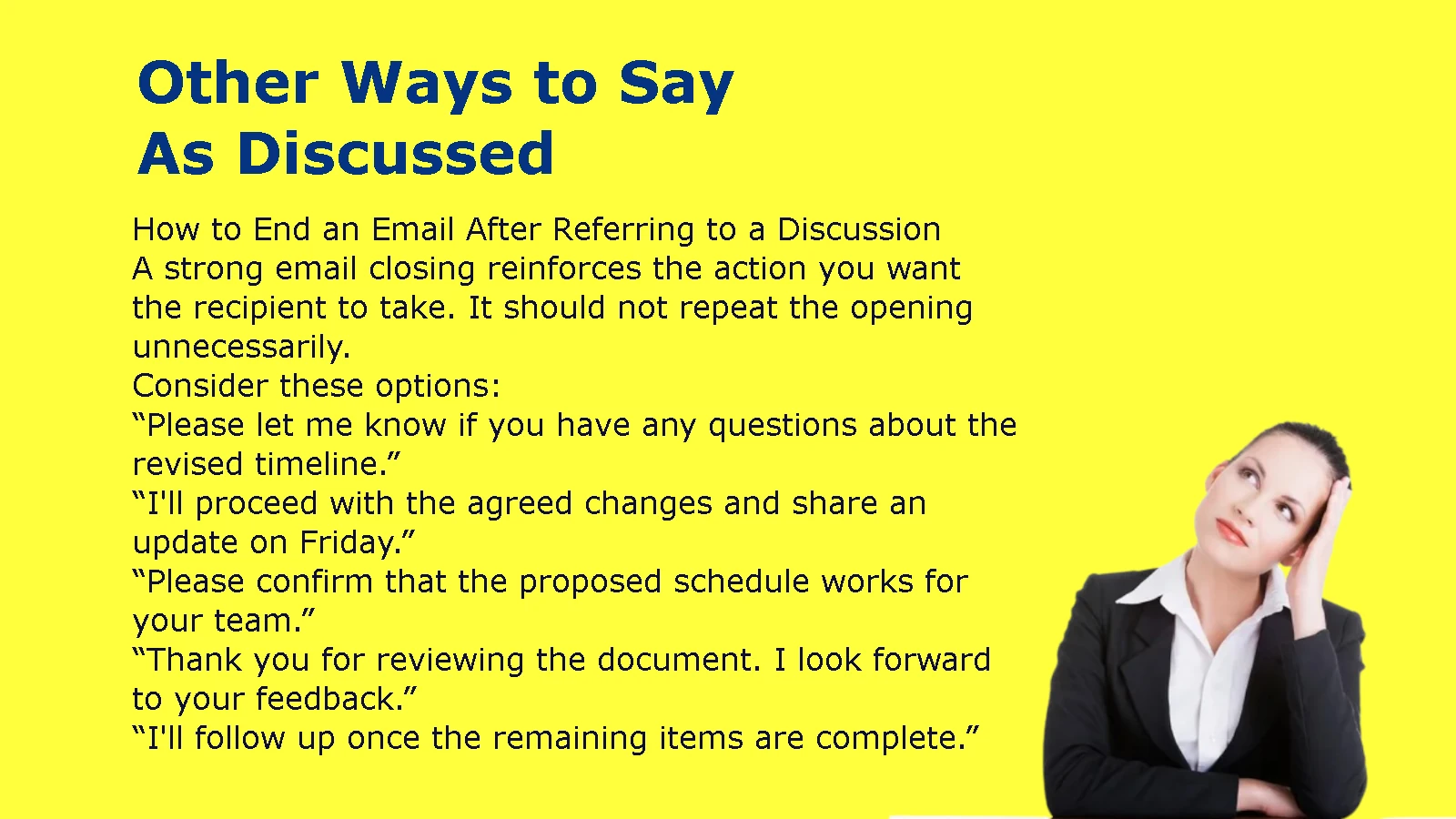
How to End an Email After Referring to a Discussion
A strong email closing reinforces the action you want the recipient to take. It should not repeat the opening unnecessarily.
Consider these options:
- “Please let me know if you have any questions about the revised timeline.”
- “I’ll proceed with the agreed changes and share an update on Friday.”
- “Please confirm that the proposed schedule works for your team.”
- “Thank you for reviewing the document. I look forward to your feedback.”
- “I’ll follow up once the remaining items are complete.”
Choose the closing based on what happens next. If you need approval, ask for confirmation. If you have already agreed on the next step, explain what you will do and when.
Complete Email Examples Using Different Alternatives
These examples show how to use professional alternatives in real communication.
Email After a Client Meeting
Subject: Revised Project Proposal
Hi Jordan,
Following our discussion, I’ve attached the revised project proposal with the updated timeline and pricing.
The document reflects the changes we reviewed during yesterday’s meeting. Please review the revised version and let me know if you’d like any further adjustments.
I’ll wait for your feedback before preparing the final agreement.
Best regards,
Alex
Email Confirming a Project Deadline
Subject: Confirmation of Project Timeline
Hi Sarah,
As agreed, I’ll deliver the completed report by Friday afternoon.
I’ve allocated additional time for the final review to make sure the figures and recommendations are accurate. I’ll let you know if anything affects the schedule.
Best,
Michael
Email Sending a Revised Document
Subject: Updated Contract for Review
Hello David,
Further to our discussion, please find the revised contract attached.
I’ve updated the payment schedule and clarified the delivery terms we reviewed during our call. Please check these sections and confirm whether the document is ready for approval.
Thank you,
Emma
Email Following a Phone Call
Subject: Follow-Up on Today’s Call
Hi Daniel,
Following our phone conversation, I’m confirming that the installation will take place on Thursday morning.
Our team will arrive at the agreed time, and I’ll share the technician’s contact details before the appointment.
Please let me know if anything changes.
Regards,
Chris
These templates work because each email identifies the earlier conversation, communicates a specific update, and explains what should happen next.
How to Say As Discussed in Different Situations
The best replacement often depends on when and how the original conversation took place. Adding that context makes your message more specific and helps the reader recall the right exchange.
Other Ways to Say As Discussed Over the Phone
When referring to a telephone conversation, mention the call directly if it helps the recipient identify the discussion.
Useful alternatives include:
- Following our phone conversation
- As we discussed on the call
- Further to our telephone conversation
- As agreed during our call
- Based on our conversation earlier today
- As confirmed over the phone
Examples:
“Following our phone conversation, I’ve updated the delivery address.”
“As we discussed on the call, the maintenance team will arrive between 9 a.m. and 11 a.m.”
“Further to our telephone conversation, I’m sending the revised quotation for your approval.”
Use “as agreed during our call” only when you reached an actual agreement. If you simply exchanged information, “following our phone conversation” is more accurate.
For important decisions, follow up with a written summary that identifies the agreed terms, responsible people, and deadlines. This creates a clear record and reduces the chance of misunderstandings.
Other Ways to Say As Discussed Earlier
Use these alternatives when the conversation took place earlier in the day, earlier in a meeting, or in a previous message.
- As mentioned earlier
- As we discussed previously
- Returning to our earlier conversation
- As noted in my previous message
- Following our earlier discussion
- As explained earlier
Examples:
“As mentioned earlier, the final presentation needs approval before publication.”
“Following our earlier discussion, I’ve added the requested features to the project plan.”
“As noted in my previous message, the application deadline is Friday.”
If you are replying in an email thread, you may not need to mention the earlier conversation at all. Instead of writing “As discussed earlier” when the context is obvious, move directly to the update:
“I’ve added the requested features to the project plan. The revised version is attached.”
This version saves words and keeps the focus on the result.
Other Ways to Say As Discussed Yesterday
When the timing matters, identify the day of the conversation.
Useful expressions include:
- Following yesterday’s discussion
- As we agreed yesterday
- Based on our conversation yesterday
- As outlined in yesterday’s meeting
- Following our meeting yesterday
- As confirmed yesterday
Examples:
“Following yesterday’s discussion, I’ve prepared the revised marketing budget.”
“As we agreed yesterday, the design team will submit the final mockups by Thursday.”
“Based on our conversation yesterday, I’ve included the additional training session in the schedule.”
For a formal email, “following yesterday’s discussion” sounds professional and clear. For a direct message to a colleague, “as we agreed yesterday” may be more natural.
Be careful not to confuse a conversation with a commitment. If you discussed a Thursday deadline but did not confirm it, write “As discussed yesterday, Thursday is the proposed deadline” rather than “As agreed yesterday.”
Other Ways to Say As Discussed in a Meeting
Meeting-related phrases are useful when you need to document decisions, distribute action items, or follow up with several participants.
Consider these alternatives:
- As agreed during the meeting
- As outlined in our meeting
- Following today’s meeting
- As recorded in the meeting notes
- As discussed with the team
- Based on the points raised during the meeting
Examples:
“As agreed during the meeting, the finance team will submit the updated forecast by Wednesday.”
“Following today’s meeting, I’ve listed the outstanding tasks and assigned an owner to each item.”
“As recorded in the meeting notes, the team will review the proposed changes before making a final decision.”
A useful meeting follow-up should separate three things:
- Discussion points: Topics the group considered.
- Decisions: Outcomes the group accepted.
- Action items: Tasks assigned to specific people.
This distinction improves accuracy. A suggestion raised during a meeting is not necessarily an approved decision, so avoid language that implies otherwise.
Is As Per Discussed Correct?
“As per discussed” is generally incorrect in standard professional English. The word “discussed” does not fit naturally after “as per” in this construction. Use “as discussed,” “as per our discussion,” or “as agreed,” depending on your intended meaning.
What Does As Per Discussed Mean?
People often use “as per discussed” to mean that something follows an earlier conversation or arrangement. The intended meaning is usually understandable, but the phrase is grammatically awkward.
The problem comes from the structure of the expression. “Per” means “according to” or “in accordance with,” and it typically takes a noun phrase in this construction. “Discussed” is a past participle, so it does not provide the noun phrase needed after “per.”
Compare these examples:
- Incorrect: “As per discussed, I’ve sent the invoice.”
- Correct: “As discussed, I’ve sent the invoice.”
- Correct: “As per our discussion, I’ve sent the invoice.”
- Correct: “As agreed, I’ve sent the invoice.”
The simplest correction is often the best one. If you do not need the extra formality, write “As discussed, I’ve sent the invoice.”
Correct Alternatives to As Per Discussed
Use the following expressions based on your intended meaning.
| Intended meaning | Recommended phrase | Example |
| Referring to a conversation | As discussed | As discussed, I’ve revised the document. |
| Referring to a formal conversation | As per our discussion | As per our discussion, the revised terms are attached. |
| Confirming a decision | As agreed | As agreed, the order will ship on Monday. |
| Introducing a follow-up | Following our discussion | Following our discussion, I’ve prepared the requested summary. |
| Referring to a specific plan | In line with our discussion | In line with our discussion, we’ll revise the schedule. |
In everyday business English, “as discussed” usually sounds more direct than “as per our discussion.” Choose the longer version only when it suits the tone of your message.
As Discussed vs. As Per Our Discussion
Both expressions refer to a previous conversation, but their grammatical structures differ.
As discussed is concise and focuses on the subject previously talked about.
Example: “As discussed, the team will update the report.”
As per our discussion is more formal and means “in accordance with our discussion.”
Example: “As per our discussion, the team will update the report.”
The second phrase can sound stiff if you use it repeatedly. In most routine emails, “as discussed” or “following our discussion” communicates the same idea more naturally.
One important distinction remains: neither phrase automatically proves that the parties agreed to a decision. If agreement matters, use “as agreed” only when the conversation supports that claim.
Another Word for Discuss in an Essay
Academic writers often need alternatives to “discuss” to avoid repetition and describe their reasoning more accurately. The right synonym depends on what the sentence asks you to do: examine evidence, explain a concept, compare arguments, or judge the strength of a claim.
Formal Synonyms for Discuss
Here are useful academic verbs and the situations in which they fit.
Analyze
Use “analyze” when you break a subject into parts and explain how those parts work together.
Example: “This essay analyzes the economic factors that influenced the policy.”
Examine
Use “examine” when you investigate a subject closely or consider evidence in detail.
Example: “The study examines the relationship between sleep quality and academic performance.”
Explore
Use “explore” when you investigate a topic or consider several possible explanations.
Example: “The essay explores how social media influences communication among teenagers.”
Address
Use “address” when you respond to a specific issue, question, or problem.
Example: “The report addresses the main concerns raised by local residents.”
Consider
Use “consider” when you take a particular idea, argument, or possibility into account.
Example: “This section considers the advantages and disadvantages of remote work.”
Evaluate
Use “evaluate” when you assess the quality, effectiveness, or value of something.
Example: “The paper evaluates the effectiveness of the proposed teaching method.”
Investigate
Use “investigate” when you examine a question systematically, often to discover causes or relationships.
Example: “The research investigates the factors associated with employee turnover.”
Which Synonym for Discuss Should You Use?
The following table helps you choose a precise verb for your essay.
| Verb | Main purpose | Example |
| Analyze | Explain parts and relationships | Analyze the causes of inflation. |
| Examine | Study a subject closely | Examine the evidence presented in the report. |
| Explore | Investigate possible ideas | Explore different approaches to education. |
| Address | Respond to an issue | Address the limitations of the research. |
| Consider | Take a point into account | Consider the effects of the new policy. |
| Evaluate | Judge effectiveness or value | Evaluate the proposed solution. |
| Investigate | Study a question systematically | Investigate the reasons for the decline. |
| Compare | Identify similarities and differences | Compare the two theories. |
| Assess | Judge significance or quality | Assess the risks associated with the decision. |
| Explain | Make something clear | Explain how the process works. |
Do not replace “discuss” with a more complex verb just to sound academic. The replacement should describe the task you are actually performing.
For instance, if your assignment asks you to discuss two theories, you might need to explain them, compare their assumptions, and evaluate their strengths. The verb “analyze” may fit one paragraph, while “compare” may fit another.
How to Avoid Repeating Discuss in Academic Writing
Repeated words can make an essay sound monotonous, but excessive synonym swapping creates a different problem: the argument becomes less precise.
Try these techniques instead:
- Choose verbs that match your argument. Use “compare” when identifying differences and similarities, and “evaluate” when judging effectiveness.
- Rewrite the sentence structure. Instead of writing “This essay discusses the causes,” try “The following analysis identifies three major causes.”
- Use specific nouns where appropriate. Replace repeated references to “the discussion” with “the analysis,” “the findings,” or “the argument” when those terms accurately describe the content.
- Avoid unnecessary signposting. You do not need to announce every point with phrases such as “as discussed above.”
- Keep the meaning consistent. “Explore” suggests investigation, while “prove” makes a much stronger claim. Do not treat them as interchangeable.
For example:
Repetitive: “The essay discusses the causes of pollution. It also discusses the effects of pollution and discusses possible solutions.”
Improved: “The essay examines the causes of pollution, evaluates its environmental effects, and compares several possible solutions.”
The revised sentence is shorter, more specific, and easier to follow.
As Discussed vs. Similar Professional Phrases
Although many expressions can replace “as discussed,” they do not all communicate the same thing. Understanding these differences helps you avoid misleading wording in business emails and reports.
As Discussed vs. As Agreed
“As discussed” refers to a conversation, while “as agreed” confirms a decision or commitment.
Example of discussion:
“As discussed, we will review the proposed budget next week.”
Example of agreement:
“As agreed, we will approve the final budget by Friday.”
In the first example, the participants talked about a review. The sentence does not necessarily confirm a final decision. In the second, the phrase explicitly presents the deadline as an agreement.
Use “as agreed” only when the parties actually accepted the arrangement. This matters when you are documenting costs, deadlines, deliverables, or responsibilities.
As Discussed vs. As Mentioned
“As mentioned” refers to information previously stated, while “as discussed” refers to a topic that people talked about.
For example:
“As mentioned in my previous email, the office will close at 4 p.m.”
“As discussed during the meeting, the team will review the new policy.”
The first sentence refers to information already communicated. The second points to a conversation.
If you are referring to a detail from an earlier email rather than a conversation, “as mentioned” may be more accurate.
As Discussed vs. As Per Our Conversation
Both phrases refer to a previous exchange, but they differ slightly in style.
“As discussed, I’ve updated the presentation.”
“As per our conversation, I’ve updated the presentation.”
The first is concise and natural in most professional settings. The second is more formal and may suit traditional business correspondence.
In American English, “per our conversation” is also common. However, avoid using “per” in constructions such as “as per discussed.” Use a grammatically complete expression instead.
As Discussed vs. Following Our Conversation
“As discussed” points back to the conversation itself, while “following our conversation” often introduces something that happens afterward.
For example:
“As discussed, the new pricing structure starts in November.”
“Following our conversation, I’ve prepared the revised pricing structure.”
The first sentence references the subject of the conversation. The second emphasizes the action taken after it.
This difference is subtle, but it helps your writing feel more precise. Use “following our conversation” when you are sharing a result, sending a document, or outlining next steps.
Common Mistakes to Avoid When Using As Discussed
“As discussed” can make an email concise, but it can also create confusion when the writer assumes the recipient remembers details that are not clearly identified.
Using As Discussed Without a Clear Reference
A sentence such as “As discussed, please proceed” may leave the recipient wondering which task you mean, especially if you have discussed several topics.
A clearer version identifies the action:
“As discussed during Tuesday’s meeting, please proceed with the revised website design.”
You can add the date, topic, meeting, or document title when several conversations could fit the reference.
Using As Discussed When No Agreement Exists
Discussing a proposal does not mean accepting it. Avoid wording that presents an unresolved suggestion as a confirmed decision.
Unclear: “As agreed, we will increase the advertising budget.”
Better, if the budget is still under consideration: “As discussed, we will review the proposed advertising budget before making a decision.”
The second version reflects the actual status of the conversation.
How to Choose the Best Alternative to As Discussed
The simplest way to select an alternative is to identify what your sentence needs to accomplish. Are you referring to a conversation, confirming an agreement, sharing an update, or documenting a decision?
Choose Based on Your Purpose
Use this quick guide:
- To refer to an earlier conversation: “As previously discussed.”
- To confirm a shared decision: “As agreed.”
- To introduce a follow-up action: “Following our conversation.”
- To refer to a phone call: “As discussed on our call.”
- To summarize a meeting: “To recap our discussion.”
- To refer to information in an earlier email: “As mentioned in my previous email.”
- To explain a recommendation based on a conversation: “Based on our previous conversation.”
- To document a formal meeting outcome: “As recorded in the meeting notes.”
For example, a sales representative sending a quotation might write “Following our conversation, I’ve attached the revised quotation.” A manager confirming a deadline might write “As agreed, the report is due Friday.”
The distinction makes the sentence more useful than a generic synonym would.
Choose Based on Tone and Audience
The recipient and communication channel also affect your choice.
| Tone | Recommended phrase | Example |
| Formal | Further to our discussion | Further to our discussion, the revised terms are attached. |
| Professional | As previously discussed | As previously discussed, testing begins next week. |
| Neutral | As we discussed | As we discussed, I’ll prepare the report. |
| Friendly | Just following up on our conversation | Just following up on our conversation about the new design. |
| Direct | As agreed | As agreed, the team will meet on Monday. |
| Concise | Per our conversation | Per our conversation, the document is attached. |
Use formal expressions when communicating with clients, senior stakeholders, or external organizations if that tone suits your relationship. For internal team messages, a direct and natural phrase often works better.
Make the Message Specific
A phrase like “as discussed” should support your message, not replace the information the reader needs.
Compare these sentences:
Vague: “As discussed, please handle the matter.”
Specific: “As discussed during Monday’s meeting, please send the revised budget to the finance team by 3 p.m. Thursday.”
The second sentence tells the recipient what to do, who needs the result, and when to complete the task.
Before sending your email, check three things:
- Context: Can the recipient identify the conversation?
- Action: Is the requested task or update clear?
- Timing: Have you included a deadline when one matters?
You do not need all three details in every message. Include the information necessary to prevent confusion.
A Practical Example: Choosing the Right Phrase
Imagine that a marketing manager and a designer discuss a campaign on Monday. They consider two designs but do not select a final version. The manager later emails the designer.
A vague email might say:
“As agreed, please finalize the design.”
This incorrectly implies that the team chose a design.
A more accurate message would be:
“Following Monday’s discussion, please revise the two design options and send them back for review by Wednesday.”
Now suppose the manager and designer actually selected the first design during the meeting. The message can change:
“As agreed during Monday’s meeting, please finalize the first design and send the completed version by Wednesday.”
This example shows why meaning matters more than finding a phrase that sounds formal. The best alternative accurately reflects what happened.
Frequently Asked Questions
What Is Another Way to Say As Discussed?
Common alternatives include “as previously discussed,” “as agreed,” “following our conversation,” “as mentioned earlier,” and “further to our discussion.” Use “as previously discussed” to reference an earlier conversation, “as agreed” to confirm a decision, and “following our conversation” to introduce a next step.
Is As Discussed Professional in an Email?
Yes. “As discussed” is appropriate in professional emails when you need to refer to an earlier conversation, meeting, or phone call. For greater clarity, identify the subject or timing of the discussion. For example, “As discussed during Tuesday’s meeting, the revised report is due Friday.”
What Is the Meaning of As Discussed With You?
“As discussed with you” means that you previously talked about something with the recipient. For example, “As discussed with you yesterday, I’ve updated the project schedule.” In most situations, “as we discussed” or “as discussed yesterday” sounds more natural and concise.
Is It Correct to Say As Per Discussed?
No. “As per discussed” is generally considered ungrammatical in standard professional English. Use “as discussed,” “as per our discussion,” or “as agreed” instead. Each option has a slightly different meaning, so choose the one that accurately reflects the earlier conversation.
How Do You Say As Discussed Over the Phone?
You can say “following our phone conversation,” “as we discussed on the call,” “further to our telephone conversation,” or “as agreed during our call.” Use the last option only when you reached an agreement. For example, “Following our phone conversation, I’ve updated the delivery schedule.”
What Can I Use Instead of Discuss in an Essay?
Academic alternatives include “analyze,” “examine,” “explore,” “address,” “consider,” “evaluate,” and “investigate.” Choose the verb that matches your purpose. Use “analyze” to explain relationships, “examine” to study evidence, and “evaluate” to assess the strengths or weaknesses of an argument.
Conclusion
Choosing the right alternative to “as discussed” makes professional emails, meeting summaries, and academic writing clearer and more natural. Phrases such as “as previously discussed,” “following our conversation,” “as agreed,” and “as mentioned earlier” help you refer to earlier communication without repeating the same expression in every message.
The most important distinction is between a conversation and a decision. Use “as discussed” when you are referring to a topic, and use “as agreed” when the people involved actually reached a shared decision. For phone calls, meetings, and previous emails, add specific context whenever it helps the recipient understand your message.
Before sending your next email, choose the phrase that matches your purpose, state the relevant action clearly, and include a deadline when necessary. A precise sentence saves time, reduces misunderstandings, and makes your communication sound more professional.













