Looking for other ways to say “make a difference”? The phrase is commonly used to describe having a positive effect, creating meaningful change, or helping improve a situation. Whether you’re talking about someone’s actions, a workplace contribution, a personal effort, or a larger social impact, there are many natural alternatives to “make a difference” that can fit different situations and tones.
The other ways to say “make a difference” include expressions such as have an impact, make an impact, create positive change, contribute, make a meaningful contribution, have an effect, bring about change, make a real difference, and leave a positive mark. However, the best alternative depends on the context, level of formality, and type of impact you want to describe.
In this guide, you’ll discover 40+ other ways to say “make a difference,” including professional, casual, meaningful, and powerful alternatives. You’ll also see clear examples showing how to use each expression naturally in conversations, emails, workplace communication, and everyday writing.
By the end, you’ll know exactly how to replace “make a difference” with the right expression for your situation and how to choose an alternative that sounds natural, specific, and effective.
What Does “Make a Difference” Mean?
“Make a difference” generally means to have an effect that changes a situation, improves a condition, or makes something better.
Cambridge Dictionary defines the phrase as meaning to improve a situation. It also notes that when a person makes a difference, their actions make a situation better.
For example:
Your advice made a difference.
This means the advice had a positive effect.
You could also say:
Her research made a difference in how the disease is treated.
Here, the phrase means that her research had a meaningful influence on an outcome.
The expression can also describe something that matters:
It doesn’t make a difference which option you choose.
In this construction, however, make a difference does not necessarily mean “create positive change.” It means matter or affect the outcome. Collins lists “to have an effect” and “to matter” among its meanings.
This distinction is important because not every synonym works in every sentence.
“Make a Difference” vs. “Make the Difference”
These expressions are related but not identical.
Make a difference usually means to have an effect or improve a situation.
Make the difference can mean to be the decisive factor that determines an outcome.
For example:
- Your support made a difference. → Your support helped.
- Your final goal made the difference. → Your final goal was the decisive factor.
“Make an impact” is one of the strongest and most versatile alternatives to “make a difference.”
It emphasizes the effect or influence something has rather than simply saying that it helped.
Examples
- Your leadership made an impact on the entire organization.
- The new campaign made a significant impact on customer engagement.
- Her research could make an impact on future medical treatments.
When to Use “Make an Impact”
Use it in:
- Business writing
- Resumes and cover letters
- Presentations
- Academic writing
- Leadership discussions
- Nonprofit communication
If you are writing a resume, for example, “made an impact” can be more specific and professional than repeatedly saying that you “made a difference.”
Better:
I made a difference in the company’s sales process.
Stronger:
I made a measurable impact on the company’s sales process.
The second version signals influence more directly.
Have an Impact
“Have an impact” is another professional way to say “make a difference.”
It is especially useful when you are describing the effect of a policy, decision, discovery, product, or event.
Examples
- The new policy had a significant impact on employee retention.
- Her research had a lasting impact on the field.
- The training program had a positive impact on productivity.
The phrase can also work when the effect is negative:
The unexpected delay had a major impact on the project.
That makes “have an impact” broader than “make a difference,” which often carries a positive implication.
Create Positive Change
If you want to emphasize improvement or transformation, “create positive change” is an excellent alternative.
Examples
- We want to create positive change in our local community.
- Small businesses can create positive change by hiring locally.
- Her goal is to create positive change through education.
This phrase works particularly well in:
- Mission statements
- Charity websites
- Personal statements
- Speeches
- Community projects
- Social media campaigns
It is more explicit than “make a difference” because it tells the reader that the change is positive.
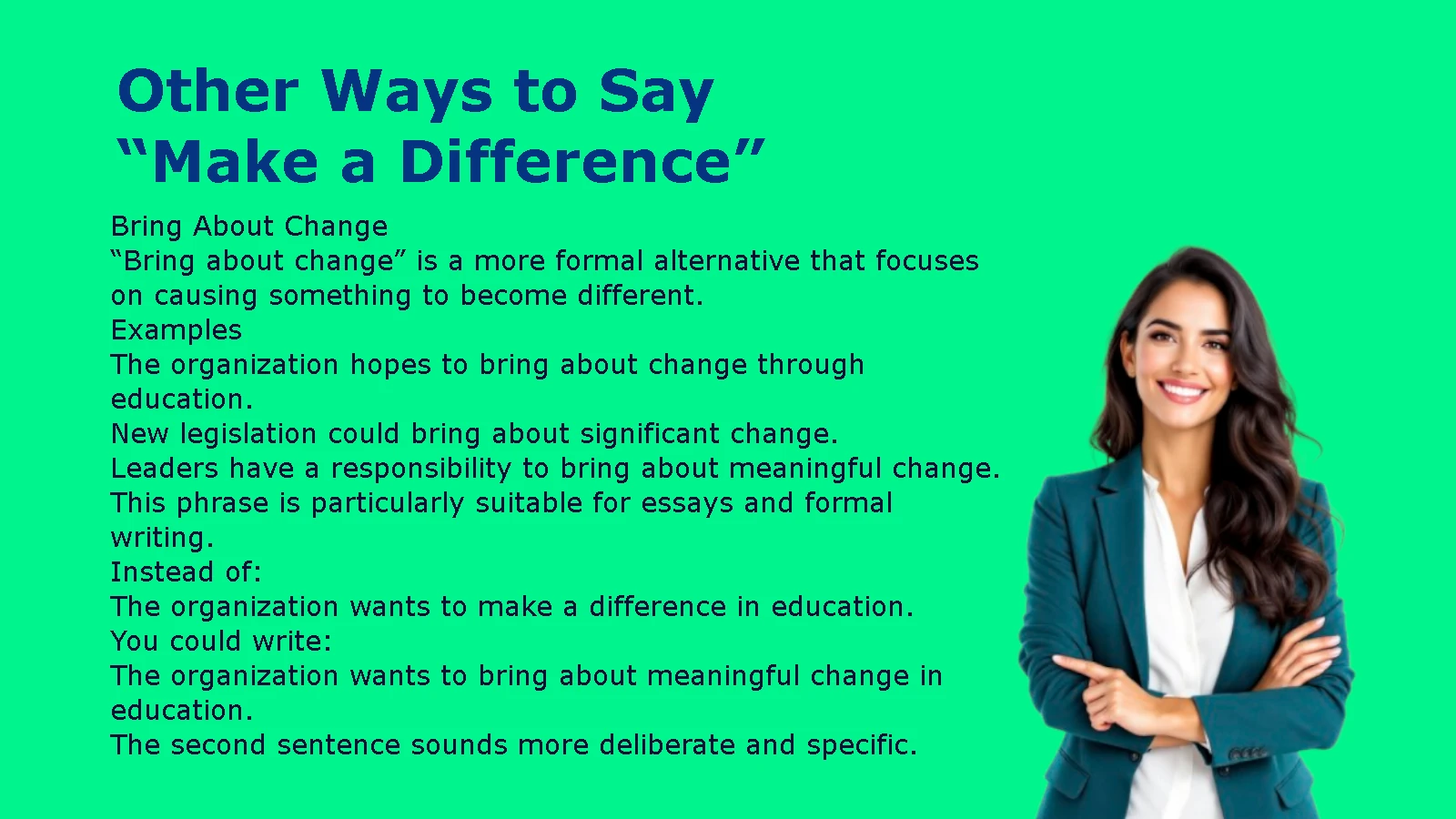
Bring About Change
“Bring about change” is a more formal alternative that focuses on causing something to become different.
Examples
- The organization hopes to bring about change through education.
- New legislation could bring about significant change.
- Leaders have a responsibility to bring about meaningful change.
This phrase is particularly suitable for essays and formal writing.
Instead of:
The organization wants to make a difference in education.
You could write:
The organization wants to bring about meaningful change in education.
The second sentence sounds more deliberate and specific.
Drive Change
“Drive change” suggests actively pushing a process forward.
It is particularly common in business, technology, management, and leadership contexts.
Examples
- Strong leaders drive change within an organization.
- The company is using technology to drive change in the industry.
- Employees can help drive positive change in the workplace.
Why “Drive Change” Sounds Stronger
The verb drive implies action and momentum.
Someone who “makes a difference” may have a positive effect.
Someone who drives change sounds like an active force behind that change.
That makes this phrase especially useful for:
- Leadership profiles
- Business presentations
- Corporate websites
- Professional resumes
- Strategic plans
Influence Outcomes
“Influence outcomes” is a precise alternative when you are talking about decisions, results, or measurable consequences.
Examples
- Good communication can influence outcomes during negotiations.
- Early intervention can influence patient outcomes.
- Better planning can influence project outcomes.
This expression is less emotional than “make a difference.”
It is therefore a good choice for analytical writing where you want to explain how an action affects a result.
Have a Positive Effect
When you want a simple, direct alternative, use “have a positive effect.”
Examples
- Regular exercise can have a positive effect on your health.
- Her encouragement had a positive effect on the students.
- The new system should have a positive effect on productivity.
This is one of the safest replacements because it preserves the basic meaning without sounding overly promotional.
Improve the Situation
Sometimes the clearest alternative is also the simplest.
“Improve the situation” works when you are specifically talking about making circumstances better.
Examples
- We need to find a solution that will improve the situation.
- Your suggestion could improve the situation considerably.
- The new measures are designed to improve the situation for customers.
This option is especially natural in everyday conversation.
Make a Meaningful Impact
If you want to emphasize that an action matters in a significant or valuable way, use “make a meaningful impact.”
Examples
- She hopes to make a meaningful impact through her work.
- The program has made a meaningful impact on local families.
- Your contribution can make a meaningful impact on the project.
This phrase works particularly well when discussing purpose, careers, volunteering, education, or community work.
Contribute Meaningfully
“Contribute meaningfully” focuses on the person’s contribution rather than the final result.
Examples
- Every team member should have an opportunity to contribute meaningfully.
- She wants to contribute meaningfully to the research project.
- Volunteers can contribute meaningfully to the community.
This is a polished choice for professional and academic writing.
It is especially useful when you want to avoid vague motivational language.
Add Value
“Add value” is one of the most common professional alternatives to “make a difference.”
Examples
- Her experience adds value to the team.
- This new feature will add value for customers.
- I want to find ways to add value to the organization.
However, there is an important difference.
Make a difference focuses on impact or improvement.
Add value focuses on usefulness, benefit, or contribution.
So they overlap, but they are not perfect synonyms.
Help Improve Things
For casual conversations, “help improve things” can sound more natural than a formal expression such as “drive positive change.”
Examples
- We are just trying to help improve things.
- Your feedback could help improve things for everyone.
- Even a small donation can help improve things for families in need.
This phrase is straightforward, friendly, and conversational.
Move the Needle
“Move the needle” is an idiomatic expression often used in business to mean produce a noticeable or measurable improvement.
Examples
- We need a strategy that will actually move the needle.
- This campaign could move the needle on customer retention.
- Small improvements are useful, but we need something that will really move the needle.
It is more informal than “make an impact.”
When Not to Use It
Avoid “move the needle” in:
- Formal academic essays
- Legal documents
- Highly formal correspondence
- Situations where the reader may not know the idiom
For a business meeting, however, it can sound concise and energetic.
Leave a Mark
“Leave a mark” emphasizes lasting influence.
Examples
- Her work left a mark on the community.
- He hopes to leave a lasting mark on the industry.
- Great teachers often leave a mark on their students.
This phrase is more emotional and reflective than “make a difference.”
Use it when talking about:
- Legacy
- Personal influence
- Teachers
- Leaders
- Artists
- Historical figures
- Long-term achievements
Make a Real Impact
If you want to make the phrase more emphatic, “make a real impact” is a natural choice.
Examples
- We want our work to make a real impact.
- Her research is already making a real impact.
- You can make a real impact by supporting local organizations.
The word real adds emphasis without making the sentence unnecessarily formal.
Change Things for the Better
“Change things for the better” is a warm, natural alternative that clearly communicates positive improvement.
Examples
- She wants to change things for the better.
- Small acts of kindness can change things for the better.
- The new policy is intended to change things for the better.
This expression works especially well in personal writing and motivational messages.
Make a Positive Contribution
“Make a positive contribution” is a formal alternative suitable for professional, academic, and community-related contexts.
Examples
- Every employee can make a positive contribution to the organization.
- Students are encouraged to make a positive contribution to their communities.
- The research could make a positive contribution to the field.
This phrase emphasizes participation and usefulness rather than dramatic transformation.
Have an Influence
“Have an influence” is useful when someone’s actions, opinions, or ideas affect other people or decisions.
Examples
- Teachers have a major influence on their students.
- Social media can have a significant influence on consumer behavior.
- Her advice had a strong influence on my decision.
Unlike “make a difference,” this expression does not necessarily imply that the effect is positive.
That makes it more neutral.
Produce Results
When the “difference” you mean is measurable performance, “produce results” may be much more precise.
Examples
- The new strategy is already producing results.
- We need an approach that produces measurable results.
- Her efforts produced impressive results.
This is particularly useful in business because it moves the conversation from vague impact to observable outcomes.
Improve Outcomes
“Improve outcomes” is another precise alternative.
Examples
- Better communication can improve patient outcomes.
- The new program aims to improve educational outcomes.
- Early planning can improve project outcomes.
It is especially appropriate in:
- Healthcare
- Education
- Business
- Research
- Public policy
This phrase is more analytical than “make a difference.”
Help Create Change
If you want a positive but less forceful expression, “help create change” works well.
Examples
- Volunteers can help create change in their communities.
- Education can help create change that lasts for generations.
- Your support can help create positive change.
The word help makes the statement more modest. It does not claim that one person is solely responsible for the outcome.
Make a Meaningful Contribution
“Make a meaningful contribution” is particularly useful when writing about someone’s role in a project, organization, academic field, or community.
Examples
- She made a meaningful contribution to the research.
- Every employee has the opportunity to make a meaningful contribution.
- His work made a meaningful contribution to the project.
This is a strong professional alternative because it recognizes someone’s effort without exaggerating its effect.
Make a Lasting Impact
Use “make a lasting impact” when the effect continues over time.
Examples
- The teacher made a lasting impact on her students.
- The organization hopes to make a lasting impact in the community.
- His discovery made a lasting impact on the field.
The adjective lasting changes the meaning significantly.
It tells the reader that the effect is not merely temporary.
Make an Important Contribution
“Make an important contribution” is a formal alternative for academic and professional contexts.
Examples
- The study made an important contribution to the field.
- Her work made an important contribution to the company’s success.
- The volunteers made an important contribution to the project.
It is particularly useful when you want to sound measured rather than promotional.
Turn Things Around
“Turn things around” is a conversational expression used when something improves after being in a difficult or unsuccessful state.
Examples
- The new manager helped turn things around.
- We still have time to turn things around.
- Her leadership turned things around for the struggling team.
This is not a universal synonym for “make a difference.” It works best when there is a problem, decline, setback, or difficult situation that needs to improve.
Make a Noticeable Difference
Sometimes you simply need to emphasize that the effect can actually be seen.
Examples
- The new lighting made a noticeable difference.
- A few small changes can make a noticeable difference in productivity.
- Her feedback made a noticeable difference to the final result.
This is useful when the improvement is visible or measurable but not necessarily enormous.
Matter
The simplest alternative may be “matter.”
Examples
- Your opinion matters.
- Every contribution matters.
- Small actions matter.
- What you do matters to the people around you.
“Matters” is especially powerful in personal and emotional writing because it is short and direct.
Instead of:
Your support can make a difference.
You might say:
Your support matters.
The second sentence has fewer words but can carry more emotional weight.
Professional Ways to Say “Make a Difference”
When writing a business email, report, resume, or presentation, some alternatives are more appropriate than others.
| Instead of “make a difference” | Professional example |
| Make an impact | Your work made a significant impact on the project. |
| Have an impact | The policy had a positive impact on productivity. |
| Drive change | Our leadership team is driving change across the organization. |
| Add value | Your expertise adds considerable value to the team. |
| Influence outcomes | Better planning can influence project outcomes. |
| Improve outcomes | The new process should improve customer outcomes. |
| Produce results | The campaign has already produced measurable results. |
| Contribute meaningfully | Every member can contribute meaningfully to the initiative. |
| Make a positive contribution | She made a positive contribution to the department. |
| Bring about change | The initiative aims to bring about lasting change. |
Best Choice for a Business Email
Consider the difference between these sentences:
I hope this project will make a difference.
and:
I hope this project will improve customer outcomes.
The first is positive but vague.
The second tells the reader what kind of difference you expect.
That is the central advantage of using alternatives: they can make your writing more precise.
Other Ways to Say “Make a Difference” in an Essay
Academic writing often benefits from replacing broad phrases with language that explains the specific effect.
Useful academic alternatives
- Have an impact on
- Influence
- Contribute to
- Affect
- Improve outcomes
- Bring about change
- Produce measurable results
- Make a significant contribution
- Shape
- Play a significant role in
Example
Weak:
Education can make a difference in society.
More precise:
Education can influence social mobility and improve economic opportunities.
The second sentence gives the reader information rather than simply making a positive claim.
Other Ways to Say “Make a Difference” at Work
Workplace communication often requires a balance between confidence and precision.
Try these alternatives:
- Make an impact
- Add value
- Drive results
- Improve outcomes
- Influence decision-making
- Support positive change
- Contribute meaningfully
- Deliver results
- Move the needle
- Strengthen the team
Workplace Examples
Instead of:
I want to make a difference in this company.
Try:
I want to add value to the team and improve our results.
Instead of:
This change could make a difference.
Try:
This change could improve efficiency and reduce processing time.
The second versions are more persuasive because they identify the actual benefit.
Other Ways to Say “Make a Difference” in an Essay or Personal Statement
Personal statements often use “make a difference” because it communicates purpose. However, it can become generic when many applicants use the same wording.
Instead of:
I want to make a difference in people’s lives.
Consider:
I want to improve access to education for underserved students.
Or:
I hope to use my skills to create meaningful opportunities for others.
Or:
I want to contribute to work that produces measurable improvements in people’s lives.
These alternatives communicate the same underlying motivation while giving the reader a clearer picture of your goals.
Other Ways to Say “Make a Difference” in a Sentence
Here are some quick sentence-level replacements:
| Original | Alternative |
| Your help made a difference. | Your help had a meaningful impact. |
| We want to make a difference. | We want to create positive change. |
| Her work made a difference. | Her work made a significant contribution. |
| This could make a difference. | This could improve the outcome. |
| I want to make a difference at work. | I want to add value to the organization. |
| Small actions can make a difference. | Small actions can create meaningful change. |
| The program made a difference in students’ lives. | The program positively affected students’ lives. |
| We need to make a difference quickly. | We need to produce meaningful results quickly. |
| His advice made a difference. | His advice influenced my decision. |
| Your support makes a difference. | Your support matters. |
“Make a Difference” Alternatives by Tone
| Tone | Best Alternatives |
| Formal | Bring about change, influence outcomes, make a significant contribution |
| Professional | Make an impact, add value, improve outcomes |
| Academic | Have an impact on, contribute to, influence |
| Motivational | Create positive change, make a meaningful impact |
| Personal | Matter, leave a mark, make a lasting impact |
| Casual | Help improve things, change things for the better |
| Business | Drive change, move the needle, produce results |
| Community-focused | Contribute meaningfully, create positive change |
| Emotional | Matter, leave a lasting mark, touch lives |
| Results-focused | Produce results, improve outcomes, have a measurable impact |
Common Mistakes When Replacing “Make a Difference”
Not every synonym can replace “make a difference” in every sentence.
Using “Move the Needle” in Formal Writing
“Move the needle” is an idiom. It can work well in a workplace conversation but may sound too informal in an academic paper.
Instead of:
The policy moved the needle on educational outcomes.
A formal paper might use:
The policy produced measurable improvements in educational outcomes.
Using “Add Value” for Human Relationships
“Add value” is strongly associated with business and professional communication.
For example:
My friend added value to my life.
This is grammatically understandable but can sound strangely corporate.
A more natural choice would be:
My friend made a meaningful difference in my life.
Or:
My friend had a positive influence on my life.
Using “Make an Impact” When the Effect Is Tiny
“Make an impact” often suggests a noticeable effect.
If you are describing a small improvement, “help,” “improve,” or “contribute” may be more accurate.
How to Make “Make a Difference” More Specific
One of the easiest ways to improve your writing is not necessarily to replace the phrase. Instead, explain what difference was made.
Compare:
The program made a difference.
with:
The program reduced waiting times for patients.
The second sentence is stronger because the reader can understand and evaluate the result.
Another example:
She made a difference to the team.
Becomes:
She improved communication between the design and marketing teams.
This approach is particularly valuable in resumes, essays, case studies, and business writing.
A Simple Formula
Use this structure:
Action + specific effect + measurable or observable result
For example:
The new training program improved employee onboarding and reduced the average time required to reach full productivity.
That communicates much more than:
The new training program made a difference.
Case Study: Replacing a Generic Phrase in Professional Writing
Imagine a project manager writing:
Our new process made a difference to the team’s performance.
The statement sounds positive, but it does not explain the result.
A stronger version might be:
Our new process improved team efficiency and reduced project delays.
An even stronger version could be:
Our new process reduced project delays by 18% and helped the team complete routine tasks faster.
The lesson is simple: specificity creates credibility.
A synonym can make your sentence more varied, but a concrete result makes it more informative.
Case Study: Making a Personal Statement More Original
Consider this common sentence:
I want to make a difference in my community.
There is nothing wrong with it, but it is broad.
A more specific version might be:
I want to help expand access to educational resources for students in underserved communities.
The second sentence communicates:
- What the person wants to do
- Who they want to help
- What kind of change they want to create
That is much more compelling than a general statement about making a difference.
Case Study: Choosing the Right Phrase for a Team Email
Suppose a team member has completed a difficult project.
You could write:
Your work really made a difference.
That is friendly and appreciative.
But you could make the praise more specific:
Your work had a major impact on the project’s timeline.
Or:
Your attention to detail helped us avoid several costly errors.
Or:
Your contribution played an important role in keeping the project on schedule.
Each version communicates a slightly different kind of value.
Is “Make a Difference” Professional?
Yes. “Make a difference” is professional and grammatically correct. There is no general rule requiring you to avoid it in business or academic communication.
The problem is usually overuse, not professionalism.
For example:
Our company makes a difference.
This is positive but vague.
A more informative statement would be:
Our company helps small businesses reduce operating costs through automated accounting tools.
The second sentence tells the reader exactly what the company does.
So you do not need to eliminate “make a difference.” Instead, use it when its broad meaning is appropriate and replace it when greater precision is needed.
Is “Make an Impact” the Same as “Make a Difference”?
They overlap, but they are not identical.
Make a difference often emphasizes improvement or meaningful positive change.
Make an impact emphasizes the strength or significance of an effect.
For example:
The new tutoring program made a difference for struggling students.
This emphasizes improvement.
The new tutoring program made a significant impact on graduation rates.
This emphasizes a measurable effect.
In many situations, either phrase will work. However, “make an impact” tends to sound more professional and results-oriented.
Is “Make a Difference” Overused?
It can be.
The phrase is familiar, positive, and easy to understand, which explains why it appears frequently in motivational writing, business messaging, nonprofit communication, and personal statements.
Current thesaurus listings provide alternatives such as affect, count, matter, signify, have influence, carry weight, and be of value, demonstrating that the phrase can be expressed in several more precise ways.
The solution is not to avoid the phrase completely.
Instead, ask yourself:
What kind of difference am I talking about?
Is it:
- An effect?
- An improvement?
- A contribution?
- A measurable result?
- A long-term influence?
- A decisive factor?
- A personal connection?
Once you identify the meaning, the right alternative becomes much easier to choose.
Frequently Asked Questions About Other Ways to Say “Make a Difference”
What is another way to say “make a difference”?
Some common alternatives are make an impact, have an impact, create positive change, bring about change, influence outcomes, have a positive effect, add value, contribute meaningfully, and improve outcomes.
The best choice depends on the context.
What is a professional way to say “make a difference”?
Professional alternatives include make an impact, add value, improve outcomes, influence results, drive change, contribute meaningfully, and make a significant contribution.
For business writing, “make an impact” and “add value” are especially versatile.
What is a powerful way to say “make a difference”?
For a strong and confident tone, try “make a significant impact,” “drive meaningful change,” “create lasting change,” “make a lasting impact,” or “produce measurable results.”
What is another way to say “make a positive difference”?
You can say “create positive change,” “have a positive impact,” “make a meaningful contribution,” “improve outcomes,” or “help make things better.”
What is a casual way to say “make a difference”?
In casual conversation, you can say “help make things better,” “change things for the better,” “make an impact,” or simply “matter.”
For example:
Your support really matters.
What is another way to say “make a difference in someone’s life”?
Natural alternatives include:
- Have a positive influence on someone’s life
- Make a meaningful impact on someone’s life
- Improve someone’s life
- Change someone’s life for the better
- Have a lasting impact on someone
- Make someone’s life better
- Touch someone’s life
The best choice depends on whether you want the sentence to sound professional, emotional, or conversational.
What is another way to say “you made a difference”?
You could say:
- You made an impact.
- You had a positive influence.
- Your help mattered.
- You made things better.
- Your contribution was meaningful.
- You had a real impact.
- Your support was invaluable.
For a heartfelt message, “Your support really mattered” can sound more personal than a formal synonym.
Final Thoughts on Other Ways to Say “Make a Difference”
There is nothing wrong with saying “make a difference.” It is a clear, natural, and widely understood expression. The problem only arises when it becomes so familiar that it stops telling the reader anything specific.
The strongest alternative depends on the exact meaning you want to communicate.
Use “make an impact” when you want to emphasize influence.
Use “create positive change” when you want to emphasize improvement.
And when possible, go one step further: explain exactly what changed.
Instead of simply saying that someone “made a difference,” show the reader what they changed, improved, influenced, or accomplished.
The goal is not simply to find a synonym for “make a difference.” The goal is to choose words that tell your reader what the difference actually was.













