“Keep up the good work” is more than just a compliment—it’s an encouraging phrase used to recognize someone’s effort, progress, or strong performance while motivating them to continue. If you’ve come across the phrase “keep up the good work” and want to express the same idea in a different way, there are many alternatives that can fit casual conversations, professional settings, emails, messages, and everyday encouragement.
The other ways to say “keep up the good work” include phrases such as “great job,” “keep it up,” “well done,” “you’re doing great,” “keep up the great work,” “excellent work,” “nice work,” and “you’re on the right track.” However, the best alternative depends on the situation, your relationship with the person, and how formal or enthusiastic you want to sound.
In this guide, you’ll learn the best ways to say “keep up the good work,” how to use each alternative in a sentence, and which expressions work best in professional, casual, academic, and friendly situations. You’ll also see clear examples to help you choose the right phrase for different conversations.
By the end, you’ll have a useful collection of natural alternatives to “keep up the good work” that you can use to praise someone, show encouragement, recognize their progress, and motivate them to continue doing well.
What Does “Keep Up the Good Work” Mean?
“Keep up the good work” means continue doing something well and maintain your current level of effort or performance.
The expression combines praise with encouragement. You are not simply saying that someone did a good job. You are also encouraging them to continue performing at that level.
Cambridge Dictionary gives “keep up the good work” as an example of the phrasal verb “keep something up,” meaning to continue something without allowing it to stop or change.
For example:
“You handled that presentation very well. Keep up the good work!”
The speaker is doing two things:
- Recognizing the person’s successful performance.
- Encouraging them to continue performing well.
That makes the phrase useful for teachers, managers, coaches, coworkers, parents, mentors, and friends.
Is “Keep Up the Good Work” a Compliment?
Yes. “Keep up the good work” is a compliment and an expression of encouragement.
It suggests that someone’s current work is satisfactory or better than satisfactory and that the speaker wants that performance to continue.
However, the phrase can be somewhat general. If you want your praise to feel more personal, mention what the person did well.
Instead of:
“Keep up the good work.”
Try:
“Your attention to detail on this report was excellent. Keep it up.”
The second version gives the person a reason to feel appreciated because it identifies the behavior that earned the praise.
Quick Answer: What Are Other Ways to Say “Keep Up the Good Work”?
Some of the best alternatives include:
| Alternative | Best for | Tone |
| Keep up the great work | General encouragement | Positive |
| You’re doing an excellent job | Workplace and formal situations | Professional |
| You’re doing a great job | Everyday praise | Friendly |
| Keep up the momentum | Projects and goals | Motivational |
| You’re on the right track | Encouraging progress | Supportive |
| Your hard work is paying off | Recognizing effort and results | Appreciative |
| Keep going—you’re doing great | Motivation | Warm |
| Your efforts are appreciated | Professional communication | Formal |
| Great job—keep it going | Coworkers and teams | Friendly |
| You’re making excellent progress | Students and long-term projects | Encouraging |
| Your work has been outstanding | Performance feedback | Professional |
| Way to go! | Friends and casual situations | Enthusiastic |
The best choice depends on who you are speaking to, what they accomplished, and how formal you want to sound.
Professional Ways to Say “Keep Up the Good Work”
When you are communicating with coworkers, employees, clients, managers, or business partners, your wording should sound encouraging without becoming overly casual.
Here are some polished alternatives.
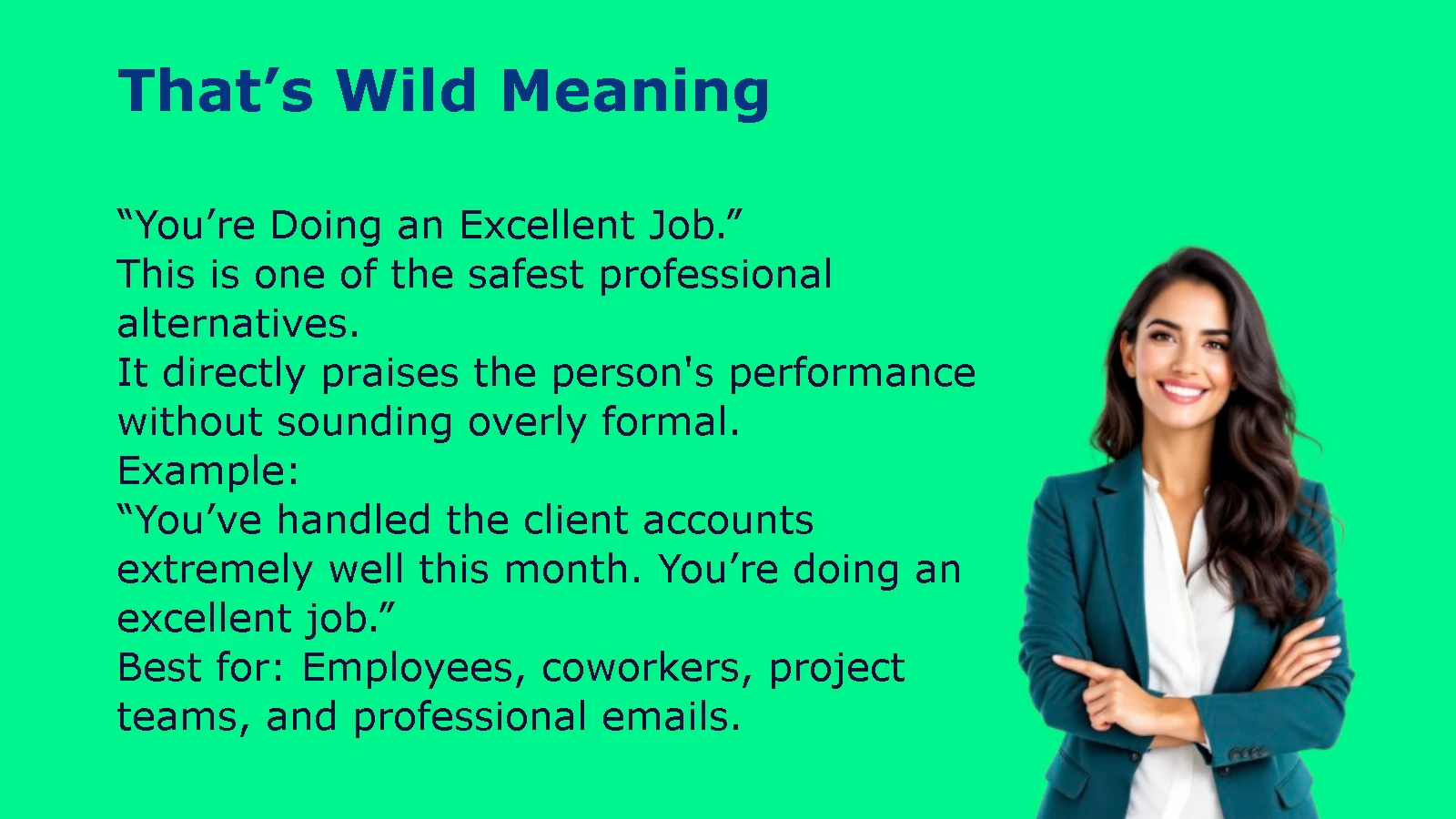
“You’re Doing an Excellent Job.”
This is one of the safest professional alternatives.
It directly praises the person’s performance without sounding overly formal.
Example:
“You’ve handled the client accounts extremely well this month. You’re doing an excellent job.”
Best for: Employees, coworkers, project teams, and professional emails.
“Keep Up the Excellent Work.”
This is a slightly more polished version of the original phrase.
Replacing good with excellent increases the level of praise while preserving the meaning.
Example:
“The new reporting process has been much more efficient. Keep up the excellent work.”
Best for: Workplace emails, managers, supervisors, and formal feedback.
“Your Work Has Been Outstanding.”
This phrase places more emphasis on the quality of someone’s work rather than simply telling them to continue.
Example:
“Your work on the quarterly report has been outstanding. Thank you for your attention to detail.”
Best for: Performance reviews, employee recognition, and formal praise.
“Your Efforts Are Truly Appreciated.”
Use this when you want to recognize someone’s effort and contribution, particularly when the result may not tell the whole story.
Example:
“I know this project required several late revisions. Your efforts are truly appreciated.”
This can feel warmer than a generic “good job” because it recognizes the work behind the outcome.
“Thank You for Your Continued Dedication.”
This is especially useful when someone has consistently performed well over an extended period.
Example:
“Thank you for your continued dedication to the team. Your consistency has made a real difference.”
Best for: Formal emails, employee recognition, annual reviews, and leadership communication.
“You’re Making Excellent Progress.”
This works particularly well when someone has not finished their goal yet.
It recognizes improvement rather than pretending the final result has already been achieved.
Example:
“The project is coming together nicely. You’re making excellent progress.”
Best for: Long-term projects, training, professional development, and coaching.
“Keep Up the Momentum.”
This alternative emphasizes continued progress.
It is particularly natural when discussing a project, campaign, sales goal, or business initiative.
Example:
“The first phase exceeded our expectations. Keep up the momentum as we move into the next phase.”
Best for: Projects, teams, campaigns, business goals, and leadership communication.
Other Ways to Say “Keep Up the Good Work” to a Coworker
Coworkers usually need a tone that is professional but not stiff.
You do not necessarily need a formal phrase such as “Your performance continues to demonstrate exceptional standards.” That can sound like a performance review when you’re simply congratulating someone.
Try these instead:
“Great Work on This.”
Short and natural.
“Great work on this presentation. The data was really easy to follow.”
“You’re Doing a Great Job With This.”
This sounds supportive and conversational.
“You’re doing a great job with the new onboarding process.”
“I Really Appreciate Your Effort.”
This is useful when you want to recognize the person’s contribution without exaggerating the result.
“I really appreciate your effort on this. It made the deadline much easier to manage.”
“You’ve Done an Excellent Job Here.”
This focuses on a specific piece of work.
“You’ve done an excellent job here. The final version is much clearer.”
“Your Work Is Making a Difference.”
This is stronger than generic praise because it connects the person’s effort to an outcome.
“Your work is making a real difference to the team’s turnaround time.”
“Thanks for Keeping Things Moving.”
Use this when someone’s effort has helped a project progress.
“Thanks for keeping things moving while I was out of the office.”
Encouraging Ways to Say “Keep Up the Good Work”
Sometimes you are not simply praising someone’s work. You are trying to motivate them to continue.
In those cases, use language that creates forward momentum.
“Keep Going—You’re Doing Great.”
This is warm and encouraging.
“The final section is almost finished. Keep going—you’re doing great.”
“You’re on the Right Track.”
This is especially useful when someone is uncertain about their approach.
“Your research is heading in the right direction. You’re on the right track.”
“Keep Pushing Forward.”
This has more energy than “keep up the good work.”
“The first few weeks were difficult, but you’ve made real progress. Keep pushing forward.”
“Don’t Stop Now.”
Use this when someone is close to reaching a goal.
“You’ve already completed most of the project. Don’t stop now.”
This is more motivational than professional, so consider your relationship with the person before using it in a formal workplace message.
“You’ve Got This.”
This is a highly conversational expression of confidence.
“The presentation looks great. You’ve got this.”
It works particularly well in messages to friends, teammates, students, and coworkers you know well.
“Your Hard Work Is Paying Off.”
This is a strong choice when the person has invested significant effort and is beginning to see results.
“Your sales numbers have improved significantly. Your hard work is paying off.”
Casual Ways to Say “Keep Up the Good Work”
With friends and people you know well, you can be much more relaxed.
“Nice Work!”
Simple, natural, and versatile.
“Nice work on that presentation!”
“Way to Go!”
This expresses enthusiasm and congratulations.
“You finally finished the course? Way to go!”
“You’re Doing Awesome!”
Very casual and upbeat.
“You’re doing awesome with your new training routine.”
“Keep It Up!”
This is one of the closest casual alternatives to “keep up the good work.”
“Your drawings are getting better every week. Keep it up!”
“You’re Crushing It!”
This is highly informal and enthusiastic.
“You’ve landed three new clients this month. You’re crushing it!”
Use it with friends, teammates, or informal workplace groups rather than in a formal business letter.
“You’re Killing It!”
This means someone is doing exceptionally well. Despite the literal wording, it is a positive idiom in informal American English.
“You’ve been absolutely killing it at the gym lately.”
Because it is highly casual, avoid it in formal emails or performance evaluations.
Ways to Say “Keep Up the Good Work” in an Email
The right phrase depends on the purpose of the email.
A quick message to a coworker can be friendly. A performance-related email to an employee may need more specific praise. A message from a manager to an entire team should usually connect the compliment to the team’s results.
Formal Email Examples
For an employee:
“Thank you for your continued dedication to this project. Your attention to detail has been outstanding.”
For a coworker:
“You’ve done an excellent job organizing the project materials. I really appreciate the effort.”
For a team:
“Thank you, everyone, for the strong effort this week. We’ve made excellent progress, so let’s keep the momentum going.”
For a client or business partner:
“We appreciate your continued collaboration and the excellent work your team has contributed to the project.”
Short Professional Email Phrases
If you need something brief, try:
- Excellent work on this.
- Great job on the project.
- Your efforts are greatly appreciated.
- Thank you for your continued dedication.
- You’re making excellent progress.
- Keep up the excellent work.
- Your contribution has been invaluable.
- The results speak for themselves.
- You’ve done an outstanding job.
- Keep the momentum going.
Ways to Say “Keep Up the Good Work” to an Employee
Managers should be careful with generic praise.
“Keep up the good work” is positive, but specific feedback usually communicates more information.
Compare these two statements:
“Keep up the good work.”
and:
“The way you handled the customer escalation was excellent. You stayed calm, explained the options clearly, and resolved the issue quickly.”
The second message tells the employee exactly what behavior was successful.
“Your Performance Has Been Outstanding.”
Use this for consistently strong performance.
“Your performance has been outstanding this quarter, particularly in client retention.”
“Your Dedication Has Not Gone Unnoticed.”
This recognizes sustained effort.
“Your dedication during the product launch has not gone unnoticed. Thank you for putting in the extra effort.”
“You’ve Raised the Quality of the Work.”
This is useful when someone has noticeably improved standards.
“You’ve raised the quality of the team’s documentation. The new process is much easier to follow.”
“You’re Exceeding Expectations.”
This is a strong professional compliment.
“You’re consistently exceeding expectations in both productivity and accuracy.”
Use it when the evidence supports it. Overusing very strong praise can make it lose its impact.
“I Appreciate the Ownership You’ve Taken.”
This is particularly effective when an employee has independently handled a responsibility.
“I appreciate the ownership you’ve taken throughout this project. You’ve kept everything moving without needing constant direction.”
Ways to Say “Keep Up the Good Work” to a Student
Students often benefit from encouragement that focuses on progress, effort, and specific improvements.
Instead of constantly saying “Good job,” consider:
“You’re Making Excellent Progress.”
“Your writing has become much clearer this semester. You’re making excellent progress.”
“Keep Working Hard—You’re Improving.”
“Your last few assignments have been much stronger. Keep working hard—you’re improving.”
“You Should Be Proud of Your Progress.”
This recognizes achievement without putting unnecessary pressure on the student.
“You struggled with this topic at first, but now you can solve these problems independently. You should be proud of your progress.”
“You’re on the Right Track.”
This is useful when a student needs reassurance.
“Your approach to this essay is strong. You’re on the right track.”
“Your Effort Is Paying Off.”
This connects persistence with improvement.
“You’ve been practicing every day, and your results are improving. Your effort is paying off.”
Ways to Say “Keep Up the Good Work” Without Saying “Good Work”
If you are tired of repeating the words good work, change either the praise or the encouragement.
| Instead of | Try |
| Keep up the good work | Keep up the excellent work |
| Keep up the good work | You’re doing an excellent job |
| Keep up the good work | You’re making great progress |
| Keep up the good work | Your hard work is paying off |
| Keep up the good work | Keep up the momentum |
| Keep up the good work | You’re on the right track |
| Keep up the good work | Your efforts are appreciated |
| Keep up the good work | Your performance has been outstanding |
| Keep up the good work | Keep going—you’re doing great |
| Keep up the good work | Great job—keep it going |
| Keep up the good work | Your dedication is showing |
| Keep up the good work | You’re making a real difference |
This approach gives you more flexibility without changing the underlying message.
Formal Alternatives to “Keep Up the Good Work”
If you are writing a performance review, official email, recommendation, evaluation, or formal recognition message, consider these options:
- Please continue your excellent work.
- Your performance has been exemplary.
- Your continued efforts are greatly appreciated.
- Thank you for maintaining such a high standard.
- Your contribution has been highly valuable.
- Your dedication is commendable.
- Your performance continues to exceed expectations.
- We appreciate your continued commitment.
- Your consistent performance is impressive.
- Please continue maintaining this high standard.
When Formal Language Is Better
Formal alternatives work best when the message may become part of an official record.
For example:
“Your performance has consistently exceeded expectations, and your contribution to the project has been highly valuable.”
This is more appropriate for a performance evaluation than:
“You’re crushing it!”
The latter is enthusiastic, but the former communicates professional recognition.
“Keep Up the Good Work” vs. “Keep Up the Great Work”
These expressions have essentially the same basic meaning, but great creates a slightly stronger impression than good.
| Phrase | Impression |
| Keep up the good work | Positive and standard |
| Keep up the great work | More enthusiastic |
| Keep up the excellent work | More polished and professional |
| Keep up the outstanding work | Very strong praise |
| Keep up the fantastic work | Warm and enthusiastic |
“Keep up the good work” remains completely natural. You do not need to replace it simply because another phrase sounds more impressive.
The best alternative is the one that accurately reflects the situation.
What Is Another Word for “Keep Up the Good Work”?
There is no single word that perfectly replaces the entire phrase because “keep up the good work” combines praise and encouragement.
However, several words can express parts of the idea:
- Continue
- Persist
- Persevere
- Progress
- Advance
- Excel
- Improve
- Succeed
For example, instead of saying:
“Keep up the good work on your research.”
You could write:
“Continue your excellent research.”
Or:
“Keep progressing with your research.”
However, these alternatives do not always carry the same warm, conversational tone. A phrase is often more natural than a single synonym.
How to Choose the Right Alternative to “Keep Up the Good Work”
The best phrase depends on tone, relationship, context, and purpose.
Consider Your Relationship
A manager speaking to an employee should usually sound different from a friend texting another friend.
Manager:
“Your performance has been excellent. Thank you for your continued dedication.”
Friend:
“You’re crushing it! Keep going!”
Both communicate encouragement, but the relationship determines the appropriate vocabulary.
Consider What You Are Praising
Try to connect the compliment to something specific.
If someone solved a difficult problem:
“You handled that challenge exceptionally well.”
If someone is improving:
“You’re making excellent progress.”
If someone has worked consistently:
“Your dedication is really showing.”
If someone achieved a major result:
“That’s an outstanding achievement.”
Specificity makes praise feel less automatic.
Consider the Desired Tone
| If you want to sound… | Try… |
| Professional | “You’re doing an excellent job.” |
| Formal | “Your performance has been outstanding.” |
| Warm | “I really appreciate your effort.” |
| Motivational | “Keep pushing forward.” |
| Casual | “Nice work!” |
| Enthusiastic | “Way to go!” |
| Supportive | “You’re on the right track.” |
| Team-oriented | “Let’s keep the momentum going.” |
| Appreciative | “Your efforts are truly appreciated.” |
| Highly informal | “You’re crushing it!” |
Why Specific Praise Is Often Better Than “Keep Up the Good Work”
“Keep up the good work” tells someone that their performance is positive, but it does not explain why.
Specific praise gives the person useful information.
Consider this example:
“Keep up the good work.”
Now compare it with:
“Your summary made the main findings much easier to understand. That clarity really strengthened the report.”
The second version recognizes a specific behavior and explains its impact.
This makes it more useful as feedback.
A recent collection of alternatives similarly emphasizes naming the action, result, or behavior rather than relying only on generic praise.
A Simple Formula for Better Praise
You can make almost any compliment stronger with this formula:
Specific action + positive result + encouragement
For example:
“You handled the client call calmly, and that helped resolve the issue quickly. Keep doing that.”
Or:
“Your research is much more detailed this week, and it shows in the quality of the report. Keep going.”
This approach sounds more sincere because it demonstrates that you actually noticed the person’s work.
Case Study: Turning Generic Praise Into Meaningful Feedback
Imagine a manager has an employee who consistently responds quickly to customer complaints.
Generic version
“Keep up the good work.”
Nothing is wrong with this sentence. However, the employee does not know exactly what behavior the manager wants to recognize.
More specific version
“You’ve been responding to customer complaints quickly and calmly, and that has helped reduce escalations. Your consistency is making a real difference.”
The second version does more.
It recognizes:
- The behavior: responding quickly and calmly.
- The result: fewer escalations.
- The consistency: the behavior is happening repeatedly.
- The impact: the employee’s work is helping the wider team.
That is why specific encouragement can be more useful than a generic compliment.
Examples of “Keep Up the Good Work” in a Sentence
Here are practical examples for different situations.
At Work
“The new workflow has already improved our turnaround time. Keep up the excellent work.”
To a Coworker
“Great job on the presentation. You made the complicated parts easy to understand.”
To an Employee
“Your performance this month has been excellent. Keep up the momentum.”
To a Student
“Your writing has improved significantly. You’re on the right track.”
To a Friend
“You’ve made so much progress with your training. Keep going!”
To a Teammate
“That was a great play. Keep it up!”
In a Performance Review
“Your consistent attention to detail has contributed significantly to the quality of the team’s work.”
In an Email
“Thank you for your continued effort on this project. Your contribution is greatly appreciated.”
During a Difficult Project
“I know this has been challenging, but you’re making real progress. Keep pushing forward.”
After a Major Achievement
“You did an outstanding job getting this across the finish line. Keep up the momentum.”
Short Alternatives to “Keep Up the Good Work”
Sometimes you do not need a full sentence.
These short phrases work well in chats, comments, texts, and quick conversations:
- Great job!
- Nice work!
- Excellent work!
- Well done!
- Keep it up!
- Keep going!
- Way to go!
- Fantastic job!
- Outstanding!
- You’ve got this!
- Great progress!
- Keep pushing!
- Stay with it!
- You’re doing great!
- Keep the momentum going!
Choose the phrase according to the relationship. “Outstanding!” can work in a workplace message, while “You’re crushing it!” is better suited to casual communication.
Heartfelt Ways to Appreciate Someone’s Hard Work
Sometimes the goal is not simply to encourage someone to continue. You want to make sure they know their effort has been noticed and valued.
Try these:
“Your Hard Work Has Not Gone Unnoticed.”
“Your hard work throughout this project has not gone unnoticed. Thank you for everything you’ve contributed.”
“I Really Appreciate Everything You’ve Done.”
“I really appreciate everything you’ve done to help us meet this deadline.”
“Your Dedication Is Inspiring.”
“Your dedication to improving your skills is inspiring.”
“You’ve Made a Real Difference.”
“Your work has made a real difference to the team.”
“Thank You for Going the Extra Mile.”
“Thank you for going the extra mile to make sure everything was ready.”
These expressions shift the focus from performance alone to appreciation.
Common Mistakes When Saying “Keep Up the Good Work”
Even positive feedback can miss the mark if the wording does not fit the situation.
Being Too Generic
If you always say “Keep up the good work,” the compliment may eventually feel automatic.
Better:
“Your organization of the project files saved everyone a lot of time.”
Using Excessively Formal Language
A phrase such as:
“Your continued performance demonstrates exceptional adherence to organizational standards.”
may sound unnatural in an ordinary conversation.
Sometimes:
“You’ve done a great job on this.”
is much better.
Using Casual Slang in Formal Settings
Expressions such as “You’re crushing it!” and “You’re killing it!” can be fun, but they are not appropriate for every professional situation.
Save them for informal conversations where you know the tone is acceptable.
Praising Without Explaining the Impact
Whenever possible, connect the person’s work to an outcome.
Instead of:
“Excellent work.”
Try:
“Excellent work. Your revisions made the proposal much easier to follow.”
That small addition makes the compliment more meaningful.
Frequently Asked Questions
What is another way to say “keep up the good work”?
Some natural alternatives are “keep up the great work,” “you’re doing an excellent job,” “keep it up,” “you’re making great progress,” “keep up the momentum,” and “your hard work is paying off.” The best choice depends on the situation and desired tone.
How do you professionally say “keep up the good work”?
Professional options include “You’re doing an excellent job,” “Your performance has been outstanding,” “Thank you for your continued dedication,” “Your efforts are greatly appreciated,” and “Please continue your excellent work.”
Is “keep up the good work” professional?
Yes. “Keep up the good work” is polite and acceptable in many professional situations. However, it is somewhat general, so a more specific phrase can sound more thoughtful in formal feedback or performance reviews.
What can I say instead of “good job”?
You can say “excellent work,” “well done,” “great job,” “outstanding effort,” “you handled that very well,” “your work is impressive,” or “your hard work is paying off.”
How do you praise someone’s hard work?
Recognize both the effort and its result. For example, you can say, “I really appreciate the effort you put into this,” “Your dedication is showing,” or “Your hard work has made a real difference.”
How do you say “keep up the good work” to an employee?
Try to make the feedback specific. For example: “Your handling of the client issue was excellent. You stayed calm, solved the problem quickly, and kept the customer informed. Keep it up.”
How do you say “keep up the good work” to a student?
Use encouraging language that recognizes progress. “You’re making excellent progress,” “Your hard work is showing,” “You’re on the right track,” and “Keep working hard—you’re improving” are all good choices.
Is “keep up the great work” better than “keep up the good work”?
Not necessarily. “Keep up the great work” sounds slightly more enthusiastic, while “keep up the good work” is a standard and natural expression. Choose based on how much enthusiasm you want to communicate.
What is a short way to say “keep up the good work”?
The simplest alternatives are “Keep it up,” “Great job,” “Nice work,” “Well done,” “Keep going,” and “You’re doing great.”
What is the most professional alternative to “keep up the good work”?
For a formal setting, “Thank you for your continued dedication,” “Your performance has been outstanding,” or “Your continued efforts are greatly appreciated” can sound more polished.
Final Thoughts on Other Ways to Say “Keep Up the Good Work”
There is nothing wrong with saying “keep up the good work.” It is clear, positive, and widely understood. Cambridge Dictionary uses the expression as an example of “keep something up,” meaning to continue something without allowing it to decline.
The real advantage of knowing other ways to say it is flexibility.
You can choose a phrase that matches the person and the situation:
- Use “You’re doing an excellent job” in a professional setting.
- Use “Keep up the momentum” for a project or long-term goal.
- Use “Your hard work is paying off” when recognizing effort and results.
- Use “You’re making excellent progress” when someone is improving.
- Use “Keep going—you’re doing great” when someone needs encouragement.
- Use “Nice work!” for casual praise.
- Use “Way to go!” when celebrating an achievement.
- Use “Your efforts are greatly appreciated” when you want to emphasize gratitude.
Most importantly, make your praise specific when you can. Instead of simply telling someone that they are doing a good job, identify what they did well and explain why it mattered.
A thoughtful compliment does more than make someone feel good. It tells them which behavior is worth repeating.
So the next time you are about to type “keep up the good work,” take a second to consider the situation. You may find that a more precise phrase makes your message warmer, clearer, and much more memorable.













