If you’re looking for other ways to say to be honest, the best alternatives include honestly, frankly, truthfully, in all honesty, and to tell you the truth. However, the right expression depends on your audience, purpose, and tone. A professional email calls for different wording than a text to a friend or an academic essay.
The best synonyms for to be honest help you express sincerity, share an opinion, disagree respectfully, or introduce an uncomfortable truth without sounding repetitive. Some phrases emphasize facts, while others communicate personal judgment or casual openness. Understanding these differences will help you choose more precise words for professional communication, formal writing, everyday conversations, and text messages.
Quick Answer: What Can You Say Instead of To Be Honest?
The best alternatives to to be honest include honestly, frankly, truthfully, in all honesty, and to tell you the truth. Use frankly to express a direct opinion, truthfully to emphasize accuracy, and from my perspective to introduce a personal viewpoint. Choose the phrase that matches your message rather than replacing the original expression mechanically.
Here are five versatile alternatives you can use immediately:
- Honestly: Honestly, I think we need more time to finish the project.
- Frankly: Frankly, the current proposal needs significant improvement.
- Truthfully: Truthfully, I wasn’t expecting such a positive response.
- In all honesty: In all honesty, I prefer the original design.
- To tell you the truth: To tell you the truth, I haven’t made up my mind yet.
Other expressions work better in specific situations. For example, my assessment is sounds professional in a business meeting, while not gonna lie fits a casual conversation.
| Alternative | Tone | Best situation |
| Honestly | Neutral | Everyday conversations |
| Frankly | Direct | Sharing a strong opinion |
| Truthfully | Sincere | Clarifying what is true |
| In all candor | Formal | Professional discussions |
| From my perspective | Diplomatic | Workplace disagreements |
| To tell you the truth | Conversational | Personal conversations |
| Not gonna lie | Informal | Texts and casual chats |
| The reality is | Assertive | Explaining difficult facts |
| In my estimation | Formal | Evaluations and judgments |
| I’ll be honest | Natural | Introducing a candid opinion |
How to Say To Be Honest Professionally
Professional alternatives to to be honest let you communicate concerns, give feedback, and express disagreement without sounding unnecessarily blunt. Phrases such as candidly, in my assessment, from a strategic standpoint, and based on the available evidence work well in workplace emails, meetings, presentations, and client conversations.
In a professional setting, your goal isn’t merely to sound sophisticated. You want to communicate your point clearly while maintaining trust and respect.
For example, compare these two statements:
- Less polished: “To be honest, I don’t think this plan will work.”
- More professional: “Based on the current projections, I don’t think this plan will achieve our targets.”
The second statement explains the concern without making the conversation about the speaker’s honesty. It also gives the listener a reason to consider the feedback.
Alternatives for Emails and Workplace Conversations
Use the following phrases when you need to communicate a difficult opinion, challenge an assumption, or share an assessment.
In all candor
This expression signals openness and directness. It suits formal discussions, although it may sound overly ceremonial in a quick chat with a colleague.
Example: “In all candor, the current timeline doesn’t leave enough room for quality assurance.”
Candidly
Candidly means speaking openly and honestly. It’s a concise option for performance reviews, project updates, and conversations about workplace challenges.
Example: “Candidly, we need a more realistic estimate before committing to the launch date.”
To be frank
Use this phrase when you want to communicate a firm opinion without hiding your concerns. It can sound forceful, so pair it with constructive feedback.
Example: “To be frank, the proposal needs stronger evidence before we present it to the client.”
My assessment is
This expression works particularly well when discussing performance, risks, budgets, or business decisions. It frames your statement as a considered judgment rather than an emotional reaction.
Example: “My assessment is that the campaign needs clearer performance indicators.”
From my perspective
This is one of the best diplomatic alternatives to to be honest. It acknowledges that you’re sharing a viewpoint, not necessarily stating an indisputable fact.
Example: “From my perspective, we should resolve the customer support issues before expanding the service.”
To give you my honest opinion
Use this phrase when you want to signal that you’re about to provide genuine feedback. It works well in one-to-one conversations and mentoring sessions.
Example: “To give you my honest opinion, the presentation is strong, but the opening needs more focus.”
In my professional judgment
This phrase emphasizes experience, expertise, and careful consideration. It’s useful when explaining recommendations to clients or senior colleagues.
Example: “In my professional judgment, the proposed changes will reduce unnecessary delays.”
From a practical standpoint
Choose this alternative when you want to focus on feasibility, resources, or real-world consequences.
Example: “From a practical standpoint, hiring another developer would help us meet the deadline.”
Examples of Professional Alternatives in Business Emails
The best phrase often depends on the type of message you’re sending. Here’s how you can replace repetitive wording in common workplace situations.
| Situation | Instead of this | Try this |
| Discussing a deadline | To be honest, we need more time. | Based on our current progress, we need an additional week. |
| Giving feedback | To be honest, the report is confusing. | My assessment is that the report needs a clearer structure. |
| Disagreeing with a manager | To be honest, I disagree. | I see this differently because of the projected costs. |
| Discussing a budget | To be honest, we can’t afford it. | Given the current budget, this expense isn’t feasible. |
| Advising a client | To be honest, this approach is risky. | From a risk management perspective, this approach presents several concerns. |
Notice that the stronger alternatives often replace the introductory phrase with evidence, context, or a specific reason. This makes your message more useful and easier to act on.
How to Be Honest at Work Without Sounding Rude
You don’t need to soften every opinion until it loses meaning. Instead, deliver your message with clarity and respect.
- Focus on the issue, not the person. Say, “The report needs more supporting data,” rather than, “You haven’t done enough research.”
- Explain your reasoning. A brief explanation helps others understand why you hold a particular view.
- Offer a practical next step. Suggest a revision, alternative, or solution instead of stopping at criticism.
- Use measured language. Words such as may, appears, and based on the current information can express uncertainty accurately.
- Be direct when the situation requires it. Serious risks and missed deadlines deserve clear language rather than vague hints.
For instance, if a colleague submits work that misses the brief, you could say, “The draft doesn’t address two of the client’s main requirements. Let’s revise those sections before sending it.”
That statement is honest, specific, and constructive. It doesn’t need an introductory disclaimer.
Formal and Academic Synonyms for To Be Honest
Formal synonyms for to be honest include truthfully, to speak plainly, in my estimation, and to be precise. In academic writing, research papers, formal presentations, and analytical reports, choose expressions that communicate evidence, reasoning, or a clearly identified opinion. Avoid casual slang and unnecessary conversational fillers.
Formal writing values precision. A phrase that sounds natural in conversation may distract readers in an essay or research report. Sometimes, the best alternative is to remove the introductory expression entirely and state the finding directly.
Formal Phrases for Essays , and Presentations
Here are useful alternatives and examples of how to apply them.
In truth
Use in truth when contrasting a commonly held belief with the actual situation. It can sound literary or emphatic, so it isn’t necessary in every formal paragraph.
Example: “In truth, the initial findings reveal a more complicated relationship between the two variables.”
Truthfully
Truthfully emphasizes that a statement accurately reflects what the speaker knows or believes. It’s appropriate in many contexts, but research writing usually benefits from specific evidence.
Example: “Truthfully, I cannot determine whether the observed change resulted from the intervention alone.”
A more academic revision would be: “The available data do not establish whether the observed change resulted from the intervention alone.”
To speak plainly
This phrase introduces a straightforward explanation, especially when the underlying issue is complicated.
Example: “To speak plainly, the proposed model requires more data than the study currently provides.”
In actual fact
Use this expression to correct a misconception or distinguish a documented fact from an assumption. However, it can sound wordy when in fact would communicate the same idea.
Example: “In fact, the second experiment produced a different result under otherwise similar conditions.”
Upon careful consideration
This phrase introduces a conclusion reached after examining relevant information. It works well in formal recommendations and reflective essays.
Example: “Upon careful consideration, the committee recommended postponing implementation until the safety review was complete.”
The evidence suggests
This is especially useful in academic writing and research reports because it connects a conclusion to supporting information.
Example: “The evidence suggests that participants responded differently depending on their previous experience.”
Unlike to be honest, this expression tells readers something about the basis for your claim.
To be precise
Use this phrase to clarify a measurement, correct an earlier statement, or narrow the meaning of a claim.
Example: “To be precise, the revised procedure reduced processing time by 18% in the test environment.”
Only include a figure like this when your actual data supports it.
In my estimation
This phrase communicates a considered judgment. It can suit essays, evaluations, and formal commentary, although it remains a statement of personal opinion.
Example: “In my estimation, the benefits of the proposed policy outweigh its implementation costs.”
Examples of Formal Alternatives in Academic Writing
Academic writing becomes stronger when you select language that reflects the kind of claim you’re making.
| Purpose | Less suitable wording | Stronger alternative |
| Presenting a finding | To be honest, the results are surprising. | The results differ from the original hypothesis. |
| Acknowledging uncertainty | Honestly, we don’t know why it happened. | The available evidence does not establish the cause. |
| Introducing an interpretation | To be honest, I think the model is flawed. | The model has limitations that warrant further investigation. |
| Correcting a misconception | To be honest, the two methods aren’t identical. | The two methods differ in their underlying assumptions. |
| Offering a recommendation | To be honest, this approach is better. | The findings support using this approach under the tested conditions. |
These examples illustrate an important distinction: formal writing isn’t simply casual writing with longer words. It requires you to distinguish between evidence, interpretation, uncertainty, and personal judgment.
When presenting research, don’t use the evidence suggests if the evidence doesn’t actually support your claim. Likewise, don’t present your personal estimation as an established fact.
Which Formal Alternatives Should You Avoid in Academic Papers?
Some phrases are grammatically correct but unsuitable for certain formal contexts.
- If I’m being real: Too conversational for most academic papers.
- Not gonna lie: Informal slang that distracts from analytical writing.
- Keeping it 100: A casual expression that may not suit formal research.
- Just between us: Suggests confidentiality rather than evidence.
- I won’t sugarcoat it: Sounds confrontational and conversational.
- With all due respect: Often signals disagreement and can sound defensive.
Even to be perfectly frank may feel unnecessarily dramatic in a scientific report.
For most academic writing, the simplest solution is often the strongest. Instead of writing, “To be honest, the sample size was too small,” write, “The small sample size limits the generalizability of the findings.”
This version identifies the limitation without adding an unnecessary statement about honesty.
Casual and Conversational Alternatives to To Be Honest
Casual alternatives to to be honest include I’ll be honest, to tell you the truth, if I’m being real, not gonna lie, and real talk. These expressions work well in everyday conversations, personal messages, informal blogs, and social media posts. Their tone ranges from friendly and sincere to playful or blunt.
The key is to match the expression to your relationship with the reader. A phrase that feels natural among close friends might sound unprofessional in a client email.
Everyday Alternatives for Talking With coworker
To tell you the truth
This familiar expression introduces a personal disclosure, unexpected opinion, or piece of information.
Example: “To tell you the truth, I enjoyed the smaller concert more than the main event.”
If I’m being real with you
Use this phrase when you want to sound open and personal, particularly when discussing feelings or preferences.
Example: “If I’m being real with you, I don’t think I’m ready to take on another project.”
Honestly speaking
This phrase emphasizes sincerity, although honestly alone often sounds more natural.
Example: “Honestly speaking, I’d rather stay home tonight.”
Between you and me
This expression suggests that the information is private or intended for a limited audience. It isn’t a direct synonym for honesty in every situation.
Example: “Between you and me, I think they’re considering a different venue.”
Be careful with this phrase. It can imply that you’re sharing confidential information, so avoid using it when discussing sensitive workplace or personal matters without permission.
I’ll be honest
This is one of the most flexible expressions in everyday English. It works when introducing an opinion, admitting a mistake, or preparing someone for a candid answer.
Example: “I’ll be honest, I forgot about the appointment until this morning.”
Not gonna lie
Often shortened to NGL in online conversations, this expression introduces an opinion, reaction, or admission in an informal tone.
Example: “Not gonna lie, that was one of the best meals I’ve had in months.”
Real talk
This phrase signals a serious, candid conversation. It can introduce advice or a difficult observation.
Example: “Real talk: you need to give yourself more time to recover before taking on extra responsibilities.”
If you ask me
Use this expression when giving your opinion, especially when the listener hasn’t explicitly requested a formal assessment.
Example: “If you ask me, the original ending was much stronger.”
Modern Slang and Texting Alternatives
Texting and social media have popularized several short expressions that communicate sincerity or candidness.
| Expression | Meaning or function | Example |
| TBH | To be honest | “TBH, I prefer the first version.” |
| NGL | Not gonna lie | “NGL, that movie surprised me.” |
| Keeping it 100 | Being genuine or completely candid | “I’m keeping it 100: we need a better plan.” |
| For real | Expressing sincerity or emphasis | “For real, you did a great job.” |
| Low-key | Expressing something subtly or without making a big deal of it | “I low-key want to leave early.” |
These expressions overlap, but they aren’t interchangeable.
TBH is a direct abbreviation of to be honest. NGL often introduces a candid reaction. For real can express agreement or emphasize sincerity, while low-key usually softens or downplays a feeling.
For example:
- “TBH, I’m not interested.” — A straightforward personal opinion.
- “NGL, I’m disappointed.” — A candid emotional reaction.
- “For real, that was impressive.” — An emphatic response.
- “I low-key enjoyed the presentation.” — A subtly expressed opinion.
Choose slang based on your audience. A casual text doesn’t require formal language, but an important message may deserve more precise wording.
Examples of Casual Alternatives in Conversations and Text Messages
Here are realistic ways to use conversational alternatives without repeating the same phrase.
Sharing a personal preference
Instead of: “To be honest, I don’t like this restaurant.”
Try: “Honestly, the food isn’t really my thing.”
Admitting a mistake
Instead of: “To be honest, I forgot to call you.”
Try: “I’ll be honest, that completely slipped my mind.”
Giving a friend advice
Instead of: “To be honest, you should talk to her.”
Try: “Real talk: I think you should have a conversation with her.”
Reacting to a surprise
Instead of: “To be honest, I didn’t expect that.”
Try: “Not gonna lie, I didn’t see that coming.”
Sharing an unpopular opinion
Instead of: “To be honest, I didn’t enjoy the concert.”
Try: “If I’m being real, the opening act was my favorite part.”
Each alternative gives the sentence a slightly different personality. The best choice depends on whether you want to sound relaxed, thoughtful, emphatic, or direct.
When Casual Alternatives Can Sound Insensitive
Casual language doesn’t automatically make an honest statement kinder.
Expressions such as not gonna lie, real talk, and I won’t sugarcoat it can prepare someone for a difficult opinion, but they can also make the speaker sound dismissive.
Compare these examples:
- Blunt: “Not gonna lie, your idea makes no sense.”
- Constructive: “I see what you’re trying to achieve, but I’m concerned about how the plan would work in practice.”
The second sentence communicates disagreement without attacking the other person’s judgment.
Use casual alternatives carefully when discussing appearance, relationships, financial problems, personal setbacks, or sensitive decisions. If someone is looking for emotional support, a direct expression of empathy may help more than a declaration of honesty.
For example, “I can see why that hurt you” may be more appropriate than “Real talk, you need to move on.”
One-Word Alternatives to To Be Honest
The closest one-word synonym for to be honest is honestly. Other useful options include frankly, truthfully, sincerely, genuinely, and openly. Each word carries a different emphasis, so choose one based on whether you want to communicate directness, accuracy, authentic feelings, or transparency.
Single-word alternatives work particularly well in concise writing. They help you remove unnecessary introductory phrases while keeping the sentence natural.
The Best Single-Word Substitutes
Honestly
The most versatile option for everyday communication. It can introduce an opinion, admission, or genuine reaction.
Example: “Honestly, I expected a better result.”
Frankly
Use frankly when expressing a direct opinion, especially when it may be uncomfortable to hear.
Example: “Frankly, the current design isn’t suitable for the target audience.”
Truthfully
This word emphasizes truthfulness and accuracy. It can sound slightly more serious than honestly.
Example: “Truthfully, I don’t remember what happened during the meeting.”
Sincerely
Sincerely emphasizes genuine feeling or intention rather than simply stating a fact. It often appears in apologies, expressions of gratitude, and formal correspondence.
Example: “I sincerely appreciate your help with the project.”
It doesn’t replace to be honest naturally in every sentence. “Sincerely, I disagree” is possible, but “I honestly disagree” is usually more natural.
Genuinely
Use genuinely to emphasize that a feeling, reaction, or interest is authentic.
Example: “I genuinely enjoyed working with your team.”
Openly
Openly emphasizes transparency and a willingness to communicate without concealment.
Example: “We discussed the project’s limitations openly.”
Actually
Actually introduces a correction, clarification, or contrast. It isn’t a direct synonym for to be honest, but it can replace the phrase when you’re correcting an assumption.
Example: “Actually, we finished the report yesterday.”
Examples of One-Word Alternatives in Sentences
A small change in wording can shift the meaning of an entire sentence.
| Word | Main emphasis | Example |
| Honestly | Sincerity or personal opinion | Honestly, I’m impressed. |
| Frankly | Directness | Frankly, the results aren’t good enough. |
| Truthfully | Accuracy or truthfulness | Truthfully, I don’t know the answer. |
| Sincerely | Genuine intention or feeling | I sincerely regret the mistake. |
| Genuinely | Authentic emotion | I’m genuinely happy for you. |
| Openly | Transparency | We openly discussed our concerns. |
| Actually | Correction or contrast | Actually, the meeting starts at noon. |
Editing tip: Try deleting to be honest before replacing it. Many sentences become stronger without any introductory phrase.
For example:
- Original: “To be honest, we need to change the schedule.”
- With a synonym: “Frankly, we need to change the schedule.”
- More concise: “We need to change the schedule.”
The third version is often the clearest. Use an introductory word only when it adds useful emphasis or context.
40+ Other Ways to Say To Be Honest: Complete Synonym List
If you need a larger vocabulary for writing, speaking, or editing, the following alternatives cover neutral, professional, informal, and opinion-based contexts. Some are close synonyms, while others serve a similar conversational purpose without having exactly the same meaning.
Neutral and Direct Alternatives
These expressions suit ordinary conversations, general writing, and situations where you want to communicate clearly.
- Honestly — Introduces a sincere opinion or reaction.
- Frankly — Signals directness.
- Truthfully — Emphasizes truthfulness.
- In all honesty — Adds emphasis to a candid statement.
- To tell the truth — Introduces a truthful disclosure.
- To be truthful — Emphasizes sincerity.
- In fact — Introduces a fact or reinforces a point.
- Actually — Corrects an assumption or adds clarification.
Example: “In all honesty, I expected the process to be much simpler.”
Professional and Diplomatic Alternatives
Use these phrases when discussing work, making recommendations, or disagreeing respectfully.
- In all candor — Communicates formal openness.
- Candidly — Signals straightforward communication.
- My assessment is — Introduces an evaluation.
- In my professional judgment — Emphasizes professional reasoning.
- From my perspective — Frames a statement as a viewpoint.
- In my estimation — Introduces a considered judgment.
- To give you my honest opinion — Prepares someone for candid feedback.
- From a practical standpoint — Focuses on feasibility and consequences.
Example: “From my perspective, the proposal needs a clearer implementation plan.”
Casual and Informal Alternatives
These expressions work well with friends, in informal messages, and in conversational writing.
- I’ll be honest — Introduces a candid opinion or admission.
- If I’m being real — Emphasizes personal sincerity.
- Not gonna lie — Introduces an informal reaction or admission.
- Real talk — Signals candid advice.
- For real — Adds emphasis or expresses sincerity.
- Keeping it 100 — Signals complete candor.
- To be fair — Introduces a balancing point or qualification.
- If you ask me — Introduces a personal opinion.
Example: “If you ask me, the simpler version works much better.”
Alternatives for Sharing Difficult Opinions
These phrases help you communicate criticism, disagreement, or uncomfortable facts.
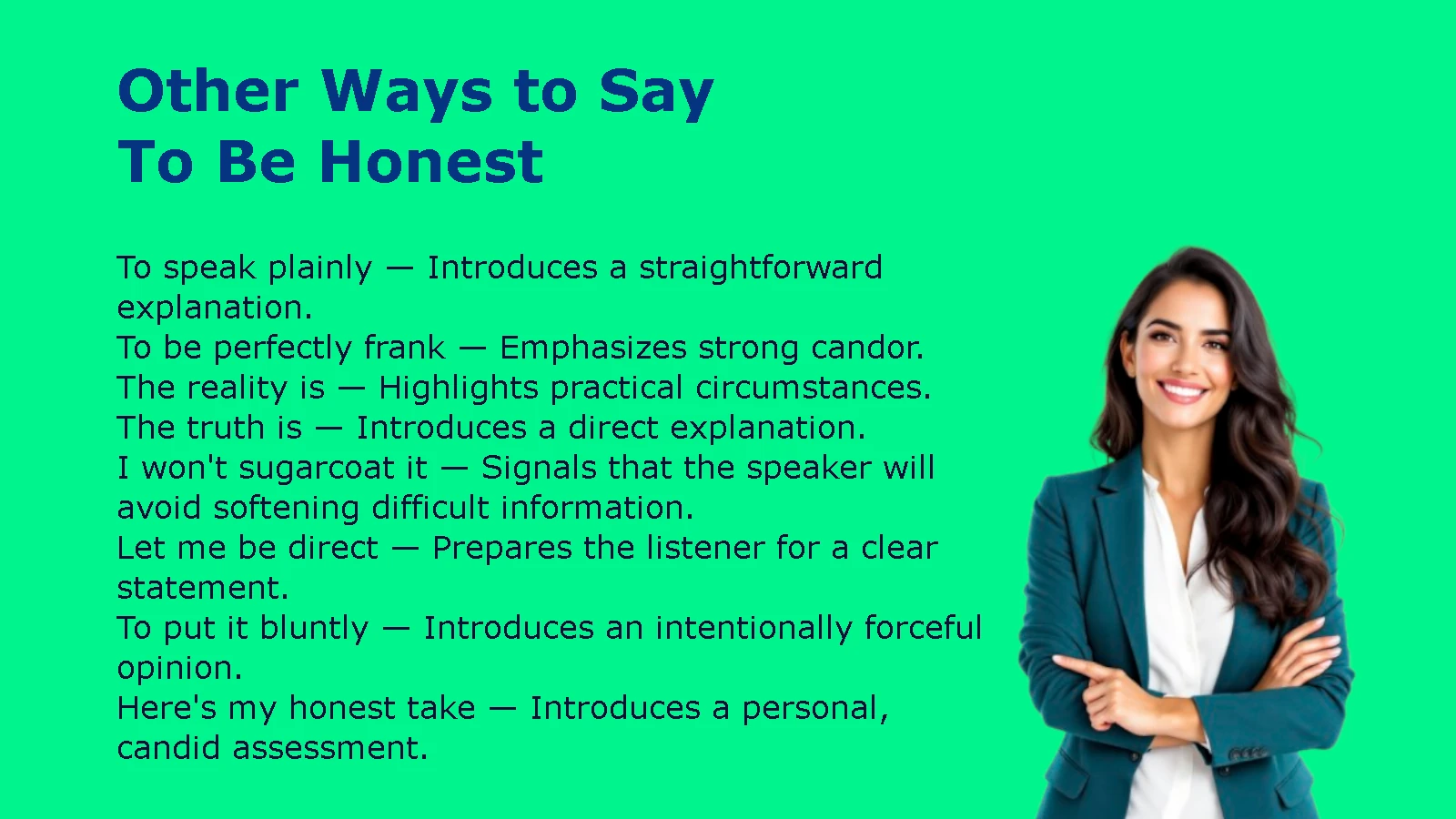
- To speak plainly — Introduces a straightforward explanation.
- To be perfectly frank — Emphasizes strong candor.
- The reality is — Highlights practical circumstances.
- The truth is — Introduces a direct explanation.
- I won’t sugarcoat it — Signals that the speaker will avoid softening difficult information.
- Let me be direct — Prepares the listener for a clear statement.
- To put it bluntly — Introduces an intentionally forceful opinion.
- Here’s my honest take — Introduces a personal, candid assessment.
Example: “Let me be direct: we need to address the quality issues before accepting new orders.”
Alternatives for Expressing Personal Views
Use these phrases when the main purpose is to communicate what you think rather than establish an objective fact.
- In my opinion — Clearly identifies a personal view.
- From my point of view — Presents an individual perspective.
- As I see it — Introduces a personal interpretation.
- Personally — Emphasizes an individual preference or belief.
- In my experience — Draws on personal experience.
- My understanding is — Expresses an interpretation that may need confirmation.
- The way I see it — Introduces a conversational opinion.
- As far as I’m concerned — Communicates a personal position, sometimes emphatically.
Example: “As I see it, we have two reasonable options.”
These categories provide more than 40 expressions and related alternatives. The distinction matters: a synonym should preserve the intended meaning, not merely sound different.
For example, in my opinion emphasizes viewpoint, whereas truthfully emphasizes truthfulness. You can use either to begin a sentence, but they don’t communicate precisely the same thing.
Comparison Table: Choosing the Right Alternative to To Be Honest
The best alternative depends on your audience, the sensitivity of the topic, and the message you want to convey. A phrase that sounds appropriate in a personal conversation may feel too informal in a business proposal.
Compare Synonyms by Tone, Context, and Formality
| Phrase | Tone | Best use |
| Honestly | Neutral | Everyday conversations and writing |
| Frankly | Direct | Sharing a firm opinion |
| In all candor | Formal | Executive discussions and professional feedback |
| Truthfully | Neutral to serious | Clarifying what you know or believe |
| From my perspective | Diplomatic | Workplace disagreements |
| To tell you the truth | Conversational | Personal conversations |
| Not gonna lie | Informal | Texts and casual chats |
| The reality is | Assertive | Explaining practical constraints |
| In my estimation | Formal | Evaluations and considered judgments |
| I won’t sugarcoat it | Blunt | Preparing someone for difficult feedback |
| In my experience | Reflective | Sharing lessons learned |
| Let me be direct | Assertive | Delivering a clear message |
| My assessment is | Professional | Reports and recommendations |
| As I see it | Conversational | Explaining a personal viewpoint |
| To be fair | Balanced | Acknowledging another side of an argument |
How to Choose the Right Phrase for Your Audience
Imagine you’re responding to a colleague who asks whether a proposed launch date is realistic.
You could communicate the same basic concern in three ways:
Professional: “Based on the current development schedule, we need another two weeks.”
Neutral: “Honestly, I don’t think we’ll finish by Friday.”
Casual: “Not gonna lie, Friday seems pretty unrealistic.”
Each version communicates concern, but the first is the most useful in a formal workplace setting because it identifies the basis for the recommendation.
Use these guidelines when choosing your wording:
- For clients and managers: Prefer evidence-based language such as my assessment is or based on the current information.
- For essays and reports: State findings directly and distinguish evidence from interpretation.
- For friends and family: Choose natural expressions such as honestly or I’ll be honest.
- For difficult conversations: Use let me be direct or explain the issue without a dramatic introduction.
- For social media: Informal expressions such as TBH and NGL may fit the audience.
The best phrase isn’t necessarily the most formal one. It’s the one that communicates your intended meaning without creating an unintended impression.
Why You Should Avoid Overusing To Be Honest
The phrase to be honest isn’t grammatically wrong, and using it occasionally is perfectly natural. However, overusing to be honest can make your writing repetitive, weaken the impact of your message, and sometimes create the impression that you need to announce your sincerity before people can trust what you’re saying.
The solution isn’t to eliminate the phrase completely. It’s to recognize when it adds meaning and when it simply takes up space.
Can To Be Honest Make You Sound Less Credible?
Repeatedly introducing statements with to be honest may unintentionally suggest that honesty requires a special announcement.
The repetition makes the speaker sound hesitant and the message monotonous. It also draws attention away from the actual feedback.
A stronger version would be:
“I liked the first design, but the second feels too complicated. I think we should simplify the layout before moving forward.”
The revised version sounds more confident because it states the speaker’s views directly.
However, context matters. In a personal conversation, to be honest can signal vulnerability or introduce a difficult admission. It can also help soften a confession when someone expects an uncomfortable answer.
The practical lesson: Don’t treat the phrase as a credibility problem in itself. Focus on whether it helps the reader understand your intention.
How to Sound More Honest Without Saying It
You can communicate honesty through the substance of your message rather than announcing it.
State facts clearly. Instead of saying, “To be honest, sales are disappointing,” explain what happened: “Sales fell 12% this quarter, and we need to investigate the reasons.”
Support your opinion. Replace “To be honest, this plan won’t work” with “This plan may miss the deadline because we haven’t secured the required resources.”
Acknowledge uncertainty. If you don’t know something, say so. “I don’t have enough information to answer that yet” is clearer than pretending to be certain.
Accept responsibility. Instead of “To be honest, I made a mistake,” try “I made a mistake in the report, and I’ll correct it today.”
Offer constructive feedback. Explain what needs to change and why, rather than relying on an introductory phrase to make criticism sound sincere.
These habits improve communication because they make your statements more specific, transparent, and actionable.
Before-and-After Examples: Removing Unnecessary Filler
| Original sentence | Improved sentence | Why it works |
| To be honest, I disagree with the proposal. | I disagree with the proposal because the costs exceed our budget. | Gives a clear reason. |
| To be honest, I’m not sure. | I’m not sure yet, but I’ll check. | Acknowledges uncertainty and offers a next step. |
| To be honest, your presentation was confusing. | The presentation needs a clearer structure and simpler examples. | Focuses on actionable feedback. |
| To be honest, I forgot. | I forgot to send the email, and I’ll do it now. | Accepts responsibility. |
| To be honest, I really enjoyed the event. | I really enjoyed the event. | Removes a phrase that adds little meaning. |
A useful editing exercise is to search your draft for to be honest. Review every occurrence and ask three questions:
- Does this phrase introduce a meaningful admission or personal disclosure?
- Would another expression communicate the intended tone more accurately?
- Would the sentence become clearer if I removed the phrase entirely?
This simple process helps you write with more confidence without making your language sound stiff or unnatural.
Frequently Asked Questions About Other Ways to Say To Be Honest
Is To Be Honest Grammatically Correct?
Yes, to be honest is grammatically correct. It commonly functions as an introductory expression that signals a candid opinion, admission, or personal reaction. For example, “To be honest, I prefer the original version.” You can use it in conversation and informal writing, although formal contexts may benefit from more precise wording.
What Can I Say Instead of To Be Honest in an Interview?
In an interview, use expressions such as “In my experience,” “My assessment is,” “To give you a direct answer,” and “Based on what I’ve learned.” These phrases help you communicate clearly and professionally. When discussing weaknesses or mistakes, provide a specific example and explain what you learned rather than relying on a general statement about honesty.
What Does the Acronym TBH Stand For?
TBH stands for “to be honest.” People commonly use it in text messages, online conversations, and social media posts to introduce an opinion, admission, or candid reaction. For example, “TBH, I prefer the original design.” The abbreviation is informal, so spell out the full phrase in formal reports and professional documents when appropriate.
What Is the Most Professional Way to Say To Be Honest?
The most professional alternative depends on your purpose. “My assessment is” works well when evaluating a situation, “from my perspective” introduces an individual viewpoint, and “based on the available evidence” connects a conclusion to supporting information. For sensitive feedback, explain your concern respectfully and provide a practical reason or recommendation.
What Is a One-Word Synonym for To Be Honest?
Honestly is the closest general-purpose, one-word alternative to to be honest. You can also use frankly to emphasize directness and truthfully to emphasize accuracy. For example, “Honestly, I disagree” is a natural substitute for “To be honest, I disagree.” Choose the word that best matches your intended tone.
Is Frankly Rude or Impolite?
No, frankly isn’t inherently rude, but it can sound blunt when you use it to introduce criticism or disagreement. “Frankly, this report needs more evidence” may sound forceful, while “My assessment is that the report needs more supporting evidence” sounds more measured. Your wording, relationship with the listener, and situation all affect how the phrase comes across.
Conclusion: Choose the Right Alternative to To Be Honest
Finding the best other ways to say to be honest isn’t just about expanding your vocabulary. It’s about communicating with the right level of sincerity, confidence, and tact.
For everyday conversations, honestly, truthfully, and to tell you the truth are reliable choices. In professional settings, my assessment is, from my perspective, and based on the available evidence can help you communicate more clearly. For casual messages, TBH, NGL, and if I’m being real may sound more natural.
Remember that these phrases don’t all mean exactly the same thing. Frankly emphasizes directness, in my opinion identifies a viewpoint, and the evidence suggests connects a claim to supporting information. Choosing the right expression helps you preserve your intended meaning.
Your next step: Review your next email, essay, or message before sending it. If you’ve used to be honest more than once, replace unnecessary repetitions with a more precise expression—or remove them altogether. Your writing will sound more natural, your ideas will stand out, and your message will be easier to understand.













